Implications
Interests in developing functional animal products with modified fatty acid composition to improve their healthy and functional properties for consumers have been increased. Inclusion of wheat dried distillers grain with solubles (DDGS) into the finishing diet may improve fatty acid profile of beef muscle. Supplementing feed enzyme (FE) in wheat DDGS-based finishing diets did not modify any concentration of the individual fatty acid. Overall, inclusion of DDGS might be useful strategy to improve the nutritional quality of beef meat.
Introduction
Recently, there has been growing recognition of health benefits of polyunsaturated fatty acids (PUFA) in the human diets, in particular n-3 fatty acids and α-linolenic acid (ALA). These essential fatty acids have been reported to play important roles in preventing and treating hypertension, diabetes, cancer and some inflammatory disorders (Simopoulos, Reference Simopoulos2008; Yashodhara et al., Reference Yashodhara, Umakanth, Pappachan, Bhat, Kamath and Choo2009). It was reported that in addition to the amount of essential fatty acids consumed, the dietary ratio of n-6/n-3 PUFA is associated with cardiovascular health (Wijendran and Hayes, Reference Wijendran and Hayes2004). Hence, there is an increased interest in developing functional animal products (e.g. egg, milk and meat) with increased amount of n-3 PUFA or decreased ratio of n-6/n-3 to improve their healthy and functional properties for consumers.
Using FE as feed additives for ruminants has received considerable attention for their potential role in increasing forage digestibility and improving animal performance (Beauchemin et al., Reference Beauchemin, Colombatto, Morgavi and Yang2003). However, research on the effects of adding FE on fatty acids composition of beef meat has been limited. It is well known that the composition of ruminant meat and milk lipids differ markedly from those of non-ruminants, and those distinctive lipid compositions are due to the microbial transformations in the rumen (Chilliard and Ferlay, Reference Chilliard and Ferlay2004; Shingfield et al., Reference Shingfield, Bonnet and Scollan2013). Although the reason for improvements in feed digestion due to added FE is multifaceted, increasing ruminal microbial activity is one proposed mode of action (McAllister et al., Reference McAllister, Hristov, Beauchemin, Rode and Cheng2001). We hypothesize that supplementation of finishing diets with FE would modify the fatty acid composition of beef due to induced changes in the ruminal microbial population. We further hypothesize that incorporating DDGS into the finishing diet would also improve the health properties of muscle. Wheat DDGS contains a relatively high fat content (~5% dry matter (DM) basis) and is commonly included in finishing beef cattle diets in North America. It has been suggested that feeding wheat DDGS potentially improves the beneficial fatty acid profile of beef in several studies (Dugan et al., Reference Dugan, Aldai, Kramer, Gibb, Juárez and McAllister2010; He et al., Reference He, Yang, Dugan, Beauchemin, McKinnon and McAllister2012a) where choosing pars costalis diaphragmatis (PCD) muscle for assessing fatty acid profile of beef. The objective of this study was to evaluate the effects of wheat DDGS inclusion and adding FE in a diet containing wheat DDGS on fatty acid profile of PCD muscle in finishing beef steers.
Material and methods
Animal and diets
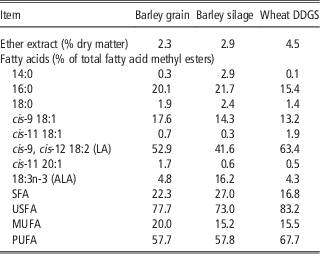
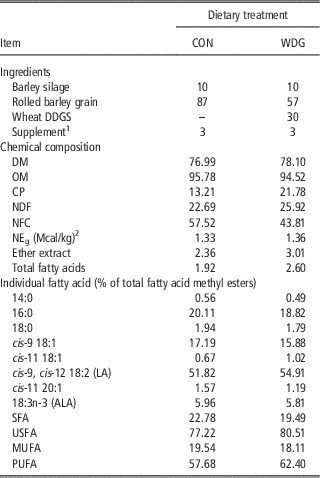
This study was approved by the Animal Care Committee of the Agriculture and Agri-Food Canada, Research Centre, Lethbridge, Alberta, and was conducted according to the guidelines of the Canadian Council on Animal Care (2009). Crossbred yearling steers (n=160, initial BW, 495±38 kg) were blocked by BW and then randomized into 16 pens (10 head/pen). The pens were randomly assigned to one of the four treatments: (1) control (CON; 10% barley silage and 90% barley grain-based concentrate, DM basis); (2) diet containing 30% wheat DDGS in place of barley grain without FE (WDG); (3) WDG diet supplemented with low FE (1 ml FE/kg DM); and (4) WDG diet supplemented with high FE (WDGH; 2 ml FE/kg DM). Fatty acid profile of the three main feed ingredients and the experimental diets are showed in Tables 1 and 2, respectively. The CON was a typical diet fed to finishing beef cattle in western Canada.
Fatty acid profile of feed ingredients

DDGS=dried distillers grains with solubles; LA=linoleic acid; ALA=α-linolenic acid; SFA=saturated fatty acids; USFA=unsaturated fatty acids; MUFA=monounsaturated fatty acids; PUFA=polyunsaturated fatty acids.
Ingredient and chemical composition (% DM) of the experimental diets

DM=dry matter; CON=control (10% barley silage and 90% barley grain-based concentrate, DM basis); WDG=diet containing 30% wheat dried distillers grains with solubles (DDGS) in place of barley grain without FE (DM basis); OM=organic matter; NFC=non-fibrous carbohydrates; NEg=net energy for gain; LA=linoleic acid; ALA=α-linolenic acid; SFA=saturated fatty acids; USFA=unsaturated fatty acids; MUFA=monounsaturated fatty acids; PUFA=polyunsaturated fatty acids.
1 Supplied per kilogram of dietary DM: 565 g barley grain, 100 g canola meal, 250 g calcium carbonate, 25 g molasses, 30 g salt, 20 g urea, 0.5 g flavor, 0.66 g vitamin E 500 and 10 g premix. The premix in the supplement contained per kilogram of dietary DM: 15 mg of Cu, 65 mg of Zn, 28 mg of Mn, 0.7 mg of I, 0.2 mg of Co, 0.3 mg of Se, 6000 IU of vitamin A, 600 IU of vitamin D and 47 IU of vitamin E.
2 Estimated based on beef National Research Council (NRC, 1996).
The tested FE, Econase XT (AB Vista, Marlborough, UK), was a liquid product derived from a strain of Trichoderma reesei. Endoglucanase (EC 3.2.1.4) and xylanase (EC 3.2.1.8) activities of FE used in this study were 30 and 969 µmol/min per ml of enzyme product, respectively. Enzymatic activities were determined at pH 6.0 and 39°C using medium–viscosity carboxymethyl cellulose and oat spelt xylan (both obtained from Sigma Chemicals, St. Louis, MO, USA) according to the procedures described by Colombatto and Beauchemin (Reference Colombatto and Beauchemin2003). The FE was sprayed onto wheat DDGS before mixing into total mixed ration (TMR). The mixture of FE and wheat DDGS was prepared every 3 days by diluting using water (1 : 4 ratio vol/vol) and sprayed at a rate of 5 l Econase XT/100 kg wheat DDGS in 5 min while being mixed in a feed mixer (Data Ranger; American Calan Inc., Northwood, NH, USA). The TMR was prepared daily and offered ad libitum with a daily minimum of 5% to 10% refusals in each feed bunk. Steers were adapted to experimental diets by gradually increasing the proportion of concentrate over a period of 4 weeks before starting the experiment. The trial was conducted over 120 days with a targeted final live weight of 650 kg.
The steers were weighed on 2 consecutive days at the start and the end of the trial. Feed intake, averaged daily gain (ADG) and feed conversion ratio were determined. Diets, refusals and feed ingredients were sampled weekly, and analyzed for DM by oven-drying at 55°C for 48 h. Weekly samples were composited by period (28 days) and stored at −20°C. A 1-kg subsample from each diet composite was ground through a 1-mm screen (Wiley mill, standard model 4; Arthur H. Thomas, Philadelphia, PA, USA) for chemical analysis.
At the end of the finishing period, the cattle were shipped to a commercial abattoir (Cargill, High River, AB, Canada) within 2 days. At slaughter, the PCD muscle samples were collected from 80 steers, by randomly selecting 2 pens/treatment. Samples were frozen on dry ice and stored at −40°C until analyzed. The PCD muscle samples were collected as it is a well-representative tissue for determining the fatty acid profile of beef (Dugan et al., Reference Dugan, Aldai, Kramer, Gibb, Juárez and McAllister2010; He et al., Reference He, Yang, Dugan, Beauchemin, McKinnon and McAllister2012a). In addition, there is great restriction to collect other samples than PCD muscle sample to avoid damaging carcass for reducing sale value. Results on intake of DM, feed digestibility and carcass traits of feedlot steers were previously reported (He et al., Reference He, He, Walker, McAllister and Yang2014).
Feed and tissue fatty acid analysis
Total lipids in feed samples were extracted with ethyl ether (Association of Official Analytical Chemists (AOAC), 1995, method 960.39) using a Goldfisch apparatus (Laboratory Construction Co., Kansas City, MO, USA) following the procedure of Mir et al. (Reference Mir, Okine, Goonewardene, He and Mir2003). Lipids in PCD muscle samples were extracted by homogenizing the tissue with 2 : 1 chloroform–methanol (vol/vol), as described by Folch et al. (Reference Folch, Lees and Sloane-Stanley1957). Lipids in feed or muscle samples were recovered by evaporating the ethyl ether or chloroform, respectively, under N2. Non-adecanoic acid (19:0) methyl ester (100 µl, 5.96 mg/ml hexane; Nu-Chek Prep, Inc., Elysian, MN, USA) was added to the residues as an internal standard. The methylation and gas chromatography analysis of fatty acids were conducted as described by He et al. (Reference He, McAllister, Kastelic, Mir, Aalhus, Dugan, Aldai and McKinnon2012b). A combined base/acid methylation procedure using sodium methoxide (0.5 mmol/l in methanol) and boron triflouride (140 ml/l methanol) was used for methylation. All the chemicals used were purchased form Sigma-Aldrich Inc. (Oakville, ON, Canada). Fatty acid methyl esters were quantified using a gas chromatograph (Hewlett Packard GC System 6890, Mississauga, ON, Canada) equipped with a flame ionization detector and SP-2560 fused silica capillary column (75 m×0.18 mm×0.14 µm, Supelco Inc., Oakville, ON, Canada).
Feed chemical analysis
Analytical DM was analyzed by drying samples at 135°C for 2 h, followed by hot weighing (AOAC, 1995; method 930.15). The NDF, expressed inclusive of residual ash, was determined as described by Van Soest et al. (Reference Van Soest, Robertson and Lewis1991) using heat-stable α-amylase and sodium sulfite. For the measurement of starch and CP (nitrogen (N)×6.25; AOAC, 1995, method 990.03), samples were ground using a ball mill (Mixer Mill MM 2000; Retsch, Haan, Germany) to a fine powder. Starch was determined by enzymatic hydrolysis of α-linked glucose polymers as described by Rode et al. (Reference Rode, Yang and Beauchemin1999). Total N was determined by flash combustion and thermal conductivity detection (model 1500; Carlo Erba Instruments, Milan, Italy).
Statistical analysis
Before analysis, a normal distribution was verified using the UNIVARIATE procedure (SAS Institute Inc., Cary, NC, USA). The data were normally distributed and analyzed using the MIXED procedure of SAS. The pen was experimental unit. Treatment (i.e. diet) was considered as a fixed effect, and pen was a random effect. Contrasts were generated to compare the CON and WDG diets (CON v. WDG). The effect of increasing FE in the diet containing wheat DDGS was examined through linear and quadratic orthogonal contrasts. Least squares means were presented in the text that were also compared using the Tukey correction for multiple comparisons. Statistical significance was declared at P<0.05 with trends discussed at 0.05<P<0.10.
Results
Feed intake and growth performance
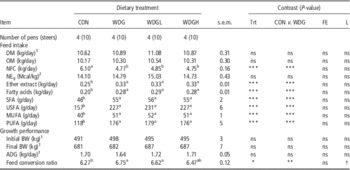
Steers fed WDG had no difference in intake of OM, but less (P<0.001) intake of non-fibrous carbohydrates and greater (P<0.001) intake of fatty acid than steers fed CON (Table 3). Increasing FE application in wheat DDGS diets did not affect intake of the nutrients. Final BW and ADG were not affected by the treatments (He et al., Reference He, He, Walker, McAllister and Yang2014). However, steers fed WDG had greater (P<0.01) feed conversion ratio than steers fed CON, and increasing FE application in wheat DDGS diets tended (P<0.10) to linearly decrease feed conversion ratio. There was no difference in feed conversion ratio between steers fed CON and WDGH. For more detail on growth performances and carcass quality please refer to the study by He et al. (Reference He, He, Walker, McAllister and Yang2014).
Effect of wheat dried distillers grains with solubles and FE supplementation on feed intake and growth performance of finishing feedlot steers

FE=feed enzyme; DM=dry matter; CON=control (10% barley silage and 90% barley grain-based concentrate, DM basis); WDG=diet containing 30% wheat DDGS in place of barley grain without FE (DM basis); WDGL=WDG diet supplemented with low FE (1 ml FE/kg DM); WDGH=WDG diet supplemented with high FE (2 ml FE/kg DM); OM=organic matter; NFC=non-fibrous carbohydrates; NEg=net energy for gain; SFA=saturated fatty acids; USFA=unsaturated fatty acids; MUFA=monounsaturated fatty acids; PUFA=polyunsaturated fatty acids; ADG=average daily gain; Trt=effect of dietary treatment; CON v. WDG=control v. DDGS diet containing no FE; FE=effect of applying FE in WDG diets; L=linear effect of applying FE in DDGS containing diets (0, 1 and 2 ml of FE/kg DM); quadratic effects of applying FE in WDG diets were not significant (P>0.05) for the variables measured.
a,bMeans with different superscripts differ (P<0.05).
ns=P>0.05, †P<0.10, *P<0.05, **P<0.01, ***P<0.001.
1 Data of DM intake, initial and final BW, and ADG were adapted from the study by He et al. (Reference He, He, Walker, McAllister and Yang2014).
2 Estimated based on beef NRC (1996).
Diaphragm fatty acid composition
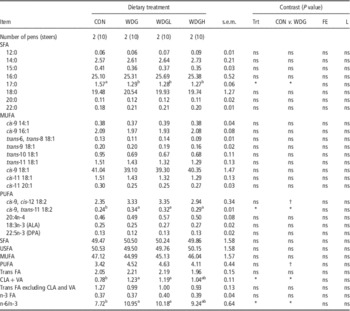
Inclusion of wheat DDGS in finishing diets did not modify (P>0.05) total SFA and unsaturated fatty acid (USFA) in PCD muscle samples (Table 4). However, concentration of PUFA tended (P<0.10) to be greater in steers fed WDG than steers fed CON diet. Moreover, inclusion of wheat DDGS without FE supplementation increased (P<0.05) concentration of CLA+VA and ratio of n-6/n-3 PUFA compared with CON diet. Supplementing FE to WDG diets did not affect the major fatty acid profile in PCD muscle samples.
Effect of wheat dried distillers grains with solubles and FE supplementation on fatty acid profile (% of total fatty acid methyl esters) in the pars costalis diaphragmatis muscle in beef feedlot steers

FE=feed enzyme; CON=control (10% barley silage and 90% barley grain-based concentrate, DM basis); WDG=diet containing 30% wheat DDGS in place of barley grain without FE (DM basis); WDGL=WDG diet supplemented with low FE (1 ml FE/kg DM); WDGH=WDG diet supplemented with high FE (2 ml FE/kg DM); ALA=α-linolenic acid; DPA=docosapentaenoic acid; SFA=saturated fatty acids; USFA=unsaturated fatty acids; MUFA=monounsaturated fatty acids; PUFA=polyunsaturated fatty acids; Trans FA=trans fatty acids; CLA+VA=total concentration of CLA and vaccenic acid; Trans FA excluding CLA and VA=total concentration of trans fatty acids excluding CLA and vaccenic acid; n-3 FA=n-3 fatty acids; Trt=effect of dietary treatment; CON v. WDG=control v. DDGS diet containing no FE; FE=effect of applying FE in WDG diets; L=linear effect of applying FE in DDGS containing diets (0, 1 and 2 ml of FE/kg DM); quadratic effects of applying FE in WDG diets were not significant (P>0.05) for the variables measured..
a,b,cMeans with different superscripts differ (P<0.05).
ns=P>0.05, †P<0.10, *P<0.05.
Individual SFA was not affected by inclusion of wheat DDGS except that steers fed WDG had lower (P<0.05) 17:0 concentration than steers fed the CON diet (Table 4). Supplementation of FE in WDG diets did not affect any of the individual SFA.
For the individual PUFA (Table 4), inclusion of wheat DDGS without FE increased (P<0.05) concentration of cis-9, trans-11 18:2 (CLA) and tended to increase (P<0.10) concentration of cis-9, cis-12 18:2 (linoleic acid; LA). However, concentrations of 20:4n-4, 18:3n-3 (ALA) and 22:5n-3 (DPA) were not affected with inclusion of wheat DDGS. There were no effects of adding FE on any of the individual MUFA and PUFA.
Discussion
Replacement of barley grain with wheat DDGS
In western Canada, interests in using wheat DDGS as an energy source in feedlot cattle rations have increased because of its comparative price to barley and readily digestible NDF and high fat content (Schingoethe et al., Reference Schingoethe, Kalscheur, Hippen and Garcia2009). Studies showed that wheat DDGS can effectively replace a portion of barley grain or silage in finishing diets either with no adverse impact on daily gain and feed efficiency (Beliveau and McKinnon, Reference Beliveau and McKinnon2008; Yang et al., Reference Yang, Li, McAllister, McKinnon and Beauchemin2012) or improved feed conversion by 7.7% as in the present study. The effects of including wheat DDGS in beef diets enhanced the fatty acid composition of beef by decreasing trans-10 18:1 while increasing the major CLA isomer (cis-9, trans-11 18:2) and its precursor trans-11 18:1 (Dugan et al., Reference Dugan, Aldai, Kramer, Gibb, Juárez and McAllister2010). These authors suggested that dietary inclusion of wheat DDGS could increase PUFA sources in the diet and may develop beef products with increased concentrations of trans-11 18:1 and cis-9, trans-11 18:2. The n-3 PUFA and CLA isomers are considered to be healthy fatty acids, and desirable for human consumption (Wood et al., Reference Wood, Enser, Fisher, Nute, Sheard, Richardson, Hughes and Whittington2008).
Giving the higher fat content in DDGS than in its original grain (Nuez Ortín and Yu, Reference Nuez Ortín and Yu2009), inclusion of wheat DDGS may modify fatty acid composition of diets. Dugan et al. (Reference Dugan, Aldai, Kramer, Gibb, Juárez and McAllister2010) reported that dietary fatty acid compositions were overall similar between diets containing or not containing wheat DDGS. He et al. (Reference He, Yang, Dugan, Beauchemin, McKinnon and McAllister2012a) reported no major changes in fatty acid compositions of diets with increasing inclusion of wheat DDGS from 0%, 25%, 30% to 35% (DM basis). In the current study, the slightly greater cis-9, cis-12 18:2 concentration of the WDG diet (54.9% v. 51.8% in CON diet) reflected the greater concentration of this fatty acid in wheat DDGS. The cis-9, cis-12 18:2 concentration of wheat DDGS was greater (+20%) than that of barley grain. Fatty acid profile in diets containing wheat DDGS can vary among studies due to high variability in chemical composition of wheat DDGS among ethanol plants or loads (Nuez Ortín and Yu, Reference Nuez Ortín and Yu2009), or the inclusion rate of wheat DDGS in the diets (Beliveau and McKinnon, Reference Beliveau and McKinnon2008; Li et al., Reference Li, McAllister, Beauchemin, He, McKinnon and Yang2011).
Dugan et al. (Reference Dugan, Aldai, Kramer, Gibb, Juárez and McAllister2010) and He et al. (Reference He, Yang, Dugan, Beauchemin, McKinnon and McAllister2012a) reported increased concentrations of PUFA in beef when 60% or 35% wheat DDGS were substituted for barley grain in finishing diets. In agreement, numerically increased concentration of PUFA in PCD muscle samples occurred by replacing 30% barley grain with an equal amount of wheat DDGS in the present study. Fatty acid composition of meat reflects fatty acid biosynthesis in tissue and dietary fatty acid composition (Mourot and Hermier, Reference Mourot and Hermier2001), although dietary USFA are normally hydrogenated by ruminal bacteria before leaving the rumen (Doreau and Ferlay, Reference Doreau and Ferlay1994; Kronberg et al., Reference Kronberg, Scholljegerdes, Barceló-Coblijn and Murphy2007). The greater fatty acid intake for steers fed WDG than CON may partially account for the tendency of increased cis-9, cis-12 18:2 and PUFA concentrations in muscle from WDG-fed steers. The results suggest that some PUFA were not completely hydrogenated in the rumen, and feeding wheat DDGS with high cis-9, cis-12 18:2 and PUFA concentrations potentially increased these fatty acid concentrations in beef. This finding suggests some degree of protection of the PUFA in DDGS from ruminal biohydrogenation (Depenbusch et al., Reference Depenbusch, Drouillard, Loe, Higgins, Corrigan and Quinn2008).
While there was no difference in CLA concentration between CON and WDG diets, the increased concentration of CLA in PCD muscle samples as a result of replacing barley grain with wheat DDGS suggests that dietary inclusion of wheat DDGS affects CLA biosynthesis. Feeding wheat DDGS was reported to foster the ruminal production of trans-11 18:1 (VA), which is the precursor of CLA (Dugan et al., Reference Dugan, Aldai, Kramer, Gibb, Juárez and McAllister2010). Aldai et al. (Reference Aldai, Klieve, Dugan, Kramer, Ouwerkerk, Aalhus, McKinnon and McAllister2012) observed that inclusion of wheat DDGS rather than corn DDGS in finishing diets increased the trans-11 to trans-10 18:1 ratio in the rumen fluid. They suggested that dietary USFA from wheat DDGS was partially protected from ruminal biohydrogenation. Therefore, an increased flow of VA to the lower digestive tract occurred, which are utilized by cattle more efficiently, leading to increased CLA biosynthesis in beef.
Inclusion of wheat DDGS in finishing diets increased the ratio of n-6 to n-3 fatty acids in beef, as indicated by numerically increased 18:2n-6 (i.e. cis-9, cis-12 18:2 and cis-9, trans-11 18:2) in PCD muscle. Similarly, Dugan et al. (Reference Dugan, Aldai, Kramer, Gibb, Juárez and McAllister2010) reported increasing dietary wheat DDGS from 0%, 20% to 40% (DM basis) caused a linear increase in the n-6/n-3 ratio in PCD muscle. It has been reviewed by Simopoulos (Reference Simopoulos2002) that human consumption of excessive amounts of n-6 PUFA and a very high n-6/n-3 ratio promoted the pathogenesis of many diseases, including cardiovascular disease, cancer, and inflammatory and autoimmune diseases, whereas increased dietary levels of n-3 PUFA (a low n-6/n-3 ratio) exerted suppressive effects. It is recommended that the ideal ratio of n-6 and n-3 PUFA is less than five (World Health Organization, 2003; Wood et al., Reference Wood, Richardson, Nute, Fisher, Campo, Kasapidou, Sheard and Enser2004). The values in beef from the current study ranged from 5 to 15, and thus still exceed the recommended ratio. Nevertheless, partly substituting wheat DDGS for barley grain in finishing diets potentially enhanced the PUFA of PCD muscle by increasing cis-9, trans-11 18:2 and potentially increasing cis-9, cis-12 18:2, which are beneficial to improving beef quality.
Enzyme application in finishing diets containing wheat DDGS
The lack of changes in the n-6/n-3 fatty acid ratio and in any other individual fatty acid concentration with additions of FE in diets containing wheat DDGS contradicted our hypothesis; it is expected that FE would modify fatty acid composition of beef by reducing the ratio of n-6/n-3 PUFA due to induced changes in the ruminal microbial population. Our previous study using the same diets showed that applying FE in wheat DDGS-based finishing diets increased ruminal digestibility of feed (He et al., Reference He, He, Walker, McAllister and Yang2014), suggesting an alteration of ruminal microbiome. However, this alteration may only relate to the microbes that improve feed digestion in the rumen rather than the microbes associated with isomerization and hydrogenation of USFA. It may be concluded that the FE used in the present study has effect on improving feed digestion but has limited effect on rumen biohydragenation.
Conclusions
This study showed that partially replacing barley grain (30% of DM) with wheat DDGS increased feed conversion ratio, increased CLA and numerically increased total PUFA and LA in beef. However, increasing FE application in diets containing wheat DDGS did not modify concentration of individual fatty acid. Results suggest that the use of wheat DDGS in finishing diets could develop value-added beef products by improving some desired fatty acids that benefit human health.
Acknowledgments
This research was funded by Alberta Crop Industry Development Funds (ACIDF; Grant #2012F012R, Lacombe, Alberta, Canada) and AB Vista (Marlborough, UK). The authors acknowledge the Lethbridge Research Center barn staff for their care and management of the animals, and Alastair Furtado, Leah McCormick and Erin Palmer for their assistance with the laboratory analyses.