


Introduction
Obsessive-compulsive disorder (OCD) was considered a treatment resistant disorder until the 1970s, but behavioural and pharmacological treatments developed in the past three decades have dramatically improved the prognosis of the disorder. The validity of exposure and response prevention (ERP) in the psychological treatment of OCD sufferers is now well established (Franklin, Abramowitz, Kozak, Levitt and Foa, Reference Franklin, Abramowitz, Kozak, Lewitt and Foa2000). Foa and colleagues (Foa and Kozak, Reference Foa, Kozak, Mavissakalian and Prien1996; Foa, Franklin and Kozak, Reference Foa, Franklin, Kozak, Swinson, Antony, Rachman and Richter1998) demonstrated that more than 75% of treated patients showed a good treatment response. However, only a minority of successfully treated patients remained free of symptoms after the ERP, and a clear tendency to relapse was observed for around 25% of treated patients (Foa et al., Reference Foa, Franklin, Kozak, Swinson, Antony, Rachman and Richter1998). It must also be pointed out that between 25%–30% of patients refuse the ERP treatment (Emmelkamp and Foa, Reference Emmelkamp, Foa, Foa and Emmelkamp1983; Kozak, Liebowitz and Foa, Reference Franklin, Abramowitz, Kozak, Lewitt and Foa2000), and around 28% leave the treatment (Kozak et al., Reference Kozak, Liebowitz, Foa, Goodman, Rudorfer and Maser2000). Even after successful treatment, most patients still have some residual symptoms (Abramowitz, Reference Abramowitz1998). Moreover, the estimation of non-responders to ERP ranges from 20% to 30% (Steketee, Reference Steketee1993). In a recent review of 16 controlled studies on ERP (Abramowitz, Franklin and Foa, Reference Abramowitz, Franklin and Foa2002), an average reduction in OCD symptoms of 48%, with relatively low relapse rates after treatment, was found.
All of the above-mentioned data suggest that, in spite of the advances in the treatment of the disorder, it still remains “a chronic condition refractory to treatment” (Emmelkamp, van Oppen and van Balkom, Reference Emmelkamp, van Oppen, van Balkom, Frost and Steketee2002, p. 391). In the last decade, the shift from behavioural explanations to a more cognitive-based theory of OCD has changed the emphasis “from behavioural maintaining factors to a focus on the person's beliefs and the associated appraisals of perceived threat” (Rachman, Reference Rachman2002, p. 626). In this setting, the current cognitive approaches to obsessions as being caused and/or maintained by misinterpretations of their meaning (Purdon and Clark, Reference Purdon and Clark1999) can be considered a main focus for psychological treatment. With these approaches, the treatment must include specific cognitive techniques designed to weaken and, ideally, eliminate the misinterpretations patients have about their obsessions (Clark, Reference Clark2004; Freeston et al., Reference Freeston, Ladouceur, Gagnon, Thibodeau, Rhèaume, Letarte and Bujold1997; Freeston, Ladouceur, Rhéaume and Léger, Reference Freeston, Ladouceur, Rhéaume, Léger and Sanavio1998; Freeston, Léger and Ladoucer, Reference Freeston, Léger and Ladouceur2001; Ladouceur, Freeston, Gagnon, Thibodeau and Dumont, Reference Ladouceur, Freeston, Gagnon, Thiboudeau and Dumont1995; Rachman, Reference Rachman1997, Reference Rachman1998; Salkovskis, Reference Salkovskis1999; Salkovskis and Warwick, Reference Salkovskis and Warwick1985, Reference Salkovskis, Warwick, Perris, Blackburn and Perris1988; Salkovskis and Westbrook, Reference Salkovskis and Westbrook1989).
Several specific proposals for treating OCD using cognitive techniques were made in the 1990s, and early individual treatment studies indicate that CT could be considered as a useful psychological treatment (i.e. Emmelkamp and Beens, Reference Emmelkamp and Beens1991; Emmelkamp, Visser and Hoekstra, Reference Emmelkamp, Visser and Hoekstra1988). However, as Whittal, Thordarson and McLean (Reference Whittal, Thordarson and McLean2005) indicate, these pioneer studies were not designed to specifically target the dysfunctional appraisals postulated by the current cognitive approaches to OCD. Moreover, in many cases, the cognitive techniques used to challenge the dysfunctional beliefs associated with the disorder were simultaneously applied with EPR. From this perspective, the specific contribution of the CT itself, compared to that of the ERP, has only been examined to date in four controlled trials, although several differences can be observed among them. In some of the studies, only a few of the OCD-related beliefs are challenged, whereas in others the exposure condition is self-applied.
In the first study, van Oppen et al. (Reference van Oppen, De Haan, van Balkom, Spinhoven, Hoogduin and van Dick1995) followed a treatment protocol in which participants individually received either CT or in vivo ERP for six weekly sessions. After the intermediate session, behavioural experiments were added to the CT condition treatment. The two groups obtained comparable results at the sixth session on the Yale-Brown Obsessive Compulsive Inventory (YBOCS; Goodman et al., Reference Goodman, Price, Rasmussen, Mazure, Fleishman, Hill, Heninger and Charney1989 a, b), and on the Padua Inventory (Sanavio, Reference Sanavio1988), showing that the CT was as least as effective as the ERP. Cottraux et al. (Reference Cottraux, Note, Nan Yao, Lafont, Note, Mollard, Bouvard, Sauteraud, Bourgeois and Dartigues2001) randomly assigned 64 obsessive patients to 20 hours of individual CT or ERP during a 16-week period. There were no differences in obsessive symptoms between the two treatment conditions at post-treatment and a one-year follow-up. McLean et al. (Reference McLean, Whittal, Thordarson, Taylor, Söchting, Koch, Paterson and Anderson2001) compared CT to ERP in the group treatment format, and their data showed that ERP was significantly more effective than CT. This research group has more recently compared CT (challenging all the dysfunctional beliefs considered OCD-relevant) to ERP (in vivo, therapist guided) delivered in an individual format, and the authors did not find significant differences in the YBOCS scores between the two treatments at post-treatment and at a 3-month follow-up (Whittal et al., Reference Whittal, Thordarson and McLean2005). These authors have suggested that CT may become the first line treatment when ERP is not effective, or even when the patients are reluctant to engage in the exposure procedures.
To summarize, the data concerning the effectiveness of CT as a treatment for OCD are more than promising but still scarce. There is little evidence concerning, first, the comparative stability of CT and ERP with regard to the OCD symptom changes over time and, second, the beliefs and thought control strategy changes following CT compared to ERP at post-treatment and, especially, in long-term follow-up periods. Moreover, the published data on the clinically significant changes obtained after CT and ERP, following empirically derived approaches, continue to be limited (Fisher and Wells, Reference Fisher and Wells2005). Our objectives are to provide data about the comparative effectiveness of CT and ERP in modifying OCD symptoms, dysfunctional beliefs and thought control strategies, and about the stability of the observed changes over a follow-up period of one year. For this purpose, we will take into account not only the magnitude of the observed changes (effect sizes), but also the clinical relevance of these changes at post-treatment and at the follow- up. Additionally, we are especially interested in the external validity of the results to be obtained, without compromising the internal validity.
Method
Participants
Fifty patients were recruited throughout one year in two outpatient mental health clinics included in the network of the public National Health System and located in the outskirts of the city of Valencia, Spain. Both of these clinics serve a population of approximately 160,000, and the number of patients who visited both centres for the first time during the year of the study was 1081. All the patients were referred for psychological treatment by the psychiatrist-in-chief of each of the two clinics on the basis of the usual organization of these clinical settings. Of the initially referred patients, 14 (28%) did not fit the inclusion criteria (see below), and 3 patients refused to receive any form of psychological treatment.
The inclusion criteria were as follows: a primary diagnosis of OCD according to the Diagnostic and Statistical Manual of Mental Disorders (DSM-IV, American Psychiatric Association, 1994), age range between 18 and 65 years, a duration of OCD of at least one year, absence of any organic mental disorder, mental retardation, psychotic disorder, Cluster A personality disorder (DSM-IV criteria) or current history of substance abuse disorders, and having an adequate level of reading ability. The severity of the disorder, its duration in years, comorbidity with other psychological disorders, and concurrence with psycho-pharmacotherapy were not considered exclusion criteria. All of the patients who were undergoing pharmacotherapy were required to have maintained stable doses during a period of at least 3 months before being included in the psychological protocol treatment. Medications could be reduced or removed during the treatment or the follow-up period, but not changed or increased.
Thirty-three patients fulfilled the inclusion criteria and started the treatments, but only 29 completed. Two patients abandoned the treatment, one in each treatment condition (withdrawal rate = 6.90%), and two others were finally not included in the study because their medication regimens were changed during the treatments. Finally, there were 13 completers in the ERP condition, and 16 in the CT treatment. The percentage of women was 62.1%. The Mean (SD) age was 32 (9.7) years. On average, the OCD duration was 6 (5.7) years. Regarding the YBOCS score, the group could be labelled as severe (mean pre-treatment YBOCS = 25.36 (5.39)). Regarding comorbidity, 34.5% of the patients had a comorbid Axis I disorder, and another 20.7% had a comorbid Axis II disorder (DSM-IV criteria). At pre-treatment, 86.2% of the patients were using medication for their OCD.
With regard to the OCD form of presentation, 27.6% of the patients had only pure obsessions (aggressive, sexual, or moral/religious obsessions), 53.6% had obsessions with overt compulsive rituals (checking, cleaning, or superstition obsessions), and 17.8% exhibited both pure obsessions and obsessions with overt compulsive rituals. One of the patients who completed the treatment in the CT group was not included in the statistical analyses because s/he refused to complete the questionnaires at post-treatment and follow-up. Only the YBOCS scores for this patient are offered in this study.
Procedure
Before being included, all potential participants were individually screened with a full history and examination by a Doctoral level clinical psychologist (AB) who had extensive experience with the cognitive and behavioural treatment methods. The intake assessment consisted of a diagnostic interview using the Anxiety Disorders Interview Schedule for DSM-IV: lifetime version (ADIS-IV-L; Di Nardo, Brown and Barlow, Reference Di Nardo, Brown and Barlow1994), in a session lasting 120–150 minutes. Information about basic demographic data (age, gender, occupation, educational level, socio-economic status), medical conditions and current/past psychological or pharmacological treatments were also recorded. The evaluator also completed the YBOCS. The patients were informed about the purpose and assessment procedure of the study, and they gave their explicit consent to participate. After giving his or her consent, each patient was then given a questionnaire packet containing all the self-report questionnaires described in the instruments section.
The patient was then randomly referred to one of the two therapists (EC or CC), licensed clinical psychologists (Doctoral level) with extensive experience in the use of cognitive and behavioural procedures for the treatment of anxiety and depressive disorders, and also responsible for the training and supervision of clinical psychologists in their respective settings. These two therapists completed the assessment in a two-hour session and randomly applied ERP or CT to the patients in order to ensure that each therapist treated both groups.
Once the treatments were completed, the same questionnaire packet as in the pre-treatment was again administered, as well as at 3, 6, and 12-month follow-ups. In this study, only the data from the 12-month follow-up are presented. The questionnaire packet was always given to the patient by the independent evaluator (AB), who met with the patients individually and evaluated the severity on each occasion (YBOCS). This independent evaluator was blind to the treatment received by the patient.
Design and treatments
The patients were randomly assigned by the therapists to one of the two following treatment conditions: Exposure and response prevention (ERP) or Cognitive Therapy (CT). Before starting the treatments, ERP and CT were manualized by the authors, following the guidelines of Steketee (Reference Steketee1999) and Kozak and Foa (Reference Kozak and Foa1997) for the ERP, and those of Clark (Reference Clark2004), Freeston, Rhéaume and Ladouceur (Reference Freeston, Rhéaume and Ladouceur1996), Freeston et al. (Reference Freeston, Léger and Ladouceur2001), Ladoucer, Léger, Rhéaume and Dubé (Reference Freeston, Rhéaume and Ladouceur1996), Rachman (Reference Rachman1998, Reference Rachman2003), Salkovskis (Salkovskis, Reference Salkovskis1985, Reference Salkovskis1989, Reference Salkovskis and Rapee1996) and van Oppen and Arntz (Reference van Oppen and Arntz1994) for the CT. In order to discard the possibility that behavioural experiments involving some type of self- or therapist-guided exposure might bias the results obtained following CT, these techniques were explicitly excluded from the CT protocol. This decision was adopted to ensure that the entire treatment protocol was based exclusively on a strictly cognitive approach to the treatment of OCD (that is, without the confounding results derived from the well-established efficacy of EPR as a “pure” behavioural treatment). Similarly, cognitive techniques were not included in the ERP protocol. All the treatment sessions were recorded, in order to ensure that the two therapists followed the same procedures. The Protocol adherence in the treatment conditions was monitored by randomly selecting tapes of 30% of the sessions and blind rating them on their use of all the techniques from the two conditions.
The ERP treatment consisted of 20 sessions over a period of 6 months. Six twice-weekly 60–90 minute sessions were followed by 8 weekly and then 6 biweekly sessions, whose duration decreased from 60 to 45 minutes in the last sessions. The content of the first session was psycho-educational, in order to familiarize patients with the behavioural model of OCD. In the second session, the exposure hierarchy was developed. The rest of the sessions were devoted to graduated ERP in-session exposure tasks and daily homework tasks with self-monitoring of discomfort and/or anxiety levels during self-administered exposure.
In the CT condition, the treatment lasted 18 sessions over a 6-month period. The first two sessions were psycho-educational, in order to familiarize patients with the cognitive model of OCD and its usefulness in explaining the obsessions and compulsions reported by the patient. The following 16 sessions were carried out over 5 months: 10 weekly 60-minute sessions followed by 6 twice-weekly 60-minute sessions. The objective of the sessions was to help the patients challenge the catastrophic and dysfunctional interpretations of their obsessions. All the dysfunctional evaluative appraisals and beliefs maintained by the patients about their obsessions were analysed and then corrected. The techniques used were: evidence for and against the belief related to the obsession; generation and evaluation of alternative belief consequences; re-attribution procedures; re-assignment of probabilities; cost-benefit analysis; and advantages and disadvantages of maintaining obsessive beliefs and appraisals. Behavioural experiments were not included in the treatment protocol. The homework tasks consisted of exploring and trying to correct dysfunctional appraisals and beliefs on the basis of the daily records of obsessions and associated beliefs and appraisals. At the end of the two treatment modalities, two additional sessions were devoted to relapse prevention.
Measures
Structured interview
Yale-Brown Obsessive-Compulsive Severity Scale (YBOCS; Goodman et al., Reference Goodman, Price, Ramussen, Mazure, Delgado, Heninger and Charney1989a, b) This is an interview especially designed to measure OCD severity. It yields 3 scores: severity of obsession, severity of compulsions, and a total score obtained by adding the obsession and compulsion subscores together (ranging from 0 to 40). The YBOCS items assess the frequency, interference, distress, resistance, and perceived control of both obsessions and compulsions, using a scale from 0 (none) to 4 (extreme). Inter-rater reliability for this instrument has been shown to be excellent (total YBOCS score = 0.98, p<.001; Goodman et al., Reference Goodman, Price, Rasmussen, Mazure, Fleishman, Hill, Heninger and Charney1989a), and it is widely considered a gold-standard for assessing the severity of OCD, both in the clinical settings and in the outcome research. As we applied the YBOCS to assess the severity of the patients, this interview was also employed to analyse the clinically significant change obtained with the two treatments.
Self-report questionnaires
Padua Inventory-Washington State University Revision (PI-WSUR; Burns, Keortge, Formea and Sternberg, Reference Burns, Keortge, Formea and Sternberg1996) This is a 39-item self-report that measures obsessive and compulsive symptoms. It was conceived as a better measure of O-C symptoms than the original questionnaire developed by Sanavio (Reference Sanavio1988), as various items in the original PI assessed worry-like themes more than obsessional contents. Each item is rated on a 5-point scale according to the degree of disturbance caused by the thought or behaviour (0 = not at all to 4 = very much). In addition to the total score, the PI-WSUR includes five subscales: 1) obsessive thoughts about harm to self/others; 2) obsessive impulses to harm self/others; 3) contamination obsessions and washing compulsions; 4) checking compulsions; and 5) dressing/grooming compulsions. The Spanish version of the instrument was applied (Ibañez, Olmedo, Peñate and Gonzalez, Reference Ibáñez, Olmedo, Peñate and González2002). This instrument was not completed by all the patients because at the beginning of the study the Spanish version was not available to us. The questionnaire was filled out by 20 patients, 9 of whom were included in the ERP treatment condition, and 11 in the CT group.
Beck Depression Inventory (BDI; Beck, Rush, Shaw and Emery, Reference Beck, Rush, Shaw and Emery1979) This is a 21-item self-report measure of the intensity or severity of depressive symptoms, using a 4-point scale ranging from 0 (symptom not present) to 3 (symptom very intense). BDI total scores range between 0 and 63. The validity of the BDI with clinical and non-clinical samples is well established (Beck, Steer and Garbin, Reference Beck, Steer and Garbin1988). The Spanish version of the instrument was applied (Sanz and Vazquez, Reference Sanz and Vazquez1998).
Automatic Thoughts Questionnaire (ATQ; Hollon and Kendall, Reference Hollon and Kendall1980) This is a 30-item self-report inventory that assesses the frequency of the occurrence of different negative automatic thoughts typically associated with depressive states, using a Likert scale from 1 (never) to 5 (all the time). The Spanish validated version by Belloch and Baños (Reference Belloch and Baños1990) was applied.
Penn State Worry Questionnaire (PSWQ; Meyer, Miller, Metzger and Borkovec, Reference Meyer, Miller, Metzger and Borkovec1990) This 16-item self-report inventory was designed to assess the generality, excessive-ness, and uncontrollability dimensions of worry. Each item is rated on a 5-point scale (1 = not at all typical of me, to 5 = very typical of me). The Spanish version that was applied in this study (Sandin and Chorot, Reference Sandín and Chorot1991) has demonstrated good psychometric properties.
State-Trait Anxiety Inventory-State (STAI; Spielberger, Gorsuch and Lushene, Reference Spielberger, Gorsuch and Lushene1970) This is a 40-item self-report measure of general anxiety. The first 20 items (STAI-S) assess state anxiety, or how the subject feels right now. The second 20 items (STAI-T) assess trait anxiety, or how the subject generally feels. In the present study, we only used the state version (Spanish validation: Seisdedos, Reference Seisdedos1988).
The White Bear Suppression Inventory (WBSI; Wegner and Zanakos, Reference Wegner and Zanakos1994) This is a 15-item self-report inventory that measures the chronic tendency to suppress negative and/or unwanted thoughts in general. The items are scored on a 5-point Likert scale from 1 = Absolutely disagree, to 5 = Absolutely agree. We used the Spanish version of the instrument (Luciano et al., Reference Luciano, Belloch, Algarabel, Tomás, Morillo and Lucero2006), which showed good reliability indexes (Cronbach's alpha: 0.88). The confirmatory factorial analysis of the WBSI (Luciano et al., Reference Luciano, Belloch, Algarabel, Tomás, Morillo and Lucero2006) showed that the questionnaire might be reliably used as a one-dimensional or two-dimensional measure. Given that in the two-factor solution latent factors were highly correlated (r = 0.86, 95%CI from 0.82–0.90), we decided to use the WBSI as a one-dimensional measure.
Thought Control Questionnaire (TCQ; Wells and Davies, Reference Wells and Davies1994) This 30-item self-report instrument assesses the frequency of the use of different strategies to control negative unwanted thoughts. The instrument includes five empirically derived subscales: distraction, punishment, reappraisal, social control and worry. The items are scored on a 4-point Likert scale from 1 = Never to 4 = Almost always. The original five-factor structure of the TCQ has generally been replicated using exploratory factor analysis in both non-clinical (Wells and Davies, Reference Wells and Davies1994; Luciano et al., Reference Luciano, Belloch, Algarabel, Tomás, Morillo and Lucero2006) and clinical samples (Reynolds and Wells, Reference Reynolds and Wells1999).
Obsessive Beliefs Spanish Inventory (OBSI; Belloch, Cabedo, Morillo, Lucero and Carrió, Reference Belloch, Cabedo, Morillo, Lucero and Carrió2003; Cabedo, Belloch, Morillo, Giménez and Carrió, Reference Cabedo, Belloch, Morillo, Giménez and Carrió2004; Giménez, Morillo, Belloch, Carrió and Cabedo, Reference Giménez, Morillo, Belloch, Carrió and Cabedo2004; Luciano, Morillo, García-Soriano and Belloch, Reference Luciano, Morillo, García-Soriano and Belloch2006) This is a 58-item self-report questionnaire designed to assess several dysfunctional beliefs hypothetically related to the maintenance and/or development of OCD. It was designed following the preliminary work by the Obsessive Compulsive Cognitions Working Group (1997, 2001). Some of the items were originally developed to tap the dimensions proposed by this group, whereas other items were derived from two other published instruments: the Thought-Action Fusion Scale (Shaffran, Thordarson and Rachman, Reference Shafran, Thordarson and Rachman1996) and the Responsibility Attitude Scale (Salkovskis et al., Reference Salkovskis, Wroe, Gledhill, Morrison, Forrester, Richards, Reynolds and Thorpe2000). Participants were asked to rate whether or not they agreed (7-point Likert scales from 0 = Absolutely disagree, to 7 = Absolutely agree) with statements corresponding to general dysfunctional beliefs. A recent series of exploratory and confirmatory factor analyses conducted on non-clinical participants (N = 573), 75 OCD subjects, 22 depressed patients and 25 non-OCD anxious patients revealed that the seven and eight factor solutions obtained the best fit indexes (Belloch et al., Reference Belloch, Morillo, Luciano, García-Soriano, Cabedo and Carrió2008). For the seven factor solution, the Akaike's Information Criterion (AIC) was = −34.84469. The Root Mean Square Error of Approximation (RMSEA) yielded a value of.041 (with a 90% confidence interval of 0.039 to −0.044), which indicates an excellent fit. The factor loadings were all significant (p ≤.01), and ranged from 0.46 to 0.83. The seven OBSI subscales were the following: 1) Over-importance of thoughts (5 items); 2) Thought-action fusion, Probability (6 items); 3) Thought-action fusion, Morality (8 items); 4) Inflated responsibility and Importance of thought control (10 items); 5) Over-estimation of threat (9 items); 6) Intolerance of uncertainty and Perfectionism (14 items); and 7) Rigidity of beliefs (6 items). The OBSI total score and the seven factors showed a good internal consistency (α OBSI total score = 0.94; α values ranging from 0.75 (Over-importance of thoughts) to 0.89 (TAF-morality).
Results
Preliminary analyses
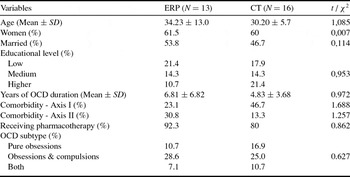
In order to analyse the homogeneity of the two groups at pre-treatment, t-tests for independent samples or χ2 were used. No significant differences were observed between the groups on the socio-demographic variables studied (age, gender, marital status, education level, economical status). There were no significant differences in the clinically relevant variables either: duration of the disorder, OCD comorbidity with axis I and II, use of medication, OCD content or subtype. Data are displayed in Table 1.
Demographic and clinical symptom measures for patients who completed the treatment

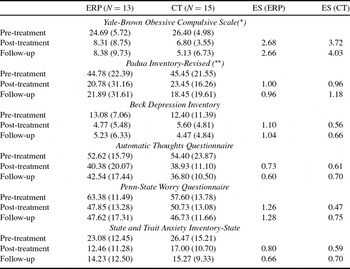
The two groups were also comparable with regard to the severity of the OCD (YBOCS), the obsessive symptoms (PI-WSUR), non-OCD symptoms (BDI, STAI, PSWQ, ATQ), the OCD-relevant beliefs and thought control strategies assessed by the OBSI, TCQ and WBSI. Table 2 shows these data.
Differential changes at post-treatment and one-year follow-up in OCD and non-OCD symptom measures for participants who completed treatment

The data are expressed as Mean (SD). ES = Effect size pre- vs. post-treatment and pre- vs. follow-up
(*)CT: N = 16; (**) ERP: N = 9; CT: N = 11
Comparative efficacy of treatments at post-treatment and at follow-up on OCD symptoms and non-OCD symptom measures
To compare the results produced separately by each therapeutic procedure, we conducted one-way ANCOVAS of each measure, with the post-treatment scores as dependent variables, and the pre-treatment scores as covariates, once the equivalence of the pre-treatment standard deviations was verified. Effect sizes were also calculated for the change produced in each treatment condition for each of the variables considered in the study.Footnote 1
Regarding the pre-post treatment changes in OCD symptoms, differences were not observed between the post-treatment scores obtained by the two treatment modalities on any of the OCD measures (all p's >.05). The effect size values were high in the three measures for the two groups, with the change in severity (YBOCS) being higher at post-treatment and follow-up with CT than with ERP. Moreover, the changes observed at post-treatment increased at follow-up. Table 2 summarizes these results.
With regard to the changes in non-OCD symptoms, the results indicate the absence of differential effects at post-treatment between the two treatment modalities on depressive symptoms (BDI), anxiety (STAI), worry (PSWQ) and negative automatic thoughts (ATQ), although the effect sizes were higher for the ERP condition, especially with regard to the depression (BDI) and worry (PSWQ) measures (see Table 2).
Clinically significant changes at post-treatment and one-year follow-up applied to the YBOCS
Following the Jacobson and Truax (Reference Jacobson and Truax1991) proposal, the following combined criteria to consider a patient improved and/or recovered at post-treatment and at follow-up were calculated: Improvement = YBOCS ≤ 12, plus YBOCS pre- versus post-treatment decrease of at least 6 points; Recovery = YBOCS ≤ 7 plus YBOCS pre- versus post-treatment decrease of at least 6 points.
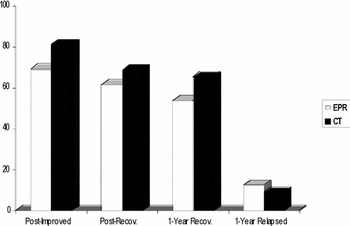
Regarding the improved and recovered rates of patients in each treatment condition, we observed that in the ERP treatment group, 9 out of 13 patients (69.23%) met the improvement criteria and 8 were also recovered (61.53%). In the CT condition, 13 out of 16 patients (81.25%) met the improvement criteria, whereas 11 (68.75%) were also recovered. With regard to the stability of these outcomes, one patient relapsed at the one year follow-up in each treatment condition, so that the rate of recovery decreased to 53.85% in ERP and to 65.5% in CT. These results indicate a 12.5% rate of relapse for the recovered patients with ERP, and a 9.09% rate of relapse for the recovered patients with CT (see Figure 1)
Percentages of improved, recovered, and relapsed patients after EPR and CT at post-treatment and one-year follow-up

Comparative efficacy of treatments at post-treatment and at follow-up on OCD-relevant beliefs and strategies
The same statistical analyses as in the preceding section were performed: one-way ANCOVAS, with the post-treatment scores as dependent variables and the pre-treatment scores as covariates. Effect sizes were also calculated.
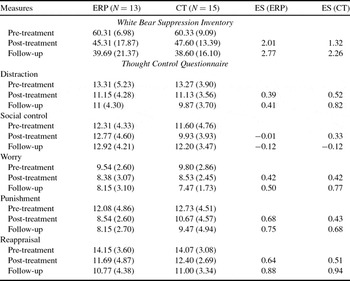
Both treatments were equally effective at modifying thought control strategies, as assessed by the WBSI and TCQ. The pre- vs. post-treatment effect sizes were only medium after the two treatments, with the exception of the suppression tendencies (WBSI), which were high in the two treatment conditions, both at the post-treatment and at follow-up (see Table 3). It is interesting to note that, with the exception of the Social Control strategy (TCQ), the changes observed at post-treatment increased at follow-up.
Differential changes following ERP and CT in thought control strategies for participants who completed treatment

The data are expressed as Mean (SD). ES = Effect size pre- vs. post-treatment and pre- vs. follow-up
Correlation coefficients between residual gain scores for the thought control strategies and the YBOCS scores indicated that the change on the thought suppression strategy (WBSI) was highly associated (p<.01) with symptom improvement in the two treatment conditions (ERP: r = 0.76; CT = 0.65). However, the correlation between YBOCS change and TCQ-reappraisal change was only significant in the EPR treatment condition (r = 0.66; p<.01), whereas the association between YBOCS change and TCQ-Worry change was only significant, although moderate, in the CT treatment condition (r = 0.48; p<.05).
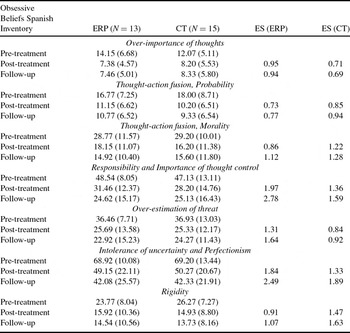
Regarding the OCD-related beliefs (see Table 4), it was also observed that the two treatments were effective in changing all the belief domains assessed (all the p values were ≤.05). These changes were generally higher in the ERP condition than in the CT condition, except for two domain beliefs: Thought-Action Fusion and Rigidity, in which the changes were higher when CT was applied. Over time, the dysfunctional belief changes increased slightly, regardless of the treatment applied, except for over-importance of thoughts, which decreased at follow-up. The correlation between symptom improvement (YBOCS change) and belief changes (OBSI) was moderate. The greatest associations were for YBOCS change and OBSI-TAF-probability change (ERP: r = 0.59; CT: r = 0.60; p<.01), for OBSI-Threat change (ERP: r = 0.53; CT: r = 0.48; p<.05), and for OBSI-Responsibility change (ERP: r = 0.49; CT: r = 0,48; p<.05).
Differential changes following ERP and CT on OCD-related dysfunctional beliefs for participants who completed treatment

Data are Mean (SD). ES = Effect size pre- vs. post-treatment and pre- vs. follow-up
Discussion
The purpose of this study was to provide data about the comparative effectiveness of CT and ERP in modifying OCD symptoms, dysfunctional beliefs and thought control strategies, and about the stability of the observed changes over a more extended period of time (one year) than is usually found in the literature. Additionally, our interest focused not only on the comparative magnitude of the changes observed after the two treatment conditions, but also on the clinical relevance of the changes at post-treatment and at the one year-follow-up. Moreover, given the characteristics of our specific context, we delivered the treatments on the basis of a routine clinical practice in a public-mental health service. For this reason, no patients were excluded due to comorbid diagnosis, concurrent medication, medical problems or past treatments.
The admission criteria implied the non-inclusion of 28% of the patients referred for psychological treatment. This is a lower rate than the 52.62% reported in the meta-analysis by Eddy, Dutra, Bradley and Westen (Reference Eddy, Dutra, Bradley and Westen2004). Consequently, we are reasonably confident that our study has an adequate balance between external and internal validity. The rate of patients who withdrew from the treatments once they had started was lower than the 12.11% reported in the above-mentioned meta-analysis (Eddy et al., Reference Eddy, Dutra, Bradley and Westen2004). Taking into account the severity of the disorder (YBOCS pre-treatment mean score), the patients who completed the treatments fall, as a group, into the range of severe OCD. From this view, our data are also comparable to what was mentioned in the Eddy et al. (Reference Eddy, Dutra, Bradley and Westen2004) and Fisher and Wells (Reference Fisher and Wells2005) studies, which reported mean YBOCS pre-treatment scores of 24.85 and 28.5, respectively.
Comparing the effects of the treatments, we observed that both procedures were equally effective at reducing obsessive symptoms (PI-WSUR) and OCD severity (YBOCS). These results are consistent with those observed in some published studies (van Balkom et al., Reference van Balkom, de Haan, van Oppen, Spinhoven, Hoogduin and van Dyck1998; Cottraux et al., Reference Cottraux, Note, Nan Yao, Lafont, Note, Mollard, Bouvard, Sauteraud, Bourgeois and Dartigues2001; Whittal et al., Reference Whittal, Thordarson and McLean2005), but not with what was reported in other studies, where ERP was comparatively more effective than CT (McLean et al., Reference McLean, Whittal, Thordarson, Taylor, Söchting, Koch, Paterson and Anderson2001), or CT was more effective than ERP (van Oppen et al., Reference van Oppen, De Haan, van Balkom, Spinhoven, Hoogduin and van Dick1995). In our opinion, the discrepancies between the two latter mentioned studies and our results could be explained in terms of the special features of the treatments applied. In the McLean et al. (Reference McLean, Whittal, Thordarson, Taylor, Söchting, Koch, Paterson and Anderson2001) study, ERP and CT were delivered in a group format and, as the authors themselves argue (Whittal and McLean, Reference Whittal, McLean, Frost and Steketee2002), CT is less effective when it is provided in a group format. Similarly, in the van Oppen et al. (Reference van Oppen, De Haan, van Balkom, Spinhoven, Hoogduin and van Dick1995) study, the ERP condition consisted of self-exposure, which has been considered a less effective modality of the exposure techniques (Abramowitz, Reference Abramowitz1997). These arguments have received support in the Whittal et al. (Reference Whittal, Thordarson and McLean2005) reported data, where CT in a group format and self-exposure were associated with lower effect sizes.
The magnitude of change obtained after the two treatment modalities was high, taking into account the two specific OCD measures, YBOCS and PI-WSUR, and this was especially true for the former. Moreover, the observed change in the YBOCS was greater for CT than for ERP. Additionally, the changes obtained increased over time (one year follow-up) in the CT condition treatment group, but this was not true for the ERP treatment group. These results are similar to those reported by Whittal et al. (Reference Whittal, Thordarson and McLean2005) when they calculated the effect sizes for the ERP and CT conditions in various controlled studies on the basis of the same formula that we applied. The patients who participated in ERP treatments improved 2 SD as a mean, whereas those who joined CT improved approximately 3 SD. Eddy et al. (Reference Eddy, Dutra, Bradley and Westen2004) also reported big effect sizes for the two treatment modalities, but they were lower than those observed in our study (1.53 for ERP and 1.54 for CT). This discrepancy was probably due to the greater heterogeneity in the treatment conditions included in the Eddy et al. (Reference Eddy, Dutra, Bradley and Westen2004) meta-analysis, especially regarding the CT condition. None of the studies included in the study applied a CT program specifically designed to change the cognitive beliefs and thought control strategies considered OCD-relevant by the current cognitive conceptualizations of this disorder. The same argument can be applied to the meta-analysis by Abramowitz (Reference Abramowitz1997).
As for the clinical relevance of the changes obtained after the treatments, our results show that both ERP and CT were effective, although the improvement and the recovery rates at the post-treatment were higher for CT than for ERP. Regarding the stability of these rates after one year follow-up, we must conclude that they were satisfactory, as only two patients relapsed (one in each of the two treatment conditions). These results coincide with those reported in the few controlled studies that specifically address these parameters and use similar criteria to what we used to consider that a given patient was recovered, that is, the Jacobson and Truax (Reference Jacobson and Truax1991) criteria. In these studies, a slight superiority for CT is shown when compared to ERP (Abramowitz, Foa and Franklin, Reference Abramowitz, Foa and Franklin2003; Cottraux et al., Reference Cottraux, Note, Nan Yao, Lafont, Note, Mollard, Bouvard, Sauteraud, Bourgeois and Dartigues2001; Freeston et al., Reference Freeston, Léger and Ladouceur2001; van Oppen et al., Reference van Oppen, De Haan, van Balkom, Spinhoven, Hoogduin and van Dick1995; Whittal et al., Reference Whittal, Thordarson and McLean2005). The Eddy et al. (Reference Eddy, Dutra, Bradley and Westen2004) meta-analysis also reveals a higher percentage of recovered patients for CT. Also, in the Fisher and Wells (Reference Fisher and Wells2005) report again a slight advantage for CT appeared, once the only non-controlled study that was initially included in their analyses had been excluded. To conclude, although the evidence is still scarce, it seems that the stability over time of the therapeutic gains after CT must be considered satisfactory, at least for the patients who were recovered after the treatment. In any case, more research is needed with longer follow-up periods.
As for the depressive symptoms, which were not specifically addressed in the treatments, it is interesting to note that the two therapeutic programmes produced similar effects in reducing these symptoms, as was revealed by the BDI and ATQ scores, with the effect sizes being medium or high. Several studies have reported improvements in OCD comorbid depressive symptoms only under CT conditions (Emmelkamp et al., Reference Emmelkamp, Visser and Hoekstra1988; Cottraux et al., Reference Cottraux, Note, Nan Yao, Lafont, Note, Mollard, Bouvard, Sauteraud, Bourgeois and Dartigues2001; van Balkom et al., Reference van Balkom, de Haan, van Oppen, Spinhoven, Hoogduin and van Dyck1998). We would expect the decrease in obsessive symptoms to be associated with a decrease in the comorbid depressive symptoms, regardless of the treatment applied, as other studies also observed (van Oppen et al., Reference van Oppen, De Haan, van Balkom, Spinhoven, Hoogduin and van Dick1995; Whittal et al., Reference Whittal, Thordarson and McLean2005). As for the changes in anxiety-related measures (PSWQ and STAI-e), although no differences between groups were observed, the effect sizes indicated that the participants in the ERP condition improved slightly more than the participants in the CT condition, probably due to the largely demonstrated usefulness of exposure techniques for typically anxious symptoms.
The two treatments were equally effective in changing OCD-related beliefs (OBSI) and thought-control strategies (TCQ and WBSI). The effect sizes associated with these changes were large for most of the variables after both therapeutic procedures. The correlation coefficients between the symptomatic changes, beliefs changes, and thought control strategy changes were only moderate in magnitude and similar in the two treatment conditions. Taken together, these data allow us to conclude that not only CT, which specifically challenges the OCD-related beliefs and appraisals, was able to effectively modify them. The changes, also observed after ERP, could be explained in the terms that Rachman (Reference Rachman1998) has argued: after exposure to the feared stimuli without the expected negative consequences, the vicious cycle that the patients use to confirm their dysfunctional beliefs is broken; to that end, perhaps ERP and CT are equally effective. Even so, as Whittal et al. (Reference Whittal, Thordarson and McLean2005) argue, the question of whether OCD related cognitions are coeffects or causal in OCD symptom change remains unanswered.
Our results coincide with those reported by Whittal et al. (Reference Whittal, Thordarson and McLean2005), in the only published study that compares the effectiveness of ERP and CT, with the two treatments being applied in a similar individual format to the one applied in the current study. CT addressed all the OCD-relevant beliefs considered, and the ERP delivery was gradual, in vivo and therapist-guided. Moreover, the aforementioned study also applies a specific beliefs measure for OCD, the Obsessive Beliefs Questionnaire, to assess the relevant cognitive domains. These authors observed that in the two treatment conditions all the meta-cognitive beliefs and appraisals significantly changed between pre- and post-treatment, with no differences found between the two groups.
The effect size indexes allow us to more carefully compare the effectiveness of the treatments on changing appraisals and beliefs. The improvement of the patients was around 1 SD compared to the pre-treatment on most of the beliefs variables in the two treatment programmes, and in some cases the effect was even larger. In contrast, some other controlled studies have shown changes in OCD-related beliefs after CT but not after ERP (Emmelkamp et al., Reference Emmelkamp, Visser and Hoekstra1988; van Oppen et al., Reference van Oppen, De Haan, van Balkom, Spinhoven, Hoogduin and van Dick1995; Cottraux et al., Reference Cottraux, Note, Nan Yao, Lafont, Note, Mollard, Bouvard, Sauteraud, Bourgeois and Dartigues2001). However, given that the instruments used to assess the meta-cognitive beliefs were somewhat different from those applied in our study, it is difficult to make direct comparisons.
In relation to the role of the dysfunctional thought control strategies in OCD, Belloch, Morillo and Garcia-Soriano (in press) observed that the chronic tendency to suppress negative unwanted thoughts (WBSI) was associated with Punishment for having negative intrusions (TCQ). Moreover, these two strategies were the only ones specific to OCD patients, compared to other non-OCD anxious, depressed and non clinical participants. From this perspective, the decrease in the frequency of use of these two thought control strategies must be considered an objective for the treatment of OCD patients. Our results with regard to the change observed in the thought control strategies indicate very large effect sizes for the general strategy of suppressing thoughts (WBSI). The patients who participated in ERP improved 2 SD in relation to the pre-treatment, and the participants in CT improved almost 1.5 SD. However, the changes produced in the general thought control strategies, as assessed with the TCQ, were from medium to small, especially for the social control strategy. As far as we know, only one published study has provided data about the change in the use of thought control strategies after psychological treatment (Abramowitz, Whiteside, Kalsy and Tolin, Reference Abramowitz, Foa and Franklin2003). These authors found a decrease in the use of Punishment in OCD patients after EPR, as we also observed. However, we cannot compare our results with those obtained by other authors because there are no published studies reporting the comparative effects of ERP and CT on changes in thought control strategies. In our opinion, it is important to include reliable measures of dysfunctional thought control strategies in the studies designed to examine the efficacy of psychological treatments, especially to increase the understanding of the role that these variables play in the genesis and/or maintenance of the OCD.
To conclude, our results show that both CT and ERP are at least equally effective for the treatment of OCD symptoms. Both treatments are equally useful in changing both dysfunctional beliefs and maladaptive strategies characteristic of this disorder. From a clinical perspective, CT was slightly more effective than ERP, regardless of the OCD presentation (YBOCS improvement and recovery rates). An additional advantage of the CT over the ERP was the lower number of sessions (16 and 18 sessions, respectively), although the total length of time devoted to the treatments was the same (6 months). However, as Longmore and Worrell (Reference Longmore and Worrell2006) stated, more studies comparing cognitive measures and symptom measures throughout the course of therapy are needed, in order to examine temporal changes in beliefs and cognitive mediation in OCD.
The main limitation of our study was the sample size, which limits the generalization of the results obtained. However, taking into account the number of patients who had their first intake in our clinical settings throughout the year of the study, we can reasonably assume a good representation of OCD patients, which is near the annual prevalence rate usually estimated for OCD. Moreover, we think that the design of our study accomplishes most of the recommendations made by Eddy et al. (Reference Eddy, Dutra, Bradley and Westen2004), especially taking into consideration the general purpose of our study (the comparative effectiveness of CT and ERP for OCD in a general clinical setting), the design (non selected patients), the analysed variables (not only OCD severity, but also the appraisals and the thought control strategies suggested by the current cognitive conceptualizations of OCD), the follow-up period (one year), and the statistical methods applied to the data obtained.
Another limitation of the study has to do with the non-inclusion of cognitive techniques in the ERP protocol and, similarly, the exclusion of any form of self-exposure under the CT procedure. As we explained in the design and treatments section, these decisions were adopted to ensure that the treatment effects to be obtained with each type of psychological intervention were mainly attributable to their respective theoretical backgrounds. Nevertheless, we cannot be sure whether the patients made use of self-exposure (under the CT condition) or cognitive techniques (under the ERP condition) on their own throughout the duration of the treatment. However, we honestly think that, even if the patients used self-exposure and/or self-cognitive discussion, the possible confounding effects of their use would have little impact on the results obtained.
Acknowledgements
This study was supported by the Spanish Ministerio de Ciencia y Tecnología and EC Feder funds (Grant no. SEJ2006/03893-PSIC).



Comments
No Comments have been published for this article.