Introduction
Tympanic membrane perforation due to otitis media or traumatic injury has long been regarded as a common otological condition.Reference Santa Maria, Atlas and Ghassemifar1 As the tympanic membrane plays an important role in the physiology of hearing as well as in the pathophysiology of middle-ear diseases, chronic and unhealed membrane perforations, along with atelectatic healed neomembranes, may cause some degree of hearing loss and worsen middle-ear infections, requiring intervention.Reference Golz, Goldenberg, Netzer, Fradis, Westerman and Westerman2 The most favourable repair techniques (and resultant healing processes) for tympanic membrane perforations, especially large ones, should preserve the shape, thickness and consistency of the tympanic membrane, in order to protect its vibrational characteristics, prevent adhesion formation and resist reperforation.Reference Chen, Yang, Gao, Yu and Gao3 Even after multiple perforations, the tympanic membrane tends to heal itself by keratinised epithelial cell migration, following migration and proliferation of connective tissue.Reference Wang, Wang and Chi4 However, in most cases self-healing is insufficient and leads to the formation of a dumbbell-shaped membrane with a thick, fibrotic layer of lamina propria, or, conversely, a thin membrane consisting only of irregular outer keratinised epidermal layers together with loss of the circular fibrous and connective tissue layers of the lamina propria; in both cases, intervention is required.Reference Kim, Bae, Lim, Choung, Park and Choi5 Such neomembranes may cause hearing and middle-ear problems.
Surgical tympanoplasty is still the conventional and most effective method of repairing tympanic membrane perforation. However, in light of the costs involved, long hospitalisation period and consequences of surgery, more recent studies have focused on alternative treatment approaches such as myringoplasty, graft myringoplasty and, most recently, laser therapy.Reference Mudry6–Reference Ribari, Jori, Kiss, Vona and Tomity11
For more than four decades, low-level laser therapy has been regarded in many medical fields as an efficient approach to wound healing, inflammation reduction and disease treatment.Reference Chen, Arany, Huang, Tomkinson, Sharma and Kharkwal12–Reference Bykov15 Unfortunately, there are still insufficient studies of low-level laser therapy post-tympanoplasty to persuade ENT specialists to favour such therapy for the repair of tympanic membrane perforation. Based on current evidence, low-level laser therapy seems to be an excellent choice for tympanic membrane perforation repair, as, unlike other kinds of laser therapy, the results are obtained through photochemical and photobiological effects rather than photothermal effects.Reference Tuner and Hode13, Reference Posten, Wrone, Dover, Arndt, Silapunt and Alam16, Reference Baxter17 The latter may increase the temperature of exposed tissue, with consequent damage.Reference Tuner and Hode13, Reference Baxter17
In the present study, we prospectively assessed the effect of local irradiation by 630 and 860 nm low-level lasers on the healing process following traumatic tympanic membrane perforation, by evaluating the inflammatory responses and histological changes in the tympanic membrane.
Materials and methods
This prospective, controlled, randomised animal study was conducted to assess the effect of local irradiation by 630 and 860 nm low-level lasers on the repair of traumatic tympanic membrane perforations.
Our institute's Ethics Committee and Animal Research Committee approved the study.
Study population
Twenty-four healthy, adult, male guinea pigs weighing 350–400 g were included in the study.
Pre-operative microscopic examination of the middle ear was carried out to exclude cases of middle-ear infection.
Following this, the animals were randomly assigned to either the experimental or the control group.
All animals underwent general anaesthesia by intraperitoneal administration of 50 mg/kg ketamine and 5 mg/kg xylazine. After general anaesthesia had been administered and the ear canals disinfected with povidone-iodine and hydrogen peroxide, a 2 mm diameter, centred myringotomy was made in the right ears of animals in the experimental group and the left ears of animals in the control group, using angiocatheter needles.Reference Stenfors, Bloom and Hellstrom19 On day one of the procedure, the tympanic membranes of all 12 animals in the experimental group were irradiated with 630 and 860 nm diode lasers; this treatment continued for 10 days. Other 12 animals in the control group were only observed and did not receive laser treatment.
Post-operatively, all the animals received an intramuscular injection of dexamethasone and B-complex vitamins in order to prolong survival and prevent early death, plus a prophylactic regimen of enrofloxacin for 5 days.
Low-level laser therapy
The low-level laser therapy was conducted as described in our previous work.Reference Kamrava, Farhadi, Rezvan, Sharifi, Ashrafihellan and Shoaee18 In summary, the experimental group was scheduled to be locally irradiated once a day for 10 consecutive days with a 30 mW red laser (630 nm) and a 100 mW infrared laser (860 nm); these were transmitted by manual K30 and H100 probes, respectively, over a 1.0 cm2 surface area for 1 minute in a direct and continuous fashion.
Both red and infrared laser irradiation were transmitted using the same apparatus (Azor-2000, Moscow, Russia). The energy density was set at 14.6 J/cm2.
Outcome
Two weeks after completion of laser treatment (i.e. 34 days after tympanic membrane perforation), the animals were decapitated. All specimens were sent to a veterinary laboratory for histological and pathological evaluation of tympanic membrane thickness, length and inflammatory response. The same group performed all procedures and measurements. The histological variables studied were tympanic membrane thickness, tympanic membrane length (from the auditory canal to the malleus tip) and inflammatory response status; this latter parameter was evaluated by measuring the number of infiltrating inflammatory cells in the tympanic membrane and surrounding tissues (e.g. malleus tip).
Cases of early death and otitis media were excluded from the study.
Statistical analysis
All data were analysed using the Kolmogorov–Smirnov normality test, which showed normal distribution. Univariate analysis of the continuous variables was carried out using Student's t-test. A p value of less than 0.05 was considered statistically significant. Statistical analysis was performed using SPSS 13 for Windows software (SPSS Inc, Chicago, Illinois, USA).
Results and analysis
Of the 24 guinea pigs included, seven animals (four from the experimental group and three from the control group) died during the study period and were thus excluded from analysis. No cases of otitis media occurred during the study.
The thickness of the tympanic membrane and the number of infiltrating inflammatory cells in the tympanic membrane and the surrounding tissue (including the malleus tip) were significantly reduced in the experimental group compared with the control group (p < 0.001, p < 0.001 and p = 0.005, respectively). The length of the tympanic membrane from the auditory canal to the malleus tip did not differ significantly between the groups (p = 0.427).
All details are shown in Table I.
Tympanic membrane characteristics by group

Data represent means ± standard deviations unless otherwise specified. *n = 9; †n = 8. ‡From external auditory canal wall to malleus tip. ICC = inflammatory cell count per 100 µm2 tympanic membrane (TM) or malleus
Discussion
The most favourable repair techniques (and resulting healing processes) for tympanic membrane perforations, especially large ones, should preserve the shape, thickness and consistency of the original tympanic membrane, in order to protect its vibrational characteristics, prevent adhesion formation and resist reperforation.Reference Chen, Yang, Gao, Yu and Gao3
The tympanic membrane has three distinct layers: the outer epidermal layer of keratinising squamous epithelium; the lamina propria (consisting of three connective tissue layers: two dense radial and circular fibrous layers, and one thin layer of oblique fibres in between); and a single mucosal layer of flattened epithelial cells.Reference Kim, Bae, Lim, Choung, Park and Choi5, Reference Stenfors, Bloom and Hellstrom19, Reference Spandow, Hellstrom and Dahlstrom20
Tympanic membrane perforations tend to heal spontaneously in approximately 80 per cent of cases, depending on the age of the patient and the size of the perforation.Reference Santa Maria, Atlas and Ghassemifar1, Reference Truy, Disant and Morgon21–Reference Kristensen23 Nevertheless, in such cases the neomembrane is generally malformed due to excessive proliferation of the fibrous layer or, conversely, due to the formation of a thin, loose membrane consisting of just two layers (an outer epidermal and an inner epithelial layer) without the connective tissue layers of the lamina propria. In addition, large perforations tend to become chronic unhealed ones, as the healing process stimulates and increases mitotic activity, cell division and differentiation up to just 2 mm from the edge of the injury.Reference Reeve24 Such pathology can cause hearing and middle-ear problems requiring subsequent surgical intervention (e.g. tympanoplasty, myringoplasty or graft myringoplasty).
During recent decades, many studies have investigated various wavelength spectra of lasers, and more recently low-level lasers, as an adjunctive or alternative therapy to surgical procedures, in many different medical fields including ear surgery. Low-level lasers are becoming more popular as ‘cold’ lasers due to their photochemical and photobiological stimulative effects on RNA and DNA synthesis and on cell division, proliferation and differentiation, as opposed to the photothermal effects; thus, low-level lasers have the potential to greatly reduce the temperature change and consequent tissue damage associated with laser therapy.Reference Tuner and Hode13, Reference Posten, Wrone, Dover, Arndt, Silapunt and Alam16, Reference Medrado, Pugliese, Reis and Andrade25, Reference Lubart, Wollman, Friedmann, Rochkind and Laulicht26 Low-level lasers may also attenuate inflammation (including excessive inflammatory cell infiltration) and fibrosis formation, accelerating the healing process.Reference Kamrava, Farhadi, Rezvan, Sharifi, Ashrafihellan and Shoaee18
Some aspects of low-level laser therapy are still controversial. Some studies have shown a stimulating effect of low-level laser irradiation on collagen production and cell proliferation, while others have observed the opposite effect.Reference Evans and Abrahamse27–Reference Colver and Priestley32 Some studies have shown low-level laser therapy to be effective in promoting cell proliferation and the healing process, especially in the upper wavelengths, while others have demonstrated its ineffectiveness or reported thermal damage, especially in the upper wavelengths.Reference Evans and Abrahamse27, Reference Colver and Priestley32, Reference Hawkins and Abrahamse33
It is important to note that low-level laser therapy includes a spectral wavelength ranging from 300 to 10 600 nm, with different power ranges, pulse rates, pulse durations, interpulse intervals, irradiation times, intensities and doses, all of which could produce different results, making comparison difficult.Reference Posten, Wrone, Dover, Arndt, Silapunt and Alam16, Reference Evans and Abrahamse27, Reference Karu34
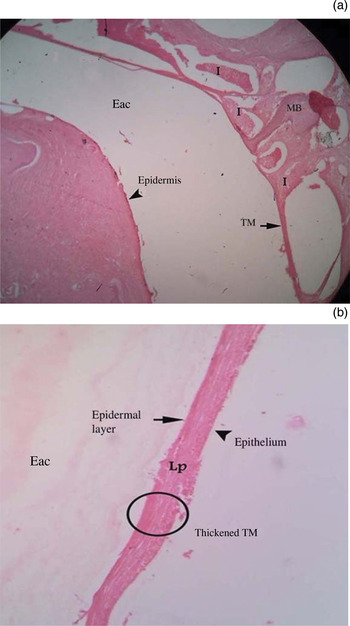
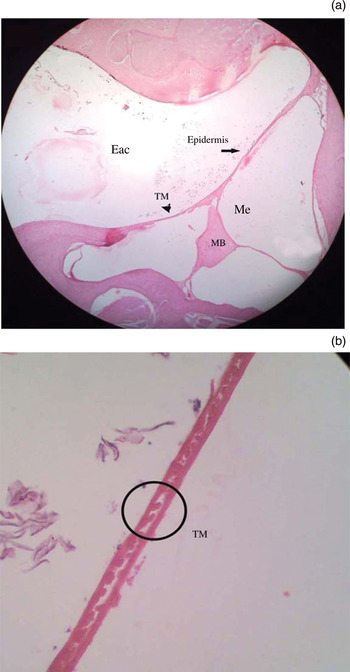
In the present study, and in accordance with our previous work, we evaluated the effect of red and infrared lasers of 630 nm and 860 nm wavelengths, respectively, and found significantly less tympanic membrane thickening in the experimental group than in the control (non-laser) group; furthermore, the tympanic membrane length (from the auditory canal to the malleus tip) and shape were closer to normal morphology (Figures 1 and 2).Reference Kamrava, Farhadi, Rezvan, Sharifi, Ashrafihellan and Shoaee18 The combination of these two laser wavelengths may stimulate migration of fibroblast-like stem cells from the epidermal layer towards the perforation area, and may also attenuate the inflammatory response (including excessive inflammatory cell infiltration and fibrosis formation), more significantly than each laser wavelength used alone. In the present study, these processes led to the repair of the tympanic membrane, with adequate proliferation of connective tissue and without excessive formation of fibrotic tissue. Inflammatory cell infiltration into the tympanic membrane layers and surrounding tissues (including the malleus tip) was favourably prohibited and inflammatory cells were significantly fewer in the experimental group. These results indicate that the use of a red laser in combination with an infrared one significantly increases cell proliferation, and attenuates inflammatory responses and fibrosis formation, resulting in improved healing. In comparison, higher numbers of inflammatory cells and thicker, more fibrotic tympanic membranes were seen in the control group (Figure 1).
• Tympanic membrane perforations are common
• Large, chronic perforations generally heal with a dysfunctional neomembrane
• Thus, tympanoplasty is generally required
• This study used an animal model to test the effect of low-level laser on tympanic membrane perforation healing
• Healing was significantly enhanced
• Laser therapy could be a useful alternative in this clinical setting
Photomicrographs of control group specimens showing: (a) external auditory canal (Eac), outer epidermal layer of tympanic membrane (TM), malleus bone (MB) and areas of inflammation (I) (H&E; ×64); and (b) epidermal layer, lamina propria (LP), epithelial layer of TM, and TM thickening (oval) (H&E; ×640).

Photomicrographs of laser treatment group specimens showing: (a) external auditory canal (Eac), outer epidermal layer of tympanic membrane (TM), middle ear (Me) and malleus bone (MB) (H&E; ×64); and (b) the TM (circle) (H&E; ×640).

According to the present study, utilising low-level lasers seems to be a time-saving, cost-effective and less invasive method of repairing large tympanic membrane perforations.
Conclusion
These study results provide histological evidence that the application of 630 and 860 nm low-level lasers results in a statistically significant improvement in the healing process following traumatic tympanic membrane perforation.