The academic job market for political scientists has been relatively strong in recent years,
with job listings in the last several years outpacing those in the 1980s and 1990s. The number
of jobs posted for academic year 2003 was the highest in over 20 years. Listings for last
year, AY2004, dipped from these recent highs. But early numbers of listings in AY2005 seem to
have rebounded and are greater than those for corresponding quarters in the last few years. In
AY2004, 920 positions were listed with the association, compared with 1,123 the year before.
The 2004 level still exceeded all openings posted annually during the 1990s. Total numbers of
academic jobs listed with APSA are charted in Figure 1.
Total Job Listings with APSA
One of the best indicators of the job opportunities for political scientists, at least in
academic settings, is the number of open positions posted with the American Political Science
Association through its Personnel Service. The service began in 1968 as a monthly paper
newsletter of job listings and now is managed entirely online as the eJobs service.
Professional ethics standards for political science1
The APSA
Ethics Guide reads: “It is a professional obligation of all political science departments to
list in the APSA Personnel Service Newsletter all positions for which they are recruiting at
the Instructor, Assistant, and Associate Professor levels. In addition, the listing of
openings at the Full Professor level is strongly encouraged. It is also a professional
obligation for departments to list temporary and visiting positions.
call for all
aca demic positions at the assistant and associate level to be listed with APSA and the
standards recommend that all positions be so listed. We can thus treat this practical
requirement as a longitudinal data set, and the recent conversion to electronic listings gives
us some added flexibility in analysis of the job market.
Most APSA academic job listings are regular openings at the assistant, associate, or full
professor level; 7% are listed as visiting positions and 4% as instructor/lecturer. Twenty
percent of the listings indicate that rank is open. Of the remaining positions listed, almost
90% are at the assistant professor level.
Location
Half of all job openings are in just nine states: California, New York, Pennsylvania,
Texas, Massachusetts, Illinois, Michigan, New Jersey, and Florida; though by census region
the East North Central group of states in the Midwest (Wisconsin, Michigan, Indiana,
Illinois, and Ohio) had the most listings as a group. New England had the highest proportion
of openings in undergraduate institutions—talmost two thirds of all positions there are in
B.A. programs. The East South Central states (Kentucky, Tennessee, Mississippi, and Alabama)
had the highest percentage of their openings in Masters level institutions.
Academic Fields
The major fields for which jobs are listed remain remarkably stable, at least since the
mid-1980s from when some comparable data are available.2
Regarding the long-term stability of the fields of political science at liberal arts
colleges, see Timothy V. Kaufman-Osborn, “ ‘Go To, Let Us Centrifugate1’ The Political
Science Major at Liberal Arts Colleges” (Paper read at Western Political Science
Association Annual Meeting, Portland, OR, March 11–13, 2004.
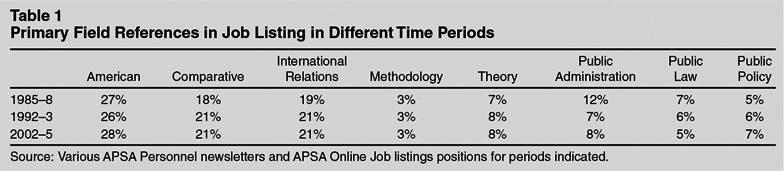
A little over a
quarter of all jobs are posted with a primary field of American politics, a fifth each for
comparative politics and international relations, under 10% each for theory, public
administration, public policy, and public law, and 3% for methodology.
Table 1 shows the percentage of jobs with a primary listing in each major field from
the mid-1980s, to early 1990s, to the last several years. The only significant difference
seems to be the larger percentage of positions listed in public administration in the 1980s
than now.
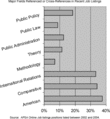
Jobs are often listed with more than one field designated, usually as a cross-reference.
For the jobs listed recently, it is possible to tally the percentage of all listings that
reference a given field. For instance, while a fifth of all academic listings specify
comparative politics as the primary field, over a third specify comparative as one of the
desired areas. This may give a more accurate picture of opportunities available on the market
for job seekers in particular areas. Public policy in particular emerges as a proportionally
larger cognate preference than primary. Figure 2 shows the
percentage of recent listings that refer specifically to each of the major field areas.
Major Fields Referenced or Cross-References in Recent Job Listings
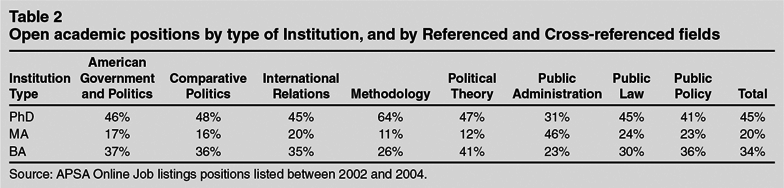
Almost half of all academic job openings are in Ph.D.-granting institutions, about a third
in B.A. level institutions, and the rest mostly in M.A. level institutions, as shown in Table 2. This roughly mirrors the distribution of faculty in the APSA
membership as a whole. APSA's job listings include almost no positions for community colleges
and relatively few for non-academic jobs, an omission in the eJobs service that we intend to
rectify. There is relatively little difference in the type of field specialization sought in
different types of institutions, except for what might readily be expected—there are more
methodology openings in the Ph.D.-granting institutions and substantially more public
administration openings at the M.A. level schools, as shown in Table
2.
Job openings usually report a preference for a specialized focus in addition to broadly
defined fields such as comparative, American, or theory. These preferences can be difficult
to categorize. Many are very specific (“applied negotiation and bargaining analysis”), many
simply replicate the broad field categories (“public law”), and many use widely different
ways to describe a possible common thread (country names instead of region names, such as
Paraguay versus Latin America; or names of specific techniques instead of general skills,
such as case study analysis instead of qualitative methods).
Still, we can identify some themes that appear more than others. From a world region
perspective, Asian and Latin American research interests were the most frequently listed. Out
of a sample of listings,3
The following numbers should be
considered in a relative, not an absolute, sense since specifying such a specialization is
optional in the job postings.
144 specified an interest in some aspect of Asian or
Chinese politics, and 127 specified Latin America. Africa was cited 87 times, and the Europe
and the Middle East were each cited 72 times.
Environmental issues were the most frequently named policy themes, though these are very
difficult to categorize. Environmental policy was specified formally in 93 listings, criminal
justice in 53, social welfare in 24, education in 23, health in 21, and so forth. This
however does not include references to generic policy emphasis, such as urban politics and
policy, so the overall policy emphasis in the openings is larger.
From a methodology perspective, 150 positions included a specific request for quantitative
methods and 27 requested qualitative methods skills—many specifying both. Interestingly, all
references to qualitative methods skills were for AY2004 and none in the prior
year—indicating either this interest is newly emerging in hiring or that it has been in place
but not articulated in the past. Only nine openings made reference to expertise with rational
or public choice approaches.
Conclusion
From the lens of academic job listings, the political science academic market is stronger
today than a decade ago, when the signs of a tightening market were clear (Brintnall 1996). More recent analyses highlight the in teracting importance of
doctoral production, placement, academic hiring, and alternative career options on overall
employment outcomes (Lopez 2003). APSA is gathering information now
on these other aspects of the labor market, and will report on them on a regular basis in
these pages.