Fear of falling and associated activity avoidance is common among older people. Approximately 50 percent of community-living older people report fear of falling and approximately 40 percent report activity avoidance due to this fear (Reference Murphy, Williams and Gill1;Reference Zijlstra, van Haastregt and van Eijk2). Fear of falling and associated activity avoidance have negative consequences in terms of functional decline, restriction of social participation, decreased quality of life, and increased risk of falling (Reference Cumming, Salkeld and Thomas3–Reference Friedman, Munoz and West6). Furthermore, these negative consequences of fear of falling can result in increased healthcare usage and associated costs (Reference Cumming, Salkeld and Thomas3). In the Netherlands, for example, falls have been identified as a major cause of healthcare costs and result in more than double the costs of traffic accidents (Reference Meerding, Mulder and van Beeck7). Furthermore, falls account for 5.9 percent of healthcare costs in persons aged 85 years or over (Reference Meerding, Mulder and van Beeck7;Reference Meerding, Bonneux, Polder, Koopmanschap and van der Maas8). This underlines the need for cost-effective interventions to reduce fear of falling and associated activity avoidance in older persons.
A systematic review of randomized controlled trials showed that fall-related multifactorial programs (n = 5), tai chi interventions (n = 3), exercise interventions (n = 2), and a hip protector intervention (n = 1) were effective in reducing fear of falling among older persons (Reference Zijlstra, van Haastregt and van Rossum9). Eight of these programs were primarily targeted at outcomes such as falls, mobility, and balance (Reference Zijlstra, van Haastregt and van Rossum9), and three were primarily targeted at fear of falling (Reference Tennstedt, Howland and Lachman10–Reference Zhang, Ishikawa-Takata and Yamazaki12). Only one of these three interventions, the multicomponent American program “A Matter of Balance” (Reference Tennstedt, Howland and Lachman10), was aimed at both reducing fear of falling and associated activity avoidance. To our knowledge, there is no published data on cost-effectiveness of interventions to reduce fear of falling and activity avoidance. Therefore, the question remains whether these interventions also contribute to a reduction in healthcare usage and associated costs.
Previously, we published the results of a randomized controlled trial to assess the effectiveness of a Dutch version of the promising American program “A Matter of Balance” (Reference Tennstedt, Howland and Lachman10;Reference Zijlstra, van Haastregt and Ambergen13;Reference Zijlstra, Tennstedt and van Haastregt14). This multicomponent nurse-led cognitive behavioral group intervention showed favorable effects on all primary outcomes (i.e., fear of falling, activity avoidance, fall-related self-efficacy, and daily activity). Furthermore, favorable effects were observed on several of the secondary outcomes such as feelings of anxiety and symptoms of depression (Reference Zijlstra, van Haastregt and Ambergen13;Reference Zijlstra15). Falls data were collected for safety monitoring because increased activity might lead to increased falls risk due to greater exposure. This trial showed that despite the increase in daily activity, participants in the intervention group did not report more falls than participants in the control group. To the contrary, the intervention group showed a positive but nonsignifcant trend with respect to the number of fallers and total number of falls during the trial. Furthermore, the number of recurrent fallers was significantly lower in the intervention group than in the control group one year after the intervention (Reference Zijlstra, van Haastregt and Ambergen13;Reference Zijlstra15).
This study describes the economical evaluation which was incorporated in the trial mentioned above. This cost-effectiveness analysis is performed from a societal perspective, and aims to assess whether the cognitive behavioral group intervention is preferable to usual care in terms of costs and effects on fear of falling and associated activity avoidance.
METHODS
Design and Participants
This economic evaluation was embedded in a two-group randomized controlled trial with 14 months of follow-up (Reference Zijlstra, van Haastregt and Ambergen13). The evaluation consists of a cost-effectiveness analysis in which we compare the healthcare costs and effects of this multicomponent cognitive behavioral group program on fear of falling and activity avoidance, with those of a usual care group. The Medical Ethics Committee of the Maastricht University/University Hospital Maastricht approved the study protocol. A detailed description of the design of the trial is published elsewhere (Reference Zijlstra, van Haastregt and van Eijk16). The economic evaluation was performed from a societal perspective, and with a time horizon of 14 months.
Study participants were selected by means of a short screening questionnaire (Reference Zijlstra, van Haastregt and Ambergen13). Persons were eligible for participation in the trial if they were community-living, aged 70 years or over, reporting at least some fear of falling and some activity avoidance due to fear of falling, and provided informed consent. We excluded persons who were confined to bed, permanently dependent on a wheelchair, on a waiting list for nursing home admission, or participating in other intervention studies. Participants were randomly allocated to intervention or control group by an independent researcher blinded for participant's characteristics using SPSS (version 12.0). Participants in the intervention group were invited to participate in the multicomponent cognitive behavioral group program to reduce fear of falling and associated activity avoidance. Participants in the control group received usual care only. For both groups no restrictions were placed on co-interventions, meaning that participants were allowed to follow other care programs in the field of fear of falling and activity avoidance if they wanted to. However, at the time of the study no programs specifically aimed at reducing fear of falling and related activity avoidance among elderly persons were available in the study region.
Intervention
The multicomponent cognitive behavioral group intervention comprised eight weekly sessions of 2 hours and a booster session 6 months after the intervention period (Reference Zijlstra, Tennstedt and van Haastregt14). To reduce fear of falling and associated activity avoidance, four strategies were applied: (i) restructuring misconceptions to promote a view of falls risk and fear of falling as controllable; (ii) setting realistic goals for increasing activity in a safe manner; (iii) changing the home environment to reduce the risk of falls; and (iv) promoting physical exercise to increase strength and balance. The intervention was conducted in local community centers. Between February 2003 and May 2004, twenty group courses were conducted by six trained nurses qualified in geriatric care. More details about the intervention are published elsewhere (Reference Zijlstra, van Haastregt and Ambergen13;Reference Zijlstra, Tennstedt and van Haastregt14).
Comparator
The comparator in this economical evaluation is usual care. Though the Dutch guideline for preventing falls stresses the importance of preventing fear of falling, currently, no standard approach for the treatment of fear of falling and associated activity avoidance is available in the Netherlands. Therefore, whether and how a person with these complaints is treated, largely depends on whether the fearful and avoidant person actively seeks help and whether the consulted professionals are willing and able to offer some kind of treatment.
Measurements
We collected data on clinical outcomes and cost outcomes at baseline and at 2, 8, and 14 months (i.e., directly after the intervention, and at 6 and 12 months after the intervention).
Background Characteristics
Data on age, gender, living situation, educational level, cognitive status, perceived health, and falls in the previous 6 months were assessed at baseline. Details of the measurement of these variables were published elsewhere (Reference Zijlstra, van Haastregt and van Eijk16).
Costs Outcomes
The economic evaluation is assessed from a societal perspective. Therefore, we assessed healthcare costs, and patient and family costs. We did not distinguish between costs related to fear of falling and costs related to other health problems, because fear of falling and avoidance of activity can have their influence on a wide range of outcomes relating to physical, mental and social health (Reference Cumming, Salkeld and Thomas3;Reference Delbaere, Crombez and Vanderstraeten17;Reference Deshpande, Metter and Lauretani18). Furthermore, it is very difficult for both researcher and participant to make the distinction between what is related to fear of falling and what not.
Healthcare costs consisted of intervention costs and other healthcare costs. Intervention costs included costs for course materials, rent of the course locations including catering, costs of transportation of participants to and from the course location, and costs of the facilitators (nurses). Costs of facilitators were based on the time spent on the training for facilitators, time spent on travelling to the course location, time spent on preparation of the course sessions, and time spent on conducting the course sessions (Reference van Haastregt, Zijlstra and van Rossum19). Data regarding the intervention costs were collected prospectively by means of registration forms.
Other healthcare costs included general practitioner consultations, inpatient and outpatient specialist care, days in hospital, physiotherapist’ consultations, and hours of district nursing care (e.g., wound care, injections, personal hygiene). Volumes of these healthcare costs were collected by means of structured telephone interviews with the participants at 2, 8, and 14 months. In these interviews the participants were asked to report the volumes for the period between the previous measurement and the time of the interview.
Patient and family costs included hours of professional domestic help, home adaptations, aids and assistive devices. Productivity losses were not assessed because they are of limited relevance in our population of retired persons (as 65 years is the age of retirement in the Netherlands). Patient and family costs were assessed by means of the structured telephone interviews at 2, 8, and 14 months. To ensure blinding during data-collection the telephone interviews were performed by trained outcome assessors who were unaware of group allocation.
Costs were calculated by multiplying the volumes with cost prices that were largely based on the Dutch manual for cost analysis in healthcare research (Reference Oostenbrink, Bouwmans and Koopmanschap20;Reference Oostenbrink, Koopmanschap and Rutten21). We used standardized cost prices according to the Dutch manual for costing research (Reference Oostenbrink, Bouwmans and Koopmanschap20;Reference Oostenbrink, Koopmanschap and Rutten21). Where no standardized cost prices were available, real costs or tariffs were used to estimate costs. Cost prices are presented in Euros (€) from the year 2004, and otherwise indexed to the baseline year using a consumer price index of 4 percent as suggested in the manual (Reference Oostenbrink, Bouwmans and Koopmanschap20;Reference Oostenbrink, Koopmanschap and Rutten21). Because the inclusion period was 9 months and the follow-up period 14 months, we perceived it unlikely that there would be substantial differences in healthcare consumption and effects incurred at the beginning and toward the end of the study. Hence, there were no reasons to discount volumes of healthcare consumption or effects for different stages of our study. Details regarding volumes and cost prices are available on request.
Clinical Outcomes
Clinical outcomes were fear of falling and activity avoidance due to fear of falling as measured at 14 months. Fear of falling was assessed by asking “Are you afraid of falling?” Activity avoidance was measured by asking “Do you avoid certain activities due to fear of falling?” Answer options for both questions were 1 = never, 2 = almost never, 3 = sometimes, 4 = often, and 5 = very often. Both outcomes were measured by means of a self-administered questionnaire. We considered being at least sometimes afraid of falling a clinical relevant level of fear of falling. The same holds for activity avoidance (Reference Zijlstra, van Haastregt and van Eijk16). We, therefore, dichotomized these two clinical outcomes into the number of persons who never or almost never experience fear of falling or avoid activity (hereafter called “not afraid of falling” and “not avoiding activity,” respectively), and the number of persons who at least sometimes are afraid of falling or avoid activity (hereafter called “afraid of falling” and “avoiding activity,” respectively).
Data Analysis
Primary analyses (base-case analyses) were performed according to the intention-to-treat principle, including all participants with valid data on costs and clinical outcomes, regardless of whether they received the (complete) intervention or not. SPSS statistical software (version 14.0) was used for the analysis. Arithmetic means are generally considered the most appropriate measures to describe cost data (Reference Ramsey, Willke and Briggs22). Therefore, we present arithmetic means and use t-tests to assess differences in total costs between the intervention and control group. Clinical outcomes at 14 months of follow-up were analyzed by means of Chi-square tests.
The incremental cost-effectiveness ratio (ICER) represents the differences in mean costs between the intervention and usual care group in the numerator and the difference in mean clinical effects in the denominator (Reference Drummond, Sculpher and Thorrance23). The uncertainty around the ICER was checked by (1,000 times) nonparametric bootstrapping (percentile method). Nonparametric bootstrapping is a method based on random sampling with replacement based on individual data of the participants (Reference Briggs, Wonderling and Mooney24). Furthermore, we performed one-way sensitivity analysis to assess the robustness of the assumptions we made. Sensitivity analysis was done by comparing the results of our base-case (intention to treat) analysis with the results of the per-protocol analysis and when using double intervention costs. In the per-protocol analysis (in which we used the same techniques as in the base-case-analysis), we compared the outcomes of participants who attended at least five sessions of the intervention to outcomes of the usual care group. Based on prior work attending five sessions was considered to be minimally sufficient intervention exposure (Reference Tennstedt, Howland and Lachman10;Reference Zijlstra, van Haastregt and Ambergen13).
RESULTS
Participants
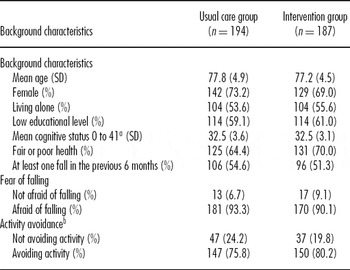
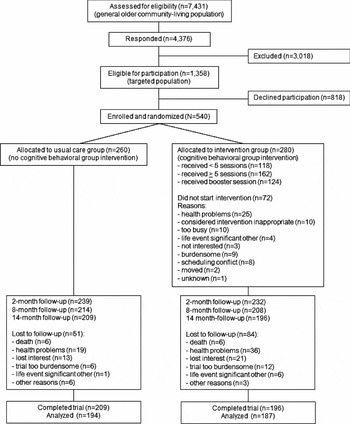
Figure 1 shows the number of people screened for eligibility and the progress of the participants through the trial. A total of 540 persons were included in the study, of which 280 participants were randomly allocated to the intervention group and 260 to the usual care group. The intervention was performed according to protocol (Reference van Haastregt, Zijlstra and van Rossum19). A quarter of the 540 participants (n = 135) withdrew from the study during the complete follow-up period. Reasons for drop-out were similar in both groups. A total of 381 participants had complete data on both cost and clinical outcomes and were available for analysis (194 usual care and 187 intervention group). Table 1 shows that usual care and intervention group were comparable on background characteristics and clinical outcomes as measured at baseline.
Background Characteristics and Clinical Outcomes Measured at Baseline

Note. Values are numbers (percentages) unless stated otherwise.
aThe underlined score indicates the most favorable score.
b“Not afraid of falling” and “not avoiding activity” indicate never or almost never experiencing afraid of falling and avoiding activity, respectively. “Afraid of falling” and “avoiding activity” indicate experiencing at least some fear of falling and at least some avoiding activity, respectively.
Trial profile.

Cost outcomes
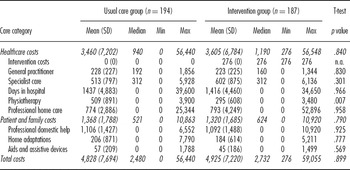
Table 2 shows the mean costs per cost category, for the participants in the intervention and usual care group over the complete follow-up period of 14 months. The costs for the intervention program were €276 per person in the intervention group. The total costs per person (including the intervention costs) were slightly higher in the intervention group (€4,925) compared with the usual care group (€4,828), but this difference was not statistically significant (p = .899). Only one cost category (physiotherapy) showed a significant difference between the intervention and usual care group. This difference was in favor of the intervention group (€295 versus €509; p = .007).
Mean Costs in Euros per Care Category at 14 Months

Clinical Outcomes
At baseline, all participants were afraid of falling and avoiding activity due to fear of falling. At 14 months of follow-up, the percentage of participants who were no longer afraid of falling was higher in the intervention group compared with the usual care group, 23.5 percent (n = 44) versus 14.4 percent (n = 28), respectively. This difference was statistically significant (p = .016). Furthermore, the percentage of participants who were no longer avoiding activity due to fear of falling was also significantly higher in the intervention group compared with the usual care group, 37.4 percent (n = 70) versus 23.2 percent (n = 45), respectively (p = .002).
Base-Case Cost-effectiveness Analysis and Sensitivity Analysis
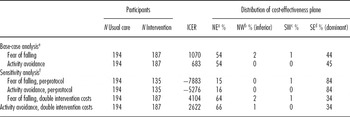
Table 3 shows the ICERs for fear of falling and activity avoidance for the base-case (intention-to-treat) and sensitivity analysis. The base-case analysis for fear of falling revealed that the cost for every additional patient who is no longer afraid of falling is €1,070 (ICER = 4,925–4,828 / 0.235–0.144) and the cost for every additional patient who is no longer avoiding activity due to fear of falling is €683 (ICER = 4,925–4,828 / 0.374–0.232). For fear of falling, 44 percent of the ICERs were in the dominant quadrant, which represents the probability of the intervention having more effects on fear of falling and lower costs compared with usual care (Supplementary Figure 1, which can be viewed online at www.journals.cambridge.org/thc2013091). In addition 54 percent of the ICERs are in the quadrant representing the probability of the intervention having more effect on fear of falling but higher costs. For activity avoidance these percentages were almost similar (Supplementary Figure 2, which can be viewed online at www.journals.cambridge.org/thc2013092). For both clinical outcomes holds that the chance that the intervention is inferior to usual care, is very small (2 percent and 0 percent, respectively). The per-protocol sensitivity analysis that compared the intervention participants who attended at least five sessions of the intervention program (n = 135) with the usual care participants (n = 194), revealed that every cured patient leads to a decrease in direct healthcare costs of €7,883 for fear of falling and €5,276 for activity avoidance due to fear of falling, with a 84 percent chance that the intervention is more cost-effective than usual care (Table 3). The sensitivity analysis with double intervention costs (€552 instead of €276), revealed that every cured patient leads to an increase in direct healthcare costs of €4,104 for fear of falling and €2,622 for activity avoidance due to fear of falling, with a 34 percent chance that the intervention is more cost-effective than usual care (Table 3).
Results of Base-Case and Sensitivity Analysis

a NE, north east quadrant (higher costs, more effects).
b NW, north west quadrant (higher costs, less effects).
c SW, south west quadrant (less costs, less effects).
d SE, south east quadrant (less costs, more effects).
e Base-case analysis means 14 months of follow-up, intention-to-treat, and 1000x bootstrap.
f Sensitivity analysis means 14 months of follow-up, per-protocol and double program costs, and 1000x bootstrap.
DISCUSSION
This cost-effectiveness evaluation showed that a multicomponent nurse-led cognitive behavioral group intervention significantly reduced fear of falling and associated activity avoidance while it only slightly increased costs. One cost category (physiotherapy) showed a significant difference in favor of the intervention group (i.e., lower cost for physiotherapy in the intervention group). This can be explained by the fact that practicing physical exercise during the sessions was an important element of the intervention. In addition participants were encouraged by the facilitators to practice physical exercises at home. Therefore, it is likely that due to these exercises there was less need among intervention participants for physiotherapy.
With regard to fear of falling, there is a 44 percent chance that the intervention is more cost-effective than usual care, and a 54 percent chance that the intervention is more effective than usual care but associated with some additional costs. Almost the same holds for activity avoidance (45 percent and 54 percent, respectively). These favorable results of our base-case analysis were confirmed by the results of the per-protocol analysis, which showed that there is an 84 percent chance that the intervention is more cost-effective than usual care for those persons who attend at least five sessions of the intervention program. Sensitivity analyses revealed that when program costs are doubled, there is still a 34 percent chance that the intervention is more cost-effective than usual care.
Comparing the cost-effectiveness of our multicomponent cognitive behavioral intervention with the cost-effectiveness of other interventions in the domain of fear of falling and activity avoidance is not possible because (to our knowledge) no economical evaluations have been performed in this domain before. Based on the results of this economical evaluation we recommend health policy to accept this intervention for implementation. The base-case analysis indicate that the cost for every additional patient who is no longer afraid of falling is €1,070 and the cost for every additional patient who is no longer avoiding activity due to fear of falling is €683. The average direct healthcare cost of intervention participants were €97 higher (not statistically significant) than the costs of the usual care group.
The present study has some limitations. First, costs were measured, retrospectively, at 2, 8, and 14 months by means of self report. The relatively long period between the measurements may have led to recall bias, which may result less reliable estimations of healthcare usage. However, it is unlikely that this has influenced the results of this study because we presume the recall bias to be comparable in the intervention and usual care groups. Second, in this economical evaluation the singe-item measure “Are you afraid of falling” was used to assess fear of falling. In the trial in which this economical evaluation was embedded, we also measured concerns about falling by means of the Falls Efficacy Scale (Reference Zijlstra, van Haastregt and Ambergen13;Reference Zijlstra, van Haastregt and van Eijk16). However, due to the fact that no cutoff point for this scale is available yet for the presence or absence of fear of falling, we considered this measure not suitable for this economical evaluation. Moreover, in their recent review of the measurement of fall-related psychological constructs, Moore and Ellis indicated that single-item measures of fear of falling are useful in research studies where participants are categorized into “afraid of falling” and “not afraid of falling” groups (Reference Moore and Ellis25), which is the case in our study. However, as a limitation of single-item measures Moore and Ellis argue that because fear of falling is considered a multidimensional construct, operationalizing it in terms of a single item can underestimate the incidence of fear of falling (Reference Moore and Ellis25). The same may account for avoidance of activity. Third, the timeframe of the study is 14 months. Therefore, it remains unclear whether the favorable results of the intervention also remain on the long-term. However, we have no reason to expect that persons in the intervention group will show higher costs on the long-term, compared with persons in the control group. Fourth, we did not include quality of life in this cost-effectiveness study and were therefore not able to calculate quality-adjusted life-years (QALYs). The reason for not including quality of life as a primary outcome is that we expect the effects of this intervention on quality of life to be only measurable on the longer-term and not within our 14 months of follow-up. However, there are strong indications that older people who are afraid of falling and consequently avoid activities enter a debilitating spiral of loss of confidence, restriction of physical activities and social participation, physical frailty, falls, and loss of independence, which may influence their quality of life on the long-term if not treated properly (Reference Zijlstra, van Haastregt and Ambergen13;Reference Delbaere, Crombez and Vanderstraeten17;Reference Deshpande, Metter and Lauretani18).
Lastly, the results of our per-protocol analysis (comparing intervention participants who attended at least five sessions with the usual care participants) should be interpreted with care, because the advantages of randomization might no longer apply due to selection bias.
Based on the results of this trial, several recommendations can be made. The per-protocol analyses indicate that the cost-effectiveness of the intervention is considerably higher for those persons who attended at least five sessions. Although part of this gain in cost-effectiveness may be explained by selection bias, it also indicates that the efficiency of the intervention may be increased by increasing the attendance rate. Therefore, we recommend assessing whether it is possible to improve the intake procedure of the program. Furthermore, we recommend assessing the possibilities of optimizing the attendance by further tailoring of the intervention to the capacities and skills of the target population (Reference van Haastregt, Zijlstra and van Rossum19). Lastly, we recommend future researchers to use a longer follow-up period to assess the long-term effects of this intervention (2 to 3 years), and to also include quality of life as a primary outcome in the cost-effectiveness study.
To conclude, this study showed that the multicomponent nurse-led cognitive behavioral group intervention is preferable to usual care in terms of costs and effects. The program had comparable costs and significantly reduced fear of falling and associated activity avoidance among older community-living persons. Therefore, we recommend to implement this program with some minor adjustments in regular healthcare in the Netherlands.
SUPPLEMENTARY MATERIAL
Supplementary Figure 1: www.journals.cambridge.org/thc2013091
Supplementary Figure 2: www.journals.cambridge.org/thc2013092
CONTACT INFORMATION
Jolanda C. M. van Haastregt, PhD, Assistant professor, Maastricht University, Maastricht, the Netherlands
G.A. Rixt Zijlstra, PhD, Assistant professor, Maastricht University, Maastricht, the Netherlands
Marike R. C. Hendriks, PhD, Assistant professor, Maastricht University, Maastricht, the Netherlands
Mariëlle E.J.B. Goossens, PhD, Associate professor, Maastricht University, Maastricht, the Netherlands
Jacques Th.M. van Eijk, PhD, Professor of Medical Sociology, Maastricht University, Maastricht, the Netherlands
Gertrudis I.J.M. Kempen, PhD, Professor of Social Gerontology, Maastricht University, Maastricht, the Netherlands
CONFLICTS OF INTEREST
All authors report a grant to their institution from ZonMw (The Netherlands Organization for Health Research and Development, grant 014-91-052).