Ireland’s literary history in the English language has been subject to much discussion. The majority of the focus has remained on the emergence of modern literature in English (poetry, prose, and drama) in the nineteenth and twentieth centuries pioneered by world-renowned Irish writers such as W. B. Yeats, James Joyce, Samuel Beckett, and others. Ireland’s medieval literary world heritage is less well known. We are left holding fragments of a literary corpus which paint an incomplete yet intriguing picture. With a few exceptions, individual celebrity is not the hallmark of medieval literature, and the majority of those involved in producing medieval literature are anonymous.
This chapter will outline the extant evidence for English-language literature in medieval Ireland. It will provide an overview of some of the themes and topics which are found in the material and offer a guide to some of the major categories of surviving work. The chapter’s focus includes vernacular historical material, religious writing, and practical writing. Particular attention is paid to relatively unknown evidence for medical material, including charms, and the presence of complexional and gynaecological texts. The latter part of the chapter deals with drama and evidence for the genre of romance as well as connections between written English- and Irish-language material. The chapter concludes with comments on cultural engagement and the bilingual environment of medieval Ireland.
Surviving Literature
The shower of gunpowder, masonry, and fragments of paper and parchment that rained down on Dublin’s streets after the bombardment of the Four Courts in 1922 destroyed much of the extensive administrative material produced by the medieval chancery of English Ireland at Dublin, which came to be housed in the Public Record Office. The majority of this medieval material was enrolled in Latin, but some of the entries were written in English (although this administrative material is not the direct focus of this book, its existence is an important context). Some of the medieval administrative material can be recovered through duplicate copies filed in archives in London and through material found elsewhere.1 Some of the other non-administrative medieval material which was lost in 1922 is also recoverable: the most memorable is perhaps an 1891 transcription by James Mills, deputy keeper of the Public Records of Ireland, of the Pride of Life, which saved that play from destruction. Preserved in the Public Records Office through a late fourteenth-century transcript written on the reverse side of an account roll (30 June 1343 to 5 January 1344) from the Priory of the Holy Trinity in Dublin, now Christ Church Cathedral, Mills’ transcription and his photographic facsimile of the roll are all that remain today. The drama is an allegory of human failings in which the main character, the king of Life, Rex Vivus, mistakenly trusts the flattery of his knights Strength and Health, and dismisses the caution urged by the bishop and the queen, so that he challenges Death to mortal combat, which the king is doomed to lose. An important survival, considered to be one of the earliest extant morality plays anywhere, it offers unique evidence for dramatic production in late medieval Ireland and the Anglophone world.2
Much of the existing medieval writing was passed through families and bibliophiles or gifted, bought, and sold by individuals or institutions for whom this old material still held value. General dangers of fire and accidental destruction in the Middle Ages and the Reformation in the sixteenth century ushered in a new assault on the literary archive. The latter was particularly destructive for records held in monastic houses, which, if they were not destroyed, frequently found their way into personal collections where their survival depended on generations of continued interest and protection.3 If medieval books could survive fires, rats, and intentional destruction, they also had to navigate changing appetites. There is evidence of suppression in the sixteenth century of Middle English works in Ireland. Consult the chronicles of England if you wish to learn more about Archbishop Thomas Becket, Richard Robinson suggests in his 1575 handwritten copy of the Conquest of Ireland (the Middle Hiberno English translation of Giraldus Cambrensis’ Expugnatio Hibernica), NLI MS 1416, when he encounters a lengthy passage relating to King Henry II’s infamous episode with the archbishop, now unpalatable to Protestant readers in post-Reformation Dublin.4 The extended celebratory passage on Becket, which is suppressed in the sixteenth-century copy of the Conquest, is the only substantial addition to the late medieval copies of the translation of the original Expugnatio, but the cult of Becket, murdered by knights of King Henry II in 1170, had the potential to be politicised as evidence of the medieval crown’s overreach in church matters, which was made more significant after the break with Rome. The copyist removes this material, not because it is non-canonical but because it does not chime with their Protestant religious world view. A marginal note offers no doubt as to their sentiments – ‘pope a usurper’ – and fits with the Latin note on the penultimate folio of the booklet describing the contemporary monarch at the time the copy was made, Queen Elizabeth I (1533–1603), as the supreme head of the church and ruler by God over land in England, France, and Ireland: ‘Elizabeta Dei Gratia / Angliae, / Francia, & / Hybernia, / Nunc Sereniff Regina’ (Elizabeth, by the grace of God Queen of England, France, and Ireland, now serene Queen).5 This dedication is displayed decoratively on the page and suggests that in 1575 this old medieval English-language copy of the even older Expugnatio remained a valuable source for those seeking to justify English rule in Ireland.
The interests of Protestant intellectuals may also have helped preserve some volumes. For instance, James Ussher (1581–1656), who became Archbishop of Armagh, amassed a large collection of medieval books, which preserved them for consultation, for instance, by his mentee at Trinity College Dublin, Sir James Ware (1594–1666), who mined medieval sources for inclusion in his writings on Irish history.6 Many of the medieval volumes containing MHE are found in the collection of the antiquarian Sir George Carew (1555–1629), bequeathed to his illegitimate son, Sir Thomas Stafford, and many volumes were eventually distributed among the libraries of Lambeth Palace, Trinity College Dublin, and the Bodleian at Oxford.7
Not all literature could be adapted as easily to suit different perspectives, and many volumes fell by the wayside, either through changing fashions or practical security. A suspicion fell on old books which supported the pope, and this anti-medieval sentiment (which morphed into anti-Catholic sentiment) condemned many volumes. Perhaps the most well-documented loss of books in early modern Ireland is the dispersal of the library of the Fitzgerald earls of Kildare after their possessions were seized by the crown in 1535, but religious conflict during the Reformation and the confederate wars in Ireland (1641–53) likely led to small-scale destruction of many books and collections which has left little trace. Even among books which were not destroyed, certain portions could become obsolete or inappropriate, as can be evidenced from the deliberate but rather neat – probably medieval – obscuring of a text in BL Harley MS 3724, a fourteenth-century book produced in Anglophone Ireland which contains Latin and English historical and religious items.8
In the seventeenth century, the Middle Ages were often regarded with suspicion, frequently categorised as a Catholic wasteland of superstition and excess. This depressed view of the period persisted in modern scholarship, when the fifteenth century was frequently considered to have degenerated into an age of stilted imagination and innovation, representing an uneasy frontier between the medieval and early modern periods.9 All of this hindered the preservation of old books. Not all of these books, however, were deemed useless. The anti-clerical reflex of much late medieval writing – particularly in English – could be embraced as evidence not just of a reforming ethos of earlier days but as a proto-Protestant sensibility, which excused much of that writing from the charges of popery. This might explain the high survival rate of religious and satirical literature, frequently with a moral bent, in contrast to other genres. Moreover, sustained interest in the early modern period in some romances which had a religious theme might have been on account of reader focus on the actions of the protagonists as individuals rather than as agents of the Catholic church.10
Traditionally, the medieval English literature of Ireland has been described as displaying a primarily anti-clerical and anti-authoritarian character.11 While this character is certainly evident, it should not be considered the primary focus of literature of Anglophone Ireland. The bulk of the surviving archive of medieval English-language material in Ireland falls into two broad divisions: religious and historical. A third overlapping area would be that of practical material – obviously this includes the administrative records of medieval Ireland and to some extent histories, but it also includes medieval advice manuals in English dealing with both the spiritual and physical spheres.
Religious and Medical Material
One example of a book with religious and medical material is TCD MS 158, a mostly English-language manuscript (with entries in Latin and French) held at the end of the fifteenth century in county Meath. The first part of the manuscript consists of the Prick of Conscience (ff.1r–81r); the second half, on paper, includes, among other items, a Latin inventory of moveable property of Rogerus Jekyn (f.82r); a Latin praise verse: ‘O Domine Richarde vir magne virtutis / Tu dulcis in sermon tu honore rectus …’ (O Master Richard, man of great virtue, you are sweet in speech, you are upright with honour); quite a lot of medical material in English; and accounts.12 The medical portion begins with recipes (ff.83r–86r) and opens with the description,
hic incipient medicine – Here be-gynnyth medicines þat gode leches hathe founden & drawen oute of bokes of Galyon, Clipius & ypotras þat were þe best leches þat euer were leuyng on erth. & þer medicynes ar prouede.13
It includes a selection of recipes (ff.83r–86r) extracted from a longer medical work found in multiple manuscripts, including treatment for fever, jaundice, and mouth hygiene, and against poison; and there is also a long recipe for treating a head wound (ff.86v–87v).14 The dialect has been judged to be a northeast dialect of England, and it is likely that the manuscript was imported to Ireland.15 Michael Benskin has noted eleven variants, outside of Ireland, of one of the works in English which offers advice on treating a head wound, showing that this recipe was copied from pre-existing knowledge and indicating a shared medical literature with Britain.16
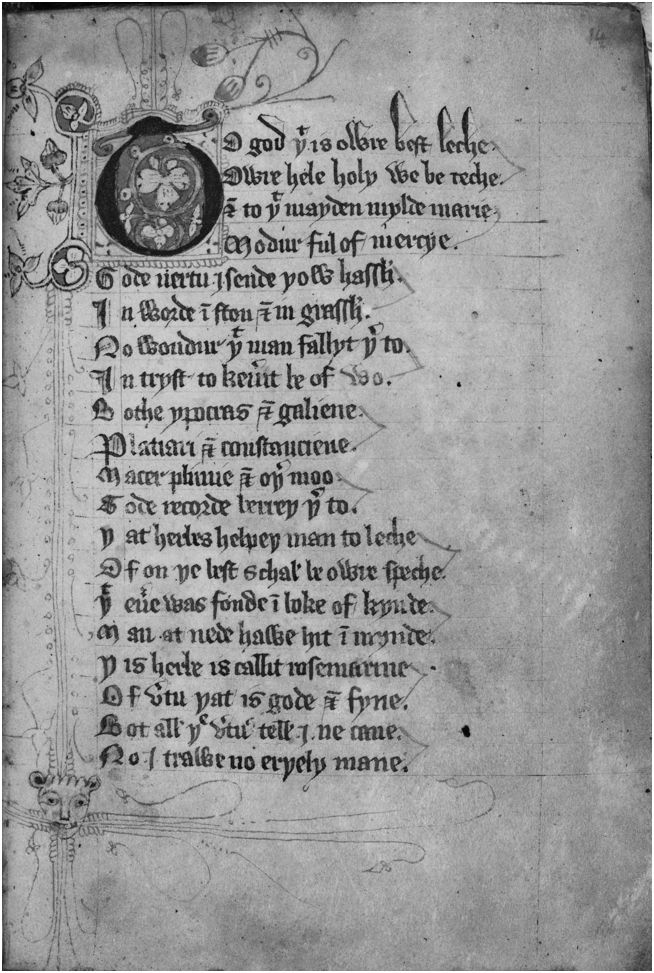
The evidence from Wellcome Collection, Wellcome Historical Medical MS 406 (Figure 2), suggests that the core fourteenth-century portion of this neat vellum book (made up of three English-language medical texts in rhyme in the dialect of Ireland) had paper leaves with further medical material added in the sixteenth century, when it appears to have still functioned as a medical reference book. These medieval medical texts were imbued with religious links, which may have further helped secure their survival.17 Scholarship tends to conflate the latter two poems partly on account of the temporary disappearance of the manuscript into private ownership and partly because of a lost quire, which obscures the end of one poem, On the Virtue of Rosemary/On the Virtue of Herbs, and the start of the third, Mayster Jon Gardener’s The Feate of Gardening. Part one of the manuscript (until folio 22), in vellum, dates from the fifteenth century and was probably composed in Ireland, with the remaining paper folios sixteenth-century additions.18 In part two, following a blank folio (ff.24v–25r), a list of herbs finishes with a colophon – ‘Finis quod Smertwaytt tenet palmer [?] londini’ – which might suggest a connection to London. The latter part of the manuscript (which may not be connected to Ireland) includes a copy of the sixteenth-century verse Antidotarie of Helthe (c.1575) and recipes in sixteenth- and seventeenth-century hands.
Decorated opening folio of MHE poem On the Virtues of Herbs. Wellcome Historical Medical MS 406, f.14r. London, Wellcome Collection.
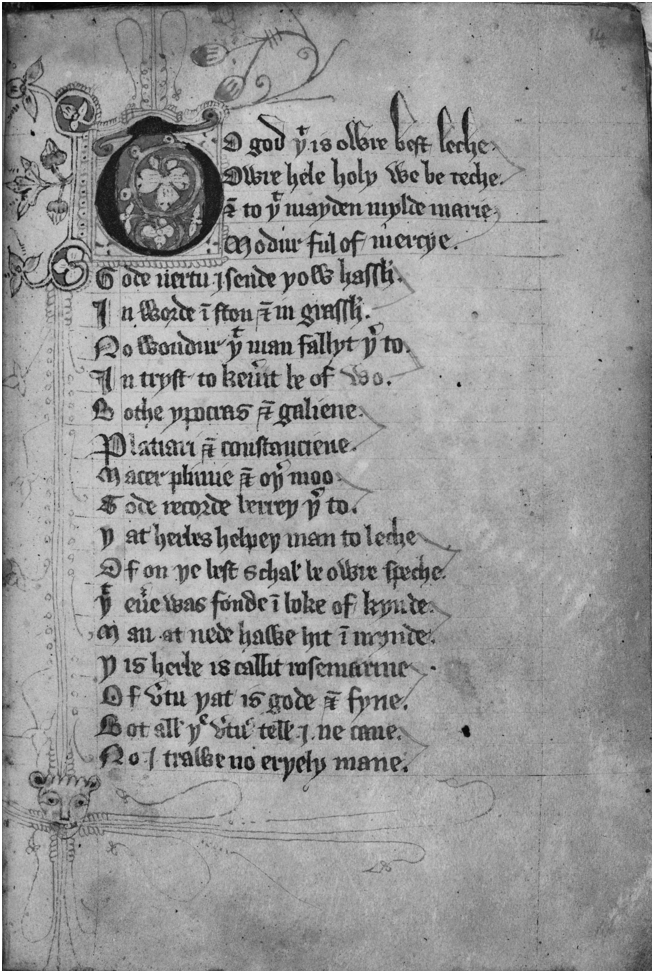
Figure 2 Long description
The text features a prominent illuminated initial T decorated with floral motifs. The first letter of the first word of each line is slightly enlarged and decorated. Transcription begins (after Wright and Halliwell; contractions are expanded):
To God that is owre best leche
Owre hele holy we be-teche
And to that mayden mylde Marie
Modur ful of mercye
Gode vertu I sende yow hasshe,
In worde, in ston, and in grasshe
No wondur that man fallyt therto.
In tryst to keverit be of wo.
Bothe Ypocras and Galiene,
Platiari and Constanciene,
Macer, Plimie, and other moo,
Gode recorde berreth therto,
That herbes helpeth man to leche
Of on the best schale be owre speche
That euere was fonde in boke of kynde
Man at nede hawe hit in mynde.
This herbe is callit rosemarine,
Of vertu that is gode and fyne.
Bot all the vertues telle I ne cane,
No I trawe no erthely mane.
‘Hand B’ is responsible for writing much of the first part of the manuscript, and, given that the English texts have been identified as MHE, it seems plausible to presume that the Latin material was also written in Ireland.19 This includes the ninety-line medical poem Ars Phlebotomandi (ff.1v–3v) in couplets on blood-letting in the English dialect of Ireland.20 This is followed by medical recipes and charms in Latin and English (ff.4v–7r); medical recipes (ff.8r–13v); and two poems in English: On the Virtue of Herbs (ff.14r–16v) and the aforementioned Mayster Jon Gardener’s The Feate of Gardening (ff.17r–20v).21 It is possible that the entries on f.7v and f.13v were also written in Ireland. Parallels for these poem types are found in Britain, but the final poem reflects a local flavour: ‘All of the herbys o Ierlonde / Here thou schall ham know everi onde.’22 As Arne Zettersten, building on the work of P. J. Irwin, understands the transmission, ‘the English tradition probably represents the original, while the Anglo-Irish tradition appears to represent an adaptation for horticultural purposes, with special reference to Ireland’.23
As well as the poems, the manuscript contains recipes and charms, the latter in use long past the Middle Ages by healers within a community or family. After the first poem, a self-contained leechbook of charms and medicinal recipes presents a number of English-language charms offering verbal formulae to treat illnesses.24 Charms to staunch bleeding include a version of the popular ‘Longeus charm’ (second version) and a short Flum Jordan charm (second type).25 The latter is a type of charm which evokes an apocryphal miracle that happened when Jesus was baptised in the Jordan and the river stopped flowing.26 Just as the river stopped flowing when Jesus entered the water, so it was hoped that the blood would stop flowing once the charm was recited:
Charms are often copied in margins or blank spaces, but here they do seem to be incorporated into the manuscript, forming a leechbook.28 In this manuscript, the charms link to the rest of the medical sections of the manuscript by theme and by decoration. Research on charms in Ireland is ongoing, and evidence from charms in Latin and Irish has led Ilona Tuomi to suggest that some Latin charms arrived in Ireland via England.29 The recent work of Deborah Hayden on medical material from Gaelic Ireland suggests a strong connection and borrowing, including via Old English, between Ireland and England.30 The English and Latin charms in this manuscript of the English community in Ireland demonstrate that links between audiences in Ireland and medical texts from Britain were active in late medieval Anglophone Ireland.31
Another manuscript which contains charms is BL Royal MS 12 B. xxv, a sizable fourteenth-century volume of 284 folios of vellum and paper. Mostly in Latin, the book has some MHE, with contents dominated by material related to health, science, and medicine.32 A number of entries link the manuscript to medieval Ireland. The clearest connection is in fifteenth-century receipts on the final folio related to Kilmainham, county Dublin, ‘Allocacio redditus de Kylmaynan’ (the allocation of income from Kilmainham).33 Notes of agricultural expenses alongside a recipe for making ink point to the practical nature of some of the contents.34 It is possible that the manuscript may be connected to the Knights Hospitallers of St John of Jerusalem, who had a foundation in Kilmainham.35 Another fifteenth-century addition nearby on ff.278v–281v, a tract on simples (simple recipes, often medical in nature), is the only substantial MHE text in the manuscript and may be contemporaneous.36 The Linguistic Atlas suggests this dialect may be from Dublin, beginning, ‘Isop is hote and dry in two degrees’ and ending ‘as he cometh uppon þe day þus saith Gallyen, &c.’37
The volume’s prayers and charms in Latin, English, and French are found throughout the manuscript and generally focus on human ailments.38 Of particular interest to those seeking Irish connections are three charms which aim to extinguish lust under the heading: ‘hii sunt extinccionis libidinis’ (These are for the extinction of lust), directing each charm to a saint with powers over fire, either physical or symbolic.39 The first charm calls on Saint Lawrence’s aid: ‘O bone Laurenti martir venerande per orbem Renibus in nostris extingue libidinis ignem’ (O good Laurence, martyr venerated throughout the world, extinguish in our kidneys the fire of lust).40 The second charm invokes Irish saint Columcille (prayed to for childbirth) to protect women from the dangers of what Olsan describes as ‘unnamed injuries associated with lust’: ‘Sancte Columquille prohibe mala dampna famelle. Atque Columquillus prohibit mala dampna famelle’ (St Columcille, prevent the bad losses to the woman. And Columcille prevents the bad losses to the woman).41 St Agatha (patron of nurses and illnesses of the breast) is called on to protect against the fires of lust, and the charm alludes to details in the saint’s life when she resisted her forced marriage and other attempts to destroy her virtue.42 Certainly, the charm to Columcille (Columba), one of the three patron saints of Ireland, has an Irish dimension. Although it is more likely that the Laurence appealed to here is the Roman martyr Lawrence (roasted to death and thus a suitable saint to appeal to for dealing with igniting fires), the name also had local resonances: St Laurence O’Toole, former abbot of Glendalough and archbishop of Dublin in the twelfth century, was the patron saint of Dublin and had a strong cult associated with Christ Church Cathedral in Dublin. These charms clearly have a medical aspect, which is in keeping with the rest of the manuscript, but it also seems as if there may be a focus on female protection from lust or its potential conclusion in childbirth itself, not simply a generic rejection of the sin.
The manuscript contains mostly medical material and deals with bodily humours, herbs, medicinal recipes, extracts from medical treatises, wines, astrology, and how to make fireworks – a collection which seems of practical value for a medical practitioner or healer in a clerical context. While it is not clear if all of this manuscript was written in or circulated in medieval Ireland, at least part of it is connected to Ireland and Dublin, and so it is plausible to suggest that some of the texts were circulating and likely written in medieval Ireland, and it may be associated with the Hospitallers. The manuscript, once in the library of John Lord Lumley, also contains a reference to Ser Wyllam Orcharde and to individuals who may have penned certain sections: Wyllyam Armare and Wyllyam Collyng.43 Some of the charms noted above have a likely Ireland connection; another Latin Flum Jordan charm to staunch bleeding found earlier in the manuscript is also found in the Wellcome Historical Medical MS 406, which can be localised to Ireland, although, given the popularity of this charm, this is unsurprising.44
Another fourteenth-century manuscript localised to Ireland with medical material is BL Sloane MS 2135. A multilingual (Latin, English, French, and some German and Italian) paper manuscript, it contains Alchemica recipes in English identified as MHE.45 The manuscript contains entries from the fourteenth to the seventeenth century and is composed mostly of early chemistry as well as the work of the legendary Hermes Trismegistus, Secreta Alchemica (ff.12r–17r) and Albertus Magnus, Semita Recta (ff.20r–21r).46 Other medical material in English survives not because it was necessarily still useful beyond the Middle Ages but because it was incorporated into a manuscript containing other material, which was itself considered useful or important. Lambeth Palace MS 523 is a religious book likely first written for a preacher and acquired by a medieval priest based at Dublin’s oldest parish, St Michans, which was established on the left bank of the River Liffey in the medieval suburb of Oxmantown.47 Among its Latin and English entries (the latter in the dialect of Ireland), this book records medieval English-language tracts on childbirth, medieval physiology, and commentary on spiritual weakness.48
The bulk of this book comprises two Latin preaching source-texts popular in England but rarely identified in Ireland: De Oculo Morali (The Moral Treatise on the Eye), written by Pierre de Limoges in Paris (c.1274–89), which used optical science to inform pastoral care and supplied exemplars to create memorable and instructive sermons,49 and De Veneno, generally called De Venenis (The Poison), attributed to Friar Malachy of Ireland (fl.1279–1300).50 The Dublin manuscript is one of only three out of the current tally of 115 copies of the text (after Richard Sharpe) which presents an accurate attribution for its authorship to Malachy for De Venenis in what looks like the scribal hand.51 It has been suggested that Malachy was a Franciscan friar from Limerick elected archbishop of Tuam in 1280, but this is difficult to confirm.52 De Venenis is a treatise on the seven deadly sins, ‘for the instruction of simple men who have to teach the people’.53
The manuscript also includes some of the authentic Latin sermons and treatises of Robert Grosseteste and an abbreviated copy of his confessional tract Confessio II/Deus est with obvious practical value.54 Judging by the multiple additions and notes across this manuscript, the book was in use in Dublin in a pastoral context at least until the sixteenth century (its non-dialectal localisation is confirmed by the name of a Dublin priest in part two and entries related to Ireland in part one).
The practical nature of the care required by this community is demonstrated by the third entry in English in this volume, inserted between Malachy’s work and Grosseteste’s sermons in the second part of the manuscript. With an obviously functional purpose, it describes how ‘fort deliuer a dede child’55 and explains that ‘Saneyne [the medicinal plant Juniperus sabina, which is poisonous if ingested] droken oft wyt wynde wol deluyer a woman of dede childe.’56 The remainder of the folio contains medical recipes in the same hand in Latin and English, often without a break: ‘Lekes eten wyt wyne or drunken wol make an harde wombe seþe þe whyte of lekes in wyne and after þe first boylyng …’.57
Another English-language entry appears in a spidery fifteenth-century hand on a number of inserted folios – manuscript scraps of varying lengths, the latter only a half-leaf – presenting a short dense prose treatise on spiritual affliction, Trials of Tribulation/The Six Masters/The Six Masters on Tribulation.58 This treatise was generally (wrongly) attributed to the English mystic Richard Rolle of Hampole (c.1300–49). It presents a discussion between six doctors of divinity debating the importance of embracing spiritual affliction.59 One of the values (as the fifth master explains) is that it helps an individual come to self-knowledge and purge their life of imperfection: ‘for tribulacyoun quenchiþ synne and lernþ a man to knowe hym-silf and his euen-cristyn. And tribulacyoun vertues in man.’60 Although the treatise as it appears here remains quite close to the general text of this work, the English text is inserted on scrap parchment without the common paring of a Latin or a companion Middle English work on a similar theme.
The Trials of Tribulation also contains a verse on the four complexions.61 Complexional theory was based on Aristotle’s concept of balance in the body, which was further developed by Galen (AD 120–c.216), and sought to understand human nature by tracing the relationship between body and soul to offer a guide to what individuals were most susceptible to, depending on their nature. The phlegmatic individual had a propensity to gluttony and sloth; the sanguine to lechery; the choleric individual tended towards wrath; the melancholy towards envy. Added to a blank folio by a fifteenth-century hand, it offers a summary perhaps with a mnemonic function. For instance,
In a pastoral context, these descriptions might have been incorporated, with appropriate moralising comments, in vernacular sermons to an assembled audience.
These types of books must have been ubiquitous across medieval English Ireland and elsewhere in English-speaking communities. This multi-lingual, multi-authored manuscript – of practitioners rather than writers – offers us a rare glimpse of not just a functional preaching book from medieval Ireland but also one which was growing and developing according to its readers’ own requirements. This book serves as a repository of pastoral and historical material, some of which has local allusions – we can add the story of the crowning of an English king in Dublin (discussed below) and the addition of an excerpt from the short chapter 69 from Jocelin of Furness’s twelfth-century Vita S. Patricii, recalling the Christianisation of Norse Dublin by St Patrick.62 This pastoral handbook contains traditional pastoral material as well as entries on medical matters and natural science. In this way it served as a multi-functional handbook, catering for spiritual and practical needs of communities in medieval Ireland.
Historical Material
Historical literature in English is perhaps the only surviving genre, from Ireland specifically, but also in Middle English more generally, which rivals religious material in volume. These works could serve propagandistic functions, which made them appropriate and acceptable in later times. Histories of the English community in Ireland could serve as easy-access unifiers for Englishmen seeking to represent links between Ireland and the crown. Positive representations of the sovereign – as with the adapted depiction of King Henry II in the Conquest, the late medieval English translation of Giraldus’ Expugnatio Hibernica – indicate an appropriate respect and nod to sovereign power.63 Occasionally, however, books from English Ireland are not necessarily supportive of the crown. The scribe who wrote the English complexional verses in the aforementioned Lambeth Palace Library, MS 523, also wrote a short Latin entry noting the coronation of the pretender to the throne Lamberth Simnel (c.1475–1535) as King Edward VI in the cathedral prior of Holy Trinity, Dublin (now Christ Church Cathedral) in 1487.64 The claimant generated considerable support from the English in Ireland, presumably by those seeking to exploit a political opportunity to put Ireland firmly on the royal agenda. The short descriptive note may be explained by its local event of some significance.65 Given the defeat of the short-lived pretender ‘King Edward VI’, this note is likely to be relatively contemporary. The date of the coronation is debated (and the catalogue erroneously refers to the unnamed pretender as Perkin Warbeck, another medieval pretender but one associated with Cork). Traditionally considered to have taken place on Whitsunday, the dates generally suggested are Thursday, 3 June 1487 (the annals), and Thursday, 24 May (attainder against conspirators). The date offered in the Lambeth manuscript – Sunday, 27 May – supports that suggested by Randolph Jones, who was guided by an entry in the lost Red Book of the Exchequer, suggesting the coronation took place (more appropriately) on a Sunday, 27 May.66
The archbishop’s palace library at Lambeth contains a number of further items from medieval Ireland. Perhaps the most important volume from an Irish perspective is that of the only surviving copy of the Hiberno-French Geste des Engleis en Yrlande (Song of Dermot and the Earl), which, together with the work of Giraldus, is one of two almost contemporary accounts of the English invasion of Ireland begun in the 1160s and composed from the perspective of the invaders.67 The surviving copy of the Song, Lambeth Palace, Carew MS 596, emanating from the extensive library of the soldier, administrator, and antiquarian Sir George Carew (1555–1629), earl of Totnes, betrays little of its medieval or later owners’ interests. It has few annotations on the text or in its wide margins and relatively little evidence of its medieval circulation or impact.68 The likely oral origins of this type of work should remind us that much early engagement with literary compositions may not have been committed to paper, and much of this will thus elude modern textual scholars seeking evidence for such works and their reception. The fact that this old poem, in Hiberno-French, was copied in the fourteenth century points to the continuing interest in such histories, which served as foundational narratives of the English community in Ireland.
Similarly, copies of other histories of medieval Ireland in the fourteenth century, in Latin and a little later in English, remind us that such works (based on Giraldus and various Irish annals) were important to Anglophone readers in the later Middle Ages and beyond. Early modern historians found a use for these earlier histories even when they rejected their conclusions. When transcribing medieval histories in the sixteenth century, historians or scribes could challenge their sources and yet rely heavily on them. Richard Robinson’s ‘tweaking’ of the Conquest text (a late medieval translation of Giraldus’ Expugnatio Hibernica) has been noted above, but, in comparison with the objections of Christopher St Lawrence, seventh baron of Howth (d.1589), and his subsequent alteration of that same source, Robinson’s alterations seem minor. St Lawrence’s reworking of the Conquest in the 1560s–70s in his encyclopaedic Book of Howth (Lambeth Palace Library, Carew MS 623) is a masterful example of historical rewriting at a particular moment of political and social upheaval when the so-called ‘Old English’ (long established in Ireland) and ‘New English’ (recently arrived in Ireland) clashed in the Tudor world.69
Three of the manuscripts once owned by Carew described above contain works on the history of medieval Ireland: the Geste des Engleis en Yrlande is the sole work in Lambeth Palace Library, Carew MS 596. Lambeth Palace Library, Carew MS 598, presents a full copy (arguably the best extant version of this work) of the late medieval English-language Conquest affixed to a nicely executed late medieval copy (with spaces left for illustration which was not completed) of the metrical poem in French written by Jean Creton (fl.1386–1420) after his 1399 visit to Ireland. That these illustrations were not completed is not unusual, and only one of the surviving copies of Creton’s work is illustrated, BL Harley MS 1319, although others were prepared for illustration. In the Lambeth Palace manuscript, the work is entitled Deposicio Regis Richardi Secundi, and it is followed by later paper folios with illustrations of the coats-of-arms of leading families of Ireland.70 It is likely that all of these texts circulated separately before being combined into the one book, making it difficult to unpick the transmission history of this volume. A third manuscript, Bodleian Library, Laud Misc. MS 526, contains a short copy of the Conquest affixed to Latin annals of Ireland.71 Other manuscripts relating to Irish history are found among his collection, for instance, a Latin Expugnatio Hibernica in Lambeth Palace Library, Carew MS 622. Carew and other New English planters had a practical use for old histories of Ireland, and these contemporary uses often challenged and changed the received narrative of the past – imbuing in them a continued function and thus longevity which was hard to match.
Much of the surviving medieval material found its way into private hands and collections which were eventually deposited in archives in Ireland (such as Trinity College Dublin and the National Library of Ireland) or in Britain (primarily the British Museum – later the British Library – Lambeth Palace Library, and the Bodleian library at Oxford, as well as a few others which hold one or two relevant manuscripts or books). The personal and frequently historical interests of various antiquarians may have helped preserve much of the historical material from Ireland – in English, but also in Latin, Irish, and French – which survives in various collections.
Drama, Romance, and Translation
Drama, mentioned at the outset of the discussion on surviving material, combined religious and community entertainment, and it has been argued that this helped connect the English community in Ireland to Britain. Indeed, the presence of a number of dramatic works which survive from medieval Ireland such as the Pride of Life, the earliest extant morality play in English, found among the deeds of the cathedral priory of Holy Trinity, Dublin (now Christ Church Cathedral), illustrates cultural parity with England.72 Dolan’s suggestion that the references to English towns in the works were ‘comforting references to the homeland for an Anglo-Irish audience’ would seem to be overstating the case, but they could provide them with a sense of connection with England and a shared sense of English identity and heritage.73 It appears that there is a distinction between the dramatic entertainment enjoyed by the ‘expatriate community’ (to use Dolan’s phrase, in the manner of ‘the homeland’) as opposed to the cultural habits of the Irish, ‘who seemed not to have much interest in drama.’74 As a participatory performance, drama provided an opportunity for the English colony to unite as a community to engage in a unique ‘English’ form of entertainment, communicated in a shared ‘English’ language. Of course, medieval drama was frequently connected to the church and often used Latin. Alan Fletcher has traced legal frameworks in medieval Dublin which supported and regulated this type of entertainment, hinting at the presence of a vibrant cultural sphere not adequately reflected in the surviving textual material.75
The value of various how-to books may have waned over time, but their continued importance as repositories of knowledge is understandable and (notwithstanding the variety of unpleasant fates which may have befallen the more unlucky volumes) likely to have contributed to the preservation of the books which survive today. What is less preserved are the more secular forms of culture, the less exalted modes of entertainment which must have resonated with the populace in English Ireland. Much of this is likely to have been oral and not committed to parchment or paper. What does remain is frequently linked to religious material and has likely survived by hanging onto the coattails of its more serious companions. Such a weight towards religious over secular literature is mirrored in Britain. In this context, BL Harley MS 913, perhaps the most famous of Ireland’s medieval manuscripts to contain early English-language material, does not seem so unusual. It has been compared to BL Harley MS 2253 from the Welsh marches, which contains similar types of texts and has evidence in the flyleaves of the Mortimer household accounts during an eleven-day trip to Ardmulchan, county Meath.76 What makes Harley MS 913 the treasure-trove of English writing in Ireland, however, is the range and volume of the material it contains, which is unparalleled in Ireland (The Land of Cokaygne and Satire are discussed at length in Chapters 3 and 5, respectively).77
The treasures of Harley MS 913 notwithstanding, what is surprising is the lack of Middle English romance narratives – medieval fiction, the escapist (but also moralistic) heroic stories of heroes, knights, and ladies in an age of chivalry. Instead, in the surviving material from Ireland, we are arrested by an immediate practicality, a functionality – it conjures for us a literary landscape which, on occasion, deals with local places and historical people rather than heroes in far-off lands. Nonetheless, in the surviving material, we encounter the vulgar bawdiness of the tavern, the vices of the monastic world, the search for spirituality in a debased reality. This is a world readily recognised from Geoffrey Chaucer’s The Canterbury Tales (c.1387) – ‘our English Homer’, as Roger Ascham (1515–68), one-time tutor to Queen Elizabeth I, characterised him – as he speaks of heroes and real people with their wealth of fanciful stories.78 The Canterbury Tales themselves are absent in records from Ireland, with the exception of perhaps the least representative, the moralising The Parson’s Tale, surviving in a late fifteenth-century manuscript compilation connected to Dublin: Bodleian Library, e. Musaeo MS 232 (also see Chapter 4). The wider extant corpus connected to Ireland is not without heroic figures, but frequently protagonists are drawn from the near contemporary world – the English adventurers of the twelfth-century are archetypal knights in an English milieu; Piers de Bermingham (d.1308) is a conflicted figure in the tussle between the English and Gaelic worlds in the MHE poem of the same name in Harley MS 913. The latter participates in communal English–Gaelic socialising before slaughtering his Irish guests and on other days hunting Irishmen like hares.
This focus on the material world is counterbalanced by the instructive values inherent in many of these and other works of literature: handbooks on how to survive illness and injury, avoid moral sickness, and navigate the realities of frontier living in English Ireland. The suspicion then must be not that these more practical works were all that was produced in English Ireland but that these were the texts which endured. Evidence of translation into Irish in the late medieval period hints at lost material.79 Five extant romances which were translated into Irish survive from the fifteenth century, while three translated romances survive in seventeenth-century copies.80 Four of the surviving romances in Irish – on Bevis of Hampton, Guy of Warwick, Fierabras, and Recuyelle of the Historyes of Troye – survive in the fourteenth/fifteenth century TCD MS 1298. Of these four, only Fierabras survives from medieval Ireland beyond this manuscript, with a total of eight extant witnesses; one of these is a Latin fifteenth-century copy in TCD MS 667, a manuscript localised to a Franciscan friary in county Clare.81 The Fierabras story also has a fifteenth-century Irish-language version, Sdair Serluis Mhóir (called Sdair Fortinbrais by its modern editors), which was found in BL Egerton MS 1781 and seems to have been based on a Latin rendering of the French-language verse.82 Outside of the riches of TCD MS 1298, the fifth extant romance surviving in Ireland from a medieval source is the Queste de Saint Graal, which has three witnesses. Three post-medieval copies of Irish translations of Octavian, William of Palerne, and the Seven Sages of Rome may be based on earlier medieval texts which no longer survive.83 Research on the probable language sources for these romances suggests that the Seven Sages of Rome is likely based on a Latin source; the Queste de Saint Graal and the Latin Fierabras likely have French-language sources; and the rest are most probably based on English-language sources. If we expand our search beyond romances, we find another Irish translation via an English-language text in that significant TCD MS 1298: the Irish translation of the English Conquest (itself a translation of Giraldus’ Latin Expugnatio).84
The almost singular significance of TCD MS 1298 as a vehicle for transmitting foreign works into Irish via English-language texts is clear. The evidence suggests that this manuscript was owned by the Fitzgeralds of Allen, a minor Gaelicised branch of the Fitzgerald earls of Kildare.85 The Fitzgeralds of Allen (and their more illustrious relations, the Fitzgerald earls of Kildare) possessed a copy of the Conquest, and it has also been suggested that the translation had a Geraldine impetus.86 Maurice Fitzgerald (c.1110–76), one of Giraldus’ main protagonists in the history, founded the Fitzgerald line in Ireland, and it is clear how such a work could serve as a heroic foundational narrative for the extended family, whose most prominent branches were the earls of Kildare and the earls of Desmond. However, the rather dismissive remarks in the Conquest (but not in the Latin source on which it is based) about Maurice Fitzgerald suggest that if this particular translation was indeed aimed at a Gaelicised English audience, the Irish translator was not particularly interested in flattering any Fitzgeralds who might have encountered the work: ‘Is imhailt is imchían a n-abair Camrens do maith re Muiris’ (tedious and overlong is what Cambrensis says in praise of Maurice).87
If we assume a professional Gaelic scribe was responsible for this work for an English patron (rather than a bored Irish or Gaelicised English scribe or student assigned what they considered a rather dull translation task), they seem to have failed to channel Ó Dálaigh’s focus on pleasing a patron regardless of the scribe’s personal opinion. Ironically, the tenor of this dismissive comment, which comes very early in the translation, may have been considerably stronger had the scribe been faced with Giraldus’ far lengthier verbose Latin prose descriptions of individuals rather than the abbreviated English version from which the translator was working. (The entire translation is a trimmed version of the Latin text, but this is particularly noticeable in the descriptions of people that Giraldus provides.) It is possible, however, that this Irish translation was written not for an English patron but to allow an Irish-speaking audience access to this English-language work, which continued to influence arguments about power and the legitimacy of the English in Ireland into the sixteenth century. Reading about what the English community claimed about the history of the English arrival in Ireland and justifying their ‘civilizing’ presence might have been of rhetorical use to a Gaelic scribe if he were composing a political document challenging English rule in Ireland. The most famous of these documents in an Irish context is, of course, the Remonstrance of the Irish Princes (c.1317), sent by Domhnall Ua Néill of the northern Uí Néill to Pope John XXII asking for papal support to overthrow the yoke of English domination and offering the kingship of Ireland to Edward Bruce of Scotland. This text challenged many of Giraldus’ arguments justifying the English invasion and cleverly dismantled stereotypical representations of the Irish as barbarians being saved by an English crusade-like mission.88 This is not to say that there is any evidence to link the Irish translation of the Conquest and the Remonstrance but merely to suggest that studying histories that do not reflect your own perspectives can have a practical value. In this case, the Irish translation of the Conquest may not be the missing clue to the Scottish chapter of counterfactual history, but it nonetheless demonstrates the potential that such histories might serve in the right library. The unfortunate loss in this Irish translation of the chapters on the English rights to Ireland prevents us from knowing how this rather unimpressed Irish scribe might have reacted to such a vehement and sustained articulation of the historical rights of the crown to Ireland – if their attention had not been diverted elsewhere before they reached this stage in the translation project. It seems possible to envision a plausible interest in this work at least by some parts of the Gaelic community. Should we then, instead of a Gaelicised English patron, assume a Gaelic patron for the translation? It seems possible that this might subsequently have passed into the hands of Gaelicised English readers perhaps buying a copy of a pre-existing translation from an Irish scribe or stationer who saw an opportunity to offload a work which may not have generated much interest in Gaelic circles. In any case, it is hardly surprising that we know of two English readers and owners of copies of this work who may have had considerably more interest in the pro-English history of the Geraldines and the English in Ireland than Gaelic readers who considered the English presence in Ireland in a different light.
The significance of this manuscript for translations into Irish from English-language works does not preclude the existence of other examples. Moreover, the links between the Gaelic and the English community suggested by this manuscript and within these texts indicate that the base texts for these Irish-language specimens were surely sourced from the English community in Ireland or from the English book trade. The evidence also seems to point to both a Gaelicised English audience for Irish-language works and an Irish audience sampling English literature. The Anglicisation of the Irish is a less studied phenomenon in this period than Gaelicisation, but it is likely that such cultural engagement occurred in both directions, at least to some degree.89 Moreover, our paucity of evidence for this interaction suggests that, although the English copy texts for these Irish translations are no longer extant, their ghostly presence indicates a more complete picture of the range of books available in medieval Ireland than we can see presently.
A tantalising record likely written in 1334 for Matilda of Lancaster, the recently widowed countess of Ulster, contains an itemised list of her possessions and an accompanying explanatory letter after the murder of her husband, one of the most important and powerful of the English community in Ireland, William de Burgh, third earl of Ulster (b.1312) in June 1333.90 Along with weapons and armour, the inventory includes five yellow tapestries with green parrots and scarlet roses and a number of books, including what are described as books and pamphlets of romances. The books are described by genre with a few extra details about the form but not the content or language of the secular volumes. They include: a small psalter, a little book with the seven psalms wrapped in a silk cloth, four books of romance, one of surgery, and thirteen pamphlets of romance, physic, and surgery.91 We cannot tell what exactly these volumes are, but they are undoubtedly representative of countless others which have failed to leave a substantial trace in the archive. These are, of course, the possessions of no ordinary family; they represent the elite of colonial society. Matilda was the cousin of the king, and he arranged the betrothal of Matilda and William’s daughter and heir, the infant Elizabeth (d.1364), to his second son, Lionel of Antwerp (the marriage took place in 1352), in an effort to ensure that the interests of the crown and the colony remained intertwined through significant transnational landholding.92
This seeming invisibility of ‘fiction’ within our surviving corpus of English-literature in Ireland is partly the result of this popular literature serving its purpose and then quietly fading (or disintegrating) away, particularly if it was bound in non-durable forms. Moreover, given the difficulties in tracing imported books into medieval Ireland and their subsequent dispersal beyond Ireland even if they do survive, works without dialectal or ownership clues are likely to remain below our radar when considering books in Anglophone Ireland, which were undoubtedly more numerous than any modern count might suggest. Thus, the surviving corpus of literature likely represents only a glimpse of Ireland’s cultural heritage, even if, in totality, it paints a vivid picture.
Conclusion
Much of the literature and indeed the scribes of medieval Ireland did not exist in a monolingual environment. Latin was used for religious and legal purposes; French initially for entertainment and later exclusively legal material; and English for oral and later written communication in the English communities. The Irish language offered an alternative avenue for Gaelicised English bibliophiles – both the elite (such the earls) and the burgeoning upwardly mobile gentry and professional classes — to show off their learning and perhaps wealth. The quality of fifteenth-century literature in general was once disregarded, and the inclination in this period to produce translations into English was seen as a symptom of a ‘creative drought’. In Ireland this could be seen as an indication of a failing English vernacular in a besieged and shrinking colony.93 It is perhaps more useful, however, to understand this as an engagement with authorities and old books or learning rather than a rejection of invention and imagination. Moreover, evidence of a parallel focus on translations into Irish in the fourteenth and fifteenth centuries such as those discussed above and commissions in Irish for English patrons seem to suggest an engagement with a multilingual environment which does not rigidly demarcate the boundaries of the Gaelic and English worlds by linguistic and cultural factors.94
The establishment of the printing press in Dublin in 1551 (some years after that in London in 1476) meant that Ireland produced no incunabula (books printed in the fifteenth century).95 Constant and strong trade links between Ireland and England undoubtedly facilitated the acquisition of printed volumes in Ireland prior to the establishment of a press in Dublin. The evidence of the library list of the earls of Kildare suggests that, by the sixteenth century, their multilingual book collection was drawn from English, Irish, and continental sources, and likely included printed volumes.96 When it was established, the printing press in Dublin was linked to the government, the king’s printer, suggesting that it was intended to serve a political purpose as a governmental mouthpiece.97 The sparsity of the Dublin press’s early post-incunabula suggests, however, that its political voice was a weak squawk rather than a roar, certainly at the beginning of the early modern period.98
English vernacular writing flourished in England in the mid to late fourteenth century, and by the later part of that century it witnessed similar – if less widespread – growth among the communities on the so-called ‘Celtic Fringe’. The growth of the English vernacular in the colony in Ireland is paralleled in Scotland, where historical writing in Middle Scots also flourished in this period, with John Barbour’s Bruce (1375), an anonymous chronicle of the 1390s, and an English translation of the Legends of the Saints appearing in the late fourteenth century, while the first full-scale history of Scotland is found in the early fifteenth-century chronicle of Andrew of Wyntoun (c.1350–c.1425). Steve Boardman, however, has argued that the use of English in Scotland does not indicate a sense of connection to England.99 The eventual flourishing of the English language in Ireland was far from secure in the fourteenth and fifteenth centuries. The traditional view is that the English language was almost obliterated in Ireland before a resurgence, which led to its being spoken throughout the land under English control in the early modern period.100 Michael Benskin notes that ‘as a written language … Hiberno-English is scarcely known from before the early fourteenth century, and it is poorly documented until the fifteenth’.101 There is, however, a rich body of material which does survive, and exploring the vernacular works these books carry, the audiences they serve, and their value to those interested in the cultural and social history of medieval Ireland makes a detailed examination of these textual survivals a valuable and worthwhile endeavour.