Implications
The results of this study show that processing of the diets can partly compensate for the low quality of the proteins in heat damaged ingredients and that the effects are more positive at higher protein damage. The swine and feed industries will benefit from the knowledge that the processing steps used for feed production have positive effects on amino acid digestibility. The results of this study also question the current feed evaluation system for pigs, where the ingredients are normally tested as mash and the effects of diet processing are not considered.
Introduction
The production process of defatted oilseed meals, such as soybean meal and rapeseed meal (RSM), can cause protein damage, with negative effects on the nutritional value of proteins (Newkirk et al., Reference Newkirk, Classen, Scott and Edney2003). According to these authors, most of the protein damage results from the desolventization-toasting process. Toasting is important for the reduction of antinutritional factors, for example glucosinolates in RSM (Jensen et al., Reference Jensen, Liu and Eggum1995). Increasing the toasting time (TT) of RSM from 48 to 93 min linearly decreased the standardized ileal digestibility (SID) of most amino acids (AA) in growing pigs (Eklund et al., Reference Eklund, Sauer, Schöne, Messerschmidt, Rosenfelder, Htoo and Mosenthin2015). In addition, post-absorptive utilization of the AA may also be reduced due to the Maillard reaction products formation (Batterham, Reference Batterham1992).
During compound feed manufacturing, the processed oilseed meals are mixed with other ingredients and re-processed (secondary processing) using agglomeration technologies (e.g. pelleting or extrusion) that involve hydrothermal treatments. Contrasting results of secondary processing of ingredients or diets on protein digestibility have been reported (Vande Ginste and De Schrijver, Reference Vande Ginste and De Schrijver1998; Lahaye et al., Reference Lahaye, Ganier, Thibault and Sève2004; Rojas et al., Reference Rojas, Vinyeta and Stein2016). The lack of consistency in reported effects of secondary processing on protein damage and protein digestibility is probably caused by variation in the process conditions employed (temperature, time), as well as by variation of the initial extent of protein damage of the ingredients (primary processing). The nutritional composition, moisture content and particle size of the experimental diets might also contribute to the variation in protein digestibility reported in literature. Previous research has not involved secondary processing of diets that contained ingredients with different degrees of protein damage. Hence, the aim of this study was to test the effects of TT of RSM, the secondary diet processing (DP) method, and the interaction between both on the apparent CP digestion along the gastrointestinal tract and the apparent ileal digestibility (AID) of AA. We hypothesize that there will be additive negative effects of TT and DP on CP and AA digestibility.
Material and methods
Experimental setup
The experiment was approved by the Central Committee of Animal Experiments (the Netherlands) under the authorization number AVD260002015139. The experiment involved a 3×3 factorial arrangement of treatments including TT of RSM (0, 60 and 120 min) and secondary processing of diets that contained those RSM (mash, pelleting and extrusion) as factors. This design resulted in nine experimental diets: 0, 60 and 120 min mash (M-0, M-60 and M-120, respectively); 0, 60 and 120 min pelleted (P-0, P-60 and P-120, respectively); and 0, 60 and 120 min extruded (E-0, E-60 and E-120, respectively).
Processing of the rapeseed meals
Commercial 00-rapeseeds (Brassica napus) harvested in 2015 were purchased from Coop Arterris (Toulouse, France). The RSM was processed at the pilot plant of CREOL/OLEAD (Pessac, Bordeaux, France). Production of the untoasted (0 min) RSM was achieved following the procedure described by Salazar-Villanea et al. (Reference Salazar-Villanea, Bruininx, Gruppen, Hendriks, Carré, Quinsac and Van Der Poel2016). The 0 min toasted RSM was divided in three batches: one untoasted and the other two undergoing toasting for 60 and 120 min. Approximately 450 kg of the untoasted RSM was toasted in three batches for 60 or 120 min each in the lower tray of a desolventizer-toaster (Schumacher type; Desmet Ballestra, Zaventem, Belgium) with injection of live steam (30 kg/h). During toasting, the arm rotation in the tray was set at 20 r.p.m. and indirect steam pressure at 3 bar. Temperatures during toasting ranged between 100°C and 110°C.
Processing of the diets
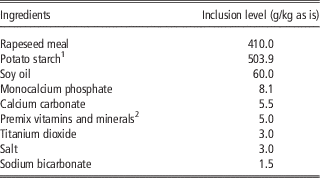
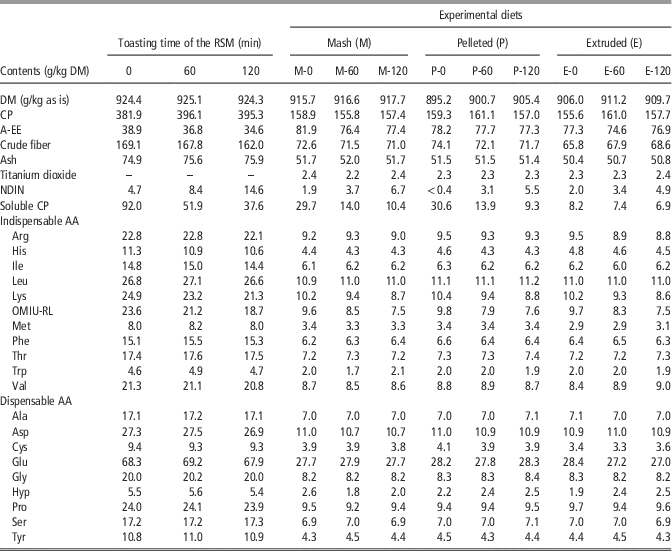
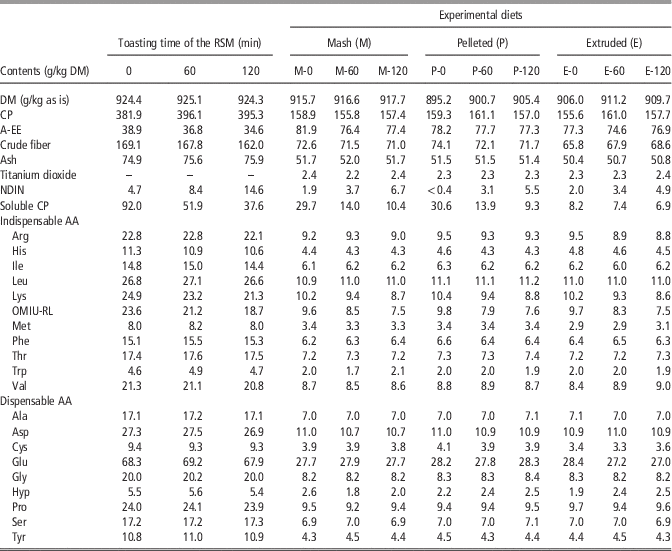
Mash diets including the 0, 60 and 120 min toasted RSM were prepared according to the formulation described in Table 1. Rapeseed meal was the only protein source included in the diets and was ground by hammer milling to pass a 3-mm sieve. Each of these mash diets was divided into three batches in order to prepare the mash, pelleted or extruded pig feeds. The mash diets were mixed without any further treatment. The RSM containing diets were pelleted (Research Diet Services, Wijk bij Duurstede, the Netherlands) at a mash conditioning temperature of 80°C to pass through a 4×40-mm die. Pellet temperatures after the die reached 86°C, 87°C and 89°C for the P-0, P-60 and P-120 diets, respectively. The corresponding energy consumptions of the pellet press were 7.50, 7.55 and 7.61 kWh/t, respectively. Extrusion was performed in a co-rotating twin-screw extruder (M.P.F.50; Baker Perkins, Peterborough, UK) after the diets were mixed with water to 850 g dry matter (DM)/kg in a paddle mixer (type F60; Halvor Forberg, Bygland, Norway). The screw configuration in the extruder has been described elsewhere (De Vries et al., Reference De Vries, Pustjens, Kabel, Salazar-Villanea, Hendriks and Gerrits2013). The extruder consisted of nine heating zones and a die with two orifices (Ø 1.9 mm). Temperatures in the nine heating zones were set at 30°C, 40°C, 50°C, 60°C, 70°C, 80°C, 90°C, 105°C and 115°C, respectively. During extrusion of the three diets the speed of the extruder screw was fixed at 200 r.p.m. and the measured internal temperatures at the die ranged from 111°C to 118°C, 110°C to 118°C and 114°C to 120°C for the E-0, E-60 and E-120 diets, respectively. Water was added directly in the extruder with a water pump at 4.3, 3.2 and 4.5 l/h for the E-0, E-60 and E-120 diets, respectively. Corresponding measured throughputs were 41.1, 32.7 and 42.2 kg/h, respectively. The extruded diets were subsequently air-dried at 60°C in air-forced ovens until a DM content of ~900 g/kg (IR 200 Moisture Analyzer; Denver Instrument Company, Arvada, CO, USA) was obtained. The pelleted and extruded diets were left to cool to room temperature before bagging. The analyzed chemical composition of the diets is reported in Table 2.
Ingredient composition of the experimental diets

1 Paselli™ (Avebe, Veendam, the Netherlands).
2 Composition premix per kg of feed: 100 mg Fe (as FeSO4·H2O), 70 mg Zn (as ZnSO4·H2O), 20 mg Cu (as CuSO4·5H2O), 30 mg Mn (as MnO), 1.2 mg I (as KI), 0.25 mg Se (as Na2SeO3), 125 mg antioxidant, 10 000 IU vitamin A, 2000 IU vitamin D3, 150 mg choline chloride, 40 mg vitamin E, 30 mg niacin, 15 mg d-pantothenic acid, 4 mg vitamin B2, 1.5 mg vitamin K3, 1.5 mg vitamin B6, 1.0 mg vitamin B1, 0.4 mg folic acid, 0.05 mg biotin, 20 μg vitamin B12. Carrier was potato starch.
Chemically analyzed nutrient composition of the rapeseed meal (RSM) and the experimental diets
DM=dry matter; A-EE=acid hydrolyzed ether extract; NDIN=neutral detergent insoluble nitrogen; OMIU-RL=Ο-methylisourea reactive lysine.
Animals and housing
In all, 81 crossbred boars (Pietrain×Topigs 20) weighing on average 20.4±0.9 kg were used. The experiment was performed in four trials, three trials of 24 pigs each and one trial of nine animals. Pigs were housed in groups of four animals per pen, except during the trial with nine animals, when each pen housed three animals. To enable individual feeding, animals were separated twice per day (0800 and 1600 h) using physical barriers. The animals remained individually housed for the duration of feeding (~1 h), where after they were again group housed. All pigs had free access to water both during group and individual housing. The pens (0.71 m2/animal) had a 3 : 1 ratio of solid to slatted floor. Temperature in the barn was 28±1°C and the lights were turned off from 1900 h till 0700 h of the next day.
Animals were fed at a rate of 2.8×maintenance energy requirement (293 kJ NE/kg BW0.75; CVB, 2011). Sucrose (Van Gilse, Oud Gastel, the Netherlands) was added (10% w/w in final diet) on top of the diets before feeding to the M-0, P-0 and E-0 diets in order to mask the bitter taste of the glucosinolates and promote feed intake. To stimulate feed intake and to prevent sucrose separation, all the 0 min toasted RSM and the mash diets were mixed with water (1 : 1.5 w/w feed to water) just before feeding. The experiment consisted of 10 adaptation days, during which the animals were fed meals consisting of 30% (w/w) of the test diet and 70% (w/w) of commercial grower diet (Agrifirm Feed, Apeldoorn, the Netherlands) for the first 3 days. Incremental amounts of the test diet (10% extra per day) were exchanged for the commercial diet, until 100% test diet was achieved on the 10th day. Hence, the test diet (100%) was fed for 4.5 consecutive days. On the morning of the 14th day, the animals were fed 4 h before being euthanized. Pigs were weighed on days 8 and 13 in order to calculate the amount of feed provided.
Sample collection and chemical analysis
For euthanasia, animals were injected with pentobarbital in the ear vein and exsanguinated. Immediately after exsanguination, the stomach, small intestine and rectum were removed. The contents of the stomach were vigorously mixed in the stomach to obtain a homogeneous suspension before sampling. The small intestine was carefully spread on a table and divided with clamps in three segments of equal length. The terminal 1.5 m from each segment (SI1, SI2 and SI3, respectively) were dissected and their contents flushed out with 50 ml demineralized water. Section SI3 was considered to represent the ileum. A section of 0.2 m of the rectum was removed and its contents collected by gentle stripping. Digesta samples were immediately frozen on dry-ice and kept at −20°C until freeze drying. After freeze drying, samples were ground to pass a 1 mm sieve using a centrifugal mill at 12 000 r.p.m. (ZM200; Retsch, Haan, Germany).
Nitrogen content was analyzed by combustion (AOAC 968.06; Thermo Quest NA 2100 Nitrogen and Protein Analyzer; Interscience B.V., Breda, the Netherlands) and the CP content calculated using a 6.25 conversion factor. Dry matter content was determined according to International Standards Organization (ISO) 6496 (International Standards Organization, 1999a). Ash was determined according to ISO 5984 (International Standards Organization, 2002). Crude fat was determined according to ISO 6492 (International Standards Organization, 1999b) after hydrolysis with HCl. Crude fiber was determined according to ISO 6865 (International Standards Organization, 2000). The neutral detergent insoluble nitrogen (NDIN) was determined as the nitrogen (determined by the Kjeldahl method, ISO 5983; International Standards Organization, 2005a) remaining after 60 min hydrolysis with neutral detergent reagents (Boom, Meppel, the Netherlands), containing Termamyl (Novozymes, Bagsvaerd, Denmark) and Alcalase (Novozymes) at pH 7.0. Protein solubility in water and the protein denaturation enthalpy were determined according to Salazar-Villanea et al. (Reference Salazar-Villanea, Bruininx, Gruppen, Hendriks, Carré, Quinsac and Van Der Poel2016). For particle size determination, 250 to 300 mg of the diets were suspended in 3 ml demineralized water and mixed in a rotator until the pellets or extrudates completely disintegrated. Particle size was determined by laser diffraction (Mastersizer 3000; Malvern, Worcestershire, UK) using demineralized water as dispersant. Measurements were performed in the range 0.01 to 5 000 μm. The reference material was wood flour (refraction index 1.53, absorption index 0.1) and five measurements per sample were obtained. The particle size distribution (D10, D50 and D90) and the mean particle size (D4,3) were obtained using the Mastersizer V3.50 software. Titanium dioxide, added as marker, was determined according to the spectroscopic method described elsewhere (Morgan et al., Reference Morgan, Scholey and Burton2014). Amino acids in the diets and ileal-digesta were analyzed according to ISO 13903 (International Standards Organization, 2005b). Oxidation using a performic acid/phenol mixture was performed before hydrolysis for the analysis of Met and Cys. Tryptophan was analyzed according to ISO 13904 (International Standards Organization, 2016). Reactive Lys was determined after reaction of the diet and ileal-digesta samples with Ο-methylisourea (OMIU) for 3 days and subsequent hydrolysis with 6 M HCl for 23 h (Moughan and Rutherfurd, Reference Moughan, Gall and Rutherfurd1996). The OMIU-reactive Lys content was calculated from the molar amount of homoarginine and the molecular weight of Lys after separation by ion exchange chromatography, post-column reaction with ninhydrin and detection at 570 nm.
Calculations
Apparent digestibility (AD) of CP for each section of the gastrointestinal tract (i.e. stomach, SI1, SI2, SI3 and rectum) and of AID of AA was calculated according to the following equation:
 $${\rm AD}\,{\rm or}\,{\rm AID}\,{\rm of}\,x\,{\equals}\,{\rm 1}-\big[\left( {x_{{{\rm chyme}}} \,/\,x_{{{\rm diet}}} } \right){\times}\left( {{\rm TiO}_{{{\rm 2}\,{\rm diet}}} \,/\,{\rm TiO}_{{{\rm 2}\,{\rm chyme}}} } \right)\big]$$
The rate of protein digestion (k) was estimated for each individual pig using the AD of CP of each intestine section. Retention times for each of the sections of the small intestine (SI1, 27 min; SI2, 74 min; SI3, 101 min) were obtained from the values reported by Asche et al. (Reference Asche, Lewis and Peo1989) for weanling pigs. A cumulative retention time (CRT) of 27, 101 and 202 min was used for sections SI1, SI2 and SI3, respectively. Equal retention times were assumed for all diets based on their identical ingredient composition. The MODEL procedure of SAS (version 9.3) was used to fit k according to a second order kinetic model, in which the maximum possible digestibility (D max) was set to 100. The model is described in the following equation:
 $${\rm AD}\,{\rm of}\,{\rm CP}\,{\equals}\,D_{{{\rm max}}} -[D_{{{\rm max}}} \,/\,({\rm 1}{\plus}k{\times}{\rm CRT}{\times}D_{{{\rm max}}} )]$$
Statistical analysis of the results
Effects of experimental treatments were tested by restricted maximum likelihood using the MIXED procedure of SAS (version 9.3) by means of an F test according to a model with trial, TT of RSM, DP and their interaction as fixed factors. Feed intake of each of the animals on the day of euthanasia corrected for the average intake per treatment was used as covariate in the model. The individual animal was considered as the experimental unit. Significance was assumed at P-values lower than 0.05, whereas trends were considered at P-values between 0.05 and 0.1. Post hoc comparison between treatment means was performed using the Bonferroni adjustment.
Results
Chemical composition and particle size distribution of the rapeseed meals and the diets
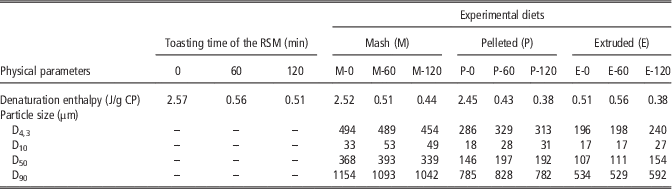
Increasing TT increased the contents of NDIN, whereas these were decreased in the P-120 and E-120 diets compared with the M-120 diet (Table 2). Increasing TT of the RSM resulted in a reduction of the Lys and OMIU-reactive Lys contents and the ratio between them, which was also reflected in their contents in the diets (Table 2). The DP method did not seem to influence the content of any of the AA in the diets. Increasing the TT reduced the denaturation enthalpy and the content of soluble CP in the RSM (Table 3). In the diets, whereas pelleting did not change the denaturation enthalpy or content of soluble CP compared with the mash diets, these appeared to be reduced after extrusion, mainly in the E-0 diet.
Denaturation enthalpy and particle size distribution of the rapeseed meal (RSM) and the experimental diets

Overall, there was a decrease in particle size after pelleting and, even further, after extrusion compared with the particle size in the mash diets (Table 3). The reduction in particle size after extrusion and pelleting was notorious across the whole distribution (D10, D50 and D90). The mean particle size of the P-0, P-60 and P-120 diets was 42%, 33% and 31% lower compared with that of the M-0, M-60 and M-120 diets, respectively (Table 3). Extrusion had a major impact on the mean particle size compared with pelleting, as this was decreased by 60%, 60% and 47% when comparing the E-0, E-60 and E-120 diets to the M-0, M-60 and M-120 diets, respectively.
Crude protein digestion along the gastrointestinal tract
Due to low feed intake four animals (three from diet M-0 and one from diet M-120) were excluded before the end of the experiment. Another two animals (both from diet P-0) were excluded from the experiment because low amounts of digesta were collected after euthanasia. There was a significant interaction (P=0.002) between TT and DP for the feed intake on the day of euthanasia. Feed intakes on this day were 0.279, 0.427, 0.397, 0.288, 0.417, 0.371, 0.449, 0.380 and 0.424 kg for the M-0, M-60, M-120, P-0, P-60, P-120, E-0, E-60 and E-120 diets, respectively.
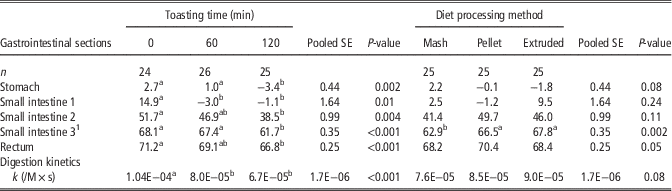
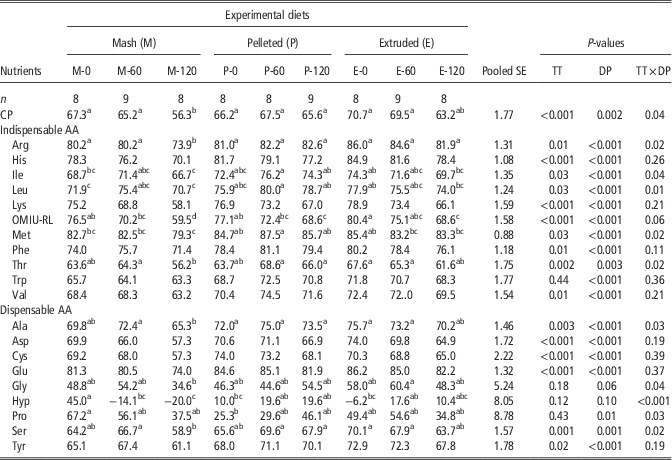
In general, the variation in the AD of CP decreased from the proximal to the distal sections of the small intestine (Table 4). There were no interactions (P>0.05) between TT and DP for the AD of CP in the stomach, SI1, SI2 and rectum. The AD of CP in the stomach was higher (P=0.002) in the 0 and 60 min toasted RSM diets compared with the 120 min toasted diets. Mash and pelleted diets tended (P=0.08) to have higher AD of CP in the stomach compared with the extruded diets. The AD of CP of the 0 min toasted RSM diets in SI1 was higher (P=0.01) compared with that of the 60 and 120 min diets. The TT also affected the AD of CP in SI2 (P=0.004). The AD of CP in SI2 of pigs fed the 0 min toasted RSM diets was higher than that of pigs fed the 120 min toasted diets whereas, the AD of CP in SI2 of pigs fed the 60 min toasted diets was intermediate. There was an interaction (P<0.05) between TT and DP with regard to the AD of CP in the ileum (SI3) (Table 5). The AID of CP in pigs fed the M-120 diet was lower than in pigs fed the other diets, apart from the intermediate value in pigs fed the E-120 diet (Table 5). Although pelleting of the 0 and 60 min toasted RSM diets did not change the AID of CP with respect to the mash diets, pelleting of the 120 min toasted RSM diet increased the AID of CP by 9.3% units. Extrusion increased the AID of CP of the 0 and 60 min toasted RSM diets by 3.4% and 4.3% units with respect to the mash diets, whereas extrusion of the 120 min toasted RSM diet increased the AID of CP by 6.9% units. The AD of CP in the rectum of pigs fed the 0 min toasted RSM was higher (P<0.001) than for pigs fed the 120 min diets, whereas the digestibility of the 60 min diets was not different between either of them (Table 4). Significant effects of TT (P<0.001) were observed on k (Table 4). The k for the 0 min toasted RSM diets was 23% and 35% higher than that of the 60 and 120 min toasted RSM diets, respectively. The DP method tended (P=0.08) to affect the k, with higher values for the extruded>pelleted>mash diets.
Apparent CP digestibility in the different sections of the gastrointestinal tract of growing pigs and the derived kinetic digestion parameters as affected by toasting time of rapeseed meal and diet processing method

n=number of pigs; k=rate of digestion.
a,b Means with different superscript letters within a row and treatment are significantly (P<0.05) different.
1 Significant interaction Toasting time×Diet Processing (P=0.04) (see Table 5).
Toasting time×diet processing method subclass means for the apparent ileal digestibility (AID) of CP and amino acids in growing pigs

n=number of pigs; TT=toasting time; DP=diet processing; OMIU-RL=O-methylisourea reactive lysine.
a,b,c,d Means with different superscript letters within a row represent significant differences (P<0.05) or trends (P⩾0.05 and <0.10).
Apparent ileal digestibility of amino acids
Significant interactions (P<0.05) between the TT and DP were noticed on the AID of Arg, Ile, Leu, Met, Thr, Ala, Gly, Pro and Ser (Table 5). The interaction between TT and DP for the AID of OMIU-reactive Lys tended to be significant (P=0.06). Significant effects (P<0.05) of TT and DP were obtained for the AID of His, Lys, Phe, Val, Asp, Cys, Glu and Tyr. The AID of Trp was only affected (P<0.001) by DP. The effect of feed intake, which was used as a covariate in the statistical model, was not significant for the AID of any of the AA. Pelleting of the 0 and 60 min toasted RSM diets increased the AID of Lys by 1.7% and 4.4% units with respect to the mash diets, whereas pelleting of the 120 min toasted RSM diet increased the AID of Lys by 8.9% units (Table 5). Extrusion increased the AID of Lys of the 0 and 60 min toasted RSM diets by 3.7% and 4.6% units with respect to the mash diets, whereas extrusion of the 120 min toasted RSM diet increased the AID of Lys by 8.0% units (Table 5). Similar effects were noticed for the AID of OMIU-reactive Lys. The SID of CP and AA (Supplementary Table S1) was calculated by correcting for the composition of the endogenous losses (Jansman et al., Reference Jansman, Smink, Van Leeuwen and Rademacher2002). Similar results to the AID of CP and AA were obtained.
Discussion
Chemical composition of rapeseed meals and diets
Protein solubility has been identified as an important predictor for CP digestibility (Batal et al., Reference Batal, Douglas, Engram and Parsons2000). The reduction in protein solubility with increasing intensity (e.g. temperature, time) of hydrothermal processing has been linked to protein denaturation and refolding of the proteins into protein aggregates (Wang et al., Reference Wang, Nema and Teagarden2010). Thus, the 60 and 120 min toasted RSM diets can be considered to contain larger amounts of aggregated proteins than the 0 min toasted RSM diets. Pelleting of the diets including the 60 and 120 min toasted RSM did not result in a further decrease of protein solubility compared with the mash diets, indicating that the conditions applied during pelleting do not induce further protein denaturation and aggregation. In contrast, extrusion of the diets decreased their protein solubility, mainly for the diet including the 0 min toasted RSM (decreased 72%), resulting from an increase in protein denaturation (increased 80%). The decrease in protein solubility from the M-60 to the P-60 and E-60 and from the M-120 to the P-120 and E-120 diets was lower than those in the 0 min toasted RSM because their proteins were already denatured and aggregated after toasting.
Similar to our findings, decreasing contents of Lys and OMIU-reactive Lys in the RSM with increasing TT have been reported before (Jensen et al., Reference Jensen, Liu and Eggum1995; Eklund et al., Reference Eklund, Sauer, Schöne, Messerschmidt, Rosenfelder, Htoo and Mosenthin2015). The decreasing contents of these compounds were likely caused by chemical changes of proteins due to Maillard reaction products formation. Pelleting or extrusion of the diets did not further affect the contents of Lys or OMIU-reactive Lys suggesting that no chemical changes to the proteins occurred during processing of the diets.
Crude protein digestion along the gastrointestinal tract
Several actions (e.g. restriction at 2.8× maintenance, sugar and water addition) were taken to maximize the feed intake in the present experiment, especially for those diets including the 0 min toasted RSM. However, the feed intake of the M-0 and P-0 diets was still lower than those of the rest of the diets. The lower feed intake of the M-0 and P-0 diets on the day of euthanasia might be explained by a higher content of glucosinolates and the activity of myrosinase (thioglucoside glucohydrolase) in the 0 min toasted RSM. According to Tripathi and Mishra (Reference Tripathi and Mishra2007), glucosinolates (e.g. progoitrin) are non-bitter compounds, but hydrolysis by myrosinase produces bitter compounds (e.g. goitrin, thiocyanates, isothiocyanates). Extrusion probably denatured the myrosinase (Fenwick et al., Reference Fenwick, Spinks, Wilkinson, Heaney and Legoy1986) from the E-0 diet, which increased the intake of this diet, without decreasing the content and AID of Lys and OMIU-reactive Lys.
Increasing thermal protein damage with increasing TT, as determined by the decreasing denaturation enthalpy and contents of soluble protein, Lys and OMIU-reactive Lys, decreased CP digestibility at all intestinal sections. Similar results were recently reported by Hulshof et al. (Reference Hulshof, van der Poel, Hendriks and Bikker2016b) after toasting of soybean meal and RSM in presence of reducing sugars. This severe thermal process was reported to induce the formation of early (e.g. fructoselysine measured as furosine) and advanced (e.g. carboxymethyllysine) Maillard reaction products (Hulshof et al., Reference Hulshof, Bikker, van der Poel and Hendriks2016a). The AD of CP of a commercial RSM reported by Hulshof et al. (Reference Hulshof, van der Poel, Hendriks and Bikker2016b) at the end of the first and second sections of the small intestine (−28.7 and 23.3, respectively) were lower than the ones reported here for all TT (ranging from −3.0 to 14.9 in the first section and from 38.5 to 51.7 in the second section). These are large differences considering that the contents of Lys and OMIU-reactive Lys reported by Hulshof et al. (Reference Hulshof, Bikker, van der Poel and Hendriks2016a) in the commercial RSM (5.6 and 5.0 g/100 g CP, respectively) were comparable with the contents of the 60 min toasted RSM reported in the present study (5.8 and 5.4 g/100 g CP, respectively).
The AID and SID of CP did not differ between the diets containing 0 and 60 min toasted RSM for any of the DP methods (i.e. mash, pelleting, extrusion), even though the ratio of Lys to CP and the contents of soluble protein and OMIU-reactive Lys were lower for the 60 min toasted RSM diets. Previous research has identified a link between the reduction in the Lys to CP ratio and the AID or SID of CP (Almeida et al., Reference Almeida, Htoo, Thomson and Stein2014; Liu et al., Reference Liu, Song, Maison and Stein2014; Eklund et al., Reference Eklund, Sauer, Schöne, Messerschmidt, Rosenfelder, Htoo and Mosenthin2015). Although damage to the proteins after toasting for 60 min reduced the rate of protein digestion compared with the 0 min toasted diet, the extent of digestion (i.e. ileal digestibility) remained unaffected.
The reduction of the Lys to CP ratio when comparing the 0 min to the 120 min toasted RSM was 14%, 14% and 17% for the mash, pelleted and extruded diets, respectively. However, no effects of toasting for 120 min were observed on the AID or SID of CP after pelleting or extrusion of the diets. Although Maillard reactions occurred due to toasting of RSM, protein digestibility was improved by pelleting or extrusion of the diets. Positive effects of DP on CP and AA digestibility have been associated with an increase in protein denaturation (Rojas et al., Reference Rojas, Vinyeta and Stein2016). However, proteins in the 60 and 120 min toasted RSM were already denatured during the toasting treatment and no further denaturation occurred during pelleting or extrusion of the diets, as demonstrated by the absence of changes in denaturation enthalpy of their proteins. Therefore, protein denaturation during pelleting or extrusion does not explain the observed increase in protein digestibility.
Factors during pelleting and extrusion of the diets, such as shear and pressure, can reduce the particle size of the feeds as observed in the present experiment. The reduction in particle size likely explains the overall increase in the AID and SID of CP and AA after pelleting and extrusion of the diets. However, the reduction in particle size after pelleting and extrusion was constant among the different TT. This does not explain that the increase in AID and SID of CP and most AA after pelleting and extrusion was higher for the diets that contained 60 and 120 min toasted RSM compared with 0 min toasted RSM. Reducing the particle size of wheat or maize from 1000 to 500 μm did not result in improved SID of CP in growing pigs (Lahaye et al., Reference Lahaye, Ganier, Thibault, Riou and Sève2007 and Reference Lahaye, Riou and Sève2008). In addition, reducing the particle size of soybean meal in the range from 900 to 150 μm resulted in only a small increase (1.3%) of the SID of essential AA in grower-finisher pigs (Fastinger and Mahan, Reference Fastinger and Mahan2003). Therefore, it seems unlikely that the decrease in particle size after pelleting or extrusion caused the increase in digestibility for the different TTs.
The increase in the AID and SID of CP of the 60 and 120 min toasted RSM after pelleting and extrusion matches the reduction in the NDIN content after pelleting and extrusion. It is possible that the disruption of cell walls by shear increased the release of protein. However, the reduction in the NDIN content of the diets only partly accounts for the increase in SID of CP. In addition, shear can decrease the size of the protein aggregates formed after thermal treatments. The mechanical energy or shear input during extrusion is usually higher compared with pelleting. The size of the protein aggregates formed during extrusion of a soy protein isolate decreased with increasing mechanical energy input (Fang et al., Reference Fang, Zhang, Wei and Li2013). Smaller protein aggregates might be more accessible for protein hydrolysis and facilitate digestion.
Alternatively, processing could reduce specific endogenous losses as previously reported (Lahaye et al., Reference Lahaye, Ganier, Thibault and Sève2004). These authors suggested that by increasing the digestion rate, high-flow extrusion processing might decrease the proliferation of epithelial cells and secretion of mucus due to production of short-chain fatty acids following fermentation. However, lower CP digestion rates were obtained in the present experiment after pelleting or extrusion processing compared with the mash diets. The decrease in the rate of CP digestion of the 60 and 120 min toasted RSM compared with the 0 min toasted RSM could either be caused by the formation of Maillard reaction products or the formation of protein aggregates after toasting. Both factors have been identified to limit access of enzymes for protein hydrolysis (Meade et al., Reference Meade, Reid and Gerrard2005; Gerrard et al., Reference Gerrard, Lasse, Cottam, Healy, Fayle, Rasiah, Brown, BinYasir, Sutton and Larsen2012), the first step of protein digestion.
Apparent ileal digestibility of amino acids
The AIDs of most indispensable and dispensable AA followed the same trend as the AID of CP. The AIDs of AA were comparable with the values previously reported for rapeseed or canola meal (Almeida et al., Reference Almeida, Htoo, Thomson and Stein2014; Eklund et al., Reference Eklund, Sauer, Schöne, Messerschmidt, Rosenfelder, Htoo and Mosenthin2015). Previous studies indicated that thermal processing reduces the digestibility of the chemically reactive Lys (Moughan et al., Reference Moughan and Rutherfurd1996). The decrease in reactive Lys digestibility with increasing TT might be due to a restricted access of the enzymes for protein hydrolysis due to the formation of protein aggregates or the formation of Maillard reaction products. Maillard reaction products decrease enzyme access to the proteins due to steric hindrance (Friedman et al., Reference Friedman, Zahnley and Masters1981). Alternatively, proteins that are more difficult to digest could increase the secretion of enzymes (Ihse and Lilja, Reference Ihse and Lilja1979; Green and Miyasaka, Reference Green and Miyasaka1983), which could be considered as specific endogenous losses, resulting in lower AID. Pelleting and extrusion of the diets reduced the negative effects of toasting of RSM on reactive Lys digestibility. Although the negative effects of higher TT of RSM on CP digestibility seem to be compensated by thermal processing of the diets, chemically modified AA that are absorbed (mainly lysine derivatives) may not be utilized for protein deposition (Batterham, Reference Batterham1992).
The low AID values of Pro and Gly reported here might be associated with the high proportion of these AA in the endogenous secretions (Jansman et al., Reference Jansman, Smink, Van Leeuwen and Rademacher2002), for example saliva. Hydroxyproline is a major AA of the cell wall protein extension, which can crosslink cell wall polysaccharides (Lamport, Reference Lamport1967). The crosslink between Hyp and the cell wall polysaccharides likely justify the overall low AID of this amino acid.
In conclusion, toasting of RSM decreased the rate of CP digestion along the gastrointestinal tract. The negative effects of toasting of RSM on the AID and SID of CP and AA, however, can be ameliorated by pelleting or extrusion of the diets. These effects were larger for the RSM toasted for longer times. Future research should be directed toward elucidating the mechanisms by which processing of the diets increases protein digestibility of protein-damaged ingredients and to investigate whether the extra protein and AA absorbed can be utilized for protein deposition.
Acknowledgments
The authors gratefully acknowledge the financial support from the Wageningen UR ‘IPOP Customized Nutrition’ program financed by Wageningen UR, the Dutch Ministry of Economic Affairs, WIAS, Agrifirm Innovation Center, ORFFA Additives BV, Ajinomoto Eurolysine s.a.s and Stichting VICTAM BV. The authors wish to acknowledge the contribution of G.G.G. van den Biggelaar during the experiment. SSV acknowledges the support of the Universidad de Costa Rica.
Supplementary material
To view supplementary material for this article, please visit https://doi.org/10.1017/S1751731117002476