





1. Introduction
Automation of music creation has been a major research focus in recent years, and several interactive music systems that perform tasks such as assisted composition and co-improvisation have been proposed. Co-improvisation systems actively contribute to the process of music creation by semi-autonomously making decisions during performance in response to live musical inputs. When humans and machines collaborate to create an artwork, their interaction can be studied as an artificial co-creative system (Karimi et al. Reference Karimi, Grace, Maher and Davis2018). As machines become capable of making increasingly complex decisions autonomously and co-creative systems become more widespread, it is essential to develop methods to personalise the behaviour of these systems according to musicians’ unique styles and aesthetic needs, as well as understanding the creative implications of employing them in musical works.
Musical tools have the dual function of providing controls to reliably realise a musician’s aesthetic vision while expanding and informing it through novel possibilities (Magnusson Reference Magnusson2010). It is not always feasible to adapt semi-autonomous tools to individual musicians’ personal styles, ideas and aesthetic preferences; when interacting with such systems, users have highlighted the need for more nuanced expression and enhanced personalisation (Bown Reference Bown2024), including easier access to training with small datasets collected by artists themselves (Vigliensoni et al. Reference Vigliensoni, Perry and Fiebrink2022). While modular and customisable frameworks for developing co-creative systems exist, they often require advanced technical knowledge to configure or a large amount of data to train, and they expose many configuration parameters that determine system behaviour, the exploration of which can be unfeasible for less technical users – especially given that system responses depend heavily on the musician’s input sound. At the same time, characterising the perception of co-agency between musicians and performing artificial agents remains an open challenge (Dahlstedt Reference Dahlstedt and Miranda2021).
In this article, we propose a corpus-based method to automatically derive personalised configurations of a co-improvisation system, using a corpus of annotated co-performances that represent a musician’s style, sonic repertoire and aesthetic objectives. This method, based on a genetic algorithm, derives optimal system configurations by repeatedly simulating co-performances and iteratively converging towards configurations (Tanaka and Donnarumma Reference Tanaka, Donnarumma, Kim and Gilman2018) that closely match a target corpus. This method allows deriving personalised system configurations based solely on musicians’ experience with the system, enabling progressive refinement over time by curation of a personalised corpus. We demonstrate the application of this method to personalise the behaviours of the multi-agent autonomous looper (MAAL), a system we previously introduced (Madaghiele et al. Reference Madaghiele, Fasciani, Kelkar and Erdem2025). The MAAL is a rule-based co-improvisation system that autonomously samples and loops segments of a musician’s live performance, designed to expand the expressive possibilities of improvising musicians by autonomously developing musical macro-structures musicians can respond to throughout a performance. In this article, we detail the adaptation method we propose and provide an example of its application to the MAAL. Furthermore, we discuss the results of a user study in which five professional musicians adapted the MAAL to their preferences, focusing on how personalisation shaped their performance experiences.
2. Autonomous agents and co-creative interactions
2.1. Agency and creativity
Agency and creativity are both elusive concepts; they take on different definitions depending on the context in which they are applied. Agency, in its most simple conception, refers to the capacity of an entity to act (Schlosser Reference Schlosser and Zalta2019) and can be ascribed to both human and non-human actors. The extent of agency varies among different entities depending on their ability to influence the course of events (Latour Reference Latour1996). This definition of agency can be considered causal, distinguishing it from intentional agency, which implies that the agent initiating an action has a specific objective (Davidson Reference Davidson1963). In software, agency is associated with a programme’s intentionality and autonomy of operation. In this article, we define a software agent as a computer programme situated within an environment, capable of sensing its properties and acting within it over time. This allows the agent to modify the environment’s state according to its own internal objectives (Franklin and Graesser Reference Franklin and Graesser1996).
The meaning of creativity depends heavily on the context in which it is applied. Creativity has several interpretations in psychology and computer science, each representative of distinct yet intersecting ideological and epistemic stances (Hsueh et al. Reference Hsueh, Ciolfi Felice, Alaoui and Mackay2024). Generally, an artefact is considered creative when it is novel while stylistically coherent to its domain (Boden Reference Boden2004). Creativity can be associated with the discovery of novel solutions to clearly defined problems (Kaufman and Sternberg Reference Kaufman and Sternberg2010) or with the generation of novel ideas through free association (Kerne et al. Reference Kerne, Koh, Smith, Webb and Dworaczyk2008). In first-person experiences, creativity is associated with flow states (Csikszentmihalyi Reference Csikszentmihalyi1990), exploration and play (Boden Reference Boden2004). Ultimately, as noted by Cherry and Latulipe (Reference Cherry and Latulipe2014), notions of creativity are not one-size-fits-all; they should be situated within a specific practice (Remy et al. Reference Remy, MacDonald Vermeulen, Frich, Biskjaer and Dalsgaard2020).
In this article, we study creativity within the context of non-idiomatic music improvisation (Bailey Reference Bailey1993). Improvisation is the art of decision-making in time, and a creative ‘artifact’ in this context is a decision made by a (human or machine) agent which affects other agents’ behaviour. In an improvised performance, an agent’s decision is evaluated by how it shifts the course of the performance, either supporting or contrasting the specific behaviour of other agents. Consequently, we define a creative decision as one that fosters novel and surprising outcomes while maintaining stylistic coherence within the improvised context (Blackwell et al. Reference Blackwell, Bown, Young, McCormack and d’Inverno2012). We do not define creativity (or intelligence) as an inherent property of individual agents; rather, we view it as a phenomenon that emerges from the interactions of (human and/or machine) agents within a specific context (Haraway Reference Haraway1985; Saunders Reference Saunders, Veale and Cardoso2019).
2.2. Empirical evaluations of co-improvisation systems
Musical tools embody notions of the music theories they are designed for, carrying these assumptions through their affordances and constraints (Magnusson Reference Magnusson2010). Co-improvisation systems are performance-driven interactive music systems (Drummond Reference Drummond2009) in which the algorithm’s decision-making is based solely on analysis of the material played by a musician during a performance, without any predetermined temporal structure. In co-improvisation systems, the music-theoretical notions are expressed by the aspects of a musician’s sound the system listens to and by the way it responds to them, encoding stylistic expectations (Dubnov Reference Dubnov and Miranda2021). When interacting with semi-autonomous systems, musicians tend to describe their experience in terms of the artificial system’s behaviour. In previous studies, such behaviours have been interpreted by users across several categories, including communication and control (Fiorini Reference Fiorini2024), influential agency (Dahlstedt Reference Dahlstedt and Miranda2021), contextual relevance (Van Nort et al. Reference Van Nort, Oliveros and Braasch2013), emergence (Eldridge et al. Reference Eldridge, Dorin and McCormack2008; Eigenfeldt Reference Eigenfeldt, Vear and Poltronieri2022), co-adaptation (Young and Bown Reference Young and Bown2010; Erdem et al. Reference Erdem, Wallace, Glette and Jensenius2022), domain competence, active involvement, originality, ability to handle uncertainty (Jordanous Reference Jordanous2012), and exploration and stylistic coherence (Blackwell et al. Reference Blackwell, Bown, Young, McCormack and d’Inverno2012). In this article, we refer to behaviour as ‘the internally coordinated responses (actions or inactions) of an agent to external stimuli’, adapting a biological characterisation from Levitis et al. (Reference Levitis, Lidicker and Freund2009) to the definition of software agent discussed above. This definition can be applied to consider individual behaviour of agents, collective emergent behaviour of multi-agent software systems (Heylighen Reference Heylighen2008) and of human-machine co-creative systems. Consequently, in this article adapting and personalising behaviours imply modifying how agents respond to different stimuli to achieve a desired aesthetic objective.
The outputs of a co-improvisation system depend – at least in part – on the musician’s live input. For this reason, these systems can be described as in between completely reactive and completely autonomous in the continuum of autonomy proposed by Tatar and Pasquier (Reference Tatar and Pasquier2019). Similarly, Erdem et al. (Reference Erdem, Wallace, Glette and Jensenius2022) show that their co-improvisation system, coadaptive audiovisual instrument compostion, was interpreted by performers as either a tool or an actor, depending on the degree of control they felt they could exert over it, with this perception shifting throughout a performance. This echoes previous studies on feedback instruments and multi-agent systems where the musician can be a part of the system (Eldridge Reference Eldridge2007) or a manager of the system’s complexity as a curator of a sound-generating process (Wiggins Reference Wiggins, Veale and Cardoso2019; Sanfilippo Reference Sanfilippo2023). Dahlstedt (Reference Dahlstedt and Miranda2021) highlights that a tool’s influence on the final aesthetic outcome – its influential agency – is related to its complexity, which is determined by the constraints built into it by the tool’s creator. The more generative an instrument is, the more influential agency shifts from the player towards the tool designer and maker, reflecting their conception of music. Jordanous (Reference Jordanous2012) proposed a standardised procedure to evaluate co-creative systems by identifying domain-specific definitions of creativity, establishing standards based on these definitions and testing for compliance.
2.3. Personalising co-improvisation systems
Designing novel musical tools requires both technical knowledge and active musical practice (Pelinski et al. Reference Pelinski, McPherson and Fiebrink2024). Musical tools are always adapted to the practice of specific musicians, ideally allowing for subtlety, detail (Armitage Reference Armitage2022), personalised expression and virtuosity (Pachet Reference Pachet, McCormack and d’Inverno2012). This is also true when designing tools capable of making autonomous decisions, such as co-improvisation systems; in this context, the tool’s increased agency raises questions about how its behaviour should be adapted to reflect a musician’s unique expression.
According to Blackwell et al. (Reference Blackwell, Bown, Young, McCormack and d’Inverno2012), co-improvisation systems – or live algorithms – typically consist of a listening/analysis module, a patterning/reasoning module and a sound synthesis module, with each of these modules having different degrees of personalisation depending on how the system is designed. Systems based on concatenative synthesis, like Somax (Assayag et al. Reference Assayag, Bonnasse-Gahot and Borg2022), Dicy2 (Nika et al. Reference Nika, Schwarz and Muller2025) and Musical Agent based on Self-Organizing Maps (MASOM) (Tatar and Pasquier Reference Tatar and Pasquier2017), can be personalised by enabling users to define the corpus of sounds utilised for synthesis and by allowing them to select values of control parameters to adapt the system’s behaviour. Thelle and Pasquier (Reference Thelle and Pasquier2021) later expanded MASOM’s reasoning module, incorporating four discrete control behaviours for users to select from, thereby personalising the patterning/reasoning module. In both systems, there are also a few parameters available for personalising the sensing module. Similarly, systems based on neural synthesis, such as the Living Looper (Shepardson and Magnusson Reference Shepardson and Magnusson2023), can be personalised by training their models on a user-selected sound corpus. Other methods to personalise patterning/reasoning modules incorporate human judgements of model outputs in addition to providing training data. These approaches, such as human-in-the-loop reinforcement learning (Justus Reference Justus2023) and interactive evolution using genetic algorithms (Farzaneh and Mahdian Toroghi Reference Farzaneh and Mahdian Toroghi2019), offer greater control over the aesthetics of the resulting system; however, they require more effort from users to generate the necessary data and/or to contribute to the training configuration and process.
Vigliensoni and Fiebrink (Reference Vigliensoni and Fiebrink2024) argue that sustained musical practice necessitates the continuous development of an instrument and propose an Interactive Machine Learning (IML) approach (Fiebrink, Reference Fiebrink, Till, de Campo, Egermann, Hardjowirogo and Weinzierl2016) in which a model can be iteratively personalised by changing the training examples collected by the user. This approach entails a ’small data mindset’ (Vigliensoni et al. Reference Vigliensoni, Perry and Fiebrink2022) and encourages a conceptual shift from viewing data as ground truth to seeing it as a medium for communicating intention. While IML is an established technique for learning personalised reactive mappings, it has not yet been employed to fine-tune musical tools that exhibit greater autonomy, such as co-improvisation systems. The approach proposed in this article builds on the concept of using data to communicate intentions and applies it to the personalisation of a dynamic, responsive music co-improvisation system.
2.4. Evolutionary algorithms in music
Genetic algorithms (GAs) are a class of stochastic optimisation methods inspired by abstract biological models of Darwinian evolution. They are a class of optimisation methods in which the algorithm searches for optimal solutions in a search space by iteratively generating new samples. Defining a problem in GAs requires a genetic representation and a fitness function. The optimisation process starts by generating a population composed of a fixed number of candidate solutions. Each candidate solution is evaluated against the fitness function, yielding a fitness score. A small number of solutions with the largest fitness score is kept, while the remaining solutions are discarded. A new population is then generated by computing several mutations of the retained candidates, called an offspring, which is then tested on the fitness function, starting another iteration. This process is repeated until an optimal solution is found or a maximum number of iterations is reached.
GAs have been employed in several musical scenarios (Husbands et al. Reference Husbands, Copley, Eldridge and Mandelis2007). Applications in algorithmic composition include the generation of symbolic music respecting specific rules (Gartland-Jones Reference Gartland-Jones2003); sound design applications include sound matching (Shier et al. Reference Shier, Constanzo, Saitis, Robertson and McPherson2025) and sound discovery (Jónsson et al. Reference Jónsson, Erdem and Glette2024b). Jónsson et al. (Reference Jónsson, Erdem, Fasciani and Glette2024a) point out that, in contrast to machine learning’s tendency to output the most likely (and therefore least creative) outcome in response to an input, GAs have the potential to promote novel discoveries through techniques like novelty search (Jónsson et al. Reference Jónsson, Erdem, Fasciani and Glette2024a) and interactive evolution (Johnson Reference Johnson1999).
3. Personalising the behaviour of the multi-agent autonomous looper
The MAAL is a software system for music co-improvisation that we introduced in Madaghiele et al. (Reference Madaghiele, Fasciani, Kelkar and Erdem2025). The system features an arbitrary number of rule-based agents that listen to one another and to a live musician, selecting segments of the musician’s performance to loop, creating an evolving accompaniment composed of layered loops. While a comprehensive technical description of the motivations and design of the MAAL is available in (Madaghiele et al. Reference Madaghiele, Fasciani, Kelkar and Erdem2025), in Section 3.1, we summarise the function of the MAAL to contextualise the personalisation method presented in this article. In Section 3.2, we introduce a personalisation method that leverages genetic algorithms to learn personalised agent behaviours from a co-performance corpus comprising user-selected and annotated sections of previous performances, as applied to the MAAL.Footnote 1
3.1. Multi-agent autonomous looper
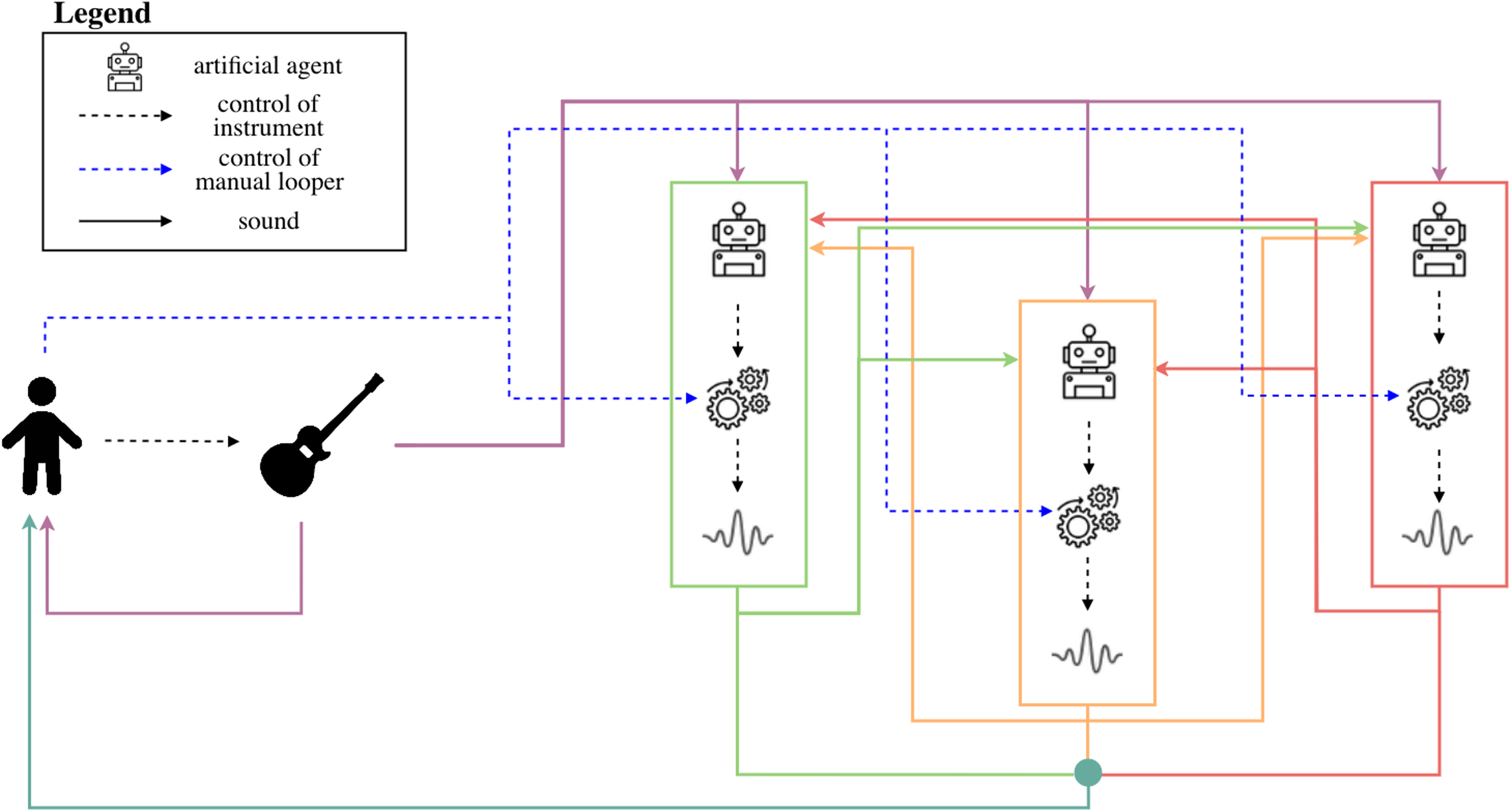
The MAAL is based on a computational model of a looper utilised in live performances, typically consisting of one or more audio buffers where musicians can record sound. Once recorded, segments usually begin playing in a loop, developing harmonic and macro-temporal musical structures over time. In the MAAL, artificial agents decide which segments of a musician’s live performance to loop using custom rules derived from machine listening. The MAAL can be configured to operate with an arbitrary number of loop tracks, each controlled by a distinct agent. Agents decide which segment to loop according to predefined rules which utilise comparison metrics and thresholds that interpret the musician’s sound at the meso-level. For example, an agent equipped with rules about rhythmic compatibility can choose to loop a segment of the musician’s performance if its rhythm is sufficiently similar (or dissimilar) to the rhythm found in the sum of the other concurrent loops. Comparison metrics assess various aspects of harmony, melody, dynamics, timbre and rhythm, and agents’ logic can be defined by combinations of multiple rules that must be satisfied concurrently, enabling complex musical reasoning. This makes each agent’s decisions dependent on other agents’ configurations, as well as the human musician’s performance, establishing a network of relations whose global characteristics exhibit emergent, self-organising behaviour or stigmergy (Theraulaz and Bonabeau Reference Theraulaz and Bonabeau1999; Heylighen Reference Heylighen2008). This makes the configuration of the system complex because of the overall global unpredictability about how different agents’ rules affect each other in a specific context. The interaction between the musician and agents in the MAAL is illustrated in Figure 1. A deeper technical description of the MAAL’s design is available in the previously published article (Madaghiele et al. Reference Madaghiele, Fasciani, Kelkar and Erdem2025).
Diagram illustrating the interaction model and data flow of a MAAL with three agent-controlled loop tracks. The dashed blue lines show how musicians would normally control a manual multi-track looper by explicitly starting and stopping the recording. When interacting with the MAAL, musicians instead control only the instrument they play, producing a continuous stream of sound that the agents listen to.

Figure 1. Long description
A diagram illustrating the interaction model and data flow of a multi-agent audio looper with three agent-controlled loop tracks. The diagram includes a legend explaining the symbols used: artificial agent, control of instrument, control of manual looper, and sound. A musician plays an instrument, producing a continuous stream of sound that the agents listen to. The sound flows into three agent-controlled loop tracks, each containing an artificial agent and a gear symbol representing the processing of sound. The dashed blue lines indicate how musicians would normally control a manual multi-track looper by explicitly starting and stopping the recording. In this setup, musicians control only the instrument they play. The solid black lines represent the flow of sound from the musician to the agents and between the agents. The dashed lines in various colors (purple, green, orange) represent the control signals between the agents and the instruments. The diagram shows the complex interaction and data flow between the musician and the artificial agents, highlighting the nuanced expression and enhanced personalization in the interaction model.
The MAAL continuously analyses non-overlapping segments s[m] of a live musician’s performance x(t), each with a predefined duration T u , which typically corresponds to meso-level musical duration (Roads Reference Roads2002). This is defined in Equation (1), where m is a discrete-time index that increments with time intervals T u .
 $$s\left[ m \right] = x\left( t \right),{\rm{\;\ \ \ \ \ \ with\;}}t \in \left[ {t + \left( {m - 1} \right){T_u},{\rm{\;}}t + m{T_u}} \right)$$
The MAAL operates under the assumption that both the musician and the agents follow a fixed known common tempo. The predefined system parameters, which users can select, include the maximum buffer length T u , expressed in number of beats; the number of loop tracks N; optional maximum and minimum durations for which a selected segment is repeated in a loop; and the tempo. The agent controlling each loop track n utilises a combination of rules ρ n (), which includes an arbitrary number J n of individual rules r j,n (). Each rule consists of a comparison metric c j,n () chosen from a pool {c 0(),c 1(),.c 19()} of nineteen distinct comparison functions, a threshold τ j,n ∈[0,1] and a comparison coefficient ξ j,n ∈{−1,1}. A rule set for loop track n can be expressed as in Equation (2).
 $${\rho _n}() = \{ {r_{j,n}}()|{r_{j,n}}() = \{ {c_{j,n}}(),{r_{j,n}},{\xi _{j,n}}\}, {\rm{\;}}j \in \left[ {1,{\rm{\;}}{J_n}} \right]\} $$
These elements determine the behaviour of the agent controlling the loop track based on the similarity or dissimilarity computed according to a specific combination of rules. The comparison metrics c j,n () yield a coefficient between 0 and 1, as in Equation (3).
 $$r\left( {s\left[ m \right],\;\overline {{l_n}\left[ m \right]} } \right) = \left\{{ {\matrix{ {0,} \hfill \cr\quad \quad {\rm\;if} \quad {\xi \cdot\left( {c\left( {s\left[ m \right],\;\overline {{l_n}\left[ m \right]} } \right) - \tau } \right) \lt 0}\cr {\xi \cdot\left( {c\left( {s\left[ m \right],\;\overline {{l_n}\left[ m \right]} } \right) - \tau } \right),} \hfill \cr \quad \quad {\rm\;if} \quad {\xi \cdot\left( {c\left( {s\left[ m \right],\;\overline {{l_n}\left[ m \right]} } \right) - \tau } \right) \ge 0\;} \cr } }}\right.$$
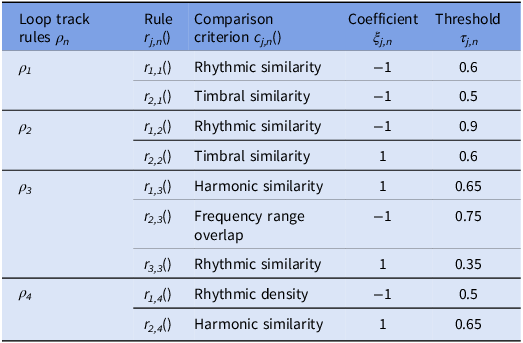
Comparison metrics are based on machine-listening principles that analyse sonic characteristics at the meso-level derived from low-level acoustic features. The complete list of the rules and a deeper technical explanation of their operations are presented in Madaghiele et al. (Reference Madaghiele, Fasciani, Kelkar and Erdem2025). An example of MAAL configuration, detailing the rule sets utilised by agents in a four-loop-track setting, is shown in Table 1. If an agent utilises a set with more than one rule, they are combined using ‘and-logic’, meaning the candidate segment is selected for looping only if all the rules are concurrently satisfied.
Example of a MAAL configuration. A rule set ρ n() is associated with each loop track n. Rule sets can contain more than one rule, each consisting of a comparison criterion c j,n(), a coefficient ξ j,n and a threshold τ j,n. In this configuration, ρ 1 and ρ 2 select rhythmically contrasting segments with different timbres, ρ 3 creates a harmonic accompaniment, and ρ 4 selects segments with contrasting density. The effect of rules depends on the musical context, and they should be interpreted as relative to each other

Table 1. Long description
A table detailing loop track rules and their associated criteria, coefficients, and thresholds. The table has four rows and five columns. The columns are labeled ‘Loop track rules ρn’, ‘Rule rj,n()’, ‘Comparison criterion cj,n()’, ‘Coefficient ξj,n’, and ‘Threshold τj,n’. The rows are labeled with different loop track rules (ρ1, ρ2, ρ3, ρ4) and their respective rules, criteria, coefficients, and thresholds. For example, under ρ1, the rules are ‘r1,1()’ and ‘r2,1()’ with criteria ‘Rhythmic similarity’ and ‘Timbral similarity’, coefficients ‘-1’ and ‘-1’, and thresholds ‘0.6’ and ‘0.5’. Similarly, ρ2 includes ‘r1,2()’ and ‘r2,2()’ with criteria ‘Rhythmic similarity’ and ‘Timbral similarity’, coefficients ‘-1’ and ‘1’, and thresholds ‘0.9’ and ‘0.6’. ρ3 includes ‘r1,3()’, ‘r2,3()’, and ‘r3,3()’ with criteria ‘Harmonic similarity’, ‘Frequency range overlap’, and ‘Rhythmic similarity’, coefficients ‘1’, ‘-1’, and ‘1’, and thresholds ‘0.65’, ‘0.75’, and ‘0.35’. ρ4 includes ‘r1,4()’ and ‘r2,4()’ with criteria ‘Rhythmic density’ and ‘Harmonic similarity’, coefficients ‘-1’ and ‘1’, and thresholds ‘0.5’ and ‘0.65’.
For each segment s[m] played during the musician’s performance, all N agents compare it against the sum of the concurrently playing segments in the other loop tracks, represented as
 $$\;\;\overline {{l_n}\left[ m \right]} $$
. If all rules associated with agent n are satisfied, s[m] is selected for looping in track n. When s[m] satisfies the rules of multiple agents, the segment is selected for looping in the track that satisfies the rules to the greatest extent.
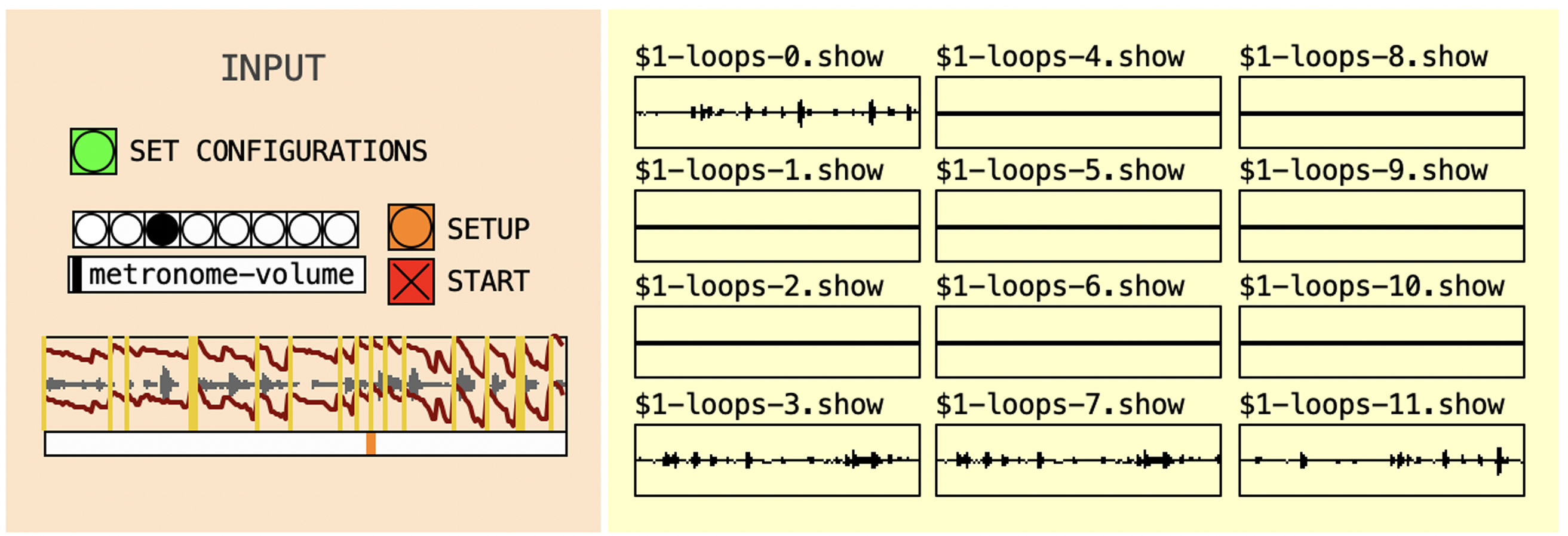
The MAAL has been implemented as both an online and offline system. The online version is a mixed implementation of Pure Data (PD) and Python, while the offline version is fully implemented in Python. In both versions, the system settings are defined in a text-based configuration file using JavaScript Object Notation (JSON) format. In the online MAAL, loop agents dynamically respond to a continuous stream of sound generated by a live musician. The sound of each loop track can be processed separately. The PD Graphical User Interface (GUI), shown in Figure 2, visualises the live input analysis and the content of each looping buffer. Settings such as the agent’s rules, tempo and loop duration are defined in the configuration file. The offline version simulates the agents’ behaviour during the musician-MAAL co-performance by using a pre-recorded audio file simulating the musician’s input to the looper. It generates a separate output audio file for each loop track, with each file containing the sequence of segments selected by the MAAL throughout the entire duration of the input file. Additionally, it produces a JSON file that includes a list of co-performance annotations D, reporting whether segments s[m] are selected or not selected for looping.
GUI of the online MAAL. This implementation provides a maximum of 12 agent-controlled loop tracks.

3.2. Personalisation based on genetic algorithms
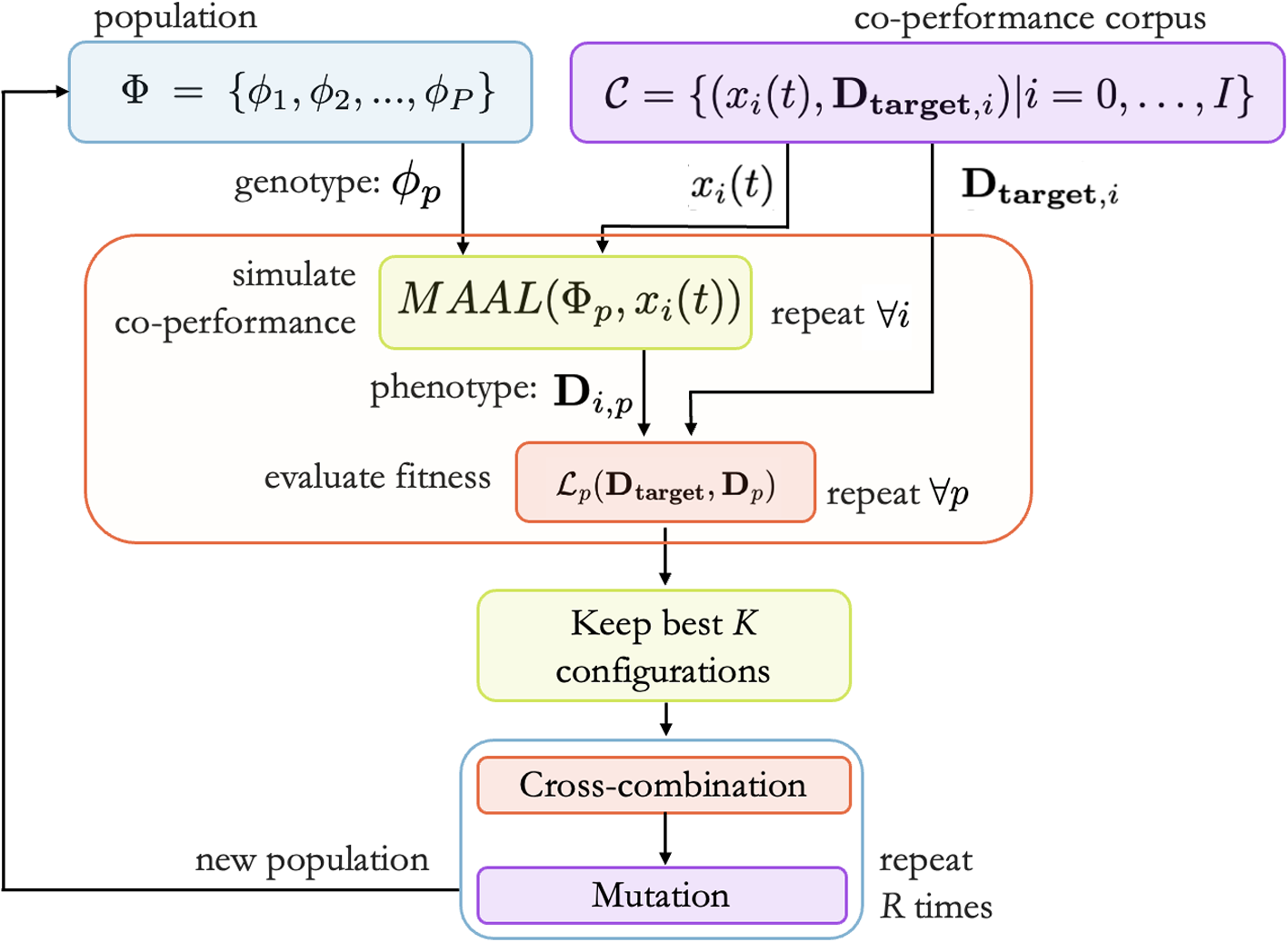
The personalisation method we propose, when applied to the MAAL specifically, configures the agents’ rules according to the user’s preferences. We developed an approach that derives these rules from a small corpus of co-performance examples indicating the collective behaviour the MAAL’s agents should produce in response to specific user inputs, identifying which segments of the input should be selected for looping and, consequently, which decisions the agents should make. The objectives of corpus-based automated rule discovery are providing an overall more accurate, efficient and accessible way to obtain desired behaviours compared to manual rule definition. Automated rule discovery could make the system more robust to diverse sounds in the musician’s palette, enhance the system’s autonomy and enable discovery of novel configurations inspiring the musician’s creativity. These aspects are discussed among the results of the user study in Section 6. A summary of the GA optimisation process is illustrated in Figure 3.
Dataflow chart illustrating the GA process. At each iteration, configurations ϕ p are used to simulate performances using the sound recordings x i(t) from the co-performance corpus and the offline MAAL. Agents’ decisions Di,p in the simulated co-performances are then compared to the target decisions Dtarget,i from the corpus. The configurations obtaining the best fitness score across all co-performances in the corpus are selected and used to produce a new population through cross-combination and mutation. The iteration stops when one or more configurations achieve a fitness score above a threshold or when the maximum number of iterations is reached.

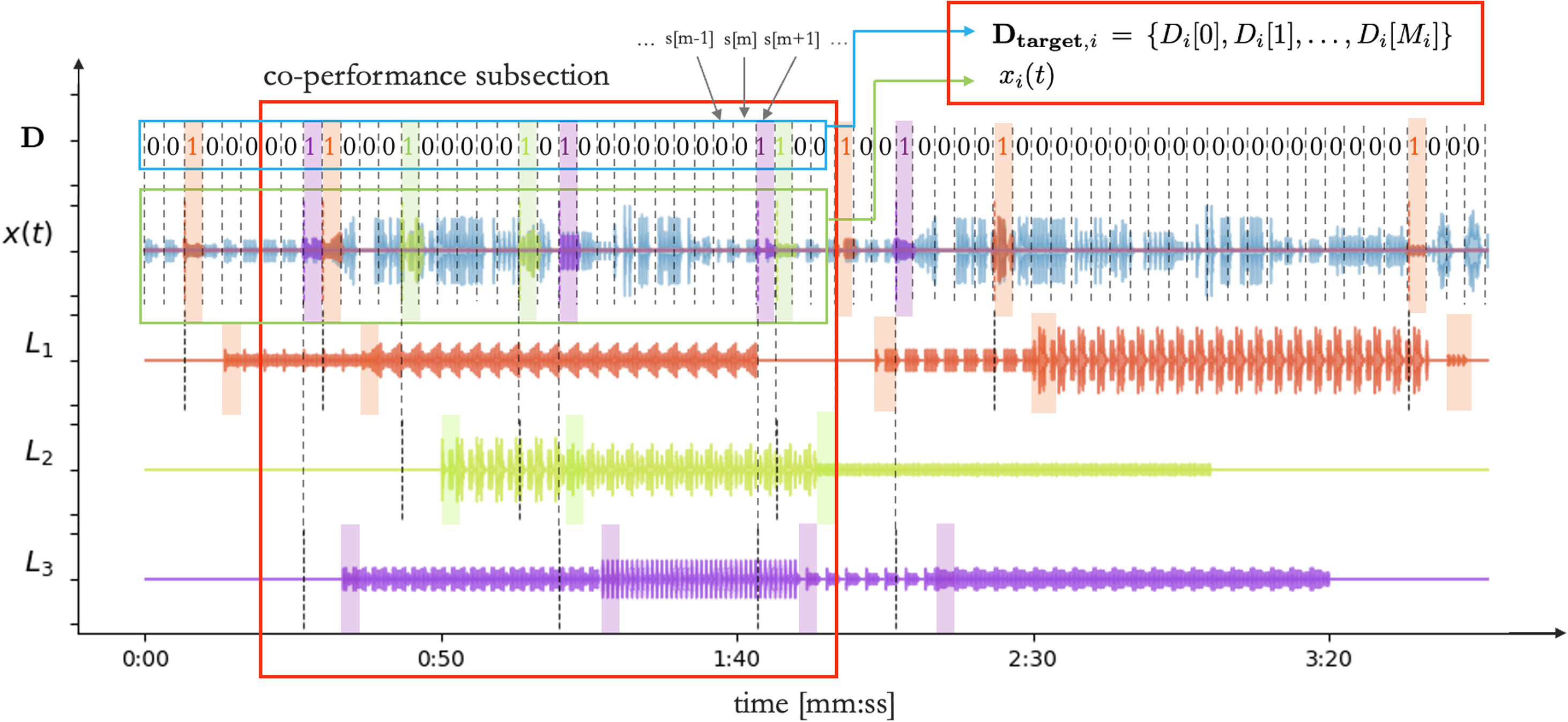
Co-performance corpus. The GA search is based on a corpus C composed of I co-performance examples provided by the musician. Each example i is an annotated co-performance, which includes an audio file of the musician’s performance x i(t) – representative of the musician’s style and instrument – along with annotations Di-describing the decisions the co-improvisation system should make at any point in time; in the case of the MAAL, decisions annotations report which segments s[m] should be chosen for looping at each time step m of the sound file. These annotations can be produced in various ways, as detailed below in Section 3.3. The annotation is a binary array Dtarget,i = {D i[0],D i[1],…,D i[M i]}, where D[m] ∈ {0,1} indicates which segments s[m] of the performance x i(t) are selected for looping. Each element of the array corresponds to a segment s[m] in x i(t), with a value of 1 if the segment at time step m is selected for looping and 0 if it is not selected. Examples can have varying total durations M i. Each entry in the co-performance corpus C is composed of a sound segment x i(t) and its corresponding annotation Dtarget,i, as in Equation (4):
 $$C = \left\{ {\left( {{x_i}\left( t \right),{{\bf{D}}_{{\bf target},i}}} \right){{|}}i = 0, \ldots, I} \right\}$$
Annotations do not specify on which MAAL track the segment is intended to be looped. This enables the learning of a set of rules that can be applied to different numbers of agent-controlled loop tracks, simplifies the annotation process and gives the MAAL freedom to discover diverse rule populations. These rule sets, while satisfying the binary annotations, can yield varied segment – track allocations, leading to diverse layerings and macro-structures in performance and, in turn, providing the system with collective creative agency. To compute the input segmentation, the fixed tempo and loop duration T u must be provided.
Population. The GA process consists of a search over a population Φ = {ϕ 1,ϕ 2,…,ϕ P} of configurations, where a configuration ϕ p = {ρ 0(),ρ 1(),…,ρ N()} is composed of a rule set ρ n() for each track n of a MAAL with N loop tracks, and P is the population size. The initial population of configurations is generated randomly, with each loop track associated with only one rule r() = {c(),τ,ξ}, with c(),τ,ξ extracted randomly. An individual configuration ϕ p is a set of rules for each track, such as in the example of Table 1. Each individual ϕ p is used to simulate the behaviour of the MAAL for each sound example in the corpus, utilising the offline implementation, which records the looping decisions Di,p made for each x i(t) in the corpus in an annotation file. These decisions are made by the agents in accordance with the rules defined by the configuration ϕ p. In GA terminology, ϕ p represents the genotype, producing a phenotype Di,p as in Equation (4). The decision annotation Di,p contains all the information needed to replicate the behaviour of the MAAL from the input sound x i(t).
 $$MAAL\left( {{\phi _p},{\rm{\;}}{x_i}\left( t \right)} \right) = {{\bf{D}}_{i,p}}$$
Fitness function. The fitness function L is computed by comparing the decision annotation Di,p produced by the offline MAAL against the annotation Dtarget,i of the corresponding corpus track. The fitness function measures the similarity between the two annotations, computing a score between 0 and 1, with a score of 1 indicating identical co-performances. The objective of the GA search is to find, for each loop track, the rule set that maximises similarity across the entire corpus of examples, meaning the system learns rule combinations that select the same segments as the user-selected annotations. This is done by computing a logic ‘and’ operation, as in Equation (5).
 $${L_p}\left( {{\bf{D}}_{{\bf{target}}},{{\bf{D}}_p}} \right) = \frac{1}{I}\mathop \sum \nolimits_i^I \frac{1}{{{M_i}}}\mathop \sum \nolimits_m^{{M_i}} {{\bf{D}}_{{\bf{target}},\;i}}\left[ m \right] \wedge {{\bf{D}}_{i,p}}\left[ m \right]$$
In contrast to directly comparing audio, we compare system decisions resulting in equivalent changes to the audio. Decision annotations are more lightweight and computationally efficient than audio comparison, less error-prone, and they allow for the generation of more diverse solutions that satisfy the same requirements.
Cross-combination and mutations. After computing the fitness of each individual, the K individuals with the highest fitness score are selected, and an offsprings of P new individuals with new configurations ϕ p are generated by cross-combining two randomly selected elements from the configurations of the K best individuals and computing R mutations over the resulting configuration. Cross-combination consists of substituting the rule set associated with a random track of a randomly selected agent in a configuration with the rules associated with a randomly selected agent in a different configuration. Six distinct mutations are possible, which are randomly selected with different probabilities. More than one mutation per iteration is possible for each individual. The possible mutations are (1) add a new random rule to a random track, (2) remove a rule randomly from a random track, (3) substitute a random rule in a random track with a new one randomly extracted, (4) increase the threshold of a random rule in a random track by 0.1, (5) decrease the threshold of a random rule in a random track by 0.1 and (6) reverse the comparison coefficient of a random rule in a random track. Mutations are computed, ensuring that there is at least one rule for each agent and that threshold values remain between 0 and 1.
Optimisation loop. The search process is repeated using the offspring as a new population. The search ends either when the fitness score of the best configuration exceeds a threshold or when the maximum number of iterations is reached. In most cases, depending on how the corpus has been generated, rule combinations that reach the maximum fitness score – making exactly the same decisions found in all examples of the user-provided corpus – are not possible; therefore, a sub-optimal solution must be accepted.
Search parameters. Optimal parameters for the search process depend on the variety of the materials in the corpus and on the cumulative number
 $$M = \mathop \sum \nolimits_i^{} {M_i}$$
of segments s[m] of each example track. The global parameters of the GA are the maximum number of iterations, the threshold for the fitness function and the probabilities of each mutation type. Heuristic experiments suggest that, with a corpus size of around M ≈ 50, appropriate parameters seem to be a threshold of 0.9, a maximum of 60 iterations, with a population P = 16 individuals and K = 2 best parent configurations kept, and R = 8 mutations at each iteration, with a higher probability of mutations (4) and (5) with respect to the others, to favour adjustment of thresholds to the musician’s sound materials. K = 2 parent configuration can be considered a low value for a typical genetic search; however, with a relatively large number of mutations, it tends to reach satisfactory values of fitness in relatively fast search times (3–4 hours). GA results obtained with these hyperparameters can more easily get stranded in a local minimum of the vast search space, a sub-optimal result; increasing K would make the GA result more robust; however, it would significantly increase the time needed for convergence. The search for optimal agent rules using the described genetic algorithm is implemented in Python, utilising multithreading to accelerate computation by enabling the simultaneous execution of multiple offline MAAL simulations.
3.3. Corpus collection
Looping decisions in a live context depends on the specific moment at which they are made, making it challenging to predict how segments would sound when looped together, whether those decisions will make musical sense in context and how the musician would respond to them during a performance. We developed two separate data collection methods that allow us to record decision-making during live looping performances and then select sections of these performances that represent behaviours the user would like to replicate.
The first data collection method employs a custom-made, manually controlled looper implemented in PD. The custom non-autonomous looper creates an annotation of the looping decisions Di as the musician plays and controls the manual looper, while simultaneously recording the live sound generated by the musician. This results in a pair consisting of a sound file and a decision annotation that can be used to mimic an ideal MAAL co-performance. In this way, musicians can explicitly indicate which materials to loop. Another way to collect data is by producing an annotation Di while using the online MAAL. The online MAAL produces an annotation of the looping decisions while the musician is playing, in a format identical to that produced by the custom non-autonomous looper.
These two data collection methods produce identical Di formats, which can both be used as part of the corpus for GA optimisation. After collection, users can visualise each co-performance as shown in Figure 4, listen back to it and select subsections of each co-performance in which they find the global musical structure most interesting by indicating start and end timestamps. The software then computes the closest m to the user-provided start and end timestamps and slices x i(t) and Di accordingly. The newly obtained subsection of the co-performance is added to the search corpus. In this way, users can select behaviours they want to promote and remove behaviours they don’t appreciate.
Example of visualisation of a co-performance. The red box indicates the section of the co-performance the musician chooses to be included in the corpus used for GA optimisation. x(t) visualises the live performance of the musician, while loop tracks L n portray the content of each loop track during performance. D shows the content of the annotation vector, which is 1 for segments s[m] selected for looping and 0 for segments not selected.

Figure 4. Long description
Panel A: A line graph visualizing a co-performance. The horizontal axis represents time in minutes and seconds, ranging from 0:00 to 3:20. The vertical axis represents different data lines. The graph includes multiple data lines labeled as x(t), L1, L2, and L3. The x(t) line visualizes the live performance of the musician, while L1, L2, and L3 portray the content of each loop track during performance. The red box indicates the section of the co-performance the musician chooses to be included in the corpus used for GA optimisation. The content of the annotation vector is shown as a series of 1s and 0s, where 1 indicates segments selected for looping and 0 indicates segments not selected. The graph shows various trends and patterns in the data lines, with the red box highlighting a specific section of interest.
4. Evaluation methodology
We have designed and conducted a study to evaluate musicians’ experiences with the MAAL. The study aims to qualitatively understand how musicians interpret the system’s aesthetic decisions during performance and to evaluate the system’s ability to adapt to their personal styles.
4.1. Participants
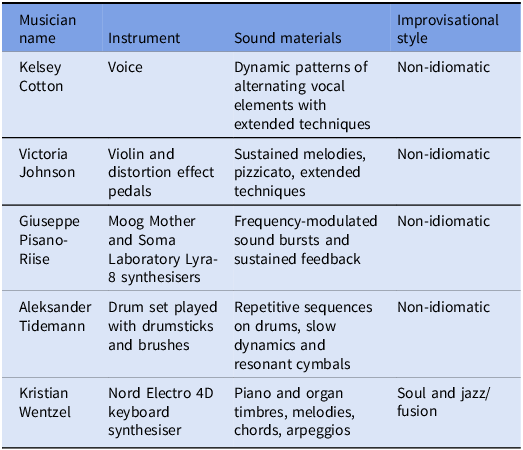
Our study aims to highlight the co-adaptation of musicians and the MAAL. For this reason, we opted to conduct a user study with a relatively small number of participants, emphasising each participant’s uniqueness rather than generalising results across many standardised studies. Five professional musicians were selected to participate in this study. All are expert improvisers and active performers in the music scenes of Norway and Sweden. We chose expert improvisers because they have a defined long-term practice, with well-defined styles, instrumentation and specific aesthetic preferences. The study was conducted by the first author at the Department of Musicology at the University of Oslo. All participants voluntarily agreed to have their identities disclosed in this article. Participants’ instrumentation and style are summarised in Table 2.
Information about user study participants

Table 2. Long description
A table summarizing musicians’ instruments, sound materials, and improvisational styles. The table has five rows and four columns. The columns are labeled ‘Musician name’, ‘Instrument’, ‘Sound materials’, and ‘Improvisational style’. Row 1: Musician name, Kelsey Cotton; Instrument, Voice; Sound materials, Dynamic patterns of alternating vocal elements with extended techniques; Improvisational style, Non-idiomatic. Row 2: Musician name, Victoria Johnson; Instrument, Violin and distortion effect pedals; Sound materials, Sustained melodies, pizzicato, extended techniques; Improvisational style, Non-idiomatic. Row 3: Musician name, Giuseppe Pisano-Riise; Instrument, Moog Mother and Soma Laboratory Lyra-8 synthesizers; Sound materials, Frequency-modulated sound bursts and sustained feedback; Improvisational style, Non-idiomatic. Row 4: Musician name, Aleksander Tidemann; Instrument, Drum set played with drumsticks and brushes; Sound materials, Repetitive sequences on drums, slow dynamics and resonant cymbals; Improvisational style, Non-idiomatic. Row 5: Musician name, Kristian Wentzel; Instrument, Nord Electro 4D keyboard synthesizer; Sound materials, Piano and organ timbres, melodies, chords, arpeggios; Improvisational style, Soul and jazz/fusion.
4.2. Study procedure
The study was structured into two separate sessions, each lasting three to four hours, conducted on different days with a maximum interval of one week between them. The methods included a combination of semi-structured interviews (Adams Reference Adams2015), stimulated recall (Dempsey Reference Dempsey2010) and think-aloud protocols (Charters Reference Charters2003).
At the beginning of the first session, participants were asked to describe their musical experience, focusing on their approach to improvisation and their instrumental setup.Footnote 2 After, musicians were introduced to the MAAL and the custom non-autonomous looper used for data collection. They were then asked to perform an improvised performance using the PD custom non-autonomous live looper, configured with four looping tracks and operated via a Musical Instrument Digital Interface controller. Subsequently, musicians were asked to perform two improvised performances with the MAAL. The MAAL had two different baseline configurations in these two sessions, equal for all participants, designed by the authors as a baseline adaptable to many instruments and styles. The first configuration was oriented to capturing melodic and harmonic relations, while the second one was focused on rhythmic and timbral relations. The two baseline configurations are available in the supplementary materials of this article. Multi-track recordings of these performances, including the musicians’ sound and co-performance decision annotations, were collected and stored. Finally, musicians were asked to listen back to their two co-performances with the MAAL and to their performance with the non-autonomous looper, visualising the annotations as in Figure 4 and selecting subsections of them to create their personal corpus for the GA to determine the MAAL’s rule set.
The co-performance corpus selected by the musician during the first session was used to run the GA, resulting in two personalised MAAL configurations of agent rules, ϕ 1 and ϕ 2. During the second session, musicians were asked to perform with the two personalised configurations of the MAAL and to compare their experiences. Musicians were asked to choose the configuration they preferred among the two and use it to film two co-performances, this time with the option of adding more loop tracks duplicating some of the existing rules. Videos of the preferred co-performance of each musician are included in the supplementary material of this article.
Throughout the whole study, all participants were limited to four loop tracks and a T u = 8 beats at a tempo of 120 beats per minute. All performances had an approximate duration of 10 minutes. The complete MAAL implementation allows selecting different loop durations per track through parameter T l; for comparability, in all the user studies we set T u = T l. The sound from each of the four loop tracks was panned at equal intervals from left to right between two stereo speakers, and participants did not have the option to process the sound of the MAAL in any way, including volume and panning.
5. Results
We analysed the interview transcripts using thematic analysis (Braun and Clarke Reference Braun, Clarke and Maggino2024), investigating video and musical materials alongside the musician’s comments about them.
5.1. MAAL personalisation
Participants selected sections of their co-performances with the custom non-autonomous looper and MAAL as part of their co-performance corpus. When listening back to their performances, musicians chose sections based on the musical relations between segments and chose to discard sections in which the MAAL had selected unappreciated materials or introduced new materials at the wrong moment.
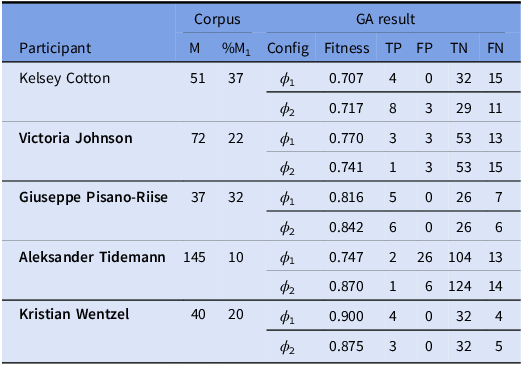
The results of the GA search are detailed in Table 3. As the table shows, participants collected corpora of significantly different sizes, M and %M1, indicating the portion of the corpus in which they desired the MAAL agents to select specific segments for looping. As expected, the GA’s convergence appears to be affected by both M and %M1. The table also presents figures for true and false positives (TP and FP) as well as true and false negatives (TN and FN) generated when simulating MAAL behaviour with the offline implementation using the GA-generated configurations ϕ 1 and ϕ 2. In this context, ‘positive’ and ‘negative’ refer to whether a looping decision was made, with ‘positive’ indicating that a segment was selected for looping. Meanwhile, ‘true’ and ‘false’ denote whether there is a match or mismatch with the decisions annotated in the user-provided co-improvisation corpus. The percentage of segments selected for looping in the corpus M1 impacts the TP, as the search tends to prioritise solutions that maximise TN if %M1 is too low. While this aspect might hinder the selection of possibly good candidate segments in performance, it reflects aesthetic preferences of participants about the rate at which contents of the looping buffer are updated by the MAAL’s agents. Convergence was also affected by the variety of musical materials and how fast materials change, with corpora composed of more uniform materials like the ones of Wentzel and Pisano-Riise reaching higher fitness scores.
Results of the GA search across participants, reporting the total number M of segments in the corpus, the percentage of segments %M1 annotated with a looping decision of 1, fitness score and the counts of true positives (TP), false positives (FP), true negatives (TN) and false negatives (FN) generated by the offline MAAL simulation over each musician’s complete corpus using the GA-generated configurations ϕ 1 and ϕ 2

Table 3. Long description
A table comparing the results of a genetic algorithm search across different participants. The table has 6 rows and 8 columns. The columns are labeled Participant, Corpus M, Corpus %M1, GA result Config, GA result Fitness, GA result TP, GA result FP, GA result TN, and GA result FN. The rows are labeled with the names of the participants: Kelsey Cotton, Victoria Johnson, Giuseppe Pisano-Riise, Aleksander Tidemann, and Kristian Wentzel. Each participant has two configurations, phi1 and phi2, with corresponding values for fitness, true positives (TP), false positives (FP), true negatives (TN), and false negatives (FN). Row 1: Kelsey Cotton, 51, 37, phi1, 0.707, 4, 0, 32, 15. Row 1: Kelsey Cotton, phi2, 0.717, 8, 3, 29, 11. Row 2: Victoria Johnson, 72, 22, phi1, 0.770, 3, 3, 53, 13. Row 2: Victoria Johnson, phi2, 0.741, 1, 3, 53, 15. Row 3: Giuseppe Pisano-Riise, 37, 32, phi1, 0.816, 5, 0, 26, 7. Row 3: Giuseppe Pisano-Riise, phi2, 0.842, 6, 0, 26, 6. Row 4: Aleksander Tidemann, 145, 10, phi1, 0.747, 2, 26, 104, 13. Row 4: Aleksander Tidemann, phi2, 0.870, 1, 6, 124, 14. Row 5: Kristian Wentzel, 40, 20, phi1, 0.900, 4, 0, 32, 4. Row 5: Kristian Wentzel, phi2, 0.875, 3, 0, 32, 5.
On the first day of the study, when playing with the two non-personalised versions of the MAAL, musicians often struggled with unpredictability and with unwanted behaviour such as too much inactivity, wrong timing or selection of unwanted materials. Personalisation in most cases achieved a baseline of adaptation that ensured that rules were more aligned with the timbre of the musician’s instruments. Most GA solutions were considered consistently better by musicians with respect to non-personalised versions. Few of them – even with high fitness scores – were still considered non-satisfactory, exhibiting unwanted behaviours such as too much inactivity (ϕ 1 with Wentzel’s corpus) or selecting sounds that were considered too random (ϕ 2 with Tidemann’s corpus). When comparing the two versions resulting from the GA, musicians often clearly preferred one version over the other, with the preferred version not always being the one obtaining the highest fitness score. While personalisation appears effective, the resulting behaviours can differ greatly from one another, and the GA process can sometimes generate configurations that do not behave satisfactorily.
5.2. Theme I: experiencing agents’ decisions
Decisions made by the agents in the MAAL were interpreted by performers in varying ways while performing. We can distinguish between incremental decisions and transformative decisions. A decision by the MAAL was interpreted as incremental if the selected loop supports the current structure composed of other ongoing loops, while transformative decisions drastically alter the course of performance, recontextualising ongoing loops and prompting the performer to change their behaviour. This distinction was highlighted by a participant who remarked, after listening back to a performance with the MAAL:
It really depends, the first [MAAL decision] really pushes me to think, it reaps me out of my mindset and forces me to think anew, but the other [MAAL decision] is more like I’m building up on one. It’s two approaches. (Wentzel)
These different interpretations of agents’ decisions influenced how musicians responded to them. For instance, it affected their perception of their role within the co-creative system; sometimes they viewed themselves as a soloist performing over a background constructed by the agents, while at other times they identified as a collaborator contributing materials to create a larger musical texture or as a discursive partner interacting with various elements of the loops:
It goes into these kinds of different roles; sometimes it’s foreground, sometimes it’s background, but sometimes it feels more like an interaction. (Johnson)
The role chosen by the musician at different moments of the co-created performance seemed to be based on adapting to the musical structures developed by the MAAL, while also reflecting a general idea of direction for the overall performance. Nevertheless, the MAAL’s decisions could significantly change the musicians’ plans. This unpredictability is part of the MAAL’s design, and musicians mostly welcomed it as a source of creative inspiration, although it was sometimes considered frustrating, forcing them to steer the performance into a direction they were not planning for previously.
5.3. Theme II: personalisation and the system’s aesthetics
The MAAL embodies the typical aesthetics of a live looper, where the durations of the loops constrain the entire performance into repeated segments of specific duration. Additionally, in the MAAL, the interactions among the agents exhibit distinct aesthetic emergent tendencies characterised by self-organisation (Heylighen Reference Heylighen2008); the global system tends to oscillate between states of equilibrium, where looping segments form clusters that adhere closely to the rules and states of rapid changes, in which agents search for equilibrium. As noticed by Tidemann (Sound_example_1.m4a), this affects the macrostructure and the form of the improvised performance. Musicians utilised these emergent characteristics to navigate between different sections of a performance, as described by one participant:
[…] then I want to calm it down, maybe play some tones, and suddenly they are recorded, and you have another landscape. (Johnson)
In this co-creative scenario, the interactions between the musicians and artificial agents can be described as a co-agency feedback loop. At the meso-level, the MAAL’s decisions are limited by the material the musician plays, and musicians choose what to play based on expectations of what could be selected by the MAAL, as further described in Section 5.4. At the macro level, the form of a live looping performance depends on the rate at which looping segments are overdubbed and when they stop; this aspect too is determined by musicians’ choices of what is played at certain moments.
The personalised MAAL was expected to replicate collective behaviours found in the corpus. When selecting materials to create the corpus, musicians had chosen specific moments of their previous co-performances, such as a sparse polyrhythmic violin pizzicato section (Johnson, in Sound_example_2.m4a) or high-pitch piano arpeggios accompanied by lower-pitched organ chords (Wentzel, in Sound_example_3.m4a). These behaviours were replicated effectively by the MAAL configured using GA results, offering the artist familiar environments within which they could improvise. Musicians recognised some of these behaviours during the second day of study, and such similarities are evident when comparing the corpus used for GA search against the co-performances recorded on the second day of study.
5.4. Theme III: listening, responding and planning
When performing with the MAAL, musicians’ decision-making was influenced by uncertainty regarding whether the sounds they produced would be captured for looping. This aspect could have the effect of creating pressure over each decision, as reported by Cotton (Sound_example_4.m4a):
The loss of control […] forces me to be much more thoughtful and intentional: you don’t quite know how it’s working, so every sound really needs to matter because it might be the sound that you are hearing back for however many bars. (Cotton)
The system’s unpredictability shifted the musicians’ focus from planning to listening and responding, as participants remarked when comparing their experience with the non-autonomous looper to that with MAAL. While the MAAL can alleviate the cognitive load of a musician by eliminating the need to plan what to play in a segment before recording it for looping, the uncertainty regarding which materials will be selected made participants more attentive to their choices. One participant compared this dynamic to a ping-pong match (Pisano-Riise, as in Sound_example_5.m4a), reflecting on how the timing of his response to a newly selected loop influences the aesthetic outcome:
I don’t know exactly what [the MAAL] got, how the new recorded gesture will sound like. So I bet: do I respond with a new gesture right away, with the risk of not knowing how they would sound like [together], or do I wait, I see how the new loop sounds like, and I react afterwards? (Pisano-Riise)
This approach to responding, combined with musicians’ focus on macro-temporal aspects such as background and foreground and performance sections, suggests that musicians simultaneously adopted the role of an agent within the co-creative system and of a manager/curator of the overall performance. Consequently, a musician’s action could serve the triple purpose of responding to the immediate musical environment, proposing new materials for sampling and steering the MAAL towards the musician’s long-term goal.
6. Discussion
The automation of sampling and looping seemed to stimulate responsive creativity based on listening, as a source of inspiration and a way to foster novel ideas, because the MAAL’s decisions layered segments they might not have selected if they had control. The MAAL changed musicians’ approach to planning and their thinking about form, facilitating serendipitous decisions and exploration of unexpected co-created structures. The main design limitations of the system were considered the confusion that could sometimes arise from the agent choosing unwanted materials and, consequently, the lack of explicit controls able to steer the MAAL’s behaviour at the macro-level instantaneously, such as eliminating unwanted segments or impeding the update of a loop track.
Overall, personalisation seemed effective in removing some of the randomness that made the experience with the non-personalised version of the MAAL sometimes confusing, and in all five cases the GA search was able to generate at least one configuration considered better than the non-personalised version. The role of personalisation appears to be the definition of a focused selection niche of behaviours for the musician to navigate during performance. Constraints are fundamentally important in artistic and creative practice (Magnusson Reference Magnusson2010; Feiten et al. Reference Feiten, Peck, Holland and Chemero2023), and musicians’ being able to intuitively understand the constraints of the system’s behaviours might be beneficial to the creativity of agents’ and musicians’ decisions.
The way the MAAL can layer the segments is constrained by its configuration, which represents a shared influential agency between the system designer – who imposes its fundamental limitations – and those who selected the rule sets. The perception of the MAAL’s influential agency appeared to shift throughout the performance. When playing with the MAAL, musicians took on a dual role of agent within the system – as when performing with other human musicians – and of manager/curator of the system – a role typically taken on in live process-based music (Sanfilippo Reference Sanfilippo2023). The perception of this role appeared to be influenced by the musicians’ judgements regarding the agents’ decisions, with musicians interpreting the MAAL behaviour as accompaniment, interaction or foreground. Personalisation appeared beneficial for musicians, as it seemed to make the agents’ actions more intuitively understandable.
7. Limitations
The main limitation of our study is that it doesn’t clarify how much of the increased trust in the system was the result of repeated practice with it. As musicians acknowledged, their growing experience with the MAAL certainly influenced their final opinions. At the same time, the chaotic and emergent characteristics of this specific co-creative system make each co-performance unique by design, making experiments not easily repeatable. Musicians expressed clear preferences over certain configurations with respect to others on both days of the study and reported consistent experience when playing repeatedly with the configuration used for filming, showing that system configuration played indeed an important role in the co-performance experience. The personalisation system based on GA we propose in this article can theoretically be applied to any system that can be configured using a parameter set ϕ, whose behaviour can be described by a decision annotation D and simulated using an offline version of the live system using a sound track x(t) as an input. Testing on different co-improvisation systems is necessary to appraise this method’s potential, and a more comprehensive investigation is needed to understand the technical affordances and limitations of the GA approach, such as the optimal corpus size and other factors affecting GA convergence.
8. Conclusions
In this article, we introduced a novel method for personalising a co-improvisation system using a user-selected corpus of annotated co-performances. We have presented the application of our personalisation method to the multi-agent autonomous looper, and we discussed the findings from a user study involving five expert musicians. Our study suggests that the MAAL seems to be able to stimulate explorative creativity, providing novel musical structures through autonomous association that musicians can alternatively interpret as foreground, background or inviting interactions. Personalisation of the system behaviour assists in eliminating stylistically undesirable actions by constraining the range of the agents’ decisions and creating a shared vocabulary of co-performance behaviours.
Supplementary material
The supplementary material for this article can be found at https://doi.org/10.1017/S1355771826101484.
Acknowledgements
This work is funded by the Department of Musicology at the University of Oslo as part of the first author’s doctoral research fellowship. The research presented herein relies entirely on open-source coding frameworks. We have released the code developed for this project as open-source software to ensure reproducibility. We would like to thank the musicians who participated in the user study for their time and generous creative inputs. Additionally, we thank Joost Rekveld, Derek Holzer and Tejaswinee Kelkar.
Competing interests
The authors report no conflicts of interest.


 Open access

