The royal bankruptcy declared by King Philip II of Spain in 1557 threw the great German banking houses into chaos, ending the Fugger family's role as the Spanish Crown's main financiers. The way was open to new bankers from Genoa, who would take over supplying the Habsburgs with liquidity and a regular income.Footnote 1 The ensuing expansion of the Genoese exchange fairs in Italy was actually the result of two phenomena: the Spanish Crown's continuous demand for gold to fund its expansionist war policies, and the need to transfer the American silver that reached Seville over to the Levant, where most of the silver was actually spent.
The Genoese provided the Spanish Crown with two fundamental services here. The first was the conversion of American silver transferred to Spain into gold that could be used in the Low Countries to pay the king's military expenses. The second was to supply the Spanish Crown with renewable short-term credit. The Bisenzone fairs were central to both processes. The Genoese set up these fictional fairs in the sixteenth century because the existing fair in Lyon had rapidly declined and it was unable to provide the large amounts of finance. At the fairs, the Genoese gathered liquid capital from several Italian states to finance the Spanish king's operations. They then spread the risk among various creditors and made gold available in Antwerp on the king's behalf via bills of exchange that were payable there.
Lending to the king of Spain through these short-term loans (known as asientos) was risky, but the reward was comparatively high.Footnote 2 The Genoese were able to manage this lending successfully for several decades, partly because their overall credit balance put them in a safe position, and partly because Genoa occupied a crucial position along the silver transfer route to the Levant. At Bisenzone, Genoese bankers entered into contact with other markets (such as Milan, Florence, and Venice) where they borrowed short term in foreign currency through the issue of foreign bills of exchange; the loans were frequently renewed and helped spread the risks of the Spanish debt over a wide market. Genoa was linked to Milan because the Genoese had direct control of Milan's finances; Florence's and especially Venice's capital markets were also part of the network, although they were more independent and not directly involved with the asientos.
This article describes the strategic factors that led to the development of the Bisenzone exchange fairs and thus to Genoa's central position in the European finance network. The financial mechanism used in Bisenzone—pactum de ricorsa—represented a significant innovation that went well beyond the process of financing via bills of exchange that Raymond De Roover called “dry exchange.” The success of this mechanism depended on the integration of the Bisenzone fairs with the credit markets in Milan, Florence, and Venice. We test how integrated these markets were, taking into account the different risks the parties bore. On the basis of these results, we paint a general picture of the international capital market in the late sixteenth century and the role that the Genoese played in it.
THE EXCHANGE FAIR OF BISENZONE
In the late sixteenth and early seventeenth centuries, exchange fairs succeeded in raising large sums of money via medium and short-term loans and came to occupy the center stage of the European financial market. The organization of the Bisenzone fairs has to be set within this broader European context.
In Italy there were several other institutions that dealt with credit, including public ones, whose activities were limited to taking deposits, making transfers, and arranging short-term loans for state finance through the giro system. Private firms also acted as banks; their reliability, though, often left much to be desired and their role was rather limited. Moreover, the development of public and private credit financing was strongly influenced by ecclesiastical prohibition of usury.
The Genoese fairs were founded in Besançon (France) in 1535 (hence the name “Bisenzone,” the Italian name for Besançon, which was retained even when the fairs moved) and were transferred to Piacenza in 1579, and later to Novi Ligure. They made it possible both to avoid ecclesiastical censure and to raise loans in a period of great tension. Moving the fairs to Piacenza was responsible for a twofold change in the whole European capital market. First, unlike typical late-medieval fairs, the Bisenzone fairs set up a financial market that was completely independent of commercial activities. Secondly, a relatively restricted group of Genoese bankers succeeded in gaining and holding control over Europe's most important financial mechanisms, and they established themselves as the Spanish Crown's main financial agents until the 1630s.Footnote 3
Despite the huge silver imports from America, the Spanish kings were desperate for money from the reign of Charles V up through the end of the seventeenth century.Footnote 4 They needed gold and silver coins to pay their troops and prevent the mutinies that could easily break out and threatened the progress of the war against the United Provinces if pay was delayed.Footnote 5 To ensure that this money was delivered on a regular basis, the Spanish kings had to rely on advances made by financiers, who were repaid in Spain or, after 1580, in Italy or Antwerp, according to a preestablished exchange agreement. The financiers were also granted the valuable privilege of exporting from Spain an amount of silver equal in value to the sum loaned (licencias de saca). In these transactions (which were known as asientos), the financiers were making a short-term loan to the Crown.Footnote 6 Between 1520–1532 and 1552–1556, the total amount of debt created through asientos increased from 5.4 to 9.6 million ducats, and in the period immediately before 1608—the first year of Spain's truce with the United Provinces—about 68 percent of the money raised through asientos was directed to Flanders. Resorting to asientos was onerous because of the Crown's difficulty in reimbursing lenders on time.Footnote 7 To do so Spain did not actually have to transfer gold, since it piled up in Antwerp because of the healthy turnover of trade in Flanders. Flanders, in fact, had a trade surplus in dealings with northern Europe (Germany and England) and accumulated gold and silver.Footnote 8 Payment in specie could be made straight by the Genoese banker's correspondent in Flanders.
Much of the lending to the Spanish kings was under Genoese control. In the years 1598–1609, direct loans by Genoese bankers to the Spanish Crown amounted to about 33 million ducats, 88 percent of the king's total borrowing.Footnote 9 It was precisely in 1579 that the Bisenzone fairs began to play a crucial role in the international payments system. Thanks to the fairs, the Genoese bankers could trade their credits in Spanish silver for foreign bills of exchange in gold provided by Tuscan, Lombard, and above all, Venetian merchants. The Venetians sought silver because the Rialto market in Venice was one of the most important centers for the redistribution of silver towards the Levant, where silver could be exchanged with gold at a very favorable rate.Footnote 10
The success of the Genoese fairs is proved by their volume of business. In the decades just before and just after 1600, the total value of transactions in one year might reach 40 million gold scudi.Footnote 11 As long as the Spanish were prepared to continue their war in Flanders, Genoa and most of the towns along the Bisenzone transfer route could sell gold at very favorable prices in exchange for silver, and that was one of the factors contributing to their enrichment.
In 1607, however, the Spanish monarchy suspended payments on its debts, and thereafter the Genoese transfer route progressively declined in importance. Because the Genoese financiers were no longer able to meet the Spanish king's continuing and growing needs for cash, he turned to Portuguese bankers, who were willing to fund his ravenous appetite for loans.Footnote 12 The Portuguese replaced the Genoese—although not completely—from 1626 on.Footnote 13 The Portuguese phase of credit supply to the Spanish Crown lasted up to 1650, when the Dutch took over their profits from trade with the Far East and Brazil. The emergence of Portuguese financial support to Spanish royal finance, however, marked the replacement of the Mediterranean financial circuits with a broader system that centered on both Atlantic and Asian trade.
COLLECTING MONEY AT THE FAIRS
The Genoese exchange fairs were forerunners of modern clearing houses, for operators could offset their credits and debits and regulate the balance either by issuing foreign bills of exchange on their creditors or by buying a special currency of account, the Scudo di Marco. Transactions at Bisenzone involved the main markets and currencies of the time, so that the fair provided the forum in which to arbitrage interest rates among the northern Italian states.
The function of the Genoese fairs was not limited to clearing accounts or to currency exchange; it also allowed individuals to extend short-term credit by using bills of exchange. Foreign bills of exchange were the most widely employed means of payment at the time: payment in gold and silver (either coined or bullion) was unsafe and much more expensive.
In its essentials, the classic bill of exchange combined an exchange of currencies, a transfer of assets across space, and a loan, in the sense that one party advanced money that would be repaid after maturity. In its simplest form, the bill of exchange transaction proceeded as follows.
Someone who wanted to borrow money from abroad arranged to receive a bill of exchange made out by the lender's bank. He then presented it to the correspondent of the lender's bank, and the correspondent paid him its value at the fair. The bill of exchange was made out by the lender's bank (the drawer), who got the money in local currency from an investor who wanted to lend money abroad. The rechange transaction simply repeated the exchange transaction in reverse. The receiver of the original bill was now the lender, the original lender became the receiver, and the bill matured at the next fair.
The initial borrower received money for the period he wanted, and at the end of a rechange operation the original lender would have his loan repaid at maturity with interest and in the original currency in which it had originally been conceded. When the obligation matured, it was largely self-liquidating. But the parties to the “loan-via-rechange” could agree to renew it for one or more times. Through “exchange-rechange” the bill of exchange lost any connection with trade and assumed the features of a purely financial transaction.Footnote 14
The Bisenzone fair was held four times a year: the fair of the Presentation at the Temple on February 1st; the Easter fair on May 2nd; the third fair on August 1st, and lastly, the fair of All Saints on November 2nd. Each fair lasted eight days and followed specific procedures. On the first and second day of the fair, each banker established his net balance vis-à-vis the others. All this was immediately sorted out because operations were based on a common currency, the Scudo di Marco, which was a money of account, not a coin. The Scudo di Marco was convertible into gold at a fixed rate, with 100 Scudi di Marco worth 101 gold Scudi delle cinque stampe (namely the Scudi of Venice, Milan, Genoa, Naples, and Castile).Footnote 15
On the third day, the exchange and rechange rates were fixed by the fair's chancellor. The nations participating in the fair elected a panel of bankers, and each of them proposed an exchange rate for every currency. The chancellor set the rate to be used during the fair basing it on the proposals that achieved most consensus: this was called fixing “the exchange or price of account.”Footnote 16 It was at this rate that the exchange bankers started negotiating loans through bills of exchange and rechange operations.Footnote 17
Since the transactions were denominated in a nonexistent currency, they were what was referred to as cambio aereo—literally ethereal exchange.Footnote 18 The overall price of the transaction was settled at the outset, and at bottom the transaction was simply a loan in a foreign currency with a guarantee against short-term fluctuactions in the rate of exchange.Footnote 19 The price of rechange included a return for the lender. The pactum de ricorsa, which formalized the transaction in Genoese law, also allowed bills drawn at one fair to be redrawn automatically at rates established by the fair's chancellor. The pactum de ricorsa, therefore, differed substantially from De Roover's dry exchange transaction, for in the dry exchange the return was not stipulated beforehand, and neither lender nor borrower was able to foresee how the exchange rate would swing.Footnote 20
The operation had additional advantages besides the guarantee that lenders received against exchange rate risks. First of all, even if the transaction constituted in all respects a loan, the two operations—exchange and rechange—were formally independent of each other and involved different fairs and could possibly involve different currencies too. The interest payments were therefore not subject to prohibitions against usury.Footnote 21 As the “rechanges” were repeated, the loans ended up having an average duration of one year, but some might last nearly a decade.Footnote 22 On average, they yielded about 10 percent yearly, and they could grow quite complex, with a variety of currencies and different intermediaries being involved.
Exchange and rechange was a widespread practice. It came to attract not just merchant bankers, but anyone who had cash to invest. As for the borrowers, there is some evidence that governments themselves—the Medici in Florence and the Venetian Senate in the fifteenth century —began to raise money via the rechange contracts.Footnote 23 Their flexibility and appeal explain how the Genoese were able to tap into the entire northern Italian merchant community for funds that could be subsequently loaned to the king of Spain, even though the Spanish Crown frequently rescheduled the payments it owned. The popularity of the instruments also explains why magistrates from both Genoa and Venice defended the pactum de ricorsa against ecclesiastical prohibition.Footnote 24
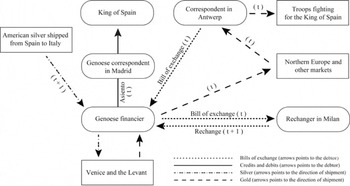
Exchange and rechange thus drew a broad spectrum of savers into the system of international finance.Footnote 25 This was not the first time such contracts had been used—there are examples of these contracts dating back to the thirteenth century—but they became widespread between the mid-sixteenth and the early seventeenth centuries.Footnote 26 The driving force behind their spread was the Spanish Crown's increasing demand for money. International credit and debits, from Florence to Kracow, and from Naples to Antwerp, were efficiently balanced at Bisenzone and Genoese bankers were able to finance their long-run loans to the king of Spain through rechange (Figure 1).
The working of exchange-rechange financing in Bisenzone can be illustrated by analyzing a specific example.Footnote 27 The king of Spain needed to have a large sum of money (500,000 ducats) available in Antwerp, and there were no merchants in Madrid able to carry out the transaction. The king therefore granted an asiento to the correspondent of a Genoese financer in Madrid, as collateral for the loan and arranged for it to be paid in Antwerp on a specific date. The correspondent in Madrid ordered the financier in Genoa to transfer the 500,000 ducats to Antwerp. Because the financier in Genoa could not carry out such a large transaction by itself, he raised the sum at the fair of Bisenzone from other financiers in Milan, Venice, and Florence, thereby spreading the risk among them. The Genoese financier, for example, might receive a bill made out by a Milanese bank on behalf of a Milanese lender; that bill would immediately be accepted by a banker in Genoa, who was the correspondent of the Milanese bank.Footnote 28 The sums raised in this way enabled the Genoese financer to purchase a bill in Antwerp to make the payment originally promised to the king of Spain's representative there. The Milanese lender, on the other hand, was promised an immediate rechange from the financier in Genoa that would mature at the next fair. During that period, the Milanese lender would earn the interest agreed on the pactum de ricorsa. The second part of this operation, the rechange, ended a cycle that in principle lasted a trimester, but that could stretch to several years.
THE PAYMENT SYSTEM OF BISENZONE

The exchange fairs of “Bisenzone” thus served as the stage where all sorts of actors performed, some before the audience, and others backstage. The cast ranged from Genoese bankers, and Flemish and Italian merchants, to the Spanish government in Madrid, imperial soldiers in Flanders, and a number of investors.
EXCHANGE AND RECHANGE
Let us now examine the economics of the exchange-rechange contract. It is an agreement whereby buyers and sellers agree to exchange currencies at the next exchange fair. Lenders are typically bankers acting on behalf of other people, and one reason why bankers enter a rechange contract is that they can be sure of the amount of foreign currency they will receive in exchange for their initial loan. In fact bankers' assets and liabilities in Scudi di Marco largely offset each other.
On the third day of the fair, the bankers calculate exchange and rechange rates. An investor investing in an exchange-rechange agreement has a return (including transaction costs) measured by the difference between the rechange price and the purchase price
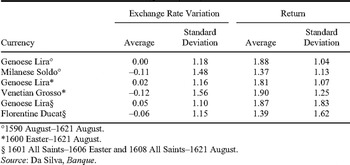
RETURNS AND EXCHANGE VARIATIONS IN VARIOUS CURRENCIES AT BISENZONE (quarterly data)

°1590 August–1621 August.
*1600 Easter–1621 August.
§ 1601 All Saints–1606 Easter and 1608 All Saints–1621 August.
Source:
Da Silva, Banque.

where  is the rechange rate (calculated at the time t and referring to the next fair, t+1) in Lira Genoese (LG) per Scudo di Marco (Sc);
 is the spot exchange rate at the current fair,
 is the return, and where borrowing is conducted by drafting bills in Scudi di Marco.Footnote 29
Table 1 presents the returns for the currencies for which we have a larger and more complete data set, Lira and Soldo Milanese (SM).Footnote 30 The starting point (the 1590 Presentation fair) reflects data availability, and the end point (the 1621 All Saints fair) is the last fair before their transfer to Novi Ligure.Footnote 31 The average quarterly rate of return in these currencies was 2 percent, and there was no trend in the exchange rate in the long run towards the debasement of either currency. The exchange rates' short-term deviations were not insignificant and were the result of several factors: current account imbalances, current conditions of the money market, rumors about the currencies' legal parity, or fears that the silver shipped to Spain might not arrive by the bills' maturity.
Rechange can be viewed as a risky short-term operation, since the fairs' exchange rates fluctuated, according to movements in the value of the different metallic currencies, but exchange rate variations from fair to fair over the long run were, on average, close to zero (Table 1) so that the average gain or loss on the exchange was nil.Footnote 32
The fair's term exchange rate was not independent of the spot market rate of exchange, and the exchange-rechange contract was usually provided with an escape clause, which allowed the debtors to abandon the obligation and pay cash if rechange at the agreed price were to prove too expensive owing to a decline of the market price over time.Footnote 33 It was, in fact, always possible to cut short the bill of exchange operation and buy the currency needed to pay off the debt on the spot market.Footnote 34 Cash payment did have cost, a premium over and above that of bank money: this cost included transport fees; a commission paid to the cash broker, who purchased the necessary specie; and sometimes a tax as well. The exchange rate at the fair might differ from the market rate of exchange, but not systematically so and only to a limited extent: had the market rechange rate and the next fair's market exchange rate diverged significantly, the entire loan operation would have been truncated by the debtor and would eventually have collapsed. The cambio aereo and the market rate of exchange could not drift far apart.
BISENZONE, A GENOESE INSTITUTION
The Genoese dominated the fairs. The fairs' consul and magistrate were Genoese, although they were assisted by representatives from Milan and other markets, and a majority (two-thirds) of the advisors and of the judges of the Court of Appeal were Genoese.Footnote 35
The bankers were predominately Genoese too. Although there were only a limited number of bankers at the fair, they dealt not just on their own account but on behalf of many other debtors and creditors who were not themselves present at the fair. The fair's clearing system thus acquired a very wide scope and a large turnover. The bankers had powerful political supporters and were required to make large security deposits.
Payments in specie at the fairs depended on the arrival of silver and gold from the American mines. If the specie arrived late, as it often did, the fairs were delayed; in the most severe cases, a moratorium would be declared by the magistrate, postponing payments to the following fair, with a modest return set for the delay. Such a moratorium was clearly favorable to Genoese debtors and damaging to their creditors.Footnote 36 The same was true for the short-term extension of the fairs.Footnote 37
Yet in the end the delays only affected the fairs marginally, because the precious metal would eventually arrive and also because only a minor part of the debt was settled in coins. As the fairs grew and involved more and more transactions, it became easier to find trades that would offset one another and make cash payments unnecessary. In their heyday, the Genoese fairs, as compared with the other fairs, had the highest proportion of such offsetting transactions relative to total payments.Footnote 38
EQUILIBRIUM INTEREST RATES
To succeed at the fairs, a banker had to estimate the future movement of the various exchange rates, in both his own city and other commercial and financial centers. He had to borrow sums in order to arbitrage the divergences between the different exchange rates, which corresponded to the vagaries in the demand for credit: a fall in the local rate or an increase in the foreign rate would increase the lender's profit and vice versa. The banker, therefore, had to be aware of the seasonal tendencies of the most important money markets, and at the same time had to keep up to date with any news that might influence the exchange rate in the short term. At an exchange fair, the banker had the opportunity to deal in various currencies chosen on the basis of the market where the bills of exchange were paid. The prices of exchange and rechange were a function of market “ease” (larghezza) or “tightness” (strettezza), and reflected the conditions in the local money market.
The demand for foreign exchange for this purpose would depend not only on the interest rates in the two currencies, but also on the expected rate of exchange at the investment's maturity. If the foreign currency appreciated in value, the investor would make a profit and vice versa.
The bankers, as we have noted, did not only raise money in Genoa itself. It came from other parts of Italy too—Venice, for instance, where large sums were invested via Genoese and Tuscan bankers active at the exchange fairs.Footnote 39 If this market was competitive, then any investor in it would have to deal with both domestic and foreign investments and multiple currencies in different markets; he would expect to earn the same rate of return, regardless of the currency in which the investment was made.Footnote 40
To see what that condition entails, let us examine the exchange-rechange between time t and time t+1 (in other words, the next fair). On average rechange transactions were renewed for four or five fairs. Such repeated transactions can be considered as the iteration of one elementary operation between two successive fairs.
Imagine the case of an investor who has the option of investing his money in exchange-rechange in Lire Genoese or in Soldi Milanese, of similar risk and maturity. If he regards the two rechanges as equally risky and can switch between them without cost, the only difference between the two financing operations is the currency of denomination and the implicit interest attached to them. In fact, the return of a financing operation embeds a compensation for possible exchange rate variation and remuneration for lending the money, i.e., interest. Assuming that the initial financing is in Lire Genoese, which are converted into Scudi di Marco and ultimately paid out in Lire Geneose, and that the alternative financing is in Soldi Milanese via Scudi di Marco. Directly from equation 1, taking into account two currencies, the Genoese Lira and the Milanese Soldo, arbitrage over the two currencies requires the equalization of the returns, or the equalization of the returns in the two currencies,  , J=LG, SM, taking into account the exchange rate variationsFootnote 41

What the equation says is that if a Lira was invested in Bisenzone for three months, then the return, after the Lira had been converted into Scudi di Marco, and finally reconverted back to Lira, would equal the return from a Milanese Soldo invested in Bisenzone for three months, after converting it to Scudi di Marco at the fair exchange rate and back into Soldi. If the exchange rates do not change in the long run, as suggested in Table 1,  and under perfect capital mobility, for a given level of risk, interest rates are equalized.
Transactions in different currencies might not diverge in general terms from profitability in Lira, because the correspondents of the Genoese bankers were active in all the important currency markets. They knew the markets and could trade in different currencies for a modest commission. For example, a Genoese financer who wanted to raise sums in Milan in Soldi had to pay several commissions, but the overall cost was modest: a commission on rechange of 0.33 percent and another one for the agents and correspondents abroad that was usually somewhere between 0.25 and 0.50 percent.Footnote 42 An example quoted by Jose-Gentil Da Silva suggests that the cost of borrowing in a currency which was not the borrower's currency, could add between 1 and 2 percent to the cost of borrowing, subject to variations depending on the amount transacted.Footnote 43 The commission included trading costs, costs for attending the fairs, and costs for information, and was paid by both the Genoese, who transacted in Soldo, and by the Milanese, who transacted in Lira. Its magnitude was influenced by rumors on market crisis, transaction costs, and the decisions by the fair's authorities.
The commission created a no-transaction band around parity and allowed for some margin of variation of the rate of exchange. If the interest differential stayed within the no-transaction band, capital would not flow between the different markets, and at the agreed prices there was no room left for competitive arbitrage between different currencies, taken two by two.
A TEST OF THE INTEGRATION BETWEEN CAPITAL MARKETS
Did the Bisenzone fairs integrate capital markets? We can answer the question by examining the patterns of interest rates on exchange operations for Genoa, Florence, Milan, and Venice during the years 1590 to 1621; again we assume that exchange rates are stable in the long run, so that we can ignore the term in parentheses on the right hand side of equation 2. The correlation coefficients among interest rates computed on bills of exchange in different fairs suggest that rechange operations between Genoa, Florence, and Milan were highly interdependent. We can push the analysis further by taking into account the risks connected to different markets and currencies; that exercise reveals the different roles played by the various Italian financial centers.
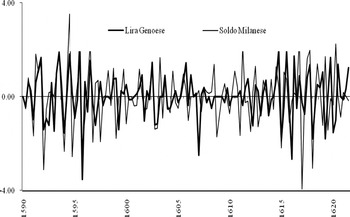
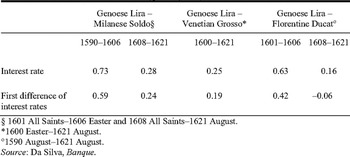
We begin by looking at the correlation between the interest rate on Genoese Lira and Milanese Soldo, Genoese Lira and Venetian Grosso, and Genoese Lira and Florentine Ducat. Interest in Milanese Soldo and Florentine Ducat are positively correlated with that in Genoese Lira, except for a couple of periods. The correlation remains fairly strong if we look at first differences of interest (Figure 2, which shows the correlation for Genoese Lira and Milanese Soldo). A crisis in 1606 did weaken this connection between Genoa and Milan; brought on by a delay in silver shipments and a suspension of payments by the king of Spain, it also cut Bisenzone's interest rates loose from Florence's (Table 2). The correlation between the Genoese Lira and Venetian Grosso remained weak throughout, suggesting greater separation between these two markets.
Another way to analyze the integration of the market in foreign exchange market between different currencies is to examine deviations between interest rates. The arbitrage condition, taking into account Lira and Soldo, then becomes

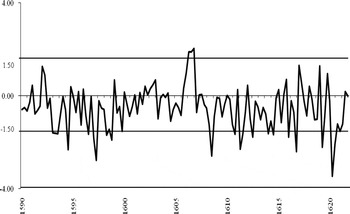
where dt represents the deviations from the arbitrage condition in period t. If deviations between the two interest rates are nonstationary, the assumption of an arbitrage-free financial market can be rejected outright. Table 1 has already provided evidence that the difference in interest rates is stationary with an expected value of zero. Deviations dt are charted in Figure 3. Interest rates deviations oscillate around zero, with constant variance. A band constructed around zero ± 1.5 percent includes 95 percent of the relevant observations in the period 1590–1621. During the crisis of 1606, Lira interest rate was higher than Soldo interest, as Genoa was more directly influenced by the delay in the silver shipment from the Americas and the consequent lack of money.Footnote 44
FIRST DIFFERENCES IN QUARTERLY INTEREST RATES ON RECHANGE IN BISENZONE, IN LIRA GENOESE AND IN SOLDO MILANESE, 1590–1621

Cointegration offers an alternative and more informative method for verifying arbitrage between markets. If the zero arbitrage condition holds, the sequence formed by  should be cointegrated with the sequence of the rates of interest in different currencies, expressed in Scudi di Marco,
 . In other words, it should be possible to express as the following sort of linear combination involving

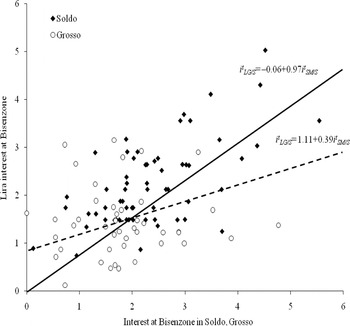
such that the error process ut is stationary, or I(0), a0 does not differ significantly from zero, and a1 does not differ significantly from one. The constant term is inserted to deal with country risk as different bankers are involved while a1 = 1 means that for a given level of risk, the returns in different currencies are equal and therefore capital is perfectly mobile. We carry out cointegration tests, using an estimation strategy advanced by M. Hashem Pesaran, Yongeol Shin, and Richard J. Smith.Footnote 45 The tests (see the Appendix for the statistical details) suggest that there is a strong relationship between the interest rates at the fairs of Milan, Florence, Venice, and Bisenzone, and a rapid movement towards equilibrium adjustment (within two quarters). Figure 4 charts the relation between the interest rates of the Lira, Soldo, and Grosso. Points along an imaginary bisecting line represents the situation of perfect capital market integration, no country risk, and perfectly synchronized capital movements, so that a0 = 0 and a1 = 1.
CORRELATION COEFFICIENTS OF INTEREST RATES ON RECHANGE OPERATIONS AT THE BISENZONE FAIRS (quarterly data)

§ 1601 All Saints–1606 Easter and 1608 All Saints–1621 August.
*1600 Easter–1621 August.
°1590 August–1621 August.
Source:
Da Silva, Banque.
Long-run estimates of the connections between interest rates in Genoa and Venice, and between rates in Genoa and Florence suggest that a0 > 0: the positive constant term tells us that the rate of interest in Lira enjoyed a premium relative to the Grosso and Ducat, which was a sign of a positive country risk.Footnote 46 The risk was a direct consequence of the risk connected with the Genoese bankers' heavy involvement in the asientos.Footnote 47 The Genoese money market was directly affected by the news that the king of Spain had defaulted or his galleons of silver had failed to arrive; as a result, interest rates on short-term financing through foreign bills of exchange in Genoa were at a premium over Venice and Florence. Interest rates in Genoa peaked in 1593/94, 1596, in 1602/03, and in 1606/07. The first peak was the result of merchant-bankers' bankruptcies in Genoa, while the following peaks were associated with the Spanish king's default on payments due, which caused the money market in Genoa to tighten and are associated with positive interest premiums.Footnote 48 Florence was at least partly affected by the same rumors that affected the Genoese market. This was because Leghorn, Tuscany's main port, was also involved in the shipment of Spanish silver, and so the interest rate in Florence was influenced by the same cycle as in Genoa. The econometric result for Genoa and Florence—a1 close to 1—points to close comovement of the two interest rates.
DEVIATIONS BETWEEN INTEREST RATES ON RECHANGE IN GENOA AND MILAN, 1590–1621

INTEREST RATES AT THE BISENZONE FAIRS, 1590–1621

Milan's capital market was also directly linked to Genoa's and shows the same characteristics, in terms of both risk and fluctuations, with a 0 close to 0 and a1 close to 1. Genoese bankers had the security of what amounted to additional collateral, because they controlled important Milanese sources of revenue. The bankers from the Balbi family in Genoa, for example, collected excise duties in the duchy of Milan and they had the monopoly of Milan's wine and salt trade.
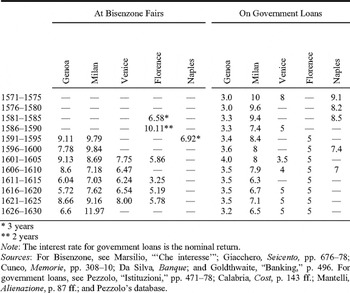
YEARLY INTEREST RATES ON RECHANGE AND LONG-TERM LOANS IN ITALIAN MARKETS, 1571–1630

* 3 years
** 2 years
Notes:
The interest rate for government loans is the nominal return.
Sources:
For Bisenzone, see Marsilio, “‘Che interesse’”; Giacchero, Seicento, pp. 676–78; Cuneo, Memorie, pp. 308–10; Da Silva, Banque; and Goldthwaite, “Banking,” p. 496. For government loans, see Pezzolo, “Istituzioni,” pp. 471–78; Calabria, Cost, p. 143 ff.; Mantelli, Alienazione, p. 87 ff.; and Pezzolo's database.
The capital markets in Genoa and Venice, by contrast, were almost independent of each other. Venetian bankers' involvement with Genoese bankers refinancing was frequent and was an indisputable source of revenue, with Venice acting as a secondary rechange market. But Venice was only indirectly influenced by the vagaries and the anxieties of the Genoese money market. The Venice money market was more strongly influenced by the conditions of Venetian trade, and it had a life of its own, as demonstrated by the a 1 low coefficient value (0.39).
The high Lira rate of interest on rechange does not stem from a high overall interest rate in Genoa. Capital in Genoa was abundant; and longterm interest rates on the Genoese public debt were lower than those in Venice, Milan, Florence, and Naples (Table 3). The short-term Lira interest rate at the Bisenzone fairs was generally higher, but that was because of the risky operations undertaken by Genoese bankers in their dealings with the asientos.
CONCLUSION
Over the sixteenth and seventeenth centuries, the kings of Spain fought long and costly wars and borrowed extensively to finance their enormous military expenditures. They raised money domestically by selling 5 percent bonds (juros) and internationally via the asientos, short-term high interest rate loans made by foreign merchant bankers, which were often renewed so that the loan ran for a relatively long period of time. In return, shipments of American silver were transferred from Seville to Genoa, in order to repay loans made by Genoese bankers and their correspondents in Spain. These bankers were thus funding the Spanish Crown's long-term obligations via short-term transactions. They, in turn, raised money for the loans mainly at the Bisenzone fairs, an international capital market where bills of exchange were discounted for three-month periods and renewed through the exchange-rechange (pactum de ricorsa).
Genoese financing at Bisenzone avoided religious bans on usury because the transactions involved different currencies and payment in different places. The ecclesiastical prohibitions thus failed to halt the development of capital markets in early modern Italy, despite what many historians have claimed.Footnote 49
Because of the Spanish Crown's bankruptcies and the large sums it owed, one might have expected that the Genoese bankers would not be able to clear the letters of exchange issued on European fairs. But they were able to do so, perhaps because they could pressure the king of Spain to repay and transform his bankruptcies into debt rescheduling.Footnote 50 They, in fact, managed to survive the Spanish Crown's frequent defaults and rescheduling of payments, even though they themselves had borrowed on the short-term market.
The Bisenzone fair was a credit market with its own currency of account and a wide and trusted network of relations. Operating under Genoese law and under Genoese legal and political leadership, it was integrated into the global financial network, which spread risk and acted as a reservoir, pumping money out when needed. Although, with a hint of contempt, the Tuscans called Bisenzone, a fiera senza luogo (fair without a place), it was in many ways an offshore capital market, firmly backed by the authority of the Genoese state, that efficiently operated on an international scale. The Bisenzone fair was thus the key element in integrating the major financial markets in Europe.
Appendix: Cointegration Tests
In the first stage of our cointegration test for the existence of the long-term relation between the interest rates in markets, we compute the F-statistics to test the significance of the lagged levels of the variables in the error correction form of the underlying Autoregressive Distributed Lag (ARDL) model (δ1 = δ2 = 0). In the second stage, the coefficients of the long-term relation are estimated. The maximum order of the lags has been chosen according to the Schwarz Bayesian Criterion and the result is (0,1). The error correction version of the ARDL (0,1) model in the variables  and
 is given by

The long-run relation (t values in brackets) is
Genoese Lira – Milanese Soldo.1590.3–1606.1

Genoese Lira – Milanese Soldo.1590.3–1621.3

Genoese Lira – Venetian Grosso.1600.2–1621.3

Genoese Lira – Florentine Ducat.1600.2–1621.3

The error correction representation for the selected ARDL model is
Genoese Lira – Milanese Soldo.1590.3–1606.1

Genoese Lira – Milanese Soldo.1590.3–1621.3

Genoese Lira – Venetian Grosso.1600.2–1621.3

Genoese Lira – Florentine Ducat.1600.2–1621.3

The coefficient of the error correction term, e t-1 (close to –0.5), is statistically meaningful, it has the correct sign and suggests a strong relation between the level variables in equation 5, i.e., the interest rates at the fairs of Milan, Florence, Venice, and Bisenzone, and a rapid movement towards equilibrium adjustment (within two quarters).Footnote 51
 and a residual,
 that represents a price for lending, i.e., the interest, once the course of the exchange has been taken care of. From equation 1,
 and hence
 . Let us assume perfect foresight so that the expected exchange rate in the next fair is equal to the actual exchange rate that materializes in the next period, so that
 . Equation 2 is then derived by equaling the returns in the different currencies. The subscripts show how a banker negotiated: in this case the initial financing was in Lira; it was subsequently converted into Scudi di Marco, to return finally to Lira.