


Just a few days after the passage of the Financial Services Modernization Act, better known as Gramm-Leach-Bliley (GLB), the office of Rep. Jim Leach (R-IA) held a mock wake for the Glass–Steagall Act, featuring a cake frosted with “Glass–Steagall, R.I.P., 1933–1999.”Footnote 1 GLB was universally said to have repealed Glass–Steagall, ending the long era during which financial services companies were prohibited from mixing commercial and investment banking activities. For Leach, then in his fifth year as chairman of the House Financial Services Committee and in his second decade in dedicated pursuit of Glass–Steagall reform, a cake was in order, even if critics lamented the demise of the Depression-era law that some felt had helped America avoid a full-blown financial crisis for many decades.
The biography of the Glass–Steagall Act is now often told as a classic of the “rise and fall” genre.Footnote 2 In their crudest forms, these narratives sometimes sound a bit like Shakespeare's Julius Caesar: the law cut down by conspirators in the prime of its life; Gramm, Leach, Bliley, and their deregulatory accomplices inflicting the fatal wounds. Some more-sophisticated critics of GLB recognize that Glass–Steagall actually had a long senescence, in which its professional reputation suffered. Still, though, they agree that the best way to understand GLB is as the culmination of a long deregulatory process in which free-market ideologues dismantled a venerable and useful old law.Footnote 3 This position is certainly not without merit, but it is incomplete. Glass–Steagall's demise can be profitably understood as part of a process of institutional adaptation far more subtle and complex than the deregulation narrative alone suggests. Cake frosting aside, GLB comes to look more ambiguous than the simple label of “repeal” implies.
A more nuanced look at the life of Glass–Steagall has much to offer to the growing body of scholarship that explores processes of transformational change in institutions. A number of scholars, including Paul Pierson, have emphasized the benefits of studying policies over long periods of time and argued that a cross-sectional perspective cannot adequately conceptualize “slow-moving causation.”Footnote 4 Leading theorists in this movement have built taxonomies of gradual change, outlining several prototypical ways in which an institution's place in society may be fundamentally shifted without undergoing a headline-generating disruption. Streeck and Thelen offer five modes of change: (1) displacement: existing institution gives way, either partially or entirely, to a competitor, which may be new or rediscovered; (2) layering: existing institution left in place, but relevance diminishes as it is circumvented by newer alternatives; (3) drift: existing institution goes without “tending” amidst changing conditions (perhaps deliberately), and as a result is “subject to erosion or atrophy”; (4) conversion: existing institution redirected to novel purposes through political contestation; and (5) exhaustion: an aging institution suffers a gradual withering away as its resources are depleted without renewal.Footnote 5
This theory-building has helpfully created a scholarly language with which to analyze institutional development, but the clarity of the taxonomy it offers can mislead scholars into viewing complex, messy phenomena as akin to cleanly separable natural processes. Scholarly users of this analytical framework would probably admit that some cases of institutional change resist easy categorization, and the differences between some of the categories (especially displacement and layering, and drift and exhaustion) are fairly subtle.Footnote 6 Still, in general they present their categorizations as value-neutral descriptions of empirical fact.Footnote 7
In this article, I argue that this sense of objective taxonomy ultimately obscures a full understanding of many institutional developments. Understandings of institutional change are necessarily embedded in particular institutional perspectives, so that gradual change is likely to be perceived very differently depending on how one conceptualizes the relevant institutions. What looks like harmful drift from one vantage point can look like constructive conversion from another. This importance of perspective applies to scholars, but more importantly it also applies to policy actors themselves. My central argument is that the reactions of legislators, bureaucrats, and judges to institutional developments depend on their frames of reference for the unfolding changes, making the question of which frame is most appropriate a matter of consequential normative contestation. Institutional changes strike observers differently depending on where they are situated (e.g., in a bureaucratic agency vs. in the legislature) and how they conceptualize the relevant institutions (e.g., in terms of particular statutory mechanisms vs. in terms of larger public policy goals).
Scholars seeking to understand how institutional developments play out must be able to understand participants' own frames of reference, even—or especially—when differences in institutional perspective lead to mutually exclusive interpretations of events. This is best accomplished by adopting a process-tracing method that emphasizes understanding policymakers' own outlooks as they make decisions. I use this approach to analyze the history of the Glass–Steagall Act, a case study which features two institutional frames competing against each other across many years.Footnote 8
Over the course of decades after the Act's passage, its efficacy came under pressure from a variety of sources. Commercial banks' profitability periodically lagged, and the industry was forced to adapt—which often meant seeking innovative ways to gain market share in activities that Glass–Steagall seemed to mark as off-limits. For several decades, legislators and regulators conceived of these pressures as harmful drift and sought to counter them. Beginning in the 1970s, however, pressures increased, and regulators began to see the strict separation of commercial and investment banking as non-essential to their larger mission of providing a safe banking sector. They conceptualized their actions as attempts to convert the existing Glass–Steagall framework to serve their purposes in a new era of finance. This framing ran into stiff resistance, especially from securities firms that wished to preserve the old framing of drift, but conversion eventually won out in court and later in Congress.
THE SPECIAL ROLE OF STATUTORY TEXT IN SHAPING INSTITUTIONAL CHANGE
To provide insight into judges' thinking about institutional frames of reference, this article also pursues a secondary argument about the importance of statutory text, thus adding to a literature that studies how bureaucrats and judges shape policy developments through statutory interpretation.Footnote 9 By being fixed on a page, statutory text cannot be easily ignored as change proceeds—at least if there is some group that possesses legal standing to contest novel interpretations (whether they are departures from past practice or responses to novel circumstances). Although it seems too obvious to state, the actual content of the text turns out to matter greatly. But language does not interpret itself, creating opportunities to argue for interpretations that serve actors' own institutional purposes, which are shaped by their institutional perspectives. Questions of legal interpretation, therefore, get caught up in larger questions of institutional framing.
Generally speaking, vague or ambiguous text creates room for discretion, allowing interpreters to work their will, whether it is for drift, conversion, or preservation of the status quo. Legal interpreters—usually in the executive branch in the first instance—are forced to supply meaning where definitions are incomplete or missing, where language is vague or equivocal, and where there are lacunae.Footnote 10 Conversely, by delineating specific requirements, really clear text generally prevents interpreter-driven change, or at least creates an obstacle that must be worked around.Footnote 11
But the concept of “clarity” is itself somewhat ambiguous and subject to definition through practice. Text really does differ in terms of clarity, and the differences do matter in determining how big an obstacle to change statutory text presents. Especially difficult to “interpret away” are statutory provisions creating structural legal features, such as the unambiguous assignment of jurisdiction or the requirement that certain rules be passed. But “clarity” is also sometimes an imaginatively attributed quality that stands in for political will; as political will diminishes, it may turn out that language once respected as “clear” turns out to allow circumvention or outright reinterpretation after all, as several examples from Glass–Steagall's history will show.
Imagined textual clarity is likely to give way if the re-interpreters can offer a compelling justification from what courts take to be a valid institutional perspective. This is especially likely under the long shadow of Chevron v. NRDC (1984), as courts are instructed to defer to agencies' reasonable constructions of their controlling statutes.Footnote 12 Bureaucrats are generally well positioned to argue that their interpretations strike a reasonable balance among sometimes-conflicting statutory purposes, especially since judges lack their intimate knowledge of the tradeoffs embedded in specific regulatory decisions. When banking regulators began to reorient their Glass–Steagall interpretations toward conversion, judges were reluctant to question their judgments about what was necessary to protect the financial system as a whole.
The tendency toward deference should not be overstated, however. Some text's clarity is likely to stand as a significant obstacle to institutional change, as courts are often faithful to clear text out of a genuine belief in legislative supremacy. Even where judges might sympathize with the policy ends served by ignoring text, they will sometimes insist on fidelity to text. Recalling Mencken's definition of democracy, these judges insist that the people should get what they asked for, through their legislators' clear enactments, whether executive branch policymakers judge their choices prudent or not.Footnote 13
For this textualist argument to carry weight, judges must believe that Congress is willing and able to pursue meaningful action in the relevant policy areas, such that its failure to act conveys meaningful information about a preference for preserving the status quo. As the case of Glass–Steagall will demonstrate, however, this belief in legislative ability can only withstand so much falsification before it gives way to the inclination toward deference, especially when bureaucrats offer a plausible framing of their preferred interpretive shift. Context-specific institutional capacities guide judges' thinking about how much leeway to give executive branch creativity.Footnote 14 The account of Glass–Steagall's bureaucrat-driven conversion, ultimately acquiesced to by courts in the 1980s after a period of reluctance, suggests that judges are likely to allow even text that seems quite fixed in its meaning to be bent if the institutional facts-on-the-ground suggest that political support for legal change exists but is unable to mobilize legislative action.
I proceed in this article by first clarifying its main argument regarding institutional perspectives by considering exactly how Glass–Steagall was viewed through competing frames of reference. The body of the article then presents a detailed analytical narrative of Glass–Steagall's history, showing how a consensus against drift was gradually displaced by a belief in the need for conversion. A postscript considers this history in light of claims made in the wake of the recent financial crisis, showing why scholars who exclusively rely on framing Glass–Steagall's demise in terms of drift are likely to miss important aspects of the institutional change that occurred in finance in the 1980s and 1990s. Finally, a concluding section returns to questions about the role of statutory text, drawing implications for American Political Development scholarship more broadly.
COMPETING INSTITUTIONAL FRAMES FOR THE GLASS–STEAGALL ACT
What is “the Glass–Steagall Act?” Contemporary popular usage is often quite confusing; especially in reflecting on its role in the financial crisis of the late 2000s, talking about “the repeal of Glass–Steagall” is more often used as a kind of political rallying cry than as a referent for a particular set of statutory provisions.Footnote 15 A brief examination of the legal particulars is, therefore, in order.
The Banking Act of 1933 was an ambitious and complex statute that regulated or prohibited practices believed to have brought on the Great Depression. Thanks to the policy entrepreneurship of Rep. Henry Steagall (D-AL), the Act's most lasting contribution was to create the Federal Deposit Insurance Corporation (FDIC), an idea that had long been disfavored and still lacked the enthusiasm of leading politicians, including President Roosevelt.Footnote 16 Sections 16, 20, 21, and 32, which together came to be commonly referred to as the Glass–Steagall Act, were primarily the work of the architect of the Federal Reserve System, Sen. Carter Glass (D-VA). These sections legally mandated the separation of commercial and investment banking, which until then had both often been conducted by the same powerful firms.Footnote 17 The law would purportedly prevent (1) banks making risky investments in securities, thereby endangering deposits; (2) unsound loans made to prop up companies in which a bank was invested; and (3) pushing underwritten securities onto banking customers.Footnote 18
As is discussed at length below, some of the most significant challenges to Glass–Steagall's efficacy came from the rise of the bank holding company corporate structure, which led to significant enactments of Bank Holding Company Acts in 1956, 1965, and 1970. Sometimes, those discussing “the Glass–Steagall Act” implicitly mean to include the parts of these Bank Holding Company Acts that deal with the separation of commercial and investment banking.
Depending on one's preferred institutional framing, Glass–Steagall can be thought of in a narrow legal sense, as just the four sections of the 1933 Act. To the extent that courts treated this body of law as distinctive, creating a self-contained body of precedent, this institutional perspective was likely to be especially important to those whose actions were regulated by the Act and who therefore had to consider defending their actions with reference to the statutory text.
Somewhat more broadly, “Glass–Steagall” was the colloquial way of referring to the public policy goal of separating commercial and investment banking. This clearly includes the relevant portions of the 1933 Act as well as the later Bank Holding Company Acts, as well as the extensive body of regulations developed under these statutes by the Office of the Comptroller of the Currency (OCC), Federal Reserve (Fed), and FDIC. Importantly, the distinction between commercial and investment banking turns out to be less straightforward than it sounds at first, which means that the implementation of this policy goal became a source of continuous legal contestation as the nature of finance evolved over the course of the twentieth century.
We can also place Glass–Steagall within a larger institutional context, in which the relevant institutional complex is “American banking regulation” and the legal particulars of Glass–Steagall create just one institutional resource among many. A similar, if more fragmented, institutional picture presents itself if we anchor our discussions of institutions entirely in easily discernible government bodies (OCC, Fed, and FDIC) that, after all, seem distinct and independent to their inhabitants.Footnote 19
With these various institutional perspectives in mind, we can see that what looks like drift or corrosive capture (i.e., intentionally facilitated drift) from one institutional perspective looks like an attempt to perform a constructive conversion from another (i.e., institutional adaptation to changing circumstances). This requires unpacking.
Let us first use the institutional terms favored by Glass–Steagall's defenders (both historic and contemporary), who see the institution as being a robust separation of commercial and investment banking on behalf of the public's interest in a stable financial sector.Footnote 20 Given this perspective, the law's history is best characterized by a period of successful attempts to resist drift (through the 1970s), followed by a long, slow drift toward irrelevancy culminating in the formal legislative “repeal” of Gramm-Leach-Bliley in 1999. This drifting trajectory is best understood as driven by what Carpenter and Moss call “corrosive capture,” in which special interests drive deregulatory policies contrary to the public interest.Footnote 21 In more colloquial terms, this is a story of corruption or rot, in which the public's general interest, though embodied in statutory law, was outmaneuvered and ultimately defeated by commercial bankers.
Ironically, this story need not be told much differently if one cynically doubts whether Glass–Steagall really served the public interest at all. While the standard story is that the law responded vigorously to abuses uncovered by the Pecora Commission, revisionist scholarship by George Bentson charges that the Pecora Commission's findings were largely fabrications or mischaracterizations of acceptable behavior. Glass–Steagall is thus best understood as a piece of “special interest legislation” favoring securities firms, whose businesses it would protect from having to compete with deposit-taking institutions. Commercial bankers' acquiescence to the changes, and their failure to effectively combat the allegations of the Pecora Commission, can be explained as functions of their political weakness at the moment and their belief that bowing to this reform was a relatively painless way to avoid more retributive measures. At the time, many primarily commercial banks with troubled balance sheets were contracting their operations and would not have been conducting securities activities in any case.Footnote 22
Following in the tradition of George Stigler's “Interest Group Theory of Regulation,” one might nevertheless see special-interest bargains as the legitimate product of democratic government, and thus believe that Glass–Steagall deserved to be scrupulously enforced as a special-interest bargain.Footnote 23 Jonathan Macey's exploration of Glass–Steagall's history, a classic of the Public Choice literature, reaches this conclusion.Footnote 24 Macey dismisses the possibility that separating commercial and banking could genuinely serve the public interest, creating the potential for confusion among those trying to understand how the law ought to be interpreted (especially because of Glass–Steagall's own professions of its public interestedness in its preamble). For Macey, “Faithful interpretation of the statute in accordance with its purported (as opposed to actual) objectives is virtually impossible due to the intrinsic incoherence of the legislative mandate.”Footnote 25 Given this pickle, Macey argues that judges should follow the statutory text's specific demands as the best way to honor our society's democratic commitment to legislative control, even if the legislature's true motivations strike some of us as troubling. As we will see shortly, Macey thus sees in Glass–Steagall's institutional changes a story not so far apart from those who lament the fall from grace of a public-protecting institution. For him, the story is the rise and fall of a piece of perfectly typical special-interest legislation. His narrative is characterized by greater ambivalence, but ultimately it is still one in which drift renders impotent an institution that should have been kept vital.
Adopting a different institutional perspective can support a rather different view of Glass–Steagall's gradual demise, however, and the actors most directly involved in the changes to Glass–Steagall did not think of themselves as simply facilitating drift. Many of the changes in the interpretation of Glass–Steagall that might be characterized as accelerating drift were understood as part of a broader institutional adaptation to changing economic and technological conditions that threatened to move financial activity into less-regulated, more-volatile sectors. In terms of Streeck and Thelen's taxonomy, regulators were coping with exogenous pressures by converting Glass–Steagall to serve what they took to be their primary responsibility: promoting “bank safety and soundness.” This led them to deprioritize the goal of strictly separating commercial and investment banks, but they believed their actions were consistent with the statutory text and useful to their broader mission. Similarly, the movement for legislative “Glass–Steagall reform” becomes comprehensible as something other than just ideology-driven “deregulation” (though that certainly accounted for some of the support). Leach's quest was motivated by a desire to bring law and practice into alignment, thereby facilitating the process of conversion, and Gramm-Leach-Bliley is poorly characterized as a simple “repeal.”
Understanding the reformers' perspective requires appreciating the changing context in which Glass–Steagall operated over a half-century, to which I now turn.
ANALYTICAL NARRATIVE
Early Implementation: 1933–1956
Soon after Glass–Steagall's passage in 1933, various parties sought to find weaknesses in its “wall of separation” between commercial and investment banking. During the law's first two decades, judges, bureaucrats, and legislators all sought to define the act's practical applications in terms that prevented easy evasion.Footnote 26 Divergences in official institutional perspectives in this period were small.
One early challenge to the law's efficacy was rooted in its central language, which prohibited anyone “primarily engaged” in securities activities from also engaging in commercial banking. In Board of Governors v. Agnew (1946), the Supreme Court was asked to review the Federal Reserve Board's decision to remove as directors of a national bank several men who were indisputably involved in securities activities.Footnote 27 First, the Court had to decide whether Federal Reserve decisions made under Glass–Steagall were subject to judicial review, which the Board of Governors disputed. For a unanimous Court, Justice Douglas decided this momentous question in the affirmative without offering much justification, ensuring that bureaucratic decisions about Glass–Steagall would receive judicial scrutiny.Footnote 28 Second, the Court had to decide whether “primarily engaged” would be given a broad or narrow meaning. As the Fed read it, “primarily” meant “substantial,” whereas the removed directors argued it should mean “principal,” i.e., “greater than fifty percent.”Footnote 29 The Court ruled that the Board's broad reading was both reasonable and fully consonant with the purposes of the statute, and therefore due deference.Footnote 30 In doing so, they allowed regulators to arrest an early trend toward drift.
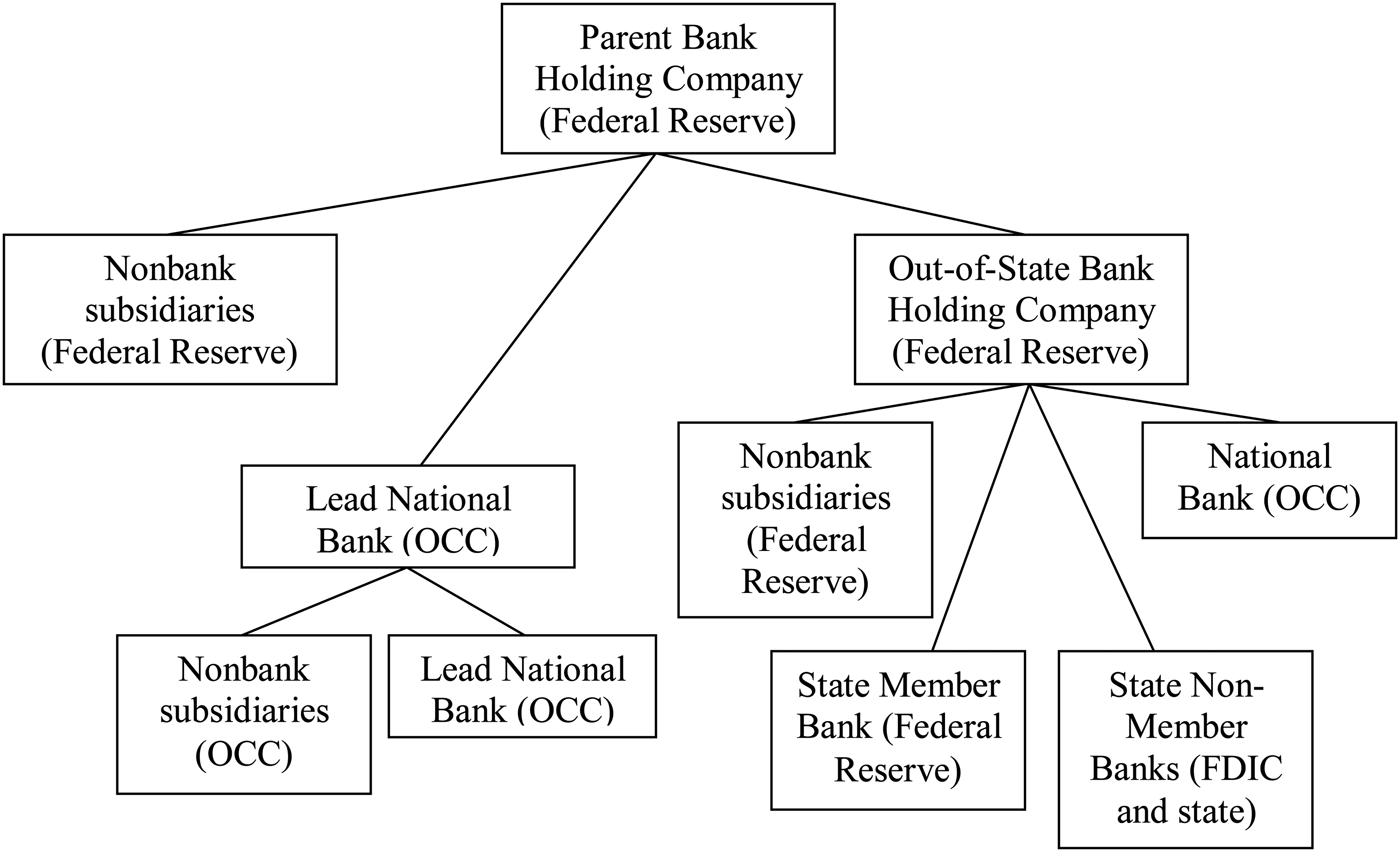
A challenging development in the early years of Glass–Steagall was the migration of many bankers to the bank holding company (BHC) corporate form, in large part because it was not covered by the main provisions of Glass–Steagall or, indeed, by much of any regulatory law.Footnote 31 By bringing bank ownership under the same corporate umbrella as companies pursuing non-banking activities, a BHC could effectively join control of banking and non-banking activities, thus undermining Glass–Steagall's purpose. Congress was well aware that this shift had the potential to undermine the separation between commercial and investment banking, and bills addressing it were introduced into almost every session of Congress after 1938, when President Roosevelt specifically called for regulation of BHCs. Major efforts in 1938 (Glass-McAdoo), 1947 (offered by Fed Chairman Marriner Eccles), and 1949–50 (Maybank-Robertson) all died in committee, opposed by the American Bankers Association (ABA) and its sympathetic regulator, the OCC. By the early 1950s, the Federal Reserve was sounding a consistent refrain to pass strong regulation of all BHCs, essentially sounding the alarm about policy drift.Footnote 32 A critical source of disagreement that doomed these bills in committee was the question of whether regulation should extend to BHCs controlling just one bank.Footnote 33 With President Eisenhower's support, a bill finally emerged in 1956 and Congress passed the BHC Act by an overwhelming margin, establishing Federal Reserve regulation and prohibiting BHCs from managing or controlling non-banking assets other than those directly related to their core banking business. This only partially addressed the BHC threat, however: in order to win easy passage, the act included a slew of exemptions, most crucially excluding BHCs controlling only one bank, a source of disappointment for the President and the Federal Reserve.Footnote 34 At the time of passage, only 46 BHCs were subjected to regulation, while 116 (mostly very small) BHCs were exempted.Footnote 35 Consequential as it was, BHC Act supporters secured a consensus only by retaining many exemptions, demonstrating how legislation intended to promote the general good is often greased with side payments to affected interests in order to secure passage, thus undermining the very rationale that motivated the reform.Footnote 36 The price of this consensus was relative weakness, and by 1958 the Fed would be lobbying Congress again to close the Act's loopholes, especially the one-bank exemption.Footnote 37
The language of the Bank Holding Company Act also left the door open to reinterpretation when various parties would later seek to reorient the broad Glass–Steagall institution. Key language allowed banks to conduct those activities “so closely related to banking as to be a proper incident thereto” without further defining just what these activities might be.Footnote 38 Regulators would be charged with making initial determinations about which activities were permissible, giving them significant power to direct the evolution of the law in practice. Of course, their decisions could also then be contested in court by parties who could articulate why their interests were impaired. This open-textured language thus set the stage for a long struggle over the direction of Glass–Steagall's institutional development.
Bank Holding Company Corporate Organization (Each Unit's Regulator Noted in Parentheses)
Protecting Separation under the BHC Act, 1956–1971
The next period of Glass–Steagall (and now BHC Act) development was characterized by the same dynamic of seeking to find ways to adjust to innovations at the least possible political cost, with only small divergences in institutional perspectives opening up. Bureaucrats and legislators remained basically committed to the original aims of Glass–Steagall, but they nevertheless sought to accommodate various constituents as they reacted to new developments. Where courts saw this accommodation as going against their conception of Glass–Steagall's institutional purpose, they intervened to protect it.
The major challenges during this time were dictated by the compromise of the BHC Act, which had left many loopholes intentionally and also contained enough ambiguity to allow others to form. For example, in 1957, commercial banks sought the ability to profit from conducting brokerage transactions for their customers. Such off-balance-sheet activities could potentially enhance a bank's profitability and, if kept small, would not pose a major threat to Glass–Steagall's fundamental differentiation between commercial and investment banks. The OCC allowed the shift, although the regulator still insisted that such services be offered only to existing customers rather than marketed to the public in order to ensure that they remain modest in scope.Footnote 39 Such incremental decisions may seem inconsequential, but they may accumulate until they represent a substantial institutional change. Although the OCC would not provide a comprehensive rationale for such actions until much later, this early concession to banks foreshadowed the formation of a distinct institutional perspective for commercial banks' regulators.
Courts sometimes arrested these small steps toward expanded powers for commercial banks, showing their willingness to stand up for the institutional conception of Glass–Steagall as a strict wall of separation. In Baker, Watts & Co. v. Saxon (D.D.C. 1966), a federal district judge invalidated the Comptroller's decision to allow a bank to underwrite and trade state bonds not backed by the taxing power.Footnote 40 Glass–Steagall itself contained an exception for “obligations of the United States, or general obligations of any State or of any political subdivision thereof,” but the court interpreted “general obligations” narrowly, to include only those debts directly backed by the state's power of taxation, thus preventing this intentionally included loophole from growing. On one level, this case can be seen as a narrow matter of statutory interpretation, but on another, it represents an early clash between the major ways of thinking with respect to Glass–Steagall's purposes.
In 1965, aiming to strengthen the institution of Glass–Steagall-plus-BHC-as-strict-wall-of-separation, Congress took aim at many of the loopholes left in place by the 1956 Act. House Banking Committee Chairman Wright Patman (D-TX) first introduced a narrow bill repealing one particular exemption for testamentary trusts, which had allowed the blossoming of a miniature empire of unregulated firms in Florida under the auspices of the estate of Alfred du Pont. But Rep. Charles E. Bennett (D-FL), encouraged by the Fed, offered a comprehensive amendment to level the playing field, which would have repealed all of the most important exemptions, including for one-bank BHCs. This broader bill passed the House in spite of opposition by Patman, who argued that every exemption deserved individual consideration before being repealed.Footnote 41 Although the Fed was adamantly in favor of ending the one-bank exemption, doing so was strongly opposed by the Independent Bankers Association of America, the ABA, and the OCC (which said “imaginary possibilities of abuse” were no reason for action and worried about Fed jurisdictional imperialism). To secure passage, the Senate Banking Committee dropped the one-bank exemption before sending the bill to the floor.Footnote 42 The House assented to the Senate amendments by voice vote, and the bill was signed into law by a fairly uninterested President Johnson on July 1, 1966, having closed many important loopholes but leaving the most important one untouched. Most legislators were apparently still committed to an institutional vision of Glass–Steagall as the separation of commercial and investment banking, making them willing to support loophole-closing upkeep. Their commitment was not so strong, however, as to make them willing to spend much political capital on the matter, and so concessions to vocal interests limited the scope of their responses.
Legislators' political calculations seem to have been fairly short-sighted, as rapidly growing numbers of BHCs took advantage of the one-bank loophole to escape Fed supervision.Footnote 43 There were 550 one-bank BHCs in 1965, 691 by year-end 1968, and 810 by February 1969, controlling 40 percent of all commercial bank deposits.Footnote 44 President Nixon urged Congress to stop this “disturbing trend in the past year toward erosion of the traditional separation of powers between [banks and commerce].” Chairman Patman now abandoned his defense of the one-bank loophole, and indeed now derided the Administration for being too lax. After struggling over who should have regulatory jurisdiction and the power to define the scope of permitted activities (and therefore who would be the first responder to future industry attempts to circumvent or redefine the law), Patman's Fed-favoring bill ultimately won out in the House. The Senate passed an amended version of the bill, but not before adding several exemptions for very small BHCs and those in which banking was only a small part of the company's overall operations, as well as clarifying that “traditional banking practices” were not meant to be targeted.Footnote 45 The ABA intensely lobbied House conferees to accept these bank-friendly Senate amendments and mostly succeeded. Once again, loopholes that served well-positioned interests were included as long as they seemed not to threaten the overall efficacy of the law.
Importantly, there were some unresolved disputes between the House and Senate on how the Act's language would operate. Although Congress had considered including a “laundry list” of prohibited activities, in the end they failed to agree on one and instead legislated the rather vague standard that any allowed non-bank activities must result in public benefits.Footnote 46 In practice, this left the Fed to exercise its own discretion to determine what “public benefits” would mean, as courts would be unable to discern a clear congressional intent capable of trumping bureaucratic interpretations embedded in a reasonable framing. Congress clearly has the formal power to explicitly dictate the course of a law's institutional transformation, but doing so may require a degree of political consensus and detailed policy knowledge that seldom exists. Given the political costs of resisting drift, the responsibility for doing so is likely to be shunted onto regulators—with the added political bonus of plausible blame-avoidance if anything should go so wrong as to attract critical public attention.Footnote 47
The next major developments for Glass–Steagall and the BHC Act came in the federal courts. The judiciary's centrality was guaranteed by the unanimous holding in Association of Data Processing Service Organizations v. Camp (1970), which established the precedent that aggrieved competitors were entitled to standing to challenge regulatory decisions in spite of the absence of any explicit statutory provision providing it.Footnote 48 Thenceforth, the chief opponents of new powers for commercial banks—their potential competitors, especially among non-deposit-taking investment banks—would be able to bring legal challenges. As Macey emphasizes, securities firms were naturally the most dedicated defenders of understanding Glass–Steagall as a strict wall of separation because of the protection from competition the Act afforded them, and they would vigorously advocate this perspective in court over the coming years.
The first major case in which they did so was Investment Company Institute v. Camp (1971).Footnote 49 The ICI, a securities industry trade group, contended that the Comptroller's decision permitting banks to offer customers “investment funds” violated Glass–Steagall's ban on commercial banks conducting securities activities. The District Court ruled against the Comptroller, but the Court of Appeals reversed, deferring to the Comptroller. Writing for a Supreme Court majority, Justice Stewart acknowledged the need for deference, but found that, whatever the Comptroller might say, the investment funds in question were so nearly indistinguishable from mutual funds as to represent violations of Glass–Steagall's clear purpose—which he accepted was well understood as the ICI framed it, as a strict separation.Footnote 50 Deference was inappropriate when the Comptroller had offered little rationale for its holding (with appellate counsel's “post hoc rationalizations” deemed too little, too late) and when Glass–Steagall's legislative history (discussed at great length) clearly indicated that mutual fund activity was meant to be prohibited.Footnote 51 In light of these facts, Justice Stewart concluded that the Comptroller's narrow reading of the term “securities” would vitiate the enacting Congress's will and was thus impermissible.Footnote 52 Justice Blackmun dissented, complaining that the majority's opinion was “based more on what is … desirable national banking policy than on what is a necessary judicial construction of the Glass–Steagall Act … Policy considerations are for the Congress and not for this Court.”Footnote 53 Blackmun thus found textualism inadequate to settle the ambiguities, and preferred to defer to the Comptroller's expertise as to how this particular decision would affect the functioning of the law.
ICI v. Camp vividly illustrates why disagreements about the institutional nature of Glass–Steagall had such large stakes. Whereas Stewart and the majority accepted the idea that Glass–Steagall served the public interest by strictly preventing commercial banks from offering any services that resemble investment banking, the OCC and Blackmun in dissent took a narrower view of the law that limited its powers to the bare minimum required by the text.Footnote 54 In doing so, the OCC insisted that it was serving the public's true interests by allowing banks to enhance their profitability while taking on little risk—thereby increasing the stability of the banking system. Whether Glass–Steagall's “wall of separation” was an institution worth defending from the pressures of a changing world would be a question regulators and courts were forced to confront with increasing frequency.
Competing Institutional Visions Clash: 1970s to 1980s
The next phase of Glass–Steagall's development features a growing conflict between institutional conceptions of the law. Regulators were less and less committed to cabining commercial bank powers, instead conceiving of their primary institutional responsibility as safeguarding their own supervisory powers in the larger context of a rapidly changing financial services industry. As bureaucratic decisions butted up against the limits imposed by statutory text, Congress was too internally torn to dictate the direction of change. As a result, judges were confronted by a rising tide of security industry complaints and found that they were the ones charged with figuring out what sorts of conversion or drift were consistent with the law.
Congress had taken care in 1970 to give administrative responsibility for Glass–Steagall and the BHC Acts to the Fed rather than dividing it among the three banking agencies, apparently in hopes of keeping implementation strict. It came as a surprise to legislators, then, that the Fed from 1970 through 1974 turned out to be fairly lenient in allowing non-bank activities, leading the BHC to become far and away the dominant corporate form for commercial banking during the period. In 1972, the Board amended the regulations governing which actions were “closely related to banking,” enlarging the permissible scope of activities for BHCs.Footnote 55 The Fed's move away from a strong “wall of separation” was somewhat equivocal; in 1974, with an economic downturn, the Fed return adopted a “go slow” policy and multiplied its denials of applications for new activities.Footnote 56 Meanwhile, the OCC continued to facilitate a slow but steady opening of new activities to commercial banks—for example, in 1974 interpreting Glass–Steagall to let banks advertise computer-assisted stock purchasing services, although they could still only be offered to those with checking accounts at the bank.Footnote 57
Pressures on commercial banking significantly intensified during the 1970s because of a confluence of economic conditions. Commercial banks were prohibited from offering customers interest on their demand deposits and subject to caps on interest rates for savings accounts by Regulation Q (which also came from the Banking Act of 1933). For many years, these caps were not all that onerous, as the rates they required remained competitive with other savings vehicles such as Treasury bills. As annual inflation rates rose to unprecedented heights—sometimes into the low double-digits—because of oil shocks and a hard-to-break wage-price spiral, the burden imposed by Regulation Q became much more significant, however. Customers keeping their money in demand deposits or savings accounts would essentially be forced to pay a large tax as they watched inflation outpace the interest they were offered by banks.Footnote 58 In response to this shortcoming of commercial banks, the new money market mutual fund industry emerged to offer customers fairly liquid savings vehicles that could keep up with inflation (and eventually take advantage of the high Treasury yields caused by the Fed's attempt to crush inflation). Banks lost business to these upstarts, and at the same time saw the real value of their fixed-rate loans diminish because of inflation. Businesses also found new ways to raise capital through market offerings, especially commercial paper (short-term corporate bonds).
This phenomenon of commercial banks being cut out of the loop, called “disintermediation,” meant that the well-developed regulatory system for commercial banking covered a shrinking proportion of the nation's assets, a trend which pleased the securities industry but worried banking regulators charged with overseeing the stability of the nation's financial system.Footnote 59 The Chairman of the FDIC from 1981 through 1985, William Isaac, would later write, “[B]y confining banks to a narrow range of products and services of declining profitability, Glass–Steagall threatens the long-term health and survival of banks as the fulcrum of our regulatory system.”Footnote 60
Quite naturally, commercial banks' regulators were determined to resist this process. They believed it would be highly damaging to the economy if the firms they regulated were forced to wither in the face of financial innovation, and decided to convert the statutory tools at their disposal to the purpose of shoring up commercial banks' viability. Understanding their actions requires us to appreciate this broader institutional perspective, rather than simply insisting that regulators were caught up in the intellectual movement in support of deregulation.Footnote 61 Though there is little doubt that they were influenced by that movement, their motivations in changing their orientation toward Glass–Steagall were considerably more complex.
To meet the challenges of the new financial scene, the Fed hoped to expand the menu of services that BHCs could offer, and the OCC hoped to give national banks the broadest powers their statutes could support. By allowing banks access to profitable activities, they hoped to strengthen the overall safety and soundness of their regulated institutions, increasing their ability to withstand difficult economic times. This goal was reflected in regulators' joint emphasis on capital adequacy requirements, and was also made explicit in 1987 when the Fed announced it would require affiliated banks to channel revenue toward any troubled banking affiliate, thus making the expanded scope of banks' activity a source of systemic strength.Footnote 62 Regulators were thus largely motivated by a concern that still animates banking policy debates today: the desire to avoid taxpayer-funded bailouts of large financial institutions. Embodying this position, Comptroller of the Currency C. T. Conover delivered a speech in 1984 entitled “Strength = New Powers + Firm Supervision.”Footnote 63
Another contemporaneous challenge is worth noting, although a full treatment is beyond the scope of this article. Financial markets and large corporations in the 1970s were becoming increasingly globalized. Because other important markets did not have any law equivalent to Glass–Steagall, banks that were solely commercial in their U.S. incarnation were simultaneously full-service operations in foreign markets, providing their overseas customers with a full range of financial services. For example, J. P. Morgan, one of America's leading commercial banks, included a London office reputed to be among the boldest innovators in the U.K. securities market. While this arrangement might not normally have caused any special problems for U.S. regulators, innovation in financial derivatives in the 1970s, 1980s, and 1990s gave J. P. Morgan and other firms new products that did not fit clearly into either the “commercial” or “investment” category. Once found to be profitable in London, these products could be brought back to the United States, where regulators would have little guidance for how to treat them. To the extent that Glass–Steagall was thought of as restricting commercial banks to well-understood, staid lines of business, the rapid importation of complex, hard-to-understand derivatives clearly posed a threat. On the other hand, to the extent that regulators were glad to allow novelties in commercial banking if they offered stability, derivatives seemed like an attractive addition both for the profits they offered and because of the belief that they could allow firms to manage risk more effectively than ever before.Footnote 64
Keeping in mind the context of a dynamic marketplace exerting pressures on old ways of doing business and of regulating, those who remained committed to the institutional conception of Glass–Steagall as a strict separation could nevertheless fairly argue that the changes implemented by bank regulators' statutory interpretations in the 1980s represented drift. Those who saw Glass–Steagall's wall as self-evidently in the public interest, and moves to weaken it as harmful actions undertaken on behalf of banks, could allege corrosive capture with some plausibility. Explaining the OCC's stance, Comptroller Conover was not coy: “if a bank can make a strong case that a proposed activity is legal, our inclination is to approve it.”Footnote 65 The OCC abandoned limitations on banks' brokerage services and opened the door to bank subsidiaries marketing insurance.Footnote 66 Acting in parallel, the Fed allowed bank subsidiaries to market and underwrite all types of government securities, provide full brokerage services, and to trade or underwrite revenue-bonds and mortgage-backed securities.Footnote 67 Affiliates were given full power to deal in commercial paper.Footnote 68 Whether viewed through a lens of conversion or drift, bureaucrats had become prime movers in transforming Glass–Steagall.
There is clearly a case for understanding the regulators' attitudes as shaped by a kind of “cultural capture,” in which government officials come to strongly identify with the beliefs and interests of the firms they regulate.Footnote 69 In seeking to enhance banks' profitability, regulators had come to adopt many of commercial banks' interests as largely coincident with their own. If one believes that their highest duty should have been realizing the Glass–Steagall Act's separation, thereby faithfully honoring the vision of the statute's framers of the 1930s, then it is fair to say that the regulators were negligent. On the other hand, if we think of these regulators as owing a deeper fidelity to protecting the institution of a functional and well-regulated banking sector through administration of the larger edifice of banking laws, their actions can make sense without any cynicism. Regulators thought they could maintain the vitality of the law's deeper spirit by allowing Glass–Steagall's requirements to bend, whereas they believed that a literalistic fidelity to the law would lead to a disastrous break in the whole system. (And, ironically, the case for remaining true to the strict-separation vision of Glass–Steagall was advanced almost exclusively by investment banks, making it hard to believe that regulators' protectiveness of commercial banking interests was self-evidently contrary to public interest.)
Legislators were best situated to negotiate the competition between institutional perspectives, since they could offer fresh statutory language settling how much continuing relevancy the half-century-old Glass–Steagall Act should retain. While some legislators showed interest in this task, especially when changes directly provoked their important constituents, no critical mass coalesced during this period to provide direction one way or the other. Instead, other banking policies took priority. The House passed a bill in 1980 to restrict BHCs from acting as insurance agents, but the Senate never responded. The two large banking bills that did pass, the Depository Institutions Deregulation and Monetary Control Act of 1980 and the Garn-St. Germain Depository Institutions Act of 1982, contained few provisions relevant to Glass–Steagall in spite of Senate Banking Committee Chairman Jake Garn's (R-UT) desire to address the issue.Footnote 70
Signs soon emerged that Congress was considering abandoning the defense of Glass–Steagall's central tenets and turning toward large-scale “reform”—in other words, legislators began to embrace the frame of conversion favored by regulators. In 1983, Ronald Reagan proposed granting banks the ability to conduct real estate operations, but it was not an administration priority and came to naught. The House considered legislation in 1984 to close remaining loopholes in the 1956 legislation as the Senate worked at cross-purposes, passing a bill to allow BHCs to form subsidiaries dealing in mortgage-backed securities and municipal bonds. No legislation resulted.Footnote 71
Even as regulators altered their focus and Congress failed to react decisively to keep up with this change, the statutory text itself continued to act as a significant constraining force. The bureaucrats themselves were not immune to textualist misgivings about offering expanded powers without changing the laws. Several decisions made by the Federal Reserve split the Board of Governors, 5–2, with rare dissents from Chairman Paul Volcker, whose objections were based less on policy disagreement than on a lack of legal authority to approve the changes under existing law. Volcker wrote: “As the Board as a whole has repeatedly urged, the plain and desirable remedy to this legal and substantive morass is a fresh congressional mandate.”Footnote 72 Volcker and other Fed officials also testified in numerous congressional committees throughout the early 1980s, practically begging legislators to address “the significant erosion, at the margin, of the commerce-banking barrier” and other developing legal rifts.Footnote 73 Central to these pleas was the argument that the Fed was incapable of reaching optimal policy without new statutory language. As it was, the Fed could provide legally creative (and sometimes dubious) patchwork fixes subject to judicial second-guessing, providing (at best) uncertain resolution.Footnote 74
With regulators having largely abandoned the framing of Glass–Steagall as the necessary provider of total separation, and Congress having become somewhat ambivalent, the task of ensuring the law's continuing relevancy in the 1980s fell mostly to the courts. Judges were confronted with two starkly opposed institutional visions assigning very different roles to Glass–Steagall. Given the esoteric nature of the policy area, it is probably fair to suppose that judges had no particular policy preference for either vision. Instead, as they sought to determine statutory meaning, they balanced a generic textualist desire to preserve respect for the laws on the books with their impulse to defer to expert regulators' calls for flexibility when reasonable.
In Board of Governors v. ICI (1981), the Supreme Court deferred to the Fed's determination that banks could affiliate with closed-end investment companies, distinguishing the case from ICI v. Camp (which seemed to require the opposite result) by noting that the regulator this time offered an extensive, convincing rationale for its action and that affiliates, rather than banks themselves, would be empowered.Footnote 75 In other words, the Fed offered an account of conversion that seemed compelling.
Continuing the trend toward deference, the D.C. Circuit ruled in favor of the Fed's decision to allow a state member-bank to deal commercial paper in A.G. Becker Inc. v. Board of Governors (1982).Footnote 76 The Fed had decided to interpret Glass–Steagall's prohibition on banks marketing “securities” as not covering commercial paper, arguing that these instruments functioned enough like loans to fit into the core functions of banking.Footnote 77 Showing sympathy for a regulator trying to make the best of difficult circumstances, the majority in Becker emphasized the deference due to the Fed's opinion because of the agency's expertise, the lack of an explicit definition of “notes and securities” in the statute (“we cannot assume that Congress intended the term to comprise a set of rigid and unchanging categories”), and the thoroughness and validity of the board's reasoning.Footnote 78 The court thus endorsed the Fed's functional analysis, agreeing that commercial paper was more like normal bank lending than securities speculation.Footnote 79 A vigorous textualist dissent denounced the majority's holding as contrary to ICI v. Camp and Glass–Steagall's simple language, which left no room for basing regulatory decisions on functional equivalencies.Footnote 80 Statutory language that had seemed clear for many decades was thus unsettled by a novel reading backed by a new institutional vision.
The overall trend toward deference to agencies' functional interpretations was reinforced by Chevron v. NRDC (June 1984), the landmark case involving the regulation of factory pollution.Footnote 81 Justice Stevens, writing for a unanimous Court, set out a two-pronged test for agency deference fated to become canonical: first, if the intent of Congress is clear in the statute's language, this is always definitive for courts; second, if ambiguity exists, an agency's reasonable and permissible constructions of the statute deserve judicial deference.Footnote 82 Chevron belonged to a long-term trend toward deference, but its independent causal influence would grow as courts worked to sort out the banking laws in the years to come.
When regulators became too aggressive and appeared to simply ignore the statute's plain meaning, however, courts were still willing to take a stand. A string of Glass–Steagall cases in the years after Chevron probed the limits of deference. Two different strands of cases are particularly important. The first had to do with the Federal Reserve's ability to define what constituted a bank for the purposes of the BHC Act. The second returns to the issue of commercial paper debated in A.G. Becker.
In First Bancorp. v. Board of Governors (Feb. 1984), the Tenth Circuit showed that deference was not absolute. In this case, change was driven by loophole-exploiting private firms acting without regulators' blessing, and the Fed reverted to its earlier role as protector of Glass–Steagall. But the court ruled that attempts to arrest institutional drift could not be halted without some statutory sanction.Footnote 83 “Banks” under the BHC Act were defined as institutions offering both demand deposits and commercial loans, and the early 1980s saw a rise in so-called non-bank banks, institutions that offered only one of these services and thus circumvented regulation. Pernicious loophole or not, the court found that the Fed's sudden decision to treat as a bank any entity that offered both commercial loans and negotiable orders of withdrawal (NOW) was clearly inconsistent with the unambiguous statutory definition of what was to be considered a bank.Footnote 84 To reach its preferred outcome, the Fed had treated NOWs as creating a “legal right of withdraw on demand” and thus ignored their specific legal terms that made such withdrawals “negotiable.” Such a functional flexibility in interpreting the law might have been sensible, but the court insisted it illegitimately created an unpredictable legal environment for regulated actors doing their best to comply.
The Fed did not relent, promulgating a new official definition of a bank affecting both NOW accounts and commercial loans, this time offering more extensive justification. It quickly found itself back in front of a Tenth Circuit panel in Dimension Financial v. Board of Governors (Sept. 1984), where it argued that non-bank banks enjoyed an unfair competitive advantage by escaping Fed regulation.Footnote 85 In reviewing the Board's change in the definition of commercial loans, the court declared that there had been no changes in common usage, congressional directive, or regulatory usage regarding the meaning of “commercial loan” since 1970 apart from the Fed's new regulation. It then chastised the Fed for making changes “with no reference to the actual meaning,” but rather “purely … to stop changes in the business of providing financial services—thus to bring a large number of additional enterprises under its jurisdiction.” The judges further scolded this “device to freeze the changes in the business of financial services until the Board could persuade Congress to act.”Footnote 86 The court reasoned that the institutions the Fed now sought to target had perfectly legally exploited “permitted exceptions” and could not suddenly be treated as if they had impermissibly evaded the BHC Act. If anyone was going to fix this “problem, if it is that,” it would have to be legislators, who had proven themselves perfectly capable of tending to the BHC Act in the past.Footnote 87 Statutory text thus enabled industry-driven drift, even when regulators opposed it.
A unanimous Supreme Court affirmed in Board of Governors v. Dimension Financial Corporation (Jan. 1986), following the lower court's logic closely.Footnote 88 Chief Justice Burger found that Chevron's first prong applied, since the statutory language creating the loophole was unambiguous and therefore did not leave the Federal Reserve latitude to close it at will.Footnote 89 The Board, in this case seeking to combat change, justified its position by arguing that “a statute must be read with a view to the ‘policy of the legislation as a whole’ and cannot be read to negate the plain purpose of the legislation.”Footnote 90 The Court, however, declined to entertain this purposive logic, insisting that such imperfections in the statute were Congress's to fix.Footnote 91
At stake in the Dimension cases was whether Congress could be cut out of policymaking in an area dominated by experts. If the courts had assented to the Fed's policy changes, they would have effectively given the banking agencies unlimited scope in deciding how and when to allow drift or conversion, thereby depriving Congress of ultimate authority to shape the functioning of particular statutes. As with Justice Blackmun's 1971 ICI v. Camp dissent, the Court apparently found that the language at issue was clear enough to resist reinterpretation, even in the face of contrary political will. It also showed faith in Congress's ability to provide direction for statutes facing new pressures, even when those statutes were old and rusty. Subsequent cases, however, would expose this faith as limited.
The second strand of cases, which began in 1982 with the D.C. Circuit's above-described A.G. Becker decision, temporally overlaps with the first. In its June 1984 case known as Becker, the Supreme Court overturned the D.C. Circuit's decision to treat marketing commercial paper as permissible for commercial banks.Footnote 92 Justice Blackmun, writing for the majority, insisted that commercial paper “falls within the plain language of the act,” and therefore should be treated as a security for the law's purposes.Footnote 93 The Fed's turn in this case toward bank safety and soundness was deemed illegitimate, as it required disregarding statutory language.Footnote 94
Becker shares with Board of Governors v. Dimension Financial (to be decided by the Supreme Court nineteen months later) an insistence that the Fed is not allowed to treat itself as ultimate arbiter of how to “make the statute as a whole work.” Instead, Congress must be the source of this guidance, with its inaction representing an “adherence” to previous statutory language.Footnote 95 But not everyone on the Court dismissed the Fed's articulation of its institutional perspective out of hand. Foreshadowing things to come, Justice O'Connor, joined by Justices Brennan and Stevens, dissented in Becker. Because there was no explicit definition of “securities” provided in the statute, the dissenters would have deferred to the Board's determinations on grounds of expertise, in line with Chevron (handed down three days earlier).
In the wake of Becker, courts attempted to figure out what to do with the Comptroller's similar decision to allow banks to establish individual retirement accounts (IRAs). ICI v. Conover (N.D. Cal., Aug. 1984) aligned with Becker, insisting that the Comptroller was charged with administering unchanging statutory language and not with creating its own discretionary law.Footnote 96 This was to be the high-water mark for the textualist position embodied in Becker, though. In a parallel action, also called ICI v. Conover (D.D.C., Nov. 1984), the ruling instead followed Chevron in finding the Comptroller's IRA decision worthy of deference, and the same result obtained in another nearly identical action, ICI v. Clarke (D.Conn., Jan. 1986).Footnote 97 The Second Circuit affirmed the deferential result in a quick per curiam opinion in May 1986, and a unanimous D.C. Circuit followed suit later in the month.Footnote 98 Noting the extensive justification provided by the Comptroller in making his ruling, the court distinguished ICI v. Camp and determined that the key statutory language and legislative history was ambiguous, thus warranting Chevron deference (though nothing had really changed since 1971).Footnote 99 Rather than seeing statutory deficiencies as being Congress's to correct, the court wrote that “Congress has charged the Comptroller with making” complex economic judgments “in the first instance,” and that it was none of the court's business to interfere with that delegation.Footnote 100 Shorty thereafter, the Ninth Circuit overturned the outlying Northern District of California, declaring that “whether [the Comptroller] performs his task wisely is not for us to decide.”Footnote 101 Much to the dismay of the investment bankers seeking to keep Glass–Steagall's wall of separation robust, the Supreme Court denied certiorari in November 1986.Footnote 102
Finally, capping this strand of cases, the D.C. Circuit took up another case called Securities Industry Association (SIA) v. Board of Governors (Dec. 1986).Footnote 103 A unanimous three-judge panel challenged Becker head-on, upholding a permissive commercial paper ruling made by the Fed on remand from Becker that circumvented the Supreme Court's specific complaints by relying on a different section of Glass–Steagall.Footnote 104 Noting that the Board had now “comprehensively addressed the language, history and purposes of the Act,” the court found the action met Chevron's deferential standard: the interpretation could be reconciled with the statute's text and was reasonable.Footnote 105 Once again, this time perhaps more surprisingly, the Supreme Court denied cert. in June 1987, choosing to remain silent as its own precedent was distinguished into oblivion.Footnote 106 Quietly but effectively, then, the Court allowed Chevron deference to become the controlling rule in banking regulation.
Why did the Court ultimately decide to accept the institutional perspective of conversion advanced by regulators? It seems likely that as the 1980s wore on and congressional attention failed to be converted into congressional action, textualist insistence on the legislature's ability to provide guidance no longer seemed grounded in a realistic understanding of the policymaking process. Holding the line until Congress acts, even as doing so frustrates bureaucrats' efforts to make the overall system of regulation function sensibly, became a difficult proposition to defend. In the persistent absence of renewed congressional action, judges' limited capacity and resources made acquiescence to the banking regulators the court's best hope for achieving a consistent, sensible legal environment for banks. In such a fast-changing context, achieving the coherence aspect of the rule of law was in tension with remaining faithful to a fixed understanding of the law's text. Though investment banks protested to what they characterized as drift, given the larger context the Court decided that the long-settled term “securities” could be reinterpreted on behalf of regulators' legitimate purposes.
Although judges might hope that letting the executive branch have its way would secure some modicum of coherence, the resolution that bureaucrats could provide was in many ways problematic, being both uncertain and jurisdictionally messy. With the recent commercial paper holdings allowing banks to act so much like securities firms, the Securities and Exchange Commission (SEC) asserted its right to regulate them and convinced a D.C. District Court judge of its power to do so in ABA v. SEC.Footnote 107 A unanimous D.C. Circuit panel reversed the ruling in November 1986, stating that although “the original administrative construction of the Glass–Steagall Act has been dismantled piecemeal over the last fifty years,” this did not justify the SEC's functionalist argument for jurisdiction, which had no basis in the text of laws that made jurisdiction a function of “the species of financial institution.” Since its attempt to adapt to new institutional developments had no basis at all in statutory text, whether the SEC had a sound conversion story of its own struck the court as beside the point.Footnote 108 In her opinion for the court, Judge Wald sympathized with the SEC's argument from functional need, but nevertheless asserted that “it is not the job of courts to play the game of ‘what if’ in predicting hypothetical congressional reactions to hypothetical circumstances,” especially when the statutory language itself was so clear.Footnote 109 Showing worries for courts' capacities, Wald wrote that allowing such untethered improvisation “would embroil courts in constant controversies as to whether the context that had changed was really relevant.”Footnote 110 Here, in other words, interpretive creativity stemming from a compelling institutional framing would not be allowed to circumvent clear text—with the unfortunate consequence of opening a gap in regulatory supervision that would grow in the coming years.
Transformation of the Glass–Steagall regime continued with regulator encouragement now—for example, with the FDIC's decision to grant the state banks it regulated the ability to have securities affiliates. The D.C. Circuit upheld this decision in ICI v. FDIC (Apr. 1987), finding that Glass–Steagall's language was clearly meant to give regulators the power to make such a choice, and therefore Chevron's first-prong analysis was all that was necessary to decide the question.Footnote 111
Institutional Transformation Consummated: Late 1980s to 1999
Beginning in the late 1980s, many legislators came to share regulators' belief that converting the institutional pieces of the Glass–Steagall regime to modern finance required significant reshuffling. But their attempts to deliver reform ran aground against the original vision of Glass–Steagall as a strict separation of banking and commerce, defended by the securities industry just as vigorously in Congress as in court. Ironically, during this period, commercial bankers' successes at winning regulatory accommodation from regulators lessened the urgency of their push for broad legislation, as they could afford to oppose any amendments that failed to match the steadily improving treatment they were already receiving under reinterpreted existing law.
Congress seemed poised to provide Glass–Steagall leadership in 1987, when it brought non-bank banks into the BHC regulatory framework in the (mostly unrelated) Competitive Equality Banking Act. It simultaneously signaled its intent to take larger action against regulator-driven change by imposing a one-year moratorium on regulatory approval of BHC applications to engage in real estate, insurance, or securities underwriting activities, giving legislators time to draft a comprehensive proposal. That came in 1988 in the form of the bipartisan Proxmire-Garn bill, negotiated by Senate Banking Committee Chairman William Proxmire (D-WI) and Ranking Member Garn, which would allow banks to market securities subject to Fed supervision and “firewalls” prohibiting risky arrangements, as well as conferring a limited ability to market insurance. With ABA and insurance industry support, the bill sailed through the Senate, 94–2.Footnote 112 It seemed that embracing conversion had become the ascendant, bipartisan consensus. In the House, however, Glass–Steagall reform became entangled with other priorities. Banking Committee Chairman Fernand St. Germain (D-RI) insisted on including strict consumer protections and an expansion of the Community Reinvestment Act (CRA); House Energy and Commerce Committee Chairman John Dingell (D-MI), a champion of the securities industry, wanted to sharply limit bank affiliates' permitted activities (no doubt continuing to frame the issue in terms of preventing socially harmful drift).Footnote 113 No compromise was reached, and the congressional session ended without House action.
At this point, new Fed Chairman Alan Greenspan wrote and repeatedly testified to urge action, with a thinly veiled message that the Fed would act on its own if Congress would not. The outgoing Proxmire (headed to retirement deprived of a career-capping achievement) supported Greenspan's message, but St. Germain was emphatic that he would not be dictated to by the Fed, saying he would feel free to overturn Fed actions—a hollow threat, since what the Fed was demanding was congressional action.Footnote 114
With the fallout from the savings and loan crisis dominating the Banking Committees' attention in the years to come, St. Germain never made good on his promise. The giant Financial Institutions Reform, Recovery, and Enforcement Act of 1989 failed to address banking powers except to empower banks to acquire distressed thrifts.Footnote 115 The Fed and OCC continued apace in their subordination of commercial-investment bank separation to other goals. In November 1989, the Fed allowed banks' subsidiaries to derive as much as 10 percent (up from 5 percent) of their revenue from their otherwise ineligible securities activities.Footnote 116 This had an immediate impact: total bank-ineligible securities underwritten by these subsidiaries nearly doubled from $36.2 billion in the third quarter of 1989 to $68.7 billion in the fourth quarter, and by 1991 these firms accounted for 10 percent of the market for certain types of financial products, including asset-backed securities.Footnote 117 By 1995, they would represent nearly 15 percent of all broker-dealer assets, meaning some of the most important firms in the securities business were being regulated as if they were purely commercial banks—a problem the GAO diagnosed as endemic to congressional inaction, and not eradicable by the regulators themselves given existing statutory language.Footnote 118
In 1991, at the urging of President Bush, Congress took up Glass–Steagall reform again alongside an overhaul of the nation's acutely distressed deposit insurance system. By this point, even the securities industry became cautious supporters of reform, wanting reciprocal access to banking activities instead of defending an increasingly illusory strict separation.Footnote 119 “Resisting drift” had become an obsolete institutional framing. But embracing conversion would be useful to them only if it enabled banks to affiliate with non-bank commercial enterprises, since most controlled non-financial subsidiaries.Footnote 120 A broad compromise passed by the House Banking Committee successfully fended off most amendments that would have threatened this nascent coalition, including Rep. Jim Leach's attempt to prevent affiliations between banking and commerce. At that point, the bill had to face the demands of four other committees, where opposing interests once again bogged it down.Footnote 121 In the end, Glass–Steagall reform was thrown overboard that year to secure a narrow consensus on deposit insurance reform.Footnote 122
The Republican takeover of 1994 gave Glass–Steagall reformers new hope, but it was to prove unfounded. While favoring conversion may have become the dominant view, determining just what shape changes ought to take remained quite contentious. Regulatory changes already in place had lessened the urgency felt by many commercial bankers, who were doing much of what they wanted without having had to change the underlying statutes. Some members of Congress, including new House Banking Committee Chairman Leach, were still determined to “bridge the gap between law and reality,” but once again other priorities intervened.Footnote 123 Although Leach's committee easily passed his reform bill in 1995, resistance from the Commerce Committee and disinterest in the Senate doomed the effort once again. In an attempt to salvage the effort, reform was joined to various regulatory relief provisions, along with a permanent moratorium on OCC expansion of bank powers. This last provision would prevent the commercial banks' favored regulator from directing the course of future change, and, therefore, it soured commercial bankers on the entire package. The compromise soon unraveled.Footnote 124
Commercial bankers could afford to reject legislative action in part because they expected the Supreme Court to ratify OCC decisions confirming some bank insurance powers, opening a whole new frontier for new business lines to support their profitability.Footnote 125 They were not disappointed: unanimous decisions in Nationsbank v. Variable Annuity Life Insurance Co. (1995) and Barnett Bank v. Nelson (1996) deferred to the OCC, paving the way for BHC affiliates to sell insurance.Footnote 126 The ruling allowed banks to greatly expand their insurance operations and thus further weakened their demands for legislation.
Back in the legislative arena, in 1996 Chairman Leach continued to press for Glass–Steagall reform, but was ultimately compelled to table it in favor of other priorities again.
As other bills gained momentum, he tried to fill one of the regulatory gaps that had opened up by attaching a provision subjecting banks that marketed insurance to state licensing requirements, but the newly empowered banks saw the provision as undercutting their gains from regulators and courts and therefore opposed it, and Leach's efforts stalled once more.Footnote 127
After these legislative failures, the Fed acted on its own volition to allow BHCs to expand securities operations in affiliates, changing the cap on bank affiliates' securities revenue from 10 percent to 25 percent. Similarly, the OCC began allowing bank subsidiaries to perform activities previously restricted to affiliates.Footnote 128 These changes meant that the legislative status quo now advantaged commercial banks at the expense of the securities and insurance industries. Converting existing institutions to acknowledge the new reality now became a priority for these industries, which found that commercial banks were restricted from entering their core businesses only where the original statute was crystal-clear, while they were still barred from engaging in all commercial banking activities.Footnote 129 The special-interest bargain Macey had countenanced when he wrote his article in 1984 was now in tatters, in large part thanks to the courts' unwillingness to support it under pressure.
In 1997, legislative efforts resumed yet again. Chairman Leach's goal was to repair the now woefully fragmented, bank-favoring regulatory edifice, advancing the goal of having a fair, coherent, and capable regulation even as the wall between commercial and investment banking was chipped away. Reform would provide an “equalitarian” framework, while also still maintaining the separation between banking and commerce.Footnote 130 Early in the year, a merger between Bankers Trust and the brokerage Alex. Brown had been approved, representing the biggest and most blatant breach of Glass–Steagall yet. In May, former Fed Chairman Volcker told Congress that legislation was overdue, with the resolution provided by courts and regulators being uncertain and inadequate. Members of Congress other than Leach finally began to feel jealous of their own institutional prerogative, as well. Conference Chairman John Boehner (R-OH) declared, “Congress wants to preserve our right to write laws, which frankly has been overshadowed by the OCC and other regulators.”Footnote 131 The legislative wrangling during 1997 bogged down yet again, however, as there were heated intraparty disagreements about whether to allow a mix of banking and commerce (which Leach vehemently opposed). A compromise brokered by the Republican leadership in March 1998 stalled yet again when the ABA deemed the compromise unpalatable. Leach sought to lure commercial banks back to the table by including a provision to allow limited securities powers to bank subsidiaries (rather than just to BHC affiliates), and hoped to gain Democratic support by tying in an extension of the CRA.Footnote 132
At this point, the political landscape was altered by the announcement on April 6, 1998, of the merger of Citicorp and Travelers Group, at that point the biggest stock swap in history. Both companies' shares surged as the intended merger was greeted with enthusiasm, despite then-existing laws requiring (in no uncertain terms) that the merged company divest itself of insurance and underwriting activities—which accounted for about half of Travelers' revenue. The Fed approved the merger, giving a five-year window for divestment—though most expected that congressional action would finally arrive before then.Footnote 133
With more pressure on Congress than ever before, Leach's reform bill was reintroduced in the House in May 1998. Leach successfully stripped the provisions that would allow mixing banking and commerce, passing an amendment 229–193, and the final bill squeaked by 214–213, backed by about 2/3 of Republicans and 1/3 of Democrats after many favors were called in.Footnote 134 Senate Banking Committee Chairman Alphonse D'Amato (R-NY) reluctantly agreed to try to get a bill through his chamber, but this attempt ran into Sen. Phil Gramm's (R-TX) intransigent opposition to provisions relating to the CRA.Footnote 135 Meanwhile, Treasury Secretary Robert Rubin promised a veto from President Clinton if the bill vested supervisory powers wholly in the Fed rather than the Treasury Department, indicating what many called a “turf war.”Footnote 136 Despite the breadth of the interests favoring compromise, 1998 ended without Senate action.
In 1999, the new Congress picked up where the old one left off. Finally, this was to be the year when comprehensive legislative conversion would triumph. Gramm was now chairman of the Senate Banking Committee after D'Amato's November defeat, and he directed a Senate bill that would allow non-banking subsidiaries for banks with assets less than $1 billion and was unsurprisingly uncompromising on the CRA. With its controversial provisions, it passed the Senate floor on a party-line vote, 55–44. A broader coalition was forged in the House by grafting elements of a Commerce Committee effort onto Leach's Banking Committee bill and, in spite of fierce floor battles over peripheral issues, the House bill won the administration's backing and strong bipartisan support, passing 343–86 on July 1.Footnote 137 Conference committee negotiations featured intense conflicts, especially over the CRA, where Gramm doggedly held out until he won concessions. The Fed and Treasury eventually announced a truce in their jurisdictional disputes, agreeing on a structure that gave the Treasury much of what it wanted on supervisory powers for bank subsidiaries.Footnote 138 After more than a month of wrangling, a compromise emerged that won passage in both houses on November 4, 363–57 and 90–8 respectively. A week later, President Clinton signed into law the Financial Services Modernization Act, better known as Gramm-Leach-Bliley (GLB).Footnote 139
Most sources regard GLB simply as a repeal of Glass–Steagall, and understandably so. A new corporate form was born—the Financial Services Holding Corporation—which explicitly allowed commercial banks, investment banks, and insurance companies to reside under the same corporate umbrella. As noted at the beginning of this article, Rep. Leach's office could not resist frosting their celebratory cake with “Glass–Steagall, R.I.P., 1933–1999.”Footnote 140 But as we have seen, although eulogies may well have been in order, “repeal” of the law's substance had mostly been accomplished by a long process of bureaucratic and judicial reinterpretation. The regulators' broad institutional focus on “banking regulation” as a whole, which had already done so much to change de facto law, now finally matched the law in the statute books. This vision did not, however, represent a wholesale deregulation of the banking industry. Rep. Leach thought of GLB as “procompetitive, but not anti-regulatory” reform, and was pleased to have ensured that the new regime would not allow the intermixing of banking with other kinds of commerce.Footnote 141 For those who adhered to the institutional vision of Glass–Steagall as providing a needed and useful barrier between commercial and investment banking, GLB represented the consummation of the long process of drift, or corrosive capture, with commercial bankers' interests having penetrated policymakers across the political spectrum. But the preceding narrative should make clear that the regulators and legislative reformers had come to be genuinely committed to their very different institutional perspective, leading them to believe the new institutional landscape would better serve the public's interest in a stable banking sector.
POSTSCRIPT: UNDERSTANDING GLASS–STEAGALL'S DEMISE IN THE WAKE OF THE 2008 FINANCIAL CRISIS
In the wake of the 2008 Financial Crisis, there has been a lively debate among public figures and policy wonks about whether Gramm-Leach-Bliley's “repeal” of Glass–Steagall exacerbated the financial crisis.Footnote 142 Put in the terms of this article, there has been a remarkably strong resurgence in the institutional vision of Glass–Steagall as a protector of the public interest, and indeed a real stirring to reinstate Glass–Steagall as a means of preventing another financial crisis.
Joining this dispute in substantive terms is beyond the scope of this article; elsewhere, I have argued why I believe the focus on the old law serves mostly to distract from better-targeted reform proposals more relevant to the financial system's current weaknesses.Footnote 143 But it is worth briefly noting here how advocates for Glass–Steagall restoration have portrayed the history of the law's demise. In general, they are determined to deny the plausibility of any explanation other than corrosive capture leading to drift. Their insistence on this particular framing undoubtedly provides them with certain rhetorical advantages, but it also creates a number of blind spots.
The crudest accounts tell the story as follows: commercial banking and investment banking were cleanly separated from 1933 to 1999, during which period “there were very few large bank failures and no financial panics comparable to the Panic of 2008. [Glass–Steagall] worked exactly as intended.” Then, “In 1999, Democrats led by President Bill Clinton and Republicans led by Sen. Phil Gramm joined forces to repeal Glass–Steagall at the behest of the big banks. What happened over the next eight years was an almost exact replay of the Roaring Twenties.”Footnote 144 Gramm's involvement is generally emphasized because of the former senator's ideological devotion to the cause of deregulation, which many critics of Glass–Steagall “repeal” want to establish as the primary cause of the financial crisis.Footnote 145
As we have seen, even those who believe the demise of Glass–Steagall made the financial crisis worse should acknowledge that the Depression-era Act's descent was a long process with many fathers, undertaken in concert with attempts to pursue competing regulatory goals. Holding GLB solely responsible is nearly nonsensical in light of this history. Indeed, one determined law professor has creatively argued that on the eve of the passage of GLB, there was not a single Glass–Steagall prohibition that a company could not work around through the right maneuvers of corporate organization.Footnote 146 Those who have attempted to indict GLB's sponsors for Glass–Steagall's demise would need to significantly broaden their view if they seek even a modicum of accuracy in their portrayal (which is hardly self-evident, since many of these critiques are made by individuals better understood as policy actors than as dispassionate scholars). Singling out Phil Gramm as the primary mover of Glass–Steagall reform is an especially telling mistake, given his role in derailing the Glass–Steagall reform bill championed by Leach in 1998.
More-sophisticated critics show an awareness of the bureaucratic and judicial history tracked in this article, but then relentlessly press the institutional vision of Glass–Steagall as public-benefitting-wall-of-separation. Given that framing, the story is presented as an unambiguous indictment for corrosive capture: “It is nothing short of amazing to see how effective [corporations and their lobbyists] can be when confronted with laws they don't like.”Footnote 147 There is no suggestion that regulators had any motivations other than acquiescing to the desires of the “big” commercial banks. As a result, their favored prescriptions tend to focus on preventing corruption of regulators by moneyed interests, with the implication that morally upright public servants would have successfully taken a stand against the pressures for policy drift.
As a rhetorical strategy designed to advance a particular policy agenda, the omission of complexity is perfectly understandable. But if we seek a deeper understanding of why institutional change took the path that it did, assuming such simple and base motivations on the part of public officials is quite counterproductive. It is true that regulators did not remain committed to fending off drift from the original vision for Glass–Steagall. But regulators' motivations were far more complex than simply being beholden to moneyed interests. First, the major opponent of drift was the securities industry, which feared competitive harms from commercial banks empowered to compete for some of their business, and which hardly lacked lobbying clout. Second, because of disintermediation, regulators had good reasons to worry that their whole regulatory edifice would become irrelevant unless they reinterpreted Glass–Steagall's prohibitions to be less restrictive on commercial banks' activities. In order to maintain a working, coherent regulatory system as a whole, they believed it was necessary to adapt, which entailed converting Glass–Steagall's statutory requirements to ends not contemplated by their drafters. Third, in determining which bureaucratic interpretations were permissible, courts were eventually persuaded to accept the institutional framing favored by regulators, and there are no compelling reasons to see the judges involved as having been captured. Fourth, when legislators finally got involved, they also sought conversion on behalf of coherence, clearing away the underbrush of a regulatory scheme that hamstrung regulators rather than empowering them to adequately oversee modern financial firms. It isn't clear that “getting the money out of politics” would have meaningfully addressed any of these issues.
None of this is to say that the vision of conversion that eventually won out was simply “right” or that the criticisms of drift were “wrong.” The relationship between institutional changes in banking regulation and the onset of the financial crisis is mind-bogglingly complex and difficult to separate from political disputes about the best way to proceed in the present. The “drift” framing undoubtedly has much to offer. When changes in regulations failed to keep up with changes in the financial marketplace, the resultant process of drift created regulatory lacunae that posed special dangers. Often discussed as a contributor to the crisis is the rise of a “shadow” banking sector in which all sorts of organizations increasingly utilized “exotic” financial instruments, including many varieties of derivatives, which escaped the confines of existing regulatory structures. This led to a complex web of obligations undermining the financial system's stability, although few people recognized the situation's precariousness before it was too late. In hindsight, the inadequacy of existing regulatory laws clearly called out for congressional action. GLB may have exacerbated growing problems; the contemporaneously enacted Commodities Futures Modernization Act, which prevented any regulator from undertaking comprehensive regulation of derivatives, certainly seems to be ripe for even greater criticisms.
This article's exposition of the regulatory challenge driving the transformation of Glass–Steagall should make it clear, however, that simply wishing that regulators had been stricter in combating drift misses the point. If regulators had pursued a strategy of “stringency on every front” in overseeing commercial banks, thereby much more narrowly limiting commercial banks' activities, they might have made escaping regulatory jurisdiction even more attractive to those meant to be included. During the crisis, it was firms that remained pure investment banking operations, such as Bear Stearns, Merrill Lynch, Morgan Stanley, and Lehman Brothers, that caused some of the most severe problems. It is possible that a stricter OCC and Federal Reserve in the 1980s and 1990s would have driven a greater portion of assets into such firms, rather than providing greater protection for the financial system as a whole. Institutional framing emphasizing the state of “the banking system as a whole” should not be dismissed out of hand as merely the favored obfuscating rhetoric of commercial banks.
Thinking about Glass–Steagall reform in light of regulators' and legislators' goal of conversion provides a different and underappreciated angle for criticism. Accepting that “safety and soundness” of the whole banking system represented a legitimate end, GLB nevertheless fell short of providing a comprehensive and coherent regulatory landscape. In other words, thinking in terms of conversion makes GLB seem far from sinister, but there are compelling reasons to think of it as incomplete. Regulators were left without all of the resources they needed to adequately supervise the full range of activities in the new full-service banks, while vestigial boundary lines from the old Glass–Steagall regime remained in place and limited their effectiveness.Footnote 148 The group of financial industry and government elders known as the Group of Thirty emphasized this point in their financial crisis retrospective, lamenting that institutional typologies continued to determine regulatory jurisdiction rather than real economic functions.Footnote 149 This line of thinking arguably produces much more fertile ideas for useful regulatory reform in the current environment than the blame-assigning focus on unchecked drift.
Admitting the relevance of multiple institutional frames necessarily complicates things for policy analysts, potentially making it more difficult to derive clear policy implications. Nevertheless, better understanding of the dynamics of institutional change yielded by appreciating multiple institutional perspectives offers new angles for reform. Both the past and the present are made more comprehensible when we use Streeck and Thelen's taxonomy of institutional changes to understand policymakers' struggles over the meaning of institutions, rather than treating their categorization as a Linnaean classification of incontestable social facts.
CONCLUSIONS: STATUTORY TEXT AND INSTITUTIONAL CHANGE
Beyond its implications for current debates about financial regulation, this article's tracing of Glass–Steagall's institutional development also offers several more-general lessons about the way in which statutory text impacts institutional development.
One is that the permanence of statutory text creates special challenges for making adjustments in a dynamic world. Meanings that seem “clear” and thus fixed can sometimes give way to reinterpretations, but some statutory provisions are simply impossible to convert in any sensible way. This makes legislation uniquely able to respond to changing conditions by either guiding or resisting conversion, as legislators can adopt fresh statutory language suited to the needs of the present in a way that decades-old text is unlikely to be.
But if legislation is clearly formally superior, actual legislatures may prove limited in their ability to mobilize the political coalition necessary to perform conversion. As a result, even a statute that has been vitiated by drift or converted to new purposes (depending on one's perspective) may continue to serve parts of its earlier purpose, constraining policy in haphazard and distortionary ways.Footnote 150
Judges often provide the definitive decisions as to how strong a constraint existing statutory text will be on institutional adaptation (however it is framed). They should be understood as balancing several competing concerns in service of a general commitment to the rule of law. Courts hope to define the scope of their own jurisdiction, defending their ability to weigh in but avoiding becoming arbiters of every regulatory conflict, a role that would swamp judicial capacity. Judges also want to create and support a coherent legal environment combining the capability to respond to changes with a measure of predictability. In many contexts, judges saw faithfully upholding the plain meaning of statutory language and Congress's underlying intent as an important means of achieving stability, although figuring out exactly what that entailed could be far from easy. In other contexts, especially when congressional guidance was not forthcoming, coherence seemed more likely to be secured by deference to policy actors with greater expertise. The specific words used in the statute matter in making these determinations by foreclosing some possibilities and leaving others open.
Contextual considerations of institutional capabilities may also influence judicial decisions. Where congressional control of a policy's development is assured, a narrowing textualism offers an appealing support of democratic control. In this context, privileging constraining statutory text empowers Congress to dictate the course of institutional development.Footnote 151 On the other hand, if legislators seem unwilling or unable to provide the necessary guidance, as they did in the 1980s and 1990s for Glass–Steagall policymaking, courts are more likely to ratify bureaucratic solutions so long as they do not actively defy the terms of a statute—and perhaps even then, as long as the agency is duly respectful of legal niceties.
This observation brings us back to consideration of the way that differing institutional perspectives can lead to contrasting visions of what the law requires. For those who view statutory language as an imperfect attempt to realize a coherent and meritorious underlying statutory vision, readings of the law that fail to serve this underlying purpose are necessarily suspect. On the other hand, if the statute is viewed as containing a multiplicity of conflicting or obsolete purposes, interpretations of its language in service of other goals (especially those persuasively justified by bureaucrats) may be welcomed.
Given his allegiance to the Stiglerian theory of regulation, Macey argued that this latter sentiment should be resisted. In his thinking, most regulatory statutes are products of bargains between legislators and interest groups, so judges should have little expectation that the actual function of laws will be consistent with the lofty, public-spirited goals offered as justification for the law. He concluded that judges should hard-headedly see the true special-interest functions and respect them as Congress's will, regardless of their ability to benefit the general public. Following this logic requires a rather thoroughgoing cynicism about the possibilities for government action on behalf of the public good. When faced with a choice between manifestly problematic statutory language and expert bureaucrats acting in good faith, most judges will have a hard time discounting the possibility that the bureaucrats are worth heeding. “It's against the law!” is, in the end, a rather feeble denunciation of government action if there is little independent belief in the law's purposes, especially when every legislator who voted for the law has passed from the scene.Footnote 152 It may simply be inevitable that aging statutes will be senescing statutes, unless rejuvenated deliberately. And yet scholars of institutional development should remain attuned to the ways in which these aging statutes do not become non-entities, but rather continue to shape available choices in a classic instance of path dependence.
As a closing thought, we lack a clear understanding of how legislators themselves think about the relationship between the text they pass and the eventuality of later institutional transformation. The pressures exerted by a changing world should be a “known unknown” when Congress enacts legislation, a factor to be considered and planned for rather than left to future legislators likely to be distracted by other problems. But if we are all dead in the long run, congressmen are out of office even faster than that. Studying when Congress chooses to take such long-run concerns seriously, how they choose between legislative forms when they do so, and what information would help them more prudently anticipate these changes, remains a promising avenue for future research.



