In this article, I explore women's practice and theatrical presentation of jujutsu and judo in the early years of the twentieth century in the United States, Britain and New Zealand. Women's adoption of these Japanese martial arts both as self-defence tools and as dramatic spectacle emerged shortly after the initial introduction of the Japanese martial arts in the West – a phenomenon that formed part of the broader process of Japan's rapid commercial and cultural expansion during the later nineteenth century, and dovetailed with several Euro-American social trends, including the nascent physical culture movement, the vogue for professional wrestling, the music hall or vaudeville circuit as locus of cultural entertainment and the developing first-wave feminist movement. As innovative forms of physical engagement that enabled weaker participants to overcome much stronger opponents, judo and jujutsu were eagerly taken up by certain female practitioners who were attracted not only to the arts’ literal defensive potential, but to the ways in which the demonstration of women's physical equality might have symbolic significance and wider practical applications at a time when women's campaigns for greater political rights and social freedoms were becoming increasingly visible. The inherently theatrical nature of martial arts displays, furthermore, encouraged some of these women to actively publicize their skills and attendant social messages on the popular stage, sometimes adding narrative and dramatic embellishment to their routines to create a new form of politically charged performance.
My discussion centres around three figures in particular: Fude Yamashita, who tutored upper-class Washington socialites and performed judo demonstrations on the American stage; the English militant vote-seeker, playwright and jujutsu practitioner Edith Garrud, proponent of jujutsu as a political activist performance and coordinator of the ‘fighting suffragettes’; and New Zealander Florence Le Mar, vaudeville performer and ‘the World's Famous Ju-Jitsu Girl’, who enthralled audiences with her spectacular show designed as an educational enterprise to empower women through transferable self-defence skills. In presenting martial arts on the vaudeville stage and in the broader urban arena, Yamashita, Garrud and Le Mar combined pedagogy, feminist philosophy and performance, creating transgressive bodies that defied Western expectations of women's physical abilities and concomitant cultural identities. A historical survey of these women's activities contributes to our understanding of the varied ways that women during this period used performance to resist patriarchal institutions and definitions, while offering insights into some of the ways judo and jujutsu were reinvented in the new cultural environments in which they were transplanted and took root.
Economies of the exotic: the international transference of the Japanese martial arts in the late nineteenth century
The Japanese art of jujutsu (‘art of softness, yielding’) and its modified and modernized correlate, judo (‘gentle way’) were the first of the Asian martial arts to be accepted and developed in the West in the late nineteenth century, initially in England and then further throughout the Euro-American world.Footnote 1 A specific confluence of complementary trends during this period contributed to the ready adoption of these particular unarmed Japanese arts. Following the expansion of trade networks with the West after the mid-1850s, it did not take long for Japan to establish a discrete national profile overseas. As Ayako Ono notes, for example, Japan's presence in its own distinct section at the 1862 International Exhibition in London signalled how, already, ‘in western eyes, Japan started to have a separate cultural identity from the general category of the “Orient”’.Footnote 2 Japan's international image became increasingly prominent throughout the subsequent Meiji era (1868–1912), a phase of rapid modernization, westernization and emergence as a world power.Footnote 3 During this period, commercial and leisure travel between Japan and countries in Europe and North America increased markedly, presenting new opportunities for cultural interaction; Western acknowledgement of Japan's growing military prowess stimulated popular interest in Japanese methods of combat;Footnote 4 while the exportation of a large number of Japanese cultural products and objets d'art led to a Japanese stylistic influence on European and American visual, decorative and performing arts (japonisme), a fashion that may well have facilitated the integration of the Japanese martial arts beyond their primary sporting and competitive contexts.
Indeed, in Japan, the martial arts came to be viewed as prime cultural exports. Changes in Japan's social structure during the Meiji reforms led to jujutsu becoming a more widespread and egalitarian practice, gaining the imprimatur of the Japanese government.Footnote 5 The new practice of judo, pioneered by Jigoro Kano, went even further with the reinvention of the martial arts in service of national identity. Originally conceived as a hybrid cultural form that modernized ‘traditional’ practice, judo developed into a national sport and body culture, symbolizing ‘Japanese spirit’.Footnote 6 Kano was keen to promote the practice overseas, making his first trip to Europe and the United States in 1889. Jujutsu and judo were introduced to Westerners as a ‘system of athletics’ and a ‘method of physical training’,Footnote 7 and – judo especially – as a ‘means of mental and moral training’.Footnote 8 These physical and moral qualities gelled well with the developing modern sports ideal of late Victorian England, pioneered by the upper and middle classes, which combined sport, health and morality.Footnote 9 In particular, in a case of one nation-building project being appropriated for another, Victorian gentlemen's rather idealized understanding of the martial arts code of bushido (‘way of the warrior’) emphasized qualities of duty, honour, masculine heroism and devotion to imperialism that they identified with in their own cultural pasts and sought to inculcate through their sporting practice.Footnote 10
Initial Japanese exponents of jujutsu and judo who travelled to the West were fortunate that their efforts also coincided with the burgeoning physical culture movement and the era when professional wrestling was at its most popular.Footnote 11 A main avenue of publicity for these fitness and sporting activities was the music hall (or vaudeville circuit in the United States), catering to a wide variety of audiences. Japanese practitioners such as Yukio Tani and Sadakazu Uyenishi in England, and Yoshiaka Yamashita in the United States, quickly made names for themselves in these venues, accepting challenges against much larger European-style wrestlers. Several also performed demonstrations to advertise their schools, both in the music halls and in a range of other social settings as diverse as colleges, military academies, club reunions, ladies’ ‘at-homes’ and garden parties.Footnote 12 In addition to their formal practice as sports, jujutsu and judo – which seem to have been interchangeable in the Western popular imagination during this period and were often amalgamated under the umbrella term ‘Japanese wrestling’ – were readily adapted as theatrical entertainment, establishing a persistent, contradictory tension between practical skill and dramatic display. Because, as Kano argued, the main principle was ‘not to match strength with strength, but to gain victory by yielding to strength’,Footnote 13 these Japanese martial arts offered an exotic yet superior spectacle of grace and artistry capable of defeating the strongest masculine force.
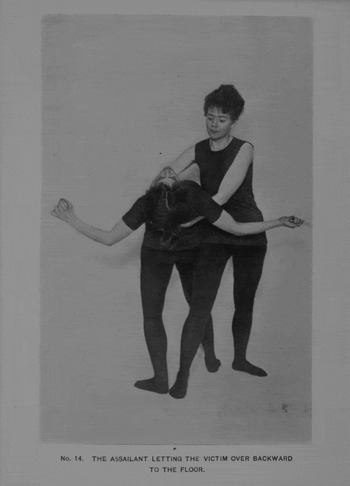
From early on, jujutsu and judo were taught to adults and children of both sexes – a radical development in the Western practice of sport at the time.Footnote 14 By the early twentieth century, students included European and American women and girls, and specialist manuals had been published to accommodate their training (Fig. 1).Footnote 15 Women's martial arts practice offers insights into a further set of trends of the era, including changing conceptions of women's physical abilities and image, connected to the emergence of the ‘New Woman’ who demanded greater rights and freedoms. The New Woman represented the breakdown of social barriers and the enlargement of women's social spheres, and independence in the urban milieu entailed a heightened need for self-assertion and self-protection. The same quality of strategy over strength that made the Japanese arts popular in the musical halls also made them attractive to women, who saw useful opportunities to become proficient in the ‘art of the weak’.Footnote 16 In a period when women were participating in a greater range of sporting activities, jujutsu and judo resisted ideologies of other sports in which, as Jennifer Hargreaves observes, ‘the female body was redefined to symbolize a more active, yet nonetheless still subordinate role’.Footnote 17 Rather, she affirms, ‘The ability of women to use their skill, agility, timing and alertness to outclass a male opponent in direct combat threatens the concept of maleness and symbolizes female empowerment’.Footnote 18
‘The assailant letting the victim over backward to the floor.’ H. Irving Hancock, Physical Training for Women by Japanese Methods (1904), p. 38.

Some of these early women saw theatre as one forum for investigating the potential of this new bodily practice, both within and beyond the frame of the martial arts demonstration. As Susan A. Glenn argues, ‘Within the context of the new century's spirited social, political, and intellectual ferment, female stage spectacle and its explorations became all the more meaningful for popular perceptions of women's nature and role’,Footnote 19 with female performers functioning as ‘agents and metaphors of changing gender relations’.Footnote 20 Practitioner–performers such as Fude Yamashita, Edith Garrud and Florence Le Mar took advantage of the fact that, in their process of recent cultural transference, the Japanese martial arts had acquired diverse meanings and contexts for display, allowing greater flexibility for the strategic redeployment of martial arts skills through theatrical performance in ways that not only were profitable, but – in the case of Garrud and Le Mar especially – reflected and helped advance feminist political agendas in their particular communities.
Graceful judokas and ju-jitsu girls: women's martial performance on the early twentieth-century popular stage
One of the first female practitioners about whom we have evidence in the West is Fude Yamashita (born c.1878), a Japanese woman who accompanied her husband, Professor Yoshiaka Yamashita (a former student of Jigoro Kano), from Tokyo to the United States in October 1903. According to martial arts historian Joseph Svinth, Yoshiaka Yamashita expected to teach judo in Seattle, but soon travelled east to offer classes to members of Washington, DC's social elite – a fashion fuelled by the participation of President Theodore Roosevelt, who was attracted to the ‘manly art’ of judo (frequently referred to as ‘jujutsu’ in the popular press), and the opportunity to lose weight in election year. Yoshiaka Yamashita remained in the United States for several years, teaching judo at the White House, various army and naval academies, and Harvard University.Footnote 21 Although Fude was not initially contracted to teach judo, she came to have an impact on American women's participation in the Japanese martial arts. At the prompting of certain competitive Washington socialites, it was not long before Mrs Yamashita was running daily lessons for some of the country's richest and most famous women, who had the material means and leisure time to follow what the papers now termed the ‘fashionable Japanese craze’.Footnote 22
The participation of Fude and her students can be read as a performative act in itself, a conscious cultivation and self-expressive display of the body,Footnote 23 designed in part to challenge the discourse of the ‘manly art’ in favour of showcasing women's abilities. Even though many other women and girls would soon take up judo in a range of more pedestrian institutional contexts, Fude's society women lent the practice a particular glamour. The group rapidly attracted transatlantic media attention, appearing in the New York World in May 1904 in a feature entitled ‘A Japanese Woman Teaching American Girls Japan's Secret Science of Self Defence’. As the epithet ‘secret science’ suggests, the article develops a tension between judo as a modern sport and efficacious defensive tool, and as an exotic mystery. As well as profiling the socially prominent students, the feature pays rather sensational attention to the teaching influence of ‘Madame Yamashita’. As a female martial artist and a Japanese woman, Fude was depicted as doubly exotic, and as a veritable poster girl for the benefits of judo. Emphasizing the astonishing efficacy and impressive spectacle of the martial art, the article claims that a ‘woman of however slight physique with a knowledge of judo would be absolutely safe anywhere in the world . . . With a slight touch she could absolutely paralyze a large man, and with another throw him a distance of several feet’.Footnote 24 In support, the magazine describes Fude as ‘several inches below the height of an American woman. She however, does some things that seem like feats of stupendous strength to the uninitiated’.Footnote 25
These descriptions point to the theatrical potential of the martial body, and despite the magazine's thrilling tone, it is apparent that Fude herself, like her male contemporaries in the London music halls, exploited the dramatic spectacle of judo to further advertise the practice, developing exciting demonstrations for the Washington stage. The World attests to the reaction of a ‘marvelling spectator’ following ‘a performance during which she had balanced a man on either arm and tossed still another man across the stage as easily as if he had been cork’,Footnote 26 and the following year, Fude assisted her husband in a ‘Demonstration of the Art of Judo’ for mainstream audiences at Washington's Lafayette Theater.Footnote 27 Such demonstrations, performed by the Yamashitas and by other Japanese practitioners who followed soon after, gripped the public imagination; as a Washington Post write-up of 1905 vaudeville novelties explains, ‘Everything Japanese is especially interesting at this time, and jiu jitsu has excited an extraordinary degree of public attention, owing to the effective demonstrations of its defensive value that have been made by Japanese experts recently arrived in this country’.Footnote 28 Although caught in a contradictory web of representation as both subject and object of the spectacle she created, Fude contested (without necessarily escaping) prevailing notions of gender and ethnicity, challenging Western stereotypes of the ‘demure Oriental female’ and performing new physical possibilities for female spectators. As the Chicago-based Dignam's Magazine would later assert, ‘In Japan there is no such thing as the weaker sex, so far as physical ability is concerned’.Footnote 29
Whereas other performance genres – aerial acts, for instanceFootnote 30 – already deconstructed conceptions of women's bodies, physical abilities and concomitant cultural identities, the agonistic nature of the martial arts displays, pitching victorious women against men, had different implications for social relationships. While the aesthetic frame allowed female martial artists to showcase their abilities, the fact that, offstage, they were transferring their skills to other women meant that the acts could not be dismissed as pure amusement. In her role as an early practitioner and pedagogue, as well as one of the first female performers to present the Japanese fighting arts on the American stage, Fude's efforts may be seen as one catalyst for ensuing partnerships between martial arts, feminist philosophy and performance.
The influence of Fude and her society women diffused further into the popular sphere: American playwright Winston Churchill's play The Title Mart, which opened on Broadway in 1906, featured the character of Edith Blackwell, a modern, independent American heiress who was also a jujutsu expert,Footnote 31 and the dancer Mademoiselle Dazie (Daisy Peterkin) premiered her martial arts–dance amalgam, the ‘Jiu-Jitsu Waltz’, as part of the Ziegfeld Follies of 1907 at the New National Theatre in Washington.Footnote 32 Such representations are evidence of the increasing American interest in the use of women's Japanese martial arts practice in, or as, popular performance, alongside the growing formal practice of what the New York Times called ‘the science that is attracting so much attention among athletes’.Footnote 33
Ju-Jutsuffragettes: the political performance of Edith Garrud
These various developments in the United States took place alongside the early establishment of women's jujutsu in Britain. In 1905, the London-based Sandow's Magazine reported how the ‘Japanese national game’ had come to be ‘the fashionable exercise with smart women’ in the United States, and announced that women's jujutsu had been introduced to Britain ‘in more prosaic fashion’, but ‘promises to create an interest little less than in America, and possibly more abiding’.Footnote 34 During the first decade of the new century, several British women became proficient in jujutsu: Phoebe Roberts earned a black belt, competed, and taught at Yukio Tani's Japanese School of Ju-Jitsu in Oxford Street; and Emily Watts qualified at Sadakazu Uyenishi's Academy in Golden Square, publishing her own manual, The Fine Art of Jujutsu, in 1906. Of these women, however, it was Edith Garrud (1872–1971) who was to reframe the Japanese martial arts most significantly in terms of political activism and theatrical spectacle. As the arts were mapped onto Western women's bodies in new contexts, they were appropriated for new ends and their social meanings changed. Garrud foregrounded the political promise of self-defence capability, employing martial arts as a means of embodied resistance and social consciousness-raising.
Like Watts, Garrud began studying jujutsu with Uyenishi in about 1903 and helped run classes with her husband, William Garrud, before opening her own London dojo at 9 Argyll Place. A committed supporter of women's suffrage, Garrud organized the women athletes’ branch of the Women's Freedom League,Footnote 35 and in May 1909 presented her first solo jujutsu demonstration for the militant Women's Social and Political Union's ‘Woman's Exhibition’ at the Prince's Skating Rink in Knightsbridge – a compelling performance which, she recalled, left her ‘inundated with signatures afterwards’.Footnote 36 Subsequently, Garrud arranged a Suffragettes’ Self-Defence Club that met twice a week, preparing members of the WSPU for the violent situations they often encountered in their campaign for the vote.Footnote 37
In its capacity as a practical self-defence and empowerment tool, jujutsu was eagerly embraced by the suffragettes, who saw the unarmed combat techniques as facilitating personal independence and as a way of defending themselves against much larger and stronger policemen. These militant female martial artists became known as the ‘Ju-Jutsuffragettes’, attracting attention from newspapers and magazines of the day, which testified to a great deal of unease within the establishment about the potential for this application of women's jujutsu. In 1910, Garrud remarked with irony that the
daily papers, by their witticisms, smart or otherwise, at the expense of the Suffragette who goes in for ju-jutsu so that she may foil her supposed natural enemy, the man in blue, has certainly helped to popularise that mode of self-defence we owe to the Japanese amongst our women, whether they clamour for the vote or not.Footnote 38
Indeed, Garrud actively publicized jujutsu's role in the suffrage movement, staging a consciously performative practice that took advantage of many available media outlets, including published scenarios, photographs, and the suffragette play.
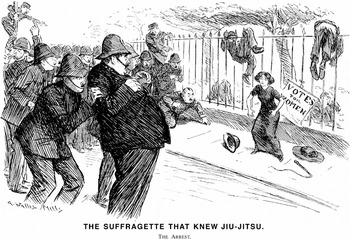
The London Sketch of 6 July 1910 featured photographs of Garrud throwing a uniformed policeman over her head – a feat that she apparently accomplished six timesFootnote 39 – and the same day, Punch magazine published a cartoon captioned, ‘The Suffragette That Knew Jiu-Jitsu’ (Fig. 2), depicting London bobbies cowering before a lone Ju-Jutsuffragette while several of their more unfortunate cohorts dangle from the park railings.Footnote 40 Garrud also developed more imaginative scenarios that moved beyond resistance to formal public institutions of law and order to address ways of controlling aggressive men on the street or in the home. The short story ‘Damsel v. Desperado’, published in the physical-culture journal Health & Strength in July 1910, features a petite lady who is attacked by a ‘rascally hooligan’, but evades his various assaults with blocks, holds and throws, and eventually ‘tie[s] him in a knot’.Footnote 41 The narrative was illustrated with photographs of Garrud and a male companion dressed in character, to demonstrate the realism of these techniques for young women.
‘The Suffragette That Knew Jiu-Jitsu: The Arrest’, Punch, 6 July 1910, p. 9. Reproduced courtesy of Punch magazine.

Throughout her advertising campaigns, Garrud evinced a strong taste for the theatrical, augmenting the existing format of the music-hall demonstration with dramatic plots, costumes and props. Garrud pursued the relations between jujutsu, theatre and political activism through the ‘suffragette play’, an alternative genre of women's performance flourishing at the time. In 1911, Health & Strength reported on a ‘new suffragette sketch’ being rehearsed at Garrud's dojo, ‘in which Ju-jutsu (the real thing) plays a dominant part’.Footnote 42 Entitled Ju-Jutsu as a Husband-Tamer: A Suffragette Play with a Moral, the piece was choreographed by Garrud, and features Liz the costermonger's wife (played by a pupil of Garrud's), who tames her drunken husband Bill into subjection with her jujutsu skills, resulting in a sober, contrite spouse and more equal household relations. The visual script was reproduced for Health & Strength readers in a series of numbered tableaux. As with Garrud's other jujutsu demonstrations, the message was clear: the physical practice of jujutsu had revolutionary potential for women, opening up unprecedented freedoms through new bodily acts. Notably, as the working-class characters and situation of the play suggest, Garrud was determined to revise the reputations both of jujutsu and of the suffrage movement as largely upper- and middle-class preoccupations, emphasizing their relevance for all women.
As the militant suffrage movement gathered force during the early 1910s, Garrud directed her jujutsu practice increasingly from the stage into the street. In 1913, the WSPU developed a bodyguard unit to protect Emmeline Pankhurst from rough police treatment when she was being arrested. Garrud trained some thirty initial recruits in jujutsu, who also received instruction in the use of rubber clubs, and engaged in several violent confrontations with the police.Footnote 43 As a public performance that symbolized the relationship between, and resistance to, bodily and social oppression, jujutsu might be read as an early form of performance art: as performance studies scholar Leslie Hill has noted of the suffragettes’ other militant activities (bombing, arson, chaining, hunger striking and so on), this ‘new hybrid of politics and performance’ foregrounded the suffragettes as ‘exquisite performers with absolute performance awareness and control, perfectly marrying the content and the form of their work’ in modes that were levelled toward tangible social outcomes.Footnote 44
Edith Garrud's importance lies in her appreciation and deployment of the broader political potential encoded in jujutsu skills. In adopting jujutsu as a radical physical and political performance that disrupted simultaneously gender expectations and the masculine ideal upon which the discourse of British nationalism was based, Garrud helped modify women's cultural identities while resignifying the Japanese martial arts in terms of social purpose and gender, class and national identity. In this era of sought-after personal and political autonomy, Garrud's use of the martial arts reflected, and helped contribute to, social change.
Florence Le Mar, ‘the World's Famous Ju-Jitsu Girl’
As women's jujutsu spread its influence further throughout the British Empire, New Zealand was quick to manifest the trend. The bodybuilder Eugen Sandow's 1902–3 national tour, with its spectacular stage routine, had stimulated great interest in physical culture for men and women, while New Zealand's development from a British colony to a dominion in 1907 brought with it new concepts of national identity and a desire for bodies that exhibited literal and figurative strength.Footnote 45 The formation of jujutsu classes began around 1905, the same year that New Zealand newspapers began reporting on women's martial arts classes in Britain and the United States.Footnote 46 In 1910, Lieutenant-Colonel David Cossgrove published Peace Scouting for Girls, which contained an important chapter on jujutsu self-defence techniques and sold widely throughout New Zealand, as well as in the United States and Japan.Footnote 47 It was within this milieu that Florence Le Mar (1889–1951) established herself as an actress, feminist, martial artist, author and self-defence pioneer.
Florence Christina Warren began performing a jujutsu routine with her British pro-wrestler husband, Joe Gardiner, in early 1911, at which point she adopted her stage name.Footnote 48 During their eight-year vaudeville career, the couple toured a wide variety of urban and rural venues with their double turn, in which Le Mar successfully defended herself against Gardiner's assaults. The show, however, was not simply spectacle, but an educational enterprise designed to advertise jujutsu's physical and political benefits for women. Although Le Mar almost certainly learnt her jujutsu from her husband (who may originally have been one of Uyenishi's London students), she soon outshone Joe to become the star of the show, styling herself ‘the World's Famous Ju-Jitsu Girl’ and publishing a mythologized autobiography in 1913 that extended and developed the offstage life and adventures of her persona for a specifically female audience.
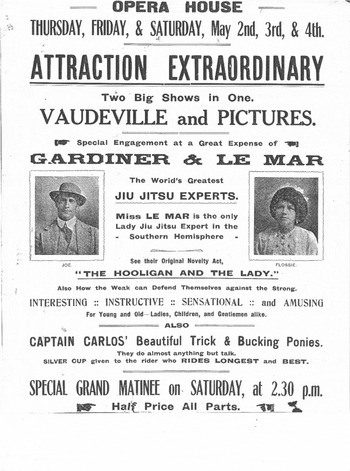
Managed initially by Australasian vaudeville impresarios Harry Rickards and John Fuller, the couple enjoyed ‘wide popularity with the amusement-loving public, their novel exposition of jiu-jitsu having been witnessed by large audiences in all the principal cities of New Zealand’,Footnote 49 and eventually secured the patronage of Lord Liverpool, governor of New Zealand. Their show had a tripartite structure, incorporating a dramatic sketch, a contest and a jujutsu lesson. The first and chief part of the show, ‘The Hooligan and the Lady’ (Fig. 3), comprised a series of jujutsu manoeuvres structured around a narrative drama ‘with special scenery and effects’.Footnote 50 Carefully coded in terms of female virtue and male vice, the scenario featured Le Mar as a respectable lady using jujutsu to repel Gardiner's varied methods of attack, ridding him of a stick, bludgeon, chair, knife, chain, bottle, piece of iron and loaded revolver. Excerpts from a 1914 poem published by Le Mar to advertise the show in Christchurch illustrate the key angles from which the performance was marketed, and suggest how the Japanese martial arts were shaped to fit the vaudeville culture of the period:
In ‘The Hooligan and Lady’, they are smart, clean, clever, straight.
No act in this world better, fast, and strictly up-to-date.
This act[’s] a small-sized drama – constructed round Jitsu
A Japanese discovery, wherein they show to you,
How it's possible for a lady, when molested by a cad,
Maybe tackled by a robber, in fact, any man that's bad,
Can hold her own against him and quickly put him through,
When she knows the locks and holds – pertaining to the art Jitsu.
. . .
No lady in New Zealand should miss viewing their great show.
So clever is the lady that when the tough with pistol, knife
And bludgeon tries to rough her and mayhap take her life,
Like lightning-flash she meets him and quickly stays his hand,
By tumbling him hard earthwards – I tell you it is grand –
And proves to me and all here what women folk can do
When attacked, if they but study Miss Le Mar at Ju Jitsu.Footnote 51
Playbill advertising a performance of ‘The Hooligan and the Lady’ at the Palmerston North Opera House, 2–4 May 1912. Courtesy of Gardiner Family Archive.

Onstage, Le Mar presented audiences with a transgressive body that promised new physical and social liberties, while her role as the dominant member of a husband-and-wife team further dismantled the hierarchy of the Edwardian patriarchal family structure. A review of a mature performance at King's Theatre, Auckland, provides the following account:
Miss Le Mar is seated in a park, reading a book, with her purse on her lap, when she is attacked by Joe Gardiner, dressed as a ruffian. He snatches at the purse, but is quickly checked by the wrist grip, and thrown to the ground. Nothing daunted, he again attempts an attack, but is caught by the leg and tossed heavily some yards away. He again comes on, and is this time subjected to a somersault that should teach him a lesson; however, seeing an advantage in the lady's back being turned, the burglar catches her by the wrist, but the clever young lady in a trice has him fast and gives him a nasty fall over the head. Finally he draws a revolver, but ere he can fire, both wrists are gripped, and he is powerless. The whole exhibition looks so simple that one can only marvel at its powers.Footnote 52
Notably, the particular structure of ‘The Hooligan and the Lady’ was almost certainly based on the scenario described by Edith Garrud in ‘Damsel v. Desperado’. Although New Zealand had enjoyed universal suffrage since 1893, Le Mar was sympathetic to the British suffragettes’ aims and acknowledged a relationship with them, although she reversed the vein of influence, claiming in 1912 that she had spent time in England and ‘was once approached by the suffragettes with a view to teaching her art for the benefit of female vote-seekers’.Footnote 53
In the following section of her show, Le Mar extended a challenge to audiences to try to break her jujutsu grip. This participatory section, in which laypeople became part of the performance, went beyond ocular proof of women's ability to resist male attack, and provided visceral evidence of the veracity of her performance. At the height of Le Mar's career, the Gardiner Vaudeville Company announced that ‘Miss Le Mar has backing up to £1000 against any lady in the world in a Jui Jitsu [sic] Contest’.Footnote 54 For male audience members especially there was a very real danger in going to see Le Mar perform; in describing a technique called the ground armlock, Le Mar recalls, ‘This causes him excrutiating [sic] pain, and, as happened to a sailor who came on the stage . . . recently to test this lock, may break his arm with the greatest ease’.Footnote 55 The final part of the show featured classes that Le Mar offered to patrons in her role as the Ju-Jitsu Girl, targeted specially towards women.
Le Mar deliberately set herself up as an example for other women to follow, and this pedagogical element distinguished her from most of the other vaudeville performers who were billed alongside her during her career. While fellow acts sold themselves precisely on the basis of their idiosyncratic abilities and attributes, Le Mar's feminist philosophy of empowerment through jujutsu was premised on its transferability from body to body. Subsequently, all women had the potential to become ‘Ju-Jitsu Girls’ in their own ways, and help realize Le Mar's broader vision of ‘a race of self-reliant womanhood’ with a strong sense of social responsibility.Footnote 56
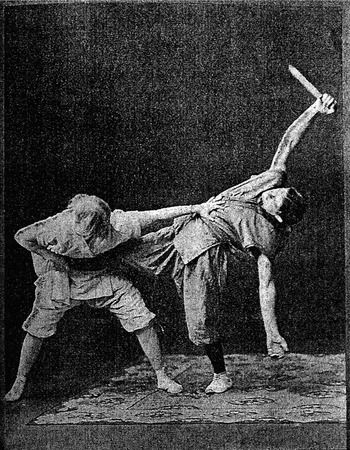
Le Mar's own mythmaking was tied inherently to this broader feminist vision. In 1913, anxious to spread her message in print and to further embellish her persona, Le Mar published her ‘autobiography’, The Life and Adventures of Miss Florence Le Mar, the World's Famous Ju-Jitsu Girl (Fig. 4). The book is fascinating as an extension of the vaudeville performance, but is also noteworthy for its unique structure, being an interdisciplinary amalgam of martial arts theory, fitness instruction, history, biography, adventure narrative and feminist rhetoric. The second half of the book, comprising forty photographs of Gardiner and Le Mar performing jujutsu manoeuvres with detailed explanations, constitutes one of the world's first self-defence manuals written by a woman for other women, some seventy years before New Zealand's next such publication.Footnote 57 The first part of the book consists of six short stories related in a highly sensational mode, detailing Le Mar's adventures across the globe with a variety of drug smugglers, cheats, molesters, madmen and animal abusers, all thwarted by her jujutsu prowess. From the Sydney docks to the grand houses of the English aristocracy, the stories run the gamut of situations that the New Woman might encounter, while reflecting the resourcefulness and ingenuity of the New Zealand pioneer character. The anecdotes are designed to promote jujutsu by example, offering a feminist fantasy of the dominance, freedom and independence offered by martial arts skills. In the stories, men are always the aggressors, and jujutsu becomes a contract between the women as a way to restore order, with the Ju-Jitsu Girl functioning as a moral arbiter, defending the weak and punishing the wicked. Although Le Mar disseminated her message through the avenues of theatre and fiction, it seems clear that she was a sincere and zealous advocate of jujutsu, and intended her inspirational message to be taken seriously and to open up new horizons for women of all social backgrounds.
‘The overbalance.’ Florence Le Mar, Life and Adventures (1913), p. 107.

Conclusion
It would be satisfying to claim that the legacies of these women continued unbroken to the present day,Footnote 58 but in fact their work was enabled by a unique set of economic, political, social and aesthetic circumstances that had changed by 1920 – due in part to women's suffrage; to the multivalent impact of the First World War, during which the martial arts were reincorporated within a masculinized, militarized model; and to the decline of vaudeville in favour of cinema. Although women continued to practice judo, jujutsu and an increasing variety of other martial arts in various institutional settings throughout the twentieth century, it was not until the 1960s that the political valences of women's self-defence capabilities were again brought to the fore.Footnote 59 In this brief historical overview, I have outlined the activities of Yamashita, Garrud and Le Mar, and identified preliminary relations between some of the contexts and applications of women's judo and jujutsu in the early twentieth century, in order to draw attention to some of the less well-known political performance strategies employed by women during this period, and to investigate some of the more unorthodox ways in which these Japanese cultural exports circulated and were resignified. Significantly, the varied manifestations and interpretations of judo and jujutsu in the early 1900s suggest that martial arts practice was not merely a peripheral example of the Victorian and Edwardian penchant for esoterica, but might be read as an exemplary discourse of the period: facilitated by, contributing to and connecting a broad range of concurrent and emergent trends. Consequently, we might read these women's performances as representing a similar nexus, foregrounding a complex interplay between cultural adaptation, physical training, gender politics, social identity and popular performance during an era of rapid social transition.