





Decolonizing pedagogy, as much as research, remains a critical part of Middle East studies (MES). Many scholars, including in North American university contexts, have shifted their focus to relationality as part of critical approaches to decolonizing higher education. For instance, Hanieh Haji Molana adopts a feminist relational pedagogy to reexamine the student–teacher relationship and how students and teachers each relate to the Middle East in ways that challenge enduring “colonial attitudes, narratives, and relationships.”Footnote 1 As Haji Molana highlights, an important goal of this work is to question misrepresentations of the Middle East and biases that some students bring into the classroom.
Building on work that recognizes the potential of relational pedagogies for decolonial and anticolonial praxis, we reflect in this article on the transformative possibilities of a particular relational pedagogical approach, called “students as partners,” for MES classrooms. Students as partners (SaP) is a pedagogical approach in higher education that aims to transform teaching and learning practices by directly involving students in the design of pedagogical practices, learning activities, and curriculum. This approach centers the values and ethics involved in partnership and repositions students as experts of their own learning experience and active contributors to teaching and learning, rather than as passive recipients of knowledge. The SaP approach therefore emphasizes reciprocal and inclusive collaborations and collective decision-making among participating faculty, staff, and students as intellectual equals, each with their own respective areas of expertise.Footnote 2
In the 2023–24 academic year we formed our SaP partnership, consisting of an early-career faculty member and two former students of the faculty instructor’s history course, entitled “The Abbasids: History, Heritage, and Memory,” at a Canadian research university. We received institutional funding for our SaP project to transform this Middle East History course from a small special topics seminar to a higher-enrolling, permanent lecture course in the history department curriculum. Reflecting on our respective experiences in this partnership, we argue for the possibilities of SaP work to address the pedagogical goals and challenges encountered in MES classrooms. We join recent scholarship on the benefits of student–faculty collaborations in MES and argue for the importance of student partnerships for the construction of MES curricula.Footnote 3 Many MES practitioners work in academic systems in which “teaching wisdom is presumed to derive almost exclusively from instructors’ classroom experience, research training, and subject expertise.”Footnote 4 Pheroze Unwalla argues that although these sources of expertise are necessary for teaching in MES, they alone are insufficient and betray “a limited perception of teaching aptitude and care.”Footnote 5 This observation reveals a key challenge: curricula that are only oriented toward MES scholars’ own specific research expertise will contain gaps in what and how students learn in MES classrooms. We consider SaP to be a valuable approach for addressing this challenge and embedding collaborative, relational values and multiple perspectives into the structure of curricula to better support the diverse, social learning that takes place within it. Finally, we argue for the important, yet understudied, impacts that faculty–student partnerships can have for the partners involved.
Project Formation
Following extensive research that emerged from SaP projects and applications in higher education, SaP has become a practice that institutions now formally support.Footnote 6 The establishment of a formal students as partners fund at the authors’ institution (2022), modeled on existing SaP initiatives at other Canadian universities, offered competitive “Students As Partners in Course Design” grants to support undergraduate students who wish to work in partnership with faculty members. The grant stipulated that participating students be treated as collaborative partners: 99 percent of the maximum funding possible for an awarded project covered the salaries of student partners, and student labor could not be used for teaching assistant–related or grading-related tasks. This core value of treating students as equal collaborators rather than as subordinate assistants or graders provides an important model for how MES practitioners might work with students on pedagogical projects.
Our SaP project emerged from a special topics course, “The Abbasids: History, Heritage, and Memory,” which examined the political, social, and cultural history of the Abbasid Caliphate (132–656 AH/750–1258 CE), a period often referred to as the Islamic Golden Age. The faculty instructor had designed and taught the course for the first time in spring 2023. As part of a growing number of offered Middle East history courses and a recently established Middle East studies program at our institution, the course attracted students from many cultural and disciplinary backgrounds. Although student feedback on the original course was positive, the faculty instructor wished to incorporate student stakeholder values and experiences into the course redesign before transforming the temporary special topics course into a permanent course in the history curriculum. Whereas some practitioners view SaP as a remedy for teachers who forget the experience of being a student, we argue for a more nuanced justification for engaging SaP work: in occupying the positionality of the teacher, the instructor cannot simultaneously occupy the student experience of their own teaching. The SaP approach recognizes that faculty and student partners each have their own experiential expertise.
Our partnership was formed between the original course designer and instructor (Knutson) and two former students from the first course cohort (Shaheen and Izadi).Footnote 7 The faculty partner invited these students to be partners based on multiple considerations: their respective engagement and demonstrated leadership in the classroom; their constructive ideas for improving the course; their disciplinary positions as non–history majors who could speak to the experience of accessing the course content without specialized disciplinary knowledge; and their demonstrated potential to build a trust relationship in which they could feel comfortable speaking up even when they did not share their faculty partner’s views. SaP scholarship promotes the vital importance of trust and other relational values to successful partnerships, particularly with existing power dynamics between faculty or staff and students in mind.Footnote 8 We also appreciate that each partner brought unique positionalities and experiences to the partnership, which inspired generative conversations on teaching and learning in MES.
Asking critical questions about how students learn in the MES classroom remains a challenge in our field, especially when instructors fail to consider how students might experience a course differently through their own unique positionalities and past learning experiences. Because no single teaching intervention will adequately support every student, instructors must confront the pedagogical complexities of supporting a diverse community of learners—especially in an MES classroom. Although SaP is not a panacea for these challenges, the partnership helped us to collaboratively ask questions about the student experience that, individually, we might not have otherwise considered. Recognizing that the first student cohort had consisted of diverse positionalities and disciplinary backgrounds (students’ declared majors or chosen programs of study), our main guiding research questions were:
-
1. What was the student experience of diversity and cultural learning in this Middle East history course, and how can we support students across different positionalities and experiences?
-
2. What was the student experience of learning about the Islamic past, often for the first time and, for most students, as non–history majors, and how can we support students across different disciplinary perspectives?
Our partnership aimed to support future learning communities of students with diverse positionalities and disciplinary backgrounds. Situated in a Euro-Western and Anglophone context, we wished the course to provide a space for students who culturally identify with the Middle East to feel more seen and included on campus and for students who do not culturally identify with the region to become more curious and invested in decolonizing efforts and problematizing harmful biases and forms of exclusion, including racism and Islamophobia.Footnote 9 Although goals and values are critical to SaP projects, they will remain disconnected from any pedagogical redesign if they are not rooted in research on the student experience. We therefore caution future SaP partnerships in MES to carefully consider the alignment between partnership values, pedagogical interventions, and research on student experiences (before and after the redesign) to avoid merely supplanting former pedagogical practices with other untested teaching interventions. Using our guiding values and research questions and methods, the course redesign involved three main tasks: (1) surveying former students on their course experiences alongside analyzing their feedback in formal university course evaluations to refine our project goals and pedagogical initiatives; (2) redesigning the course syllabus with updated primary and secondary source course preparations; and (3) creating an open-access resource to support students in the course’s cumulative research project.
Course Redesign
To address our guiding research questions and gather information on student perspectives of the course’s existing strengths and weakness, we analyzed feedback from the former students through anonymized, formal student course evaluations. We additionally created a separate, postcourse student survey to solicit more specific insights into the student experience of the course beyond what the formal university course evaluations capture. We developed the survey together, contributing ideas and formulating targeted questions rooted in our respective experiences as former students and the course instructor. The survey solicited information regarding former students’ self-identified learning styles, previous exposure to Middle East history courses, and experiences of the course readings, content, and classroom activities.
Together, the formal course evaluations and separate survey revealed many insights related to our research questions on diversity and cultural learning and the student experience across disciplinary backgrounds. Student respondents highlighted the challenges that underprivileged students can face in managing external commitments and circumstances alongside their academic pursuits, such as part-time or full-time employment and commuting long distances to campus. The survey suggested that the in-person, synchronous modality of the course posed a barrier to students who could not easily commute to campus regularly. Many student respondents voiced support for changing the course name to one that did not assume that students in a North American context, including those who culturally identify with the Middle East, would already be familiar with terms like “Abbasid.” Student respondents appreciated the course instructor’s sensitivity to cultural issues covered in the course and the opportunity to learn from an invited guest speaker, a locally based Iranian artist who had presented on the Kufic script’s influence on contemporary Islamic art. In the surveys students also expressed their overwhelming preference for more historical primary sources in the assigned readings. Students were enthusiastic about the course’s emphasis on experiential learning and appreciated the scaffolded assignments building up to the cumulative research project, but some responding non–history majors struggled with reading and researching specialized historical scholarship as they developed their research projects. These barriers showcase the necessity of asking critical questions about the student experience, especially because many of these issues typically elude MES instructors’ detection in the classroom. That kind of inquiry involves thinking critically beyond the confined questions that institutions regularly inquire, such as in formal student evaluations, in the current landscape of the humanities in higher education. This critical inquiry is also critical to MES, which has much to offer students, particularly as the necessity for cross-cultural competencies—especially with the Middle East—continues to increase.
The surveyed student feedback proved paramount to the course redesign and helped our partnership appreciate the impact of both external circumstances and internal course design decisions on the student learning experience. The post-course survey was particularly valuable to Knutson, the course instructor, as a way to learn about the student experience beyond what professors typically receive from classroom interactions and office-hour conversations: “I came to better appreciate that students’ nonacademic commitments influence how they engage with a course.” The creation and analysis of the surveys generated discussions in our partnership about enhancing course accessibility to ensure that the course learning experience aligned with student needs and well-being. As a commuter to campus, Izadi described that “it was validating to see that survey responses echoed feedback that Laila and I had also raised in team meetings.” Our partnership therefore discussed ways to diversify course preparations to support students, including those who commute and work part-time or full-time, who may be able to better access course content in their busy schedules through multimedia such as podcasts.
Redesigning Course Syllabus and Supporting Student Research
After analyzing the student survey findings, our partnership collectively redesigned the course. We wished to support social inclusion and well-being, especially for students who face external pressures and commitments that make accessing a fully synchronous, in-person course more difficult. We revised the course modality to a hybrid model, in which students access an asynchronous, recorded lecture once a week and an in-person discussion on the second course day each week. We learned from former students that the original course title, “The Abbasids: History, Heritage, and Memory,” assumes that enrolling students have preexisting familiarity with the Abbasid Caliphate. We therefore developed a new course title, “The Islamic Golden Age,” to attract students who are interested in Islamic history but may not be familiar with Abbasid history or know to search for this term in the university registration system. This change speaks to the kind of decisions involved when MES practitioners center student learning beyond simply examining their own teaching practice. Although the faculty partner preferred the greater specificity of the term “Abbasid” and would not use “Islamic Golden Age” or “medieval Islam” uncritically in her own research, somewhat more complex sets of considerations are required when making a course more accessible to diverse learners within the constraints of student-facing university registration systems and institutional website pages. In recognition of the scholarly debates on, and complexities of, the term “Islamic Golden Age,” we decided to include a week in the course during which students problematize this term and consider the legacies of the historical period.
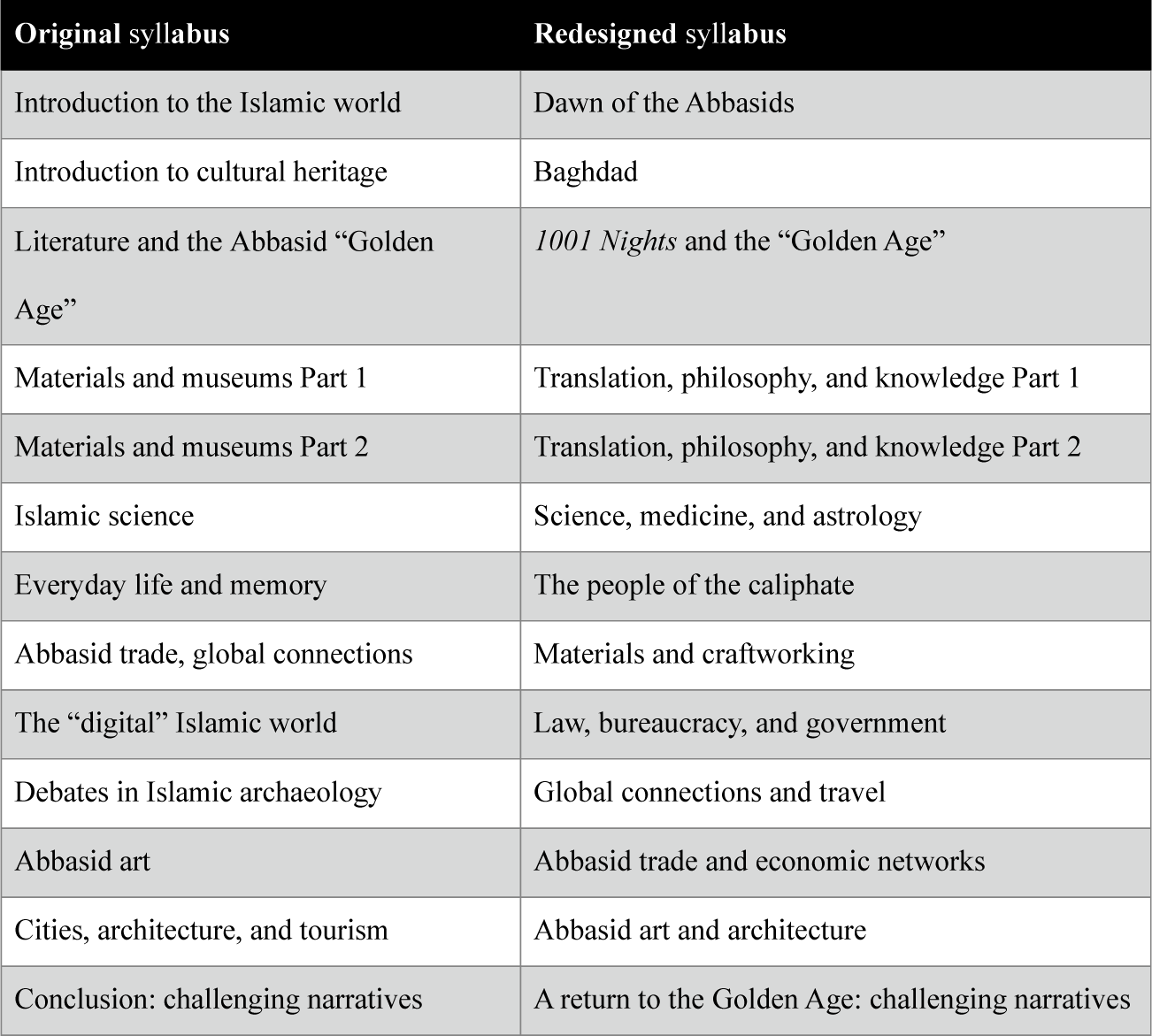
We significantly updated the syllabus to complement the course redesign. The original syllabus was divided into weekly themes, and we chose to keep a thematic structure in the course redesign over a traditional, chronology-driven survey course (Fig. 1). MES scholarship has discussed some challenges of history survey courses, including balancing historical processes and events, the privileging of imperial centers and provincial capitals, and determining the ideal course endpoint—issues that might be amplified in premodern Islamic history courses in which instructors are typically expected to provide greater chronological coverage than their modern history colleagues.Footnote 10 SaP offers a model for incorporating student input into such pedagogical decision-making and, more importantly, provides opportunities to assess and strengthen the alignment between what the instructor believes they are teaching and what students actually learn in the course. In our case, the student survey feedback and the student partners’ communicated experiences revealed that some original weekly themes were more effective than others. Although not a challenge exclusive to our field, MES courses tend to reflect scholars’ own subject expertise and resource curation to the neglect of other pedagogical initiatives and content; this limitation was reflected in the original syllabus.Footnote 11 SaP can address this challenge by diversifying the syllabus through collaboration and multivocality, provided that the instructor is open to this feedback and teaching outside their specialized research domain.
Weekly themes in the original course syllabus of spring 2023 and the weekly themes in the student and instructor partnership’s redesigned course syllabus (spring 2024 and ongoing).

We redesigned the thematic structure, guided by incorporating new primary sources in English translation into the assigned weekly readings. The redesigned syllabus more appropriately centers Abbasid-era content, balances historical processes and events, and mobilizes Knutson’s archaeological expertise to offer more desired content on social history beyond the elites in the thematic week “People of the Caliphate.” Our inclusion of new topics, such as law, bureaucracy, and administration, sometimes challenged the faculty partner to expand her knowledge on subjects beyond her own specific areas of expertise. These interventions, as Izadi points out, more greatly reflect “multifaceted perspectives on Abbasid-era historical and cultural contexts,” and positively address a wider range of student interests. Knutson learned from her student partners and the student survey respondents that non–history majors needed more pedagogical support in learning discipline-specific methods, such as the analysis of primary and secondary sources. To help address this barrier, we designed weekly, precirculated reading questions that encourage students to practice identifying the main points of the assigned sources. These questions are provided at the end of each recorded lecture and scaffold student learning of the assigned course preparations to help students feel more confident as they prepare the readings for the in-person discussion classes.
Finally, our partnership aimed to center student research in the MES learning experience. Building on feedback that students appreciated the course’s emphasis on experiential learning and research but wished for additional support in developing their research projects, we transformed support for the cumulative project. We designed specific classroom activities to support student comprehension and analysis of primary sources and scaffold their skill-building in research skills throughout the course, leading to the final project. Led by Shaheen, we created an “Medieval Islam Repository,” of indexed primary and secondary sources available in English, Arabic, and Persian that provide students with access to relevant Islamic history source materials.Footnote 12 Our partnership chose to make this open-access resource multilingual rather than restricted to translated sources in English. “As a scholar who values the intersection between history and cultural heritage,” Knutson reflects, “it was meaningful to work alongside my student partners on primary and secondary source research and to see them contributing sources written in their respective native languages to build a resource that can support future multilingual student research.” As a native Persian speaker, Izadi recalls that this research process “afforded me insights into people in the past who used Persian to preserve their culture while witnessing the contrasting abundance of Arabic primary sources. This deepened my appreciation of complex historical processes that involve documentation and preservation.” As a result, Izadi found opportunities to engage the historical significance of the Persian language to Abbasid history while exploring the intricate dynamics at play in historical research. Finally, with feedback from the student partners and surveyed former students, the faculty partner developed an open-access, digital humanities activity to support student learning of digital tools and data applications in the context of a Middle East history course. Since completing the course redesign, we have published our revised syllabus, including the weekly readings, discussion questions, and other pedagogical resources, to share this work with teachers, researchers, and students beyond our institution.Footnote 13
More than Pedagogy
Our project is rooted in the scholarship of teaching and learning that examines the potential of SaP to improve teaching and learning and contribute to pedagogical theory.Footnote 14 One contribution of our project has been to apply this approach to a specifically MES context. We therefore reflect on what SaP can offer MES instructors. We argue that SaP work offers important possibilities to not only transform teaching practices but also to address more than pedagogy, including the embedded structures that shape student learning experiences of MES curricula, decolonizing pedagogy, and opportunities for mentorship and professional development.
Students As Partners in MES Curriculum Design
Based on our experience, we found that SaP work can radically inform an MES instructor’s pedagogy based on the inclusion of student experiences; these are best integrated into pedagogical practice when students are repositioned as experts of their learning and as partners with the agency to inform pedagogical decisions. In addition to the transformative possibilities that SaP offers for teaching MES, we argue for the value of student partnerships in the construction of MES curricula, not least to reveal and address structures that shape students’ experiences, sometimes even before they enter the classroom. In the previous section, we discussed some hidden structures that inform student access to MES courses, including the course title and how students search for courses in university registration systems. In our own institutional context, in which enrolling students can search for courses by keyword, we found that shifting from more specialized terms like “Abbasid” to broader terms like “Islamic” better supported students’ ability to find our course. We also discussed how students’ external commitments, such as employment or a long commute, can impact student learning as well as a student’s decision to enroll in a course based on scheduling. Our partnership found that addressing a course’s modality can impact student access to a course as much as expanding the kinds of course preparations through which students access course content. Finally, although the task of course-level curriculum design often falls primarily to the MES course instructor, the decision-making power of the instructor alone is also a structure that informs student experiences of MES. Our partnership therefore took seriously the importance of incorporating former student values and subject interests into the course redesign to better ensure that the course serves future student needs. Although these issues are not exclusive to MES, much is at stake here for our field, especially in North American higher education. In such contexts, it is not uncommon for the instructor to not be culturally affiliated with the Middle East or for instructors who are culturally affiliated with the region to have received at least part of their education in Euro-Western contexts. And given that MES instructors, across positionalities, will very likely teach students culturally affiliated with the Middle East as well as students whose first proper exposure to the region may be through the course, the instructor’s positionalities actively shape the way that students engage with MES. SaP can therefore be a powerful mechanism for multiperspectival representation in the course and, for the teacher and institution, accountability.
SaP offers opportunities for the partners involved to reflect on disciplinary norms that impact student learning.Footnote 15 Although our partnership emerged from shared excitement at the possibilities of contributing our respective experiential expertise to the course redesign, we discovered that this work also required team conversations on disciplinary and institutional practices in higher education and their impact on MES pedagogy, a complex process that is rarely shared with undergraduate students. This reflective process, too, presents possibilities to decolonize pedagogy by prioritizing changes driven by student experiences of learning and questioning institutional or disciplinary norms, especially when they do not align with student needs. For instance, to redesign the syllabus, we reflected on what it means to teach and learn Middle East history in the twenty-first century at our institution and in a wider North American context. We each had preconceived expectations about what a history course should look like, and we deliberated whether we wished to support or resist those expectations, including in the context of Middle East history. Knutson joined the institution in 2022 as a new faculty member after receiving her PhD in a social science field. Her first year in this tenure-track position in a history department involved creating and teaching five new courses, including the Abbasid history course. When Shaheen and Izadi inquired about the faculty partner’s own expectations and intentions for the course, she realized, “My original course design often tried to collapse multidisciplinary content into what I thought might fit an acceptable history disciplinary mold.” Addressing this issue within the context of our partnership helped Knutson shift her internalized assumptions about teaching in MES and focus on developing course themes that translate to student interests and embrace her multidisciplinary training.
We suggest that SaP invites reflection on the complexities of teaching MES in institutional contexts and the pedagogical norms informed by institutional structures. We grappled with the complexities of teaching MES in a North American research institution where it has become increasingly common for upper-level humanities and social science courses to not have prerequisites that presume some level of preexisting familiarity with disciplinary practices or knowledge. We do not claim that this is necessarily a negative development, as courses without prerequisites can promote greater inclusivity and accessibility to learning in higher education. That said, there are pedagogical challenges involved in teaching, in this case, an upper-level Middle East history course that attracts not only upper-level history majors, but also students from other declared programs of study who may have never previously studied undergraduate-level history and selected the course for an elective requirement. This issue demands nuanced considerations for a course design in which students will inevitably have differing levels of familiarity and comfort with the content and, therefore, different learning experiences and needs. These considerations exist in any course, not simply in those without prerequisites. The faculty partner navigates these complexities in her courses by “meeting each student where they are,” a phrase often used in K-12 educational contexts but one that overlaps with pedagogical theories and approaches used in higher education, including self-directed learning, student-centered learning, communities of practice, and engaging emotionality to move toward ethical learning and social responsibility.Footnote 16 These pedagogical models are certainly not the same, but they each build on a foundational principle: that students are active, embodied learners, not passive recipients of knowledge in which learning is “deposited” into blank minds, to use Paulo Freire’s “banking education” metaphor.Footnote 17 These pedagogical models hold immediate relevance for MES curricula, because, we argue, they must inform the very structural design of MES courses—not simply the occasional classroom learning activity—to effectively engage decolonizing pedagogy. MES instructors must therefore consider both how and what students learn in their course designs. They must also reckon with how their own pedagogies and institutional contexts and constraints directly shape student learning experiences in order to best support diverse learners in MES.
Decolonizing pedagogy begins with asking critical questions centered in student learning. As Unwalla inquires, “What lies beneath the surface of our syllabi, readings, and classroom activities?”Footnote 18 When instructors focus only on their teaching and not the student experience of those practices, underlying student needs will remain overlooked, especially those of underprivileged students. SaP was the mechanism through which we addressed this problem and implemented our decolonizing goals. However, we must reiterate that SaP is a model, not a panacea, for decolonizing pedagogy. SaP is neither easy nor fast work and must be conducted ethically, or else it may inflict harm and reinforce colonial values and norms. With this warning, we argue that SaP can support MES practitioners in decolonizing pedagogies in a few key ways: addressing structural barriers; mobilizing relationality and multivocality; and encouraging accountability.
First, although many MES instructors regularly work to address misconceptions of the Middle East in their courses, structural barriers also impact this learning and influence which students enter our classrooms; addressing these challenges therefore remains a key part of decolonizing pedagogy in MES. SaP decenters the instructor within academic systems, which are historically rooted in colonial values and prioritize the expertise of only this individual in the classroom. In contrast, when the experiential expertise of students also is valued, SaP partnerships can help illuminate barriers rarely revealed in classroom or office hour settings and enact changes driven by student experiences, rather than institutional or disciplinary norms often rooted in colonial values.
Second, SaP’s relational practice also encourages individuals to reflect on their positionalities within the partnership. Shaheen recalls that SaP transformed our discussions from simply technical procedures to “eye-opening conversations that helped me to locate myself in relation to my partners and to expand my perspective on pedagogical practices that I was unable to register before.” Her observations resonate with scholarship that demonstrates SaP can support a transformed sense of self-awareness, an integral process to decolonizing pedagogies.Footnote 19 This relational, collaborative work meant that we better integrated multivocality into the redesigned syllabus (incorporating more diverse MES content and interests than what one person alone can achieve) and decolonized the assignments and classroom experiences by supporting more diverse student needs rather than catering to only certain types of learners (whom institutions tend to unevenly support). Finally, the student partners found the cocreative process on a course connected to their cultural heritage to be empowering. As Shaheen notes, “redesigning the syllabus alongside the teacher, instead of being data points for her, was incredibly fulfilling.” Empowering individuals who culturally identify with the Middle East, yet whose voices are too often underrepresented in curricula, is an important decolonizing pedagogical practice.
Third, given the critical importance of MES pedagogies in shaping how learners relate to MES, we argue that instructor accountability is a core practice in decolonizing pedagogies, one that SaP ideally encourages. SaP resides on the premise that the best pedagogical work cannot be done alone, no matter the instructor’s positionalities, because they only can ever occupy their own perspective. The stakes, and admittedly risks, are also high in intercultural partnerships like ours, formed between a white instructor and two students from the Middle East. We have argued that multiple perspectives are required to sufficiently address diverse student learners and challenge colonial discourses and norms. Izadi recalls, “I learned that decolonizing education is not simply a theory but a practice in which students can actively be involved.” His experience emphasizes that decolonizing pedagogy should not be exclusive to MES instructors and also that students have an important role to play in this process. We suggest that the valued, active role of students in SaP work must keep the instructor accountable to hearing and addressing student experiences and operating with decolonial values in mind.
Professional Development and Mentorship
In addition to opportunities for SaP partnerships to reflect on, decolonize, and address structural impacts on student learning experiences of MES curricula, we join an emergent body of scholarship that examines SaP’s potential for mentorship and professional development in higher education.Footnote 20 Based on the National Association of Colleges and Employers’ concept of career readiness, some researchers understand professional development as the learning of “competencies for a career-ready workforce.”Footnote 21 We argue for reframing professional development as an emphatically relational process: building on Lave and Wenger’s concept of “communities of practice,” professional development is more appropriately understood as the participation of learners in a community of practitioners collectively engaging in professional practices—that is to say, activities that are practiced in specific careers and workplace settings.Footnote 22 We pose this critical reframing of professional development as relational, rather than a top-down process in which professional norms are simply imparted to students, because scholars on decoloniality have rightly warned of the reinforcement of colonial, dominant cultural norms and power dynamics in mentoring contexts. These challenges exist alongside the issue that undergraduate students often receive little training in professional practices in the classroom, despite the growing demand for experiential learning. This training can emerge from conversations between practitioners and learners, as Cook-Sather and her colleagues point out, but also from the learner directly engaging in participatory tasks.Footnote 23
As intellectual equals, the SaP project offered each of us professional development in an MES context, based on collectively engaging practical, participatory tasks that offered learning of highly applicable professional skills. As a psychology major, Izadi wished to gain experience in social science evaluation methods, skill-building that had been absent from his own classroom learning experiences. As a trained social scientist, Knutson could support this training and introduced Izadi to the Qualtrics platform, with which he built the online student survey. The partnership collectively wrote the survey questions. Izadi reflects, “I appreciated learning about the ethical considerations and technical aspects involved in survey design. This process helped me to refine the goals of the SaP project and my own active role in the partnership.” Shaheen, meanwhile, found the survey development simultaneously enjoyable and frustrating, especially in crafting survey questions that would not lead respondents in biased ways. She reflects, “While meticulously evaluating whether a question might lead respondents was frustrating, I found learning opportunities in every disagreement. I see now that my frustration was a by-product of the mental shifts happening at the time.” The coparticipatory task of survey development taught Shaheen that how researchers ask questions can influence or bias survey responses and that formulating questions in particular ways can help capture the nuances of student feedback. The student partners’ experiences highlight how MES coparticipatory projects can offer professional development of skills not necessarily associated with MES pedagogy. This is not to dismiss the undeniably critical conceptual learning that emerges from MES curricula, but MES practitioners, especially in the humanities, are rarely trained to attend to, and communicate to students, the important, specific processual learning that can emerge from professional engagements of MES.
In addition to the participatory learning in our course redesign work, we gained professional development from the collaborative processes of presenting at local and international academic conferences and publishing our redesigned syllabus. Through these coparticipatory experiences, the student partners engaged in common scholarly and professional activities rarely taught to undergraduates, including how to apply for conference travel funds, submit an abstract to academic conferences, and revise a conference paper for publication, as well as the considerations involved in selecting a venue for publication. These activities also gave the faculty partner professional development in learning effective mentorship skills. During the project, we encountered institutional dynamics and constraints, such as with applying for funding or policies that determined when and how students receive salaries and reimbursements for conference travel, instances in which the faculty partner had to intervene. In examining the faculty partner’s professional development, our aim is not to recenter the faculty member at the expense of the students. Instead, our collective and individual experiences here reveal what is required of decolonializing mentorship in MES. Scholars on decoloniality have warned that harmful power dynamics can occur “when mentors, consciously or unconsciously, impose their worldview and standards onto the mentee, potentially marginalizing or disregarding [I]ndigenous or minority perspectives.”Footnote 24 To avoid these dynamics, faculty partners must be open to mental shifts and (un)learning as much as their student partners—and likely more so—and willing to face the intersectional ways in which they might be privileged. In our experience, the partnership enabled the faculty partner to reflect on these privileges and institutional practices that reinforce colonial, dominant cultural values and to unlearn norms that she would have otherwise taken for granted. Although SaP here opened an opportunity for (un)learning structural norms—a decolonizing practice—we echo scholars’ warnings that mentorship, like teaching, creates vulnerable possibilities to either (un)learn or harmfully normalize structural norms. To avoid the latter, mentors and teachers must listen to students’ lived experiences and listen for forms of silences and silencing. Not least, “disciplinary borders and alienating academic norms are forms of institutional silencing. . . . [To] create space for marginalized perspectives and knowledges to enter the academy, decolonial mentors allow their worldviews to be disrupted.”Footnote 25 We demonstrated earlier how SaP encouraged our own conversations on disciplinary norms and how those reflections can effectively reorient MES curricula.
Conclusion
We have reflected on our experiences of engaging SaP in the redesign of a Middle East history course. We have argued for the importance of student–faculty partnerships in the structural design of MES curricula, professional development, and decolonizing pedagogies. We join current scholarship that highlights SaP as a practice that renegotiates traditional power arrangements and practices in higher education. Our project was similarly established on the premise that students, when repositioned as intellectual equals, can offer powerful insights into MES pedagogy through their own sets of experiential expertise. Scholars continue to debate to what extent SaP can challenge neoliberal agendas at institutions of higher education, including tendencies to treat students as subjects, data, or customers.Footnote 26 These are worthy debates, and we would agree that SaP has the potential to generate culture change in institutions as well as fields like MES. However, these debates, as Maisha Islam and colleagues also point out, can lose sight of SaP’s possibilities to address structural issues that are felt by SaP partners, not least those from underrepresented backgrounds.Footnote 27 We therefore prefer to resist making arguments of institutional utility or impact and instead examine SaP’s opportunities for empowerment among its practitioners in MES. For instance, SaP can foster equity and inclusion, not least when this approach is accessed by partners from underrepresented and equity-seeking backgrounds.Footnote 28 An ongoing challenge in SaP work is to address who among faculty, staff, and student groups has access to SaP initiatives in institutions of higher education.Footnote 29
Scholarship has identified other relevant challenges, including the power dynamics that persist in SaP partnerships, including intercultural partnerships, and the limited ability for most partnerships to include more than a small number of partners.Footnote 30 As an intercultural partnership, our SaP partnership was not immune to these dynamics. We join Zhang and colleagues in recognizing the particular power and cultural dynamics involved in our partnership and we reiterate Matthews and Dollinger’s warnings of the harm in positioning student partners as representatives for individuals with similar identities. Given the stakes of this work, especially in MES, we deliberately and regularly worked to develop mutual trust based on communication, respect, and open, reflective learning; this foundation allowed us to embrace and communicate some instances of discomfort. When Knutson invited Izadi to the partnership, he expressed gratitude and explained, “I didn’t know that you saw me.” His comment surprised Knutson, as she considered Izadi a leader and someone she had regularly interacted with in the classroom and office hours. But as Oberg and her colleagues discuss, recognition in pedagogical contexts involves complex relationality that affirms that a participant (in the community of practice) is not only seen but valued.Footnote 31 Her student partner’s comment compelled Knutson to reflect on her relationality to her students and to gain insight into his personal experiences on campus. Izadi describes the relational learning and the recognition of his contributions to the partnership as healing, given his experiences with racism in Canadian educational settings. Knutson, meanwhile, noticed her discomfort with his praise, especially in conference settings, because her goal was to decenter herself as the faculty partner. She reflects, “I found myself deflecting Izadi’s praise until Shaheen took me aside and said, ‘I think you really need to hear him and how this project has been healing for him.’ I realized that as a partner, I had been given a mandate, one that went beyond accepting gratitude.” This was a mandate to hear her student partner’s experiences, to better notice the silences, and to internalize that having new, healing experiences in academia was a tangible, and not to be understated, outcome of partnership.
Recognizing that there are more opportunities for reflection and experiences with institutional, disciplinary, and pedagogical practices than what we have discussed here, our goal is not to offer prescriptions for future student–faculty partnerships in MES, but rather to inspire discussion among future such partnerships and to highlight the kinds of transformative experiences and impacts that can emerge from ethical SaP work. Beyond the impacts of SaP on student and faculty partners, SaP can be an influential tool for instilling social justice values into MES curricula. Studies on SaP to support anticolonial, antiracist, and anti-Islamophobic values are few, but emergent, and therefore offer important, promising areas for future research and practice in our field.Footnote 32

 Open access

