INTRODUCTION
Research suggests that a sense of entitlement is increasing in employees and across organizations (Harvey & Martinko, Reference Harvey and Martinko2009; Fisk, Reference Fisk2010; Harvey & Harris, Reference Harvey and Harris2010; Myers & Sadaghiani, Reference Myers and Sadaghiani2010; Brouer, Wallace, & Harvey, Reference Brouer, Wallace and Harvey2011). A sense of entitlement is considered to have conceptual links to self-esteem and narcissism and is defined as a heightened or excessive belief that one is special or unique, and therefore, deserves preferential treatment or rewards (Raskin & Terry, Reference Raskin and Terry1988; Campbell, Bonacci, Shelton, Exline, & Bushman, Reference Campbell, Bonacci, Shelton, Exline and Bushman2004; Harvey & Martinko, Reference Harvey and Martinko2009). In the workplace, entitlement is linked with negative behavior and conflict (Harvey, Harris, Gillis, & Martinko, Reference Harvey, Harris, Gillis and Martinko2014), as well as a lack of reciprocity toward the organization and colleagues (see Naumann, Minsky, & Sturman, Reference Naumann, Minsky and Sturman2002; Harvey & Martinko, Reference Harvey and Martinko2009; Myers & Sadaghiani, Reference Myers and Sadaghiani2010). In this article, we argue that sense of entitlement has a direct impact on the employee’s perceptions of the psychological contract, a construct established in the literature regarding a reciprocal agreement focussing on the employee’s views of the employment conditions between the organization and its employees (Herriot, Manning, & Kidd, Reference Herriot, Manning and Kidd1997; Bankins, Reference Bankins2014). Reciprocity is at the core of working relationships (Wei, Reference Wei2013) and essential to the psychological contract, however, as Bell and Bryman (Reference Bell and Bryman2007) note, is seldom formally recognized in organizations. To date, research on psychological contract breach has primarily focused on an employee’s perceptions of breaches of the organization’s obligations, with significant research examining the impact of change (Conway, Kiefer, Hartley, & Briner, Reference Conway, Kiefer, Hartley and Briner2014), organizational commitment (Restubog, Bordia, & Bordia, Reference Restubog, Bordia and Bordia2009) and the outcome of breaches of the psychological contract on employee job strain (e.g., Gakovic & Tetrick, Reference Gakovic and Tetrick2003). In this article, we move focus from the organization’s obligations to concentrating on the employee’s obligations, and in particular their views on reciprocity. To do this, we examine the relatively newly identified construct of sense of entitlement.
Despite these assertions of increasing levels of entitlement and its association with counterproductive attitudes and outcomes, there has been comparatively little empirical research into workplace entitlement, and the construct has yet to be clearly and consistently conceptualized or measured (Naumann, Minsky, & Sturman, Reference Naumann, Minsky and Sturman2002; Harvey & Martinko, Reference Harvey and Martinko2009; Fisk, Reference Fisk2010; Harvey & Harris, Reference Harvey and Harris2010; Brouer, Wallace, & Harvey, Reference Brouer, Wallace and Harvey2011). Research (see Van Dijk & De Cremer, Reference Van Dijk and De Cremer2006; Harvey & Harris, Reference Harvey and Harris2010) has relied on the Psychological Entitlement Scale (PES) which was developed to measure general entitlement, a personality trait encompassing ‘a belief that one deserves more and is entitled to more than others’ across situations (Campbell et al., Reference Campbell, Bonacci, Shelton, Exline and Bushman2004: 31). Other research has used a variety of measures from peer assessments of entitlement (Hochwarter, Meurs, Perrewé, Royle, & Matherly, Reference Hochwarter, Meurs, Perrewé, Royle and Matherly2007) to measures of preferences for equity (Miller & Konopaske, Reference Miller and Konopaske2014). While these new methods of measuring sense of entitlement provide promise, we argue that although sense of entitlement may be considered a trait, there are also aspects of context that may serve to activate these traits (Ajzen, Reference Ajzen2001). There are subtle differences between researching entitlement as a trait and considering entitlement in relation to trait activation relevant to context (see Tett & Guterman, Reference Tett and Guterman2000). In this view, entitlement behaviors can be situationally activated and manifested in context specific responses. As such, our aim in this article is to develop a measure of entitlement focussing on both trait and context activation aspects of entitlement in the workplace, and to test this measure in relation to reciprocity, a key component of the psychological contract.
Psychological entitlement and the psychological contract
The concept of the psychological contract has been in the organizational literature for many years and is described by Rousseau (Reference Rousseau1989) as concerning the beliefs of an individual in relation to their terms of employment and their expectations for remuneration and other benefits from the organization in exchange for their work. Specifically, however, Rousseau states that it is the ‘individual’s belief in an obligation of reciprocity that creates the contract’ (p. 214, italics in the original). This topic has been extensively researched with a number of meta-analyses available focussing on psychological contract breach and work outcomes (Zhao, Wayne, Glibkowski, & Bravo, Reference Zhao, Wayne, Glibkowski and Bravo2007), and job attitudes (Bal, De Lange, Jansen, & Van Der Velde, Reference Bal, De Lange, Jansen and Van Der Velde2008). Other research has emerged in relation to psychological contract, including job insecurity (Jordan, Ashkanasy, & Hartel, Reference Jordan, Ashkanasy and Härtel2002), change (Conway et al., Reference Conway, Kiefer, Hartley and Briner2014) and how the concept plays out in non-Western contexts (Restubog, Bordia, & Tang, Reference Restubog, Bordia and Tang2007). We note, however, that the majority of these studies have examined contract breach from the perspective of the organization and the impact on the individual of that breach. There is limited research on employee breaches of the contract and the impact of the lack of reciprocity from the employee on that contract. Research available on reciprocity in the workplace currently examines the construct in the context of a lack of reciprocity between individuals in organizations as a result of stress (Van Horn, Schaufeli, & Taris, Reference Van Horn, Schaufeli and Taris2001) and burnout (Schaufeli, Dierendonck, & Gorp, Reference Schaufeli, Dierendonck and Gorp1996). In one of the few projects to focus on the relationship between employee reciprocity and the psychological contract, Dabos and Rousseau (Reference Dabos and Rousseau2004) examined employee reciprocity and found that employee reciprocity to the organization was positively related to performance and the potential for participants to continue to work for the organization.
If reciprocity is an essential element of the psychological contract, then in light of reports of the increasing level of entitlement across employees, the potential for creating an imbalance in the psychological contract is clear. Additionally, advancing our understanding of employee entitlement is important given the links to counterproductive attitudes and behaviors, which are phenomena that cost organizations much in both human and financial capital (Fehr & Gächter, Reference Fehr and Gächter2000; Fida, Paciello, Tramontano, Fontaine, Barbaranelli, & Farnese, Reference Fida, Paciello, Tramontano, Fontaine, Barbaranelli and Farnese2015). In this article, we outline two studies that develop and validate a self-report scale that captures trait and state elements of employee entitlement, which we named the Measure of Employee Entitlement (MEE). The first study was designed to develop the measure and the second study was used to test the validity of the measure, including against a measure of positive reciprocity as a test of the impact of entitlement on the psychological contract.
STUDY 1: SCALE DEVELOPMENT
Method
The MEE was developed and tested utilizing DeVellis’ (Reference DeVellis2011) scale development process, commencing from the establishment of a construct definition.
Construct definition
Drawing on the initial work of Campbell et al. (Reference Campbell, Bonacci, Shelton, Exline and Bushman2004) and Harvey and Martinko (Reference Harvey and Martinko2009), and more recent work into entitlement (e.g., Fisk, Reference Fisk2010), we define employee entitlement as an excessive self-regard and a belief in the automatic right to privileged treatment at work. This definition captures the entitled employee’s sense of self-importance, and propensity to expect preferential treatment in their workplace. The inclusion of the term ‘automatic right’ also encompasses the entitled employee’s lack of consideration of all of the factors involved in determining rewards and remuneration in that context (e.g. their performance, the costs, impact on other employees, equity issues) when making their demands. This construct has direct implications for factors that are considered to be a part of the psychological contract (Rousseau, Reference Rousseau1989).
Generation of initial items
The initial item pool consisted of 47 items drawn from the extant work entitlement literature. These items reflect the core elements of psychological definitions of entitlement within the literature, but are contextualized to a work environment to acknowledge that context can contribute to trait activation. They included the individual’s belief that they are special or unique (e.g. ‘I believe I have exceptional skills and abilities,’ Campbell et al., Reference Campbell, Bonacci, Shelton, Exline and Bushman2004; Raskin & Terry, Reference Raskin and Terry1988); a self-serving attribution bias (e.g., ‘It is the organization’s fault if I don’t perform my job requirements,’ Sedikides, Rudish, Gregg, Kumashiro, & Rusbult, Reference Sedikides, Rudish, Gregg, Kumashiro and Rusbult2004; Harvey & Martinko, Reference Harvey and Martinko2009); and a desire for control over their environment (e.g., ‘I expect to be able to delegate tasks that I don’t want to do’). We also incorporated and adapted items that emerged following a broader review of the literature in disciplines outside of organizational behavior including research by Kopp, Zinn, Finney, and Jurich (Reference Kopp, Zinn, Finney and Jurich2011) who developed the Academic Entitlement Questionnaire.
In line with the recommendations of Gable and Wolfe (Reference Gable and Wolf1993), the initial item pool was viewed by two expert researchers familiar with entitlement research. From this analysis, 13 items were eliminated as they were deemed inappropriate, lengthy, difficult to read, or negatively worded (DeVellis, Reference DeVellis2011). After expert review, 34 items remained for the pilot test as set out below. We used a six item response Likert scale which ranged from strongly disagree through to strongly agree to ensure respondents did not choose a neutral midpoint response (DeVellis, Reference DeVellis2011). We note that although there is an extensive use of 5 and 7-point response categories, there is also a history of developers using even response categories (Chang, Reference Chang1994). For example, Lee and Paek (Reference Lee and Paek2014) compared response categories in rating scales and found no difference in the reliability, validity, convergent validity, divergent validity or correlations with other scales between using a 4, 5 or 6-point Likert type response formats. The instructions to participants were as follows: ‘The statements below represent possible expectations, beliefs and attitudes that individuals might have in relation to employment and the workplace. Please indicate your level of agreement with the following statements.’
Procedure
Pilot test
The 34 items were pilot tested with ten participants who were asked to provide feedback primarily in relation to ease of understanding the items, as outlined by Dawis (Reference Dawis1987). These ten participants included 10 individuals employed in private and public sector industries. As a result of this pilot test, three more items were removed and the phraseology for some of the items was revised, resulting in 31 items.
Administer scale to assess internal structure
The 31 items were administered to a convenience sample drawn from a network of participants (not a professional panel) with a range of work experience. No remuneration was paid for participation in the study. Approximately 600 questionnaires were distributed. This initial data collection was a part of a broader study, which will be described later in this article.
Sample
Data collection resulted in 307 useable responses, a 51% response rate. Of these participants, 125 were male (40.7%) and 182 were female (59.3%). The mean age was 24.4, with ages ranging from 18 to 55 years old. The mean work experience was 6.9 years, ranging from 6 months to 37 years.
Results
Refinement of scale using item analysis
The data were screened and cleaned as per procedures recommended by Tabachnick and Fidell (Reference Tabachnick and Fidell2007), including checking the 31 items for data entry errors, missing data, outliers, and normality. The 31 items in total obtained a Cronbach’s α of 0.92. We also checked the inter-item correlation matrix for any coefficients below 0.3 and above 0.7, to remove nonrelated items or items that are so highly correlated as to result in multicollinearity (Field, Reference Field2009). This analysis resulted in the removal of three items, which resulted in a pool of 28 items for further analysis.
Factor structure
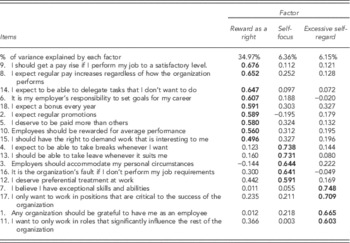
While a clear number of factors emerged during our literature review, a specific a priori structure for these factors did not emerge and so we began our analysis by conducting an exploratory factor analysis on the 28 items. First we examined the 28 items to assess the suitability of the data for factor analysis. The Kaiser–Meyer–Oklin value was 0.92, which exceeded the recommended value of 0.6 (Kaiser, Reference Kaiser1974; Tabachnick & Fidell, Reference Tabachnick and Fidell2007) and Bartlett’s Test of Sphericity (Bartlett, Reference Bartlett1954) was statistically significant 3269 (378 df, p=.000) which indicated that the data were suitable for factor analysis. Using the recommendations of Tabachnik and Fidell (2007), an initial exploratory factor analysis revealed the presence of six components with eigenvalues exceeding 1. Examination of these components showed the items did not produce prima facie validity. Therefore, as recommended by Pallant (Reference Pallant2011), Monte Carlo PCA (Watkins, Reference Watkins2000) was used to conduct a parallel analysis. This analysis suggested three components with eigenvalues exceeding the corresponding criterion values for a randomly generated data matrix of the same size (28 variables×307 respondents). We continued with the exploratory factor analysis, forcing a three factor structure. The three factor solution explained a total of 47.48% with the individual factors explaining variance as follows: Factor 1=34.97%, Factor 2=6.36%, and Factor 3=6.15% (see Table 1).
Rotated factor matrix of the 18-item MEE

Notes. Extraction method: Principal Component Analysis (PCA) with varimax rotation.
Items are numbered in the sequence they appeared in the original survey.
MEE=Measure of Employee Entitlement.
All items that cross-loaded above 0.40 were subsequently eliminated except for the item ‘I deserve preferential treatment.’ We decided to retain this item in Factor 2 given its clear relationship with the majority of construct definitions which state that an expectation of special treatment is a key component of entitlement (Raskin & Terry, Reference Raskin and Terry1988; Campbell et al., Reference Campbell, Bonacci, Shelton, Exline and Bushman2004; Harvey & Martinko, Reference Harvey and Martinko2009). As a result of the exploratory factor analysis, 18 items remained in the scale, with nine items retained in Factor 1, five items retained in Factor 2, and four items retained in Factor 3 (see Table 1).
Factor 1: Reward as a right
All nine items in this factor represent the expectation that compensation, reward, and recognition are automatic, rather than having regard to all of the circumstances within the workplace. Items indicate the individual’s unwillingness to consider external factors that may impact on an organization’s actual ability to give rewards, and a misalignment between the employee and employer’s views as to the level of performance and reciprocity required in order to obtain rewards. Indeed, we included items such as wanting to be involved in interesting work and being able to delegate mundane jobs as these are often seen as rewards by employees.
Factor 2: Self-focus
The five items in this factor focus on self to the exclusion of others, as well as a desire for differential or special treatment. The items are also reflective of a self-serving attribution bias (e.g., ‘Employers should accommodate my personal circumstances’ and ‘It is the organization’s fault if I don’t perform my job requirements’), which is consistent with descriptions of entitlement by Harvey and Martinko (Reference Harvey and Martinko2009) and Sedikides et al. (Reference Sedikides, Rudish, Gregg, Kumashiro and Rusbult2004).
Factor 3: Excessive self-regard
All four items reflect the entitled employee’s perception of the great value they offer to employers, for example, ‘I believe I have exceptional skills and abilities.’ This aligns with prior entitlement research in which entitled individuals described as seeing themselves as particularly unique or special (Raskin & Terry, Reference Raskin and Terry1988; Campbell et al., Reference Campbell, Bonacci, Shelton, Exline and Bushman2004). In developing this scale, we made a specific assumption about a distribution of ability and skill in a workplace – not everyone can be suited to working in critical and influential jobs, nor would everyone have exceptional skills. In developing these items we used excessive language to draw out entitlement views.
Descriptive statistics
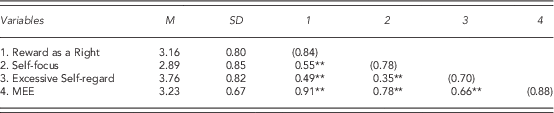
Based on our factor analysis, we considered that the 18 items identified in Table 1 combine to form the scale we named the MEE. Means, standard deviations, correlations, and Cronbach’s αs of the composite 18-item scale and three sub-scales are reported in Table 2. The reliability and correlations between the subscales are all acceptable.
Means, standard deviations, correlations, and reliability for the MEE and its subscales

Notes. N=307.
MEE=Measure of Employee Entitlement.
**p<.01.
Test: retest reliability
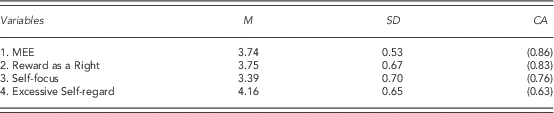
A re-test of the MEE was administered to 24 of the original respondents 10 weeks after the initial 31-item scale was administered. The re-test participants included 8 males and 16 females with a mean age of 27.2 years. The re-test resulted in a significant correlation with the first administration of 0.80, p<.01. The means, standard deviations, and Cronbach’s α reliabilities for the re-test are reported in Table 3.
Descriptive statistics and reliabilities across time for the re-test of the MEE
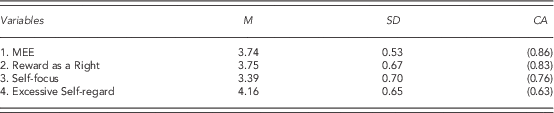
Note. N=24.
CA=Cronbach’s Alpha; MEE=Measure of Employee Entitlement.
STUDY 2: EXTERNAL VALIDATION AND THE LINKS TO RECIPROCITY
To ensure the validity of the MEE, we conducted a study to test it against a number of other measures. We hypothesized the MEE to be positively related to similar measures of entitlement. To test this, we used the Psychological Entitlement Scale (Campbell et al., Reference Campbell, Bonacci, Shelton, Exline and Bushman2004). A sense of entitlement has also been linked to high self-esteem and consequently, we predict that the MEE is positively related to Rosenberg’s (Reference Rosenberg1989) Self-esteem Scale. In addition, prior research suggests that entitled employees do not reciprocate with their employers (Naumann, Minsky, & Sturman, Reference Naumann, Minsky and Sturman2002; Harvey & Martinko, Reference Harvey and Martinko2009; Harvey & Harris, Reference Harvey and Harris2010). Therefore, we predict the MEE to be negatively related to the Positive Reciprocity Questionnaire (Perugini, Gallucci, Presaghi, & Ercolani, Reference Perugini, Gallucci, Presaghi and Ercolani2003).
Procedure and sample
The measures were administered using a multi-staged split administration design. The MEE was administered to all participants. Other variables collected in this study were administered to specific subgroups of the sample based on random assignment. In total, there were four data collection points in this study separated by ~1 week between each collection. Each data collection was based on a different sample. The demographic information of the sample for each variable is set out at the bottom of the respective tables (Tables 4–6). The three samples consisted of 137 participants, 47 participants and 189 participants. No participant completed more than two surveys (the MEE and 1 other variable). The mean work experience across the different samples was 8.5 years.
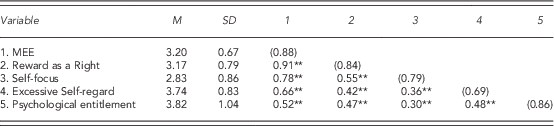
Descriptive statistics, correlations, and reliability for the MEE and the PES
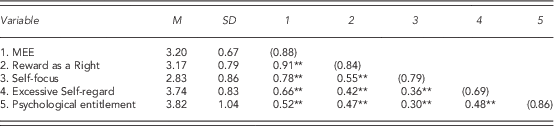
Notes. N=137, Males=32.8%, Females=67.2%, M age=25.6, M years work experience=8.1.
MEE=Measure of Employee Entitlement; PES=Psychological Entitlement Scale.
*p<.05; **p<.01.
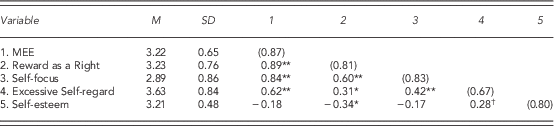
Descriptive statistics, correlations, and reliability for the MEE and the self esteem scale
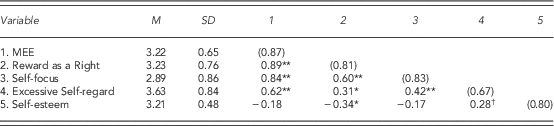
Notes. N=47, Males=40.4%, Females=50.96%, M age=29.7, M years work experience=11.4.
MEE=Measure of Employee Entitlement.
*p<.05; **p<.01; †p<.10.
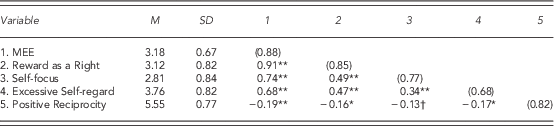
Descriptive statistics, correlations, and reliability for the MEE and the PRQ

Notes. N=189, Males=38.6%, Females=61.4%, M age=24.2, M years work experience=6.9.
MEE=Measure of Employee Entitlement; PRQ=Positive Reciprocity Questionnaire.
*p<.05; **p<.01; † p<.10.
Measures
Employee entitlement
Employee entitlement was measured using the MEE (from Study 1), an 18-item scale consisting of three subscales: Reward as a Right, Self-focus, and Excessive Self-regard. A 6-point response format (1=strongly disagree to 6=strongly agree) was used. Alpha reliabilities across the various data collection points ranged from 0.88 to 0.87 for the overall scale, 0.81 to 0.85 for Reward as a Right, 0.79–0.83 for Self-focus and 0.67–0.69 for Excessive Self-regard.
Psychological entitlement
The PES (Campbell et al., Reference Campbell, Bonacci, Shelton, Exline and Bushman2004) uses a seven point response format (1=strong disagreement to 7=strong agreement). The items include statements such as ‘Great things should come to me’ and ‘I feel entitled to more of everything.’ The reliability for this measure was 0.86.
Self-esteem
Rosenberg’s (Reference Rosenberg1989) Self-esteem scale is a well-validated and frequently used 10-item scale. Examples of items include ‘On the whole I am satisfied with myself’ and ‘All in all, I am inclined to feel that I am a failure’ (Reversed). It is scored using a 4-item Likert scale ranging from 1=strongly agree through to 4=strongly disagree. This measure had a Cronbach’s α reliability of 0.80.
Positive reciprocity
The Positive Reciprocity Questionnaire (Perugini et al., Reference Perugini, Gallucci, Presaghi and Ercolani2003) is a 9-item scale with items such as ‘If someone is helpful with me at work, I am pleased to help him/her’ and, ‘I’m willing to do a boring job to return someone’s previous help.’ A 7-item Likert scale is used as the response format: 1=not true for me through to 7=very true for me. Perugini et al. (Reference Perugini, Gallucci, Presaghi and Ercolani2003) obtained reliabilities of 0.76, 0.79, and 0.74 for this scale.
Results
MEE and psychological entitlement
Table 4 presents the means, standard deviations, correlations, and αs among the MEE and its subscales and the PES. Significant positive correlations emerged between the MEE, each of its subscales and the PES. Thus, our prediction that the MEE would be positively associated with the PES was supported.
MEE and Self-esteem
Table 5 presents the means, standard deviations, correlations, and αs among the MEE and its subscales and the Self-esteem scale. The results indicated a significant negative relationship between Self-esteem and the Self-focus subscale of the MEE. In addition, a significant positive relationship was obtained between the Excessive Self-regard subscale and the Self-esteem scale. Overall, a significant relationship between the MEE and Self-esteem did not emerge; thus our overall prediction in relation to self-esteem was not supported.
MEE and positive reciprocity
Table 6 presents the means, standard deviations, correlations, and αs among the MEE and its subscales and the Positive Reciprocity Questionnaire. The composite MEE, as well as the three subscales showed significant negative correlations with the Positive Reciprocity Questionnaire, which supported our predictions.
DISCUSSION
Our aim in this article is to provide original and significant contribution to the literature relating to workplace entitlement by developing and validating the first scale to measure a sense of entitlement in the context of the workplace and testing the predictive validity of the MEE in terms of an employee’s potential for reciprocity. The MEE is an 18-item scale comprising three subscales: Reward as a Right, Self-focus, and Excessive Self-regard. Overall, the 18-item MEE shows acceptable reliability. The initial test of the MEE obtained an α of 0.88 and the re-test an α of 0.86. The subscales also obtained acceptable alphas. The inter-correlations are all significant at the 0.01 level which, along with the acceptable αs, supports using the MEE as a unitary measure.
In relation to external validation, the MEE shows a significant, yet moderate, positive correlation with the PES (Campbell et al., Reference Campbell, Bonacci, Shelton, Exline and Bushman2004), which provides evidence of convergent validity for our measure (see Smith & Archer, Reference Smith and Archer2014). The MEE, however, captures these concepts within the context-specific domain of the workplace. For example, instead of capturing general beliefs such as ‘I feel entitled to more of everything’ as does the PES (Campbell et al., Reference Campbell, Bonacci, Shelton, Exline and Bushman2004), the MEE captures this belief in relation to the individual’s role as an employee, e.g., ‘I deserve to be paid more than others.’ This is consistent with researchers such as Chowning and Campbell (Reference Chowning and Campbell2009) and Kopp et al. (Reference Kopp, Zinn, Finney and Jurich2011), who argue that individuals may not identify with general entitlement beliefs, and that entitlement may not arise across all life contexts, but may be related to an individual’s role in a specific context. As such, the MEE may be more appropriate for use in researching entitlement in the workplace, as opposed to a measure such as the PES (Campbell et al., Reference Campbell, Bonacci, Shelton, Exline and Bushman2004), which measures general entitlement as a personality trait.
Despite our prediction that employee entitlement is positively associated with self-esteem, the results of our study did not entirely support this. The composite MEE does not show a significant relationship with self-esteem, although the Excessive Self-regard subscale shows a weak but positive relationship with the Self-esteem scale. Conversely, the Reward as a Right subscale of the MEE shows a significant negative relationship with self-esteem, which is reflective of some results obtained in the academic entitlement literature (see Lessard et al., Reference Lessard, Greenberger, Chen and Farruggia2011). In this respect, we note that excessive self-regard may actually have closer links to narcissism than to self-esteem, and this is an issue we intend to follow up in future research. Finally, in terms of the psychological contract, we proposed that the MEE captures an exploitive component in that entitled employees do not necessarily consider the need to reciprocate or the employer’s circumstances (e.g., ‘I expect a bonus every year’). The significant negative relationship between the MEE and positive reciprocity suggests that highly entitled employees may not perceive it necessary to provide positive reciprocity to the employer as a part of the psychological contract. Harvey and Martinko (Reference Harvey and Martinko2009) note that entitled employees have a self-serving attribution bias which results in them inflating their value to the organization. Similarly, Naumann, Minsky, and Sturman (Reference Naumann, Minsky and Sturman2002) theorise that entitled employees will not engage in reciprocity with their organization. Accordingly, we propose that the MEE reflects the essence of workplace entitlement as defined earlier and may have direct implications for the development of a psychological contract between an entitled employee and their organization.
There are limitations in our two studies. Both studies consist of a convenience sample drawn from an existing network. In terms of the sample, however, we reported that the participants had substantial work experience. We therefore consider this to be an appropriate sample for our studies. We also acknowledge a foundation concern of common method bias, where the use of similar Likert type scaling may have inflated our findings. We note that a split administration design was used to administer the surveys in order to reduce common method bias, however this has resulted in a relatively low sample size to test one of our variables. After the surveys were matched, analysis revealed sufficient power to support statistically significant results. We also note that in Study 1, the test/re-test of the Excessive Self-regard subscale only obtained an α of 0.63. However, Ponterrotto and Ruckdeschel (Reference Ponterotto and Ruckdeschel2007) suggest that such an alpha is satisfactory when the subscale has less than six items and fewer than 100 participants complete the measure, as was the case in the re-test sample.
With these studies we take the initial steps to demonstrate that the MEE shows potential for furthering our understanding of workplace entitlement. We note promising reliability and validity in these initial studies, but we also acknowledge that the MEE requires further validation to ensure convergent and divergent validity are established. It would be prudent for testing of the MEE to be undertaken in a single organizational setting to provide a consistent context for the study. There is also a need for further theoretical development into the links between employee entitlement and reciprocity and self-esteem. Clearly, moving the study to an organizational setting would enable the concept of entitlement and its relationship to the psychological contract and employee reciprocity to be studied in greater detail. This study could include examining actual reciprocal behaviors, rather than using a self-report measure of reciprocity. The relationship between the MEE and counterproductive workplace behavior should also be explored given past research that has found strong relationships between entitlement and negative behavior and outcomes.
In conclusion, the development and validation of the MEE extends our knowledge of sense of entitlement in the workplace, and provides a platform from which researchers and practitioners can continue to coherently and consistently investigate and understand the phenomenon of employee entitlement. With workplace entitlement being a relatively newly identified construct, it is important that further research on this variable is conducted to determine its antecedents and outcomes for employees and organizations, along with theoretical development and practical implications for workplace improvement.
Acknowledgement
This manuscript is an original work that has not been published previously. The manuscript is not under consideration at any other journal. All authors have approved the manuscript and have met the criteria for authorship established by JMO.
Authors’ Contribution: Our article extends the concept of employee entitlement to incorporate consideration of aspects of the work context, which fits the aims of JMO. This measure can contribute to a coherent body of research on workplace entitlement. Our finding of a link between entitlement and reciprocity has implications for the psychological contract at work. The development and validation of the Measure of Employee Entitlement extends our knowledge of sense of entitlement in the workplace and situates entitlement as an attitude, providing a platform from which researchers and practitioners can continue to coherently and consistently investigate the phenomenon of employee entitlement.