INTRODUCTION
Piroplasms are tick-borne intracellular apicomplexan parasites which infect erythrocytes. The 2 main genera, Theileria and Babesia, include many species, some of which are pathogenic and therefore of major veterinary and economic importance, while others are considered moderately pathogenic or benign (Preston, Reference Preston and Service2001; Uilenberg, Reference Uilenberg and Service2001). Three species of bovine Babesia, B. bovis, B. bigemina and B. divergens, have been reported hitherto in Tunisia (Bouattour and Darghouth, Reference Bouattour and Darghouth1996; M'ghirbi et al. Reference M'ghirbi, Hurtado, Barandika, Khlif, Ketata and Bouattour2008), and ticks of the genera Ixodes, Boophilus, Hyalomma, Haemaphysalis and Rhipicephalus have been identified in cattle from the region (M'ghirbi et al. Reference M'ghirbi, Hurtado, Barandika, Khlif, Ketata and Bouattour2008).
In 1981 Gray and De Vos (Reference Gray and de Vos1981) described for the first time a novel Babesia species in Hyalomma rufipes collected in South Africa and found it to be transmissible to bovines, where it caused a benign form of cattle babesiosis. No apparent clinical signs other than transient elevated temperature were observed in normal animals infected with this babesia, and pathogenicity was very low even in splenectomized animals (Gray and de Vos, Reference Gray and de Vos1981). A serological survey conducted in different cattle farms showed that this Babesia species, called B. occultans, had a wide distribution and a high herd and within-herd prevalence in cattle in South Africa (Gray and de Vos, Reference Gray and de Vos1981). Despite the high prevalence of B. occultans in South Africa, the only reference to its presence in other regions of Africa dates back to 1984 when Dipeolu and Amoo (Reference Dipeolu and Amoo1984) reported the occurrence of large kinetes of Babesia sp. that morphologically resembled B. occultans in the haemolymph of Hyalomma ticks in Nigeria.
In 2008, the 18S rRNA gene from B. occultans tissue-culture material was amplified, cloned, and sequenced (GenBank Acc. no. EU376017) for the first time (Oosthuizen et al. Reference Oosthuizen, Zweygarth, Collins, Troskie and Penzhorn2008). Earlier studies had found different unnamed babesias which were later found to have highly similar sequences to B. occultans, like Babesia sp. Kashi 2 (AY726557) isolated from cattle in China (Luo et al. Reference Luo, Yin, Liu, Yang, Guan, Liu, Ma, Dang, Lu, Sun, Bai, Lu and Chen2005), Babesia sp. Kayseri 1 (EF434786) isolated from ticks collected from cattle in Turkey (Ica et al. Reference Ica, Vatansever, Yildirim, Duzlu and Inci2007) and a Babesia sp. (U09834) detected in cattle blood in 1994 in South Africa.
The present study reports the finding, for the first time, of B. occultans in Hyalomma marginatum ticks collected in Tunisia, northern Africa, and describes the use of the 18S rRNA gene as a target for the design of a species-specific probe for detecting B. occultans by Reverse Line Blot (RLB) hybridization.
MATERIALS AND METHODS
Origin of Babesia isolates
Isolates used in this study were obtained from unfed H. marginatum ticks collected on horses from 3 bioclimatic zones in Northern Tunisia: 2 males, one from Sejnene (humid) and another from Borj el Amri (semi-arid), and 1 female from Bizerte (sub-humid). These ticks were obtained among 120 specimens collected from horses in the frame of a larger study on the prevalence of Babesia and Theileria organisms infecting horses in Tunisia. Ticks were identified according to taxonomic keys (Bouattour, Reference Bouattour2002).
DNA extraction
DNA was extracted using the QIAamp DNA Mini Kit (Qiagen, Hilden, Germany). DNA yields were determined with a Nanodrop® ND-1000 Spectrophotometer (Nanodrop Technologies, DE, USA), and typical nucleic acid concentration values ranged between 15 and 50 ng/μl. DNA was stored at −20°C until subsequent analysis.
RLB hybridization
Samples subjected to RLB hybridization were processed as previously described including a panel of specific probes for 23 piroplasms (Garcia-Sanmartin et al. Reference Garcia-Sanmartin, Barandika, Garcia-Perez and Hurtado2008). The V4 variable region of the 18S rRNA gene of the genera Theileria and Babesia was amplified using the forward and reverse primers RLB-F (5′-GACACAGGGAGGTAGTGACAAG-3′) and RLB-R (biotin-5′-CTAAGAATTTCACCTCTGACAGT-3′) as reported before (Georges et al. Reference Georges, Loria, Riili, Greco, Caracappa, Jongejan and Sparagano2001) (SigmaAldrich, St Louis, USA). Preparation of RLB membrane and hybridization were carried out as previously described (Gubbels et al. Reference Gubbels, de Vos, van der Weide, Viseras, Schouls, de Vries and Jongejan1999) with the adaptations reported elsewhere (Nagore et al. Reference Nagore, Garcia-Sanmartin, Garcia-Perez, Juste and Hurtado2004).
DNA amplification, cloning and sequencing
For sequencing analysis, a 1617 bp fragment of the parasite 18S rRNA gene was amplified using primers as described previously (Oosthuizen et al. Reference Oosthuizen, Zweygarth, Collins, Troskie and Penzhorn2008). These primers were Nbab_1F (5′-AAGCCATGCATGTCTAAGTATAAGCTTTT-3′) and Nbab1_R (5′-CCTCTCCTTCCTTTAAGTGATAAGGTTCAC-3′) and were synthesized by Sigma (SigmaAldrich, St Louis, USA). PCR amplification was performed in a final volume of 50 μl containing 75 ng of genomic DNA, 200 nM of each primer, 1×PCR buffer, 1·5 mM MgCl2, 200 μM of each dNTP and 1 U of Taq Platinum Polymerase (Invitrogen, CA, USA). PCR conditions consisted of a first denaturation step of 4 min at 94°C, a second step of 40 cycles of 30 s at 94°C, 1 min at 65°C and 1 min at 72°C, and 30 min at 72°C for the final extension step in order to allow full-length 3′ adenylation for cloning purposes.
The amplified products were purified with GenEluteTM Gel Extraction Kit (Sigma), cloned into a PCR®4-TOPO® vector, and transformed into Escherichia coli according to the manufacturer's instructions (TOPO TA Cloning® kit for Sequencing, Invitrogen, CA, USA). Recombinant plasmid DNA was purified using a plasmid purification kit (FastPlasmidTM Mini Kit, Eppendorf AG, Hamburg, Germany). Sequencing reactions were carried out using the ABI BigDyeTM Terminator Cycle Sequencing Ready Reaction Kit (Applied Biosystems, Foster City, CA, USA) and primers RLB-F, RLB-R, Nbab_1Fand Nbab_1R (Georges et al. Reference Georges, Loria, Riili, Greco, Caracappa, Jongejan and Sparagano2001; Oosthuizen et al. Reference Oosthuizen, Zweygarth, Collins, Troskie and Penzhorn2008). Products were analysed on an ABI3130 Genetic Analyzer (Applied Biosystems).
Babesia occultans probe design
A new oligonucleotide probe was designed to specifically detect B. occultans. The probe was designed using Vector NTI 8.0 software (Infomax Inc., North Bethesda, MD, USA) and synthesized by Sigma containing a C12 amino linker in 5′ and with the following sequence: 5′-GTGTGCCTCTTTTGGCCCATC-3′. The specificity of the new probe was tested against Theileria and Babesia species from cattle, horse, sheep, dog and wildlife as previously described (Garcia-Sanmartin et al. Reference Garcia-Sanmartin, Aurtenetxe, Barral, Marco, Lavin, Garcia-Perez and Hurtado2007). The sensitivity of the hybridization assay was assessed by RLB processing PCR products from the serially diluted plasmid with the B. occultans 18S rRNA insert (106 to 1 copies). To exclude false positive results, negative controls included during DNA extraction and PCR amplification were subjected to RLB hybridization. The plasmid constructed as described above was also used as a positive control in each assay.
Phylogenetic analysis
The sequences obtained were compared with the GenBank database by nucleotide sequence homology searches made at the network server of the National Center for Biotechnology Information (NCBI) using BLASTn. Related sequences and sequences from the main Babesia species from ruminants were retrieved and used for sequence alignment and phylogenetic analyses. Multiple sequence alignments were performed using the program AlignX (Vector NTI 8.0 suite, InforMax, North Bethesda, MD, USA) with an engine based on Clustal W algorithm (Thompson et al. Reference Thompson, Higgins and Gibson1994). The alignment was truncated to the size of the smallest sequence (B. occultans EU376017; 1558 bp). Similarity matrices were then constructed from aligned sequence data by single distance using the Jukes and Cantor correction for multiple base changes (Jukes and Cantor, Reference Jukes, Cantor and Munro1969), and the two parameter model of Kimura (Kimura, Reference Kimura1980) that takes into account transitional and transversional substitution rates. Phylogenetic trees were constructed by the neighbor-joining (Saitou and Nei, Reference Saitou and Nei1987) and maximum parsimony methods as implement in the Mega 4.1 package (Tamura et al. Reference Tamura, Dudley, Nei and Kumar2007). All positions containing gaps and missing data were eliminated (complete deletion option), leaving a total of 1481 positions in the final dataset. Theileria annulata and Theileria buffeli were included as out-group to root the trees. Stability or accuracy of inferred topologies were assessed via bootstrap analysis (Felsenstein, Reference Felsenstein1985) of 1000 replicates.
Nucleotide sequence Accession numbers
The 18S rRNA gene sequences determined in this study were deposited in GenBank under Accession numbers HQ331478 and HQ331479.
RESULTS
RLB analysis of 3 ticks among 120 specimens, collected in the frame of a prevalence study of piroplasms in horses in Tunisia, produced a positive signal with the generic catch-all probe in the absence of hybridization with any of the Babesia or Theileria species-specific probes present on the RLB blot, indicating the presence of a novel species or genotype. The 18S rRNA gene V4 hypervariable region from the 3 samples was sequenced and showed to be identical. A BLASTn search performed in GenBank demonstrated 100% identity in this region with B. occultans (EU376017) and Babesia sp. Kayseri 1 (EF434786). The near-full-length 18S rRNA gene was then amplified, cloned and sequenced from 2 of the H. marginatum samples, one from the humid region (Sejnene) and another from the semi-arid region (Borj el Amri). Both sequences were almost identical to each other (99·7%) and to B. occultans EU376017 (99·7–100%). A BLASTn search identified other highly similar sequences such as Babesia sp. Kashi 2 (AY726557) isolated from cattle in China and an unnamed Babesia species (U09834) detected in cattle blood in South Africa, which shared similarity values of 99·7–99·9%, and Babesia sp. Kashi 1 (AY26556) isolated from ticks collected from cattle in Turkey, that had slightly lower similarity (97·9–98·1%).
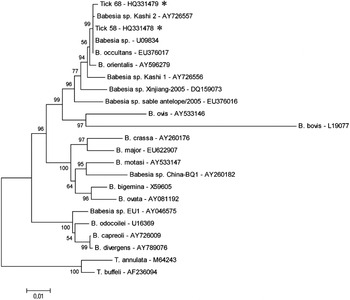
A phylogenetic tree was constructed with the entire sequences of the 18S rRNA genes of the main Babesia species from ruminants available in GenBank and the new sequences described in this study. No significant changes in the topology of the trees, or in the bootstrap values, were found when using any of the phylogenetic analysis procedures with either the neighbor-joining or maximum parsimony methods (data not shown). The tree obtained by neighbor-joining with the Kimura two parameter model for distance calculation is shown in Fig. 1. Phylogenetic analyses placed the new sequences described herein in the same clade as B. occultans along with the abovementioned unnamed babesias found in different geographical regions in cattle or ticks collected from cattle. This clade formed a monophyletic group within the true babesias supported by a bootstrap value of 99%.
Neighbor-joining phylogenetic tree showing the relationship of the taxa identified in this study (asterisk) with the main Babesia species, based on full-length 18S rRNA gene sequences. The GenBank Accession numbers are indicated for each sequence used. The scale bar indicates nucleotide substitutions per position.

The new probe designed for B. occultans gave a positive result with the amplified hypervariable V4 region of the 18S rRNA cloned from the 2 ticks and no cross-reaction was observed when tested against the Theileria and Babesia species from cattle, horse, sheep, dog and wildlife used as controls. The absolute limit of detection for the combined PCR and subsequent RLB procedure using 18S rRNA gene clones as templates was of 1 gene molecule.
DISCUSSION
This paper describes the first detection in Tunisia (northern Africa) of B. occultans, a species that was described for the first time in 1981 in South Africa as a bovine parasite with high prevalence in that region (Gray and de Vos, Reference Gray and de Vos1981), and whose 18S rRNA gene was recently sequenced (Oosthuizen et al. Reference Oosthuizen, Zweygarth, Collins, Troskie and Penzhorn2008). Although the combination of biological data (morphological features, life cycle, and ability to grow in vitro in erythrocytes from different species) with genetic data is necessary for the correct characterization and definition of Babesia species, molecular techniques, frequently based on the 18S rRNA gene, are of invaluable help in identifying unknown piroplasms and refining relationships among themselves (Uilenberg, Reference Uilenberg2006; Allsopp and Allsopp, Reference Allsopp and Allsopp2006). Here, the data provided by the 18S rRNA gene sequence analysis strongly supported the identification of the babesias from Tunisia reported herein as members of the species B. occultans, along with Babesia sp. Kashi 2 from China and the unnamed Babesia sp. U09834 from South Africa. Other babesias like Babesia sp. CS58 and Babesia sp. Kayseri 1 from Turkey also resemble B. occultans in the 18S rRNA gene, but unfortunately only 343 and 403 nt, respectively, from the V4 region were available for comparison and were therefore not enough for a definite identification. These data suggest that B. occultans may have a wide distribution in Mediterranean and Asiatic regions, and not only in sub-Saharan Africa as previously described (Gray and de Vos, Reference Gray and de Vos1981; Dipeolu and Amoo, Reference Dipeolu and Amoo1984).
Regarding ticks, H. rufipes has been reported to be the vector of B. occultans (Gray and de Vos, Reference Gray and de Vos1981). However, despite the fact that this tick is widely distributed in most parts of Africa and has been recorded from every climatic region from desert to rain forest (Estrada-Peña et al. Reference Estrada-Peña, Bouattour, Camicas and Walker2004), it seems that other Hyalomma species also carry B. occultans. In this study, B. occultans DNA was detected in H. marginatum. Similarly, DNA from the unnamed babesias, which according to sequencing analyses resemble B. occultans, was also amplified from Hyalomma ticks of the species H. anatolicum and H. marginatum (Luo et al. Reference Luo, Yin, Liu, Yang, Guan, Liu, Ma, Dang, Lu, Sun, Bai, Lu and Chen2005; Ica et al. Reference Ica, Vatansever, Yildirim, Duzlu and Inci2007). These data suggest that B. occultans could be transmitted by several Hyalomma spp., and not only in South Africa. This had already previously been suggested by Gray and De Vos (Reference Gray and de Vos1981), who detected Hyalomma truncatum in 5 farms positive to B. occultans where H. rufipes was not present, and by Dipeolu and Amoo (Reference Dipeolu and Amoo1984), who reported the occurrence of large kinetes of Babesia sp. that morphologically resembled B. occultans in the haemolymph of 5 species of Hyalomma ticks in Nigeria.
The babesias analysed in the study herein were obtained from unfed ticks collected on horses that shared pastures with cattle. Taking into account that B. occultans is a bovine parasite and that H. marginatum nymphs feed on small animals (like hare and birds), the infection should most probably have occurred when adults fed on infected cattle. Then, since B. occultans transmission in ticks has been reported to take place transovarially (Gray and de Vos, Reference Gray and de Vos1981), the infection would have been transovarially transmitted to larvae and transtadially to nymphs and adults. Also, it is important to point out that the 3 ticks included in this study were collected from 3 different climatic regions of Tunisia (sub-humid, semi-arid and humid). Consequently, it would be possible that B. occultans in Tunisia had a wide distribution. The absence of apparent clinical signs in normal animals described for B. occultans infection in cattle would have contributed to the low number of case reports. The analysis of a larger set of blood samples from cattle using the newly developed probe for B. occultans will help to estimate the true prevalence of B. occultans in Tunisia and elsewhere, and permit in depth study of this species.
FINANCIAL SUPPORT
This work was funded by the Spanish Agency for International Development Cooperation (AECID, Project No. A/026818/09) with the Ministry of High Education and Research of Tunisia, the Spanish National Institute for Agricultural and Food Research and Technology (INIA, Project no. RTA2009-000-18-00-00), and FEDER. A.R. is the recipient of a Pre-doctoral Fellowship from INIA.