Introduction
“In the beginning there were markets”—Oliver Williamson arguedFootnote 1—and the markets’ function par excellence is to select among firms, promoting worthy concerns and eliminating the unviable ones. Timelessly, and without friction and costs, an efficient selection among businesses and entrepreneurs is made, and economies that let the markets operate unfettered are allowed to prosper. However, for those who get their hands dirty digging into the reality of the history of business, a very different story emerges. The market’s function to select viable firms is, at least, mediated by, and, at most, fully replaced by a wide set of institutional settings. Among these institutions, the main player is bankruptcy (and insolvency) law.Footnote 2 If we consider, as is widely recognized, that these institutions are a key mechanism of capitalist economies, it is perhaps not surprising to discover the influence they have had on fundamental aspects of business organization and functioning. Historically, the choices of forms of governance,Footnote 3 attitudes toward risk-taking across class and gender,Footnote 4 the development of credit markets,Footnote 5 the size and structure of firms in various nations,Footnote 6 all have been shaped by legal institutions, in particular the ones dealing with failure and restarting.
Although the influence of these institutional settings on business organization has been (and still is) the subject of wide investigation in economic and business history, relatively little attention has been paid to the much broader context: the historical reconstruction of the features of bankruptcy laws over time and space. So, currently, we are unable to readily compare the fate the same firm would have faced in Britain had it been declared bankrupted in 1850 as opposed to 1950. Similarly, we do not know what would have happened to a firm in, say, Sweden in the 1970s, compared to Belgium or Germany in the same decade.
Just as importantly, little is known about the patterns of change of these laws over time. The lack of research on this topic is perhaps not surprising given the number of considerable methodological issues involved: the definition of the time span, the number of countries to be covered, the variables to be included, the fact that sources are dispersed, fragmented, and written in a number of different languages. Furthermore, the assumption that institutions naturally converge toward the most effective ones, has perhaps led many to believe that a reconstruction of bankruptcy and insolvency laws is essentially redundant. A few facts should suffice to dispel these doubts. Around the turn of the nineteenth century, treating a case of bankruptcy took, on average, about a year in England and Germany, a few more months in France, and about three times as long in Italy. In England, about 40 percent of firms would have used a prebankruptcy arrangement, about one third in France, and less than 5 percent in Italy, while in Germany such deals were simply not available as part of bankruptcy procedures.Footnote 7 Yet, in 2016, more than a century later, and after the 2007–08 financial crisis had severely tested the functioning of insolvency regulations, it appeared that little had changed, with the European Commission noting that across the EU bloc, “despite reforms in the area of insolvency, rules still diverge and remain inefficient”Footnote 8 in a number of countries.
The absence of such research also reflects a significant gap in our understanding more generally of long-term institutional development in a comparative context, with only a handful of studies on this topic despite the longstanding acknowledgement of their value to a range of disciplines. So, whereas bankruptcy and insolvency laws are key “rules of the game,” the issue of these institutions and patterns of change, so central to business history, has yet to be tackled, and the fundamental questions about the nature of bankruptcy laws in a comparative perspective and of their evolution over time are therefore still to be answered.
The purpose of this paper is to start the challenging task of addressing this gap in the business history literature in two ways. First, the core contribution of the paper is the collation, in a consistent and systematic way, of detailed information on the most important features of bankruptcy and insolvency laws in the largest thirty European economies in a long-term perspective. The paper spans the period 1850–2015 and is based on qualitative information, derived from legal documents and secondary sources, turned into a data set of quantitative measures. Whereas a similar methodology has been used for an analysis limited to the core European countries for the period 1808–1914,Footnote 9 this paper expands the study to a much broader set of countries and links the trajectory of legislative change from the mid-nineteenth century to the current day. The aim is to provide researchers with a set of coherent data that can be used either in national or in comparative studies, both in terms of bankruptcy and insolvency law, but also in terms of long-term institutional change more generally. Second, information from the data set is also analyzed in an attempt to identify some general trends in the evolution of bankruptcy legislation and legal procedures over time, and present some hypothesis for possible causes behind such trends. Clearly within the limits of a paper such as this, it is not possible to explore each of these trends in detail, however, the objective is to help move the debate regarding institutional change beyond the constraints of any particular theories, and open up new avenues for research.
This article is organized as follows: Section 1 describes the sources and methodology behind the longitudinal data collection. Sections 2 and 3 use the information from the data set to analyze the introduction of various types of solutions across time and space and of their various features: who could apply to them; outcomes possible; conditions demanded; who made the final decision on their acceptance. Section 4 analyzes a specific indicator—the total number of outcomes available in various systems—which we consider as a basic proxy of the “quality” of bankruptcy and insolvency institutions. Section 5 offers some concluding remarks.
Methodology and Definitions
A study of this kind raises a number of significant methodological challenges. The first issue is the geographic focus. We adopted a strategy of covering the thirty largest European economies by GDP in 2015, a list of which is presented in the appendix (Table A). The sample thus includes the majority of the twenty-eight countries being part of the EU in the same year (with the exclusion of Cyprus, Estonia, Latvia, and Malta), plus other important European economies such as Norway, Russia (and Belarus), and Switzerland. Some of the countries included did not exist as independent (or legally autonomous) states for the entire period, hence the number of countries in the sample changes over time. Specifically, in the period up to World War I, the existence of the Austro-Hungarian and Russian empires, and the lack of independence for some of the benchmarks, of Romania or Bulgaria, reduced the number of independent (or legally autonomous) countries to twenty in 1850–70, twenty-one in 1890, and twenty-two in 1915.Footnote 10 The number increases to twenty-five during the interwar period, with the temporary independence of Lithuania and the foundation of Czechoslovakia, and of the State of Slovenes, Croats, and Serbs (late Yugoslavia), and remains almost the same until the fall of the Berlin Wall (twenty-four, as Lithuania losses its independence after World War II). The political fragmentation that followed results in the sample size of thirty.
However, the number of observations actually included in each benchmark does not necessarily coincide with the number of independent or legally autonomous countries. For the period up to 1910, all countries are represented in the analysis; as for political entities that were parts of empires (or other states), we simply used data referring to them.Footnote 11 Between the benchmark 1928 and 1975, the spread of communism in eastern Europe ensured these institutions disappear in some of these countries, hence the number of observations varies accordingly: twenty-six in 1928 and 1938, nineteen in 1950, and twenty-two in 1975.Footnote 12 All thirty countries (with the exception of Belarus in 1995) are represented in the last two benchmarks, 1995 and 2015. Overall, nineteen countries are represented over the whole period 1850–2015.
In terms of time span, the analysis aims to capture changes and the evolution of bankruptcy law over the last century and a half by providing a series of snapshots taken at ten benchmark years. We take 1850 as a starting point because the relevant literature indicates that cultural changes toward debts, and economic transformations due to the Industrial Revolution, led, a couple of decades later, to a Pan-European wave of changes in bankruptcy and insolvency law.Footnote 13 New legislations, in general, broke with traditional punitive ways of dealing with the issue, embracing a more tolerant and supportive philosophy.Footnote 14 The snapshot taken in 1850, therefore, crystallizes the reality of legal institutions before the subsequent transformations, and allows for a comparative analysis of the changes. The remaining nine benchmarks have been selected to allow us to observe the impact of great political events in European history—such as the two world wars and the fall of communism—but also of the main economic transformations represented by the first and then second industrial revolutions (three benchmarks between 1870 and 1914); the economic instability and crises of the interwar years (two benchmarks between 1918 and 1939); the “Golden Age” of European economic growth (two benchmarks between 1950 and 1970); and the end of communism and the advent of the recent wave of globalization (benchmarks 1995 and 2015).
In regards to the type of data collected and studied, the very wide scope of our analysis forced us to focus exclusively on “formal” aspects of bankruptcy, that is, the features of the official procedures contained in legislation. We are fully aware that such an approach comes with limitations: Historically, in some countries formal institutions were rarely used while, allegedly, extrajudicial solutions were very popular. Although a systematic study of this topic is beyond the scope of this paper, where possible the paper refers to available information on the nature of enforcement mechanisms and actual functioning of procedures, in order to give the reader at least a sense of the degree of usage of formal solutions to bankruptcy.
In order to study formal aspects of legislations, we start by defining three ideal types of solutions (bankruptcy procedure; prebankruptcy procedure; businesses relaunching procedure) and then analyze when these appeared in the countries under analysis, and which specific characteristics they took.
Bankruptcy procedure in the narrow sense is the traditional and basic channel to deal with insolvent or illiquid firms and businesses. It requires a formal declaration of bankruptcy and is a full judicial remedy, in the sense that it takes place in a court. Even this basic solution, however, can vary in its practical implementation. Among key aspects, historical literature has looked at the issue of the possible outcomes of the procedure, its coverage in terms of legal entities allowed to use it, and who had the right to open it. Traditionally, bankruptcy was based on the liquidation of the debtor’s business and the sale of its assets but, over time, legal systems started allowing also the possibility of closing the procedure via a settlement with the creditors comprising the repayment of a given percentage of the debts. This was a very important change, with nineteenth- and early twentieth-century commentators stressing the key role of this solution in increasing the overall efficiency of bankruptcy procedures, in particular in terms of reducing waiting time and increasing payments to creditors.Footnote 15 Therefore, in the paper, we record for each benchmark whether or not bankruptcy allowed for a composition as well as liquidation. Another key aspect of bankruptcy relates to its application. Over the course of the nineteenth century, and up to the 1930s, fierce debates arose among legal scholars, both in common and civil law countries, on whether this solution should have been reserved for merchants (or traders), as common in French-derived legislation, or open to all categories, as was the case in England after 1861 or Germany since 1877.Footnote 16 Considering that nontraders, in general, were exposed to a much stricter legislation, opening up bankruptcy to them was part of a generalized attempt at mitigating conditions for debtors that characterized much of the later nineteenth-century reforms. This approach was the result of the growing awareness of two facts. The first one, that economic failure was not necessarily the result of misfortune. Second, that encouraging honest yet unlucky debtors to use the bankruptcy system would have generated advantages to creditors by limiting the use of extrajudicial solutions or the dissipations of resources via procrastination over the declaration of bankruptcy.Footnote 17 Connected to this point, a third fundamental aspect of bankruptcy procedure concerns its opening. Traditionally, it was up to creditors to declare the bankruptcy of debtors but, over time, debtors were allowed to make the first move themselves or, in other cases, courts could act independently. In the paper, we thus collect information on this aspect, recording whether bankruptcy law applied to all creditors or just to some specific groups, as well as information about the right to start the procedure.
The introduction of prebankruptcy proceedings or arrangements,Footnote 18 the second ideal type of procedure we use in the paper, is considered one of the major institutional changes occurring in the history of bankruptcy.Footnote 19 These solutions represented an alternative and parallel path (although in various cases failing to obtain it pushed debtors back to the bankruptcy track) requiring an agreement with (a variable majority of) creditors to be reached before the actual declaration of bankruptcy. The agreement was supervised by the court and, often, also subject to its approval. Some early examples of these procedures were the concordat préventif in Belgium (1883), the deeds of arrangements in England (1887), and the liquidation judiciaire in France (1889). As compared to bankruptcy procedures, these solutions had in common the aspect that they do not lead to the formal declaration of bankruptcy for debtors. This avoided the need for debtors to be “rehabilitated” in order to run businesses and, in countries such as France and England, the loss of civil and economic rights that came with the legal condition of a bankrupt.Footnote 20 As with bankruptcy, these proceedings differed in various ways among countries. Although geared toward reaching a settlement over payment of a given share of debts, in some legal systems they could also allow for the liquidation of the creditor’s business. This key difference is recorded and analyzed in the paper. A second difference concerned ex ante conditions (usually guarantees to be able to pay at least a given share of unsecured debts) that had to be respected in order for a prebankruptcy procedure to be allowed. Historical research has showed that such conditions could dramatically reduce the usage of these procedures, as was the case in Italy or England before compositions before bankruptcy were replaced by deeds of arrangements.Footnote 21
The third ideal type of procedure we analyze in the paper are solutions to bankruptcy specifically aimed at keeping businesses alive and relaunching them, what in the paper we call relaunching procedures. A milestone in the history of the evolution of bankruptcy is the understanding that a firm has a higher value as an ongoing concern compared to the sum of the market price of its individual assets, and that saving a firm avoids the economic and social costs that come with business liquidation via specific procedures.Footnote 22 In looking at this type of solution, a key distinction must be made between proper prelaunching procedures and the prebankruptcy procedures described above. Although in contemporary debates the latter are often seen as company-restructuring devices because of the option of keeping firms alive by reaching a settlement, it is very clear that historically this was not the case, and business relaunch was not their aim. As stressed by contemporaries and by historical literature, these procedures were, instead, part of the trend described above, aiming at reaching better deals for creditors by offering debtors less punitive solutions.Footnote 23 Instead, examples of the business-saving approach characterized different solutions, such as the English administration or receivership, the Belgian administration controlee, and the Italian amministrazione controllata. These procedures vary in nature, but they all rely on some or all of the following elements: a period of “freeze,” when creditors are not allowed to push the business into bankruptcy (debt moratorium); the conversion of credits into securities of a new company, which replaces the one in distress; the provision of an industrial plan for the future; and the replacement of existing management. In this paper, we record when these institutions started appearing and what form they took. In particular, we distinguish between the introduction of the mere debt moratorium (often unable to address the problem of business relaunch, and in very limited use) and the appearance of more complex solutions.
Finally, as a synthetic measure, we analyze the number of possible outcomes offered in each country at each benchmark as a way of assessing the menu of options available to deal with bankruptcy at that time. To calculate this variable, we add the total number of procedures (prebankruptcy, bankruptcy, and relaunching), also taking into account their possible outcomes. So, for instance, a country where there is a prebankruptcy procedure that can only lead to composition and where bankruptcy procedure can lead to liquidation or composition, and there are also two different relaunching procedures, will have a total of five outcomes (one for prebankruptcy, plus two for bankruptcy, and plus two for relaunching).Footnote 24
The approach we take in this paper is based on the following steps. Using a wide set of secondary sources (sources are described in the appendix), first we populate table A (in the appendix), which records which law applied at each country/benchmark, the changes (or lack of) vis-à-vis the previous country/benchmark, and the sources we used in each case. Because of the nonhistorical nature of some sources, for each benchmark/nation we cross-referenced at least two sources (when possible).
Changes in the legislation are considered only in the following cases:
-
• Provision of new legislation replacing the previous one. We use this definition even when, as in many communist countries, the previous legislation has not been active for a period of time.
-
• Introduction of a prebankruptcy or relaunching procedure, when distinct from the introduction of a bankruptcy law.
-
• Changes in one key aspects of the procedures described above (possible outcomes; opening of the procedure; inclusion of different types of debtors; ex ante conditions)
This specific definition of “change” results in the omission of some cases of known reforms that have been identified in the literature,Footnote 25 and does not fully capture the dynamics of change in common law countries, where judges attitudes could deeply influence the meaning and actual functioning of procedures.Footnote 26 Despite these limitations, we believe that the criteria we have adopted for “change” enables the identification of the main episodes of institutional change in a consistent way.
The second step of our analysis (in section 2) consists of charting such change across time and countries in order to try to identify possible similarities and to look at the relationship between economic, political, and legal transformations.
In the third step of the analysis, for each country/benchmark, we use a wider set of sources, which also includes primary sources such as laws and acts (either in the original language or translated,) to analyze the details of the legislation in order to populate the spreadsheet. Footnote 27 This information is then analyzed in sections 3, 4, and 5.
Institutional Change: The Nature of Legislative Process
In this section we analyze the evolution of bankruptcy law across European countries in terms of year of introduction and number and types of changes. The aim is to capture features such as the existence of national trends, as well as the persistence of institutions when facing exogenous shocks.
When Countries Passed a National Legislation “First”
At the beginning of the nineteenth century, bankruptcy norms included in the French commercial code of 1808 were the basic model for most European countries and were directly used in Belgium, Switzerland, and some of the German states. By the 1850s, however, a process of establishment of national laws was well underway, although when this process was initiated differs between countries. We can posit various potential reasons for this: the degree of political and institutional stability of each nation, the state of its economic development, and, as suggested by dominant economic literature, the belonging to a specific “legal family” (French; Anglo-Saxon (common law); Scandinavian; German).Footnote 28 Table A shows that at the first benchmark (1850), more than 70 percent of the countries included in the sampleFootnote 29 had a national specific system of bankruptcy procedures—although not necessarily a freestanding bankruptcy law, as sometimes norms were part of the commercial code or provided via “ordinances.” By the following benchmark (1870)—and with the inclusion of Belgium, Germany, Norway, Finland, and Ireland—nearly all the countries in the sample (around 90 percent) had implemented a national bankruptcy system. Two countries (Romania and Switzerland) completed the process by the following benchmark, with Bulgaria passing a national law by the 1910 benchmark.
In seeking possible explanations for these results, the issue of “legal family” does not appear to be significant, as the pattern of institutional change shows little evidence of clustering according to specific legal groups.Footnote 30 Similarly, the degree of economic development appears a poor explanation, if we consider that relatively backward countries such as Russia, Poland, and Spain had national legislation before emerging industrial powers such as Germany or Belgium. What appears to be the case is that the establishment of a national commercial code and a bankruptcy law was an important component in the process of state building, as the advent of political stability (or the age of consolidation of state power) seems concurrent with the appearance of national legal institutions in this field. The process displayed a complex relationship with the existing models. For instance, whereas Italy and Greece de facto almost simply translated the French code in an attempt at demonstrating their consolidation as advanced economies, Belgium and Holland tried to mark their independence by making nation-specific changes to the law they had inherited from their previous rulers.Footnote 31
Changes by Country
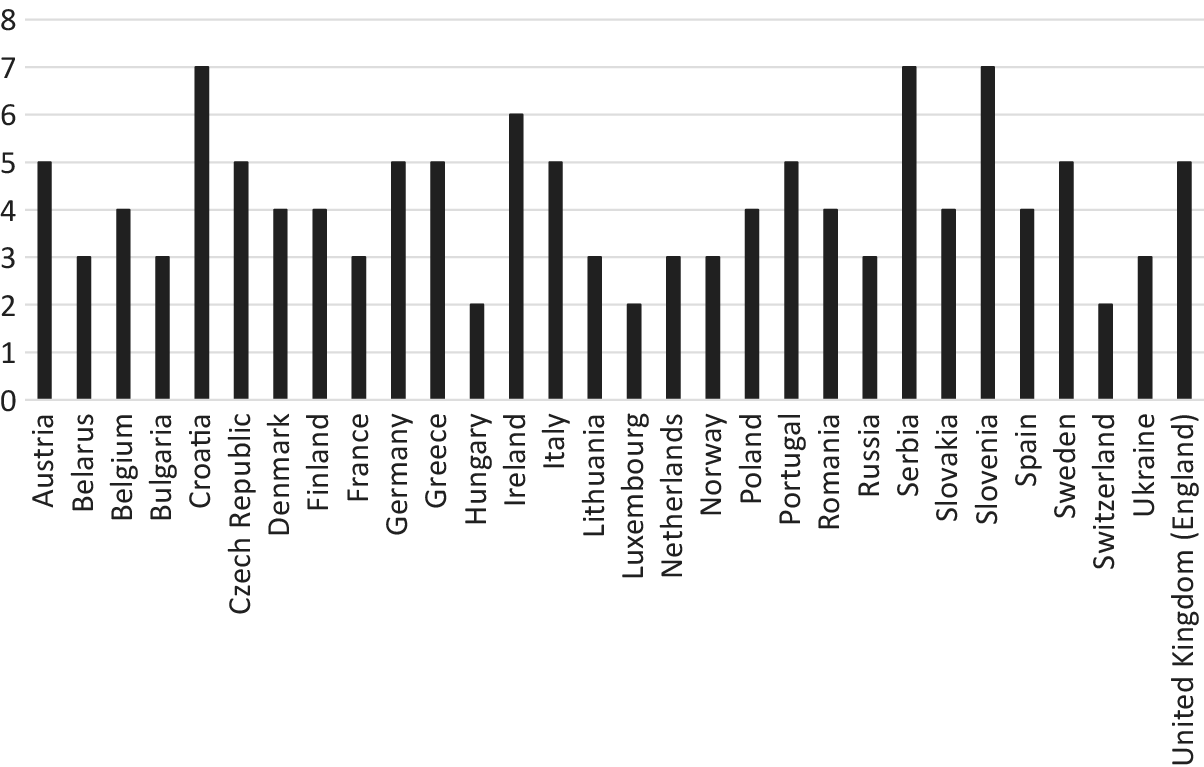
Other than the date of introduction of the initial bankruptcy law, another interesting aspect is the number of changes over time as defined in the previous section. Figure 1 below plots, for each country, the number of changes from the 1870 benchmark onward. Likewise, the timing of the introduction of bankruptcy procedures gives some indication as to the validity of the idea that belonging to a specific legal family might dictate some similarities in the process of institutional (legal) change.
Number of total changes to bankruptcy law by country: 1870–2015.
Note: Change defined as: 1) provision of new legislation replacing the previous one; 2) introduction of a prebankruptcy or relaunching procedure, when distinct from the introduction of a bankruptcy law; 3) changes in one of these aspects: possible outcomes of procedures; opening of the procedure; inclusion of different types of debtors; ex ante conditions.
Data sources: See text.

The evidence from Ireland and England, displaying six and five changes respectively against a modal range of three changes, at first glance suggests that their “legal family” might have played a role, but this stands at odds with other cases. For instance, clear differences exist between Norway and Sweden (respectively three and five changes), despite their cultural ties and belonging to the same legal family. At the same time, collective political stability seems to be a good explanation for similarities—for instance in the three Benelux countries, the basic legal frameworks were based on late nineteenth-century laws (with some changes in the 1930s) for most of the period, and in general, these countries show a limited number of changes. On the other hand, countries formerly belonging to Yugoslavia (Croatia, Serbia, and Slovenia) and to a lesser extent Czech Republic display relatively high numbers of changes, but this appears to be in line with a common history of multiple political changes, rather than the collective belonging to a legal family.
Changes by Benchmark and the Introduction of “Alternative” Procedures
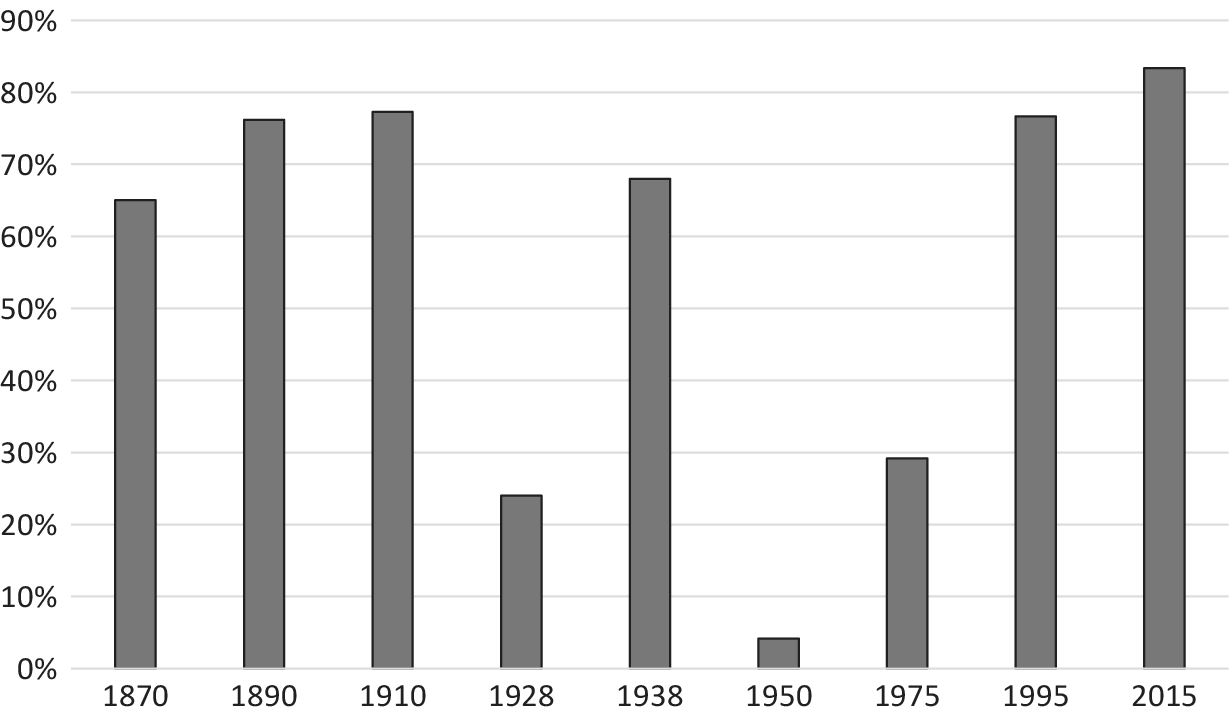
Instances of legal change not only differ across countries but also chronologically, with phases of rapid changes between periods of calm. Figure 2 plots the number of changes occurring at each benchmark as percentage of the number of existing independent (or legally autonomous) countries.
Number of changes to bankruptcy per benchmark years as percentage of the number of countries included in the sample.
Data source: See text.

Figure 2 shows a period of a high and growing number of changes up to World War I, followed by another (lower) peak at the end of the 1930s. After a long period of calm after World War II, the process of legal reforms gathered fresh momentum from the 1990s onward, with the number of changes being the absolute highest in 2015.
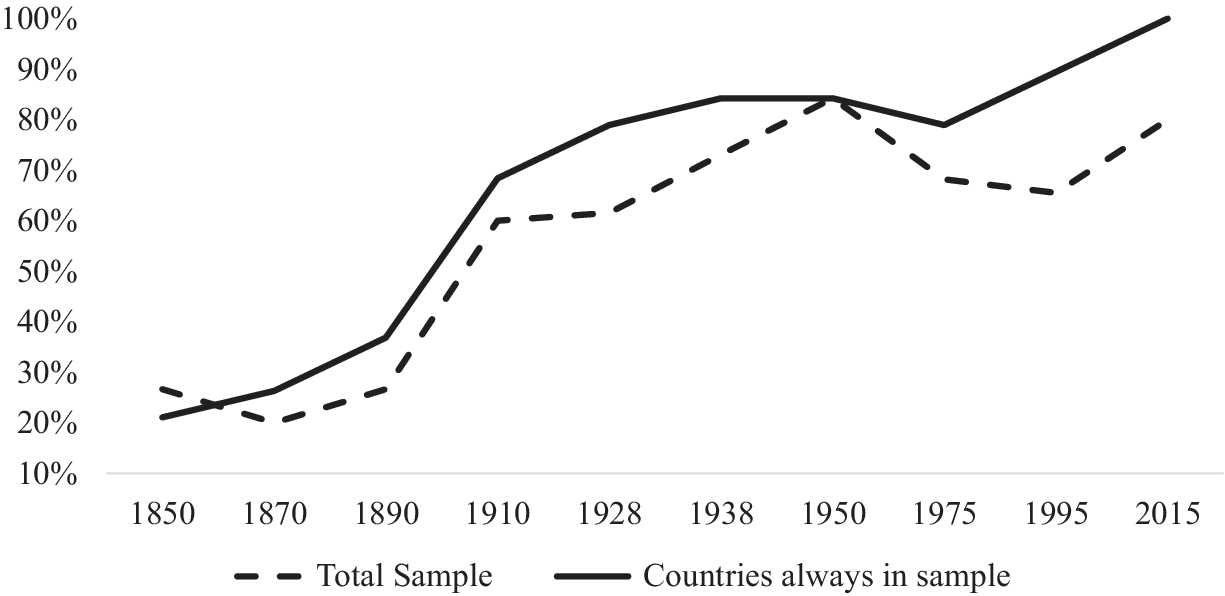
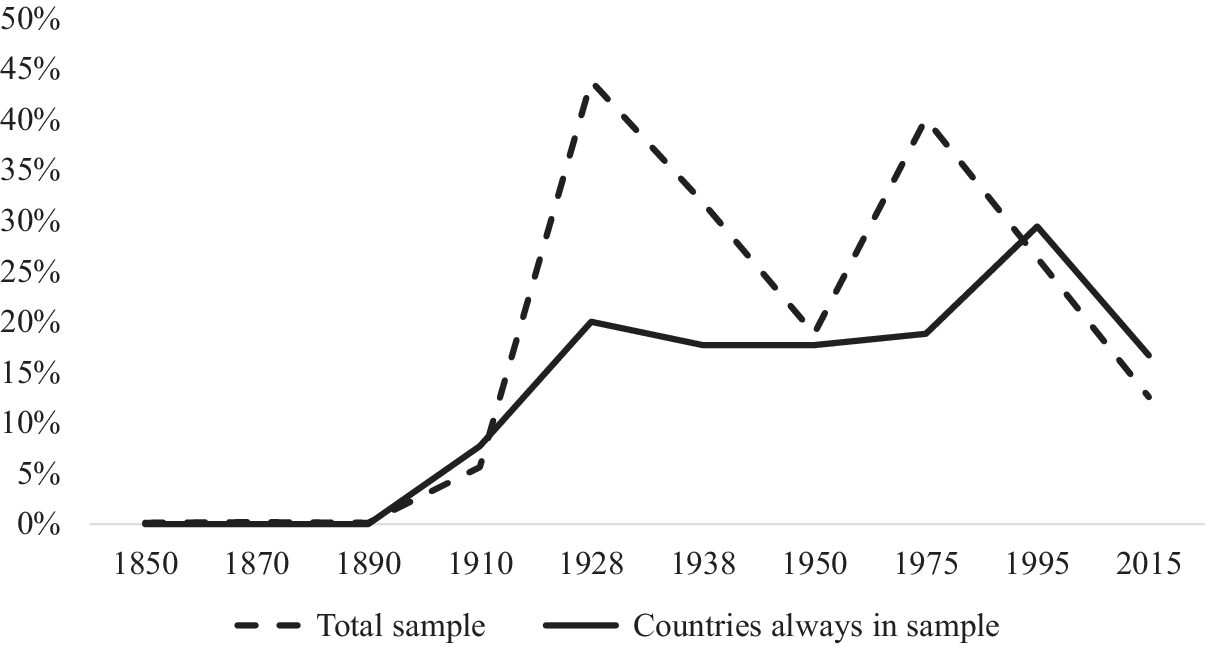
The period up to 1910 was a phase of deep economic change with profound technological transformation that characterized the Second Industrial Revolution. As argued in section 1, these economic changes progressively revealed the inadequacy of traditional punitive bankruptcy law, and triggered institutional transformation. This took place mainly via the introduction of alternative prebankruptcy procedures. Figure 3 shows the share of countries that, at a given point in time, had such procedures. The figure gives data both for the total sample at that point in time, and for the countries that are constantly present in the sample from 1850 onward.
Share of countries having prebankruptcy procedures.
Note: Prebankruptcy procedures defined as solutions leading to either liquidation or requiring an agreement with (a variable majority of) creditors to be reached before the actual declaration of bankruptcy.
Data source: See text.

While in 1850 only a limited percentage (about twenty per cent) of countries had such procedures, by 1910 this had risen to about 60 percent, something that helps explain the high number of changes occurring to bankruptcy laws during this time. It must be noted, however, that the process of introducing these procedures continued after World War II, with the share of countries having at least one type of prebankruptcy solution jumping to more than 80 percent in 1950 for the total sample. These results offer some qualification to the established view linking the introduction of prebankruptcy procedures to an awareness of the inadequacy of traditional remedies in a rapidly changing economic environment. The institutional response to similar economic and cultural changes took place along national lines, and according to internal national considerations. Among them, we can include the approach to the German codes, which emerged as a leading alternative to the French modelFootnote 32 and did not include prebankruptcy procedures. In conclusion, the process of institutional convergence suggested by the literature is still visible,Footnote 33 but it appears much slower and more complex when the sample of countries is expanded.
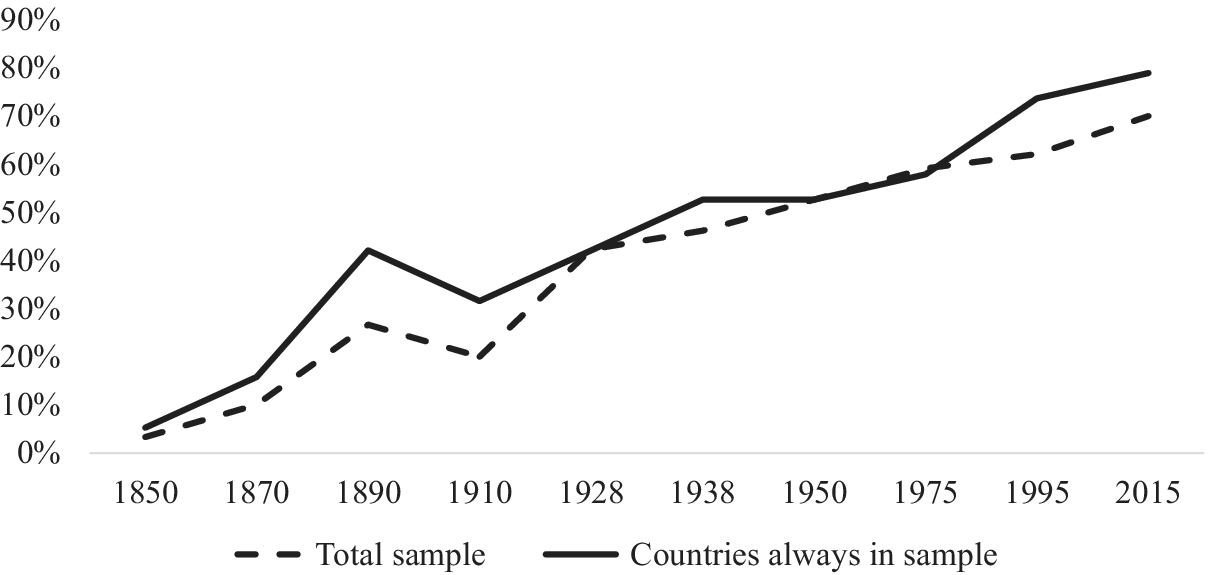
In order to explain the timing in the changes occurring to bankruptcy law, we have to consider another institutional change occurring in the period up to World War I: the introduction of what we defined as relaunching procedures. Figure 4 plots the percentage of nations that, at a given point in time, had such procedures. The figure gives data both for the total sample at that point in time, and for the countries that are constantly present in the sample from 1850 onward.
Share of countries having a relaunching procedure (including Moratorium).
Note: Relaunching procedures defined as solutions to bankruptcy specifically aimed at keeping business alive and relaunching them.
Data source: See text.

Our data, independently of which sample we consider, shows a clear increase, with the biggest jump occurring in 1910. This picture stands at odds with the idea that major economic shocks—specifically the 1930s Great Depression—triggered such legal change. Evidence of a possible link between the 1930s crisis and the need to introduce legal devices to support businesses in trouble could be found, at first glance, in the tone (and even the title) of coeval literature both in Europe and the United States.Footnote 34 as well as in the almost parallel introduction of this type of procedure in various countries, for instance Belgium (1934) and Italy (1942). Our data, however, does not support the existence of such a clear-cut connection. This result is, in part, due to having included among this type of procedure typically nineteenth-century remedies such as debt moratorium. Such devices had little practical use or effectiveness, as clearly shown in the cases of nineteenth-century Netherlands or Italy, where businesses could apply to such a procedure only when the assets exceeded the liabilities.Footnote 35 Yet, however ineffective, the early introduction of these devices can be seen as evidence of the fact that policy makers seem to have been concerned with the issue of avoiding undue liquidations of firms earlier than we previously believed. Furthermore, the lack of concurrence between the introduction of relaunching procedures and the Great Depression can also be explained by considering that the 1930s economic shocks probably stimulated adaptations to existing institutions rather than triggering the introduction of entirely new ones.Footnote 36 This conclusion is supported by nation-level evidence: In Belgium, for example, the Administration Contrôlé was introduced in 1934 but only for two years; in Italy special case was made for banks and insurances, but there was no reshaping of bankruptcy law overall; whereas in England, as stressed by contemporary commentators, “the … economic crises produced no basic change.”Footnote 37
The benchmark years in the Golden Age (1950 and 1975) are notable for their lack of changes, and this is confirmed by our data. This is unsurprising given the existence of communist states and the long-term stable economic growth during the period.
The increase in the number of changes from benchmark years 1975 and 1995 is clearly caused by the collapse of communism and its aftermath, with the emergence of new capitalist European nations, which required the institutions to deal with business failure.
The 2007–8 financial crisis is one of the main causes of the high number of changes for the 2015 benchmark. However, many of the changes relate to postcommunist nations. The data supports the argument that their initial postcommunist bankruptcy laws in the 1990s were hastily formulated institutions that struggled to cope with the economic volatility of the period, and consequently underperformed. Specifically, data on the number of outcomes available by law (arguably the most relevant synthetic statistic about the “quality” of bankruptcy institutions) shows a sharp rise between 1995 and 2015 for postcommunist countries (see sections below for details).Footnote 38
Institutional features: procedures across time and space
The introduction of legal institutions across time and space, analyzed in the previous section, does not seem to indicate that European countries smoothly converged toward similar architectures, but rather it highlights the extent to which national trends shaped different paths of development. To analyze these issues, we consider some of the features of various institutional devices (bankruptcy and prebankruptcy procedures).
Bankruptcy
The first aspect we investigate is the share of countries whose bankruptcy procedure could lead to either a liquidation of the debtor’s business or an agreement (settlement) with creditors—a solution often believed to be a “softer” alternative for debtors. Figure 5 shows, specifically, the share of countries whose bankruptcy procedure could end up with liquidation of the debtor’s assets or a composition with creditors.
Share of countries whose bankruptcy procedure could lead to either liquidation or settlement.
Data source: See text.

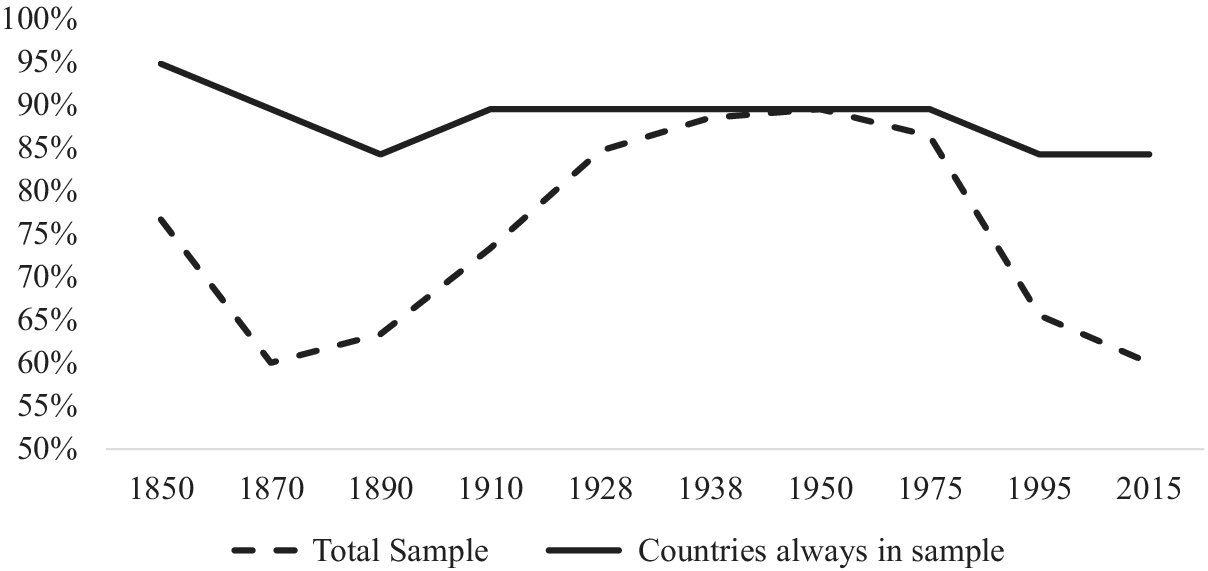
The data shows that already by the 1850 benchmark, and contrary to the image of traditional bankruptcy law as oriented toward liquidation, the vast majority of countries (between 80 and 95 percent depending on the sample considered) also allowed for a settlement. Up to 1975, this share remains fairly constant among the nineteen countries always represented in the sample, while for the total sample it seems to decline and increase again, while never going below 60 percent. In the last two benchmarks this share declines as some western countries always contained in the sample adopted liquidation-only bankruptcy procedures (Switzerland–2015 and Portugal–1995), as did a number of eastern European states postcommunism—Croatia, Czech Republic, Hungary, and Romania. Hence, the decline appears more marked when the total sample is considered. It should be pointed out that the persistency, and occasional introduction of liquidation-only bankruptcy procedures in the last two benchmarks, can be explained by the parallel introduction of ad hoc measures to relaunch companies outside the main bankruptcy pathway, for example via the use of prebankruptcy procedures or equivalent institutional devices. As such, the recent trend seems to indicate the introduction of more polarized and specific solutions, leaving bankruptcy the role of pure liquidation for extreme cases.
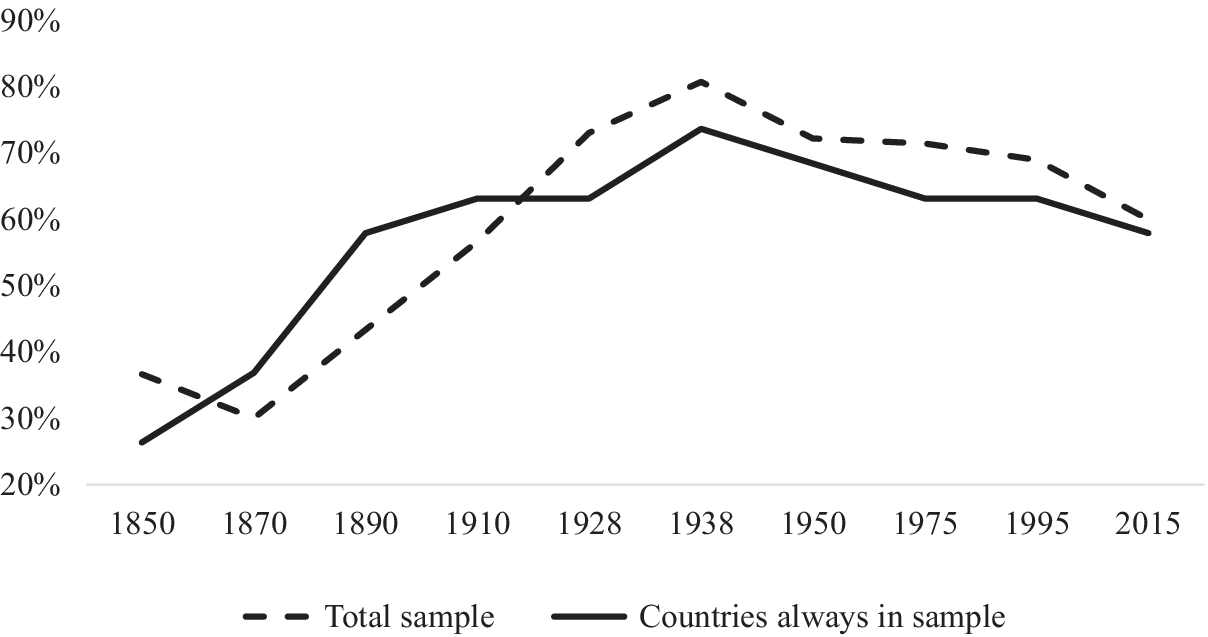
As far as the application of bankruptcy law was concerned, figure 6 shows the share of countries whose bankruptcy law was open to all debtors, and therefore did not distinguish between traders and nontraders.
Share of countries whose bankruptcy procedure applied to all types of debtors.
Data source: See text.

Irrespective of the sample considered, the data shows a very clear upward trend to 1938 (with the share passing from 30–40 percent to 70–80 percent), followed by a slight decline to around 60 percent in 2015. The trend confirms the established view of a progressive opening of procedures to a wider set of debtors (typically to nontraders), which led to lawmakers adopting a less punitive attitude, and the acceptance of the fact that bankruptcy was not necessarily an act of fraud. The data also illustrates the relative slowness of this process: By World War I, about 40 percent of the countries in the sample still discriminated among debtors. The most recent benchmark, 2015, suggests a change of direction with access to bankruptcy procedures becoming more selective. This change, rather than a reversal in the attitude toward debtors, can be explained by the parallel introduction of dedicated solutions for specific categories, confirming the pattern of an increasing number of more specialized solutions noted above.
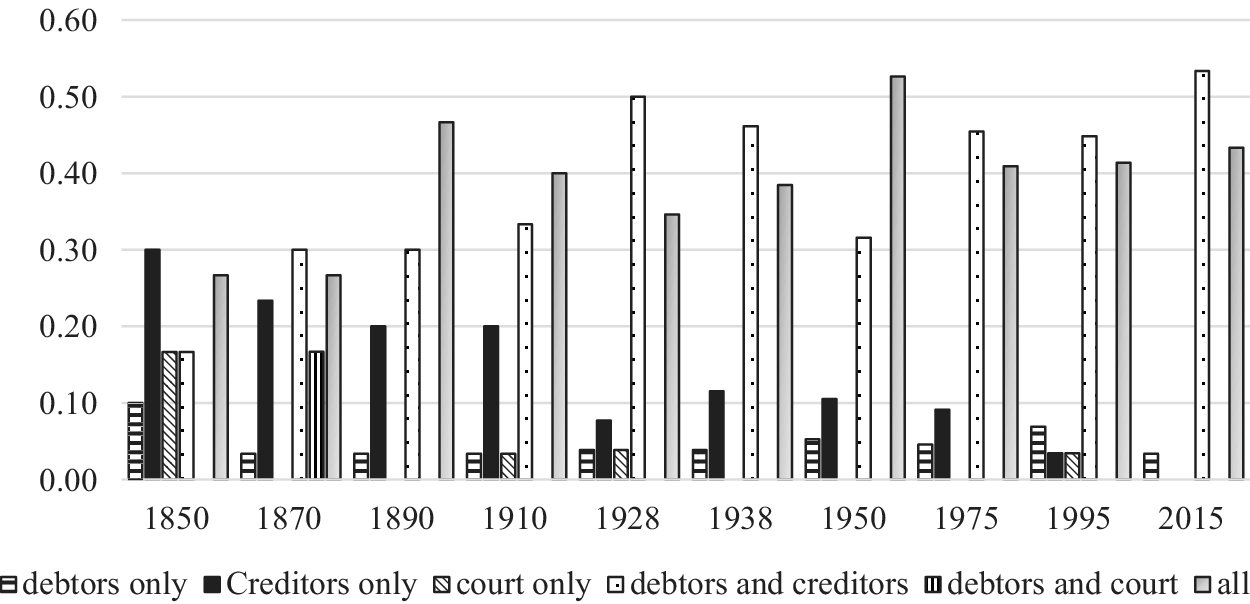
Another dimension of bankruptcy concerns who has the legal right to initiate the procedure. Figure 7 plots the share of countries, for each benchmark, in which a given set of actors (only debtors; only creditors; only courts; debtors and creditors; debtors and courts; debtors, creditors, and courts) could initiate a bankruptcy procedure.
Entities allowed to start bankruptcy procedures in various countries (as percentages of the number of countries considered).
Data source: See text.

Overall, countries moved along a consistent trajectory of evolving from a situation with the power largely in the hands of creditors to a more balanced situation in which debtors and creditors (and court) could make the decision. So while the share of countries where only creditors could activate bankruptcy procedures declines over time (eventually disappearing in 2015), legal systems in which the decision could have been made by either debtors or creditors increases over time (with some fluctuations between 1938 and 1975) to become the most common situation in 2015. This evolution mirrors the pattern of the share of countries in which all subjects (debtors, creditors, court) were allowed to open procedures—this also increases over time, albeit with a slight decline in favor of the debtors/creditors from the 1950s. Court or debtors-only solutions appear in only a small number of instances, and a combination of the two is virtually nonexistent. This pattern suggests two things: first, the increasing attempts at making debtors collaborate with the functioning of official procedures that, at the same time, progressively lose their purely punitive nature; second, the consistent (possibly growing) role given to courts as a potentially “neutral” referee in terms of their ability to start procedures independently once the option is given to creditors and debtors also.
Prebankruptcy Procedures
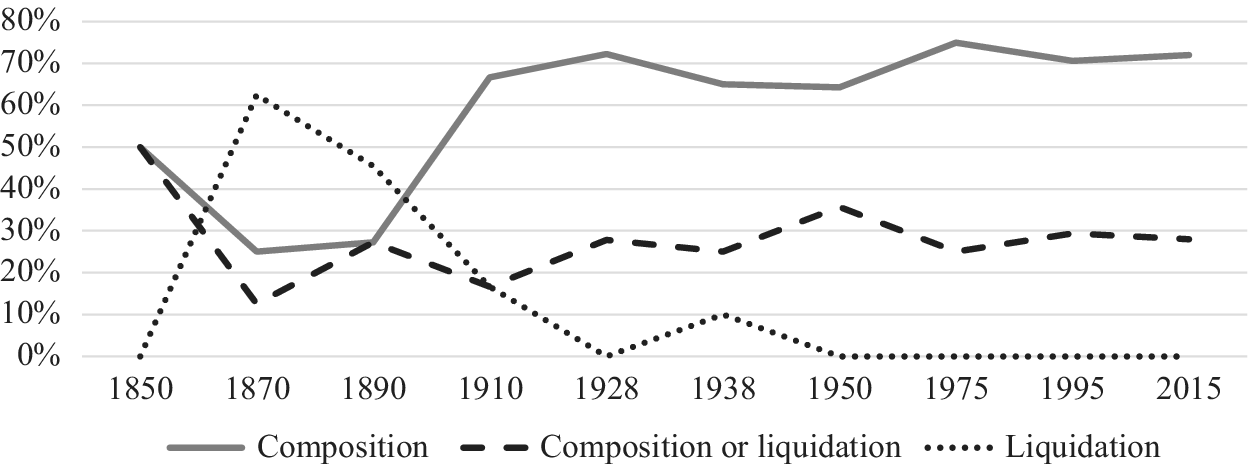
A second area we can explore relates to the features of what we defined as prebankruptcy procedures. In particular, we are able to analyze two key aspects: the possible outcomes of these procedures and the existence of official preconditions for their acceptance by the courts or creditors. Figure 8 shows the relative share of countries for which prebankruptcy could lead to liquidation, composition, or both.Footnote 39
Possible outcomes of prebankruptcy procedures (as percentage of countries having a prebankruptcy procedure).
Data source: See text.

The figure shows a revealing pattern. At the beginning of the period (1850), in the very few countries where prebankruptcy procedures existed, their outcome was equally divided between composition or composition and liquidation. In the following two decades, however, these types of procedures became common in most countries, but often directed toward liquidation (60 percent of cases in 1870), confirming their structurally different role vis-à-vis relaunching procedures. As argued by contemporaries, at their introduction, prebankruptcy procedures were not intended as devices to promote the relaunch of businesses, rather as a quicker, and probably less expensive—given the limited involvement of courts in the process—ways to collect debts.Footnote 40 This role changes around the 1910s, when in about two-thirds of countries these procedures turned into pro-settlement ones, and accelerated since the 1950 when liquidations in prebankruptcy procedures disappear. However, in about one-third of the cases these procedures keep the double outcome of liquidation or settlement, suggesting that their transformation into relaunching mechanisms is still noncomplete. Regarding this point, it is interesting to note how this feature varies even within a group of countries sharing the same legal background. For instance, common law countries (Ireland and England) have two solutions for a long time, but Ireland adopts the settlement-only pattern after 1995. Conversely, France and Spain both have the dual track system, but not Belgium—one of the most important French-law countries. Within Scandinavia, Sweden has two solutions but Denmark only one, whereas Germany is a famous case of a total absence of such procedures for a long period (prebankruptcy procedures were only introduced in 1938).
The final variable we analyze is whether or not prebankruptcy procedures were subject to the fulfilling of some ex ante conditions in terms of guaranteeing the payment of a share of unsecured debts. This is a fundamental issue, as ex ante conditions could have been a major deterrent to the use of these procedures and determined their degree of adoption across various countries.Footnote 41 Figure 9 plots the share of countries having prebankruptcy procedures subject to ex ante conditions.
Share of countries in which prebankruptcy procedures were subject to ex ante conditions (in percentage of the number of countries having a prebankruptcy procedure).
Data Source: See text.

At the beginning of the period, all countries which had adopted such procedures imposed no conditions, but a rapid change is visible between 1910 and 1928. Although still in a minority of countries (20 percent to 40 percent depending on the sample), the practice of having ex ante conditions became more common. This share stabilizes in the countries always present in the sample (apart from an increase to about 30 percent in 1995), while fluctuating to a great degree in the total sample. By 2015, both cohorts end up at a similar level. A possible interpretation of this pattern stems from considering the changing nature of these procedures over time. As long as they are simply used as a more efficient and cheaper alternative to straight bankruptcy no strings are attached to them. However, when such procedures start to show a clearer settlement-oriented pattern, then legislators feel the need to add stronger protection for creditors, as well as norms signaling the relative higher quality of creditors allowed to use softer solutions. When looking at specific national case studies, it seems hard to establish a general rule: Conditions are imposed for a long time in England, Italy, and Portugal, but for instance, not in France.
Number of outcomes
In this section, we analyze the pattern of the total number of possible solutions to the problem of insolvency as defined in section 1. The general assumption we adopt is that the greater the number of outcomes available, the greater the ability of bankruptcy institutions to deal with complex situations in which a one-size-fits-all approach is not efficient. As such, we use the number of outcomes as a generic proxy for the sophistication and “quality” of bankruptcy institutions and we explore the possibility that such “quality” evolved, over time and space, parallel to the increasing growth and complexity of the economies.
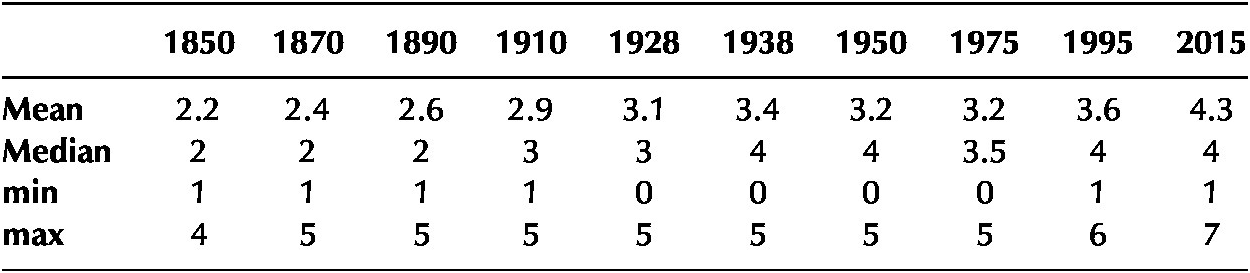
To analyze, in general, the evolution of the variable over time, in Table 1 we provide the descriptive statistics of our sample.Footnote 42
Number of available outcomes in bankruptcy procedures by benchmark

Note: number of outcomes (range between 0-7) defined as number of procedures multiplied by the number of possible outcomes under each procedure. For each benchmark we only include the countries which were independent.
Data source: see text.
Table 1 shows a clear trend toward increase over time: The average number of total outcomes increased from 2.2 in 1850 to 4.3 in 2015, when also the overall maximum (7) is the highest ever. The slight decline in 1950 and 1975 can be explained by the growing presence of communist countries for which this variable takes the value of zero. This pattern suggests that, in general, more solutions to bankruptcy and insolvency have been put in place as the complexity of the economies increases although the direction of causality remains to be established.
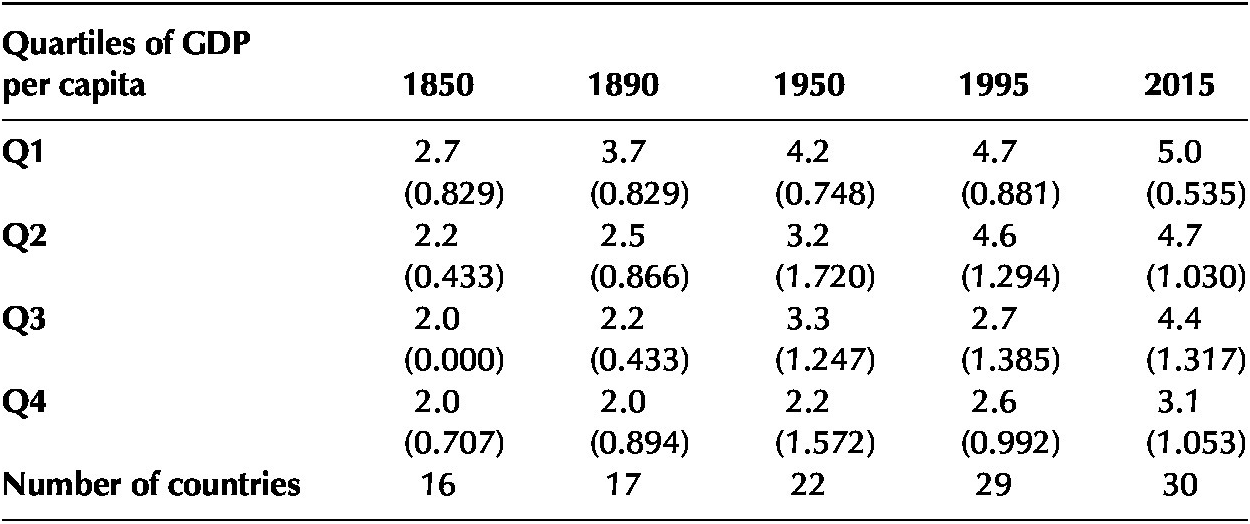
In table 2, we analyze the relation between economic and institutional development by providing, for five selected benchmark years, the average number of outcomes by countries grouped by quartiles according to levels of GDP per capita in each year. In order to obtain consistent national estimates of GDP, we have only included in the table countries that were independent at each benchmark.
Average number of available outcomes in bankruptcy procedures by country grouped in quartiles by GDP per capita

Note: number of outcomes (range between 0-7) defined as number of procedures multiplied by the number of possible outcomes under each procedure. For each benchmark we only include the countries which were independent. Q1 is highest quartile by GDP. Standard deviation in brackets.
Data source: GDP per capita (2011 US$): Maddison Project Database (www.ggdc.net/maddison/maddison-project/home.htm), version 2018. Bolt, Inklaar, de Jong and van Zanden (Reference Bolt, Inklaar, de Jong and van Zanden2018). Outcomes available in bankruptcy procedures, see Section I of the text.
Results in table 2 confirm our hypothesis: Over time, countries grouped in the highest quartiles (Q1) of the distribution of GDP per capita also appear to have, in general, a wider menu of solutions to deal with insolvency and bankruptcy. In fact, the standard deviation of the variable appears to be lower for richer countries, suggesting also a higher degree of consistency of the quality of legal institutions among richer economies. Again, although the direction of causality remains to be established, it appears that more complex economies also possess more efficient legal settings.
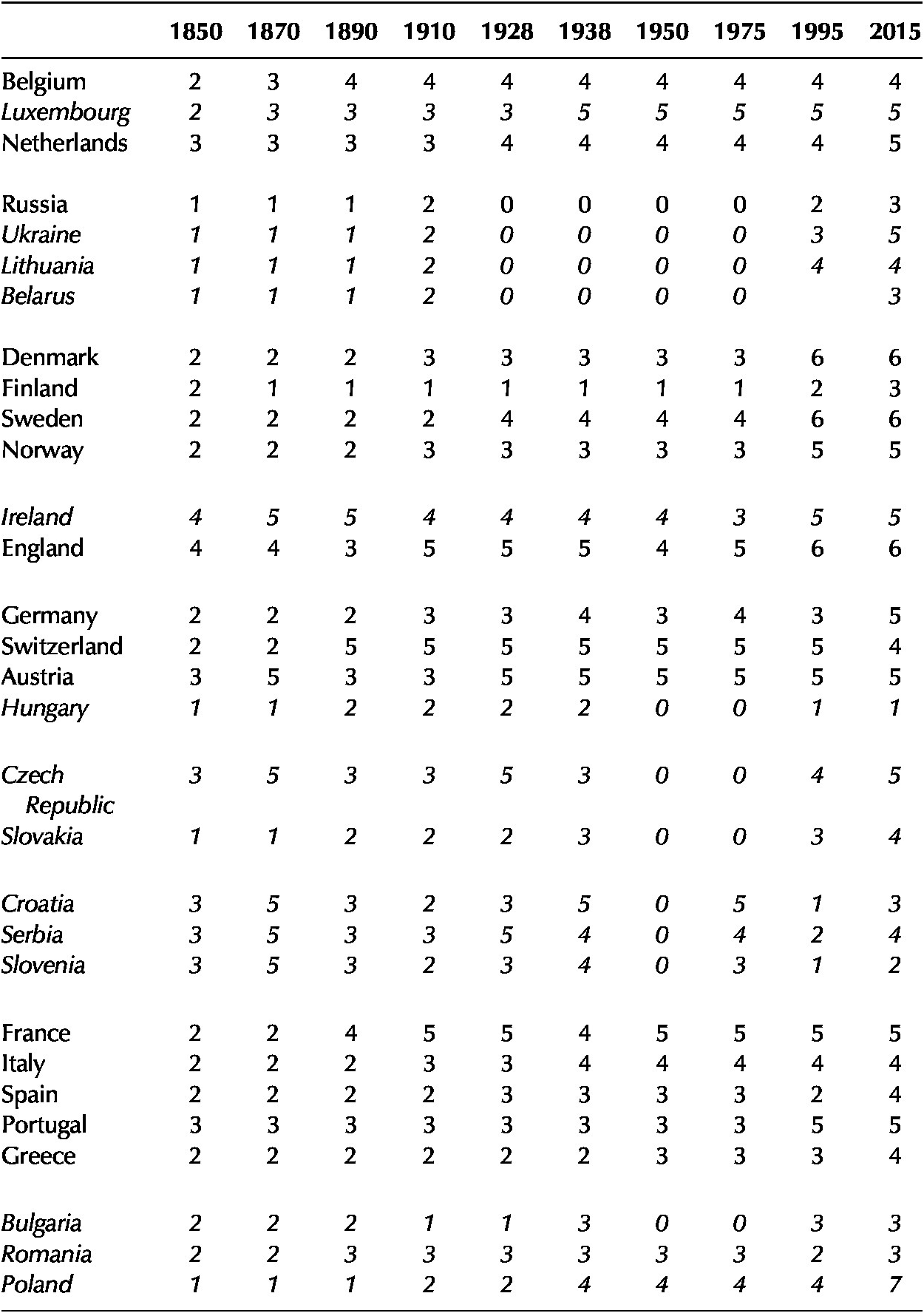
To better understand the nature of the evolution in the number of outcomes across time and space, it is worthwhile analyzing whether differences existed across countries and country groupings. Table 3 below shows the number of outcomes at various benchmarks for groups of countries.
Average number of available outcomes in bankruptcy procedures by country grouping (all countries)

Note: number of outcomes (range between 0-7) defined as number of procedures multiplied by the number of possible outcomes under each procedure. All countries included; in Italic counties which were not fully independent over the whole period
Data source: see text.
In terms of the five largest economies of western Europe (by nominal GDP), England tends to show the highest number of outcomes, whereas Spain generally exhibits the lowest. Germany has a relatively low number of outcomes available over most of the period this research covers, largely because prebankruptcy solutions became available much later than in other advanced countries. Again, there seems quite a degree of variation between these countries in terms of number of outcomes and when changes occur.
The ex-communist states show some of the most pronounced increases between benchmarks. Their mean number of outcomes tends to be below the overall mean for the thirty-country sample—this is particularly true for the benchmark year 1995 but less so for 2015. The increase in the number of outcomes for 2015 compared to 1995 again suggests that relatively poor quality institutions were constructed in the immediate postcommunist period, probably to try and quickly gain legitimacy among Western countries, followed by progressive improvement.
Grouping countries according to different criteria such as common socioeconomic characteristics, physical proximity, or cultural profiles also generates some interesting results. For example, the Benelux countries display very similar trends in the growth of the number of outcomes (which is consistent with trends for other variables), and these values remain relatively stable across the period. Similarly, the group of Russia, Ukraine, Lithuania, and Belarus exhibit fairly similar patterns of outcomes across the period although, in contrast to the Benelux countries, the number of outcomes is persistently low—far below the mean in most instances. However, as with other aspects considered in this paper, in other country groupings where one might expect to see similarities in the number of outcomes, this is not the case. For instance, the Scandinavian countries are very similar for 1870 and 1890, but from 1910 onward the number of outcomes for each county differs quite noticeably. Similarly, apart from the period 1910 to 1950, the data for England and Ireland is perhaps less closely related than expected, particularly as Ireland only gained independence from the UK in 1922.
Conclusions
Despite its relevance for the historical analysis of business organization and performance, little is known about the evolution across time and space of bankruptcy and insolvency laws. This paper offers a fresh contribution to this topic by providing a new and detailed picture of such evolution in Europe between the 1850s and 2015.
The aim is to help scholars undertaking analysis of business organization, entrepreneurship, or creditors protection within individual nations (looking at Italy, Britain, Germany, or comparing a handful of countries) by offering them data that enables such case studies to be placed in a wider comparative context.
The paper also provides some insight into the nature of institutional change in an area of key interest for business historians. In this regard, we can conclude that the data suggests the existence of a Pan-European phenomenon of institutional convergence, almost completed before World War I, centered around the introduction of procedure alternatives to bankruptcy, their opening to nontraders, and the progressive involvement of debtors in the functioning of procedures. This early trend of homogenizing the level of protection of creditors and investors seems to be a relatively strong explanation for the features of long-term institutional change.
“Path-dependency” in institutional change is certainly visible in some examples, such as the Netherlands, where the law only sporadically changed, but almost unnoticeable in other cases. The same can be said for external shocks. As expected, periods of economic stability, such as the post–World War II Golden Age, saw very little institutional change, while the industrialization of economies up to 1913 was paralleled by rapid and deep transformations in the law. On the other hand, the 1930s Great Depression left a lighter mark than usually assumed, and external economic events had very different impacts across nations. The missing link between the role of shocks and path-dependency of institutional change is likely to be in the realm of politics. In this paper we do not study this variable directly at a national level, but the evidence from the timing of the introduction of bankruptcy laws, as well as the effect of the fall of communism, clearly show that the process of state formation (hence, consolidation of the national institutional setting as a whole) had a clear and visible contribution.
Therefore, the central message of this paper is that in order to fully understand the evolution of institutional architectures, in this case the bankruptcy and insolvency laws, an approach is required that pays proper attention to the specific characteristics of these systems over time and avoids the trap of simplistic generalizations.
Appendix
Sources
Whenever possible, we directly consulted the actual law, either in the original language or translated. This was possible in the following cases: Holland, 1896; Finland, 2004; Ireland, 1872, 1988; Italy, 1842, 1938, 1942, 2006: Serbia, 2004, 2010; Spain, 1885, 1922; UK, 1914, 1986, 2002; Ukraine, 1992.
For the nineteenth century, commercial laws of some countries were published with a comment in their original language alongside a translation in either French or English, in collections of volumes titled The commercial laws of the world (in English) or Les lois commerciales de l’univers (in French). These volumes, published between 1911 and 1914, represented an important source for the reconstruction of the features of laws for countries such as Belgium, Croatia, Denmark, Germany, Hungary, Luxembourg, Norway, Russia, Serbia, Slovenia, Spain, Sweden, and Poland. For the same period, vital information could also be extracted from summaries of legislations published annually (in French) in a bulletin edited by the Société de Législation Comparé titled Annuaire de législation étrangère.
For the period after World War II, European Commission documentation has been a key source in the form of sponsored country reports collectively entitled Bankruptcy and a fresh start: stigma on failure and legal consequences of bankruptcy. Although geared toward contemporary issues and policy implications, these reports also provided, often in a very sketchy way, a summary of the historical evolution of bankruptcy and insolvency law.
For both periods, information derived from these sources has been cross-checked and integrated with that available from contemporary or modern comparative analyses, national reports, and various academic studies. Overall, more than one hundred different sources have been consulted. The full list of sources (beyond the ones included in the references) used to generate the database is available from the authors upon request.
Law applying to each country at benchmarks