Introduction
Delirium is a neuropsychiatric syndrome clinically characterized by an acute disturbance of attention, awareness, cognition, and perception which tends to fluctuate during the course of the day (American Psychiatric Association, 2013). This syndrome affects up to 30% of acute medically ill elderly patients during hospitalization and is associated with higher morbidity and mortality rates, prolonged hospital stay as well as worse functional recovery and increased cognitive deterioration following hospital discharge (Inouye et al., Reference Inouye, Westendorp and Saczynski2014).
Although a single factor can lead to delirium, usually this syndrome is multifactorial in elderly people, resulting from the interplay between predisposing and precipitating factors (Inouye and Charpentier, Reference Inouye and Charpentier1996). Advanced age and prior cognitive impairment have been consistently reported as the strongest vulnerability factors for delirium. The most common triggers of delirium include acute diseases, metabolic conditions, iatrogenic complications, surgery, trauma, uncontrolled pain, and medications (Cerejeira and Mukaetova-Ladinska, Reference Cerejeira and Mukaetova-Ladinska2011). Each delirium episode is usually associated with a unique set of contributors being difficult to establish the particular role of each individual risk factor (Inouye et al., Reference Inouye, Westendorp and Saczynski2014). Ultimately, the conjoined action of these disturbances will induce changes in dynamic aspects of neuronal activity affecting brain's ability to integrate information (Cerejeira et al., Reference Cerejeira, Firmino, Vaz-Serra and Mukaetova-Ladinska2010). It has been suggested that common final pathways involving neurotransmitter imbalances and/or exaggerated neuroinflammation underlie delirium pathophysiology (Trzepacz, Reference Trzepacz2000; Cerejeira et al., Reference Cerejeira, Firmino, Vaz-Serra and Mukaetova-Ladinska2010). However, how completely different combinations of etiological factors translate into similar symptoms remains largely unexplained. Elucidating how distinct etiological factors of delirium occur simultaneously in subgroups of patients will have significant impact in disclosing the poorly defined pathophysiology of this syndrome. Indeed, it is likely that risk factors occurring more frequently together share common pathways. However, the co-occurrence of risk factors has rarely been addressed in the field of delirium.
Adequate knowledge about how risk factors interact during an episode of delirium is also relevant for prevention and treatment of this syndrome. Multicomponent interventions aimed to modify a number of delirium risk factors have been strongly recommended for prevention of this syndrome (American Geriatrics Society, 2015). This can reduce up to 30% incident delirium rates regardless of setting and cognitive decline (Martinez et al., Reference Martinez, Tobar and Hill2015) even if this appears not to generalize into wider health gains such as reduced mortality or reduced need for long-term care (Teale and Young, Reference Teale and Young2015). However, differing groups of patients may require a different set of preventive measures (Siddiqi et al., Reference Siddiqi, Stockdale, Britton and Holmes2007). Thus, identifying subgroups of patients showing similar patterns of risk factors has also a clinically important impact. This has a potential to be used to predict patients more susceptible to develop delirium and to allow the definition of more targeted interventions according to the presence of co-occurring risk factors.
The aim of this study was to test whether acute medically ill elderly patients with delirium can be classified into meaningful subgroups according to known risk factors. Hereafter, these data will allow the implement of targeted preventing strategies that are essential to significantly improve the outcome of this serious condition.
Material and methods
Study design
A cross-sectional study was performed in the Internal Medicine Department of a University Hospital (Centro Hospitalar e Universitário de Coimbra, Portugal).
Sample
All individuals recruited for the study were acutely ill medical inpatients referred by the treating medical team to the Liaison Old Age Psychiatric team during hospitalization. Participants with 65 years or older and diagnosed with delirium by a psychiatrist were eligible to enter the study. The participants were recruited from October 2012 to December 2014. Patients were excluded if they were unable to be assessed due to sensorial deficits, communication problems, or severity of the acute medical condition.
Procedures
Delirium diagnosis
All patients were assessed with the Confusion Assessment Method (CAM) for the presence of delirium (Inouye et al., Reference Inouye, van Dyck, Alessi, Balkin, Siegal and Horwitz1990). The CAM was rated during a brief interview with the patient which also included the Mini-Mental State Examination. Positive cases of delirium (according to CAM criteria) were confirmed with DSM-IV-TR criteria (American Psychiatric Association, 2000). The severity of delirium was quantified with the Clinical Global Impression (CGI) Scale (Guy, Reference Guy1976).
Dementia diagnosis
All patients with delirium were evaluated for the presence of dementia, using the Informant Questionnaire on Cognitive Decline in the Elderly (IQCODE-SF) (Jorm, Reference Jorm1994). The principal caregiver (formal or informal) was interviewed for the possible presence of global cognitive decline before admission. The principal caregiver was asked to recollect the situation two weeks before the current admission and compare it with the situation ten years earlier. Patients with a mean score of 3.9 or higher were considered to have global cognitive impairment. Dementia was diagnosed based on operationalized DSM-IV-TR criteria (American Psychiatric Association, 2000).
Other variables
Sociodemographic data were obtained from the clinical file. Chronic comorbidity burden was determined using the Charlson Co-Morbidity scale (Charlson et al., Reference Charlson, Pompei, Ales and MacKenzie1987).
Functional status on admission and at discharge was reported in clinical records and rated by the Katz Index of Independence in Activities of Daily Living (Katz, Reference Katz1983). Length of stay (LOS) was quantified in days. Primary and secondary medical conditions diagnosed during hospitalization, coded using the International Classification of Diseases – tenth Edition, and chronic comorbidities were obtained from the clinical file.
Blood tests performed at the day of delirium assessment were selected and specific analytic parameters were extracted. All medications administered between the time of admission and the day before the delirium assessment, were collected from the clinical file. Drugs with anticholinergic properties were identified using the Anticholinergic Cognitive Burden list (ACB) (Boustani et al., Reference Boustani, Campbell, Munger, Maidment and Fox2008). The ACB identifies medications with varying degrees of anticholinergic activity, assigning a score ranging from 0 to 3. Medications were categorized into three groups: those with no anticholinergic activity (AC = 0), those with possible activity (AC = 1) and those with definite anticholinergic effects (AC = 2/3). The concomitant use in the same patient of three or more anticholinergic (with possible and definite effects) was classified as “≥3 anticholinergic drugs.”
Informed consent
The procedures and rationale used for the study were explained to all patients and relatives. Because many patients had cognitive impairment patient assent was complemented with proxy consent from next of kin (where possible) or a responsible caregiver for all participants, in accordance with the Helsinki Guidelines for medical research involving human participants (World Medical Association, 2002).
Statistical analysis
Statistical analysis was performed using PASW Statistics 22.0 software (Chicago, Illinois, USA). Descriptive analysis was used to determine the baseline and clinical characteristics of the participants in the study. A hierarchical cluster analysis was performed to identify homogenous subgroups with distinct patterns of demographic and clinical factors. Ward's method was employed to minimize the variance in each group (Ward, Reference Ward1963). This clustering method uses the dissimilarities or distances between objects (agglomeration coefficients) when constructing the clusters. To measure the distance between objects, the squared Euclidean distance measure was selected because it is appropriate for dichotomous variables.
Specific variables – acute medical conditions diagnosed during hospitalization, chronic comorbidities, abnormalities in blood test parameters, and intake of anticholinergic drugs – were entered in the cluster analysis as “present” or “not present.”
The examination of the agglomeration schedule and the analysis of the agglomeration coefficients indicated a three cluster solution. The inspection of the dendrogram confirmed a clear distinction between the three groups of patients (d1,2 = 17; d1,3 = 25; d2,3 = 25).
Clusters were compared according to sociodemographic and clinical characteristics with the following tests: χ 2 for dichotomous variables; ANOVA for continuous variables with normal distribution; and Kruskal–Wallis for continuous variables with non-normal distribution. The level of significance (alpha) was 0.5. Variables which showed a significant difference (p < 0.05) between the clusters were incorporated in the cluster in which they were more prevalent.
Results
Baseline characteristics
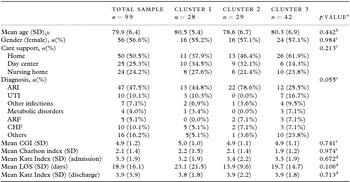
The final sample consisted of 99 participants after two being excluded because they were unable to undergo cognitive assessment. Patients were predominantly female (56.6%), had a mean age of 80 years and were receiving informal care at home (Table 1). Acute respiratory infection was the most frequent reason for admission. Episodes of delirium were considered to have moderate to severe intensity, according to CGI. Katz index increased during hospitalization (Table 1).
Clinical and demographic characteristics of total sample and three clusters

Note. ARI = acute respiratory infection; UTI = urinary tract infection; ARF =acute renal failure; CHF = congestive heart failure; CGI-S = clinical global impression; LOS = length of stay.
Values of p < 0.05 were statistically significant.
b Anova test.
c χ 2 test.
d Kruskal–Wallis test.
Clusters characteristics
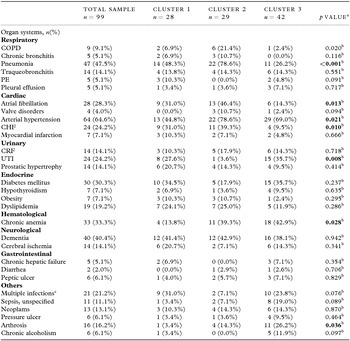
The cluster analysis extracted three distinct subgroups of participants with delirium. A total of 28 patients were assigned to Cluster 1, 29 to Cluster 2, and 42 to Cluster 3. All groups were equally distributed in relation to sociodemographic characteristics and primary diagnosis on admission. Mean scores of delirium severity, LOS, comorbidity burden, and functional status (at admission and at discharge) were similar among clusters (Table 1). Apart from hypoalbuminemia, which was detected exclusively in cluster 3, all other variables were simultaneously present in the three groups, although in different proportions. Chronic and acute medical conditions diagnosed during hospital stay were grouped into seven organ systems (Table 2). Pneumonia was the most frequent primary acute medical disorder, affecting nearly 48% of patients. Frequent comorbidities were hypertension (64.6%), pre-existing dementia (40.4%), chronic anemia (33.3%), diabetes mellitus (30.3%), and atrial fibrillation (28.3%).
Chronic and acute medical conditions

Note. COPD = chronic obstructive pulmonary disease; PE = pulmonary embolism; CHF = congestive heart failure; CRF = chronic renal failure; ARF = acute renal failure; UTI = urinary tract infection.
a Values of p < 0.05 were statistically significant.
b χ 2 test.
c Defined as two or more infections diagnosed during hospital stay.
Cluster 2 had higher rates of COPD, pneumonia, atrial fibrillation, arterial hypertension, and chronic heart failure. Acute renal failure, urinary tract infection (UTI), chronic anemia, and arthrosis were more prevalent in cluster 3. Other variables such dementia, endocrine disorders, or sepsis showed similar prevalence across the three groups (Table 2).
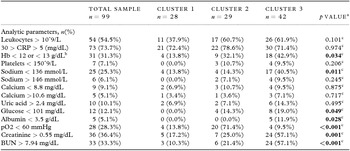
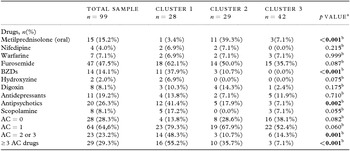
Patients in cluster 2 had higher rates of hypoxemia, affecting nearly 72% of patients (Table 3). Low levels of hemoglobin, sodium, glucose, and albumin were more prevalent in cluster 3, compared with the other groups. Higher levels of creatinine and urea nitrogen were also more prevalent in this cluster. Nearly, 65% of our sample received at least one drug with possible anticholinergic activity, the most common medications being furosemide, prednisolone, haloperidol, risperidone, and alprazolam. Twenty-three percent of participants were exposed to at least one drug with definite anticholinergic effect most frequently amitriptyline, olanzapine, and scopolamine (Table 4). All patients receiving olanzapine had dementia. Benzodiazepines and antipsychotic use were more prevalent in cluster 1. Compared with the other groups, a higher percentage of patients in this cluster was taking medications with definite anticholinergic activity. The simultaneous use of multiple anticholinergic drugs was also more prevalent in this cluster. The use of corticoids was more frequent in cluster 2.
Analytic abnormalities

Note. CRP = C-reactive protein; Hb = Hemoglobin; pO2 = Oxygen pressure; BUN = Blood urea nitrogen.
a Values of p < 0.05 were statistically significant.
b Values adjusted to gender (hb level <12 g/dL for women and <13 g/dL for men).
c χ 2 test.
Medication with anticholinergic proprieties

Note. BZDs = Benzodiazepines; AC = anticholinergic.
a Values of p < 0.05 was statistically significant.
b χ 2 test.
Discussion
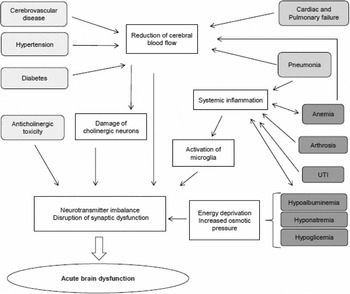
Since delirium has a complex and heterogeneous etiology, we ought to determine in what extent different sets of interacting factors are present in elderly participants with delirium. Based on clinical characteristics, we identified three subgroups of delirious patients with different pattern of risk factors (Figure 1). Predisposing factors of delirium, such as age and prior existing dementia, were similar across all clusters, indicating a comparable vulnerability to precipitant factors. Moreover, although each cluster was characterized by different combinations of precipitant factors, delirium severity, LOS and functional status were comparable between groups. This finding suggests that different pathophysiologic mechanisms translate into similar levels of clinical severity, supporting the hypothesis of a “common final pathway” (Trzepacz, Reference Trzepacz2000). Pneumonia was the most prevalent primary diagnosis in line with previous studies (Pieralli et al., Reference Pieralli, Vannucchi, Mancini, Grazzini, Paolacci and Morettini2014).
Potential pathophysiological mechanisms underlying the three clusters.

Cluster 1
Patients in this cluster were using a high number of medications with definite anticholinergic effect. There is strong evidence that delirium is associated with a global reduction of brain cholinergic activity (Brown, Reference Brown, Stoudemire, Fogel and Greenberg2005), which can be directly induced or aggravated by these pharmacological agents (Vrolijk et al., Reference Vrolijk, Opperhuizen, Jansen, Bast and Haenen2015).
We found that 20.7% of patients in cluster 1 had cerebral ischemia, a condition associated with brain hypoperfusion. It has been suggested that the cholinergic system and cerebral blood flow are linked in a reciprocal manner and changes in cerebral blood flow may affect central cholinergic neurons (Román and Kalaria, Reference Román and Kalaria2006). So, it is likely that such impairments in cerebral perfusion increase the brain vulnerability to anticholinergic drugs. Hypertension and diabetes were also highly prevalent in this cluster and these vascular risk factors are known to contribute to ischemic damage to cholinergic neurons as well as disruption of the blood-brain barrier (BBB) (Pires et al., Reference Pires, Dams Ramos, Matin and Dorrance2013). Importantly, 31.0% of patients developed multiple infections during hospitalization. There is growing evidence that peripheral inflammation, through sequential immune responses, induces a neuroinflammatory process which culminates in structural and functional brain changes and promotes cholinergic deficit (Hshieh et al., Reference Hshieh, Fong, Marcantonio and Inouye2008). So, it is expected that the accumulation of neuronal and synaptic damage due to multiple peripheral insults might lead to an increased sensitivity to anticholinergic agents. In the case of olanzapine, it is difficult to determine whether the anticholinergic toxicity overshadowed the therapeutical effects. Indeed, olanzapine is effective in the treatment of delirium (Grover et al., Reference Grover, Kumar and Chakrabarti2011). Use of benzodiazepines, which has been reported as an independent risk factor for delirium in several studies (Foy et al., Reference Foy, O'Connell, Henry, Kelly, Cocking and Halliday1995) was present in about 40% of patients in this cluster. Besides the anticholinergic effect (particularly diazepam and alprazolam) their direct effect on gamma-aminobutyric acid may contribute to precipitate a neurotransmitter imbalance.
These data suggest that delirium occurring in elderly patients with vascular risk factors and cerebrovascular disease is frequently associated with increased exposure to anticholinergic toxicity.
Although it is well established that removing all potential anticholinergic medications in elderly patients is important to prevent and treat delirium, our results suggest that this strategy will particularly benefit those with vascular risk factors and cerebrovascular disease.
Cluster 2
The second cluster was constituted by factors related to cardiopulmonary and circulatory systems, such as heart failure, atrial fibrillation, arterial hypertension, acute respiratory insufficiency, and COPD. These conditions are associated with both chronic and acute reduction of blood flow and/or oxygenation to the brain which can lead to cerebral hypoperfusion and a neurovascular unit energy crisis. Patients with these cardiac conditions are at increased risk of asymptomatic or silent cerebral infarction as a result of embolization (Udompanich et al., Reference Udompanich, Lip, Apostolakis and Lane2013) and these neuropathological changes reduce the brain resilience to cope with additional insults (e.g. acute reduction in brain perfusion or oxygenation).
In conclusion, although the role of vascular disease in the development of delirium remains poorly understood our results underlie the role of the cardiopulmonary system dysfunction in the pathophysiology of delirium. It is likely that decreased brain perfusion below the lower threshold of autoregulation might lead to an insufficient delivery of glucose and oxygen resulting in acute organ dysfunction and delirium. These changes can be further aggravated following exposure to systemic inflammatory mediators released into circulation and reaching the neurovascular unit, which has been suggested to contribute to delirium (Cerejeira et al., Reference Cerejeira, Firmino, Vaz-Serra and Mukaetova-Ladinska2010). A significant proportion of participants in this cluster have been exposed to oral glucorticoids which have been recognized as a risk factor for delirium in prior studies (Kenna et al., Reference Kenna, Poon, de los Angeles and Koran2011). However, the mechanisms by which high levels of corticosteroids underlie delirium remain unclear: these agents may have protective effects due to their anti-inflammatory proprieties but high levels of cortisol have been associated with increased anticholinergic activity (Plaschke et al., Reference Plaschke, Kopitz, Mattern, Martin and Teschendorf2010).
These findings suggest that a thorough evaluation of patients with delirium might systematically include the assessment of the cardiovascular and respiratory function linking blood perfusion to brain function. The use of glucocorticoids in these patients must be carefully evaluated.
Cluster 3
In contrast with the previous groups, Cluster 3 includes a broad array of conditions affecting multiple organs/systems with a less obvious pathophysiological link to brain dysfunction. Nevertheless, each condition included in this cluster has been previously associated with delirium.
Anemia, present in 43% of patients in this group, represents an independent risk factor for delirium in the geriatric population, and has been associated with long-term cognitive impairment (Peters et al., Reference Peters, Burch, Warner, Beckett, Poulter and Bulpitt2008). Chronic low levels of hemoglobin can lead to insufficient brain oxygenation (Wood et al., Reference Wood, Meyers, Faderl, Kantarjian, Pierce and Garcia-Manero2011) increasing the susceptibility for delirium following acute insults. UTIs are common in the elderly and affected nearly 36% of participants in this cluster. UTIs co-occur frequently with dehydration (manifesting with high blood levels of creatinine and elevated BUN) and both conditions have been reported as precipitant factors of delirium amongst hospitalized elderly medical patients (Pisani et al., Reference Pisani, Murphy, Van Ness, Araujo and Inouye2007). Hyponatremia, which affected 40.5% of participants in this cluster, is also a serious consequence of dehydration in hospitalized patients (Verbalis and Goldsmith, Reference Verbalis and Goldsmith2013) and has been strongly associated with increased delirium risk (Smith et al., Reference Smith, Rivelli, Waters, Hoyle, Durheim and Reynolds2015). Despite having a low prevalence, hypoglycemia and hypoalbuminemia clearly differentiated cluster 3 from the remaining groups (particularly cluster 1). Although the association of hypoglycemia with delirium remains unclear, it is well established that energy deprivation leads to impaired synthesis and release of neurotransmitters with disruption of neural networks involved in attention and cognition (Fong et al., Reference Fong, Tulebaev and Inouye2009). Hypoalbuminemia has been identified as a precipitant risk factor for delirium in medical patients (Margiotta et al., Reference Margiotta, Bianchetti, Ranieri and Trabucchi2006) and is known to interfere with several regulatory pathways (transport of calcium and fatty acids, regulation of osmotic pressure, coagulation, microvascular integrity, inflammatory cascades).
Importantly, the conjoint occurrence of three or more conditions was present in 62% of patients in this cluster. The most frequent combinations were high blood levels of creatinine, elevated BUN and UTI or anemia, present in 26% of patients.
The presence of such a diversity of risk factors in Cluster 3 suggests that, in this particular group of patients, “multiple hits” that combine systemic inflammation, electrolyte imbalance, and metabolic disturbances underlie delirium. Indeed, the accumulation of deficits or comorbidities, as measured by the Frailty Index (Rockwood et al., Reference Rockwood, Song, MacKnight, Bergman, Hogan and McDowell2005), has been associated to the likelihood of delirium (Eeles et al., Reference Eeles, White, O'Mahony, Bayer and Hubbard2012). Our findings highlight the need for optimal management of comorbidities in medical patients, including under-nutrition, dehydration, and infections.
Limitations
This study has several limitations. Although the sample size provided an adequate statistical power to identify three subgroups of patients, a larger sample would be more representative of medically ill delirious elderly patients. Eventually, more homogeneous clusters (or sub-clusters) can emerge with a higher number of participants. Moreover, as the study was implemented in a single hospital, and although this is likely to be representative of modern in-patient medical centers, further work replicating these findings elsewhere is warranted.
A significant number of meaningful variables were selected in accordance to the statistical power provided by the sample. However, important delirium risk factors were not assessed in the current study, including environmental factors, isolation, use of physical restraints, pain, fever, nutritional status, sensorial deprivation, and other vulnerability factors, such as prior episodes of delirium. The inclusion of an increasing number of factors in future studies will be crucial to further enhance our understanding of how risk factors aggregate in elderly patients during delirium.
Being a cross-sectional study, these results must be interpreted with caution. For example, the blood tests were collected at one single time and their values do not necessarily reflect the dynamic pathophysiological changes occurring during the natural course of the medical disorder underlying delirium. Also, although all the participants had delirium (according DSM-IV-TR criteria) important clinical features, such as motor subtypes, the duration of full-blown delirium and persistence of subsyndromal symptoms were not assessed. Additionally, whereas delirium has been traditionally studied as an episodic phenomenon, interactions between different risk factors are expected to result in fluctuating symptoms as the intensity and number of these factors might vary through time. Thus, future studies should perform sequential evaluations (i.e. before, during and after a delirium episode) to disclose the intricate relationship between clinical and analytic parameters and the changes in cognitive, behavioral, and emotional symptoms.
Conclusions
This study provides new information about how multiple factors interact and work together in elderly patients to disrupt large-scale neuronal networks in the brain and manifesting as delirium. These findings may be useful to identify individuals at high risk of developing delirium who should undergo screening and correction of several different sets of interacting biological factors. These will enable physicians to implement strategies to avoid occurrence of delirium, decrease its duration and improve outcomes.
Conflict of interest
None.
Description of authors’ roles
Study concept and design: Luísa Lagarto, Joaquim Cerejeira. Acquisition of data: Luísa Lagarto. Analysis and interpretation of data: Luísa Lagarto. Writing and revising manuscript for important intellectual content: Luísa Lagarto, Joaquim Cerejeira.