Introduction
Most organisms are hosts to a diverse community of parasites, and this raises all the classical ecological questions about the ways in which communities are structured and organised. One potential force shaping communities is interspecific competition. Interspecific competition between parasites may have shaped their behavioural strategies of host resource exploitation (Connell, Reference Connel1980; Hawkins, Reference Hawkins, Hochberg and Ives2000). In insect parasitoids (insects that develop inside another insect, their host, killing it as a consequence of their development), several species often exploit the same host population (Godfray, Reference Godfray1994; Hawkins, Reference Hawkins, Hochberg and Ives2000). In contrast to predators, insect parasitoids do not remove parasitized hosts after attack; and thus these hosts remain vulnerable to subsequent attack by other parasitoid females, belonging to the same or a different species. In solitary parasitoids, usually only one adult parasitoid develops per host and when two different females oviposit in the same host (a behaviour called superparasitism if both females belong to the same species or multiparasitism if the second female belongs to a different species), supernumerary individuals are eliminated through physical combat between larvae or physiological suppression (Chow & Mackauer, Reference Chow and Mackauer1986; Hubbard et al., Reference Hubbard, Marris, Reynolds and Rowe1987; Pexton & Mayhew, Reference Pexton and Mayhew2005). In the few studies where survival probabilities have been measured in endoparasitoids, the first egg had a marked advantage over later ones (Visser et al., Reference Visser, van Alphen and Nell1992; van Baaren et al., Reference van Baaren, Boivin and Nénon1994, Reference van Baaren, Boivin and Nénon1995).
A parasitized host is, therefore, of lower quality for a parasitoid female compared to an unparasitized one; and, accordingly, even if super- and multiparasitism can be adaptive in some situations (for a review see van Alphen & Visser (Reference van Alphen and Visser1990) ), most solitary wasps tend to avoid them. Avoidance of oviposition in already parasitized hosts generally implies the ability of female parasitoids to distinguish between unparasitized and parasitized ones, termed the host discrimination ability (van Lenteren, Reference van Lenteren, Nordlung, Jones and Lewis1981). Such ability has a strong selective advantage, as females can avoid wasting eggs and/or time (Bakker et al., Reference Bakker, van Alphen, van Batenburg, van der Hoeven, van Strien-van Liempt and Turlings1985), and is generally mediated through host markers present externally and/or internally, or on patch markers (Sugimoto et al., Reference Sugimoto, Uenishi and Machida1986; Hoffmeister & Roitberg, Reference Hoffmeister and Roitberg1997). Some solitary parasitoids mark the host they just attacked externally with either a pheromone deposited during oviposition or a physical mark left on the host body (Mackauer, Reference Mackauer, Mackauer, Ehler and Roland1990). Internal cues for host discrimination can originate either from some parasitoid injected substances or from host quality changes associated with parasitism (Mackauer, Reference Mackauer, Mackauer, Ehler and Roland1990). Intraspecific host discrimination (i.e. the ability to recognize hosts parasitized by a conspecific) has been observed in more than 200 parasitoid species and has been found in most studied species (van Lenteren, Reference van Lenteren, Nordlung, Jones and Lewis1981; van Alphen & Visser, Reference van Alphen and Visser1990). In some species, host discrimination was qualified as imperfect (Outreman et al., Reference Outreman, Le Ralec, Plantegenest, Chaubet and Pierre2001a) because only a part of the parasitized hosts encountered are rejected. In contrast to intraspecific host discrimination, interspecific host discrimination (i.e. ability to recognize hosts parasitized by another parasitoid species) has less often been detected among the parasitoid species studied, but it also has been less often studied (Turlings et al., Reference Turlings, van Batenburg and van Strien-van Liempt1985; van Baaren et al., Reference van Baaren, Boivin and Nénon1994; van Baaren & Boivin, Reference van Baaren and Boivin1998). Both intra and interspecific host discrimination are important as a mechanism for partitioning the host resource between competitors; host discrimination provides information about the level of exploitation of the host population, and thus on the intensity of the intra- or interspecific competition.
In this study, the interspecific host discrimination ability has been investigated in a guild of Aphidius species sharing the same aphid host, Sitobion avenae. This guild consists of three closely related solitary parasitoids belonging to the genus Aphidius (A. rhopalosiphi De Stephani-Perez, A. avenae Haliday and A. ervi Haliday, Hymenoptera Braconidae) (Kambhampati et al., Reference Kambhampati, Volkl and Mackauer2000), and it has been well documented that interspecific competition occurs frequently in this system (van Baaren et al., Reference van Baaren, Héterier, Hance, Krespi, Cortesero, Poinsot, Le Ralec and Outreman2004). In cereal fields of Brittany (Western France), A. rhopalosiphi is the most abundant species and is present throughout the year, while both A. avenae and A. ervi appear later in the season (van Baaren et al., Reference van Baaren, Héterier, Hance, Krespi, Cortesero, Poinsot, Le Ralec and Outreman2004). Since the fitness costs associated with multiparasitism might differ from costs associated with superparasitism, the ability of A. avenae or A. ervi females to recognize hosts parasitized by A. rhopalosiphi and vice versa has been tested here. It should be noted that this guild represents a particularly interesting case because the most abundant species, A. rhopalosiphi, often accepts hosts already parasitized by conspecifics (Outreman et al., Reference Outreman, Le Ralec, Wajnberg and Pierre2001b), resulting in high superparasitism rates even in host-patches containing numerous unparasitized hosts (Outreman et al., Reference Outreman, Le Ralec, Plantegenest, Chaubet and Pierre2001a, Reference Outreman, Le Ralec, Wajnberg and Pierre2005). The interspecific host discrimination between A. ervi and A. avenae has not been tested here because both species are rare enough that the probability of attacking the same host is negligible.
Methods
Rearing
Aphidius rhopalosiphi and A. avenae originated from S. avenae mummies sampled in cereal crops around Rennes (Brittany, France) and were reared on a mixed-age culture of S. avenae originating from one parthenogenetic female collected in 1990 in the same area (SA1 clone, INRA-Zoology Collection). Aphids were reared on winter wheat, Triticum aestivum, cv. ‘Boston’, furnished by the society Saaton Union Recherche (France). Colonies of hosts and parasitoids were maintained in Plexiglas cages (50×50×50 cm) placed in climate-controlled rooms at 20±1°C, 70±10% RH and a 16L:8D photoperiod. Aphidius ervi mummies were bought from the Biobest Company and reared for several generations on S. avenae before the experiments were done, in similar conditions as the two other parasitoid species. For experiments, only second-instar aphid larvae isolated on a wheat leaf two hours before were used. This instar is the preferred one of all three species (Outreman, Reference Outreman, Le Ralec, Plantegenest, Chaubet and Pierre2001a,Reference Outreman, Le Ralec, Wajnberg and Pierreb). To obtain parasitoid females, mummies were collected and placed individually in gelatine capsules. Newly-emerged females were isolated in plastic tubes containing moistened cotton, droplets of honey and a single male for mating. All the females used for the experiments were one day old and able to oviposit more than 50 eggs per day (Shirota et al., Reference Shirota, Carter, Rabbinge and Ankersmit1983 for A. rhopalosiphi; Starý, Reference Starý1970 for A. ervi; personal observations for A. avenae). Each female had been allowed to oviposit in a single host placed on a piece of wheat leaf in a glass Petri dish (Ø=5 cm) just before the experiment to eliminate females unable to oviposit.
Interspecific host discrimination experiment
A similar design was used to analyse interspecific host discrimination between A. rhopalosiphi and A. avenae (exp. 1 and 2) and between A. rhopalosiphi and A. ervi (exp. 3 and 4). For each experiment, 100 aphids parasitized by one of the parasitoid species were needed. They were obtained by being individually offered to parasitoid females. Each host was attacked only once; a host was considered as having been attacked when the female had stung and subsequently departed from it. Although it is not possible for either of the three parasitoid species to determine if an egg has been laid after ovipositor insertion, it is highly likely, since previous studies showed that 89–96% of healthy hosts contain a parasitoid immature after ovipositor insertion (van Baaren et al., Reference van Baaren, Héterier, Hance, Krespi, Cortesero, Poinsot, Le Ralec and Outreman2004, for A. rhopalosiphi and A. avenae; Le Lann et al., in press, for A. ervi).
To test interspecific host discrimination, a single unparasitized host and a single host parasitized by a female of a given parasitoid species were exposed to a single heterospecific parasitoid female in a choice experiment until one of the two hosts had been stung with the ovipositor. With each parasitoid female, ten successive trials on a new pair of hosts were performed; and, for each combination of parasitoids, ten independent replicates were obtained. The following combinations were tested: aphids parasitized by A. rhopalosiphi were exposed to A. avenae females (exp. 1), aphids parasitized by A. avenae were exposed to A. rhopalosiphi females (exp. 2), aphids parasitized by A. rhopalosiphi were exposed to A. ervi females (exp. 3) and aphids parasitized by A. ervi were exposed to A. rhopalosiphi females (exp. 4). All the different experimental treatments were performed in random order. Care was taken that experiments were carried out within two hours after the host had been parasitized by the first parasitoid. This threshold time was chosen because external pheromonal marks disappear after several hours; and, when the host had been parasitized much earlier, the discrimination process is generally based on the recognition of physiological changes inside the host due to the development of the parasitoid and not on the recognition marks from the first female (Roitberg & Mangel, Reference Roitberg and Mangel1988, Outreman et al., Reference Outreman, Le Ralec, Plantegenest, Chaubet and Pierre2001a).
For each host encounter, the behaviour of the female parasitoid was recorded (encounters, antennal rejections and ovipositor insertions). The number of encounters, therefore, represents the number of antennal rejections together with the number of stings. Three to four days after each experiment, the aphids were dissected in a drop of alcohol under a microscope and first-instar parasitoid larvae were counted. This latency between oviposition and dissection was chosen, since even larvae defeated in larval competition in multiparasitized hosts are still visible four days after oviposition (for all species, the development time is between 13 and 14 days in our rearing conditions) (van Baaren et al., Reference van Baaren, Héterier, Hance, Krespi, Cortesero, Poinsot, Le Ralec and Outreman2004).
To test whether healthy and parasitized aphids were encountered at different rates in the choice tests, a binomial test was used. Subsequently, the effect of the host type (i.e. parasitized or unparasitized) on the probability for an aphid to be stung by a parasitic wasp was tested. Since each female was tested in ten repeated choice trials, generalized estimating equations (i.e. GEE) for correlated data, assuming a binomial error and using a logit-link function (Liang & Zeger, Reference Liang and Zeger1986) were used. Since no specific pattern for the correlation between single choices of the repeated test has to be assumed, an exchangeable working correlation matrix was used.
To analyse the avoidance rate of multiparasitism, the observed distributions of the number of larvae per host found at dissection were compared with an expected distribution built under the null assumption that the three species had no interspecific host discrimination ability. To compute the expected distribution of the number of eggs per host after two successive attacks under the null hypothesis (H0) of no host discrimination ability, we assumed that (i) two successive encounters with the same host were independent (i.e. no host discrimination ability), (ii) a maximum of one egg can be laid per oviposition insertion (van Baaren et al., Reference van Baaren, Héterier, Hance, Krespi, Cortesero, Poinsot, Le Ralec and Outreman2004) and (iii) all eggs laid survived until dissection. Let p 0 and p 1 be the probabilities of a host containing 0 or 1 parasitoid after a single attack, respectively. From separate experiments, we obtained the estimates p 0=0.11 and p 1=0.89 for A. ervi (Le Lann, unpublished data), p 0=0.04 and p 1=0.96 for A. rhopalosiphi (van Baaren et al., Reference van Baaren, Héterier, Hance, Krespi, Cortesero, Poinsot, Le Ralec and Outreman2004) and p 0=0.05 and p 1=0.95 for A. avenae (van Baaren et al., Reference van Baaren, Héterier, Hance, Krespi, Cortesero, Poinsot, Le Ralec and Outreman2004). Therefore, under H0, in a sample of size n (number of ovipositor insertions), the expected frequencies E(N j) of the number of hosts containing j parasitoids at dissection after two successive attacks, by the two parasitoids x and y, are given by:



For each treatment, a G-test with Williams' correction was used to compare the observed distribution of parasitoid eggs per host to the expected one.
Results
Interspecific host discrimination between A. rhopalosiphi and A. avenae
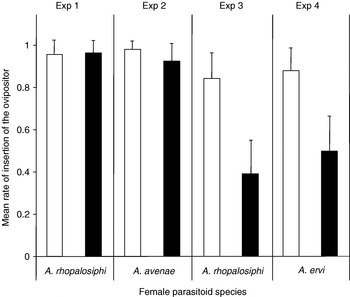
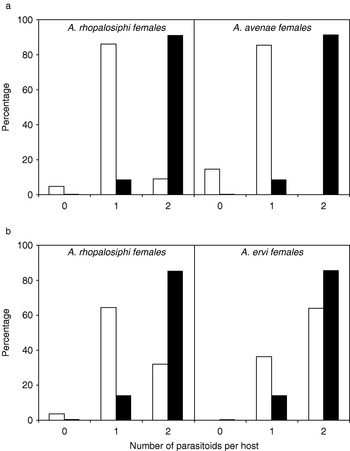
For all replicates, the number of unparasitized S. avenae hosts encountered ‘rejected after antennal contact or stung by a female’ did not differ from the number of parasitized hosts encountered (binomial tests, P>0.05). Aphidius rhopalosiphi females encountered 5.5±0.57 unparasitized hosts and 4.8±0.56 parasitized hosts, whilst A. avenae females encountered 5.4±0.39 unparasitized hosts and 4.3±0.30 parasitized hosts (mean±SE). About 90% of the encountered hosts were attacked by the female (i.e. ovipositor insertion), and this did not depend on their state (unparasitized or parasitized) (fig 1a; A. rhopalosiphi: GEE, χ2=0.22, df=1, P=0.637; A. avenae: GEE, χ2=0.99, df=1, P=0.319). However, the observed distributions of the parasitoid larvae found at dissections strongly departed from the distributions expected under the null hypothesis (i.e. no interspecific host discrimination) (fig. 2a) (A. rhopalosiphi: G=166.05, df=2, P<0.001; A. avenae: G=204.3, df=2, P<0.001). For both species, the majority of attacked hosts contained only a single parasitoid.
Mean rate (±SEM) of insertion of the ovipositor in unparasitized S. avenae hosts (open bars) and in hosts parasitized by A. rhopalosiphi (exp 1, 3), A. avenae (exp 2) or A. ervi (exp 4) (filled bars). In all four experiments, a female was placed in a Petri dish with one unparasitized host and one host parasitized by another species, and ten pairs of hosts were successively presented. Each experiment was replicated with ten different females.

Comparison of expected (under the null hypothesis of no host discrimination ability (filled bars)) and observed (open bars) egg distribution in S. avenae hosts that were stung successively by two females of different species. Figure 2a shows interspecific host discrimination between A. rhopalosiphi and A. avenae, and fig. 2b shows interspecific host discrimination between A. rhopalosiphi and A. ervi.

Interspecific host discrimination between A. rhopalosiphi and A. ervi
For all replicates, the number of unparasitized hosts encountered by a female did not differ from the number of parasitized hosts (binomial tests, P>0.05): Aphidius rhopalosiphi females encountered 9.1±1.07 unparasitized hosts and 9.2±1.37 parasitized hosts, whilst A. ervi females encountered 7.6±0.34 unparasitized hosts and 7.2±0.89 parasitized hosts (mean±SE). Among the host encountered, the proportion of ovipositor insertion (and, consequently, the number of antennal rejections) strongly depends on the type of host (fig 1b; A. rhopalosiphi: χ²=43.85; df=1; P<0.001; A. ervi: χ²=28.32; df=1; P<0.001). For both species, parasitized hosts were less often stung with the ovipositor. The observed distributions of parasitoid larvae also differed from distributions expected under the null hypothesis (i.e. no interspecific host discrimination) (fig. 2b) (A. rhopalosiphi: G=39.97, df=2, P<0.001; A. avenae, G=10.09, df=2, P=0.039). While the rates of multiparasitism in the A. rhopalosiphi-A. avenae interactions were very low (fig 2a), about 30% of hosts parasitized by A. ervi were accepted by A. rhopalosiphi females and about 60% of hosts parasitized by A. rhopalosiphi were accepted by A. ervi females (fig. 2b).
Discussion
Results showed that females of A. rhopalosiphi and A. avenae both discriminated between unparasitized S. avenae hosts and hosts parasitized by the other species. This host discrimination occurred only after an ovipositor insertion. Moreover, we found that females of A. rhopalosiphi and A. ervi discriminated between unparasitized hosts and hosts parasitized by the other species, but this recognition of hosts parasitized by the other species occurred before ovipositor insertion. Hence, interspecific host discrimination in the three Aphidius species studied here is based on either an internal mark only or on an external mark, which is used either alone or in combination with an internal mark. This is the first time that it has been shown that cues used for interspecific host discrimination depend on the specific identity of the competition.
Variation in the mechanisms of interspecific host discrimination
When A. rhopalosiphi females were exposed to hosts parasitized by A. avenae, almost all ovipositor insertions in parasitized hosts were rejections, as none or very few of these hosts contained two parasitoids larvae. This revealed that A. rhopalosiphi rejected hosts parasitized by A. avenae only on the basis of an internal factor. Females of A. rhopalosiphi probably used the internal mark left by A. avenae, which is also used in this species in intraspecific host discrimination (van Baaren et al., Reference van Baaren, Héterier, Hance, Krespi, Cortesero, Poinsot, Le Ralec and Outreman2004). Discrimination on the basis of marks produced by closely related species has already been shown in other parasitoid species (Vet et al., Reference Vet, Meyer, Bakker and van Alphen1984; van Baaren & Boivin, Reference van Baaren and Boivin1998). It is likely that closely related species produce similar marking substances and, hence, that they can recognize each other's marks. However, aphids can exude a small drop of yellowish fluid from cornicles; and, once emitted, this secretion rapidly solidifies in the air, remaining on the ends of the cornicles. Aphids with dried cornicle secretion on their body are often rejected by A. rhopalosiphi females. Rejecting hosts using this cue is safer and saves time although the cue is less reliable than the recognition of a pheromonal mark (Outreman et al., Reference Outreman, Le Ralec, Plantegenest, Chaubet and Pierre2001a; Outreman & Pierre, Reference Outreman and Pierre2005). Hosts parasitized by A. avenae rarely emitted cornicular secretion; and, thus, A. rhopalosiphi must insert its ovipositor in such hosts to recognize already parasitized hosts (van Baaren et al., Reference van Baaren, Héterier, Hance, Krespi, Cortesero, Poinsot, Le Ralec and Outreman2004).
When A. avenae females were exposed to hosts parasitized by A. rhopalosiphi, they rejected these hosts using an internal mark only, as they do with hosts parasitized by females of their own species (van Baaren et al., Reference van Baaren, Héterier, Hance, Krespi, Cortesero, Poinsot, Le Ralec and Outreman2004). Although hosts parasitized by A. rhopalosiphi show a high incidence of cornicular secretion emission, A. avenae does not induce further defensive behaviour when attacking such hosts (van Baaren et al., Reference van Baaren, Héterier, Hance, Krespi, Cortesero, Poinsot, Le Ralec and Outreman2004). Hosts parasitized by A. avenae rarely emitted cornicular secretions (A. avenae stays in proximity of the hosts, fluttering the wings for several minutes before each oviposition, and this behaviour is linked to a low rate of cornicular secretion by the host (van Baaren et al., Reference van Baaren, Héterier, Hance, Krespi, Cortesero, Poinsot, Le Ralec and Outreman2004)). Moreover, A. avenae is not repelled by hosts having emitted cornicular secretion. Aphidius avenae behaved towards hosts parasitized by A. rhopalosiphi as towards hosts parasitized by its own species.
When A. rhopalosiphi females were exposed to hosts parasitized by A. ervi, A. rhopalosiphi females rejected the majority of hosts parasitized by A. ervi after antennal examination. Sixty percent of the hosts parasitized by A. ervi emitted cornicular secretions (Le Lann, unpublished data). Thus, A. rhopalosiphi can reject these hosts because they have secreted, as they do with hosts parasitized by conspecific females. Aphidius ervi is known to use both external and internal marks to reject hosts parasitized by conspecifics (Bai, Reference Bai1991: although in this publication the experiments did not allow specifying which kind of external mark was used, cornicular secretion or pheromonal mark (McBrien & Mackauer, Reference McBrien and Mackauer1990, Reference McBrien and Mackauer1991)), and it is not impossible that these external marks could be also recognized by A. rhopalosiphi females. A small number of parasitized hosts were not rejected upon antennal contact and are subsequently stung with the ovipositor. A number of these hosts were still rejected after the ovipositor insertion, suggesting that A. rhopalosiphi females also recognize the internal mark of A. ervi in rejecting parasitized hosts, as it is able to recognize the internal mark of A. avenae (see above).
When A. ervi females were exposed to hosts parasitized by A. rhopalosiphi, A. ervi rejected hosts parasitized by A. rhopalosiphi, both using external and internal cues. The nature of the external cue is not clear; A. rhopalosiphi either deposits an external mark as has been suggested for A. ervi (Bai, Reference Bai1991) or it uses the host's cornicular secretion. Aphidius ervi also rejected hosts parasitized by A. rhopalosiphi using an internal mark, as it does in intraspecific host discrimination (McBrien & Mackauer, Reference Mackauer, Mackauer, Ehler and Roland1990; Bai, Reference Bai1991). Aphidius ervi showed a high rate of multiparasitism although it is able to recognize parasitized hosts. This high rate of multiparasitism is adaptive because of the competitive superiority of this species when in competition with A. rhopalosiphi (A. ervi wins in 77% of the contests when the time interval between the two ovipositions is short: Le Lann, in press). Likewise, the avoidance of multiparasitism by A. rhopalosiphi is functional because it loses competition with A. ervi in 77% of the contests.
Potential impact of interspecific host discrimination on resource sharing
Interspecific host discrimination is adaptive whenever there is sufficient overlap in host exploitation between two parasitoid species, such that their offspring is affected by the competition with heterospecific larvae. The occurrence of interspecific host discrimination is less well documented than that of intraspecific host discrimination (Bolter & Laing, Reference Bolter and Laing1983; McBrien & Mackauer, Reference McBrien and Mackauer1991; Scholz & Höller, Reference Scholz and Höller1992; Agboka et al., Reference Agboka, Schulthess, Chabi-Olaye, Labo, Gounou and Smith2002; Wang & Messing, Reference Wang and Messing2004; Ardeh et al., Reference Ardeh, de Jong and van Lenteren2005). Interspecific host discrimination is more difficult to show in a competitively superior species because females of such a species should accept hosts already parasitized by the inferior competitor at a high rate. Interspecific host discrimination may be absent between unrelated parasitoid species (e.g. van Strien-van Liempt & van Alphen, Reference van Strien-van Liempt and van Alphen1981). In such cases, parasitoids of both species may be unable to recognize each other's marking substances due to a phylogenetic constraint.
There, in A. rhopalosiphi, we found a more frequent rejection of hosts parasitized by one of the other species than has been found earlier for hosts parasitized by conspecifics (Outreman et al. Reference Outreman, Le Ralec, Plantegenest, Chaubet and Pierre2001a). The reason for this rejection could be a different one for A. ervi and A. avenae. The rejection of hosts parasitized by A. ervi could be due to the fact that A. rhopalosiphi is inferior in contests for the host to A. ervi larvae; the fitness returns of multiparasitism are, therefore, smaller than that of conspecific superparasitism for A. rhopalosiphi (Le Lann et al., in press). These findings are in agreement with earlier work, showing A. ervi to be a superior competitor in larval fights against other Aphidius species, such as A. smithi (McBrien & Mackauer, Reference Mackauer, Mackauer, Ehler and Roland1990). The rejection of hosts parasitized by A. avenae is more difficult to understand. As the hosts are not alerted after parasitism by A. avenae, the fitness returns from oviposition in such hosts are larger than that of oviposition in a host already parasitized by a conspecific. Indeed, when encountering a host parasitized by a conspecific, a female of A. rhopalosiphi takes the risk of being glued by the aphid if it stings it (Outreman et al., Reference Outreman, Le Ralec, Plantegenest, Chaubet and Pierre2001a); whereas, when encountering a host parasitized by a A. avenae female, a female A. rhopalosiphi does not take any risk in inserting its ovipositor, and its host discrimination ability saves eggs.
In the guild of three Aphidius species, A. rhopalosiphi is the most abundant. It is present in the field all year round and is abundant when the two other species arrive (van Baaren et al., Reference van Baaren, Héterier, Hance, Krespi, Cortesero, Poinsot, Le Ralec and Outreman2004). It exploits patches only partially, and leaves a patch when the parasitized aphids have started to emit cornicular secretions (Outreman et al., Reference Outreman, Le Ralec, Plantegenest, Chaubet and Pierre2001a). These secretions are known to act as a pheromonal signal, alerting the other aphids of the presence of a natural enemy (Montgomery & Nault, Reference Montgomery and Nault1977). The two other species have developed different strategies to avoid the defensive behaviour of the aphids (van Baaren et al., Reference van Baaren, Héterier, Hance, Krespi, Cortesero, Poinsot, Le Ralec and Outreman2004, for A. avenae; and Le Lann, unpublished data, for A. ervi). Both show interspecific host discrimination and exploit the unparasitized hosts in the patches already partially exploited by A. rhopalosiphi.
Numerous studies have documented that parasitoids sharing a single host species exhibit species-specific microhabitat preference and/or differences in spatial distribution (e.g. habitats with different microclimates, host plant species, plant clones or individuals and plant parts: Kaneko, Reference Kaneko2004). The species studied here show only partial niche differentiation with sufficient overlap to expose them to the negative effects of interspecific competition. The interspecific host discrimination found here allows all those species to use the shared resource efficiently; both A. ervi and A. avenae avoided hosts already parasitized by the abundant species, A. rhopalosiphi. The latter abandons host patches long before all hosts have been parasitized, leaving these hosts available for A. ervi and A. avenae. Hence, A. ervi and A. avenae can use a part of the host population not exploited by A. rhopalosiphi (i.e. the residual resource) with no risk of multiparasitism because of their ability to discriminate hosts already parasitized by this dominant competitor. Aphidius ervi and A. avenae are both so rare that the probability that they attacked the same host is negligible.
Acknowledgements
We thank Jacques van Alphen, Thomas Hoffmeister and an anonymous referee for helpful comments on a previous version of this manuscript. The experiments comply with the current laws of France. This work was supported by the European Marie Curie Chair programme COMPAREVOL (http://comparevol.univ-rennes1.fr/) and by the Brittany region programme ECOCLIM.