There will be those who wonder why this matters; why an independent film-maker's movie getting shelved should be of concern to anyone. It's because what happens in the film industry shows us more than how the board of censors works. It shows us how Thailand works. And that really is important.Footnote 1
On 23 April 2013, Nontawat Numbenchapol went to sleep in disappointment. Earlier in the day he had travelled across Bangkok to the Thai Ministry of Culture to acquire an authorisation document from the Thai Censorship Board, a necessary formality for releasing his film, Boundary (Fah tam phaen-din sung, low sky high ground), to a nationwide audience.Footnote 2 In previous months, he had screened the film at the prestigious 63rd Berlin International Film Festival but also, three weeks earlier, to a packed domestic audience at the opening of the 3rd Salaya International Documentary Festival at Thailand's Film Archive.Footnote 3 His documentary film personalises the lived contexts of a contentious International Court of Justice (ICJ) dispute over an Angkor-era temple along the Thai–Cambodian border, and addresses the cultural, linguistic, and class-based dimensions of political division in Thailand through shifting perspectives of soldiers, villagers, and even the director himself. This ‘cinematic geopolitics’, as my dissertation adviser Michael Shapiro would have termed the aesthetic-narrative collision, are incidental to the film-maker's quest in the first half of Boundary to move through the slow pace of life along the border, where serene long takes bridge family life with voice-over memories of a soldier during times of heightened political protest.Footnote 4 But despite the film's regional relevance or global regard, Nontawat received word from a Ministry staff member that the film could not be released. Boundary had been banned. Before Nontawat went to sleep that night he posted a status message on Facebook to relay the shock and disappointment of the ban to his friends. The next morning, after thousands of views and shares on Facebook, the viral momentum of social media framed Nontawat as a global symbol for freedom of expression in Thailand.
Nontawat's experience reveals much about the procedures of Thai censorship and points toward significant dimensions in the regulation of a historically-constituted ‘way of seeing’. For John Berger, a ‘way of seeing’ is a multidimensional configuration of power (especially within the modern orientation of looking at class, gender, metropolitan, and racial regimes) that develops and prioritises one manner of looking as the dominant regime of vision over time.Footnote 5 Berger begins his argument, following Walter Benjamin's thesis in ‘The work of art in the age of mechanical reproduction’, in the assertion that the reproducibility of an image leads to the multiplication and concentration of perspective.Footnote 6 Following Berger, I would like to consider how governments attempt to condition, and intervene in, how we see. The government banning of films suggests that vision is departmentalised and institutionalised to respond, when necessary, to the rising independence of the national image.
At the same time, cinematic independence looks to social media and global media networks to pressure executive agencies like the Thai Ministry of Culture, as evinced by the Ministry's later decision to reverse the ban. Nontawat's film thereby invites questions about the ways vision is challenged and reproduced in the procedures of film censorship. Thailand's political modernity can be better understood in the construction of looking, which motivated a particular kind of cultural governance. The 1930 Film Act and the 2008 Motion Pictures and Video Act were ratified amid conspicuous political circumstances fuelling the responsiveness of film-makers who challenged or evaded these laws on behalf of artistic freedom. Responding to the ban, Nontawat phoned other film-makers, kindred souls who inspire a new generation to confrontation via an expanding film community that works both in the system and underground. He called Apichatpong Weerasethakul, whose work has been blocked from theatrical exhibition on multiple occasions. Meanwhile, calls from The Guardian, Al Jazeera, and the Hollywood Reporter flooded in, both to Nontawat and the Ministry of Culture.
However, emphasising the intrusion of governments into creative media without revealing its frequency in so-called democracies is disingenuous. For example, Eric Smoodin's study of government viewing practices finds a pre-Second World War US State Department regulating the overseas circulation of films while, domestically, ‘study guides’ moderated the interpretation of controversial films in American schools. At the time of the release of films like Frank Capra's Mr. Smith goes to Washington (1939), the US chargé d'affaires in Bangkok recommended restricting the film from overseas distribution for its unsightly representations of American democracy.Footnote 7 In similar ways, imperial powers managed their colonies through the implementation of laws to limit self-representation.Footnote 8 These examples suggest that censorship is often geopolitical, not simply when deployed against disruptive content that exposes the fragility of national identity, but in the use of modern executive power to moderate these divisions. Censorship is clearly a central tool used by many regimes for cultural governance, but Western governments bear some responsibility for its historical precedents where national interests abroad have inhibited free cinematic expression. Within censorship's authoritarian mode, the composition and ‘active citizenship’ of film communities (of directors, film crews, critics, advocates, and cinephiles) is manifested in their political struggle.Footnote 9 And aside from the contradiction between so-called democracies and the geopolitical imperative to restrict alternative ways of seeing, the ‘independence’ of independent cinema opens toward democratic possibilities even when formal democracy is absent.
Thailand's film community is a vibrant assemblage of competing viewpoints. And despite the monopolies of studios over big budget productions and mega-mall theatres, independent film-makers tell new stories and provoke debates that continue into public viewing forums and online postings. The following record of censorship in Thailand is about this newness in film-making that emerged amid twenty-first century regime change and ideological division. My conversations with film directors, critics, and archivists provided insight into plural strategies of free expression and the relationship between censorship and citizenship. Below, I investigate the work of Apichatpong Weerasethakul and Nontawat Numbenchapol with a brief historical overview of film censorship in Thailand in order to better understand how governments watch films, and how this official regime of vision changes over time. The approach is inspired by the government imperative to structure images within dominant fields of power.Footnote 10 An inquiry into institutional ways of seeing in Thai censorship can thus help to address the dimensions of film that are of interest to media practice and governmental regulation. For example, what is the role of film, as compared to other mediums, in addressing controversial subjects? How and why does Thai film address key cultural institutions, such as religion and the monarchy, in ways that break with conventional aesthetic forms? What are the justifications for legal limits on creative expression? In other words: why do governments censor?
A historical overview of film censorship in Thailand
Any study of the image in Thailand must first consider the centrality of the monarchy. Across the country, images of the Thai monarchy abound, from the backdrop of Old City landscapes and royal birthday celebrations to the cinematic trailers that routinely project across the interior of movie theatres. Before all theatrical screenings begin, a short trailer sequences iconic images of the late King Bhumibol Adulyadej and his contributions to the modern project of nation-building. These trailers are now replaced by those of Thailand's recently-crowned King Maha Vajiralongkorn, but the visual juxtaposition of father and son in newer versions imbue the conservatism of tradition with the continuity of progress.
The development of the national image, as well as its restrictions, is uniquely linked to the incorporation of tradition in Thailand's visual modernity. Maurizio Peleggi thus writes that leadership and authority in Thailand's non-colonised past depended on mediums capable of capturing and exhibiting the nation. ‘Indeed, of all the modern consumer products the Thai court craved, cameras became the one most closely associated with it.’Footnote 11 Photography was a means of engaging with the technologies of the West in order to strengthen the public image of the monarchy in the latter half of the nineteenth century, and a significant mode of asserting independence and sovereignty in a region surrounded by expanding colonial powers. Photography would need to be structured, Berger writes, because it destroyed the eternal nature of prior representations by infusing the image with duration.Footnote 12 In this sense, Berger's study of European ways of seeing might be expanded to consider that the territoriality of the image coincided with the threat of national division, since this is when the mobility of the camera is internalised by the state or, in the Thai case, by dynastic modernisation. While King Mongkut (Rama IV, r. 1851–68) was the first photographed Thai monarch, King Chulalongkorn (Rama V, r. 1868–1910) was revered for his fascination with Western photography. Addressing the transformative power of the camera, Leslie Woodhouse's study of gender and ethnic difference illustrates how the allure of the visual impacted the circulation of power within the royal court.Footnote 13 The camera bestowed the power of capture and projection while the image provided the conditions of possibility for the circulation of power.
In the 1890s, the still image transitioned into motion pictures while, simultaneously, the nation modernised its bureaucratic machinery from Bangkok along a model of Western progress. Scot Barmé thus argued that at the turn of the twentieth century, the King appeared as patron of ‘an imported foreign form from the “civilized world”’, because cinema was ‘valued as embodying the mystique of modernity’.Footnote 14 Bangkok, the seat of royal power and the locus of a centralised bureaucratic machine, deployed its own documentarians to the provinces in order to build the foundation for the Thai identity we know today; or, in Barmé's words, to ‘define the growth of a national imaginary’.Footnote 15 A cross-national comparison would find contemporaneous documentarian strategies in other contexts, most significantly in the post-1917 propaganda trains of the early Soviet Union. The Soviet case is instructive since, as political scientist George Katsiaficus points out, the radical impulse of an ‘avant-garde’ in building a ‘new society’ in the early twentieth century was both contained and re-shaped in the violence and ‘repressive system of censorship’ of the Stalinist state.Footnote 16 For Thailand, the less-than-objective documentary films combined a plurality of traditions into a singular national identity.
Moving the camera around the nation with the logic of a national survey recalls Thongchai Winichakul's study of the relationship between the two-dimensional visual technology of map-making and the development of the modern Thai state.Footnote 17 Plotting a visual anchor for the legitimate boundaries, a new collective ‘we-self’ would flourish within a corporeal national entity he calls the ‘geo-body’. By the 1930s, the development of a geo-body of film moved to culturally govern an otherwise ambiguous territory. But it was met with increasing resistance in modernist stories, foreign networks of distribution and presentation, and demands for greater freedom. At the time, a young group of military officers and ‘commoner civil servants’ conspired to overthrow the absolute monarchy in Thailand in the 1932 coup d’état.Footnote 18 Anticipating this turn toward national liberalisation, passing the 1930 Film Act — a law that lasted until December of 2007 — meant managing images of tradition within the transformative tide of international modernisation.Footnote 19 In this sense, it is not coincidental that amid debates over the expansion of political speech and constitutional reform, the Film Act was passed in 1930, the same year as the appearance of the first film to use sound technology in Thailand.
Gaining voice within the changing circumstances of constitutional government impinged upon film legislation and its accumulation of rules in 1932, 1962, and 1971. Annette Hamilton's elaboration of the 1930 Film Act illuminates a variety of political actors, from the army and police to the Ministry of Interior and the Ministry of Education, that aimed to moderate political opposition by fortifying the law. For instance, film-makers could not show ‘demonstrations or protest marches’, nor government corruption, unfavourable images of religion and royal power, and so-called ‘films supporting communism’.Footnote 20 Under the Film Act, Hamilton continues, ‘criticizing the existing state mechanisms and organizations is forbidden’. The Film Act was overseen by the Royal Thai Police Department, which assembled a variety of cultural representatives to regulate the growing stream of visual culture in a quickly modernising Thai society.Footnote 21
Contemporary forms of censorship are therefore a crucial arm of the wider policing of society. Theoreticians of cinema and politics like Jacques Rancière articulate the concept of policing as a coercive process in which a particular kind of world is regulated as the only visible possibility.Footnote 22 For Rancière, policing is not just a function of the state, but a position for establishing boundaries around what can appear as a world. Policing takes the form of official textual descriptions and, in this case, emerges from rules reinforced by the legislation of art and culture.Footnote 23 Films become controversial when they move from these ‘police’ states to the emergence of a political subjectivity. Rancière's examples generate new conversations and relationships (that is, worlds) using images that are neither neatly resolved nor welcomed within the aesthetic norms of the nation-state. Rancière's own references to marginal immigrants of Lisbon who appear in films like Pedro Costa's Ossos (1997), or the fractured political divisions of Lebanon documented in Joana Hadjithomas and Khalil Joreige's I want to see (2008), advocate for a cinematic aesthetic that contravenes the police order by placing characters and elements where they shouldn't be: a security guard appears in an art museum; a famous actress in a warzone; text in place of a voice-over.
The relationship between policing and politicising is not so difficult to locate in the Thai case, for instance, where Shakespeare's Macbeth is refashioned as a contemporary political critique in the banned Shakespeare must die (Ing K, 2012), or in a Buddhist monk who imagines himself as a DJ in a different life in Apichatpong Weerasethakul's Syndromes and a century (Saeng Satawat, 2007) — also banned. When the Thai Censorship Board banned Nontawat Numbenchabol's Boundary, they pointed to the film's ominous ambience, which created improper associations between a New Year celebration and an onscreen celebration of the monarchy, and also criticised the film-maker's use of intertitles which, according to the Board, seemed out of place. Thus, Rancière writes, film ignites a politics of aesthetics through the ‘rearrangement of spaces’.Footnote 24 In the context of Japanese film politics, Yuriko Furuhata advances a relevant point: defying the police doesn't mean opposing the state, even if a film carries scenes of collective protest; it means (and here she cites Koji Wakamatsu's cinematic critiques of Japanese radicalism) creating new questions about what counts as a political act.Footnote 25
Rancière's comparison between police states and the politics of cinema is useful in developing an analytical framework for censorship in Thailand. Samson Lim shows that between the post-1932 regime of the ruling Peoples Party, the nationalist government of Field Marshall Plaek Phibunsongkhram, and the anti-communist militarist regime of Sarit Thanarat, the media found ways to indirectly critique the policing of political speech. By deploying the camera in exposés about the city's rampant crime, Thai Rat newspaper editor Kamphon Wacharaphon could highlight the government's inability to ensure order in a climate of censorship that had previously led to a series of arson attacks on press offices. In this backdrop, crime scene photos of high profile assassinations illustrated a direct correlation between censorship and state complicity. In the Rancièrian sense, then, the camera attacked the police order by evoking a visual ‘statement about the kingdom's politics that made no direct mention of politics’, and by establishing reference points to the police beyond the frame of representation.Footnote 26 The photographic image would now show what could not be spoken. The creative ingenuity of visual culture thereby eluded the state's growing tendency to police.
The Cultural Council (kong watthanatham), established under Phibunsongkhram's nationalist regime in 1943, was designed during wartime Thailand, when underground opposition movements such as the Seri Thai were at their high point. But the Thai case also suggests that the policing of culture increased with the consolidation of executive power. Thak Chaloemtiarana writes, ‘Phibun wanted the regime to determine what the culture of the nation should be, and he took steps to organize a Cultural Ministry to realize this goal.’Footnote 27 As Phibun eliminated the senate to create a unicameral legislature, the Cultural Council became the Ministry of Culture. When Sarit Thanarat ousted Phibun in the 1957 coup d’état, executive power was reconfigured in the conservative aesthetic of a new police order:
Sarit … wanted to maintain a conservative lifestyle for Thai people and insisted that Thai society should be governed by the concept of riaproy or orderliness … a conservative social ethic loosely defined as proper social conduct.Footnote 28
Sarit's modernisation campaigns deployed an executive paternalism through traditionalism and cultural domination, and most significantly through the three pillars of nation, religion, and monarchy. Bureaucratic work becomes a way of seeing. In this sense, Thak gives us an image of Sarit speaking to regional police chiefs on the role of civil servants who ‘should be “socialized/educated” to see things from the viewpoint of government’.Footnote 29
The sheer centralisation of Sarit's cultural policing is one possible explanation for the end of the Ministry of Culture during his tenure. After Sarit, the militarisation of the nation ebbed and flowed in cinema's ability to juxtapose the aesthetics of the state with the bureaucratic policing of everyday life. Direct censorship resonated in the ban on ‘new wave’ films like Surachai Chanthimathon's Thong Pan (1977), named for a struggling farmer who suffers amid the technocratic distance of modernisation that marches on in academic meetings and cold bureaucracy. As David Teh observes: ‘Giant electricity poles loom overhead, but there are no longer fish in the streams, nor water in the paddies, as a great dam has interrupted nature's flows.’Footnote 30 Teh's analysis illustrates how independent film participated in an ‘agrarian struggle’ at a time when other modes of visual representation belonged to ‘creatures of the city’.Footnote 31 Cities functioned as the nucleus of the political, where militarised television and radio emanated outward in a mediatised galactic polity. But even this gravitational field was challenged. Alan Klima points to the re-circulation of massacre photographs of the 6 October 1976 paramilitary attack on Thammasat University and, later, the emergence of videotapes that publicised civilian deaths of Bangkok's Black May 1992 events.Footnote 32 The transition between the military resurgence of the 1970s and the democratisation discourse of the early 1990s suggested that media could advance in new — yet precarious — lines of flight. As the government-managed order of deregulation and neoliberal markets buried military violence in the push to move forward, ‘bootleg’ videotapes opened informal channels for dissident politics to proliferate.Footnote 33
Democratisation after 1992 would assume a progressive shift in the climate of film-making. In 1994, Dome Sukvong and Chalida Uabumrungjit established the Thai Film Foundation, a non-profit collective of film activists who later coalesced with the National Film Archive of Thailand to emphasise the legacy and potential of the art form. Throughout the 1990s, a Thai new wave of cinema arose from Thai directors who spent significant periods of their lives abroad, thereby inaugurating a period of expanded international recognition with films that immersed the local within the global.Footnote 34 Many of these films, such as Pen-ek Ratanaruang's 6ixty 9ine (1999) and Apichatpong Weerasethakul's Mysterious object at noon (2000), were directly inspired by the conditions of the Asian Financial Crisis and Thailand's cultural and economic dependence on global capitalism. Domestically, national institutions were no less rampant with contradictions. The 1997 People's Constitution, passed in the wake of the economic crisis, inspired a popularisation and deregulation of media that is worth considering in light of Thailand's remilitarisation since the 2006 coup. For instance, Ubonrat Siriyuvasak pointed to constitutional reform in the late 1990s as a threat to military agencies that saw themselves as the guardians of communication.Footnote 35 Outspoken generals thereby vocalised their grievances in the language of ‘national security’ as an inheritance derived from earlier legal precedent. But after the crisis, they saw themselves losing the ‘warfare in information society’.Footnote 36 Lisa Brooten and Supinya Klangnarong argue that influential politicians utilised new openings of public media forums, based on Sections 39, 40, and 41 of the People's Constitution, to advance their own agendas.Footnote 37 These powerful interests removed quotas limiting entertainment programming on public television and private encroachment on public radio. They could then channel media toward redefining the sphere of public interest. In film, large studios continued to dominate domestic film production, strengthening their connections to the police and bureaucracy as a means of dominating circulation. Within a year of coming to power, Thaksin Shinawatra, himself a former policeman and advocate for policing and blacklisting, passed the 2002 Restructuring of Government Agencies Act to re-establish, after a 43-year hiatus, the Ministry of Culture.
The return of the Ministry of Culture was designed to moderate the national image within the global conditions of the present. Departments like the Office of Art & Contemporary Culture emphasised the neoliberal development of a ‘creative Culture-based economy’ and perceived the role that culture might play, for example, in the Thailand Creative & Design Centre (initially based in Bangkok's most exclusive shopping area). But the ministry also aimed to define the explicit priorities of culture as thoroughly national: ‘having the important mission to support works of religion, art and culture’.Footnote 38 The imposition of the revised Ministry of Culture thus resembled contemporaneous framings of national culture, for instance, in the 2001 Regulations of the Film Board of Thailand on the Request for the Permission for Foreign Film Production Act. The censor's executive authority is based on a fundamental knowledge, not only of the agency's national and moral directions, but also in policing what counts as a work of art. Responding to the Film Censorship Board's banning of Apichatpong's Syndromes and a century in April 2007, Ladda Tansupachai, director of the Ministry of Culture's Cultural Surveillance Department, applauded the decision based on her claim that Thai audiences are ‘uneducated’.Footnote 39 The official statement underscored that governments, too, watch and respond to films. The shifting collaborative and global contexts of Thai cinema meant that who watched a film would remain central to establishing or confronting the active policing of vision.
The revamped Ministry of Culture in 2002 functioned as the Thaksin era's (2001–2006) cultural watchdogFootnote 40 amid a global imaginary that Manfred Steger argues, ‘is not merely an objective process, but also a plethora of metaphors and stories that define, describe, and analyze that very process’.Footnote 41 A 2000 cover of the hip Thai-language magazine A Day magazine showcases the globally-minded youth of a new era, including Thinakorn Hutangkul, from the southern region of Nakhorn Si Thammarat, whose postmodern short fiction was based on everyday stories of Bangkok's depoliticised upper middle class. The cover also includes Prabda Yoon, recently back from an eight-year education in New York City, who would adapt his cinematic style of writing for the films of several ‘new Thai cinema’ directors. New Thai Cinema positioned such global and hybrid subjects as central to popular aesthetic norms at a time when the 1997–98 financial crisis and the coming 2001 election encouraged nationalist revisionism. With Thaksin's landslide 2001 victory, Thai film turned inward to nostalgic reveries of other times, as in the incestuous period drama Jan dara (Nonzee Nimbutr, 2001). While Nonzee's prior hits, such as the mid-twentieth century period film Dang Bireley's and young gangsters (An-tha-phan khrong mueang, 1997) and Buddhist morality tale Nang Nak (1999), are definitely central to the cinematic reconfiguration of the Thai spectator, Jan dara advances several interesting points for this analysis of censorship.Footnote 42 First, the film's narrative was set in the 1930s, when the introduction of the Film Act coincided with the end of absolute monarchy. For the 2001 theatrical screening, the Film Act required direct cuts into the celluloid of the film, which resonated sharply in the jump-cuts of the audio. During the same period, student protests of the 14 October 1973 movement were restaged in Bhandit Rittakol's 2001 film Moonhunter (Sip si tula: song-khram pra-cha-chon, 2001). The film seemed to convey the end of ideology in Thaksin's imagined free market world. As such, Thaksin attended a film screening and stated it was ‘time to move on’.Footnote 43 More overtly nationalist films like Suriyothai (2001), a high-budget film that emphasises the sacrifices of a sixteenth-century queen during the Burmese–Siamese War within the context of economic revival and anti-globalisation rhetoric, heightened stakes of national leadership and citizen submission during an era of tremendous historical contestation. A year earlier, Sirote Klampaiboon (now a co-anchor for the anti-establishment Voice Television) wrote an extended critique of the anti-Burmese film, Bang Rachan (Tanit Jitnukul, 2000), to argue that cinema itself was central to the reconfiguration of national sovereignty after the Asian Financial Crisis.Footnote 44 Blockbuster films thereby mapped centuries of resilience to reaffirm Thailand's national continuity amid the precariousness of global change.
During Thaksin's tenure as prime minister, a new kind of nostalgia emerged. The 2003 film, Sayew (Kongdej Jaturanrasamee and Kiat Songsanant, 2003), follows a comparative literature student's obsession with the world of erotica columns against the backdrop of the 1992 Black May massacre of pro-democracy protestors. But the film seems caught up in an age of videotapes and magazine columnists, not contemporary telecommunications and satellite deals. Thaksin oversaw policies that enabled the transition from policing to the militarisation of Thai society: from the notorious blacklisting of journalists working for publications like The Economist and Far Eastern Economic Review, to state terror and martial law in the south, and over 2,000 sweeping extrajudicial executions in the ‘War on Drugs’.Footnote 45 In the backdrop of so-called democratisation, Sayew projected the persistence of censorship in a personal narrative of writer's block where the mediated space of expression that envelops the closure of an adult magazine (and the moral demands of the protagonist's university thesis committee) interfaces with a mythology of heroic police. The encroachment of executive power into independent media was also central to Pimpaka Towira's 2008 film, The truth be told. In the film, Pimpaka follows the media activist Supinya Klangnarong, whose criticism of Thaksin was met with a multi-million-dollar lawsuit. We find that Thaksin's executive dominance is channelled by the ability to manipulate existing institutions, but also in the production of fear. In one scene, Supinya passes a sign addressing the disappearance of Muslim lawyer Somchai Neelapaijit, as she seeks legal consultation on her case.Footnote 46
Here we arrive at a threshold, where liberalisation gives rise to latent militarisation. In 2006, a surge of conservative protests by members of the People's Alliance for Democracy (PAD), wearing yellow shirts, filled the streets of Bangkok to contest the tax-free divestiture of large media holdings by Thaksin's Shin Corporation to Singapore's Temasek. But the protest was no less material in fiction, where characters found their lives divided and meaningless amid the new traffic of ideology.Footnote 47 Onscreen, Uruphong Raksasad's 2011 documentary Agrarian utopia (Sawan ban na) places a rural tenant farmer amid the urbanised Yellow Shirt protestors at the end of the film. Prominent academics attributed the crisis to the rural–urban divide, the loss of ‘political legitimacy’, and — most convincingly — the ‘appeal to a higher moral authority’ as framed through the fault lines of Thaksinian populism and royal conservatism.Footnote 48 Fractured and framed in competing imagery, the executive power of policing quickly transitioned into the militancy of a hegemonic nationalist consensus.
The implications of militarisation and the policing of everyday life since 2006 are concrete, especially in the narratives of those who must rearrange their routines around these events. The following films screen as contemporaneous meditations on the assertion of executive power in the 2006 coup and the 2010 military crackdown and help to think through the turbulence of division cinematically. Moreover, both films illuminate a visual regime that complicates the Thai Censorship Board's cultural vision. Apichatpong's Syndromes and a century, toward which this analysis now turns, is a seminal work that inspired future confrontations between Thai film and government censorship. As the most dominant case of the new millennium, Syndromes would challenge the police order of the 1930 Film Act and generate pressure to replace the law through the grassroots channels of the Thai film community.
Syndromes and a century (2007) and the art of censorship
Apichatpong Weerasethakul's Syndromes and a century, filmed during the last months of the Thaksin regime, and completed seven months into the early period of military rule, perfectly captures the shift in cultural governance from Thaksinian policing to the militant regimentation of vision in Thai society after the 2006 coup. But more importantly, the film demonstrates the multi-dimensionality of the image as it relates to the active citizenship of the film community and the context for opposing cultural governance in Thailand. The film's first half comprises a beautiful rendition of provincial northeastern life as filtered through the director's memory of childhood. The nostalgic depiction carefully builds through an eclectic range of rural northeastern characters and dialogic exchanges that stream through the routines of a local hospital in slow-paced lives. Their humanity unfolds in the rhythms of dreamy acoustic guitars, doctor's office lullabies, and perfectly lit night markets. A young saffron-robed monk expresses his desire to be a radio DJ to a dentist who moonlights as a pop singer. The monk's guitar reverberates in the wind while an older novice tells jokes along the outside of the hospital. But this disordered world of doctor's interviews, rehabilitation exercises, and courtship, that finds the first half of the film as possible backdrop for the director's parents falling in love, transitions into a dark dystopian world of automation and regimentation in Bangkok.
The second half of the film repeats the earlier story of two doctors under different circumstances in a military hospital far removed from its surrounding community. The residents of the urban hospital, an allegorical spatialisation of the nation-state at its most critical political juncture between Thaksinian policing and the militarisation of life after the coup, are repositioned in Bangkok's dystopian political present. Doctors and patients do not speak but are instead organised between rehabilitation exercises that prepare them for automated industrial labour and regimented forms of team-building that are visualised in rows of people geometrically led through hospital corridors. Rare glimpses of sincere interpersonal exchange unfold in the underground basement of the hospital where doctors speak of the stresses of media publicity, non-Western medical treatment, and a patient suffering from carbon-monoxide poisoning from working in a factory. Syndromes climactically establishes the mechanical rhythm of hospital life by moving between the interior of organised rehabilitation/treatment and circular low-angle tracking shots of royal statues outside.Footnote 49 The sequence is a figurative shot-reverse shot, from interior to exterior, where the relationship between military and royal dimensions of power in Thai society can be read from the Sarit regime of the late 1950s to the September 2006 coup. In their militant mode of looking the Censorship Board demanded that Apichatpong cut four scenes from the film. These scenes involve the scene of the monk playing the guitar, two scenes of doctors engaged in conduct beyond their occupational work — drinking alcohol and intimately kissing, and a scene, at the end of the film, of a monk flying a miniature remote-controlled flying saucer. The director refused to cut the scenes, which led the Board to both ban the film and refuse to return the print for fear that the director would disregard the official ruling.
While the controversial elements of the film are widely known, the Censorship Board's specific viewing practices can help to illuminate how policing operates. The Board sees its proper role as legislating over the nation's most revered institutions, especially Buddhism and medical practice — in other words, normative idealised perceptions of the traditional and the modern.Footnote 50 Characters on film must, then, uphold the moral expectations of the nation's official position. The Board's reading thereby intervenes in the film by policing scenes they interpret as ‘medical misconduct’. Cutting wayward doctors from the representation of life in Thailand is suggestive of the presence of national medical officials on the Board itself. But one should also consider the director's commentary on the role of the hospital.
I am also very interested in hospitals — Thai hospitals — and how class and power are reflected in them, the authority of the doctors and submissiveness of the patients. I am very concerned about class, codes we often don't recognize: doctors and patients, maids and masters.Footnote 51
Apichatpong's attempt to link medical practice with hierarchical power was, in political theory, mirrored by Michel Foucault's assertion, in The birth of the clinic, that the rise of the modern hospital coincided with the state's ability to manage the well-being of its citizenry.Footnote 52 Benedict Anderson thus explained the Board's decision to cut the scenes as an attempt to ‘sustain the prestige of Thai hospitals and the public's trust in Thai doctors by cultivating a public image of authority, austerity, wisdom and seriousness’.Footnote 53 These positions suggest that the Censorship Board base their decisions on a governmentalised gaze, or a normative code of how official life should appear.
Apichatpong's general disdain with the logic of control in the Thai film industry is echoed in Film Archive Director Chalida Uabumrungjit's point that many censorship decisions are based on the dominance of ‘major studios’.Footnote 54 However, the visual practices of the Censorship Board here coincide with the ability of dominant national institutions to regulate public representations of everyday life in Thailand. To challenge the government's vision of order and ideal morality, the director led cinema enthusiasts to a more active citizenship enabled by new horizontal media channels, petitions and the formation of the Free Thai Cinema Movement. The Free Thai Cinema Movement was organised by a coalition of citizens in the Thai film-making community and co-founded by the Thai Film Foundation (now a department of the Ministry of Culture called the Film Archive), the Thai Directors Association, and Bioscope magazine. Following forums at national universities, underground circulation of the film among friends, and two packed private screenings at the Alliance Française Bangkok, Apichatpong was finally able to screen Syndromes in Thailand one year later, in April 2008. However, upon resubmission of the film to the Board for approval, two additional scenes, of tracking shots of royal statues assembled as a montage of the hospital's exterior landscape, were added to the demanded cuts. As a political protest, Apichatpong filled the empty non-soundtracked scenes with black leader to cue the audience to the absence of freedom of expression in Thailand.Footnote 55
Whereas the national restrictions surrounding Syndromes were rooted in the outdated 1930 Film Act, the Free Thai Cinema movement galvanised new discussions of an improved Film Act. As mentioned above, events as diverse as the regulation of cinema from the 1930 Film Act, the emergence of a Cultural Council under the Phibun regime, and the resurrection of the Ministry of Culture in 2002 each belong to nationalist responses to pressures generated beyond the boundaries of the nation. At the base of these movements are powerful regimes and shifts in the political landscape. The censorship of Syndromes can be, partly, attributed to the military regime that came to power in the September 2006 coup d’état, an event made possible by the suspension of all laws. For this reason, the ambiguous regulation of vision (where bureaucratic officials can judge the content of art on a case-by-case basis) was highly controversial but exemplary of the contradictions of an ordered society.
On 20 December 2007, three days before the interim ‘caretaker’ regime would be replaced by an elected government, the new Motion Pictures and Video Act (hereafter, the 2008 Film Act) was passed during a year of legislative bills accommodating extra-constitutional powers at the executive level.Footnote 56 Despite the pressure of a film community united around the idea of a democratic cinema, the 2008 Film Act's ‘ratings system’ retained the right to ban films outright. Article 29 of the Film Act targets films which ‘undermine or disrupt social order and moral decency, or that might impact national security or the pride of the nation’.Footnote 57 The ‘national security’ pretentions of the law are particularly important for convergence between politics and media in Thailand.Footnote 58 National security perceives law as a device for moderating external threats by strengthening domestic boundaries. In this way, governments can moderate differences between national and foreign cultures — even when the ‘foreign’ appears in the ‘backyard’ of the nation. The first film to be banned by the new Film Act was Tanwarin Sukkhapisit's LGBTIX-themed film, Insects in the backyard (2010).Footnote 59 For the censors, such as one Chulalongkorn University film scholar, the banned film championed a dysfunctional family in an excess of onscreen sexuality, thereby ‘projecting her own subconscious fantasies onto the screen’.Footnote 60 Insects was finally released domestically in 2017 after seven years via a lawsuit against the Board in the Administrative Court, which upheld the Board's decision but opened the film to domestic release pending a 3-second cut of a television screen playing pornography in the background.Footnote 61 But the list of cases of censorship as ‘national security’ showcase the rigidity of aesthetic territory during a heightened period of political division.Footnote 62 Beside Insects in the backyard, there were many other victims, including the 2010 film Shakespeare must die, the last three episodes of the soap opera series Nua Mek 2, Nontawat's 2013 documentary Boundary, and suspension of the television programme Tob Jote subtitled ‘The monarchy under the Constitution’. Cases of self-censorship, or ‘structural censorship’, significantly exacerbate the impact of national security on the everyday circulation of culture. Often, nationwide theatres decide not to list controversial films for fear of reprisal (as with Pen-ek Ratanaruang's 2013 documentary Paradoxcracy). Nontawat's Boundary exemplifies a literal case in the connection between boundaries and so-called national security, but also the active citizenship generated in the confrontational film-making inaugurated by Apichatpong's Syndromes and a century.
The Boundary (2013) aesthetic
One of my intentions is to let the film be a space for the people in the troubled territories to voice their views, opinions and feelings that they haven't had a chance to do so in the media report on the issue. I believe that the public deserve to hear these voices, and I believe that the people in the conflicts have a right to speak their minds.Footnote 63
The above lines were taken from the official bilingual Facebook page for Nontawat Numbenchapol's banned 2013 documentary, Boundary. Upon learning that his film was banned by the Censorship Board's Film and Video sub-committee on 23 April 2013 for ‘threatening national security and international relations’, he moved to explain his documentary approach. The social media post reasserted the complexities of truth in images and voices that circulate across aesthetic, bureaucratic and virtual space. It also pointed to cinema's aesthetic possibility in opening a ‘space for the people’, which refers to the provinces but can also be linked to the immediate film community.Footnote 64 For instance, Nontawat acknowledges the importance of Apichatpong's work on his own film-making, which is certainly evident in a kindred cinematography of rural space where a cosmology of death and rebirth, burning and planting, complicate the continuity of modern time by multiplying the analogical possibilities of an image. And alongside Apichatpong's work, Boundary disrupts the symbolic imaginary of sovereign territory by slowing the pace of viewing. Nontawat worked as a still photographer on Apichatpong's 2009 film Uncle Boonmee who can recall his past lives, but their cinematic preoccupation with space can be traced back to the latter's Mysterious object at noon (2000). In this surrealist work of documentary fiction, Apichatpong mapped Thailand through a series of encounters where documentary subjects become fictional storytellers. Mysterious objects inspired a multitudinous landscape of diverse stories that resisted a single national narrative.Footnote 65 In this post-national sense, Nontawat too is interested in the multiplicity of national space, and the ability of cinema to illuminate the marginal stories of less-visible Others. His work begins with a thesis film for the Faculty of Fine Arts at Rangsit University on skateboarders ‘who try to find their own space in Thai society’ in Weirdrosopher world (Lok Parat, co-directed with Rthit Pannikul, 2005) and continues in recent films like Soil without land (2019), which follows a young conscript of the Shan State Army along the ‘buffer zone’ of the Thai–Myanmar borderlands. An earlier short film, Bangkok noise: 18 September 2006 (2007), is striking for how it sequences individuated Bangkok life in the disruptions of contemporaneous political events.Footnote 66
Benjamin wrote of the disruptive contexts of screens that coincided with the noisy, alienated, and quickened ascendancy of urban modernity.Footnote 67 Shock, he argued, was a consequence of rapid development that inspired poetic, painterly, and aesthetic responses to the overflow of nervous stimuli. Cinema, with its rapid succession of images, made such responses increasingly unlikely. But here, in a far different context, new political cinema has taken a turn away from the frenzied centre of dominant images and into the complex geopolitical landscape of some periphery where the film-maker confronts the screening of consciousness with a camera. Along the Thai–Cambodian border, Boundary documents shock in the experience of border events to move beyond national orientations of political space. The Censorship Board's banning of Nontawat's Boundary represented the institutionalisation of the nation as screen (screening out unauthorised versions) and the attempt to reassert the shock-free calibration of state fictions.
Boundary threads together two primary developments: the transformation of hybrid border residents into Thai citizen-subjects; and the discourse of national security exacerbated by Bangkok-based protests and a Thai–Cambodian military confrontation which triggers the intervention of the International Court of Justice (ICJ). In the first case, Boundary develops its protagonist Aod, a 24-year old former Thai soldier who Nontawat first met as a labourer on a film set. From the outset, we learn that the project is inspired by recent political events in Bangkok. Across a black screen we access a memory written in white text: ‘Everything began on the last day of 2010. That day made me confused and curious about things.’ In front of a renovated Central World shopping mall (set on fire seven months earlier), frolicking urban dwellers sync with the countdown of New Year festivities in Bangkok. As fireworks usher in 2011, the director introduces the complexity of this space:
Last May, the Red Shirt protestors were killed by a military crackdown in this area. Most of them came from the countryside. Red Shirts were slaughtered. Almost 100 people were killed. Some Bangkokians and those who opposed the Red Shirts welcomed the crackdown. The government at that time claimed that a third party was behind the killings, carried out in order to implicate the government. The protestors and their sympathisers blamed the government and the military. Some Bangkokians and the anti-Red Shirts groups praised the government and the military for dispersing the Red Shirts. People from the countryside were insulted as ignorant and easily-manipulated.Footnote 68
The text refers to the military crackdown on the Red Shirts, the United Front for Democracy Against Dictatorship (UDD), a non-violent social movement occupying retail spaces in the city between the beginning of April and 19 May 2010 to call for the resignation of then ‘appointed’ prime minister Abhisit Vejjajiva. The cinematic memory extends the duration of political division and calls attention to the concealing of violence beneath government-sponsored images of resilience. On New Year's eve, Abhisit was still prime minister; but an offshoot of the UDD — known as Red Sunday — was holding candle-lighting ceremonies here to remember the dead and the city's State of Emergency had only ended ten days before this scene was shot. The scene thereby captures the irony of celebration in the contrast of foreground visuality and background context.
If we return to Rancière's point that a political subjectivity is one that participates in a ‘rearrangement of spaces’ contrary to the policing of representation, we can read the staging of a celebration as the film's initial politicisation. An active spectator pursues a cinematic journey by connecting to people who push beyond an single subject position. Rather than a division, the scene creates a partition into the celebratory festival of the nation, but only in undertaking a fundamental attempt to restore details to the public record. Whereas the Board screens out content, Rancière writes that cinema ‘returns the world to its essential disorder’.Footnote 69 The Censorship Board banned the film outright on 23 April without revealing their reasoning. Upon formal request, the Board pointed to several key passages, the most significant of which indicate an objection to the director's presence in a cinematic process they assume to be external to the screen:
The events appear in the vein of a documentary, but are actually the stated perspective of the director, and are still under the legal consideration of the courts and related agencies. Moreover, there are no other summaries or assembled documents to clarify the events assembled here. Did this really happen [like this]?Footnote 70
The Board questioned Nontawat's documentary aesthetic, calling attention to the director's insertion of an ominous ambience that can be heard at the moment when the Central World crowd celebrate the anniversary of King Bhumibol's ascension to the throne. For the Board, references to authority and protest were symptomatic of a misguided form of documentation which, later in the film, promote misunderstanding and divisive associations about the Preah Vihear border dispute. At the time of the film ban, May Adadol Ingawanij addressed the Board's way of seeing as a contestation between the role of cinema and the juridical functions of courts to determine a proper ‘consensus’ since the 2006 coup.Footnote 71 Censorship, she sharply observed, was moving toward a deliberative aesthetics of truth poised to entrench cinema in the reformed institutionalisation of the post-coup state.
Censorship itself draws our attention away from the film's subjectivity, such that the director's apparent intentions draw away from the complexity of the protagonist's character. Aod's experience is aloof from the mediated culture of Bangkok's retail district but entangled in the nation's turbulent political modernity. The director's exploration of the provinces blends with Aod's voice-over recollections of early religious schooling in a rural Buddhist temple, while on screen we see young novice monks. Beyond the screen we can read that these religious spaces were integrated into the bureaucratic development of national education through King Chulalongkorn's Sangha Act of 1902.Footnote 72 For Aod, monastic life transitions to military conscription as we follow his memories to a mandatory military draft event. Dictated by a lottery of red cards (designated service) and black cards (exemption), we see that these institutions afford the few opportunities for citizen mobility in the provinces. In the military, Aod is stationed at a nearby province before being transferred to the ‘deep South’ border provinces, which were ceded to Siam in the Anglo-Siamese Treaty of 1909. But with forced disappearances, an active insurgency, and the imposition of martial law since 2004, the southern border provinces comprise the nation's most dangerous assignment. The film-maker inquires, ‘Is the unrest set-up for the sake of the security budget?’ Aod remains strikingly objective: ‘I don't know. I have heard that before … possible or not, it depends on what you think.’ From the southern border he is sent to Bangkok to join an operation coordinated by the government's Center for the Resolution of the Emergency Situation (CRES). Aod, now trained in Thailand's most volatile and invisible warzone, is moved to Bangkok to clear protestors from the streets of Bangkok during the 2010 Red Shirt protests, which provides a juxtaposition between a first-hand soldier account and the government narrative. Parts of this recollection will challenge a non-Thai audience, particularly where Aod recalls the switch from being part of ‘plain-clothes’ security in the protest zone to wearing full fatigue camouflage on the evening of the 10 April crackdown that resulted in 24 deaths. Around 2 a.m., Aod recalls, the soldiers were ordered to wait because it was uncertain whether they would take the side of the protestors or the government. It was at this point in the evening, that a ‘third hand’ military force — with superior training — confronted the soldiers.Footnote 73 Rather than resolution, the sequence deepens the trajectory of rural subjectivity and encourages an active intervention into the official record of political events.
In this way, the film's first half questions dominant narrations of the political, both in Aod's singular soldier subjectivity, and in the critique of what May Adadol calls the ‘rural pastoral’ of Thai cinema.Footnote 74 May Adadol writes that modern movements in Thai cinema, such as the new wave of 1970s social realism, began to finally address the provinces as a consequence of the unrealistic tropes of ‘lowbrow’ society films. The rural turn was shaped by the traumas of military dictatorship and anti-communist paramilitary violence, but its pastoral landscapes unfolded in ‘types’ removed from the complex consciousness of rural subjects undergoing rapid modernisation.Footnote 75
Moving beyond the rural pastoral, Boundary does not expand its realism by escalating the intensity of protest and soldiering, but in deepening the connections between subjectivity and space. One early morning, we follow the director as he films Aod's father on his daily fishing routine. Delicately paddling along the shadowed canopy of a meandering river, the scene evokes the fluidity of border life in an uninterrupted long take that reveals the complexity of the rural. In real time, the continuous shot lasts five-and-a-half minutes in order to show us how long it takes to arrive at the first fish trap, the sustainable dynamics of fishing without bait, and the relationship between land and human practices that can yield up to three kilos of fish at a time. In local space, the rural subject is more concerned with the technologies of the natural environment rather than the national one. Here, a higher cinematic truth attends national discourse in the form of a serene landscape that does not require government intervention. ‘Hold the camera steady,’ the father says, as if to emphasise the extended reflection on how the rural provides for its community. The community welcomes its guest film-maker, who later eats dinner with the family and joins villagers on a cricket hunt in the evening. In one conversation that evening, Aod's father considers rural affiliations with the Red Shirt protests. ‘There are a few hardcore Red Shirt leaders in the area, but most of the villagers are neutral.’ They all laugh together at the joke that the father is not wearing a shirt at all.
I move through these drawn-out aesthetic-narrative moments in Aod's life and local surroundings because Boundary weaves the geopolitical into the complex disposition of the borderland. This is because geopolitics streams through people at the micro-level of stories that depart from expectations as they unfold across politicised space. But two weeks into filming Aod's life in Salao village in April 2011, the Thai–Cambodian boundary dispute intensified in the militarisation of the frontier and heavy shelling near the ancient Khmer temple of Preah Vihear. The same month, Nontawat began filming in evacuation centres housing refugees from the renewed border conflict. In a montage that captures the precariousness of displaced people, intertitles fill the context with the history of Thailand's geopolitical dispute in this border area. This includes a 1962 ICJ ruling in favour of Cambodia's possession of the Preah Vihear temple vicinity and, most problematically, a 2008 Thai–Cambodian joint-communiqué to finalise the decision as part of establishing the temple as a UNESCO World Heritage Site. As Abhisit's conservative party came to power, the Preah Vihear issue escalated in the form of ‘Yellow Shirt’ protests and the militarisation of the border. As Nontawat proceeded forward in a new direction, Cambodia re-filed their case with the ICJ in an attempt to resolve the territorial dispute.
The humanitarian turn in the second half of Boundary exemplifies, cinematically, the legal reasoning of the ICJ. The Court's ‘Summary of the Decision’ remarks that its ‘dispositif’ — a movement from the administration of territory to the ‘protection of the population on territory’ — should correspond with its motif (or ‘reasoning’).Footnote 76 In other words, national security (a term re-appropriated by the Censorship Board) is secondary to the demilitarisation and safety of displaced people. In their story, we move through the voices of people at evacuation centres, Khmer-speaking Thai soldiers, an anti-government (Red Shirt) noodle vendor, an elderly woman who lost her husband in the crossfire, border patrol officers on both sides of the conflict, and finally Cambodian caretakers who live at the Preah Vihear temple. These interviews convey a horizontal dimension to a conflict comprised of multiple actors, many of whom do not fit into distinct categories of Thai political culture. The boundary is thus a top-down state dispositif, in the sense that such geographic markers are administered from the vertical God's-eye distance of Bangkok, and as a cinematic experience that violently cuts through the situated agency of the film's characters. The film is therefore a way to restore the voices of the border region to a map that renders them invisible. In Siam mapped, Thongchai observes the margins emptied from the modern map, since ‘[t]heir voices have not been heard. It is if they occupied a dead space with no life, no view, no voice, and thus no history of their own.’Footnote 77 In the cartographic reclaiming of the political, Nontawat thereby makes a film as ‘a space for the people’ and as an attempt ‘to hear their voice’.Footnote 78
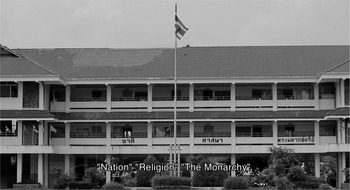
By opposing the transformational potential of art, censorship works to construct and reinforce boundaries within the otherwise fluid practices of culture. Asserting that the film posed ‘a threat to national security and international relations’, the Censorship Board initially placed a nationwide ban on the film. The Ministry of Culture also released a statement that the film complicates ‘some information on incidents that are still being deliberated by the Thai court and that have not yet been officially concluded’.Footnote 79 The logic of their decision can be understood in several dynamics of the opening scene as it relates to the Thai title of the film, Fah Tum, Phaendin Sung (lit. ‘low sky, high land’). The Board worried that the title would imply the association between the political conflict and the institution of the Thai monarchy, which is sometimes referred to as analogous to ‘the sky’. But for film-makers, the challenge is how to record what is already present in front of the camera. The dilemma is manifested in one scene where Nontawat films a border area school that was closed and damaged by the militarisation of the area. In the scene's establishing shot, we observe the preeminence of the Thai textual assemblage which demands subtitles: ‘Nation, Religion, the Monarchy’ (fig. 1).
Establishing shot: ‘Nation, Religion, the Monarchy’, Nontawat Numbenchapol, Boundary, 2013, 55:17; courtesy of the director.

Here, the redundant publicity of authority hides in plain sight and thereby forms a contrast with the blended ambience of an ominous undertone in the opening scene. Whereas this scene is unproblematic for the Board, as mentioned earlier they demanded the removal of an audio clip from the film's first scene, which they perceived as evoking inappropriate associations with a celebration of the monarchy. The restriction reveals the Censorship Board's specific ways of seeing in light of the active citizenship of film-makers who negotiate their aesthetic approaches to expand the possibilities of space. We might see this expansion as a cinematic form of democratisation that operates when actual communities of representation are restrained.
Nontawat did consider a variety of titles to capture the politics of the Boundary, for example, ‘Frontiers of the state’ (Phrom daen haeng rat). He then turned to his mother who mentioned an old Thai song from the 1970s called ‘Fa tam, phaen-din sung’ (low sky, high land). The director found the song to represent a beautiful figuration of the reality of class difference in Thai society as illustrated in terms of wealth and poverty. The song concludes, ‘love is only possible when the sky is low and the land is high’.Footnote 80 In Thailand's divisive political climate, the title appeared as a veiled reference to the monarchy. With this significant breach of cultural codes, the Censorship Board proceeded to list other aesthetic criticisms of the film. For example, they cited the director's use of intertitles as out-of-sync with either narrative continuity or proper representation. The board's determination of what counts as a documentary harkens back to the classical determination of what belongs to a genre in Aristotle's Poetics. This ‘representational regime of art’ polices its own boundaries to judge whether or not a film compromised a required objective distance.Footnote 81
Boundary is thus a significant example of the transformative participation of people in the political process, and example of how political speech and its associated visual, texual, and sonic imagery draws the attention (and ire) of government agencies. Ultimately, Nontawat removed the eerie ambience of the opening scene while international and social media pressure convinced the Censorship Board to reverse the ban. Historically, various authoritarian Thai regimes have caved in to pressure to relax censorship. Consider Thai folk rock band Carabao's famous ‘dissident’ song Pra-cha-thi-pa-thai — a play on pra-cha-thi-pa-tai (democracy) that replaces ‘merit’ with ‘Thai’ — which was banned: Hamilton observed how ‘an unprecedented amount of publicity’ led the government to later reverse its decision.Footnote 82 So, too, has the role of the film-maker become one of balancing between making visible and making noise.
Conclusion
Both Syndromes and a century (2007) and Boundary (2013), illustrate how states and the regulatory apparatus of executive agency in Thailand, such as the Ministry of Culture or the Censorship Board, intervene in representations of the modern nation-state. But official positions of the state are increasingly being challenged by national viewing expectations in a present propelled by global forces. Any single ‘way of seeing’, to return to Berger's structured field of vision, is heavily impacted by political events and everyday divisions. In April of 2015, a little over a year after the May 2014 military coup, a group of university students known as Bangsaen Rama organised a short film programme in their Division of Television and Cinema in the Department of Communications, Burapha University. Their choice to headline the programme with Nontawat's Boundary, two years after the ban had been reversed, caught the attention of military authorities who called on the University to intervene. The military's rationale: ‘The content of some of the films [presents] a danger to national security.’Footnote 83
After the May 2014 coup d’état in Thailand, the political climate again shifted toward a more intensive regulating of the cinematic threads of politics and culture, but frequent experience with film censorship also channels the film community into an expanded space of participation and urgency. On 16 August 2015, the 19th Thai Short Film & Video Festival allotted 90 minutes for a Bangsaen Rama programme, thereby encouraging a confrontational vision of film by providing an open space for cinema. The afterlife of film censorship highlights the futile nature of banning films, since the mystique of being blacklisted propels recirculation. Moreover, expanding cinema to include those denied a space in dominant representations means recognising a measure of equality within the state. This equality is what allows for visual culture to democratise even as regimes repress. There are now countless film-making projects in the Thai periphery that range from Prapat Jiwarangsan's 2015 short film, The Asylum, which meditates on the post-coup closure of a Red Shirt-affiliated radio station, to the Deep South Young Filmmaker project which recently hosted intensive workshops with veteran Thai film-makers (despite the continuing martial law in the region).Footnote 84 This is the legacy of Apichatpong Weerasethakul and Nontawat Numbenchapol, but also of Pimpaka Towira, Pen-ek Ratanaruang, the Free Thai Cinema movement, the dedicated work of the Thai Film Foundation (Film Archive), the Bangsaen Rama group, academics and programmers, exceptional journalists and bloggers, and many others in the Thai film community.
In one sense, censorship is a distraction from the expressive worlds of film that push the limits of imagination while persisting through intermittent aftershocks of regime change. In another sense, film's lasting contribution to the democratic development of any nation-state resides in its imaginative ability to transcend one group's designation of what counts as a legitimate representation of community. The historical precedents assembled here alongside cursory treatments of aesthetic, connective, and global currents in contemporary Thai cinema suggest that change is gradual yet possible. However, in the years since the 2014 coup, the culture of policing has become so dependent upon extra-constitutional articles and the citizen appropriation of Criminal Code laws, that film-makers like Apichatpong now are reluctant to screen their work in Thailand. The restrictiveness of the nation-state may indeed propel a transnational movement outward where media mobilises the connective possibilities of global cinema networks. Meanwhile, the need to circulate national images in the age of globalisation will, potentially, encourage the Censorship Board to pluralise their viewpoints. How they will do that, or whether the existing Film Act's tendency to ban controversial films will dissolve into a more democratic system, remains unclear.