


Introduction
Generating alternative interpretations (GAI) is a pillar of cognitive therapy (Beck, Reference Beck1995). This technique consists of modifying a distorted interpretation of an event by identifying other plausible interpretations. For example, if Bob states, “I know that my landlord is planning to evict me because she did not greet me when she walked past”, a cognitive therapist may encourage Bob to generate other possible interpretations of his landlord's behavior (e.g. she did not see Bob or she was on her cell phone). By increasing the accessibility of competing plausible interpretations, GAI should decrease Bob's certainty that his landlord is planning to evict him. GAI has been adopted widely in cognitive and social cognitive treatments for psychosis because psychosis has been linked with data gathering and reasoning biases that increase the likelihood of patients making maladaptive interpersonal interpretations (i.e. Jumping-to-Conclusions [JTC] and hostile attributional biases; Garety and Freeman, Reference Garety and Freeman1999).
Recent research on metacognitive experiences has revealed that when a person is engaged in GAI, the subjective experience of cognitive ease or difficulty that accompanies GAI influences the technique's effect (Schwarz, Reference Schwarz2005). If the process of generating alternatives is difficult, the exercise may paradoxically increase patients' certainty that their initial, distorted judgment is true. Thus, if Bob found it difficult to think up alternatives (e.g. that his landlord may not have seen him or may have been on the phone) he would interpret this difficulty as evidence, effectively concluding, “It was so difficult for me to imagine other possibilities that she must be planning to evict me.” This effect has particular relevance for psychotic disorders because cognitive deficits may increase the difficulty of GAI to patients and thus increase the likelihood that GAI will further entrench distorted inferences, attributions, and beliefs.
Based on this literature, we developed a modified form of GAI, called Mary/Eddie/Bill (MEB), to enhance social cognition in psychosis. Here, we describe our initial pilot trial of MEB.
Method
Participants
Twenty-four outpatients with psychotic disorders were recruited from an urban community mental health center to participate in this uncontrolled treatment trial.
MEB Intervention
The MEB technique is derived from GAI, but differs in several respects. MEB is focused on generating inferences of others' mental states — also known as Theory of Mind (ToM) inferences. To make this process feel easy, MEB provides patients with a simple heuristic that is easy to recall and easy to use. MEB presents three vivid character prototypes, My-fault Mary, Easy Eddie, and Blaming Bill, which correspond respectively to three orthogonal interpersonal attributional styles: internalizing-personalizing (i.e. self-deprecating), externalizing-personalizing (i.e. hostile attributional bias), and externalizing-situationalizing (i.e. non-blaming). The three characters are described in terms of prototypical thought/emotion/behavior complexes associated with these attributional styles. Thus, My-fault Mary has thoughts like, “This is my fault! I'm so stupid!”, feels guilty, sad, and self-blaming, and exhibits behaviors such as hanging her head and frowning. In contrast, Blaming Bill has thoughts like “This is all your fault!”, feels angry, and exhibits behaviors such as pointing his finger, and scowling. Finally, Easy Eddie has thoughts like, “No problem!” or “Oh well, I guess it's bad luck!”, feels comfortable with other people, and exhibits behaviors like smiling and shrugging. Patients are told that these characters represent three typical ways that people jump to conclusions in social situations, and that the pitfalls of each can be avoided by learning to flexibly see social situations from all three perspectives.
The goal of treatment is to instill the MEB model as an easy and fluid heuristic in the minds of patients, leading to improved ability to generate mental state representations (ToM), to gather data consistent with all three perspectives (preventing attributional bias), and to utilize all three sets of information to generate social judgments (preventing JTC). This is accomplished through repetitive practice with the model, while maximizing positive, fluid experiences associated with rehearsal. Thus MEB groups consist of a lively combination of viewing photographs and television situation comedies, hearing short stories, and discussing one another's social lives. Across these sources of social content, the therapist helps patients to practice associating the actors or story characters with the three prototypical characters in the MEB model. For example, while watching an episode of Seinfeld in group, the therapist would pause the tape and elicit model-specific input. A patient might say, “Jerry is acting like Blaming Bill, but I think Kramer feels like Easy Eddie because of the way he's smiling.” Patients also practice identifying with the three characters and acting out how the characters would respond to specific situations.
In the current pilot study, MEB was delivered in weekly, hour-long groups. Participants were asked to attend six MEB sessions.
Measures
Participants completed a short assessment battery at pre- and post-treatment. The Awareness of Social Inference Task-Abbreviated (TASIT-A; McDonald, Flanagan, Martin and Saunders, Reference McDonald, Flanagan, Martin and Saunders2004) is a video-based measure of ToM that has shown acceptable psychometric properties in previous schizophrenia research (Roberts and Penn, Reference Roberts and Penn2009). The Social Cognition Screening Questionnaire (SCSQ; Roberts, Fiszdon and Tek, 2011) is a new measure of ToM, attributional bias, and social cognitive overconfidence (a proxy for JTC). All three scales have exhibited good convergent validity with established criterion measures of the target domains (Roberts et al., Reference Roberts, Fiszdon and Tek2011). The Relational Interactivity Measure (RIM; Ralph Hoffman, unpublished) is a 5-item self-report measure of the degree of social contact and connectivity experienced in the past week. At post-test participants were also asked to recite the names of the three MEB characters, and to describe each one's typical thoughts, feelings, and actions. Participants were also given the option to complete a feedback questionnaire on MEB.
Results
Of the 24 individuals who consented to participate, 16 were considered “treatment completers” because they attended at least 5 MEB sessions. Completers did not differ from non-completers in demographic or baseline performance on outcome measures. Pre/post paired-samples t-tests were conducted and pre/post effect sizes computed for completers on the outcome measures. Because attributional bias and JTC are only thought to exist within a subset of individuals with psychosis (Garety and Freeman, Reference Garety and Freeman1999), pre/post change in these domains was assessed only within the subgroup of participants whose baseline scores exceeded the normative mean on these scales.
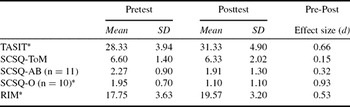
As summarized in Table 1, all measures showed mean changes from pre- to post-treatment in the expected direction except the SCSQ ToM scale. Statistically significant improvements were observed on the TASIT (ToM), the SCSQ Overconfidence scale, and the RIM. Improvement on the Overconfidence scale corresponded with a large effect size, while the other two corresponded with medium effect sizes. Changes on the SCSQ ToM and Attributional Bias scales were not significant. Post-hoc analyses (not reported here) further supported links between MEB participation and observed improvements. At post-test, all completers identified the three MEB characters by name and identified at least one appropriate behavior, thought, or emotion associated with each. Fourteen correctly identified an emotion corresponding with each (e.g. Bill = angry), and 13 correctly identified who each character blames when something bad or confusing happens (e.g. Bill blames others). Fourteen participants elected to complete the feedback questionnaire, of which 9 found MEB content to be “very easy” to understand. All 14 found the group to be either “useful” or “very useful”, with 12 indicating that it “changed the way I think socially” and 12 that it “changed the way I relate to other people”. In free-response items, the use of fictional characters was the most cited positive aspect of the group.
Mary/Eddie/Bill outcomes (n = 16)

Notes: TASIT = The Awareness of Social Inference Test; SCSQ-ToM = Social Cognition Screening Questionnaire – Theory of Mind scale; SCSQ-AB = Social Cognition Screening Questionnaire – Attributional Bias scale; SCSQ-O = Social Cognition Screening Questionnaire – Overconfidence scale; RIM = Relational Interactivity Measure
* TASIT: t = 2.81; p < .05; SCSQ-O: t = 2.66, p < .05; RIM: t = 2.22; p < .05
Discussion
Findings from this pilot trial of MEB provide initial support for its tolerability and potential efficacy. The pattern of ToM (TASIT) results are similar to those found in a recent controlled trial of Social Cognition and Interaction Training (SCIT), the 24-week intervention from which MEB was adapted (Roberts and Penn, Reference Roberts and Penn2009). Both trials yielded ToM improvements of moderate effect size on the TASIT. Further, both failed to find ToM improvements on a verbally-based measure of ToM (here, the SCSQ). These parallel findings suggest several conclusions. First, it is promising that MEB, a much briefer intervention than SCIT, yielded improvements of equal magnitude on the TASIT. It is possible that these positive results are due in part to the fact that both interventions use video stimuli in training and the TASIT is a video-based assessment measure. Second, lack of effect on the verbally-mediated ToM measures may be due in part to the known overlap of such measures with verbal memory in schizophrenia.
The most robust finding in the current study was MEB-related improvement in social cognitive overconfidence, our proxy measure of JTC bias. This finding is consistent with other studies that have found improvements in JTC and Need for Closure in psychosis through social and metacognitive interventions. The small and non-significant improvement observed in attributional bias is, unfortunately, consistent with most previous research in this area (e.g. Roberts and Penn, Reference Roberts and Penn2009). The MEB-related improvements in self-reported social engagement are the most promising finding from the current study but must be interpreted with caution because the RIM is not a validated measure. Feedback and post-test performance data indicate that MEB was experienced as easy by participants. These findings support the theoretical model of MEB, which aims to make the MEB heuristic highly available to consciousness and feel easy to users. Given that the technique was experienced as easy, it is promising that MEB was also seen as engaging by most participants rather than boring or condescending.
This study has several notable limitations. Foremost, it is an uncontrolled, within-group pilot study, and the findings should be interpreted cautiously until they are replicated in controlled research. Additionally, the RIM is a new measure with unknown psychometric properties and the SCSQ is a relatively new measure with unknown reliability properties (Roberts et al., Reference Roberts, Fiszdon and Tek2011). Finally, MEB was delivered in an abbreviated, six-session format, which may be insufficient to confer durable gains. We are currently conducting a study of the tolerability and efficacy of MEB delivered in a more intensive format.
Acknowledgements
This study was supported by a grant to the first author from the Connecticut Mental Health Center Foundation.




Comments
No Comments have been published for this article.