Lactic acid bacteria (LAB) are known for their technological potential, such as acidifying and proteolytic abilities, and in the last decades they are being increasingly explored due to their beneficial features, especially for probiotics (Masood et al., Reference Masood, Qadir, Shirazi and Khan2011). Probiotic bacteria can be defined as “living organisms that benefit consumers health when ingested in appropriate concentrations” (FAO/WHO, 2002). As a consequence, many studies are being conducted to identify and to characterize probiotic bacteria (Scott et al., Reference Scott, Duncan, Louis and Flint2011; Vieco-Saiz et al., Reference Vieco-Saiz, Belguesmia, Raspoet, Auclair, Gancel, Kempf and Drider2019).
Despite their beneficial potential, it is mandatory to evaluate the safety aspects of probiotic bacteria if these strains are intended to be added in ready-to-eat foods. Thus, the food industry must assure their safety status to avoid any risks to consumers (Sanders et al., Reference Sanders, Akkermans, Haller, Hammerman, Heimbach, Hörmannsperger, Huys, Levy, Lutgendorff, Mack, Phothirath, Solano-Aguilar and Vaughan2010). Proper characterization of probiotics regarding their virulence features, including their pathogenic potential and antibiotic resistance, is necessary for conferring them the status of Generally Regarded As Safe (GRAS) (Wassenaar and Klein, Reference Wassenaar and Klein2008; Gueimonde et al., Reference Gueimonde, Sánchez, de los Reyes-Gavilán and Margolles2013).
Fermented milks are common vehicles for probiotic bacteria (Ouwehand and Röytiö, Reference Ouwehand, Röytiö and Holzapfel2015). With this purpose, strains must also be selected based on their ability to survive under the intrinsic characteristics of fermented foods (Colombo et al., Reference Colombo, Todorov, Eller and Nero2018b). Although this is not a usual feature, probiotic strains can also be considered as starter cultures, demanding proper characterization of their technological features, and also their ability to be present at 105–107 colony forming units per gram or ml (CFU/g or ml) in the fermented food during the whole shelf-life (FAO/WHO, 2006; Mohammadi et al., Reference Mohammadi, Sohrabvandi and Mohammad Mortazavian2012).
In previous studies, we characterized a dairy-LAB culture collection regarding their beneficial and safety aspects (Colombo et al., Reference Colombo, Castilho, Todorov and Nero2018a, Reference Colombo, Nero and Todorov2020). Here, we selected the beneficial and non-virulent isolates and characterized their technological properties, in order to choose a strain to be used for the production of a fermented milk.
Material and methods
Bacterial strains and growth conditions
Fifteen LAB isolates were selected based on their beneficial and safety aspects and identified after 16s rRNA sequencing (Colombo et al., Reference Colombo, Castilho, Todorov and Nero2018a, Reference Colombo, Nero and Todorov2020). Genera of the isolates were Lactobacillus (n = 11: L. casei MSI1, MSI5, MRUV1 and MRUV6, L. acidophilus MVA3, L. nagelli MSIV4, L. harbinensis MSI3 and MSIV2, L. fermentum SIVGL1, L. plantarum MLE5 and MSI2), Pediococcus (n = 2: P. pentosaceus MLEV8 and P. acidilactici MSI7) and Weissella (n = 2: W. paramesenteroides MRUV3 and MSAV5). The isolates were stored in de Man, Rogosa and Sharpe (MRS) broth (Oxoid Ltd., Basingstoke, England) added with glycerol at 25% (v/v), and cultured in MRS broth (Oxoid) at 37°C overnight for use.
Acidifying capacity
Aliquots of the selected LAB cultures (1%, v/v) were inoculated in 10 ml of reconstituted skim milk powder (Becton, Dickinson and Company – BD, Franklin Lakes, NJ, USA, 10% w/v) and incubated at 37°C for 24 h. The pH was measured after 6 and 24 h of incubation using pH meter (HI 221, Hanna Instruments, São Paulo, SP, Brazil). The averages of two repetitions were determinate and acidification rate was calculated as ΔpH (ΔpH = pH 0 h – pH 6/24 h), as described by Morandi et al. (Reference Morandi, Brasca and Lodi2011).
Diacetyl production
Aliquots of the selected LAB cultures (1%, v/v) were inoculated in 10 ml of reconstituted skim milk powder (BD, 10% w/v) and incubated at 37°C for 24 h. Then, 1 ml of each cell culture was added 0.5 ml α-naftol (1% w/v) and KOH (16% w/v) and incubated at 37°C for 10 min: diacetyl production was identified by red ring at the top of the tubes (Dal Bello et al., Reference Dal Bello, Cocolin, Zeppa, Field, Cotter and Hill2012).
Exopolysaccharide (EPS)
Aliquots of the selected LAB cultures (1%, v/v) were inoculated in 10 ml of reconstituted skim milk powder (BD, 10% w/v) and incubated at 37°C for 24 h. EPS from lactose was determined qualitatively due to the wire formed (Cogan, Reference Cogan, Cogan and Accolas1996; Dal Bello et al., Reference Dal Bello, Cocolin, Zeppa, Field, Cotter and Hill2012).
Extracellular proteolytic activity
Aliquots of the selected LAB cultures (1%, v/v) were punctually inoculated in agar (2% w/v) supplemented with reconstituted skim-milk powder (BD, 10% w/v) and incubated at 37°C for 4 d. Proteolytic activity was indicated by halos around the colonies and ranked as + (up to 2 mm radius), ++ (2 to 4 mm radius) and +++ (more than 4 mm radius) (Franciosi et al., Reference Franciosi, Settanni, Cavazza and Poznanski2009; Dal Bello et al., Reference Dal Bello, Cocolin, Zeppa, Field, Cotter and Hill2012).
Strain selection and fermented milk production
Based on the results for technological potential, L. casei MRUV6 was selected for the production of a fermented milk. MRS cultures of L. casei MRUV6 were diluted up to tube 3 of McFarland scale (approximately 9.0 × 10⁸ CFU/ml), and used for fermented milk production, according to Tamine and Robinson (Reference Tamine and Robinson2007). One litre of reconstituted skim milk powder (BD, 10% w/v) was heated at 90°C for 5 min, cooled to 37°C, added with 20 ml of L. casei MRUV6 culture and incubated at 37°C up to acidity titration with NaOH 0.8N reach 1.7%. Then, the fermented milk was distributed into sterile plastic flasks (100 ml) and stored at 4°C and 10°C for 35 d. Fermented milk was prepared in three independent replicates.
Monitoring of L. casei MRUV6
Samples of the fermented milks were obtained at 0 h (just after the preparation) and at 7, 14, 21, 28 and 35 d. Samples were ten-fold diluted (NaCl 0.85%, w/v), plated on MRS agar (Oxoid) with added vancomycin (10 mg/l, Sigma-Aldrich, St. Louis, MO, USA) and incubated at 37°C for 48 h (Colombo et al., Reference Colombo, Oliveira, Carvalho and Nero2014). After colony enumeration, counts were presented as log CFU/g, checked for normality (P < 0.05) and compared by analysis of variance (ANOVA) (P < 0.05) using XLSTAT 19.01 (Addinsoft Inc., New York, NY, USA).
L. casei MRUV6 resistance to bile
The same dilutions as selected above were plated on MRS agar (Oxoid) with added bile salts (Sigma-Aldrich, 1.5%, w/v) and incubated at 37°C for 48 h. After colony enumeration, counts were presented as log CFU/g, checked for normality (P < 0.05) and compared by analysis of variance (ANOVA) (P < 0.05) using XLSTAT 19.01 (Addinsoft).
Results and discussion
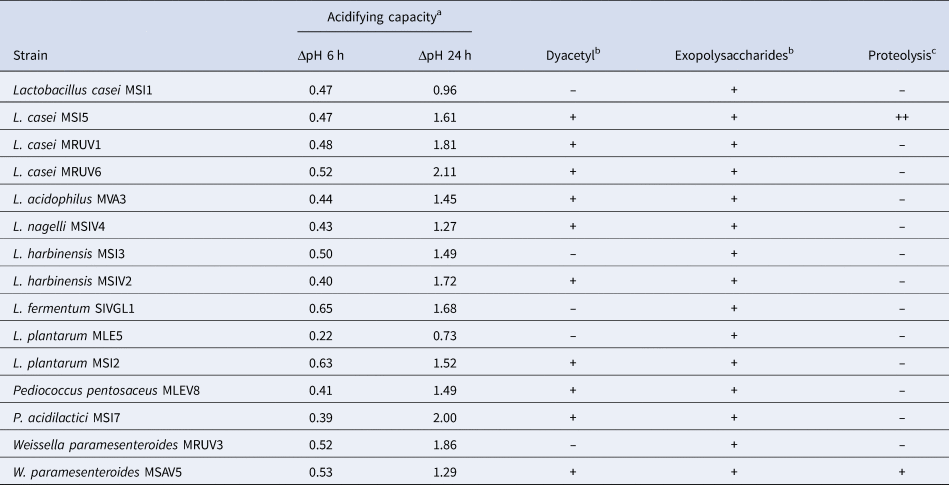
The technological potential of selected LAB is summarized in Table 1. All isolates were able to acidify milk, with ΔpH values varying from 0.73 to 2.11 after incubation for 24 h (Table 1). Although acid production by LAB is strain-dependent, the high acidification capacity is directly related to the fast acidification of the raw material by the production of organic acids, mainly lactic acid (Dal Bello et al., Reference Dal Bello, Cocolin, Zeppa, Field, Cotter and Hill2012; Pingitore et al., Reference Pingitore, Todorov, Sesma and Franco2012). Ten isolates were able to produce diacetyl (Table 1), an important feature for starter cultures since it improves the aromatic and organoleptic characteristics of the fermented dairy products (Clark and Winter, Reference Clark and Winter2015). All isolates were able to produce EPS, showing a promising ability in the improvement of the texture of dairy food products, increasing their viscosity and firmness (Dal Bello et al., Reference Dal Bello, Cocolin, Zeppa, Field, Cotter and Hill2012). Only two strains presented proteolytic activity (L. casei MSI5 and W. paramesenteroides MSAV5, Table 1).
Technological features of 15 lactic acid bacteria strains with beneficial properties and isolated from a dairy production chain (Colombo et al., Reference Colombo, Castilho, Todorov and Nero2018a).

a Mean differences of pH values recorded at 0 h from 6 h and 24 h of incubation at 37°C.
b Positive results indicated by +.
c Proteolysis halo radius: no halo (–), up to 2 mm (+), 2 to 4 mm (++), and higher than 4 mm (+++).
The simultaneous expression of probiotic and technological features by LAB is not usual (Mohammadi et al., Reference Mohammadi, Sohrabvandi and Mohammad Mortazavian2012). However, if a probiotic strain is characterized as being able to produce a technological feature, a fermented food can be developed based on this ability (Delgado et al., Reference Delgado, Leite, Ruas-Madiedo and Mayo2015; Hill et al., Reference Hill, Sugrue, Tobin, Hill, Stanton and Ross2018). Based on its technological features (Table 1), L. casei MRUV6 was selected as a promising candidate as a starter culture for the production of a fermented milk.
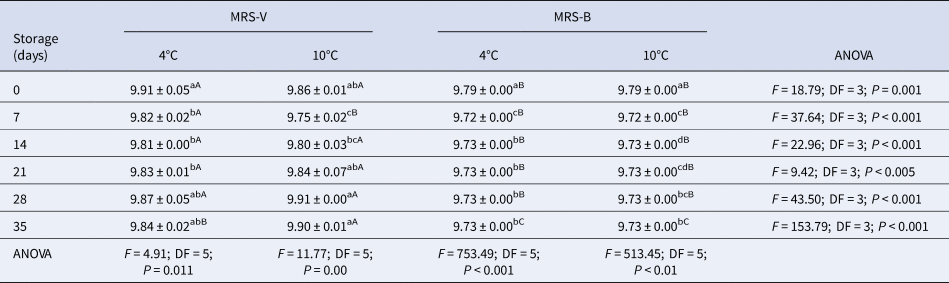
L. casei MRUV6 counts ranged from 9.72 to 9.96 log CFU/g in the produced fermented milk (Table 2). Even though in some situations there were differences between the two temperatures, the populations were always higher than 7 log CFU/g, which is desirable for probiotics in fermented foods (Table 2). The slight decrease in L. casei MRUV6 counts between days 7 and 14 was expected, indicating that they remain stable in the lag phase (Valero et al., Reference Valero, Carrasco, García-Gimeno and Eissa2012). Temperatures below 7°C are usually considered as ideal for controlling the growth of starter and probiotic cultures in fermented milk, avoiding spoilage due to overgrow and assuring their presence at the minimum required for potential benefits to consumers (Tamine and Robinson, Reference Tamine and Robinson2007). However, inappropriate temperatures are relatively common in the retail sale, which can jeopardize the quality of fermented milks and the counts of probiotic bacteria (Ndraha et al., Reference Ndraha, Hsiao, Vlajic, Yang and Lin2018). Even at the adverse condition of 10°C, L. casei MRUV6 counts were around 9 log CFU/g (Table 2). This stability was observed during the 35 d of experiment at both temperatures and that is to be expected from this type of experiment with LAB (Miranda et al., Reference Miranda, Neto, Freitas, Carvalho and Nero2011; Mani-López et al., Reference Mani-López, Palou and López-Malo2014). Despite observing some significant differences among counts from fermented milk stored at 4 and 10°C (Table 2, after 7 and 35 d), L. casei MRUV6 was viable at high concentrations. This result corroborates with that already found by fermented milk with beneficial bacteria (Lima et al., Reference Lima, Kruger, Behrens, Destro, Landgraf and Franco2009; Sarvari et al., Reference Sarvari, Mortazavian and Fazei2014).
Mean counts of L. caseiMRUV6 from fermented milk stored at 4°C and 10°C during 35 d and enumerated by using de Mann, Rogosa and Sharpe agar added with vancomycin (MRS-V) and MRS agar added with bile salts (MRS-B)

Results are expressed as log10 (CFU/g).
* Values followed by distinct letters are significantly different (P < 0.05). Lowercase letters are for comparison between times (columns) and uppercase are for comparison between temperatures and means (lines). F: ANOVA value, DF: degrees of freedom, P: level of significance
The counts obtained in MRS with added bile salts are also presented in Table 2. Based on the data obtained, L. casei MRUV6 was able to survive in a bile environment. Although significantly different in most cases (P < 0.05), the counts were not dissimilar to those obtained in MRS with added vancomycin. On the one hand this suggests some slight difficulty for L. casei MRUV6 to grow in MRS with added bile, but on the other it is positive in that the counts were always higher than 9 log CFU/g (Table 2). L. casei MRUV6 has already been described as able to grow in the presence of bile salts, indicating its ability to survive gastrointestinal conditions (Colombo et al., Reference Colombo, Castilho, Todorov and Nero2018a). Probiotic and intestinal bacteria must be able to deconjugate bile salts and to survive in environment with different concentrations of these salts (Begley et al., Reference Begley, Gahan and Hill2005; Zhang et al., Reference Zhang, Wu, Sun, Sun, Meng and Zhang2009). The bacterial mechanisms of resistance to bile can be considered multifactorial, implying a high variety of processes aimed at detoxification by bile and against the deleterious effect of these salts on bacterial structures (Ruiz et al., Reference Ruiz, Margolles and Sánchez2013).
In conclusion, we have shown the technological potential of LAB isolated from a dairy production environment, allowing the selection of L. casei MRUV6 for the production of a fermented milk, where it may have particular value due to its beneficial and safety properties. L. casei MRUV6 was stable and active during all storage periods of fermented milk.
Acknowledgments
The authors are thankful to Conselho Nacional de Desenvolvimento Científico e Tecnológico (CNPq, Brasília, DF, Brazil), Fundação de Amparo à Pesquisa do Estado de Minas Gerais (FAPEMIG, Belo Horizonte, MG, Brazil), and Coordenação de Aperfeiçoamento de Pessoal de Nível Superior (CAPES, Brasília, DF, Brazil, Financial code 001).