Introduction
The use of contraceptive methods has become an essential factor in the life of most women, although it varies at different points of their life course. For instance, the types of methods used in the early years of marriage are different from those applied in subsequent years, when desired family size has been achieved. Contraceptive methods can be divided into temporary and permanent methods (see Fathizadeh, Reference Fathizadeh, Tashi, Abedi and Kazemi2006). Temporary methods, which are more suited to couples who wish to postpone childbearing, include modern and traditional methods. The former comprise methods such as pills, injection, Norplant, IUD (intrauterine device) and obstructive methods (mechanical and chemical methods). The latter includes withdrawal, breast-feeding and the rhythm method. Although these methods are all categorized as temporary, the effects of some (i.e. the IUD and Norplant) persist for quite a long time. These methods are called long-acting methods. Permanent methods are suitable for couples who wish to stop childbearing and include vasectomy (male TL) and tubal ligation (female TL).
In order to promote women's reproductive health and prevent unwanted pregnancies, the use of effective contraceptive methods is necessary. Reports (WHO, 2012, p. 22) show that globally 287,000 maternal deaths accrued in 2010. Estimates show that in 2008, 13% of maternal deaths were due to unsafe abortions (WHO, 2010, p. 27). The number of such deaths can be reduced by providing sexual and reproductive rights and appropriate contraceptive methods. Despite increasing efforts to provide easy access to contraception, annually 400–500 thousand unintended pregnancies occur in Iran, 75% of which are caused by failure to use contraceptive methods (Hassanzadeh, Reference Hassanzadeh2008). It is important to note that the demand for contraception is likely to increase in the near future due to a rise in the number of women of reproductive age (15–49) and in those desiring smaller families (International Planned Parenthood Federation, 2010). According to projections (Alkema et al., Reference Alkema, Kantorova, Menozzi and Biddlecom2012, p. 1650) the total demand for contraception is projected to grow worldwide from 900 million married women of reproductive age (MWRA) in 2010 to 962 million in 2015, in view of projected trends in demand and the number of MWRA. The large part of this increase will be experienced in developing nations, so that the absolute number of MWRA with a demand for contraception is projected to increase significantly in 98 of 152 developing countries.
The use of long-acting and permanent contraceptive methods (LAPCMs) is the best way to protect women and couples against unwanted pregnancies. According to Haile (Reference Haile2009), these methods are more affordable than other contraceptive methods (in terms of time and economic costs) and women are more comfortable using them. However, the number of women using LAPCMs is different from the number of women who desire to use them. There are very few studies in the literature that show how common these methods are (Mizanur et al., Reference Mizanur, Tilahun, Mengistu and Jennifer2007). Most women with no desire to have another child use low-impact methods (Haile, Reference Haile2009). This shows a discrepancy between women's fertility desires and the use of appropriate contraceptive methods because LAPCMs are the best option for these women. These methods can also be very good alternatives to low-impact methods (e.g. pills); in most developing countries, 20–30% of women stop using pills within 2 years due to complications and side-effects (US Agency for International Development, 2007).
Women's demand for LAPCMs is also one of the main determinants of total fertility rate (TFR) and reproductive health issues. Increased demand for these methods will result in the continuation of fertility decline in the future. However, if this demand is not met, the number of unwanted pregnancies and abortions is likely to rise. Therefore, studies on women's fertility behaviour and intentions, and their demand for contraceptive methods, are essential.
Iran is a multi-ethnic society. In terms of ethnic diversity, it takes second place in the Middle East and North Africa and 28th in the world (Alesina et al., Reference Alesina, Develeeschauwer, Easterly, Sergio and Romain2003, p. 184–192). The majority Persians constitute 46.2% of the population, and other groups (Kurds, Turks, Lurs, Baluchis, Arabs, Turkmen, etc.) comprise the rest of the population. Kurds constitute around 10% of the population and are the third largest ethnic group in Iran (Zanjani, Reference Zanjani, Mirzaei, Mehryar and Shadpoor1999, p. 53). McDonald (Reference McDonald2002) considered ethnic groups as one the appropriate contexts to study demographic trends. Abbasi-Shavazi et al. (Reference Abbasi-Shavazi, McDonald and Hosseini-Chavoshi2009) showed that although contraceptive use has become quite widespread in Iran, there are ethnic differences in the use of these methods. For instance, in the province of West Azerbaijan, contraceptive use is more prevalent among Kurdish than Turkish women (Hosseini & Abbasi-Shavazi, Reference Hosseini and Abbasi-Shavazi2010).
The city of Mahabad is the third most important Kurdish city in Iran and the second most important city in the province of West Azerbaijan in terms of economic, social, political and cultural attributes. Hosseini et al. (Reference Hosseini, Amir, Soleiman and Belal2012) showed that the unmet need for contraception is 10.8% in Mahabad. This high rate of unmet need challenges the quality of family planning services in this city. Although the demographic study of Iranian ethnic groups has grown in recent years, information about the demand for, and use of, contraceptive methods in Kurdish areas in general, and in the city of Mahabad in particular, is still limited. This paper tries to fill this gap in the demographic literature in Iran. The main objective of the paper is to assess the demand for LAPCMs and its determinants among married women aged 15–49 in the city of Mahabad. The paper considers the IUD, Norplant, injection and male and female sterilization as LAPCMs.
Theoretical background
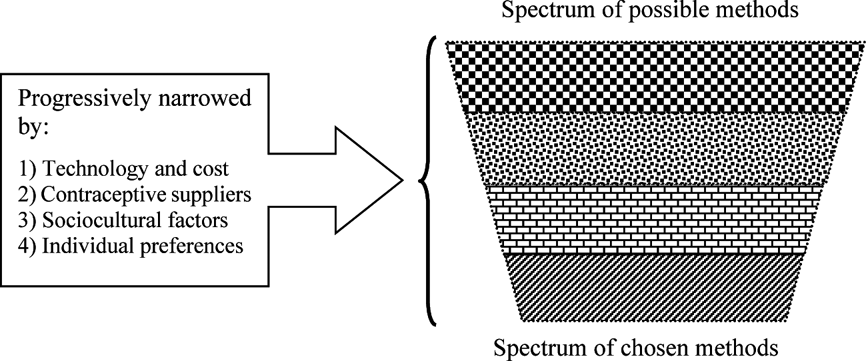
A common approach to evaluating the use of contraceptive methods is to identify their advantages and disadvantages. Freedman & Berelson (Reference Freedman and Berelson1976) believed that a contraceptive method should be safe, effective and reversible. These three characteristics are considered as intrinsic properties of a contraceptive method. In addition, a method should be socially acceptable, user friendly, free of side-effects, consistent with cultural traditions and religious teachings, free of negative effects on sexual function, easily permissible from a medical point of view, free of physiological consequences when it is no longer being used, economically suitable for individuals and society and, finally, freely selected. Choosing a contraceptive method is affected by personal choice as well as its availability and cost. The selection process can be pictured as a funnel (Fig. 1), with a wide range of possible methods at the top which is gradually restricted to a single choice by cultural, economic, technical and psychological factors.
The selection process for contraceptive method choice.

Technological developments not only expand the range of contraceptive methods, but also make some of them obsolete. Economic costs affect the decision about mass production of a particular method. Previous studies (Bhushan, Reference Bhushan1997; Bradley et al., Reference Bradley, Schwandt and Khan2009; Hosseini et al., Reference Hosseini, Amir, Soleiman and Belal2012) have shown that economic costs have a significant, but small, effect on the use of contraceptive methods. Moreover, factors such as the price and the opportunity cost of going to the family planning clinics are not important determinants of contraceptive use. The reason is that the economic costs of family planning constitute a limited share of the total household economic costs, and that is why price has so small an effect on the demand for, and the use of, contraceptive methods (Bhushan, Reference Bhushan1997). Some methods have persistent and higher costs, while others (e.g. IUD) may have an initial high cost. Furthermore, the non-financial costs of different methods are different. For instance, in many societies, the social costs of permanent methods such as sterilization are higher than temporary methods (Bhushan, Reference Bhushan1997). Because the provision of contraception in Iran is free of charge, or very cheap, the financial effects are negligible.
In addition, contraceptive suppliers determine which methods are technically useable and accessible in the society. Suppliers form a hierarchy and may be considered as a small funnel within the main funnel. Family planning policies at the national and regional levels are another factor affecting service provision in the public and private sectors. For example, in the Burma constitution sterilization is not permitted, and abortion is illegal in many countries such as Iran for religious reasons (Davidson, Reference Davidson, Bulatao, Palmore and Ward1989).
A broad range of methods are available in many developing countries. However, the quality of services is still low in some countries and others are facing supply constraints (Bulatao et al., Reference Bulatao, Bulatao, Palmore and Ward1989). These policy and resource limitations affect the choice of contraceptive methods. Sociocultural factors such as religion, social status, social norms and propaganda also determine the choice of method among those who are regarded as final consumers. Factors such as education and income are also known to be determinants of method choice (ibid). The ultimate filter is the individual's preferences, which determine the childbearing decision and the effective method to fulfil this decision.
The impact of the costs of contraception depends on the characteristics of the couple and the community. In general, two sets of social and individual factors affect the ultimate behaviour. The individual factors include the positive or negative evaluation of a person from his/her own behaviour, while social factors are influenced by the attitude of ‘important others’ on a person's behaviour (Mihret, Reference Mihret2008). As a result, the evaluation of the costs involved in contraceptive use can be different. Previous studies (Bongaart & Bruce, Reference Bongaarts and Bruce1995; Bayer, Reference Bayer2002; Mihret, Reference Mihret2008; Hosseini et al., Reference Hosseini, Amir, Soleiman and Belal2012) have shown that many women do not use contraception because of their husband's or other relatives' disagreement. In families who are still devoted to traditional customs and in which husbands rarely discuss reproductive matters with their wives, husbands are the major fertility decision-makers. In fact, the husband's decision influences all reproductive matters, including the decision to use contraception, the type of method used and the duration of use (Belachew, Reference Belachew2007). Hosseini (Reference Hosseini2012, p. 116) discussed that if the couple disagree about their ideal family size, the husband's views usually win. The role of family system – nuclear or extended – is another factor influencing a couple's attitude towards the number of children. In traditional communities and extended families, the mother-in-law has an important role in the use of contraception, number of children and their birth intervals.
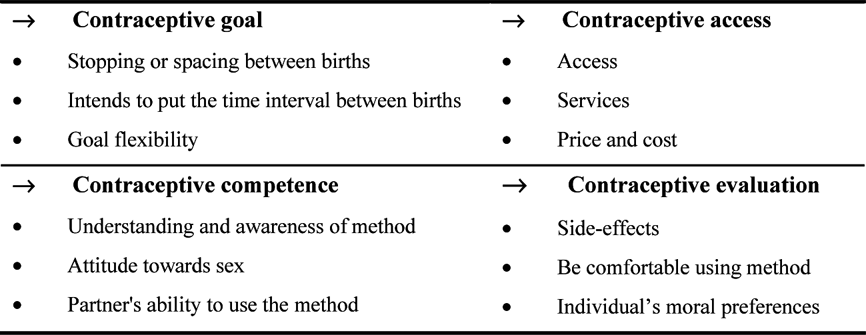
At the individual level, Bulatao (Reference Bulatao, Bulatao, Palmore and Ward1989) argued that contraceptive method choice is affected by four types of factors: contraceptive goals, competence, evaluation and access (Fig. 2). Regarding the contraceptive goals, the main distinction is the difference between stopping and postponement of childbearing, although other aspects such as the duration of postponement are also important. Contraceptive competence is the ability to use a particular method effectively. For example, traditional methods such as withdrawal largely rely on skills and experience, and need information, understanding, caring and more co-operation from the partner. In Tunisia, a Muslim country, wealthy women and those married to highly educated husbands are more likely to use traditional methods. It can be assumed that women with higher education and socioeconomic status probably have more knowledge about the side-effects of modern contraceptive methods. Better co-operation between wife and husband can be another reason (Erfani, Reference Erfani2012).
Factors influencing the choice of contraceptive methods.
Contraceptive evaluation includes judgments about the practical and ethical implications of using a particular method. In principle, the concept of evaluation can be used to cover all relevant aspects of a method, for example its effects on health or sexual satisfaction. Contraceptive access is the last factor influencing the choice of a method. Method availability is essential and varies under different conditions (Bhushan, Reference Bhushan1997). Promoting a method through the media, face-to-face communication, health personnel and physicians can significantly expand the method selection.
There are other factors influencing the choice of contraceptive methods. The survival status of children is one of these factors. Parents who have experienced child mortality are less likely to use permanent methods compared with parents with surviving children (Dalton et al., Reference Dalton, McCord and Sachs2007). Palloni and Rafalimana argued that reduction in child mortality, at least at the early months after birth, has an important impact on contraceptive use. If parents are not sure about the survival of their children, they will try to reach their ideal family size by giving birth to more children than they actually desire. This tendency can, in turn, reduce the use of contraception (Belachew, Reference Belachew2007). Women's age is also important: older women usually use LAPCMs, reflecting their intention to stop childbearing (Robey, Reference Robey, Rutsein and Morris1992).
Data and Methods
This study is based on a survey conducted in April 2012 in the city of Mahabad in the province of West Azerbaijan in north-west Iran, to study the determinants of unmet need for contraception among Kurdish women. Data were collected through structured questionnaires. The statistical population and unit of analysis were ordinary households and married women aged 15–49, respectively. The results of the 2006 Population and Housing Census of Mahabad were used to determine the sample size of 700 eligible women.
The sampling method was a combination of multi-stage cluster sampling, random sampling and systematic random sampling methods. First, using a map of Mahabad, the city was divided into 1273 blocks. Then, according to the authors' observation and general knowledge, the whole area was categorized into areas of high, medium and low socioeconomic status (SES). Finally, the blocks were selected based on the size of each cluster. As a result, the medium-SES cluster, which included 65% of the population, comprised 65% of the sample too. The high- and low-SES areas made up 16% and 19% of the sample, respectively.
Because the main purpose of this study was to evaluate the demand for LAPCMs and its determinants, the analysis focused on women who were using contraceptive methods at the time of survey. The independent variables were divided into two categories:
(1) Socioeconomic variables: women's literacy, level of education, rural–urban origin, employment status and age at marriage.
(2) Demographic variables: children ever born, ideal number of children, childbearing intentions and contraceptive costs.
The contraceptive costs variable is an index derived from the total scores of contraceptive awareness, contraceptive availability and individual and social costs of contraception. In order to examine the respondents' knowledge about each contraceptive method, first the respondents were asked to name the methods they knew or used. If the respondent did not know some methods, then the methods were named by the interviewer to see if the respondent had any knowledge about them. Finally, if the respondent did not know these methods, they were explained to examine the knowledge of the respondent about these methods. Thus, those respondents who named the methods in the first place were regarded to have the highest contraceptive knowledge. The dependent variable was the demand for LAPCMs including IUD, injection, Norplant, tubal ligation and vasectomy. This variable was measured as a dichotomous variable (demand for contraception, no demand for contraception). In order to determine the effect of each independent variable, the logistic regression technique was used.
Results
Socioeconomic and demographic characteristics of respondents
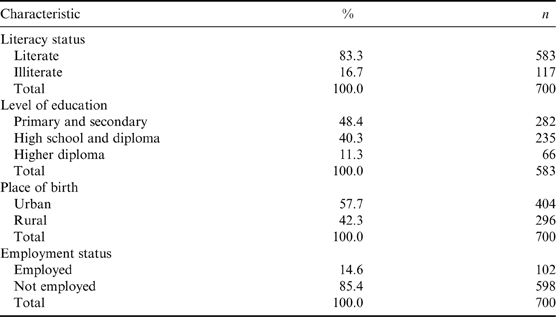
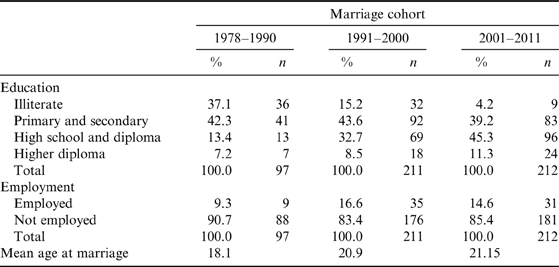
The total sample comprised 700 married women aged 15–49. The mean age of women at the time of the study and their mean age at marriage were 32.4 and 20.4 years, respectively. There was a rise in the age at marriage of successive marriage cohorts: from 18.1 years in the 1978–1990 cohort to 20.8 years in the 1991–2000 cohort and 21.15 years in the 2001–2001 cohort. The mean age at marriage of the sample population, and especially the last marriage cohort (2001–2011), suggests that girls in Mahabad marry at younger ages compared with the national level (the mean age at marriage of women in Iran is 23.3 years). Table 1 shows the distribution of respondents according their socioeconomic characteristics. This shows that literacy is quite common in the sample: only 16.7% of the respondents were illiterate.
Socioeconomic characteristics of respondents, Kurdish women in Mahabad, Iran, 2012 (N=700)
Table 2 shows that female literacy has improved over time: the percentage of illiterate people reduced from 37.1% in the 1978–1990 marriage cohort to 4.2% in the last marriage cohort (2001–2011). In general according to the information in Table 2, 48.7% of literate women had primary or secondary school education, 40.2% had high school education and diploma and 11.1% had a higher degree. There is also an improvement in educational attainment. The percentage of married women with higher education increased from 7.2% in the 1978–1990 marriage cohort to 11.3% in the 2001–2011 marriage cohort. The study also shows that 42.3% of respondents have a rural origin and 14.6% of them were employed at the time of survey. Moreover, the proportion of employed women has increased over time: the percentage of employed women was higher in the last marriage cohort (2001–2011) compared with the first cohort (1978–1990) (16.4% versus 9.3%, respectively).
Socioeconomic and demographic characteristics of respondents by marriage cohort
Knowledge of contraception methods
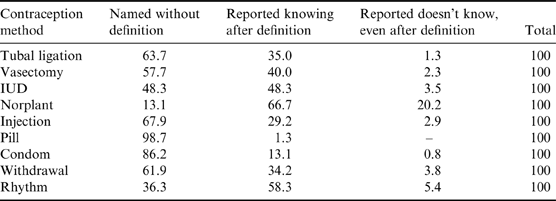
The lack of knowledge of contraceptive methods and their efficient use, accessibility and even side-effects, are all important factors in determining the use of contraceptive methods. Studies in thirteen countries have shown that lack of awareness is one of the main reasons for not using contraceptive methods (Bongaarts & Bruce Reference Bongaarts and Bruce1995). Those who lack this awareness are also more likely to fear side-effects (Mihret, Reference Mihret2008). Table 3 shows the distribution of women according to their knowledge of contraceptive methods. In general, respondents' awareness of contraceptive methods is high. Knowledge about pills is the highest: 98.7% of respondents named it without being given any definition. The condom and injection came next: 86.2% and 67.9% of women, respectively, named these. The lowest level of knowledge was about Norplant: 20.2% of respondents, even after being given a definition, expressed a lack of knowledge.
Percentage distribution of respondents based on knowledge of contraception methods
Prevalence of contraceptive methods
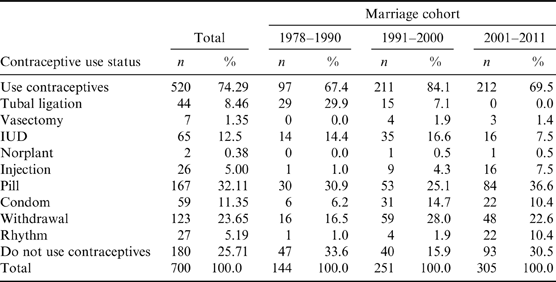
The results show that 74.3% of respondents were using contraceptive methods and that among them 71.2% and 28.8% were using modern and traditional contraceptive methods respectively. An analysis of contraceptive use among successive marriage cohorts (Table 4) suggests that the use of modern contraception is lower among women belonging to the more recent marriage cohorts. This could be due to a greater awareness of young women about the side-effects of modern contraceptive methods, as women's knowledge of contraceptive methods (and possibly their side-effects) is inversely related to their age.
Prevalence of contraceptive use by method and marriage cohort
Calculation of demand for, and use of, LAPCMs
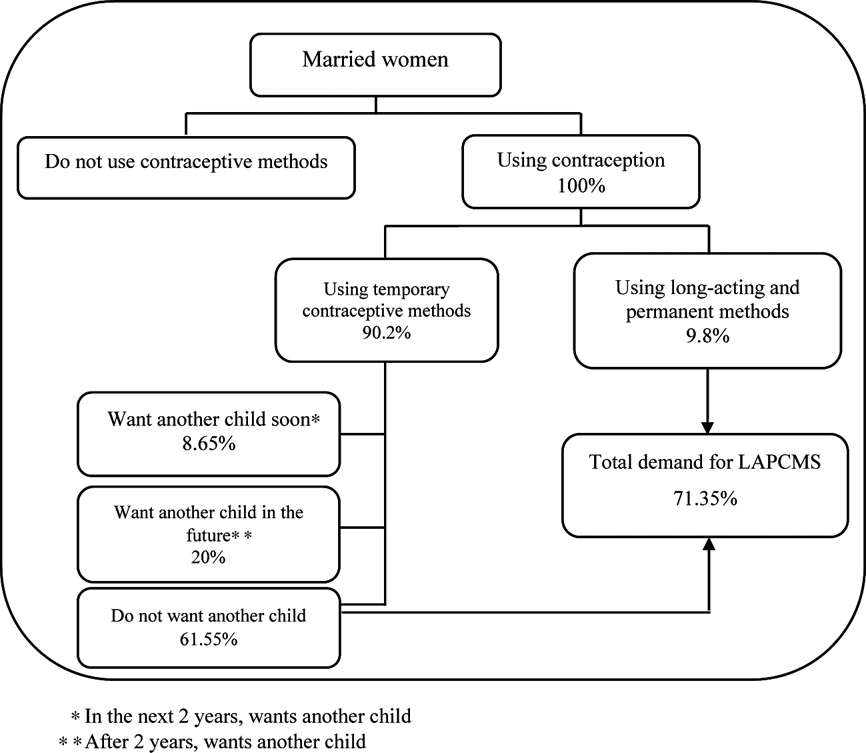
It was found that 27.7% of respondents were using LAPCMs at the time of survey. Figure 3 shows the process for calculating the demand for these methods in the study sample. First, the percentage of women using permanent contraceptive methods was added to the percentage of women using temporary methods but who did not want to have another child. The results show that 9.8% and 90.2% of respondents use permanent and temporary contraceptive methods, respectively. Among those who use temporary methods, 8.6% said that they wanted to have another child in the next 2 years, and 20% wanted to have another child in more than 2 years.
Method for calculating demand for the use of permanent and long-acting contraceptive methods.
Thus, the percentage of women who use temporary methods and do not want to have another child is equal to 61.5%. If this percentage is added to the percentage of women who use permanent methods (9.8%), the total demand for LAPCMs will be 71.35%. Accordingly, the difference between the usage and demand for LAPCMs is equal to 43.65 percentage points. Although these women do not want to have another child, they use temporary methods.
Undoubtedly, this negligence will result in unmet need for family planning, unwanted pregnancies and abortion. A marriage cohort analysis showed a significant relationship between age and demand for LAPCMs (results not shown here). The demand for LAPCMs decreased considerably from 98.1% in the 1978–1990 marriage cohort to 46.3% in the last marriage cohort (2001–2011). Thus, it can be said that older women, and those who are in the final years of reproductive life, have more demand for LAPCMs.
Multivariate analysis
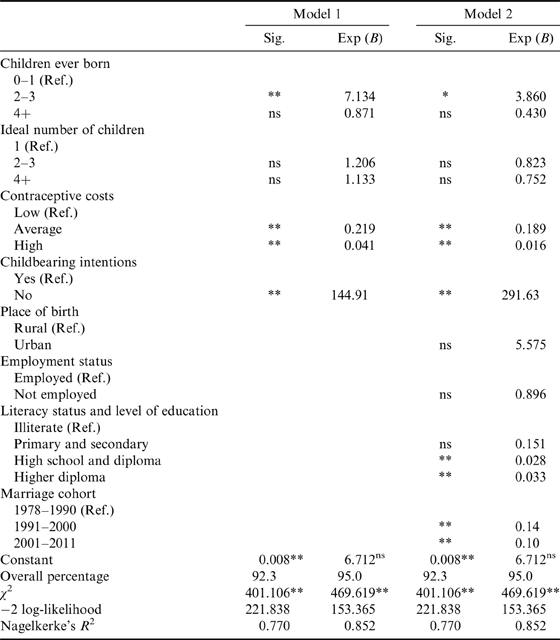
Table 5 shows changes in the probability of demand for LAPCMs by each independent variable. In order to evaluate the impact of demographic variables on the dependent variable, contraceptive costs, ideal number of children, number of children ever born and childbearing desires were included in Model 1. In Model 2, variables of place of birth, employment status, literacy, level of education and marriage cohort were also included. This model specification allows a simultaneous examination of the effect of demographic variables and socioeconomic characteristics.
Prediction of the likely demand for long-acting and permanent methods of contraception using logistic regression
Demand for LAPCMs=1; no demand for LAPCMs=0. Ref.=reference category.
*p<0.05; **p<0.01; ns=not significant.
In Model 1, none of the categories of the variable of ideal number of children was statistically significant. In other words, belonging to none of these categories changes the probability of demand for LAPCMs. The results also show that women with two to three children ever born have a greater demand than childless women or those with only one child. Moreover, the demand for LAPCMs reduces by increases in contraceptive cost and the lack of desire for more children. In Model 2, the impact of both demographic and socioeconomic variables was investigated. Here, the relationship between the ideal numbers of children and the dependent variable was still insignificant.
The significant effect of the number of children ever born was also reduced. The odds ratio values show that the possibility of having the demand for LAPCMs among women who have had two or three live births was more than three times (3.86) bigger than for those who had one or no live birth. Moreover, controlling for the socioeconomic variables does not make any changes in the significance level of contraceptive costs and childbearing desires. Among women who have moderate or high perceptions about contraceptive costs, the probability of demand is, respectively, 82% and 98% lower than for those who have low perceptions about contraceptive costs.
In terms of socioeconomic characteristics, employment status and place of birth do not change the demand for LAPCMs. Belonging to the 1991–2000 and 2001–2011 marriage cohorts reduces the demand by 86% and 90%, respectively, when they are compared with the 1978–1990 marriage cohort. The probability of demand is also higher among women with higher levels of education (high school and diploma).
Based on the multivariate analysis, the costs of contraception, childbearing desires and the number of children ever born have significant influences on the demand for LAPCMs. The impact of contraceptive costs confirms the claim that perceived contraceptive costs has a determinant role in the use and choice of contraception. The significant impact of childbearing desires confirms the arguments of Bulatao (Reference Bulatao, Bulatao, Palmore and Ward1989) about the factors affecting contraceptive method choice. Also, the likelihood of increased demand for LAPCMs among women in the 1978–1990 marriage cohort could reflect the intentions and interests of older women to stop childbearing at the end of reproductive ages. In summary, the probability of demand for LAPCMs is more among women who have given birth to two to three children, have little perception of the cost of contraception, do not want to have another child in the future, have higher levels of education and, finally, are at the end of their reproductive period (the 1978–1990 marriage cohort).
Discussion and Conclusion
This study shows that women's knowledge of contraceptive methods is generally at a high level in Mahabad city, Iran. Moreover, although 27.7% of women were using LAPCMs at the time of survey, the demand for these methods (71.35%) is much higher. This shows a high unmet demand for LAPCMs and a considerable risk of unwanted pregnancies and abortion. The multivariate analysis suggests that the costs of contraception, number of children ever born and childbearing desires have important effects on the demand for LAPCMs. In fact, this demand is higher among women who have less perception of the costs of contraception, more children ever born, higher levels of education, no desire for childbearing and who belong to the 1978–1990 marriage cohort.
These results confirm the ideas of Bulatao (Reference Bulatao, Bulatao, Palmore and Ward1989) and Bhushan (Reference Bhushan1997) that perceived costs, goal, assessment, knowledge and contraceptive access are important determinants of the choice and the use of contraceptive methods. Based on these findings, it can be concluded that although the use of contraception and family planning services has been increasing in recent decades, improvement in the quality of these services is still necessary to achieve better maternal health, especially among women of reproductive age. Awareness of the type of desired contraceptive methods, especially in societies like that of Mahabad where the desire for smaller families is rising, reduces the incidence of unwanted pregnancies and abortions, and improves women's sexual and reproductive health.
Although controlling population growth is an important goal per se, it is not the only goal of family planning programmes in Iran. Issues such as prevention of unwanted pregnancies, maternal and child health, readiness for childbearing and sexual health are important factors for producing a healthy population. The results of this study support the argument for continuation of the family planning programme in Mahabad with the aim of providing maternal and child health, and the realization of sexual and reproductive health goals. Thus, despite the declining population growth rate in Mahabad, the continued provision of reproductive health services is necessary, and policymakers should seek other ways to prevent a further decline in the country's annual population growth rate.
Acknowledgments
An earlier version of this paper was presented at the Session ‘Demand for Long Acting Family Planning Methods' of the XXVII IUSSP International Population Conference, 26–31th August 2013, Busan, South Korea. Valuable comments from Ann Biddlecom are gratefully acknowledged.