1. Introduction
Since English articles are often produced in a phonologically reduced form, investigating the processing of the and a(n) is a complicated enterprise. English articles are also semantically complex in that, in addition to definiteness, number (a car vs. cars) and countability (a chair vs. furniture) constraints should be factored in to use articles correctly. Many L2 studies documented L2 English article use regarding a wide range from singular count nouns to generic and customary uses (Butler, Reference Butler2002; Huebner, Reference Huebner1983; Master, Reference Master1987, Reference Master1997, among others), but such comprehensive documentation has made it challenging to identify the source of non-target-like behavior in L2 English article use.
Systematic investigations with a narrower focus on singular count nouns have been conducted by Ionin and colleagues (Ionin, Ko, & Wexler, Reference Ionin, Ko and Wexler2004; Ionin, Zubizarreta, & Maldonado, Reference Ionin, Zubizarreta and Maldonado2008; Ionin, Zubizarreta, & Philippov, Reference Ionin, Zubizarreta and Philippov2009; Ko, Ionin, & Wexler, Reference Ko, Ionin and Wexler2010), who put forward the Fluctuation Hypothesis, inspiring several subsequent studies in the tradition of semantic universals (Snape, Reference Snape, Snape, Leung and Sharwood Smith2009; Snape, Leung, & Ting, Reference Snape, Leung, Ting, O'Brien, Shea and Archibald2006). These studies mainly used offline methods that could not probe real-time sentence processing (cf. Ionin, Choi, & Liu, Reference Ionin, Choi and Liu2021), and their stimuli differed systematically between conditions, which could have provided participants with metalinguistic cues (see Ahn, Reference Ahn2021 for a detailed review of this issue). Trenkic, Mirkovic, and Altmann (Reference Trenkic, Mirkovic and Altmann2014) was one of a few studies designed to investigate the real-time processing of definiteness in L2, but their study design had definiteness conflated with real-world knowledge, which we will review more thoroughly in the next section.
Recently, many researchers have focused on making predictions or generating expectations in L2 sentence processing (Grüter, Rohde, & Schafer, Reference Grüter, Rohde and Schafer2017) and reported different results regarding the ability to use ‘articles’ in predictive L2 processing (Dussias, Valdés Kroff, Guzzardo Tamargo, & Gerfen, Reference Dussias, Valdés Kroff, Guzzardo Tamargo and Gerfen2013; Henry, Jackson, & Hopp, Reference Henry, Jackson and Hopp2020; Hopp, Reference Hopp2015; Hopp & Lemmerth, Reference Hopp and Lemmerth2018). These studies on L2 article processing focused on gender and case in Spanish and German articles rather than definiteness in English articles; however, their findings diverged depending on the involvement of another source of information than articles. This observation necessitates that one conduct a study in which L2 speakers are tested only on articles in the absence of any other information that can conflate the grammatical feature at issue.
It is challenging to isolate the effect of definiteness from other factors that can influence L2 processing. L2 processing has been reported to be susceptible to different information types (Clahsen & Felser, Reference Clahsen and Felser2006, Reference Clahsen and Felser2018; Cunnings, Reference Cunnings2017; Sorace, Reference Sorace2011; Sorace & Filliaci, Reference Sorace and Filliaci2006), non-linguistic information can play a role alongside linguistic information (Ahn, Reference Ahn2022), and metalinguistic knowledge could play a role when offline methods are used (Ionin et al., Reference Ionin, Ko and Wexler2004; Ko et al., Reference Ko, Ionin and Wexler2010). In this study, we present a carefully designed study to minimize the interference of real-world knowledge and the use of metalinguistic knowledge. Investigating the real-time processing of definiteness using eye-tracking in the visual world paradigm can shed light on such issues from previous findings. The method can be used to observe participants’ eye-gaze movements time-locked to auditory stimuli (Conklin & Pellicer-Sanchez, Reference Conklin and Pellicer-Sanchez2016; Dussias, Reference Dussias2010; Roberts & Siyanova-Chanturia, Reference Roberts and Siyanova-Chanturia2013). Using a method that probes online processing can help prevent the potential problem of participants’ relying on metalinguistic knowledge. The present study was also designed to separate definiteness from other factors such as real-world knowledge. We designed auditory and visual stimuli such that real-world knowledge could not interfere with definiteness processing. Below we report how definite articles can play a role in predictive sentence processing by L1-Korean L2-English speakers.
2. Background and motivation
2.1. Definiteness in L1 research
Results and implications from previous studies on the processing of English articles by native speakers vary greatly. Much of the variability in the results arises from testing different aspects of the construct ‘definiteness.’ Definiteness has been studied and defined in many different frameworks involving constructs such as unique identifiability (Hawkins, Reference Hawkins1991; Russell, Reference Russell1905), givenness (Heim, Reference Heim1982), the old vs. new distinction (Prince, Reference Prince, Mann and Thompson1992), the givenness hierarchy (Gundel, Hedberg, & Zacharski, Reference Gundel, Hedberg and Zacharski1993), and the accessibility hierarchy (Ariel, Reference Ariel1991) among others. Discussing which is the optimal way of defining definiteness is beyond the scope of this study. However, distinguishing definite NPs from indefinite NPs via previously mentioned and unmentioned entities can cause difficulty in result interpretation. When definiteness is operationalized by the distinction of discourse-old vs. discourse-new (Prince, Reference Prince, Mann and Thompson1992), a previously mentioned referent is referred to by a definite NP (discourse-old), and a referent newly introduced into the discourse is referred to by an indefinite NP (discourse-new). When definiteness is operationalized in terms of unique identifiability, on the other hand, a referent identified to be unique by interlocutors is marked definite. If mutual knowledge of the unique identifiability of an entity cannot be established, the entity is accompanied by an indefinite NP regardless of whether the entity has been previously mentioned in the discourse. The two definitions make an essential difference in carrying out a controlled study. The givenness-based research design will result in the repetition of an NP and lack thereof in definite and indefinite conditions, respectively, which could provide participants with a metalinguistic clue in distinguishing when to use which article.
The sentences in (1) are German experimental stimuli used in an ERP study (Schumacher, Reference Schumacher, Devi, Branco and Mitkov2009). As one can see, the flow from the contextual sentences to the critical sentence sounds natural only when the given or inferred contextual sentence leads to the definite critical sentence, as in (1a) and (1b), respectively.

The experiment results showed that a significantly smaller late positivity was observed in the 550–700ms time window only in the definite-given combination, which means that participants perceived only the definite given condition (1a) as natural. In this experimental setting, however, it is hard to tease apart the effect of the givenness of a discourse entity and the effect of the repetition of an NP. For the two effects to be separated, experiments should be set up so that definite and indefinite NPs can be grammatical and ungrammatical in all contexts. In this experiment, the combination of the contextual and critical sentences does not allow such counterbalancing, making it difficult to conclude that the effect of givenness induced the late positivity.
Murphy (Reference Murphy1984) distinguished the effect of givenness from that of repetition. Using sentences as in (2), he showed that a definite NP is processed faster than an indefinite NP in an experimental setting where both definite and indefinite NPs can be grammatical, representing given and new conditions, respectively. In this case, the critical noun truck in (2b) is repeated after a truck in the context sentence (2a) in both definite and indefinite conditions; therefore, the effect of givenness is separated from the effect of repetition.
-
(2)
a. Though driving 55, Steve was passed by a truck.
b. Later, George was passed by the/a truck, too.
However, the effect of (un)grammaticality could not be tested because the materials did not include ungrammatical counterparts of the definite and indefinite conditions. Also, the experiment measured the reading time of the entire sentence rather than the time it took to read the critical NPs. Thus, the resulting reading times might not necessarily reflect the processing loads of definite and indefinite NPs.
Unlike Murphy (Reference Murphy1984), where the definite and indefinite conditions were equalized by having both conditions repeat the NPs, Clifton (Reference Clifton2013) removed the potential confounding of givenness and NP repetition by manipulating both definite and indefinite NPs to be first mentions. To show that the processing of definite and indefinite NPs can rely on the presupposition made regarding the unique identifiability of a referent, he contextualized critical NPs to refer to either a unique or a non-unique referent (3).
-
(3)
a. In the kitchen, Jason checked out the/a stove very carefully.
b. In the appliance store, Jason checked out the/a stove very carefully.
(3a) and (3b) contextualize the sentence to presuppose a unique or a non-unique referent and create a grammatical sentence for definite and indefinite NPs, respectively. The study revealed that definite and indefinite NPs do not differ in processing costs when presuppositions for unique and non-unique referents are accommodated by the (in)definiteness of a referring NP.
In brief, the processing of definiteness has been investigated via different experimental settings and resulted in different findings and implications based on the definition of definiteness adopted. This variability issue is not much different in L2 studies. Below is a brief overview of L2 studies that have probed the use and processing of English articles by L2 speakers.
2.2. Definiteness as unique identifiability in L2 sentence processing
Among very few L2 studies investigating definiteness defined as unique identifiability are Trenkic et al. (Reference Trenkic, Mirkovic and Altmann2014) and Ahn (Reference Ahn2021, Reference Ahn2022). These studies report distinct findings regarding L2 definiteness processing. Ahn (Reference Ahn2021), via a self-paced reading task with materials adapted from Clifton (Reference Clifton2013), showed that definite and indefinite NPs do not display the same effect in accommodating presupposed unique and non-unique referents, respectively, in L1-Korean L2-English speakers. The phenomenon was observed not only in L2 speakers; L1 speakers also read definite NPs faster when unique referents were presupposed than indefinite NPs when non-unique referents were presupposed. Ahn (Reference Ahn2021) also reported that only advanced L2 speakers, not their intermediate peers, showed sensitivity to definiteness with regard to unique identifiability the same way L1 speakers did. Her findings show how definite and indefinite NPs can be accommodated depending on the presupposition of a unique or a non-unique referent; however, the study was not intended to investigate whether definite and indefinite NPs can lead participants to predict unique and non-unique referents, respectively. It was Trenkic et al. (Reference Trenkic, Mirkovic and Altmann2014) that investigated whether the (in)definiteness of an NP could be utilized in identifying (non-)unique referents.
Trenkic et al. (Reference Trenkic, Mirkovic and Altmann2014) reported that L1 Chinese speakers of L2 English at an intermediate level could use the definiteness of an NP to predict a unique referent the same way L1 speakers did. However, their findings and interpretations need reconsidering due to the way their experiment was set up.
Chambers, Tanenhaus, Eberhard, Filip, and Carlson (Reference Chambers, Tanenhaus, Eberhard, Filip and Carlson2002), the original study from which Trenkic et al. (Reference Trenkic, Mirkovic and Altmann2014) borrowed the experimental setup, intended to probe the effect of non-linguistic information in a situational context in L1 sentence processing. There were two visual conditions (one-target and two-target conditions), and the main experimental task was to click on the target referred to as ‘can’ at the end of the auditory stimuli in (4).Footnote 1
-
(4)
a. The man will put the cube inside the can.
b. The man will put the cube inside a can.
There were two cans in both visual conditions. In the one-target condition, only one of the two cans was open and could be a viable target, while, in the two-target condition, both cans were open (thus, two potential targets). Since the preposition used in the auditory stimuli was ‘inside,’ a bowl in the visual scene played the role of a competitor. A rubber duck and a hammer were distractors. This experimental setting allows participants to predict a container-type goal based on the preposition “inside.”
Instead of manipulating only the number of targets (cans) in the visual scene, the original study (Chambers et al., Reference Chambers, Tanenhaus, Eberhard, Filip and Carlson2002) was designed to measure the effect of real-world knowledge, e.g., that a closed can is not a good candidate as a goal to place an object in. Indeed, Chambers et al. (Reference Chambers, Tanenhaus, Eberhard, Filip and Carlson2002) interpreted their results as supporting evidence for the use of situational contexts (real-world knowledge) in L1 sentence processing, while Trenkic et al. (Reference Trenkic, Mirkovic and Altmann2014) interpreted their results to indicate that L2 speakers have the same grammatical knowledge as L1 speakers. In both experiments, grammatical knowledge might have played a role in sentence processing to a certain degree; however, the experimental design may not allow the role of grammatical knowledge to be separated from that of real-world knowledge.
The pattern of L2 behavior observed in Trenkic et al. (Reference Trenkic, Mirkovic and Altmann2014) provides support for the concerns raised above. L2 participants in their study displayed the opposite pattern of behavior from that of L1 speakers in the grammatical conditions. L2 participants took longer to fixate on a target in the indefinite/non-unique condition than in the definite/unique condition, while L1 speakers were quickest to locate a target in the indefinite/non-unique condition (see Figure S1 in Supplementary Material A). One should also note that the L2 speakers showed a larger proportion of looks to unique distractors in the indefinite condition than in the definite condition (Trenkic et al., Reference Trenkic, Mirkovic and Altmann2014, p. 247, Figure 6). This discrepancy between L1 and L2 speakers indicates that, to predict a referent, L2 speakers might have relied on both the real-world knowledge that a cube cannot be put into a closed can and the non-target-like interlanguage grammar that the indefinite article a(n) is a singular marker. This speculation is further supported by Robertson's (Reference Robertson2000) observation that L1-Chinese L2-English speakers tend to use one in place of an indefinite article.
Ahn (Reference Ahn2022) reported that L2 behavior regarding definiteness changes depending on the availability of other usable non-linguistic information. In the absence of real-world knowledge, advanced L2 speakers displayed target-like behavior and predicted a unique referent at the cue of a definite article significantly more than an indefinite article. On the other hand, in the presence of real-world knowledge, they prioritized it over (in)definiteness information to identify a referent. L1 participants, on the other hand, still used (in)definiteness to identify a referent even when real-world knowledge alone could provide cues for prediction. Ahn's (Reference Ahn2022) findings were obtained using a referent prediction task and a referent identification task. The former is a type of forced-choice task, while the latter measures participants’ reaction time to given stimuli and instructions. Although both tasks were designed to tap into participants’ reaction to stimuli without resorting to metalinguistic knowledge, the tasks were not what could observe online responses time-locked to the exact location of a critical word within auditory stimuli.
In sum, Trenkic et al.'s (Reference Trenkic, Mirkovic and Altmann2014) and Ahn's (Reference Ahn2022) findings need to be revisited to investigate the source of the discrepancies. A visual world paradigm eye tracking study designed to exclude real-world knowledge that can observe participants’ real-time sentence processing will elucidate bona fide L2 grammatical knowledge.
2.3. To predict or not in L2 sentence processing
Another important question that motivates this study is whether L2 speakers can use a nuanced and subtle grammatical feature (e.g, articles) in predictive processing. Recently, many researchers have paid attention to the role of prediction in language processing and acquisition. Some have argued that predictive processing is a necessary mechanism for acquiring language (Kuperberg & Jaeger, Reference Kuperberg and Jaeger2016; Phillips & Ehrenhofer, Reference Phillips and Ehrenhofer2015), while others have been more skeptical about its role in understanding and learning language (Huettig & Mani, Reference Huettig and Mani2015; Kaan & Grüter, Reference Kaan, Grüter, Kaan and Grüter2021).
Among numerous studies on the role of prediction in language processing and acquisition, studies that used articles to probe the topic are worth mentioning. DeLong, Urbach, and Kutas's (Reference DeLong, Urbach and Kutas2005) seminal work showed that L1 English speakers could predict an unmentioned lexical item based on top-down information (e.g., event structure) made available. A sentence like (5) is likely to end with a kite rather than an airplane. DeLong et al.'s study reported correlations between ERP components and the cloze probabilities of both nouns and articles. N400 decreased not only when the cloze probability of the noun was high (e.g., kite over airplane) but also when the cloze probability of the article was high (e.g., a over an). Martin, Garcia, Breton, Thierry, and Costa (Reference Martin, Garcia, Breton, Thierry and Costa2015) used a similar scheme to test whether L2 speakers will show sensitivity to the cloze probability of both the noun and the article. They report that L2 speakers’ ERP components responded to the nouns but not to the articles.
(5) The day was breezy so the boy went out to fly…
Another study that used articles to investigate predictive processing is Kamide, Scheepers, and Altmann (Reference Kamide, Scheepers and Altmann2003), who used the case-marking system of the German language to test how syntactic and semantic features are integrated. Since German allows variable word orders, the cases marked on the noun phrases can provide cues regarding the thematic role of the referent leading to the prediction of different referents depending on the verb. The sentence below (6) is an example from Kamide et al. (Reference Kamide, Scheepers and Altmann2003).
-
(6)
a. Der Hase frißt gleich den Kohl.
The hare-nom eats shortly the cabbage-acc.
“The hare will shortly eat the cabbage.”
b. Den Hasen frißt gleich der Fuchs.
The hare-acc eats shortly the fox-nom.
“The fox will shortly eat the hare.”
(6a) has the nominative case on the first NP (NP1) and the accusative on the second NP (NP2) while (6b) has the cases reversed on NP1 and NP2. Such linguistic stimuli were accompanied by a visual scene in which a hare, cabbage, a fox, and a distractor were presented. German native speakers used both the syntactic and semantic information to predict NP2 before it was uttered. Here, the syntactic information is the cases marked on the article and the noun in NP1, and the semantic information is such real-world knowledge that a hare will more likely eat cabbage than a fox and it is more likely to be eaten by a fox than to eat one. Hopp (Reference Hopp2015) and Henry et al. (Reference Henry, Jackson and Hopp2020) used a similar scheme and showed that L2 German speakers could use the semantic information but not the morphosyntactic information.
Not all L2 studies reported that L2 speakers could not predict upcoming signals the way L1 speakers do. Dussias et al. (Reference Dussias, Valdés Kroff, Guzzardo Tamargo and Gerfen2013) and Hopp and Lemmerth (Reference Hopp and Lemmerth2018) show that L2 speakers can use gender marking in Spanish and case marking in German, respectively, to predict an upcoming referent in the visual world paradigm. What distinguishes the studies in which L2 speakers could not use articles to predict upcoming signals (Henry et al., Reference Henry, Jackson and Hopp2020; Hopp, Reference Hopp2015; Martin et al., Reference Martin, Garcia, Breton, Thierry and Costa2015) from those in which they could (Dussias et al., Reference Dussias, Valdés Kroff, Guzzardo Tamargo and Gerfen2013; Hopp & Lemmerth, Reference Hopp and Lemmerth2018)? The answer lies in the involvement of multiple sources of information. Hopp (Reference Hopp2015) and Henry et al. (Reference Henry, Jackson and Hopp2020) both included real-world knowledge that a hare is more likely to eat cabbage than a fox, and the cloze probability used in Martin et al. (Reference Martin, Garcia, Breton, Thierry and Costa2015) is also related to real-world knowledge on the relationship between winds and kites.
What should be noted here is that the cloze probability of the nouns used in Martin et al. (Reference Martin, Garcia, Breton, Thierry and Costa2015) and the thematic relation between nouns and verbs in Hopp (Reference Hopp2015) and Henry et al. (Reference Henry, Jackson and Hopp2020), along with real-world knowledge in Ahn (Reference Ahn2022), can be labeled top-down information in the umbrella term. At the other end of top-down information such as one's understanding of the world, an event, or a situation is bottom-up information such as a phonetic feature, a sound segment, a syllable, a lexical item or a phrase. Such categorization of different types of information leads to the question whether L2 speakers experience difficulty using top-down information to make a prediction for bottom-up information. These observations, along with the discrepancies observed between Ahn (Reference Ahn2021, Reference Ahn2022) and Trenkic et al. (Reference Trenkic, Mirkovic and Altmann2014) in the previous section, motivate this research to separate definiteness from any potential interference of real-world knowledge.
2.4. Research questions and predictions
The previous studies described above called for research designed to operationalize the construct of definiteness separated from real-world knowledge and to probe the topography of real-time definiteness processing. The current study, therefore, used visual world paradigm eye-tracking in which L1-Korean L2-English speakers were tested using stimuli that did not involve real-world knowledge. With such a design, the current study aimed to answer the following two questions.
RQ 1. Do L1 and L2 speakers of English use definite and indefinite articles in the same manner to predict uniquely identifiable referents and non-unique referents, respectively, when no real-world knowledge is involved?
RQ 2. Do L2 English speakers of different proficiency levels process (in)definiteness in different manners?
Suppose the language behavior observed in both L1 and intermediate L2 speakers in Trenkic et al. (Reference Trenkic, Mirkovic and Altmann2014) was attributable to grammatical knowledge, as they claim. In that case, L1 and L2 speakers of the current study should also be able to predictively look at unique and non-unique referents when definite and indefinite articles are given, respectively. However, if the findings of Trenkic et al. (Reference Trenkic, Mirkovic and Altmann2014) could be, to a certain degree, accounted for by the use of real-world knowledge, L2 speakers, especially at the intermediate level, might not be able to use definiteness information to predict (non-)unique referents.
L1 speakers might also behave differently from those in Trenkic et al. (Reference Trenkic, Mirkovic and Altmann2014). According to Ahn's recent findings (Reference Ahn2021, Reference Ahn2022), indefinite NPs do not play clear roles in accommodating (Ahn, Reference Ahn2021) or predicting (Ahn, Reference Ahn2022) non-unique referents not only in L2 but also in L1 processing. Indeed, L1 speakers in Ahn (Reference Ahn2021, Reference Ahn2022) did not display great sensitivity to the grammaticality of indefinite NPs. If the difference between Trenkic et al. (Reference Trenkic, Mirkovic and Altmann2014) and Ahn (Reference Ahn2021, Reference Ahn2022) comes from the presence and absence of real-world knowledge, L1 speakers might not be able to use indefinite articles to predictively locate a non-unique referent in the current study, which is designed to exclude real-world knowledge.
3. Methods
3.1. Participants
A total of 134 L1 and L2 speakers of English participated in the present study. Forty-six L1-English speakers were recruited in the metropolitan Seoul area via advertisements, and 88 L1-Korean speakers who learned English as a second language were recruited from the Seoul National University community. L1 participants were born and raised in English-speaking countries but were residing in Seoul, Korea, at the time of research. To ensure that they did not have extensive exposure to a language other than English in childhood, we used a questionnaire to screen out those who used another language with their parents or caregivers while growing up and had lived for more than six consecutive months before age 7 in a community where a language other than English was spoken.Footnote 2 The same screening criterion was applied to L1-Korean L2-English speakers as well. We invited those who spoke only Korean with parents and caregivers and had not lived outside Korea for more than six consecutive months before age 7. All participants were compensated for their participation monetarily. The L2 population was divided into advanced and intermediate groups using a C-testFootnote 3 adapted from Schultz (Reference Schultz2006). The demographics and the C-test statistics are summarized in Table 1. L1 speakers’ C-test scores ranged from 36 to 40. Using this as a criterion, L2 speakers whose C-test scores were 36 or higher were categorized into the advanced group,Footnote 4 and those who scored 34 or lower were placed into the intermediate group.
Participant demographics

Note. LOR = Length of residence in an English-speaking country
3.2. Stimuli
Visual stimuli (Figure 1) were used with the auditory stimuli (7) (see Supplementary Material B for a complete list of critical stimuli). The auditory stimuli included a color word between the article and the disambiguating noun to allow time to observe whether participants would predictively fixate on the target before the final disambiguating noun was provided. Visual stimuli included competitors of the same color as that of the target to prevent the infelicitousness of the auditory stimuli. Two identical distractors (two grey squares in Figure 1a) were used for the one-target condition, and two distinct distractors (a grey square and a purple star in Figure 1b) for the two-target condition. This was to ensure the uniqueness of the target AOI in the one-target condition and the non-uniqueness of the target AOIs in the two-target condition.
-
(7)
a. Click on the blue circle.
b. Click on a blue circle.
There were a total of 24 critical stimuli and 48 fillers. Each critical stimulus had two visual conditions (one vs. two target conditions) and two auditory conditions (the vs. a). The four conditions (2 visual x 2 auditory) for each item was Latin-squared such that each participant saw each item in only one of the four conditions. The location of the target referent was rotated around the five positions on the screen, as in Figure 1. The color and shape combinations used for the critical stimuli were not used for the filler stimuli. The order of items was pseudo-randomized such that every critical item would be followed by two fillers. The mean length of the definite article in the auditory stimuli was 149ms, and that of the indefinite article was 115ms. The mean length of the color word was 555ms, and the shape word was around 716ms.
Sample visual stimuli (a) One target condition (b) Two target condition

3.3. Procedure
After participants arrived at the lab, they read the guidelines for the experiment procedure and filled out a consent form. The eye-tracking portion of the experiment was conducted before the C-test. In the main experiment, participants’ eye gazes were calibrated using nine points on the screen before written instructions were given, after which participants practiced clicking on colors (all given in the same shape) and shapes (all given in the same color). The practice trials were administered to ensure that all participants agreed on the names of the colors and shapes. Another round of calibration was conducted between practice trials and experimental trials. An SMI RED eye-tracking system was used with participants’ heads placed on a chin rest, so the location of their eyes was constant throughout the experimental session. The computer screen was approximately 60 cm away from the participant's eyes, and their eye gazes were recorded at 120 Hz. In every trial, a visual stimulus was given first, and an auditory stimulus followed 2.5 seconds after the onset of the visual stimulus. Between trials, a cross was shown in the center of the screen for participants to click on, which was to ensure that the location of the cursor or participants’ eye gazes were not biased to the target area of interest (AOI) of the previous trial (Barr, Gann, & Pierce, Reference Barr, Gann and Pierce2011).
In the C-test adapted from Schultz (Reference Schultz2006), participants were given 15 minutes to read two short paragraphs and fill 40 blanks in total such that the filled words would fit the contexts. A blank was placed in every other content word. L1 speakers also took the C-test for a comparison purpose. The entire experiment, including the eye-tracking experiment and the C-test, took around 45–50 minutes.
3.4. Analysis
AOIs were labeled as follows in the two conditions. Competitors and distractors in the one-target condition were numbered for distinction: competitor1, competitor2, distractor1, and distractor2. In the two-target condition, the two targets were distinguished as a selected target (targetS) and an unselected target (targetU). The selected target is the target that was clicked on by the participant between the two target AOIs. Although there was only one competitor in the two-target condition, it was still labeled competitor1. Also, the label targetS was used for the only target in the one-target condition.
Separate models were fit for targets and competitors because we were interested in the effect of (in)definite articles in predicting (non-)unique referents, and also because fixations to different AOIs in the same trial were not independent. Growth curve analysis was used to analyze looks to AOIs over the course of time, following the guidelines of Mirman, Dixon, and Magnuson (Reference Mirman, Dixon and Magnuson2008) and Mirman (Reference Mirman2014). Raw proportions of fixations were transformed into empirical logits.Footnote 5 We first conducted overall analyses for the 1500ms time window from the article onset, separately for each AOI (targets and competitors) in the two visual conditions. The overall models had two versions each. All participants’ data were analyzed first with participants’ first language (English vs. Korean) as a fixed factor. To see if proficiency of L2 participants has an effect in fixating on targets (and competitors), we also analyzed L2 data separately with L2 participants’ proficiency (C-test scores) as a continuous variable. For the overall models, fixation rates were modeled with third-order orthogonal polynomial terms of time and fixed effects of L1Footnote 6 (or proficiency in L2 only modelsFootnote 7) and definiteness on all time terms.
Then, within the 1500ms time span, two 500-ms periods of interest were selected and labeled Phase 1 and Phase 2. Phase 1 began 200ms after the article onset and lasted until the 700ms time point. Phase 2 began 800ms after the article onset and lasted until the 1300ms time point (see Figures 2 and 3 for the visualizations of the two phases). The two phases were set this way because it usually takes around 150ms to 200ms for auditory input to influence eye gaze movements (Matin, Shao, & Boff, Reference Matin, Shao and Boff1993), and we were interested in finding out whether participants could predict a target referent without hearing the shape word. The 200ms-to-700ms time slot (Phase 1) is where participants processed information only from the article and the color. For example, when “the blue…” is given in Phase 1, the article information hints at a uniquely identifiable referent while the color information hints at a shape that is blue. In Phase 2, which begins around 100ms after the shape word begins, participants will be able to either confirm or revise their prediction made in Phase 1.Footnote 8
Empirical logits of fixation rates for targetS, competitor1, and competitor2 by speaker group in the one-target condition.
Note. targetS = selected target; art = article; DA = definite article; IA = indefinite article

Empirical logits of fixation rates for targetS, targetU, and competitor1 by speaker group in the two-target condition.
Note. targetS = selected target; targetU; unselected target; art = article ; DA = definite article; IA = indefinite article

For each phase, fixation rates were also modeled with third-order orthogonal polynomial terms of time and fixed effects of definiteness and speaker group on all time terms. The L1 participants in the definite condition were treated as the baseline. All factors were deviation-coded with the baseline as −1 and the comparisons as 1. Due to convergence failures, maximal models with random intercepts and slopes were reduced to include random intercepts only (Barr, Levy, Scheepers, & Tily, Reference Barr, Levy, Scheepers and Tily2013; Matuschek, Kliegl, Vasishth, Baayen, & Bates, Reference Matuschek, Kliegl, Vasishth, Baayen and Bates2017). All analyses were carried out in R version 3.6.0 (R Core Team, 2019) using packages lme4 version 1.1–23 (Bates, Maechler, Bolker, & Walker, Reference Bates, Maechler, Bolker and Walker2015) and lmerTest version 3.1.0 (Kuznetsova, Brockhoff, & Christensen, Reference Kuznetsova, Brockhoff and Christensen2017). Based on these overall models, pairwise comparisons were conducted for definiteness conditions using the lsmeans package version 2.30.0 (Lenth, Reference Lenth2016).
4. Results
The one-target models with L1 as a factor showed significant interaction effects of orthogonal polynomials of time, definiteness, and language (ps <.0001). Table S1 in Supplementary Material C provides the Type III ANOVA summaries of the lmer models (Kuznetsova et al., Reference Kuznetsova, Brockhoff and Christensen2017), which is useful when interactions are of interest (Fox, Reference Fox2015; p. 201). The significant interactions mean that participants’ looks to targets and competitors differed by time, articles given, and first languages they spoke. However, the-two target models with L1 as a factor showed a significant interaction of time, definiteness, and L1 only in targetU and competitor1. Significant interactions of definiteness and L1 or of time, definiteness, and L1 was not observed for targetS (see Table S2 in Supplementary Material C). For the L2-only models with proficiency as a factor, a significant interaction of definiteness and proficiency was observed in the one-target models of the target and the competitors, but a significant interaction of time, definiteness, and proficiency was observed only for competitor1 (see Table S3 in Supplementary Material C). For the two-target L2-only models, significant interactions of definiteness and proficiency and also of time, definiteness, and proficiency were observed in all three AOIs (see Table S4 in Supplementary Material C).
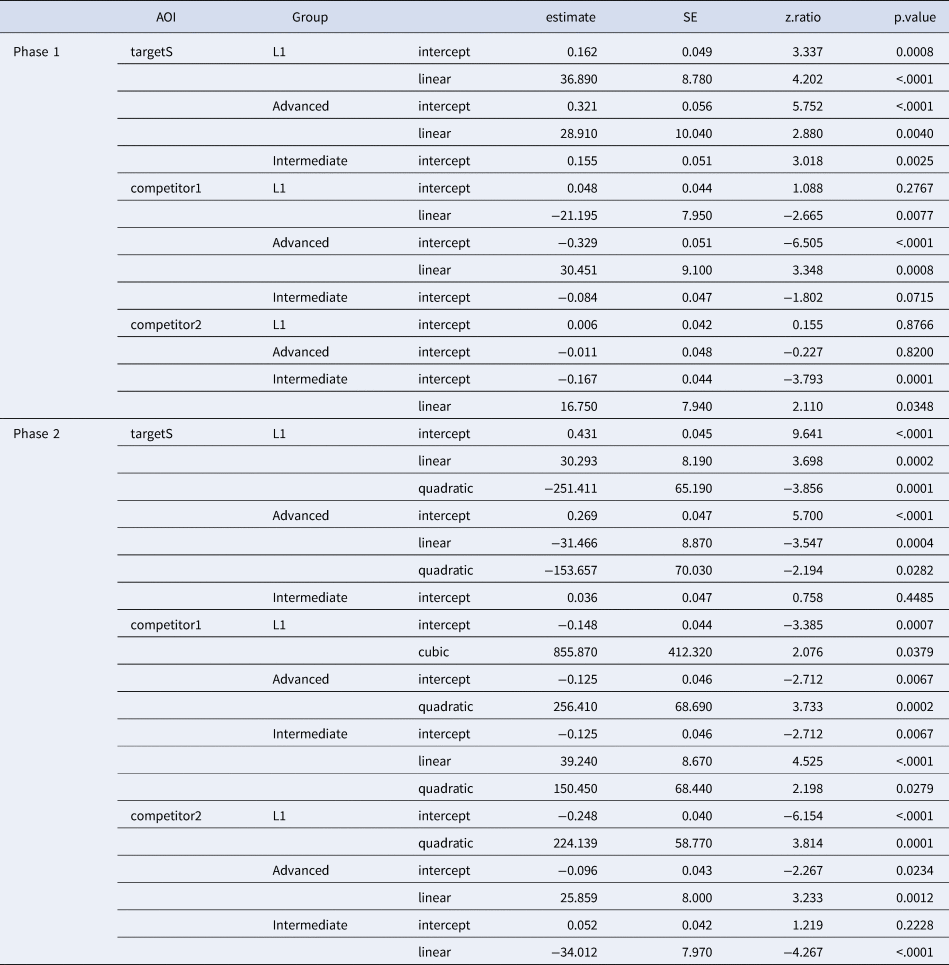
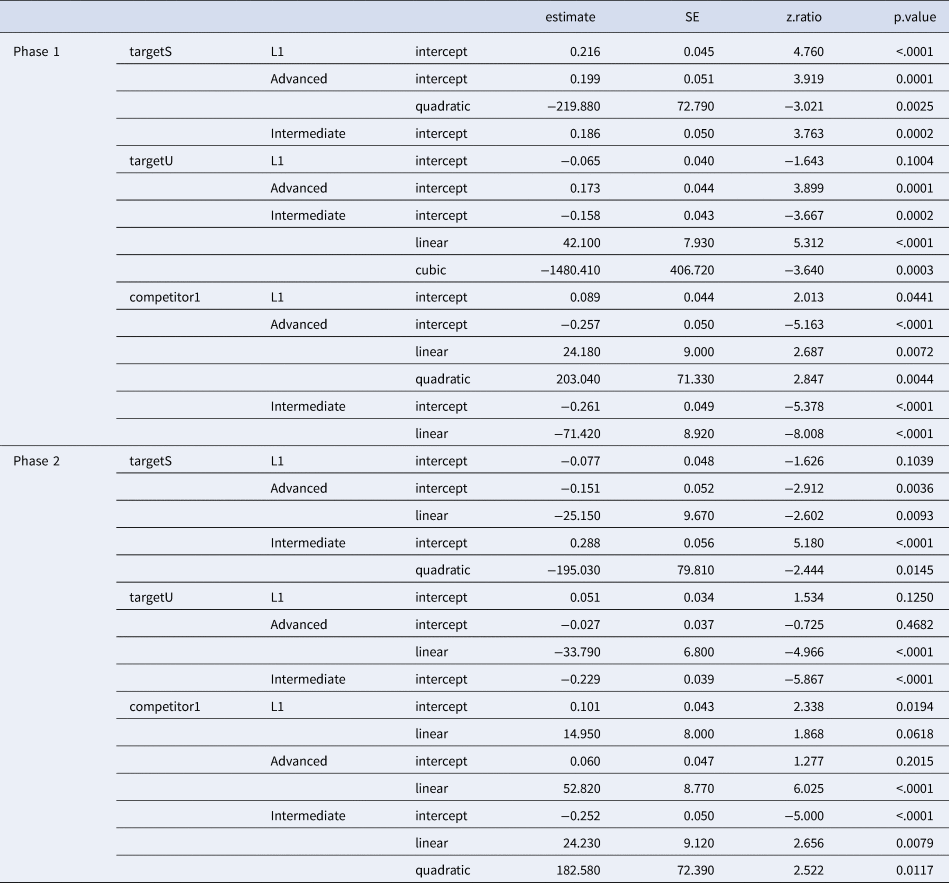
Confirming that both L1 and proficiency had significant effects in interactions with either definiteness or with both time and definiteness in the overall analyses, we used groups L1, advanced L2, and intermediate L2 to analyze eye movements in separate speaker groups phase by phase. The type III ANOVA summaries of the models for each AOI in Phases 1 and 2 in the two visual conditions can be found in Supplementary Material C (Tables S5 to S8). All models showed significant interactions of definiteness and speaker group (ps < .05). Since we were interested in finding out how each group reacted to different articles for different AOIs, we conducted pairwise comparisons to probe the effect of definiteness to fixations on targets and competitors by language group. Our discussion mainly relies on the pairwise analyses comparing eye gaze fixations on different AOIs between the two definiteness conditions per language group (see Tables 2 and 3 for the summary of the pairwise analyses).
Pairwise comparisons between definite and indefinite conditions on the target and the competitors in the one-target condition

Note. Positive values indicate larger estimates in the definite condition. Only statistically significant time terms were listed.
Pairwise comparisons between definite and indefinite conditions on the targets and the competitor in the two-target condition

Note. Positive values indicate larger estimates in the definite condition. Only statistically significant time terms were listed.
Visualizations of all AOIs in different auditory and visual conditions can be found in Figures S2 and S3 in Supplementary Material A. Since our main interests were whether participants’ eye gaze patterns differed between definite and indefinite conditions for targets and competitors, Figures 2 and 3 display the empirical logits of fixations on three AOIs in the one-target and two-target conditions, respectively. The leftmost column in each figure reports fixation rates from L1 speakers, the center column is from advanced L2 speakers, and the rightmost column is from the intermediate L2 group. Each row shows fixation rates in targetS, competitor1, and competitor2 from top to bottom in Figure 2 and targetS, targetU, and competitor1 in Figure 3. Solid lines indicate eye movement patterns in the definite condition, while dotted lines represent those in the indefinite condition.
4.1. One target condition
In the one-target condition (Figure 1a), a definite article was expected to lead to fixations on the unique target whereas an indefinite article was expected to mislead participants to fixate on one of the two competitors. L1 and advanced L2 speakers showed the effect of the definite article and fixated more on the target in the definite condition than in the indefinite condition, but their behavior regarding the indefinite article and competitors was delayed compared to that towards the target. The intermediate L2 group did not seem to use articles to predict upcoming referents.
Target: Phase 1
The first row of Figure 2 shows the three speaker groups’ eye movement patterns for targetS in the one-target condition. L1 and advanced L2 speakers both displayed more fixations on the unique target in the definite condition than in the indefinite condition during Phase 1 before the disambiguating shape word was heard (L1: β = 0.162; SE = 0.049; z = 3.337; p = .0008; Adv L2: β = 0.321; SE = 0.056; z = 5.752; p < 0.0001; see Table 2 for complete statistics). The right most column on the first row shows that intermediate L2 speakers also momentarily fixated more on targetS in the definite condition than in the indefinite condition (β = 0.155; SE = 0.051; z = 3.018; p = .0025). However, the momentary increase in the intermediate L2 group did not show gradual increase unlike the L1 and advanced L2 groups who also showed a statistically significant difference in the linear time term estimate with the definite condition showing a faster increase of fixations than the indefinite condition (L1: β = 36.89; SE = 8.78; z = 4.202; p < .0001; Adv L2: β = 28.91; SE = 10.04; z = 2.880; p = 0.004).
Target: Phase 2
The different patterns of behavior between the intermediate group and the rest became apparent in Phase 2. While L1 and advanced L2 speakers fixated significantly more on the target in the definite condition (L1: β = 0.431; SE = 0.045; z = 9.641; p < .0001; Adv L2: β = 0.269; SE = 0.047; z = 5.700; p < 0.0001), the intermediate L2 group did not show a clear difference between the two conditions (β = 0.0356; SE = 0.047; z = 0.758; p = .4485).
Competitors. Phase 1
Regarding competitors during Phase 1, all three groups behaved differently. L1 speakers did not show a significant difference between the definite and indefinite conditions in fixating on comeptitor1 or competitor2 (ps < 1; see Table 2 for complete statistics). Advanced L2 speakers showed an inconsistent pattern of behavior regarding competitors. They did show a higher fixation rates to competitor1 in the indefinite condition (β = -0.329; SE = 0.051; z = -6.505; p < .0001), but no significant difference was observed between the definite and indefinite conditions regarding competitor2 (β = -0.011; SE = 0.048; z = -0.227; p = 0.8200). The intermediate L2 group showed a marginally significant difference in competitor1 (β = - 0.084; SE = 0.047; z = - 1.802; p = .0715) and a statistically significant difference in competitor2 (β = -0.167; SE = 0.044; z = -3.793; p = .0001), showing higher fixation rates in the indefinite condition.
Competitors. Phase 2
In Phase 2, L1 and advanced L2 speakers behaved alike regarding the two competitors while the intermediate L2 group's behavior was inconsistent. The indefinite condition showed higher fixation rates in both competitors in both groups (competitor1- L1: β = -0.148; SE = 0.044; z = -3.385; p = .0007; adv L2: β = -0.125; SE = 0.046; z = -2.712; p = .0067; competitor2 – L1: β = -0.248; SE = 0.040; z = -6.154; p < .0001; adv L2: β = -0.096; SE = 0.043; z = -2.267; p = .0234). The intermediate L2 group also showed a significantly higher rate of fixation on competitor1 in the indefinite condition (β = -0.125; SE = 0.046; z = -2.712; p = .0067), but no difference was observed for competitor2 (β = 0.052; SE = 0.042; z = 1.219; p = .2228).
4.2. Two-target condition
In the two-target condition (Figure 1b), none of the three speaker groups showed the expected pattern of behavior: More eye gaze fixations were expected on one of the two non-unique targets in the indefinite condition than in the definite condition and the reverse for the unique competitor. The effect of the indefinite article was not clearly observed in any of the three groups, and a very subtle effect of the definite article (to predict the unique competitor) was observed only in the L1 group.
Targets: Phase 1
L1 and intermediate L2 participants showed an inconsistent pattern of eye movements.Footnote 9 As the top left panel of Figure 3 shows, L1 speakers’ fixation rates were statistically significantly higher on targetS in the definite condition in Phase 1 (β = 0.216, SE = 0.045, z = 4.760, p < .0001). For targetU, more fixations, if statistically insignificant, were observed in the indefinite condition for L1 speakers (β = -0.065, SE = 0.040, z = -1.643, p = .1004). The intermediate group also showed an inconsistent pattern of behavior for targetS and targetU. Their fixation rates for targetS were higher in the definite condition (β = 0.186, SE = 0.050, z = 3.763, p = .0002) while those for targetU were statistically significantly higher in the indefinite condition (β = -0.158, SE = 0.043, z = -3.667, p = .0002). Advanced L2 speakers showed the opposite behavior from what was predicted, and their fixation rates were statistically significantly higher in the definite condition for both targetS (β = 0.199, SE = 0.051, z = 3.919, p = .0001) and targetU (β = 0.173, SE = 0.044, z = 3.899, p = .0001).
Targets: Phase 2
The incoherent behavioral pattern of L1 and intermediate L2 speakers continued in Phase 2. L1 speakers did not reach statistical significance regarding the difference between definite and indefinite conditions for targets during Phase 2 and continued to show the inconsistent behavior. This time, only the conditions for higher fixations were reversed from Phase 1. Their fixation rate on targetS was numerically higher in the indefinite condition (β = -0.077, SE = 0.048, z = -1.626, p = .1039), but it was numerically higher in the definite condition for targetU (β = 0.051, SE = 0.034, z = 1.534, p = .1250). The intermediate group maintained their behavioral pattern from Phase 1 and fixated on targetS significantly more in the definite condition (β = 0.2878, SE = 0.0555, z = 5.180, p < .0001) while fixating on targetU significantly more in the indefinite condition (β = -0.2293, SE = 0.0391, z = -5.867, p < .0001). Advanced L2 speakers showed a statistically significantly higher fixation rate for targetS in the indefinite condition (β = -0.151, SE = 0.052, z = -2.912, p = .0036), but such statistical significance was not observed for targetU (β = -0.027, SE = 0.037, z = -0.725, p = .4682).
Competitor. Phase 1
As for L1 speakers, a temporary increase of fixation rate was observed in the definite condition (β = 0.089, SE = 0.044, z = 2.013, p = .0441). On the other hand, both advanced and intermediate L2 speakers showed a statistically significantly higher fixation rate on competitor1 in the indefinite condition (Advanced: β = -0.257, SE = 0.050, z = -5.163, p < .0001; Intermediate: β = -0.261, SE = 0.049, z = -5.378, p < .0001).
Competitor. Phase 2
The three speaker groups all behaved differently as for the competitor during Phase 2. L1 speakers fixated more on competitor1 in the definite condition (β = 0.101, SE = 0.034, z = 2.338, p = .0194) while advanced L2 speakers did not display any statistical difference (β = 0.0602, SE = 0.0471, z = 1.277, p = .2015) and intermediate L2 speakers fixated significantly more on competitor1 in the indefinite condition (β = -0.252, SE = 0.050, z = -5.000, p < .0001).
5. Discussion
The aims of this study were two-fold: (1) to investigate whether (in)definiteness without the interference of real-world knowledge could lead to the prediction of (non-)unique referents yet to be mentioned in L1 and L2 sentence processing and (2) to examine whether L2 speakers’ eye movements in response to definite and indefinite articles would pattern differently depending on their proficiency. The results of the experiment showed that L1 speakers and advanced L2 speakers used the definite article in the one-target condition to anticipatorily fixate on targetS (the unique target) during Phase 1 before the disambiguating noun was heard. Also, the higher fixation rate on targetS in the definite condition continued until the disambiguating noun was fully processed towards the end of Phase 2. Such a pattern of eye movements, however, was not observed in the intermediate L2 group. In the two-target condition, none of the three speaker groups formed a coherent pattern of eye movements that could be interpreted as signs of using (in)definite articles to predict (non-)unique referents except the L1 group's subtle sign of using the definite article to predict the unique competitor.
Our results point back to the issue raised at the beginning of the paper: Can intermediate L2 speakers predict a referent solely based on definiteness without resorting to real-world knowledge? The intermediate L2 group in the present study did not use English articles in predicting upcoming linguistic material, unlike the participants in Trenkic et al. (Reference Trenkic, Mirkovic and Altmann2014), who were intermediate-level L1-Chinese L2-English speakers. The proficiency levels of the intermediate learner groups in the two studies cannot be directly compared since different proficiency measures were employed. In any case, the findings from the intermediate L2 group of the current study suggest that the results of Trenkic et al. (Reference Trenkic, Mirkovic and Altmann2014) be carefully re-interpreted in discussing L2 speakers’ ability to use grammatical knowledge (definiteness) in sentence processing. If the experimental design of Trenkic et al. (Reference Trenkic, Mirkovic and Altmann2014) had not involved real-world knowledge, the intermediate-level L2 participants might not have been able to locate a target as quickly as they did.
Another difference between our findings and those of the previous studies is that an indefinite article did not induce a clear predictive processing effect in either L1 or advanced L2 speakers of the current study. In Chambers et al. (Reference Chambers, Tanenhaus, Eberhard, Filip and Carlson2002) and Trenkic et al. (Reference Trenkic, Mirkovic and Altmann2014), L1 participants could locate a target the fastest in the combination of an indefinite article and a non-unique target. This discrepancy should be attributable to the different research purposes and methodologies between the current study and the two previous studies. We aimed to investigate the role of (in)definiteness only in predicting (non-)unique referents without the influence of real-world knowledge. On the contrary, Chambers et al. (Reference Chambers, Tanenhaus, Eberhard, Filip and Carlson2002) focused on the function of situational contexts or real-world knowledge involved in definiteness processing. Therefore, Trenkic et al.'s (Reference Trenkic, Mirkovic and Altmann2014) argument that their findings indicate L2 speakers’ using grammatical knowledge of definiteness needs reconsidering.
A possible account for the lacking effect of an indefinite article could be that indefinite articles might not necessarily predict a non-unique referent. Clifton's (Reference Clifton2013) study on L1 definiteness processing suggested that when a uniquely identifiable referent or a non-unique referent is presupposed in a given context, definite and indefinite NPs, respectively, will take an equal amount of processing loads and time to accommodate the presupposition. This was not replicated in Ahn (Reference Ahn2021), where for both L1 and advanced L2 groups, indefinite NPs did not lead to a clear contrast in accommodating the presupposition of unique and non-unique referents. That is, indefinite NPs did not elicit different processing times in response to the (non-)uniqueness of a referent to the extent that definite NPs did.
Before we discuss the theoretical implications of our findings, a nagging question remains: Is it possible that L2 speakers could not aurally distinguish the from a? We did not conduct a separate test to see whether that was a case. However, assuming the perceptual indistinction between the two articles in the L2 groups will make it difficult to produce the most parsimonious account for our findings. Advanced L2 speakers clearly showed the effect of definiteness in predicting unique referents. Even for intermediate speakers alone, separate accounts will be required to explain their behaviors in different AOIs, visual settings, and auditory conditions since their behavior, if not targetlike, differed between one-target and two-target conditions, amongst different AOIs, and between the definite and indefinite conditions. If they could not distinguish definite and indefinite articles, they would not have shown different responses to the same visual scene when the only difference was the articles (see Figures S2 and S3 in Supplementary Material A for the overall view of their eye gaze patterns).
Comparing the findings of the current study and those of previous studies (Ahn, Reference Ahn2021, Reference Ahn2022; Henry et al., Reference Henry, Jackson and Hopp2020; Hopp, Reference Hopp2015; Martin et al., Reference Martin, Garcia, Breton, Thierry and Costa2015; Trenkic et al., Reference Trenkic, Mirkovic and Altmann2014) has implications for recent theories in predictive L2 processing. Hopp (Reference Hopp, Kaan and Gruter2021) lists constraints that make cues in predictive L2 processing unreliable such as “lacking and inconsistent lexical and grammatical knowledge, L1 influence, shallow parsing, and cognitive resource limitations (p. 180),” and Kaan and Grüter (Reference Kaan, Grüter, Kaan and Grüter2021) argues that unreliable cues decrease the utility of prediction in L2 sentence processing. We believe that, based on our findings, the presence of top-down information (e.g., real-world knowledge) should be considered an important factor in calculating the utility of prediction. At lower proficiency levels, L2 speakers might lack lexical and/or grammatical knowledge in L2 to base their predictions on. If top-down information, such as knowledge that a rabbit is more likely to eat cabbage than a fox (Henry et al., Reference Henry, Jackson and Hopp2020; Hopp, Reference Hopp2015) or that a closed can cannot be a viable goal for a cube to be placed in (Trenkic et al., Reference Trenkic, Mirkovic and Altmann2014), is available, L2 speakers, even when not very advanced, will be able to use such knowledge to make a prediction for how the sentence will unfold, which was the case in Trenkic et al. (Reference Trenkic, Mirkovic and Altmann2014). At more advanced levels, if top-down information provides cues clear enough to generate expectations, the grammatical redundancy of nuanced and subtle features such as articles might lack utility for L2 speakers to predict what is to be heard/read next. When L2 speakers do not use articles to make predictions, it is not just because unreliable cues will not contribute to learning, but also because it is suboptimal to process additional information when more explicit and less subtle information is available to make predictions necessary for communication.
6. Conclusion
To sum up, a definite article clearly has an effect in predicting a uniquely identifiable referent yet to be mentioned in L1 and advanced L2 sentence processing. On the other hand, the effect of an indefinite article was observed only in limited circumstances in a delayed manner. These behavioral patterns were observed in both L1 and advanced L2 speakers, but intermediate L2 speakers did not show any meaningful differences in their responses to definite and indefinite articles in either of the unique and non-unique target conditions.
A future study is called for to address the following issues. Our findings indicate that advanced L2 speakers’ eye gazes were moving more quickly and to a greater extent in response to indefinite articles and color words (observed in the one-target condition) than L1 speakers. Investigating potential causes of such L2 behavior will shed light on the nature of L2 processing that sets it apart from L1 processing. Also, although we believe that the effect of definiteness was not confounded with that of color words’ lexical information, an experimental design that can keep a distance between an article and a disambiguating noun without involving additional information (i.e., color in the current study) will lead to a more straightforward interpretation of participants’ eye movements.
Supplementary Material
For supplementary material accompanying this paper, visit https://doi.org/10.1017/S1366728922000840
A: Figures S1 to S3
B: List of critical stimuli
C: Tables S1 to S8
Acknowledgments
This study was supported by the Ministry of Education of the Republic of Korea and the National Research Foundation of Korea (NRF-2018S1A5B5A07071643). We would like to express our gratitude to Dr. Sung-Eun Lee in the Department of German Language and Literature at Seoul National University for allowing access to an eye-tracker in the Brain and Humanities Lab and Mr. Jonghyun Lee for helping us with running participants in the lab. We are also grateful to the editors Harald Clahsen, Annie Tremblay, and Kira Gor and three anonymous reviewers for their insightful feedback on earlier versions of our paper. All errors that remain are ours.
Competing Interests Declaration
The authors declare no potential conflicts of interest with respect to the research, authorship, and/or publication of this article.