

Introduction
Anthropogenic pressure in marine and terrestrial environments is increasing, with detrimental consequences for animal populations and communities (Allan et al. Reference Allan, Watson, Di Marco, O’Bryan, Possingham and Atkinson2019; Halpern et al. Reference Halpern, Walbridge, Selkoe, Kappel, Micheli and D’Agrosa2008), ultimately leading to what has been defined as an extinction crisis (Ceballos et al. Reference Ceballos, Ehrlich and Dirzo2017). The impacts of human activities include direct and indirect effects on natural components, such as habitat loss and transformation, direct killing of individuals, and increased perturbation of ecosystems (Owens and Bennett Reference Owens and Bennett2000; Pereira et al. Reference Pereira, Leadley, Proença, Alkemade, Scharlemann and Fernandez-Manjarrés2010). Raptors, an iconic group of birds regarded in many places as cultural symbols (Donázar et al. Reference Donázar, Cortés-Avizanda, Fargallo, Margalida, Moleón and Morales-Reyes2016), are an example of biological annihilation, being severely impacted by human-induced threats (Cianchetti-Benedetti et al. Reference Cianchetti-Benedetti, Manzia, Fraticelli and Cecere2016; Cruz et al. Reference Cruz, Santulli-Sanzo and Ceballos2021; De Pascalis et al. Reference De Pascalis, Panuccio, Bacaro and Monti2020). Indeed, 52% of global raptor species are in decline and 18% are threatened with extinction (McClure et al. Reference McClure, Westrip, Johnson, Schulwitz, Virani and Davies2018). Ultimately, their disappearance has top-down effects on whole trophic webs and ecosystems (Terborgh et al. Reference Terborgh, Lopez, Nuñez, Rao, Shahabuddin and Orihuela2001). Movement ecology, a relatively recent branch of ecological research, can help inform and address effective conservation strategies and mitigation measures for target species and populations, with on average 60% of available studies in this discipline being used in species status assessment and recovery plans (Fraser et al. Reference Fraser, Davies, Davy, Ford, Flockhart and Martins2018; Nathan et al. Reference Nathan, Getz, Revilla, Holyoak, Kadmon and Saltz2008). Indeed, an in-depth understanding of the areas and routes primarily used by a population is crucial for effective conservation action planning, and the identification of geographical sites important for raptors is considered a conservation priority (McClure et al. Reference McClure, Westrip, Johnson, Schulwitz, Virani and Davies2018). Ultimately, protecting areas that sustain raptor populations can help safeguard sites particularly important for biodiversity and biological resources, as raptors can effectively act as umbrella species (Sergio et al. Reference Sergio, Caro, Brown, Clucas, Hunter and Ketchum2008). In this context, a data-standardised, statistical framework has been developed and refined to delineate areas of conservation importance based on animal tracking data (Beal et al. Reference Beal, Oppel, Handley, Pearmain, Morera-Pujol and Carneiro2021; Lascelles et al. Reference Lascelles, Taylor, Miller, Dias, Oppel and Torres2016). Once identified, these Important Conservation Areas (ICAs) can be assessed against the criteria for Key Biodiversity Areas (KBAs) or Important Bird and Biodiversity Areas (IBAs) designation and proposed accordingly, in consultation with the relevant bodies, directly contributing to site-based conservation. Additionally, these areas can be used to identify potential threats and support careful spatial planning and management.
Eleonora’s Falcon Falco eleonorae is a medium-sized raptor (350 g; Walter Reference Walter1979) of European conservation interest (listed in Annex 1 of Bird Directive 2009/147/EC) that breeds almost exclusively in colonies on islands of the Mediterranean Sea (Walter Reference Walter1979), one of the most human-impacted sea basins worldwide (Claudet and Fraschetti Reference Claudet and Fraschetti2010; Halpern et al. Reference Halpern, Walbridge, Selkoe, Kappel, Micheli and D’Agrosa2008). The non-breeding areas of the species are all located in Madagascar, and they annually embark in a trans-equatorial loop migration (Mellone et al. Reference Mellone, López-López, Limiñana, Piasevoli and Urios2013a). During breeding, they shift from an invertebrate-based diet to migratory small birds, caught over the sea, synchronising the chick-rearing period with the peak of post-breeding migration of passerines through the Mediterranean region (Walter Reference Walter1979; Xirouchakis et al. Reference Xirouchakis, Alivizatos, Georgopoulou, Dimalexis, Latsoudis and Portolou2019). The dual nature of their foraging during breeding makes both marine and terrestrial areas important for them. Most satellite-tracking studies on the species so far have focused on migration and non-breeding areas (Gschweng et al. Reference Gschweng, Kalko, Querner, Fiedler and Berthold2008; Hadjikyriakou et al. Reference Hadjikyriakou, Nwankwo, Virani and Kirschel2020; López-López et al. Reference López-López, Limiñana, Mellone and Urios2010; Vansteelant et al. Reference Vansteelant, Gangoso, Bouten, Viana and Figuerola2021), with only a few descriptions of movement and spatial requirements during the breeding season (Gangoso et al. Reference Gangoso, Viana, Dokter, Shamoun-Baranes, Figuerola and Barbosa2020; Kassara et al. Reference Kassara, Evangelidis, Tsiopelas, Barboutis and Giokas2022; Mellone et al. Reference Mellone, Urios, Rguibi-Idrisi, Limiñana, Benhoussa and López-López2012, Reference Mellone, López-López, Limiñana and Urios2013b). Italy hosts approximately 3.7 % of the global population, with most individuals breeding in Sardinia across two colonies (365–453 breeding pairs overall; Spina and Leonardi Reference Spina and Leonardi2007), where they hold a special place in popular culture. The species is, in fact, dedicated to Eleonora d’Arborea, the far-sighted Sardinian ruler who, in 1392, through the legal code Carta de Logu, prohibited the collection of fledglings, becoming the first ruler in history to grant legal protection to falcons against illegal poaching (Spina and Leonardi Reference Spina and Leonardi2007; Vaughan Reference Vaughan1961). However, Sardinia is an area that is undergoing a rapid expansion in renewable energy production (wind and solar), being one of the windiest and most irradiated Italian regions (Osti Reference Osti2018). By 2030, a significant growth in wind farms is predicted at the national level and Sardinia is one of the most attractive regions for the development of offshore wind farms (Serri et al. Reference Serri, Colle, Vitali and Bonomi2020). Wind turbines pose significant threats to raptor species, leading to detrimental effects such as collision fatalities, population impacts, and habitat displacement (Estellés-Domingo and López-López Reference Estellés-Domingo and López-López2024). While specific data on Eleonora’s Falcons are scarce, other similar raptor species face a high risk of collision (Gauld et al. Reference Gauld, Silva, Atkinson, Record, Acácio and Arkumarev2022). The overarching goal of this study was to identify ICAs for a key breeding colony of Eleonora’s Falcons in Sardinia. Here we first describe the spatial ecology of Eleonora’s Falcons during the breeding season, quantifying foraging excursion metrics and potential sex-based differences. Then, using a standardised approach, we identify the ICAs for the target population. Finally, we assess the protection status and exposure to a potential threat (wind farms) within the identified area using spatio-temporal overlap with wind turbines. Our results could be used to inform marine and terrestrial spatial planning and conservation actions for this iconic falcon species.
Methods
Data collection
Birds (N = 26) were caught with mist-nets during two consecutive breeding seasons (July–September 2022 and 2023) near a water-body, in an inland area approximately 30 km away from the Isole di S. Pietro e S. Antioco (latitude: 39.15556; longitude: 8.22778), an archipelago that hosts one of the two colonies of the species in Sardinia (see Supplementary material 1 for details). All the caught birds were mature individuals (age 6 following the Euring code). Birds were ringed with unique alphanumeric metal rings, weighed, photographed, and sexed (N = 17 females, N = 9 males) following Forsman (Reference Forsman1999), and equipped with a 9-g GPS-GSM using a Teflon thoracic harness (Ornitrack-9, Ornitela, relative weight including harness, mean ± SD; females: 2.5 ± 0.4%, males: 3.0 ± 0.3%). Devices were set to record position at different sampling rates according to battery levels, spanning from 1 fix/5 minutes to 2 fixes/day. At each fix acquisition, tri-axial acceleration data were recorded (1 Hz, ± 2 G, 12 bit). All the procedures were conducted by the Italian Institute for Environmental Protection and Research (ISPRA), under the authorisation of Law 157/1992 [Art.4(1) and Art 7(5)], which regulates research on wild bird species. Birds were released within 20 minutes from capture and were handled by experienced staff only. No bird was injured by the handling/tagging procedure.
Data preparation and ICAs identification
All the subsequent analyses were performed using R software (v. 4.3.2; R Core Team 2025). We considered data from the 2022 and 2023 breeding seasons (defined as the period between July and October). Potential nest-site locations, start of the breeding attempt, and last visit at nest of each bird in each year were identified using the nestR R package (Picardi et al. Reference Picardi, Smith, Boone, Frederick, Cecere and Rubolini2020), and non-breeding individuals were removed (see Supplementary material 2). For breeding individuals, we retained data from the start of the breeding attempt (i.e. nest building) until the last visit at the nest, regardless of success of the breeding attempt. This decision was based on the rationale that, for the identification of an ICA, all breeding individuals play an important role in the population and that as colonial central-place foragers, colony fidelity is a key life-history discriminant for ICAs used during breeding.
To identify the ICAs, we applied the workflow proposed by Beal et al. (Reference Beal, Oppel, Handley, Pearmain, Morera-Pujol and Carneiro2021), implemented in the track2KBA R package and already used for different taxa (Beal et al. Reference Beal, Catry, Regalla, Barbosa, Pires and Mestre2022; Becker et al. Reference Becker, Boyd, Handley, Raymond, Reisinger and Ropert-Coudert2024; De Pascalis et al. Reference De Pascalis, Pisu, Pala, Benvenuti, Visalli and Carlon2022). Foraging trips were identified using the “tripSplit” function (inner buffer: 2 km; return buffer: 5 km; duration: 1 hour) for each bird-year. Incomplete trips (i.e. trips not returning to the colony) and periods at nest were discarded. All the trips with an average fix rate of 1 fix/60 minutes or less were removed, to retain high-quality data only (i.e. without large gaps). For each fix, we assessed if it was at sea or on land using the NASA distance from the coast variable and we calculated the mean, median, and maximum distance while at sea. Foraging excursion metrics (i.e. duration, distance travelled, and maximum distance from the colony) were computed using the “tripSummary” function. Differences in each metric between females and males were assessed with three different Generalised Linear Mixed Models (GLMMs), with each metric as response variable, individual identity as a random intercept effect, and a gamma error distribution, fitted via the glmmTMB R package (Magnusson et al. Reference Magnusson, Skaug, Nielsen, Berg, Kristensen and Maechler2020). Significance was tested by likelihood ratio tests and model diagnostics assessed with the performance R package (Lüdecke et al. Reference Lüdecke, Makowski and Waggoner2020). We then computed the 50% kernel utilisation distribution (KUD) on projected coordinates to avoid spatial biases, using the “estSpaceUse” function. Representativeness of the sample was tested using the bootstrapping approach described in Lascelles et al. (Reference Lascelles, Taylor, Miller, Dias, Oppel and Torres2016) via the “repAssess” function using 500 iterations. To ensure that the kernels were not under- or over-smoothed, we selected an appropriate smoothing parameter using the “findScale” function (href = 10.08). Finally, we used the obtained KUDs, the representativeness estimate (93.2%), and the minimum population size estimated (N = 360 individuals) (Spina and Leonardi Reference Spina and Leonardi2007) as inputs to the “findSite” function that identifies the areas (ICAs) used by ≥10% of the population (default value applied when representativeness >90%). To assess the protection level in the area, the obtained ICA was overlayed with the network of Natura 2000 sites (Sites of Community Importance, Special Areas of Conservation, and Special Protection Areas, 2023 update, retrieved from https://inpn.mnhn.fr/ and www.mase.gov.it), and the percentage of the area falling within these was computed. Additionally, we calculated the number and the percentage of wind turbines (mapped in 2023) falling within the ICA using the data set from Cerri et al. (Reference Cerri, Costantino, De Rosa, Banič, Urgeghe and Fozzi2024) for Sardinia, and from Dunnett et al. (Reference Dunnett, Sorichetta, Taylor and Eigenbrod2020) for Corsica.
Flight height and circadian activity
To obtain a good measure of flight height, among all the positions used for the identification of the ICAs, we retained only positions where the individuals were likely flying (instantaneous ground speed ≥1 m/second, threshold identified by visual inspection of histograms) and removed all the fixes with ≤4 satellites (N = 25) or with horizontal dilution of precision >4 (N = 272). In these conditions, tests run on a subset of the devices kept stationary in a location of known altitude with a similar sampling schedule (N = 7, 29,694 fixes) revealed a mean absolute error of 8.7 m. We then computed for each fix the elevation of the ground at that location using a digital elevation model (AST Global DEM V003 digital surface model; NASA/METI/AIST/Japan Spacesystems and U./Japan ASTER Science Team, 2024, 30 m horizontal and 8.5 m vertical accuracy). We calculated flight height above ground level (m agl) by subtracting the elevation of the ground (summary statistics on ground elevation based on tracking position: min = 0, median = 189, mean = 319.06, max = 2,226.91) from the height above sea level recorded by the GPS device (Gauld et al. Reference Gauld, Silva, Atkinson, Record, Acácio and Arkumarev2022; Péron et al. Reference Péron, Calabrese, Duriez, Fleming, García-Jiménez and Johnston2020). We removed outliers of flight height above ground level (values below the 1 and 99 percentile) and calculated mean, median, and interquartile range (IQR) values for flight at sea and over land (defined using NASA distance from the coast variable, where negative values represent locations on land). Some negative altitudes were present (5% of positions), possibly due to GPS and/or ground elevation model inaccuracies. We retained them to reduce possible bias (Péron et al. Reference Péron, Calabrese, Duriez, Fleming, García-Jiménez and Johnston2020). Finally, we plotted histograms (bin width = 20) of the obtained variable to visualise the percentage of data falling within the rotor-swept zone (RSZ) of wind turbines, defined as between 15 m and 250 m agl (Assandri et al. Reference Assandri, Bazzi, Bermejo-Bermejo, Bounas, Calvario and Catoni2024; Gauld et al. Reference Gauld, Silva, Atkinson, Record, Acácio and Arkumarev2022; Morant et al. Reference Morant, Arrondo, Sánchez-Zapata, Donázar, Margalida and Carrete2024).
To assess if peaks of falcon activities coincide with peaks of wind farms functionality, we compared falcons’ circadian rhythm of flight activity with circadian variation in wind speed (a proxy of functionality of wind turbines).To calculate circadian rhythm of activity, we used the absolute values of acceleration data on the z-axis (heave) as a proxy of flight activity (Hedenström et al. Reference Hedenström, Norevik, Boano, Andersson, Bäckman and Åkesson2019; Liechti et al. Reference Liechti, Witvliet, Weber and Bächler2013). This is the dorso-ventral axis, parallel to gravity when the bird is flying. Given the coarse sampling frequency of accelerometers, and the descriptive goal of this analysis, we did not disentangle static and dynamic acceleration but rather calculated the hourly mean of heave acceleration for each bird. Then we assessed the variation in this metric (N = 122,567 fixes) across the day using a Generalised Additive Mixed Effect Model (GAMM) fitted with the mgcv R package (Wood Reference Wood2019). The GAMM was built using a Gaussian error distribution and hour of the day was inserted as a response variable using cyclic cubic regression splines with shrinkage to prevent overfitting and account for cyclicity. Bird identity was inserted as a random effect to account for pseudo-replication and model diagnostics were inspected using the performance R package. To summarise wind speed, we retrieved zonal (u) and meridional (v) wind component from the ERA 5 reanalysis data set on pressure levels (hourly, 0.25° × 0.25°; Hersbach et al. Reference Hersbach, Bell, Berrisford, Hirahara, Horányi and Muñoz-Sabater2020) at 1,000 hPA, as this is similar to the operational height of wind turbines. We then calculated mean hourly wind speed across Sardinia (July–September during the years of tracking) and used it (N = 24 values) as response variable in a similar GAMM, but with a gamma error distribution (logarithmic link) and no random effect.
Results
After the cleaning phase, we obtained 1,005 foraging excursions from 25 individuals (8 males and 17 females, Figure 1) representing the 2.0–2.5% of the Italian population (489–613 breeding pairs; Spina and Leonardi Reference Spina and Leonardi2007). The tracked birds all nested in the S. Pietro e S. Antioco area, specifically on three distinct islets, i.e. Isola di S. Pietro, Isola del Toro, and Isola della Vacca. During the period when Eleonora’s Falcons were bound to the colony, they engaged in foraging excursions of variable distance and duration (Table 1; median values – duration: 7 hours, total trip length: 101 km, maximum distance from the colony: 39 km), in Sardinia, Corsica, the surrounding offshore areas, and, in some cases, the mainland (Italy and North Africa). No sex-based differences were found in any metrics. This variability in metrics is expected, as foraging excursions include data from different stages of the breeding cycle and also from failed breeders. During excursions at sea, individuals were on average 21 ± 23 km (mean ± SD) from the coastline (median: 12.4 km, maximum value: 147 km), with no differences between sexes (Table 1).
Foraging excursions (N = 1,005) from 25 Eleonora’s Falcons breeding in Sardinia (Italy). Each bird, in each breeding season, is shown with a different colour and the breeding location is shown with a star.

Characteristics of foraging excursions according to sex for 25 Eleonora’s Falcons (17 females and 8 males). Values are mean ± SD and range (minimum–maximum values in brackets) and only complete excursions were considered in these analyses (sample size reported in table header). Differences between excursions metrics were assessed by means of gamma Generalised Linear Mixed Models (GLMMs) with individual identity as a random intercept effect. Significance was tested by likelihood ratio tests. These foraging excursions cover only the periods of time when birds are faithful to a nest-site, starting from nest building and ending at the last nest visit, regardless of its fate (see Methods). Therefore, they likely include excursions from failed breeders that remained at the colony and kept returning to the nest-site, even after failure

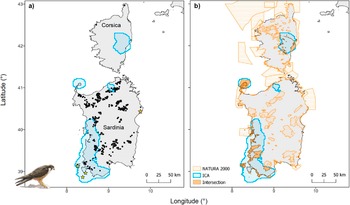
We identified an ICA (Figure 2) (see Data availability statement) for the target colony, used by at least 10% of the population breeding in Isole di S. Pietro e S. Antioco which represents 30% of the Italian breeding population and approximately 2.7% of global population (Birdlife International 2021; Spina and Leonardi, Reference Spina and Leonardi2007). Overall, the ICA is 8,099 km2 and spans Sardinia (83%) and Corsica (17%), covering both terrestrial and marine environments (65% and 35%, respectively). The area is composed of four smaller polygons. The largest is located in the south-west of Sardinia and includes the colony, another one coincides with the Asinara National Park (Parco Nazionale dell’Asinara), while another is in the north of Sardinia, and the last one is located in central-eastern Corsica (Figure 2). The tracked Eleonora’s Falcons routinely moved through wind farms, and within the ICA there are 118 wind turbines, all in Sardinia, representing 10.2% of the total number present in the region (Figure 2a); none of the wind plants found in Corsica falls within the ICA (Figure 2a). Additionally, 77.1 % of the ICA falls outside the Natura 2000 network (Figure 2b).
The Important Conservation Area (ICA) for Eleonora’s Falcons breeding in south-west Sardinia is shown with blue polygons. (a) The black dots indicate the location of wind turbines, the yellow stars show the position of the breeding islets of tracked birds, and the orange star shows the location of the other Sardinian colony (not investigated). (b) The ICA and Natura 2000 network are shown in orange). The part of the ICA falling within a Natura 2000 site is highlighted with a solid orange texture.

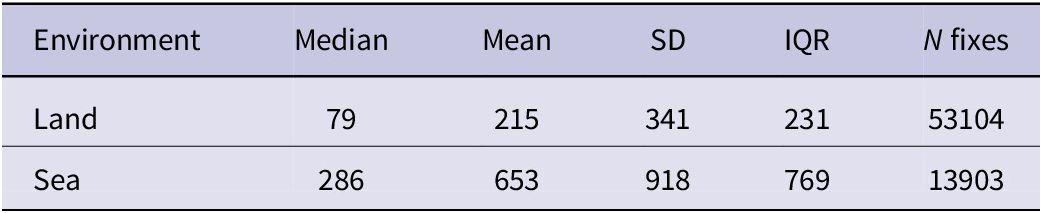
Overall, Eleonora’s Falcons flew at a median height of 97 m agl, but differences occurred between locations at sea and/or land (Table 2), with generally higher values reached while flying over the sea. Around 53% of locations fell within the turbine RSZ (15–250 m) (Figure 3). However, care must be taken in the interpretation of this result as altitude estimated by GPS devices has some biases and inaccuracies (Péron et al. Reference Péron, Calabrese, Duriez, Fleming, García-Jiménez and Johnston2020). The time-activity budgets show that Eleonora’s Falcons are mainly diurnal predators throughout the breeding season, with a peak of activity during the central hours of the day (Figure 4a). Their activity curve roughly corresponds to the circadian pattern of wind speed, with stronger winds during the central hours and lighter ones in the morning and evening (Figure 4b), albeit flight activity peaks before the wind peaks.
Summary statistics of flight height above ground level of Eleonora’s Falcon over land and sea. Values on land are metres above ground level (m agl); values at sea are metres above sea level (m asl)

Eleonora’s Falcon flight height distribution on land (m agl) and sea (m asl). The dashed lines and grey background show the rotor-swept zone (RSZ) (15–250 m), in which birds are potentially at risk of collision with turbines (shaded area). The percentages of position within the RSZ on land and sea are reported in the top right corner.

(a) The response curve from the fitted Generalized Additive Mixed Effect Model (GAMM) (P <0.001) assessing the effect of hour of the day on acceleration on the heave axis, representing a proxy of flight activity, while (b) shows the response curve for another GAMM (P <0.001) assessing the hourly patterns of wind speed for the breeding period (July–September) in Sardinia. Shaded areas correspond to the standard error of the estimate, while marks on the x-axis show the distribution of the data. Dashed vertical lines show the mean sunrise and sunset time across the breeding season.

Discussion
Eleonora’s Falcons engage in long-ranging central-place movements during the breeding season, moving across both sea and land. This behaviour is unique for a Falco species, which are typically terrestrial and short-distance foragers during breeding (Kolowski et al. Reference Kolowski, Wolfer, McDaniels, Williams and Harris2023; Morinay et al. Reference Morinay, Riotte-Lambert, Aarts, De Pascalis, Imperio and Morganti2023). Some individuals undertook long foraging excursions, reaching the Italian and North African mainland, with some trips lasting several days. These long-lasting excursions (5–29 days, N = 20 foraging trips, 1.99% of the data) were likely undertaken by failed breeders, that still returned to their potential nest-sites. Moreover, some individuals embarked on foraging excursions of intermediate duration (1–5 days. N = 86, 8.56% of the data) that could be compatible with successful breeding individuals. Therefore, observations of Eleonora’s Falcons during the breeding period in areas far from their colonies could be of breeding individuals, or at the very least, individuals still tied to the colony. When at sea, Eleonora’s Falcons ranged at impressive distances from the coast, similarly to observations in other colonies (Mellone et al. Reference Mellone, Urios, Rguibi-Idrisi, Limiñana, Benhoussa and López-López2012), with no sex-based differences in excursion metrics. These marine trips are tailored to capture migrating passerines over the sea, where they have no hiding places and are easier to catch, being exhausted from migration. Indeed, flight height at sea was on average higher than that on land, reflecting the different prey targeted in the two environments. Passerines generally migrate at high altitudes (Liechti et al. Reference Liechti, Klaassen and Bruderer2000) that hunting falcons must match to successfully forage. On the contrary, on land, the main prey are invertebrates (Xirouchakis et al. Reference Xirouchakis, Alivizatos, Georgopoulou, Dimalexis, Latsoudis and Portolou2019), that are caught at lower altitudes. The time-activity budgets suggest that they are mainly diurnal foragers, and that events of nocturnal foraging (Buij and Gschweng Reference Buij and Gschweng2017) are not regular in the studied colony and are probably linked to exceptional resource abundance or specific situations (Gangoso et al. Reference Gangoso, Viana, Dokter, Shamoun-Baranes, Figuerola and Barbosa2020; Walter Reference Walter1979).
The ICA we identified spans a large area, primarily located in Sardinia, with a significant portion extending into Corsica. This highlights the need for transnational cooperation to conserve Eleonora’s Falcons and protect critical sites for the species. The largest section of the ICA covers a portion of south-western Sardinia, encompassing both sea and land. This is an extremely important area for Eleonora’s Falcon that includes both the breeding colony and the sectors most frequently used for foraging and transiting. Other areas, which cover terrestrial portions far from the breeding colonies in mountainous regions, could be consistently vital for Eleonora’s Falcon populations, providing reliable food sources during terrestrial hunting. Alternatively, they might be important only in certain years/seasons when insects swarm in specific locations. Nevertheless, it is likely that their importance increases in periods during which migratory passerines are less abundant (Gangoso et al. Reference Gangoso, Viana, Dokter, Shamoun-Baranes, Figuerola and Barbosa2020). However, it should be noted that we identified the ICA for a single breeding population, and that the areas used by the other breeding population (Golfo di Orosei) are still to be delineated. Overall, only a small fraction of the ICA (22.9%) is covered by protected areas. The ICA contains several wind turbines, and many others are located just outside the area, frequently visited by transiting falcons. When in flight, falcons spend half of their time (53%) at an altitude coinciding with the RSZ, putting them at risk of collision. This risk is also increased by the fact that the peak flight activity of falcons coincides with the daily peak in wind speed, which is when turbines are most likely to be operational. Overall, these results suggest that Eleonora’s Falcons breeding in south-western Sardinia are potentially threatened by wind turbines, which are currently only present in terrestrial locations. An increase in wind energy exploitation is predicted in this area, including the installation of several offshore wind farms (Serri et al. Reference Serri, Colle, Vitali and Bonomi2020). Although Eleonora’s Falcons fly higher at sea than on land, there may still be a substantial collision risk at sea (31% of positions within the RSZ). However, it should be noted that offshore turbines will likely be higher than the terrestrial turbines, but still within the flight range of the species at sea. Additionally, offshore wind farms often have lower ground clearance than onshore ones, increasing collision risk (Schaub et al. Reference Schaub, Klaassen, De Zutter, Albert, Bedotti and Bourrioux2024). Therefore, plans for offshore wind farm development in the area should be carefully planned, considering the risk of collision for this iconic falcon species of European conservation interest.
Supplementary material
The supplementary material for this article can be found at http://doi.org/10.1017/S0959270925100312.
Data availability statement
The identified ICAs are available to download from https://doi.org/10.6084/m9.figshare.25273363. The tracking data are available on Movebank (Movebank ID: 3028558214) upon reasonable request.
Acknowledgements
We are grateful to Matteo Diana for the help during fieldwork and to Martin Beal for the support. This study was funded in 2023 by an agreement between ISPRA and the Ministero dell’Ambiente e della Sicurezza Energetica (MASE), signed on 23/12/2022 (PNM_03-329_2023_0001) and in 2022 by Ichnusa Wind Power srl and the Engineering and Industrial Consulting Firm Severini (iLStudio srl).