Introduction
Many older adults worldwide are continuing to work past traditional retirement age. A 2019 survey of adults aged 50–70 years reported 20% of adults aged 65 years or older were still participating in the labor force in the US, doubled from a proportion of 10% back in 1985 (Edleson, Reference Edleson2019). The reasons for working longer can often be financial, and there is a strong relationship between financial stress and mental health issues (Handley et al., Reference Handley, Rich, Lewin and Kelly2019). Work itself, especially in occupations with higher levels of job-related stress, can also bring mental health costs, such as depression, anxiety, and burnout (Ahlin et al., Reference Ahlin, Rajaleid, Jansson-Fröjmark, Westerlund and Hanson2018; Battams et al., Reference Battams, Roche, Fischer, Lee, Cameron and Kostadinov2014; Clays et al., Reference Clays, De Bacquer, Leynen, Kornitzer, Kittel and De Backer2007; Godin et al., Reference Godin, Kittel, Coppieters and Siegrist2005; Stansfeld et al., Reference Stansfeld1997; Wang, Reference Wang2005; Wang et al., Reference Wang, Lesage, Schmitz and Drapeau2008). Work stress, in particular, has been shown to have a robust effect on depressive symptoms in older workers (Sun et al., Reference Sun, Li, Jiang and Lee2020). The growth in the labor force participation of older workers raises the question whether those in occupations with a higher likelihood of persistent occupational stress experience depression, anxiety, or burnout at the same or greater levels as younger workers. If older workers have levels of stress-related depression, anxiety, and burnout consistent with or greater than those seen in younger workers, these older workers could potentially carry a heavy psychological burden for an extended number of years.
Clergy are one occupational group at risk for persistent job-related stress, in part due to work demands. These stressors may include interpersonal stress from conflicting priorities and congregational expectations. Clergy often feel like they are expected to be available 24/7 to respond to the needs of their congregation (Proeschold-Bell et al., Reference Proeschold-Bell, LeGrand, James, Wallace, Adams and Toole2011). In addition, the private life of clergy members is often scrutinized, and clergy often perceive that they and their families are held to a higher standard than their congregations (Blackbird and Wright, Reference Blackbird and Wright1985). Not only do clergy perform the tasks they were trained to do such as preaching and pastoral counseling, but they often assume other roles such as administrator, bookkeeper, fundraiser, and mediator which they do not always feel qualified to perform (Cornwell, Reference Cornwell2013). For clergy, their occupation is more than a job; it is a vocational calling, which can amplify the impact of stress. Because of this calling, clergy may be less likely to make career changes and, therefore, be more likely to spend many years in one occupation. Like other occupational groups, many clergy continue to work past 65 years of age. Within the United Methodist Church (UMC) in the US, there has been a slow, upward trend in the age at which clergy retire, with clergy with the title of ordained elder between the ages of 55 and 72 years comprising 56% of all elders in 2017, up from 30% in 2000 (Lewis Center for Church Leadership, 2018).
Clergy as an occupational group experience higher rates of depression than observed in the general population. For example, one study compared the prevalence of depression among UMC clergy (Proeschold-Bell et al., Reference Proeschold-Bell, Miles, Toth, Adams, Smith and Toole2013a) to the 5.5% reported in the overall US population (Kroenke et al., Reference Kroenke, Spitzer and Williams2001) and found the prevalence of depression among the clergy was 8.7% (Proeschold-Bell et al., Reference Proeschold-Bell, Miles, Toth, Adams, Smith and Toole2013a), with depression measured in both studies using the Patient Health Questionnaire (PHQ-9) (Kroenke et al., Reference Kroenke, Spitzer and Williams2001). This increased depression prevalence in clergy was observed across both males and females. In addition to higher levels of depressive symptoms among clergy, depressive symptoms in this group may persist over time (Hybels et al., Reference Hybels, Blazer and Proeschold-Bell2018). Clergy as a group also experience a high prevalence of anxiety, with one study reporting a prevalence as high as 13.5% (Proeschold-Bell et al., Reference Proeschold-Bell, Miles, Toth, Adams, Smith and Toole2013a). Symptoms of burnout among clergy are also not uncommon, with one study reporting a prevalence of burnout symptoms of 13% (Doolittle, Reference Doolittle2010). Often pastors with burnout also have elevated levels of depressive symptoms (Doolittle, Reference Doolittle2007). Within this same sample, the prevalence of high emotional exhaustion (EE) was 19%, high depersonalization (DP) 10%, and low personal accomplishment (PA) 11% (Doolittle, Reference Doolittle2007). Work-related burnout among samples of clergy has been reported irrespective of religious denomination or country (Lewis et al., Reference Lewis, Turton and Francis2007). Because of their characteristics as an occupational group, including their relative homogeneity in terms of education and income, clergy are well suited to study how working up to and beyond traditional retirement age in a persistently stressful occupation relates to mental health.
In the general US population, the prevalence of both depressive and anxiety disorders is lower among older adults (Grant et al., Reference Grant2005; Gum et al., Reference Gum, King-Kallimanis and Kohn2009; Hasin et al., Reference Hasin, Goodwin, Stinson and Grant2005). This lower prevalence may be due, in part, to age differences in symptom expression. For example, older adults may be less likely to endorse more common symptoms of depression (Gallo et al., Reference Gallo, Rabins, Lyketsos, Tien and Anthony1997; Hybels et al., Reference Hybels, Landerman and Blazer2012). Studies outside the US have also shown that not only these disorders are prevalent, but for older adults who do experience depressive and anxiety disorders, these disorders can be persistent (Almeida et al., Reference Almeida2012; Kang et al., Reference Kang, Bae, Kim, Shin, Yoon and Kim2016). Burnout symptoms, like depressive symptoms, appear to be endorsed less frequently in the older age group (Maslach and Jackson, Reference Maslach and Jackson1981). However, most of the work describing age differences in the prevalence of depression and anxiety across the US has been done in cross-sectional studies in the general population which would include many retired older adults no longer working (Grant et al., Reference Grant2005; Hasin et al., Reference Hasin, Goodwin, Stinson and Grant2005). It is not fully known if these age patterns in prevalence would be observed in samples that only included adults currently engaged in active employment. It is also not known how these patterns may change over time among the employed. Age differences among clergy have received less attention, although a decrease in depression, anxiety, and burnout with increasing age has been noted in cross-sectional work (Doolittle, Reference Doolittle2010; Proeschold-Bell et al., Reference Proeschold-Bell, Eisenberg, Adams, Smith, LeGrand and Wilk2015).
The purpose of the current study was to identify and describe any age differences in trajectories of depression, anxiety, and burnout in a large longitudinal sample of UMC clergy. This sample offered the unique opportunity to describe age differences in a relatively homogeneous group at risk for persistent job-related stress. We hypothesized that in analyses controlling for demographic, health, and social variables, older clergy who were assigned to a church and, therefore, at risk for persistent stress, would experience fewer symptoms of depression, anxiety, and burnout at baseline than their younger colleagues, and that these differences would become more pronounced over time.
Methods
Study sample
The sample for these analyses was 1161 clergy in the UMC in the US who participated in a randomized trial designed to test the effects of lifestyle interventions on physical health, specifically metabolic syndrome, as well as emotional and mental health. The methods and results of the trial have been previously described (Proeschold-Bell et al., Reference Proeschold-Bell2013b, Reference Proeschold-Bell2017). In summary, all UMC clergy in North Carolina were invited to participate. The trial ran from 2010 until 2016, with interviews approximately every 6 months up to 66 months post-baseline. There were three intervention cohorts in the trial. The interventions for each cohort were similar and ran for 2 years. Cohort 1 received the intervention from January 2011 to December 2012, while Cohort 2 received the intervention 1 year later, from January 2012 to December 2013. Cohort 3 received the intervention from January 2013 to December 2014. During the intervention period, cohorts were assessed at 12, 18, and 24 months. Cohort 1 was followed for 18 months post-intervention, with 69% of the cohort providing data at 42 months. Cohort 2 was not followed post-intervention. A total of 59% of the Cohort 2 sample provided data at 36 months after the baseline. Cohort 3 was followed for 18 months post-intervention, with 49% of the sample providing data at 66 months after the baseline. The lifestyle interventions had a significant positive effect on metabolic syndrome but not on depressive symptoms or perceived stress (Proeschold-Bell et al., Reference Proeschold-Bell2017). While the trial sample was used for these analyses, the research question posed here was not a part of the trial.
The survey data were collected online from the participants, and all clergy provided informed consent prior to participation. Research protocols were approved prior to study initiation and reviewed and approved annually thereafter by the Duke University Arts and Sciences Institutional Review Board.
For these analyses, survey data were only included for a particular wave if the participant was appointed to a church either part-time or full-time at the time of the interview.
Measures
The three dependent variables were symptoms of depression, anxiety, and burnout experienced during the period of 2010–2016. Depressive symptoms were measured using the 8-item self-report Patient Health Questionnaire (PHQ-8) (Kroenke et al., Reference Kroenke, Spitzer and Williams2001, Reference Kroenke, Strine, Spitzer, Williams, Berry and Mokdad2009; Spitzer et al., Reference Spitzer, Kroenke and Williams1999). The PHQ-8 asks about the frequency of depressive symptoms during the previous 2 weeks, but unlike the 9-item version does not include a question about suicidal ideation. Possible scores range from 0 to 24. For interpretation, validation studies indicate a score of 0–4 represents no significant depressive symptoms, 5–9 mild depressive symptoms, 10–14 moderate depressive symptoms, 15–19 moderately severe depressive symptoms, and 20–24 severe depressive symptoms. The PHQ-8 score was used as a continuous variable in these analyses.
Anxiety symptoms were measured using the anxiety component of the Hospital Anxiety and Depression Scale (HADS) (Zigmond and Snaith, Reference Zigmond and Snaith1983). The questions ask how often the participant has experienced particular anxiety symptoms during the past week, with a possible score range of 0 to 21. For interpretation, a score of 0–7 is considered normal, 8–10 borderline abnormal, and 11–21 abnormal. The HADS-A score was used as a continuous variable in these analyses.
Burnout symptoms were assessed using the three components of the Maslach Burnout Inventory (Maslach and Jackson, Reference Maslach and Jackson1981): EE, DP and PA. The EE subscale contains nine items and measures feelings of being emotionally overextended and exhausted by one’s work. Scores can range from 0 to 54, with higher scores indicating more burnout. The DP subscale measures unfeeling and impersonal response toward recipients of one’s care or services and contains five items. Scores can range from 0 to 30, with higher scores indicating more burnout. The PA subscale contains eight items that describe feelings of competence and successful achievement in one’s work with people. For this subscale, higher scores indicate less burnout. The possible range of scores is 0 to 48. Each of the subscales was used as a continuous variable in these analyses. The three subscales were analyzed separately.
The independent variable of interest was age measured here as 25–54 years of age vs. 55 years or older at baseline.
Demographic control variables included race category (White, Black, or other/mixed race), sex, marital status (married vs. not married), and appointment status (full-time vs. part-time). Cohort (1, 2, or 3) was included as a proxy control for the timing of the intervention.
Several health and social variables known to be associated with both age and the three dependent variables were also included. Self-rated physical health was coded as fair/poor vs. good, very good, or excellent. Current perceived financial stress was coded as extremely, very, or moderately stressful vs. slightly or not at all stressful. Occupational distress was measured using the Clergy Occupational Distress Index (CODI) (Frenk et al., Reference Frenk, Mustillo, Hooten and Meador2013) which addresses congregational demands in the past year. Scores could range from 0 to 15 for this 5-item scale, with higher scores indicating more distress. The CODI was included as a continuous variable. Perceived emotional support was measured using the eight emotional/informational support items from the Medical Outcomes Study-Social Support Survey (Sherbourne and Stewart, Reference Sherbourne and Stewart1991). The possible score values ranged from 0 to 32, with higher levels indicating more emotional support. Emotional support was included as a continuous variable in these analyses. Spiritual well-being (SWB) was measured using the Clergy Spiritual Well-Being in Daily Life subscale of the Clergy Spiritual Well-Being Scale (Proeschold-Bell et al., Reference Proeschold-Bell, Yang, Toth, Rivers and Carder2014). The possible range of scores was 0 to 24, with higher scores signifying greater SWB in daily life. SWB was included as a continuous variable in these analyses.
Covariates were included in the models at their baseline status.
Statistical analysis
We first described the characteristics of the sample by age group. We then estimated five repeated measures mixed models using SAS PROC MIXED (SAS Institute, 2011) to estimate trajectories of each of the outcomes (depression, anxiety, and the three components of burnout), in both uncontrolled models and controlling for potential confounders. We used the Bayesian Information Criteria to choose the most appropriate covariance structure for the trajectories. We estimated a model that included an age × time interaction term. Interaction terms were retained in the controlled models only if they were significant (p < .01). The first wave where data were available was considered baseline. For almost all of the participants, this was 2010. However, if, for example, a participant was not appointed to a church in 2010 or 2011 (the participant might have been working in extension ministry or be retired) but still participated in the intervention study, the data for those two waves were not used. If that participant was later appointed to a church in Spring 2012, his/her baseline became the Spring 2012 wave. Follow-up times were based on intervals between waves (i.e. the variable time reflects number of months from baseline). All analyses were conducted using SAS Version 9.3 (SAS Institute, Cary, NC 2011). All tests were two-tailed and significance levels for the five regression models were set at <.01 to reduce the likelihood of a Type I error.
Results
The sample ranged in age from 25 to 81 years of age. As shown in Table 1, 43% of the sample was 55 years or older. The sample was predominantly male, White, married, and worked full-time in ministry. The majority of the sample perceived themselves to be in excellent to good health but almost half perceived some financial stress. On average, the sample had low to mild levels of depressive, anxiety, and burnout symptoms. At baseline, the group of participants aged 55 years or older (with a mean age of 61 years) had a higher percentage of men, had a higher percentage of clergy working at a part-time appointment, and reported less perceived financial stress, less occupational stress, higher levels of SWB, lower depression scores, lower anxiety scores, and lower burnout scores when compared to the younger group of under the age of 55 years (with a mean age of 45 years). Older clergy reported less perceived emotional support. There were no age differences in marital status or self-reported health among these participants who were working.
Characteristics of the sample at baseline (n = 1161)

CODI, Clergy Occupational Distress Index; PHQ-8, 8-item Patient Health Questionnaire; HADS, Hospital Anxiety and Depression Scale.
Table 2 shows the results of the repeated measures mixed models predicting depressive and anxiety symptoms longitudinally up to 66 months post-baseline. In the uncontrolled models (Model 1), older age group was negatively associated with levels of depression and anxiety, and there was no evidence to suggest these trends changed over the course of the study. In the second model for depression controlling for potential confounders, mean PHQ-8 scores on average decreased over time. The age × time interaction term was not significant (slope = .005, p = .3661) and was removed from the model. The significant age difference observed in Model 1 was not present in Model 2, suggesting the age differences in depression over time were through the effects of potential confounders, such as perceived emotional support, self-rated health, occupational and financial stress, and SWB. Higher depression scores were significantly associated with having poorer health and higher levels of perceived financial and occupational distress. Lower depression scores were associated with higher levels of SWB and perceived emotional support.
Results of repeated measures mixed model predicting depressive and anxiety symptoms up to 66 months post-baseline by age at baseline, both uncontrolled and controlling for potential confounders (n = 1161 participants) a

a For depressive symptoms, 6353 observations from 1161 participants; for anxiety symptoms, 6356 observations for 1161 participants.
Table 2 also shows that on average in the controlled model, across all groups, anxiety symptoms decreased over time. Participants aged 55 years or older had lower anxiety scores and there was no evidence to suggest this trend differed over time. The age × time term was not significant (slope = −.002, p = .6039) and was removed from the model. Participants who were married had higher anxiety scores, as did those with higher levels of perceived financial stress and occupational distress. Higher levels of perceived social support and SWB were associated with lower levels of anxiety.
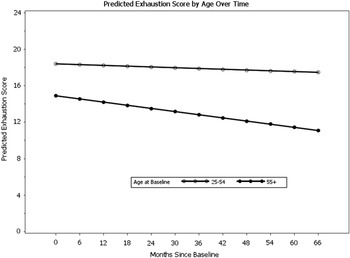
Table 3 shows the results of the uncontrolled and controlled mixed models predicting burnout symptoms over time. In the uncontrolled model for EE (Model 1), the effect of age differed over time. These trajectories are shown in Figure 1, with those aged 55 years or older showing a greater decrease in EE symptoms over time compared to younger participants. A similar trend was observed in the controlled model (Model 2). Those participants aged 55 years and older showed a significant decrease in levels of EE (slope = −.056, p < .0001), while those younger than 55 years of age showed no significant change over time (slope = −.019, p = .0254). On average, Black clergy had lower levels of EE compared to Whites. Those with higher levels of perceived emotional support and those with higher levels of SWB had lower levels of EE over time. Women had more EE compared to men as did those who worked full-time compared to part-time, those with higher levels of perceived financial stress, and those with higher levels of occupational distress.
Results of repeated measures mixed models predicting burnout symptoms up to 66 months post-baseline by age at baseline, both uncontrolled and controlling for potential confounders (n = 1161) a

a For exhaustion symptoms 6361 observations from 1161 participants; for depersonalization symptoms, 6359 observations for 1161 participants; for accomplishment symptoms, 6358 observations from 1161 participants.
Predicted exhaustion score by age group over time.

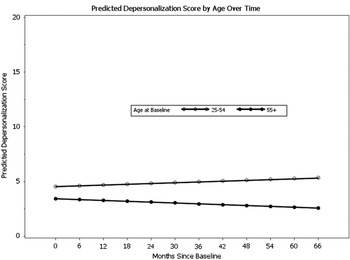
As shown in Table 3, the trajectories of the DP subscale of burnout also showed age differences over time. In the uncontrolled model, those aged 55 years or older showed a decrease over time, while those less than 55 years of age showed an increase in DP. These differences are shown in Figure 2. This pattern was also observed in the controlled model. DP scores on average increased over time among those aged 25–54 years and decreased over time on average among those aged 55 years or older. The slope for those aged 25––54 years was positive, an increase of .010 in DP score (p = .0078), while the slope for those aged 55 years or older was negative, a decrease in score (−.012, p = .0056). Levels of DP were higher over time on average for those who had full-time appointments and those who had higher levels of occupational stress, and lower for those who had higher levels of perceived emotional support and SWB.
Predicted depersonalization score by age group over time.

On average, in the uncontrolled model, perceived PA did not significantly change over time. Those aged 55 years of age and older had higher levels of a sense of PA. A similar pattern was observed in the controlled model. The age × time interaction term was not significant (slope = −.001, p = .8598) and was removed from the model. Black clergy had a lower sense of PA over time, as did participants in poorer health and those with higher levels of occupational distress. Participants with higher levels of perceived emotional support and those with higher levels of SWB had a higher sense of PA over time.
Discussion
We report several new findings from this research in a sample of working adults with similar levels of education and occupation. Across five measures of mental health, adults aged 55–81 years had lower levels of depressive, anxiety, and burnout symptoms compared to those aged 25 to 54 years, and there was no evidence to suggest these trends in mental health benefits reversed over the length of the study, which was up to 66 months. For two outcomes, EE and DP, these differences became more pronounced over time. These results add to the literature by extending earlier cross-sectional findings to trajectories over time, and doing so with an employed and generally older sample. While our older age group includes some participants less than 60–65 years of age, these findings are especially important when viewed in the context of many older adults choosing to actively work past what was previously considered traditional retirement age.
Although the results are generally consistent with cross-sectional studies from the general population which show lower levels of depression, anxiety, and burnout among older adults, in the current study, we know all participants were currently employed, adding to the literature on mental health and age while employed. Older workers may have higher levels of resilience, shown among older adults to be positively correlated with age and negatively correlated with depression and anxiety (Laird et al., Reference Laird2019). As previously reported, national studies in the US have documented that the prevalence of depressive and anxiety disorders is lower among older adults in general (Grant et al., Reference Grant2005; Gum et al., Reference Gum, King-Kallimanis and Kohn2009; Hasin et al., Reference Hasin, Goodwin, Stinson and Grant2005). Our work is consistent with that of Maslach and Jackson in their original work who found all three dimensions of burnout were less prevalent among older workers in human services fields (Maslach and Jackson, Reference Maslach and Jackson1981). Specifically, our findings are generally consistent with previous work showing moderate levels of EE and low DP among those in another caregiving occupation, caregivers of people with dementia (Costello et al., Reference Costello, Walsh, Cooper and Livingston2019). A recent meta-analysis of burnout in mental health professionals found a negative correlation between EE and age and a positive correlation between increasing age and PA. Most of the studies included in this meta-analysis reported a decreased risk of DP with increasing age, although some found a positive relationship (O’Conner et al., Reference O’Conner, Neff and Pitman2018). The current study’s findings differ from some earlier work in clergy that reported the level of burnout symptoms was not associated with age (Doolittle, Reference Doolittle2010). The findings were consistent, however, with a study of burnout that found that among clergy who had only served 1 year in ministry, chronological age was negatively associated with levels of EE and DP, suggesting an age difference rather than a difference attributed to time in ministry (Randall, Reference Randall2007).
Our findings were consistent with previous research in general samples observing associations between variables, such as financial stress, social support, physical health, and dimensions of mental health (Ahlin et al., Reference Ahlin, Rajaleid, Jansson-Fröjmark, Westerlund and Hanson2018; Battams et al., Reference Battams, Roche, Fischer, Lee, Cameron and Kostadinov2014; Godin et al., Reference Godin, Kittel, Coppieters and Siegrist2005; Handley et al., Reference Handley, Rich, Lewin and Kelly2019; Stansfeld et al., Reference Stansfeld1997; Wang et al., Reference Wang, Lesage, Schmitz and Drapeau2008). Our findings were also consistent with some studies in clergy indicating that higher levels of SWB were associated with less burnout (Doolittle, Reference Doolittle2010).
We did not observe consistent patterns of correlates across the five outcomes, supporting previous work that burnout, depression, and anxiety may be different syndromes (Iacovides et al., Reference Iacovides, Fountoulakis, Kaprinis and Kaprinis2003; Koutsimani et al., Reference Koutsimani, Montgomery and Georganta2019). Unlike studies which reported a higher prevalence of depression and anxiety among Whites (Grant et al., Reference Grant2005; Hasin et al., Reference Hasin, Goodwin, Stinson and Grant2005), there were no racial differences in depressive or anxiety symptoms in our sample. These findings should be interpreted with caution as we may have had too few non-White participants to fully describe true racial distinctions. We did find racial differences with regard to burnout symptoms. Black clergy had higher levels of EE and lower levels of sense of PA. Although community population studies generally report higher levels of depressive and anxiety symptoms among women (Grant et al., Reference Grant2005; Hasin et al., Reference Hasin, Goodwin, Stinson and Grant2005), the women in our sample did not consistently have poorer mental health than the men. While at first this may sound promising for female clergy, it is possible that the lack of differences in depression and anxiety symptoms could be due to male clergy having above-average prevalence of depression compared to US non-clergy males (Proeschold-Bell et al., Reference Proeschold-Bell, Miles, Toth, Adams, Smith and Toole2013a). In the current study, women had higher levels of EE but not higher levels of depression, anxiety, or DP and did not report lower levels of PA. The higher levels of EE may be consistent with previous work that persistent job stress puts women at increased risk for poor mental health compared to men (Godin et al., Reference Godin, Kittel, Coppieters and Siegrist2005).
The only trajectory of mental health affected by marital status in these analyses was anxiety symptoms. Those who were married had increased levels of anxiety symptoms over time. This could be due, in part, to the strain of the occupation on one’s family. Working full-time vs. working part-time in ministry was not associated with either depressive or anxiety symptoms, but working full-time was associated with higher levels of burnout (EE and DP) over time. Perceived physical health was not consistently associated with poorer mental health. Self-rated health as fair/poor was associated with higher levels of depressive symptoms and lower levels of sense of accomplishment but not with anxiety or the other burnout subscales. Perceived financial stress was associated with depression, anxiety, and EE but not DP or PA. Higher levels of occupational distress, lower levels of perceived social support, and lower levels of SWB were associated with poorer mental health across the five outcomes.
These longitudinal data offer the opportunity to consider several hypotheses for future thought. Is EE a different construct than depressive symptoms based on the observed patterns of correlates? How do these burnout components interact with each other over time? Which of these five outcomes may be most amenable to change through an intervention? For example, PA may be deeply ingrained through life experiences and culture, making it difficult to change one’s current feelings of accomplishment. On the other hand, symptoms of depression and anxiety, as well as EE, may be more situation-specific and open to intervention. Indeed, in related work, clergy who had recently changed churches reported fewer depression and anxiety symptoms than those who continued to serve the same church (Eagle et al., Reference Eagle, Miles and Proeschold-Bell2017). In the burnout scale, DP captures more of an emotional distancing and/or lack of empathy or sympathy toward others. In psychiatry, DP focuses more on a perceived loss of identity or a feeling that one’s thoughts and feelings seemed not to belong to oneself. This may explain why some variables associated with trajectories of depression were not associated with DP.
Our research is not without limitations. Beyond full-time status, we did not control for other occupational characteristics, such as congregation size, rural or urban location, or senior or associate role, variables which could affect both clergy salary and levels of stress. We also did not control for time in ministry because chronological age may be more important than years in ministry as discussed above (Randall, Reference Randall2007). Older clergy with many years in ministry may be assigned to larger congregations with fewer financial and other problems, but at the same time many older clergy may be starting ministry as a second career and be placed in a smaller church with fewer resources. It was not possible to use these data to examine whether there were particular aspects of ministry or clergy personality that may be associated with poorer mental health as has been reported by other researchers (Miner, Reference Miner2007). We did not measure or, therefore, control for the positivity effect, which, as posited in socioemotional selectivity theory, is when younger adults prioritize goals such as knowledge acquisition, whereas older adults prioritize optimizing positive emotions; attention among older adults shifts with age to processing positive information more deeply than negative information (Carstensen, Reference Carstensen2006; De Raedt et al., Reference De Raedt, Koster and Ryckewaert2013; Ebner et al., Reference Ebner, Freund and Baltes2006). We used a cut point of 55 years to describe older adults, recognizing some of the older participants were younger than traditional retirement age but at an age when they might recognize that their remaining time to work is diminishing. For example, Carstensen (Reference Carstensen2006) argues that the difference in positivity lies in how much longer you believe you have left as opposed to age per se. Finally, among the older clergy who were still appointed to a church, we do not know if factors such as financial insecurity affected why they continued to work or whether caregiving responsibilities, for example, did not allow others to continue working. Similarly, we do not know whether depression, burnout, or anxiety contributed to early retirement for those not included in these analyses.
More importantly, the current research has a number of strengths. We surveyed a large number of employed clergy with an age range of 25–81 years, following them longitudinally for up to 66 months. Each of the mental health outcomes was measured every 6–12 months. This group was homogeneous in the areas most important to address these research questions, education, and occupation. Clergy provide the opportunity to study these associations within a sample at risk for poor mental health because of job demands that can cause an imbalance between work and family, a risk factor known to be associated with both depression and anxiety disorders (Wang et al., Reference Wang, Lesage, Schmitz and Drapeau2008). We controlled for a number of potential confounders to describe the direct effects of age on these trajectories. We used standardized measures of depressive symptoms, anxiety, and burnout which allowed us to compare findings with previous work. One-third of our sample was female, reflecting changes in ordination patterns over the last decades, allowing a gender-diverse sample in which to explore these patterns. For example, our sample provided a larger proportion of men with higher levels of depressive symptoms than would typically be found in a community sample. Much of the previous work looking at the effects of job stress has focused on depression. The current research allows a broader definition of mental health to include anxiety and dimensions of burnout in addition to depression. While not part of the psychiatric nomenclature, burnout is an important focus of mental health professionals, particularly whether burnout and depression are different psychiatric entities (Bianchi et al., Reference Bianchi, Boffy, Hingray, Truchot and Laurent2013, Reference Bianchi, Schonfeld and Laurent2015). Most of the research describing the association between job stress and mental health has focused on issues such as job demands and control, job insecurity, and downsizing. The current research extends those findings by broadening job stress to include potential occupational stress experienced by those in caregiving occupations.
In summary, these findings have both clinical and research implications. Faced with the challenges of a higher likelihood of persistent occupational stress, older working adults may be able to balance personal life with occupation and engage in certain behaviors such as increased social support and, for clergy, increased SWB that may decrease stress in a way that allows these working adults to appear to tolerate working longer without poorer mental health outcomes. This is important as we observe patterns of older adults working past traditional retirement age and seek to support them.
Conflict of interest
The authors report no conflicts of interest.
Source of funding
These analyses and the preparation of the manuscript were funded, in part, by a grant from the Rural Church Area of the Duke Endowment. The Duke Endowment did not play a role in the design or conduct of these analyses, the interpretation of the results, the preparation of the manuscript, or the discussion to submit the paper for publication.
Description of authors’ roles
Dr. Hybels proposed the research question and led the statistical analyses and preparation of the manuscript. All of the authors participated in designing the analyses, interpreting the results, setting the results in context, and preparing the manuscript.
Acknowledgments
The authors would like to thank Carl Pieper, DrPH, for statistical consultation as well as the members of the Clergy Health Initiative Writing Group who participated in discussions of the analysis and findings. The authors would also like to thank the reviewers for their helpful comments which led to an improved manuscript.