Introduction
Jos is the capital of Plateau State and one of the most important cities in central Nigeria. The city is a microcosm of the country in terms of its complex and tense ethno-religious diversity. Broadly, Muslims are the majority in Jos North local government area while Christians predominate in Jos South and Jos East. It is difficult to get accurate religious demography in Nigeria due to the absence of official data. In assuming the Muslim majority, I use the election as a population indicator (people vote along religious lines) because Muslim candidates consistently win local government and national house of representative elections in Jos North.Footnote 1 Among the Muslim population, Sufis are the majority in most areas of the city while Jamā atu Izalatul Bid’ ah wa’ iqā matual Sunnah (the Society for the Eradication of Innovations and Establishment of Sunna), or Izala for short, remains a significant minority. Since most of the Muslims in Jos were Sufis before the advent of Izala, the latter might not be able to overturn this early advantage. Moreover, there are other Muslim minorities, such as Shia, Ahmadiyya and Yan Kala Kato (Qur’aniyyun).
This article is embedded within the multidisciplinary study of urban religion, which, among other things, encapsulates regimes of space and territoriality, materiality and sensorial power, and public visibility (Burchardt and Westendorp Reference Burchardt and Westendorp2018). For instance, a considerable number of studies highlight how public religious rituals such as processions (Kong Reference Kong2005; Nejad Reference Nejad2012; Alibhai Reference Alibhai2019) and amplified religious sounds (Larkin Reference Larkin2014; Van Dijk Reference Van Dijk2001) are deployed as spatial tactics for presence- and place-making. These studies interconnect with the notion of material religion that advocates for a shift from the mentalistic approach to the study of religion towards a focus on the material dimensions that place sacred objects, bodily performances, sensory experiences and spatial practices at the centre of scholarly inquiry, thereby opening up new perspectives on how religion takes place in urban space (Knott et al. Reference Knott, Krech and Meyer2016: 129).
This article attempts to remap the study of Islam in Nigeria by going beyond the tendency of scholars of religion in the country to focus on a single religious group or subgroup. In an attempt to correct this lopsided approach to the study of religion, I examine how different religious groups become entangled with each other in the pluralistic public space of the city, through various spatial practices and the deployment of material objects. To understand this entanglement, I examine how Izala, Sufis and Christians mobilize material and sensorial resources such as sounds, images and lights as instruments in a dialogical struggle of presence- and place-making. To demonstrate the importance of remapping such scholarship in Nigeria, this article shows that some practices of one religious group may be better understood and appreciated in relation to the practices of another group that shares the same habitat. Therefore, this remapping is an attempt to push the boundaries of studies of Islam and Muslim culture in Nigeria.
The first section of the article briefly traces the development of the Tijāniyya Sufi brotherhood and the Izala organization in northern Nigeria, and the latter’s dominance of the acoustic sphere through the widespread use of loudspeakers and organized preaching in public spaces. I suggest that the Sufis equate Izala’s sonic dominance to a spatial claim over the city, which has led them to respond through a rejuvenation of their Mawlūd celebrations in Jos. The second section describes these Mawlūd celebrations, which have evolved into a month-long spectacle including elaborate decorations festooned throughout the city featuring images of Shaykh Ibrahim Nyass and Christmas lights and objects. The third section focuses specifically on the Sufi adoption of Christmas lights. Despite the widespread prominence of light in religious rituals and metaphors, it has not been given adequate attention in the academic study of religion. This is why Bille and Sørensen (Reference Bille and Sørensen2007) called for the development of an anthropology of light, while Stolow and Meyer (Reference Stolow and Meyer2021) dedicated a special issue of the journal Material Religion to the subject. In different spatio-temporal contexts, the articles in the special issue (Stolow and Meyer Reference Stolow and Meyer2021; Rakow Reference Rakow2020; Verrips Reference Verrips2020) highlight how light and lighting techniques and technologies are harnessed to orchestrate religious mediation. In this article, I focus my analysis on how the Sufis have borrowed and re-conceptualized Christmas lights, not only as a part of the paraphernalia of the Mawlūd celebrations, but also as an instrument of presence- and place-making in the city.
In the fourth section, I examine how iconic pictures of Shaykh Ibrahim Nyass are displayed in all corners of the city as key objects in the Mawlūd celebrations. Unlike light, which has not yet been extensively investigated, religious images have been broadly studied in their multiple ramifications and across a wide range of disciplines (Meyer Reference Meyer2011; Reference Meyer2010; Morgan Reference Morgan2018; Reference Morgan2005; Pinney Reference Pinney2004). The focus of these studies includes the capacity of images to enact presence and agency, to inspire devotion, or to engender fear and iconoclasm. In this section, however, I focus on how Sufis use images to take over public space. As with the iridescent effect of the Christmas lights, by enmeshing the cityscape with innumerable pictures of Nyass, I argue that the Sufis are engaging in a spatial strategy of claim- and presence-making in the city. In the fifth section, I provide an empirical account of how the deployment of sounds, images and lights by Sufis and Izala goes beyond spatial politics, but also simultaneously descends into the dialogic politics of provocations that transform the city into a zone of contestations, which sometimes degenerate into physical conflict.
Sonic presence: Sufis, Izala and the struggle for acoustic space
Tijāniyya is currently the predominant Sufi brotherhood in northern Nigeria, although it was not a significant force in the region until the appearance of the charismatic Shaykh Ibrahim Nyass (1900–75) and the revivalist faida (flood) movement that he initiated, which continues to reverberate across West Africa today. The advent of the faida movement is believed to have been foretold by the founder of the Tijāniyya brotherhood, Shaykh Ahmad Tijani (1737–1815); it refers to the flooding of divine knowledge, as well as spiritual and material blessings, into the world. Shaykh Nyass claimed to be the embodiment and harbinger of faida (Brigaglia Reference Brigaglia2014). In 1937, having met Shaykh Nyass during a pilgrimage to Mecca, the emir of Kano, Alhaji Abdullahi Bayero (d. 1953), gave him his oath of allegiance and declared himself a disciple. As a result, other prominent Tijāniyya leaders in northern Nigeria, including in Jos, also offered their allegiance to Shaykh Nyass and took up the mission of propagating the faida movement through teachings, writings and links with trade networks across the country (ibid.).
Shaykh Nyass visited Jos in the early 1970s. At the request of the Tijāniyya elders of the city, the then governor of Plateau State, J. D. Gomwalk, provided a modern furnished apartment in the Rayfield area close to the government house to host him. Today, Sufis in Jos are always happy to mention that Shaykh Nyass spent a great deal of time in the city, more than in any other place he had previously visited in Nigeria, even if this was due to the bad weather that delayed his return flight. They also say that Shaykh Nyass offered a special prayer for the city.Footnote 2
It was against the backdrop of Sufi dominance in northern Nigeria that the Izala movement emerged as a powerful challenger. Izala was founded by Shaykh Isma’ila Idris in the city of Jos in 1978, with the sole agenda of purifying Islam from bid’a (innovations) and folk practices, such as the use of amulets, drinking washed scriptural verses written on a slate, intercession at the tombs of saints, singing songs of praise to the Prophet, exorcism and sorcery (Loimeier Reference Loimeier1997).Footnote 3 From its inception, Izala affirmed and assumed its mission of propagating the principle of the absolute unity of God (tawḥīd) and the completeness of the Islamic tradition, as taught and delivered by the Prophet (Sounaye Reference Sounaye2014a: 86). At present, Izala is led by Shaykh Sani Yahaya Jingir, who is the leader of the National Council of Ulama, the organization’s highest executive body.Footnote 4 It is noteworthy that Izala is always associated with the city of Jos, which serves as its national headquarters; millions of Izala members all over the country have a special regard for the headquarters of their religious organization, where their beloved and highly respected national leader Shaykh Sani Yahaya resides.
Izala developed a preaching strategy that propelled it to prominence in the country. The Izala organizational structure reflects the form of Nigerian federalism, with branches at the grass-roots, local government, state and national levels. Each of these divisions organizes its own preaching programmes, both inside mosques and in public spaces. The national preaching is a mass event that draws thousands of participants from all corners of the country. It is also a media event: sermons are recorded and distributed to mosques and subsequently broadcast via loudspeakers to the public (Sounaye Reference Sounaye2014b). The sound of Izala preaching does not emanate only from mosques; it is also broadcast through loudspeakers in public spaces, such as parking lots and market squares, and from cars that cruise the streets and alleyways. Early in the morning, at around 4 a.m., before the cacophony of the city coming to life, Izala mosques play audiocassette recordings of sermons through loudspeakers, which are able to traverse long distances and incorporate those who listen into a common acoustic space (Illich Reference Illich2000). Izala sees the act of playing sermons at this time, when most people are still asleep or just waking up, as a particularly effective means of da’awa (evangelism). This kind of sound – a sound that invades the people’s privacy and sometimes also their religious sensibilities – evokes what Isaac Weiner (Reference Weiner2013: 4) describes as ‘aural aggression’.
Through the adept use of sound mediums such as loudspeakers, audiotapes and broadcast media, Izala saturates the ambiance of the city with its sound and projects a sense of dominance over the public sphere. According to Brian Larkin (Reference Larkin2014), the use of loudspeakers in religious settings is not only a means of evangelism or da’awa, but also a performance of presence-making. Apart from announcing presence, religious sounds that emanate from loudspeakers and other sources can also be seen as an act of place-making. One can easily recognize the religious identity of a particular area of the city of Jos by the sound environment. By dominating the sonic ambiance of the city, Izala creates an impression of physical or demographic domination. The successful impact of this impression has led to serious reactions from Sufis, against whom Izala directs its barrage of amplified, scathing sermons and diatribes. Izala preaching contains derisive criticism of the veneration of saints and the practice of Mawlūd.
It is important to note here that the Sufis are not at a complete acoustic disadvantage with respect to Izala, since they also play zikr (melodious repetition of the names of God) or qasida (praise songs to the Prophet) through loudspeakers, but they are strategically disadvantaged and outplayed in terms of organized and amplified preaching. The Sufi response to Izala sermons has manifested in a doubling down on their practices that Izala specifically criticizes. This is particularly prominent in the new and increasingly flamboyant way of celebrating Mawlūd (Umar and Woodward Reference Umar and Woodward2020).
Christians, who are important actors in this spatial contestation in Jos, compete with Izala in the politics of sound, as they also mount loudspeakers on churches and moving cars and in front of gospel music shops. Where I reside in Jos is close to a Christian neighbourhood, and so I am often awakened by church loudspeakers at around 4 a.m., which is obviously a reaction to Izala’s sonic practices. As sound constitutes a physical signature of human surroundings, Izala, Sufis and Christians compete to drown out one another through loudspeakers in the contested politics of space- and presence-making.
Mawlūd celebrations in Jos
Mawlūd, which literally means ‘birth of the Prophet’, is the observance of the birthday of the Prophet Muhammad, which in Sunni Islam is commemorated on the twelfth day of the Islamic month of Rabi’al-awwal. Mawlūd is accepted and celebrated in most of the Islamic world.Footnote 5 The root of Mawlūd as a festive celebration to commemorate the birthday of the Prophet began 500 years after the Prophet’s death in 632 ad, in the Shiite Fatimid dynasty of Egypt. However, Mawlūd is now a highly contested religious festival since the emergence of Wahhabism in the late 1700s and the rise of conservative forms of Salafism in the late 1800s, which condemn the practice as bid’a because it was not practised by the Prophet himself or his companions (Schussman Reference Schussman1998). Despite sharp criticism from the Salafis, Mawlūd is now recognized as a national holiday in most Muslim-majority countries, including Nigeria, with the exception of Wahhabi-oriented countries such as Saudi Arabia, Kuwait and Qatar (Stanton Reference Stanton and Merkel2015).
According to my interlocutor Mallam Mustafa, Muslims of Jos who predominantly belong to the Tijāniyya Sufi order commenced celebrating Mawlūd in the 1950s. Mallam Mustafa stated that Mawlūd was first introduced in Jos by the renowned Kano-based Tijāniyya scholars Abu Bakr al-‘Atiq (d. 1974), Ahmad al-Tijani b. ‘Uthman (d. 1970) and Muhammad al-Thani Kafanga (d. 1989), who were active promoters of Fayda Tijāniyya (Brigaglia Reference Brigaglia2014: 104).Footnote 6 It was through the influence of these Kano-based scholars that Alhaji Salihu Nakande – a great patron of Tijāniyya – organized the first Mawlūd celebration in the city in the early 1950s.Footnote 7 As a successful businessman and devout follower of Tijāniyya, Nakande hosted most of the Sufi scholars who visited Jos.Footnote 8 When Makarantun dare (Islamic night schools) emerged in the city in the early 1960s, they started organizing their own Mawlūd celebrations; parents of the students were invited to attend and students recited the lessons they had learned and sang qasida or praise songs to the Prophet Muhammad. The organizers also invited local ulama, who narrated the birth story of the Prophet. Students of nearby schools were invited to attend either to recite verses of the Qur’an or to sing qasida. In the early 1970s, the Jos chapter of the Jama’atu Nasril Islam (JNI) introduced annual citywide Mawlūd celebrations to take place on the twelfth day of the month of Muharram at the Rwangpam stadium. Thousands of people would attend, including students of the Islamic night schools as well as city elders and the ulama who preached the virtues of the Prophet. The students would walk to the stadium in colourful processions, carrying banners displaying the badges and names of their schools inscribed in Arabic calligraphy (see Figure 1). Rwangpam stadium has become a large multi-purpose space that hosts a variety of mass activities, ranging from sports and entertainment to religious and political rallies. The stadium is co-opted into the contested politics of presence- and place-making in the city by becoming a site – when events are held – where competing religious groups attempt to attract as many attendees as possible, partly to showcase their numerical power.
Mawlūd celebration in Jos in 2020.

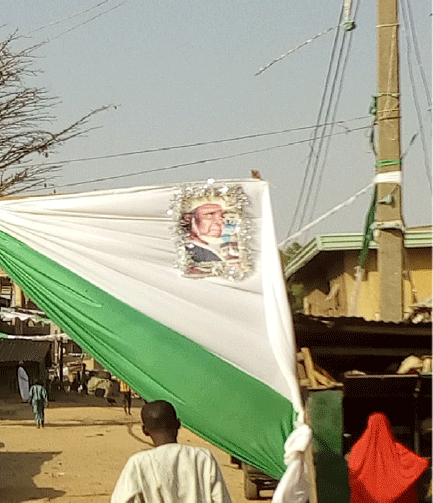
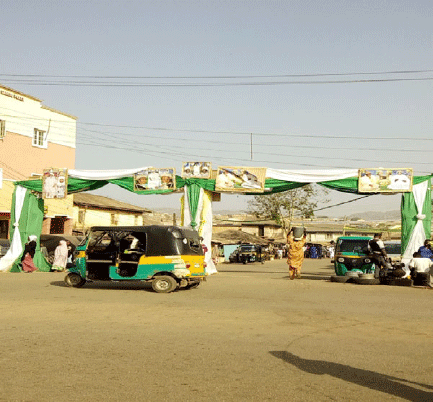
In response to Izala’s relentless criticism of the Mawlūd celebrations through amplified sound, Sufis rejuvenated the practice in the city in 2010, transforming it into a glitzy public spectacle. The gigantic processions are now made up of different groups of sha’irai (singers of praise songs to the Prophet) with their entourages, which involve young men and women dancing and singing in the street. However, the most innovative aspect of the reinvigorated Mawlūd celebrations is the transformation of the city through a variety of decorations that include pictures of Shaykh Ibrahim Nyass and other saints, flags and Christmas lights, as well as the construction at the entrance to several main streets of wooden arches adorned with a variety of illuminated objects (see Figure 4). This reinvigoration of the Mawlūd celebrations in Jos could be seen within the framework of what Umar and Woodward (Reference Umar and Woodward2020: 52) describe as ‘Izala effects’ – namely, the reaffirmation of beliefs and the intensification of practices that Izala is determined to eradicate.
Shimmering presence: seeing the dark light
The Sufis of Jos have adopted the use of Christmas lights to decorate the city as part of the Mawlūd celebrations.Footnote 9 As soon as the month of Mawlūd begins, Sufi youths from each Muslim area of the city mobilize to seek financial donations from their neighbours to buy the materials needed to decorate various spaces in the city.Footnote 10 They weave strings of multicoloured Christmas lights and bunting with white and green flags, which they fasten high up, close to the roofs of the houses, crisscrossing the streets and lanes from one side to the other. They also fix the lights on high structures such as electricity poles, multistorey buildings, billboards and trees. This is done without any government regulations. Houses close to the arches provide electricity to power the Christmas lights, while sometimes car batteries are used as a power source.
Sufis in Jos have borrowed this practice from their Christian neighbours to give emphasis to their Mawlūd celebrations in the city. The Sufis have reconceived and reconstituted the use of Christmas lights and wreaths as pure material objects of beauty that can be used in Islamic celebrations and as a means of visually imprinting Mawlūd festivities on the urban landscape. The resplendent strings of blinking lights that permeate the physical spaces of the city create a special lightscape that generates an affective atmosphere and a mood of joyful celebration. A lightscape is about ‘recognizing the luminosity and materiality of the light source, and the extended agency it offers to its surroundings’ (Bille and Sørensen Reference Bille and Sørensen2007: 274). One could argue that the new Mawlūd lightscape reconfigures the cityscape with luminous, attractive objects; these radiate an atmosphere of celebration that marks the month of Mawlūd as a distinct and special moment, and that reminds residents of the birth of the Prophet. The sense of celebration created by the affective atmosphere of Christmas lights is enhanced by the darkness of the night in a city where the street lighting infrastructure is close to collapse and where there are protracted blackouts. Darkness frames the light just as silence enhances the audibility of sound.
Another Christmas object incorporated into the Mawlūd celebrations is the wreath – an assortment of leaves, flowers or other objects assembled to form a ring. Wreaths are positioned around the pictures of Shaykh Nyass that are hung on top of the temporary wooden arches (see Figure 2). In some Western countries, wreaths are typically used as household ornaments, most commonly as Advent and Christmas decorations. The luminous, shining wreaths that adorn the pictures of Shaykh Nyass make the images come alive at night and enhance their conspicuousness. Notwithstanding the fact that wreaths are often associated with images of Jesus, the Sufis have adopted them because shininess and luminosity have sacred and spiritual dimensions in different religious traditions (Saunders Reference Saunders, Jones and MacGregor2002). The Mawlūd wreaths, which are woven with shining strings of silver-coloured objects as well as shimmering lights, enhance the pictures of Shaykh Nyass with an ‘aesthetic of spiritual power’ and attraction (Keates Reference Keates, Jones and MacGregor2002: 118).
Picture of Shaykh Nyass adorned with a wreath at Layin Zana Street in Jos.

Apart from utilizing Christmas lights as an object of celebration, it is apparent that the Sufis have another motive that spotlights the contested politics of presence-, place- and claim-making in the city. Light is not only a medium of visibility; it also has the capacity to play an active social role and serve as a powerful material agent (Bille and Sørensen Reference Bille and Sørensen2007). In this vein, the Sufis harness the agency of light and use it as a technique to announce their presence in the city by transforming the nightscape of Jos into a ‘shimmering presence’ (Kearney Reference Kearney2015: 269). Enacting this shimmering presence is one of the modalities that counterbalances the aggressive ‘sound presence’ of Izala. Just as the amplified sounds of the Izala sermons that castigate Sufi practices travel long distances, so do the sparkling lights of Mawlūd shine through the nocturnal urban space, breaching spatial boundaries. It could be argued that the luminous aesthetics of Mawlūd have become a mechanism for mobilizing and enacting Sufi religious identity in the urban space through the materiality and agency of light.
Izala members respond with disgust towards the new glittering visual trope of the Mawlūd festivities that transform the cityscape into a geography of spatial contestations. As one of my Izala interlocutors stated:
During the month of Mawlūd, I am often overwhelmed with anger and rage to see the area where I reside littered with Christian objects. It is really sad that Yan Tareeqa [Sufis] have now resorted to mimicking Christianity in what they believe to be an Islamic celebration. What they are doing is downgrading the high status of Islam. Whenever I look at this light, I only see the darkness of unbelief and bid’a. Footnote 11
From the perspective of this interlocutor and several others whom I interviewed, Christmas lights do not radiate illumination but rather signify a descent into the dark abyss of bid’a. According to my Izala interlocutors, the act of borrowing implies the superiority of the one who is borrowed from over the one who is borrowing. Therefore, they assume that by borrowing a Christian practice, Sufis are asserting that Islam is inferior to Christianity.
The Sufis, on the other hand, do not subscribe to this logic of borrowing. Indeed, they continue the practice because it has succeeded in eliciting the emotional response they intended to evoke. The Sufis are well aware that the Christian origin of Christmas lights will further provoke the Izala reformists. As one of the donors of the city’s decorations told me: ‘I support and finance these activities because they make the Mawlūd celebration more beautiful and at the same time hurt the feelings of yan Izala [members of Izala].’ Similar remarks about offending Izala through the use of conspicuous material objects continually arose in my conversations with Sufi youths, confirming that the offence and provocation caused by the use of Christmas lights in the Mawlūd celebrations are indeed intentional.
Apart from responding to Izala, there are other objectives that underscore Sufi city decorations. My interlocutor – one of the pioneers of city decorations and arch constructions – told me that there is a spiritual meaning behind their actions. He stated that Amina, the mother of the Prophet Muhammad, had experienced visions that included seeing lights, flags and spiritual beings during her pregnancy; therefore, the city decorations are an attempt to represent and materialize her visions as a welcome to the Prophet’s birthday.
As in other world religions, the metaphorical use of light is a prominent feature of Islamic traditions. In various Islamic texts, the Arabic word nūr, ‘light’, is metaphorically used to refer to God, Islam, faith and the Prophet. The Sufi mystical traditions extend the use of light beyond the metaphorical trope. For the Sufis, light was the first creation of God, and the Prophet Muhammad existed as pure light in primordial times even before the creation of the world (Dehlvi Reference Dehlvi2012). Both Shaykh Ahmad Tijani and Shaykh Ibrahim Nyass emanated ontologically from the original light of the Prophet; therefore, their essential being was constituted of transcendental light.Footnote 12 One can argue that Sufis find it easy to co-opt the use of Christmas lights because light has ontological significance in Sufi spirituality. In the Sufi biography of the Prophet Muhammad that is ritually narrated during the Mawlūd celebrations, on the day when the Prophet was born, a miraculous light with sparkling beauty radiated and filled the entire world. It thus follows that enveloping the city in flickering, multicoloured lights and encircling the pictures of Shaykh Nyass with luminous wreaths echo the great light that announced the birth of the Prophet. Furthermore, celebrating Mawlūd with light could also be seen as a symbolic expression of joy and remembrance of the day when the Prophet arrived in this world.
The Muslim borrowing of Christmas lights is not a one-way trade; Christians also borrow some forms of Muslim practice. One Christian group that borrows heavily from Muslims is Bazata Gospel International, which was founded by Yakubu Gidado in 1991. The term bazata is a Hausa-language word meaning ‘unexpected’; in the context of this ministry, it indicates that Jesus will come at a time that no one expects. Bazata’s strategy of evangelism uses preaching, gospel music, films and drama in the traditional Hausa Muslim style. In his weekly television programme, Pastor Gidado dresses like a Muslim imam, begins preaching with his version of basmala,Footnote 13 and sometimes recites Tijāniyya’s salatul fatih in Arabic, replacing the name of Muhammad with the name of Jesus.
Iconic presence:Footnote 14 when images ‘hit me on my face’
One of the most important features of the rejuvenated Mawlūd celebrations is the prominent deployment of pictures of Shaykh Nyass as a key visual element. At the beginning of the month, Sufi youths paste or hang pictures of Nyass in all corners of the city, including in private houses and public buildings, on trees and from overhead power cables. During the citywide celebrations, groups of sha’irai praise singers carry large banners that display images of Nyass on their spectacular processions to the Mawlūd ground. At the Mawlūd ground, countless pictures of Nyass are displayed high up on banners, while on the ground numerous merchants sell Sufi religious merchandise: posters of Nyass and Sufi saints, tasbih or subha Islamic prayer beads, fragrance and chew sticks. Young women wear pictures of Nyass on their hijabs.
When I asked Mallam Mustafa, a famous Tijāniyya imam in Jos, about the meaning of the use of pictures of Shaykh Nyass in the Mawlūd celebrations, he responded as follows:
Mawlūd is a celebration of the birthday of the Prophet, and since images of the Prophet cannot be used, there is no one in this world who can represent the Prophet as Shaykh Ibrahim Nyass. This is because no one cultivated the devotional love of the Prophet as Nyass. In fact, Nyass had dissolved himself in the overwhelming love of the Prophet. Another reason is Shaykh Nyass is a shareef or blood descendant of the Prophet.
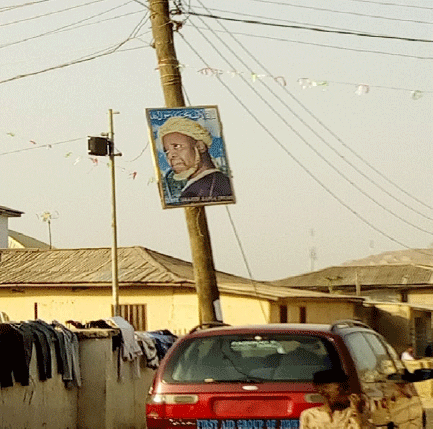
As displayed in the above remarks, pictures of Shaykh Nyass are transformed into symbols and objects of Mawlūd in Jos because the Shaykh was a descendant of the Prophet as well as the embodiment of his love. As a result, the pictures not only represent the personality of Nyass himself; they are also inextricably linked with the Prophet (see Figure 3). Moreover, it is important to note that the use of pictures of Nyass is not confined to the period of Mawlūd; they are part and parcel of Sufi visual culture. In fact, the mass-produced iconic pictures of Shaykh Nyass are probably the most recognizable pictures in northern Nigeria and in the south-west among Muslims. The pictures come in multiple forms, ranging from posters, bumper stickers, pendants and keyrings to screen wallpapers for mobile phones and computers. The pictures inhabit both public spaces and private homes, and they adorn human bodies as wearable religious objects.Footnote 15
Picture of Shaykh Nyass at Shagari Corner in Jos.

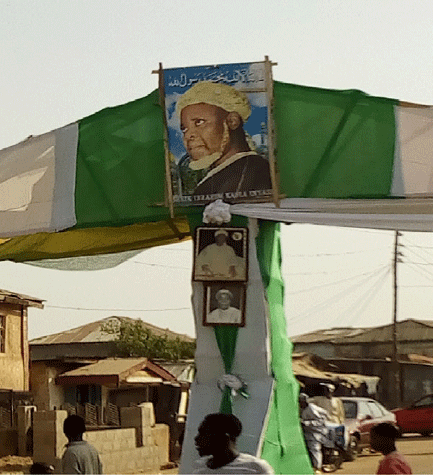
Pictures of Sufi saints on the arches at Layin Sarki in Jos.

In the first week of the month of Mawlūd, Sufi youths construct temporary high wooden arches at the entrances to major streets and decorate them with white and green materials, Christmas lights and outsized pictures of Shaykh Nyass at the top (see Figures 4 and 5). Youths from different areas of the city informally compete to make their arches the most attractive and conspicuous. Hanging a large picture of Nyass high above a street entrance is a performative act with multiple meanings. The significance of mounting the pictures high above the ground can be understood in the framework of the orientational metaphor, a system of ideas organized in terms of relations and interactions in space, such as up–down, inside–outside and in front–behind. According to Lakoff and Johnson (Reference Lakoff and Johnson1980), humans generally tend to associate goodness, high status and happiness with ‘up’ metaphors, while evil, low status and sadness are linked with ‘down’ metaphors. The high spiritual position, goodness and high status of Shaykh Nyass are metaphorically affirmed in this act of elevating his picture high above the ground. Placing the pictures high up also serves another strategy: it increases their visibility.
Mawlūd arch at Bauchi Road in Jos.

The informal name given to these arches by Sufi youths is komai Izalar ka sai kabi ta karkashi, meaning ‘no matter the intensity of your Izala you must pass under’. Employing a ‘down’ metaphor, Izala members and Salafis who are forced to walk underneath the pictures of Nyass are implicitly forced to take a low-status position in relation to him. A considerable number of Izala members and Salafis cannot hide their disgust, sense of offence and shame when they are forced to pass under these ‘arches of humiliation’, as I call them. The arches even reconfigure the movements of people in the city as they attempt long detours in order to avoid the shame of passing under the image of Shaykh Nyass.
The pictures of Shaykh Nyass have been made into a potent instrument of resistance to Izala domination of the public sphere and a weapon of retaliation against Izala’s incessant verbal criticism of others (see Figures 3 and 4). The Sufis do not perceive Izala preaching as a call to righteousness, but rather as an affront and sacrilege against their saints. David Morgan (Reference Morgan2018) maintains that images serve as agents by performing a variety of actions on human beings; on the other hand, humans also do something with images in order to effect changes in society. Sufis do something with the images of Nyass; by inscribing his presence in the cityscape, they invariably enact their own presence in the city. Furthermore, the pictures of Nyass, displayed either privately at home or publicly in the form of bumper stickers and keyrings, are markers of Sufi religious identity. It follows that the public display of pictures of Shaykh Nyass during the Mawlūd celebrations is a means of enshrining and performing Sufi identity in urban space. The ubiquitous pictures and the highly decorated wooden arches temporarily alter and refashion the cityscape to reflect Sufis’ ‘territorialized religious identities’ (Garbin Reference Garbin2012: 401).
Among the variety of Nyass’s pictures, one stands out; it is the most widely distributed and is recognized by most people in the country (see Figure 4). It is the picture snapped from the side in which Shaykh wore a black abaya with a white turban and his eyes looking upward. My interlocutor Ali Zakiru told me that this picture was snapped by Shaykh Muhammed Awwal Ayinla from Ilorin, Kwara State, when he visited Shaykh Nyass in Kaolack in 1956. On that visit, he asked Nyass’s permission to take his picture. The Shaykh agreed and he prayed for God to bless the picture and make it spread all over the world. Zakiru maintained that it is this prayer that makes this particular picture more powerful and charismatic than the rest.
Pictures of Shaykh Nyass are infused with an iconic quality; this refers to the particular human–object relation and how the iconic object is invested with a sacrosanct presence that is perceived and reproduced by its beholders (Knott et al. Reference Knott, Krech and Meyer2016: 129).Footnote 16 The iconic pictures of Nyass serve multiple functions among Tijāniyya adherents. While some keep the pictures for the purpose of love, loyalty and admiration of the Shaykh, for others the pictures are highly enchanted, agentive and devotional religious objects. In this view, Shaykh Nyass is not an ordinary human being; his real identity can be realized only through initiation into the tasawwuf that enables one to attain ma’rifa – that is, gnosis or the true divine knowledge.Footnote 17 This true knowledge enables one to realize that Shaykh Nyass is a living spiritual being who can still relate to his disciples. Thus, pictures of Nyass serve as a physical interface that mediates his real and hidden spiritual personage.
Through this power of mediation, pictures of Shaykh Nyass go beyond mere representation or enacting the presence of absence (Belting Reference Belting2016: 235); rather, they are potent sacred objects with full agency and the imagined capacity to offer protection from all kinds of physical or spiritual danger. In Sufi circles, stories abound about the protective powers of the pictures of Shaykh Nyass. However, while the enchantment of the pictures makes them desirable objects among Sufis, it is this same enchantment that makes them dreaded, polytheistic objects to the members of Izala. Some members of Izala feel as if the atmosphere surrounding the pictures and the ‘arches of humiliation’ is contaminated and unclean. One of my Izala interlocutors had this to say:
During the Mawlūd period, Yan Tareeqa [Sufis] display these pictures in provocative ways. And whenever I look at these pictures I feel as if they hit me on my face. I feel bad, but at the same time I feel sorry for Yan Tareeqa, because they have gone far and deep into polytheism, they believe that a picture can protect them instead of God. They are lost because they never listen or understand our preaching.
Sufis have capitalized on Izala’s dismay and revulsion over Shaykh Nyass’s pictures, and have instrumentalized and weaponized them in the intense struggle to mark their presence and engage in spatial politics in the city. As is highlighted in the remarks above, the pictures remind Izala members of the limitations of their decades of preaching against the veneration of saints. The widespread presence of the pictures in the city sends a message to Izala that what they preach against is alive and thriving; the sounds of their loudspeakers are not as effective as they want them to be. The presence of the pictures is ultimately about the presence and emplacement of those who put them there. Moreover, despite their opposition to their presence in their midst, Izala members do not attempt to deface the pictures, probably because they know that this would result in violent conflict.
Finally, I suggest that the multiple meanings encoded in the use of pictures of Nyass question the longstanding view in scholarship that depicts Islam as a radically aniconic religion. The visual practices of the Mawlūd celebrations, which are centred on the picture of Nyass, reveal that the issue of aniconism in Islam is laden with controversy and nuance of meaning and contestation (Meyer and Stordalen Reference Meyer, Stordalen, Meyer and Stordalen2019).
Entangled in sounds, images and lights
The Izala leadership and its members certainly perceive the new Mawlūd celebrations in the context of spatial politics and public space. The imam of a mosque at the Izala headquarters in the Sarkin Mangu area of Jos told me the following:
There is a huge conspiracy in the way Yan Tareeqa conduct the Mawlūd celebration in Jos. They do it this way because Jos is the national headquarters of Izala. So, they want to show that they dominate the city and to tell the world that Izala does not exist in Jos. If not, why is Mawlūd in core Tareeqa cities such as Kano, Maiduguri, Zaria not celebrated with such extravaganzas?
The imam clearly captures the feeling of Izala members that the reinvigoration of the Mawlūd celebrations is an attempt to diminish Izala visibility and presence in a sea of Sufi images and lights. Since Izala was founded in Jos and the city serves as its national headquarters, the organization interprets any transformation of the cityscape in the image of Sufis as a threat against its place there. A considerable number of Izala members from other states visit Jos to study at the School for Higher Islamic Studies.Footnote 18 When Izala split into two factions (referred to as Izala A and Izala B in academic circles) in the early 1990s, the rebels (Izala B) established their new headquarters in the city of Kaduna.Footnote 19 Izala A remained in Jos and its identity has become increasingly linked with the city. This may be the reason why Izala interprets the transformation of the cityscape during the Mawlūd celebrations as a conspiracy to subvert and sever its connection with the city.
During the 2017 Mawlūd celebrations, Sufi youths constructed a lavish and gigantic ‘arch of humiliation’ on the only convenient route that the national leader of Izala, Shaykh Sani Yahaya, passes along daily between his house and the city centre, including the Friday prayer mosque. Shaykh Yahaya, who has spent his entire career as a Muslim cleric preaching against the veneration of saints and Mawlūd, now had to pass under the elevated and decorated pictures of Nyass and other Sufi saints every day. At first, he tried to avoid going under the arch by taking another route through a street called Ali Kazure, but that route was too long and inconvenient for his large motorcade. He became furious and unleashed his anger throughout the Mawlūd period both in his Friday pre-sermon and during his daily short teachings after the dawn prayer in the mosque close to his residence. A few days after the general Mawlūd procession, Shaykh Yahaya made derisive remarks against the Mawlūd celebrations and images during his morning prayer preaching; these were amplified through loudspeakers. The video of these remarks spread through social media and WhatsApp. He also accused the Sufis of pasting the picture of ‘their god’ (Nyass) on the houses of Izala members. On his way home after he had finished preaching, and accompanied by his entourage and bodyguards (yan agaji), the group was accosted and insulted by Sufi youths who were offended by his remarks. The result was a bloody fight between the Sufis and the yan agaji. One of the yan agaji who had been involved narrated to me his experience:
As we were escorting Mallam [Shaykh Yahaya] back home after morning prayer and preaching, Yan Tareeqa [Sufi] youths accosted us and began insulting Mallam because he said the truths about their provocations throughout the month of Mawlūd. We immediately confronted them and a serious fight ensued between us and we fought in order to preserve the dignity of Mallam. One of the youths rushed towards me with a club intending to hit me. As I extended my hands to protect my head the club landed on my right hand, and it was instantly fractured. I felt dizzy and collapsed.Footnote 20
Due to the history of incessant ethno-religious riots and the volatile security situation in the city of Jos, soldiers had already been deployed as a peacekeeping force since 2008, so they were able to intervene immediately to stop the fighting. Later, the sector commander, who was working together with the commissioner of police to ensure security in the city, summoned representatives from both Izala and the Sufis to his office for mediation. Shaykh Yahaya did not attend the meeting in person, but sent representatives. After the commander had heard the account of each party, he passed a verdict that Izala should stop using loudspeakers in their mosques and that the Sufis should desist from pasting pictures of Nyass on the houses of Izala members.
Shaykh Yahaya did not accept this decision. Apparently, for him, loudspeakers are an integral part of the Izala project. They are one of the most effective mediums that Izala has to reach out to the public. Without the loudspeakers, Izala would be muted and toothless. In his next Friday pre-sermon preaching, Shaykh Sani Yahaya railed against the new verdict, declaring it unjust, unconstitutional and against religious freedom. He continued that the sector commander had no right to ban them from using loudspeakers and he appealed to the state governor to intervene.Footnote 21 In the end, neither Izala nor the Sufis abided by the sector commander’s decision and they continued with their activities – activities that continually trigger tension and conflict between the two religious groups.Footnote 22
In his subsequent Friday sermons at the Yan Taya mosque throughout the month of Mawlūd, Shaykh Yahaya continued to refer to the pictures of Nyass as hoton ubangijin su in the Hausa language (the picture of their god) and went as far as to express abuse and sarcasm at the iconic pictures. This bitter attack can be seen as an act of subversion and verbal iconoclasm that aimed to break the pictures’ iconic power (Belting Reference Belting2016: 235). Shaykh Yahaya claims that the use of pictures among Sufis ultimately extends to the deification of Nyass, a claim that has induced iconophobia among his followers.Footnote 23 It could be suggested that this act of verbal iconoclasm, projected through loudspeakers, is the symbolic destruction of the iconic images of Nyass and an act of counter-retaliation against the disturbing presence of the pictures in the shared environment.
In the same year, 2017, other influential Salafi scholars and one of the national leaders of Izala B, the late Shaykh Alhassan Sa’id, adopted a different strategy towards the apparent provocation of the Sufi youths who inundated his neighbourhood in Jos with pictures of Nyass and other saints.Footnote 24 Shaykh Sa’id remained silent and refused to comment. In that month, the presence of the pictures coincided with the marriage of one of Shaykh Sa’id’s daughters. Most of the influential and renowned Salafi and Izala B scholars in the country were invited to the wedding.Footnote 25 As the day of the wedding approached, Shaykh Sa’id found it humiliating and shameful that so many of the country’s key Salafi leaders coming to the wedding would be greeted by innumerable pictures of Sufi saints looking back at them in front of his house. Shaykh Sa’id knew that any attempt to remove or deface the pictures would lead to a quarrel, so he opted for a peaceful and clever solution. He called together the Sufi youths in the area and openly told them his concerns and gave them a reasonable amount of money to remove the pictures themselves. The youths collected the money and silently removed the pictures before the wedding day.
The two different approaches of Shaykh Sani Yahaya and Shaykh Alhassan Sa’id to the presence of the iconic – and, in their view, offensive and provocative – pictures in their vicinity highlight the nuanced and complicated nature of the entanglement fostered by religious materialities in the urban space. While Shaykh Yahaya unleashed a tirade of verbal iconoclasm that led to further violent confrontations, Shaykh Sa’id adopted diplomacy and offered a monetary incentive that led to the peaceful resolution of the problem. Even though there is an ethnic difference between Muslims and Christians, there is no ethnic difference between the two Islamic groups: most of them belong to the same Hausa, Fulani and Kanuri Muslims of northern Nigeria. Moreover, it is important to note that the division between Izala and Sufis has no substantial link to any other generational, economic, class or educational divide.
My Christian interlocutors indicated to me that they find it amusing and surprising that Muslims would borrow a practice associated with Christianity. Christians in Jos view Sufis as more accommodating and tolerant towards them than Izala and the Salafis. Izala ulamas are more likely to raise contested issues such as the indigene/settler problem that is at the heart of the conflict between Muslims and Christians in their preaching and sermons.Footnote 26 Shaykh Yahaya often makes incendiary and controversial remarks; this was particularly apparent at the height of religious conflict during the administration of Governor Jonah Jang (2007–15). Most of my Christian interlocutors suggest that the Sufis’ adoption of Christmas objects and Izala’s virulent criticism of the practice confirm their longstanding view that the Sufis have a softer and more tolerant attitude to them. My Christian interlocutors welcomed the adoption of Christmas decorations by the Sufis and saw it as a positive step towards amicable religious coexistence.
The convivial social relationship between Sufis and Christians involves mutual visits and the sharing of food during religious festivities such as Eid and Christmas. However, Izala, led by its founder Sama’ila Idris, launched a serious attack against receiving and consuming Christmas food by Muslims, claiming that it is haram (forbidden). At present, this practice of food exchange has diminished due to religious conflicts and residential segregation in the city. Despite the frequent religious conflict in the north, there is remarkable cultural affinity between Muslims and Christian in the region. It is for this reason that Last (Reference Last2007: 613) stated: ‘One found northern Christians wearing the normal dress of a Muslim Hausa, often taking an ordinary Hausa (Muslim) name and of course speaking the language well (but not Arabic). These new Hausa wanted to identify with a wider “northern” community that was not identified by religion.’
Conclusion
This article attempts to remap and push the boundaries of the study of Islam in Nigeria by bringing into a single analytical lens urban materialities and the multiplicity of practices in diverse religious groups who share the same spatial habitat. The article highlights how the shared urban space of Jos generates complex encounters and relationships between Izala, Sufis and Christians. The amplified sounds of Izala preaching that dominate the airwaves, the ubiquitous pictures of Nyass that permeate the city’s spaces, and the multicoloured Christmas lights that glow day and night combine to create an entangled affective atmosphere in the city every year during the month of Mawlūd. This entangled atmosphere is imbued with contradictory affective qualities of celebration, tension, hostility, conflict, a sense of belonging and difference.
The interesting aspect of this relationship is how Sufis have borrowed elements of Christianity, in the form of Christmas lights and objects, and have reconceptualized and integrated them into their Mawlūd celebrations, while at the same time they have instrumentalized them in the spatial politics of contestation against Izala.Footnote 27 This act of borrowing reveals that the longstanding conflict between Muslims and Christians in Jos does not preclude reciprocal influences between the two religious groups. It is for this reason that Benjamin Soares asserts that ‘it is a mistake to treat Muslims and Christians as monolithic communities that interact as [a] block … [T]he boundaries between Muslims and Christians have not always been rigid, fixed or unchanging’ (Reference Soares2006: 3). The fluid boundaries between the two groups have indeed engendered the mutual exchange of some practices between members of the two religions. Moreover, the spatial configuration of Jos, which is a colonial city that has not been traditionally dominated by a single group, provides a fertile ground for inter- and intra-religious competition, which spawns innovative spatial religious practices that regularly take over the public space, as we see in the mobilization of sound, images and lights. Unravelling these spatial entanglements generated by plural religious coexistence requires pushing the boundary of scholarship and taking into consideration more than one group within the analytical framework.
Murtala Ibrahim trained in Religious Studies at the University of Jos, Nigeria, receiving his PhD at the Department of Philosophy and Religious Studies, Utrecht University, in 2017. He has been a postdoctoral researcher at the Department of Cultural Anthropology, Utrecht University, since 2020.