Introduction
Major depression is common in patients with heart disease, with a prevalence of around 20% following acute myocardial infarction (MI) (Thombs et al. Reference Thombs, Bass, Ford, Stewart, Tsilidis, Patel, Fauerbach, Bush and Ziegelstein2006). However, the interpretation of the prognostic role of depression in patients with heart disease is still subject to debate. Two meta-analyses found that depression was related to a 2- to 2.5-fold increased risk of mortality and cardiovascular events in MI and heart disease patients (Barth et al. Reference Barth, Schumacher and Herrmann-Lingen2004; van Melle et al. Reference van Melle, de Jonge, Spijkerman, Tijssen, Ormel, van Veldhuisen, van den Brink and van den Berg2004). Nevertheless, it has also been reported that adjustment for cardiovascular disease severity and other disease-specific risk factors was often incomplete in individual studies (Nicholson et al. Reference Nicholson, Kuper and Hemingway2006). Thus, it is unknown to what extent depression is a truly independent prognostic risk factor, or one that is confounded by cardiovascular disease severity (Nicholson et al. Reference Nicholson, Kuper and Hemingway2006).
It has been hypothesized that the type of depression in patients with heart disease is not the same as in the general psychiatric population. Ormel & de Jonge (Reference Ormel and de Jonge2011) suggested an integrative model in which two prototypical forms of depression would comprise depression in patients with heart disease. These forms differ in terms of etiology and prognosis: a cognitive/affective subtype, marked by psychosocial vulnerability (e.g. avoidant coping, neuroticism, stress vulnerability), and a somatic/affective subtype, characterized by vascular disease [e.g. atherosclerosis, inflammation markers, sickness behavior, and deregulation of the hypothalamic–pituitary–adrenal (HPA) axis]. This model has been supported by findings from prospective longitudinal studies that investigated specific dimensions of depressive symptoms and their association with cardiovascular prognosis. In most of these studies, two symptom dimensions were distinguished: cognitive/affective (e.g. pessimism, guilt and self-dislike) and somatic/affective (e.g. insomnia, fatigue and work difficulty) depressive symptoms (Irvine et al. Reference Irvine, Basinski, Baker, Jandciu, Paquette, Cairns, Connolly, Roberts, Gent and Dorian1999; Roest et al. Reference Roest, Thombs, Grace, Stewart, Abbey and de Jonge2011). However, other distinctions were also made, such as including an appetitive dimension (de Jonge et al. Reference de Jonge, Ormel, van den Brink, van Melle, Spijkerman, Kuijper, van Veldhuisen, van den Berg, Honig, Crijns and Schene2006). A significant association between somatic/affective symptoms of depression and cardiovascular mortality among MI patients, even after adjustment for somatic health status, was reported by de Jonge et al. (Reference de Jonge, Ormel, van den Brink, van Melle, Spijkerman, Kuijper, van Veldhuisen, van den Berg, Honig, Crijns and Schene2006). By contrast, cognitive/affective depressive symptoms were not predictive of adverse outcomes. The same pattern of findings was reported in other studies in MI patients and patients with acute coronary syndrome (Martens et al. Reference Martens, Hoen, Mittelhaeuser, de Jonge and Denollet2010; Roest et al. Reference Roest, Thombs, Grace, Stewart, Abbey and de Jonge2011). However, two studies in patients undergoing coronary artery bypass graft (CABG) surgery reported an association of cognitive/affective but not somatic/affective symptoms of depression with cardiovascular mortality (Connerney et al. Reference Connerney, Sloan, Shapiro, Bagiella and Seckman2010) and recurrent cardiovascular events (Tully et al. Reference Tully, Winefield, Baker, Turnbull and de Jonge2011).
In a narrative review on this topic by Carney & Freedland (Reference Carney and Freedland2012), although most studies reported that somatic/affective symptoms were stronger predictors of adverse cardiovascular prognosis than cognitive/affective symptoms, the authors state that it is not yet possible to come to a conclusion. Several sources of bias were suggested, such as methodological inconsistencies across the studies (factor analytic techniques and covariate adjustments) and response bias (social acceptability of reporting somatic/affective symptoms versus cognitive/affective symptoms of depression). Most importantly, however, the literature on this issue lacks a systematic approach combining the existing evidence. The aim of the current study was therefore to investigate whether cognitive/affective and somatic/affective depressive symptoms are differentially associated with cardiovascular prognosis. We conducted a meta-analysis of prospective longitudinal studies assessing the association of cognitive/affective and somatic/affective depressive symptoms in patients with heart disease with cardiovascular prognosis.
Method
Inclusion criteria
The current study followed the Preferred Reporting Items for Systematic Reviews and Meta-Analyses (PRISMA) statement (Liberati et al. Reference Liberati, Altman, Tetzlaff, Mulrow, Gotzsche, Ioannidis, Clarke, Devereaux, Kleijnen and Moher2009) and the Meta-Analysis Of Observational Studies in Epidemiology (MOOSE) proposal for reporting (Stroup et al. Reference Stroup, Berlin, Morton, Olkin, Williamson, Rennie, Moher, Becker, Sipe and Thacker2000). The inclusion criteria were derived from four relevant characteristics of the studies examined, regarding patient group, depressive symptoms, outcomes and study design.
-
(1) Type of patients. Patients had to be diagnosed with one of the following conditions: coronary heart disease (CHD), acute coronary syndrome, myocardial ischemia, congestive heart failure, or MI. Studies focusing on patients who underwent CABG surgery or cardioverter defibrillator implantation were also included. One study with subjects with (suspected) myocardial ischemia, of whom 39.3% had a history of cardiovascular disease, was also included (Linke et al. Reference Linke, Rutledge, Johnson, Vaccarino, Bittner, Cornell, Eteiba, Sheps, Krantz, Parashar and Bairey Merz2009).
-
(2) Measurement of depressive symptoms. Depressive symptoms had to be measured using valid and reliable instruments (interviews or self-reports), after being diagnosed with one of the conditions listed in inclusion criteria (1). Moreover, dimensions of cognitive/affective and somatic/affective depressive symptoms had to be identified.
-
(3) Prognostic outcomes. End-points had to contain cardiovascular mortality, all-cause mortality or cardiovascular events (e.g. rehospitalization, stroke, congestive heart failure).
-
(4) Study design. Studies had to be prospective (a cohort or intervention study), with a minimum follow-up time of 12 months. Only studies presenting original data were included.
Identification of studies
We used four strings of free terms that we screened for in titles and abstracts of studies available in the literature. The first string represented the patient group: Cardiac OR Heart OR Myocard*. The second string represented depressive symptoms: Depress*. The third string described the dimensions of depressive symptoms: Somatic OR Cognitive OR Fatigue. The fourth string represented the outcomes: Mortality OR Prognos*. The literature search was performed in the electronic databases EMBASE, PubMed and PsycINFO, following previous work (Barth et al. Reference Barth, Schumacher and Herrmann-Lingen2004; van Melle et al. Reference van Melle, de Jonge, Spijkerman, Tijssen, Ormel, van Veldhuisen, van den Brink and van den Berg2004; Nicholson et al. Reference Nicholson, Kuper and Hemingway2006). The results of this search included all studies previously reviewed by Carney & Freedland (Reference Carney and Freedland2012), validating our search strategy. No limits regarding language and year of publication were applied. We also hand searched other systematic reviews and meta-analyses on the association between depression and heart disease. In the case of two studies reporting on the same sample, we selected the one most comparable to the rest of the studies (based on the questionnaire used and the objectives of the study). The literature search was performed on 4 January 2013. The complete search strategy is available in the online Supplementary Material.
The selection of studies was performed by two independent raters (R.deM.A. and A.M.R.) in two steps. The first step consisted of screening titles and abstracts obtained from the systematic search. Potentially relevant studies were included in the second step, which consisted of full text reading. The level of agreement between raters is represented by Cohen's κ coefficient.
Data extraction
The following data were extracted from the included studies: number of participants (sample size and percentage lost to follow-up), country, year of baseline assessment, percentage of males, mean age, mean or median duration of follow-up, labels of depressive symptom dimensions, method to generate the symptom dimensions, covariates used in the multivariate analyses, end-points, effect estimates [e.g. hazard ratios (HRs) and odds ratios (ORs)] and occurrence of the end-point. To pool the studies, we selected the analyses with the lowest number of covariates for the least-adjusted models and with the highest number of covariates in the fully adjusted models. In cases where more than two dimensions of depressive symptoms were reported in one study, we selected the two dimensions most comparable to the dimensions of the other studies. To check whether the dimensions were similar with regard to individual items, we listed the way these symptoms loaded at each dimension across the studies.
Statistical analyses
The overall meta-analysis consisted of pooling the effect sizes (HRs and ORs) for both cognitive/affective and somatic/affective symptoms dimensions. As not every study reported unadjusted results, we conducted least-adjusted and fully adjusted analyses. If the same study reported on multiple end-points, the hierarchy for inclusion in the overall analysis was: cardiovascular mortality, all-cause mortality, and cardiovascular events. Heterogeneity was assessed with the I 2 index: a value of 25% implies a small degree of heterogeneity, a value of 50% a moderate degree, and 75% a large degree (Higgins et al. Reference Higgins, Thompson, Deeks and Altman2003). Because significant heterogeneity across methods of individual studies (different end-points, questionnaires and patient groups) was expected, a random-effects model was chosen a priori rather than a fixed-effects model, as the first takes into account the within- and between-study variation of the distribution (DerSimonian & Laird, Reference DerSimonian and Laird1986).
To aid the interpretability of the pooled effect size, we performed a subgroup analysis of studies that calculated their risk statistic using ± 1 standard deviation (±1 s.d.) rather than arbitrary values in the depressive symptoms dimensions subscales. To calculate this, we used the following formula, where HR i is the hazard ratio associated with a symptom dimension i, SD i is the standard deviation of the symptom dimension score and U i is the unit of the associated risk (e.g. per one-point increase in the dimension score) (Davidson et al. Reference Davidson, Pickering and Jonas2001):
 $$\exp \{ {\rm ln[HR]}_i \times {\rm SD}_i {\rm /U}_i \}. $$
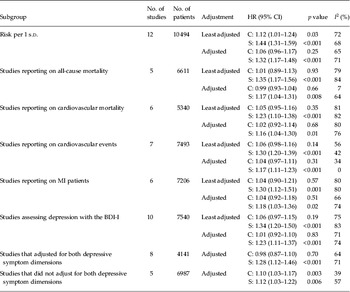
Subgroup analyses were planned a priori and were based on: end-points (all-cause mortality, cardiovascular mortality, and cardiovascular events), patient group (MI patients), assessment of depressive symptoms [Beck Depression Inventory – I (BDI-I); Beck & Steer, Reference Beck and Steer1987] and covariate adjustment (studies that adjusted and studies that did not adjust simultaneously for both dimensions of depressive symptoms). Subgroup analyses were performed on fully adjusted results.
One study reported results for two independent arms (drug versus placebo), and it was therefore included twice (once for each arm). In one study, cognitive/affective and somatic/affective symptoms were included as dichotomous variables (Schiffer et al. Reference Schiffer, Pelle, Smith, Widdershoven, Hendriks and Pedersen2009). To keep in line with the other studies, the authors provided us with the results including both dimensions as continuous variables. As not every author reported their results with the risk associated with a 1 s.d. increase in the symptom dimension, we requested means and standard deviations for the dimensions that were not reported in the manuscripts. One author provided us with the means and standard deviations for each dimension of depressive symptoms (Connerney et al. Reference Connerney, Sloan, Shapiro, Bagiella and Seckman2010).
To assess the agreement on symptom assignment to one of the two dimensions, a multi-rater κ coefficient was estimated for the BDI-I (Light, Reference Light1971). To get a conservative estimate, loss of appetite and weight loss were considered as cognitive/affective items for specific studies in which these items were excluded or included in a third dimension. Although loss of appetite and weight loss were not considered as cognitive/affective symptoms in any of the studies, we classified these items as cognitive/affective in these cases to avoid the possibility of overestimating the coefficient of agreement.
The possible presence of publication bias was examined using three different approaches: visual assessment of the funnel plot, Egger's regression approach, and the trim-and-fill method (Soeken & Sripusanapan, Reference Soeken and Sripusanapan2003). A funnel plot consists of a scatterplot displaying the effect sizes of individual studies on the horizontal axis and the standard error of the effect sizes on the vertical axis. If publication bias is absent, the display should be comparable to a funnel. In case it is asymmetrical, with studies apparently missing on the lower left side of the scatterplot, publication bias is likely to be present. Comprehensive Meta-Analysis version 2.2 (Borenstein et al. Reference Borenstein, Hedges, Higgins and Rothstein2005) was used to perform the analyses.
Results
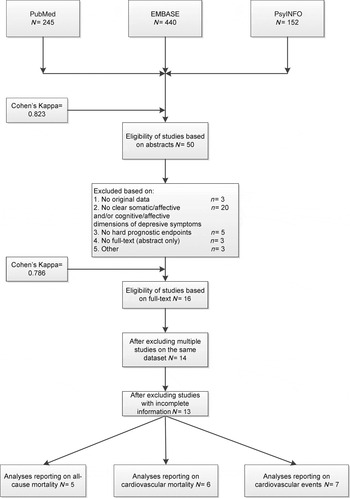
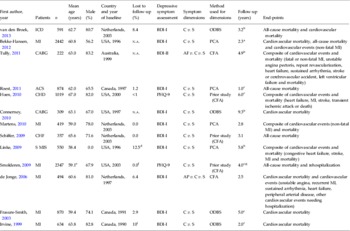
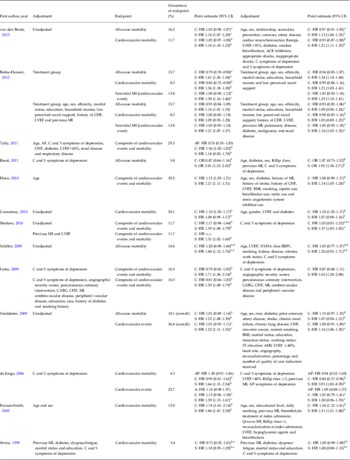
A flow diagram of the literature search is displayed in Fig. 1. The agreement between raters was good to very good (Brennan & Silman, Reference Brennan and Silman1992). Cohen's κ was 0.82 for the first step and 0.79 for the second step. A total of 14 studies met our inclusion criteria. However, as the authors of one study could not provide the confidence intervals (CIs) of the effect estimate, this study could not be included in the analyses (Barefoot et al. Reference Barefoot, Brummett, Helms, Mark, Siegler and Williams2000). Hence a total of 13 studies were included in the meta-analysis, providing data on 11 128 patients. The characteristics of these studies are displayed in Table 1. The results of the separate studies are presented in Table 2.
Flow chart of the systematic search.

Overview of pooled studies

ACS, Acute coronary syndrome; AF, affective symptoms of depression; AP, appetitive symptoms of depression; BDI-I, Beck Depression Inventory version I; BDI-II, Beck Depression Inventory version II; C, cognitive/affective symptoms of depression; CABG, coronary artery bypass graft; CFA, confirmatory factor analysis; CHD, coronary heart disease; CHF, congestive heart failure; ICD, implantable cardioverter defibrillator; MI, myocardial infarction; n.a., not available; ODBS, original division as proposed by Beck & Steer (Reference Beck and Steer1987); PCA, principal component analysis; PHQ-9, nine-item Patient Health Questionnaire; S, somatic/affective symptoms of depression; S MIS, suspected myocardial ischemia.
a Mean for follow-up mortality; 2.1 years for non-fatal MI.
b Median.
c No specific statistic.
d Missing follow-up, covariate data or incomplete BDI.
e Value for patients with high score on somatic/affective symptoms.
f Data were complete for mortality. The percentage lost to follow-up for rehospitalization was 9.0%.
g Value for mortality. The follow-up time for rehospitalization was 1 year.
i Missing data.
Overview of the associations of cognitive/affective (C) and somatic/affective (S) symptoms of depression and cardiovascular prognosis

ACE, Angiotensin-converting enzyme; AF, affective symptoms of depression; AMI, acute myocardial infarction; AP, appetitive symptoms of depression; BMI, body mass index; CABG, coronary artery bypass graft; CHD, coronary heart disease; CHF, congestive heart failure; CI, confidence interval; HR, hazard ratio; LVEF, left ventricular ejection fraction; MI, myocardial infarction; n.a., not available; NYHA, New York Heart Association; OR, odds ratio.
a Values included in subgroup analyses.
b Values included in the overall meta-analysis.
c Results for adjusted analysis were not reported for the cognitive/affective dimension, therefore we used the ones reported in the univariate analysis.
d Results informed by authors.
e Amiodarone group (anti-arrhythmic drug).
f Placebo group.
Dimensions of depressive symptoms
Among the 13 included studies, 10 used the BDI-I questionnaire to measure symptoms of depression (Irvine et al. Reference Irvine, Basinski, Baker, Jandciu, Paquette, Cairns, Connolly, Roberts, Gent and Dorian1999; Frasure-Smith & Lesperance, Reference Frasure-Smith and Lesperance2003; de Jonge et al. Reference de Jonge, Ormel, van den Brink, van Melle, Spijkerman, Kuijper, van Veldhuisen, van den Berg, Honig, Crijns and Schene2006; Linke et al. Reference Linke, Rutledge, Johnson, Vaccarino, Bittner, Cornell, Eteiba, Sheps, Krantz, Parashar and Bairey Merz2009; Schiffer et al. Reference Schiffer, Pelle, Smith, Widdershoven, Hendriks and Pedersen2009; Connerney et al. Reference Connerney, Sloan, Shapiro, Bagiella and Seckman2010; Martens et al. Reference Martens, Hoen, Mittelhaeuser, de Jonge and Denollet2010; Roest et al. Reference Roest, Thombs, Grace, Stewart, Abbey and de Jonge2011; Bekke-Hansen et al. Reference Bekke-Hansen, Trockel, Burg and Taylor2012; van den Broek et al. Reference van den Broek, Tekle, Habibovic, Alings, van der Voort and Denollet2013). The following items were found to represent a cognitive/affective dimension: sadness (80%), pessimism (90%), sense of failure (100%), dissatisfaction (70%), guilt (100%), self-punishment (100%), self-dislike (100%), self-accusations (100%), suicidal ideation (100%), crying (70%), irritability (50%), social withdrawal (90%), indecisiveness (70%) and change in body image (50%). The individual symptoms (work difficulty, insomnia, fatigability, somatic preoccupation and loss of libido) were considered somatic/affective symptoms in all studies that used the BDI-I. Loss of appetite was regarded as a somatic/affective symptom in 80% of the studies, but in one of the studies it loaded higher on a third ‘appetitive’ dimension (de Jonge et al. Reference de Jonge, Ormel, van den Brink, van Melle, Spijkerman, Kuijper, van Veldhuisen, van den Berg, Honig, Crijns and Schene2006). The other study used the same division proposed by de Jonge et al. (Reference de Jonge, Ormel, van den Brink, van Melle, Spijkerman, Kuijper, van Veldhuisen, van den Berg, Honig, Crijns and Schene2006), and therefore this item was not included in the analyses (Schiffer et al. Reference Schiffer, Pelle, Smith, Widdershoven, Hendriks and Pedersen2009). The item weight loss was also regarded as appetitive in one study (de Jonge et al. Reference de Jonge, Ormel, van den Brink, van Melle, Spijkerman, Kuijper, van Veldhuisen, van den Berg, Honig, Crijns and Schene2006), was not included in another study (Schiffer et al. Reference Schiffer, Pelle, Smith, Widdershoven, Hendriks and Pedersen2009) and did not load on either a cognitive/affective or somatic/affective dimension in two studies (Martens et al. Reference Martens, Hoen, Mittelhaeuser, de Jonge and Denollet2010; Bekke-Hansen et al. Reference Bekke-Hansen, Trockel, Burg and Taylor2012). The agreement on BDI-I symptom assignment to one of the two dimensions across studies was moderate (κ = 0.60) (Light, Reference Light1971; Conger, Reference Conger1980).
Only one study used BDI-II (Tully et al. Reference Tully, Winefield, Baker, Turnbull and de Jonge2011) and yielded a three-factor solution (cognitive, affective and somatic symptoms). Two studies (Smolderen et al. Reference Smolderen, Spertus, Reid, Buchanan, Krumholz, Denollet, Vaccarino and Chan2009; Hoen et al. Reference Hoen, Whooley, Martens, Na, van Melle and de Jonge2010) assessed depressive symptoms with the nine-item Patient Health Questionnaire (PHQ-9). In both studies, two dimensions were derived from previous knowledge based on a confirmatory factor analysis on this questionnaire (de Jonge et al. Reference de Jonge, Mangano and Whooley2007): a cognitive dimension consisting of depressed mood, lack of interest, worthlessness, concentration problems and suicidal ideation; and a somatic dimension consisting of appetite problems, sleeping difficulties, psychomotor agitation or retardation, and fatigue.
Adjustment for covariates across individual studies
All individual studies reported adjusted results. However, measures used to adjust for cardiovascular disease severity or medical co-morbidity diverged considerably between studies. Ten studies (77%) adjusted for left ventricular ejection fraction (LVEF), 10 (77%) for history of MI, nine (69%) for co-morbid diabetes, five (38%) for CHF and three (23%) for Killip class.
Least-adjusted overall meta-analysis
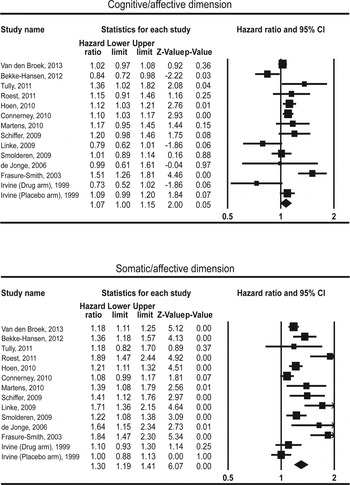
The pooled HR indicated that both the cognitive/affective (HR 1.07, 95% CI 1.00–1.15, p = 0.05) and somatic/affective (HR 1.30, 95% CI 1.19–1.41, p < 0.001) dimensions of depressive symptoms were significantly associated with cardiovascular prognosis. The forest plots of the overall analyses for each dimension are presented in Fig. 2. High levels of heterogeneity were found in both dimensions (cognitive/affective: I 2 = 71%; somatic/affective: I 2 = 78%). Eight studies provided unadjusted estimates, two adjusted for age and sex, one for age only, one included both symptom dimensions in the model, and two only reported fully adjusted analyses.
Forest plot of the least-adjusted analysis of the cognitive/affective and somatic/affective dimensions. CI, Confidence interval.

Fully adjusted overall meta-analysis
The pooled HR indicated that cognitive/affective symptoms were not (HR 1.04, 95% CI 0.97–1.12, p = 0.247) but somatic/affective symptoms were (HR 1.19, 95% CI 1.10–1.29, p < 0.001) significantly associated with cardiovascular prognosis. Moderate heterogeneity was found in the results for both dimensions of depressive symptoms (cognitive/affective: I 2 = 66%; somatic/affective: I 2 = 67%).
Subgroup analyses
Subgroup analyses are displayed in Table 3. In general, the subgroups indicated the same pattern of findings: only somatic/affective symptoms were associated with cardiovascular prognosis. However, in a subgroup of studies that did not simultaneously adjust for both dimensions, cognitive/affective symptoms were also associated with cardiovascular prognosis.
Subgroup and sensitivity analyses

C, Cognitive/affective dimension; S, somatic/affective dimension; HR, hazard ratio; CI, confidence interval; MI, myocardial infarction; BDI-I, Beck Depression Inventory version I; s.d., standard deviation.
Publication bias
There were no indications for publication bias concerning the association between the cognitive/affective dimension and prognosis. However, the funnel plots of the results for the somatic/affective dimension showed an asymmetrical distribution of the studies in both least-adjusted and fully adjusted models (Online Supplementary Fig. S1) and the results of Egger's regression intercept confirmed this asymmetry (least-adjusted: p = 0.01, two-tailed; fully adjusted: p = 0.01, two-tailed). After imputing five possible missing studies using the trim-and-fill method, the pooled effect size decreased, but the association between the somatic/affective dimension and cardiovascular prognosis remained statistically significant (least-adjusted: HR 1.17, 95% CI 1.07–1.28, p < 0.001; fully adjusted: HR 1.11, 95% CI 1.02–1.21, p < 0.001).
Discussion
Main findings
This is the first meta-analysis to assess the association of cognitive/affective and somatic/affective symptom dimensions of depression with cardiovascular prognosis in patients with heart disease using data from 13 studies. Both dimensions of depressive symptoms were associated with adverse outcomes. However, in the fully adjusted analysis, only somatic/affective symptoms of depression, and not cognitive/affective symptoms, were significantly associated with an increased risk of adverse outcomes. To reduce bias due to heterogeneity across studies, several subgroup analyses were performed. The results did not differ by end-point. All except one of the fully adjusted subgroup analyses demonstrated the same pattern of association: only somatic/affective depressive symptoms predicted adverse prognosis. Even in the subgroup of studies that did not adjust for both dimensions, where cognitive/affective symptoms were significantly associated with cardiovascular prognosis, the somatic/affective dimension showed a stronger effect. An increase of ± 1 s.d. in the somatic/affective dimension was associated with a 32% increased risk of adverse cardiovascular outcomes in the fully adjusted model.
Most depressive symptoms consistently loaded on the same symptom dimension across individual studies (e.g. guilt, self-punishment and self-dislike in the cognitive/affective dimension, and work difficulty, insomnia and fatigue in the somatic/affective dimension). However, a minority of symptoms loaded indistinctly on both factors across studies (e.g. irritability and change in body image). Moreover, some symptoms could represent only one dimension in one study and two dimensions simultaneously in another study. Carney & Freedland (Reference Carney and Freedland2012) suggested potential causes for these inconsistencies, including differences in the samples, analytic procedures and decision rules. We consider that, despite of these inconsistencies, the dimensions were sufficiently similar to pool the studies.
Mechanisms
Several mechanisms may help to explain the differential association between cognitive/affective and somatic/affective depressive symptom dimensions and cardiovascular prognosis. In the Heart and Soul Study (de Jonge et al. Reference de Jonge, Mangano and Whooley2007), lower heart rate variability (HRV) was associated with a somatic/affective but not with a cognitive/affective dimension of depressive symptoms in heart disease patients. Similarly, somatic/affective symptoms of depression were associated with lower HRV and higher cortisol levels in healthy adolescents (Bosch et al. Reference Bosch, Riese, Dietrich, Ormel, Verhulst and Oldehinkel2009).
Inflammation may also play a role in the differential association of depressive symptom dimensions and cardiovascular prognosis. One study reported that baseline scores on the cognitive/affective dimension and changes in scores on the somatic/affective dimension were associated with soluble tumor necrosis factor (TNF)-α receptor 2 (sTNFR2) in patients with CHF (Kupper et al. Reference Kupper, Widdershoven and Pedersen2012). Another study in post-MI patients found that somatic/affective symptoms of depression were significantly associated with C-reactive protein (CRP), white blood cell count (WBC) and N-terminal pro-brain natriuretic peptide (NT-proBNP) (Smolderen et al. Reference Smolderen, Spertus, Reid, Buchanan, Vaccarino, Lichtman, Bekelman and Chan2012). Cognitive/affective depressive symptoms were associated only with platelet counts. However, none of the dimensions explained more than 1% of the variance of any of the biomarkers (Smolderen et al. Reference Smolderen, Spertus, Reid, Buchanan, Vaccarino, Lichtman, Bekelman and Chan2012). Although most studies in populations with heart disease focused on the somatic/affective and cognitive/affective symptom clusters, other subtypes of depression were also used to investigate the association between depression and biological markers in the general psychiatric population. Findings from The Netherlands Study of Depression and Anxiety (NESDA) showed that patients with a melancholic subtype of depression had higher levels of awakening cortisol response compared to patients with an atypical subtype of depression and healthy controls. Nonetheless, patients with an atypical subtype of depression had significantly higher levels of inflammatory markers (CRP, interleukin-6 and TNF-α) and markers of the metabolic syndrome, including large waist circumference, elevated triglycerides, elevated body mass index (BMI) and lower levels of high density lipoprotein cholesterol (Lamers et al. Reference Lamers, Vogelzangs, Merikangas, de Jonge, Beekman and Penninx2013).
Limitations
The results of these analyses should be considered in light of the study limitations. The quantified heterogeneity was moderate to high in almost all analyses (Higgins et al. Reference Higgins, Thompson, Deeks and Altman2003). Several possible sources of heterogeneity across the literature were mentioned in the study by Carney & Freedland (Reference Carney and Freedland2012): the technique used to derive the dimensions; factor loadings of individual symptoms; covariate adjustment; and severity of cognitive/affective versus somatic/affective symptoms of depression. The inclusion of different end-points and patient groups might also have contributed to the elevated quantified heterogeneity. There was also substantial divergence on which covariates were included in fully adjusted analyses across the studies, partially because of the inclusion of different patient groups.
All included studies provided adjustment for some type of cardiovascular disease severity marker. LVEF and previous MI were included in most studies (77%) but other markers such as Killip class and medical co-morbidity were sometimes present. Adjustment for cardiovascular disease severity may decrease the strength of the association between depression and cardiovascular outcomes (Nicholson et al. Reference Nicholson, Kuper and Hemingway2006; Meijer et al. Reference Meijer, Conradi, Bos, Thombs, van Melle and de Jonge2011). For example, a recent individual participant data (IPD) meta-analysis in MI patients showed that depression was associated with an increased risk of 32% of all-cause mortality (Meijer et al. Reference Meijer, Conradi, Bos, Anselmino, Carney, Denollet, Doyle, Freedland, Grace, Hosseini, Lane, Pilote, Parakh, Rafanelli, Sato, Steeds, Welin and de Jonge2013a ). However, after adjustment for cardiac disease severity, the association decreased by 29%. Thus, incomplete adjustment (i.e. residual confounding) for cardiac disease severity markers could lead to biased estimates (Meijer et al. Reference Meijer, Zuidersma and de Jonge2013b ). Therefore, we cannot exclude the possibility that part of the association between somatic/affective depressive symptoms and cardiovascular prognosis could be explained by cardiovascular disease severity. There are also indications of publication bias in our dataset, which means that the association between somatic/affective symptoms of depression with adverse outcomes might be smaller than reported here. However, the results remained statistically significant after adjusting for this possible bias in both least-adjusted and fully adjusted models.
In the majority of the studies examined (n = 10), depression was measured with the BDI-I self-report. The BDI-I was updated to the BDI-II partly as a result of potential inflation of the overall score due to the influence of somatic illness on the somatic items (Delisle et al. Reference Delisle, Beck, Ziegelstein and Thombs2012). One of the main differences between the two versions of the BDI is that the BDI-II excludes the items work difficulty, weight loss and somatic preoccupations. Delisle et al. (Reference Delisle, Beck, Ziegelstein and Thombs2012) showed that MI patients had on average a score that was 3.4 points higher than that for psychiatric patients matched on age, sex and cognitive/affective scores when measured with the BDI-I. In a similar report on the BDI-II, somatic symptom scores were not higher among post-MI patients in comparison to psychiatric out-patients (Thombs et al. Reference Thombs, Ziegelstein, Pilote, Dozois, Beck, Dobson, Fuss, de Jonge, Grace, Stewart, Ormel and Abbey2010). Therefore, we cannot exclude the possibility that part of the association between somatic depressive symptoms and cardiovascular prognosis could be explained by cardiovascular disease severity.
Clinical implications
A meta-analysis by Baumeister et al. (Reference Baumeister, Hutter and Bengel2012) assessed the effect of psychological and psychopharmacological interventions in comparison to care as usual in CHD patients with depression. The authors found a small but clinically significant effect on depression. However, there were no indications that these interventions also improved cardiovascular prognosis. Nevertheless, secondary analyses of the Enhancing Recovery In Coronary Heart Disease (ENRICHD) study showed that, in particular, decreases in somatic/affective depressive symptoms were associated with event-free survival among MI patients treated with cognitive behavior therapy and concurrent antidepressant medication when necessary (Roest et al. Reference Roest, Carney, Freedland, Martens, Denollet and de Jonge2013). Currently, there are high expectations towards physical exercise as a potential treatment that could improve both depression and cardiovascular prognosis, as it could target specific biomarkers associated with adverse prognosis in heart disease (Blumenthal et al. Reference Blumenthal, Sherwood, Babyak, Watkins, Waugh, Georgiades, Bacon, Hayano, Coleman and Hinderliter2005; Blumenthal, Reference Blumenthal2008). Blumenthal et al. (Reference Blumenthal, Sherwood, Babyak, Watkins, Smith, Hoffman, O'Hayer, Mabe, Johnson, Doraiswamy, Jiang, Schocken and Hinderliter2012) have shown that physical activity significantly reduced depressive symptoms compared to placebo in CHD patients. We conclude that the dimensions found across the literature are comparable to the prototypical subtypes of depression described by Ormel & de Jonge (Reference Ormel and de Jonge2011). Therefore, their treatment recommendations for patients exhibiting higher levels of somatic/affective depressive symptoms (e.g. promotion of health behaviors, compliance to cardiac rehabilitation programs) should be further explored.
Recommendations for future research
Several meta-analyses have assessed the association of depression and cardiovascular prognosis, indicating the increasing number of individual studies on this subject (Barth et al. Reference Barth, Schumacher and Herrmann-Lingen2004; van Melle et al. Reference van Melle, de Jonge, Spijkerman, Tijssen, Ormel, van Veldhuisen, van den Brink and van den Berg2004; Nicholson et al. Reference Nicholson, Kuper and Hemingway2006; Meijer et al. Reference Meijer, Conradi, Bos, Thombs, van Melle and de Jonge2011). However, relatively few studies have assessed the impact of specific dimensions of depressive symptoms in the context of heart disease. Thus, there are several cohorts where these associations are yet to be explored. In addition, designating the most appropriate technique to derive symptom dimensions is warranted. Authors could consider reporting distinct analyses for dimensions yielded through different techniques. More research is also needed to assess potential behavioral and biological mediators in the association between dimensions of depressive symptoms and adverse medical outcomes. Behavioral factors such as poor adherence to medication, a high-fat diet, physical inactivity and lack of social support have been shown to be more prevalent among depressed patients than non-depressed patients (Ziegelstein et al. Reference Ziegelstein, Fauerbach, Stevens, Romanelli, Richter and Bush2000). Finally, future studies could assess the differential associations of cognitive/affective and somatic/affective depressive symptoms in an IPD meta-analysis, as this approach can lead to more reliable estimates (Riley et al. Reference Riley, Lambert and Abo-Zaid2010).
Conclusions
Somatic/affective symptoms, but not cognitive/affective symptoms, of depression were found to be associated with cardiovascular prognosis in patients with heart disease,. Although significant heterogeneity was found, the results seem to be robust in subgroup analyses. Future research should focus on the mechanisms by which somatic/affective depressive symptoms may affect cardiovascular prognosis.
Supplementary material
For supplementary material accompanying this paper, please visit http://dx.doi.org/10.1017/S0033291714000063.
Declaration of Interest
None.