





1. Who is entitled to judge?
If a machine judges the words of another machine, whose judgment are we accepting?
At first, the arrangement appears technical. A model produces a response, another model assigns a score, and a researcher compares the results. However, something more consequential happens when that score becomes a reason to select a model, retain a training example, or release an application. An assessment acquires authority. Someone has decided what counts as a good answer, which differences matter, and what evidence is sufficient to proceed. The machinery can make these decisions less visible without making them less human.
Consider a hypothetical community programme. Residents who registered before a specified date are eligible for the first round; later applicants will be considered in a second round. Summary A preserves both conditions. Summary B announces, more fluently and reassuringly, that all residents can participate in the first round. A rubric rewarding readability and a welcoming tone might prefer B. A procedure that first checks eligibility conditions against the source would reject it, however attractive its language. The same responses can therefore receive different verdicts because the procedures ask different questions.
Fluency concerns how easily the message reads. Factual accuracy concerns whether its claims are supported. Preservation of consequential information concerns whether the reader retains what is needed to act. For this use, an eligibility condition should be a non-negotiable constraint: a higher style score should not compensate for changing who believes they can participate. That choice requires a reason grounded in the programme’s purpose and its readers’ needs. It should be explicit before scores are aggregated.
The first piece in Responsible NLP asked why performance alone is insufficient (Lamsiyah Reference Lamsiyah2026a). The second traced responsibility through models, systems, institutions, and the evidence connecting them (Lamsiyah Reference Lamsiyah2026b). This third piece examines the authority given to that evidence. The same judge may offer a useful experimental comparison while lacking the support needed to approve a public-facing service. The responsibilities attached to its use change with the decisions its judgments inform.
The question pursued here is how an evaluation result acquires the authority to guide a decision. Research on reliability, bias, agreement, validity, and accountability supplies essential foundations. This piece brings them together around bounded evaluative authority: a constraint on how far institutions may reasonably rely on automated judgments, and on whose terms. Its practical proposals serve that argument by making the grounds of reliance visible and contestable. The word ‘judge’ denotes a computational role; responsibility for defining its remit and acting on its outputs remains with people and institutions.
2. When evaluation becomes infrastructure
Language has always made evaluation difficult. A translation may be accurate but culturally awkward. A summary may preserve every verifiable statement while omitting the point that matters most to a particular reader. A conversational response may be courteous while evading a question. Many tasks permit several defensible outputs, and their qualities cannot be exhausted by comparing strings.
LLM-based evaluation responds to this difficulty with adaptable instructions and scalable assessments. G-Eval uses prompted evaluation steps and structured scoring for generation tasks (Liu et al. Reference Liu, Iter, Xu, Wang, Xu and Zhu2023); Prometheus 2 trains open evaluator models to support direct assessment and pairwise ranking under user-specified criteria (Kim et al. Reference Kim, Suk, Longpre, Lin, Shin, Welleck, Neubig, Lee, Lee and Seo2024). These approaches improve the means of eliciting judgments and studying correspondence with reference evaluators. They do not, by themselves, justify every decision to which their scores might subsequently be attached.
The surveys by Li et al. (Reference Li, Jiang, Huang, Beigi, Zhao, Tan, Bhattacharjee, Jiang, Chen, Wu, Shu, Cheng and Liu2025) and Gu et al. (Reference Gu, Jiang, Shi, Tan, Zhai, Xu, Li, Shen, Ma, Liu, Wang, Zhang, Lin, Zhang, Ni, Gao, Wang and Guo2026) already organise evaluator methods, applications, benchmarks, reliability concerns, and bias-mitigation strategies. They provide technical foundations for this discussion, including attention to practical deployment. Empirical work likewise establishes qualified utility: Zheng et al. (Reference Zheng, Chiang, Sheng, Zhuang, Wu, Zhuang, Lin, Li, Li, Xing, Zhang, Gonzalez and Stoica2023) report substantial agreement with human preferences in the settings examined alongside position, verbosity, and self-enhancement biases. Across twenty datasets and eleven LLMs, Bavaresco et al. (Reference Bavaresco, Bernardi, Bertolazzi, Elliott, Fernández, Gatt, Ghaleb, Giulianelli, Hanna, Koller, Martins, Mondorf, Neplenbroek, Pezzelle, Plank, Schlangen, Suglia, Surikuchi, Takmaz and Testoni2025) show that agreement varies with the task, annotator expertise, and whether the assessed text is human- or model-generated. A reputation for judging well cannot replace evidence for a specified use.
The emphasis here is the unit of justification: the evaluator configuration in relation to the decision it informs. A public leaderboard distributes visibility; synthetic-data filtering changes a training distribution; a deployment gate controls exposure to a system. These uses can share a scoring pipeline while requiring different evidence. Each use places a different burden on the justification for relying on a score. The distinction concerns the effects of decisions in their particular setting.
This is how evaluation can become infrastructure: its criteria are embedded in routines that others inherit. Bowker and Star’s account of classification shows how categories and standards organise social life while often receding from view (Bowker and Star Reference Bowker and Star2000). In NLP, apparently modest choices about a rubric can acquire similar persistence. A preference for a particular register, answer length, or conversational style can become part of what a research community rewards.
The philosophical concern is the conversion of a situated judgment into an apparently impersonal fact. A number can travel farther than the qualifications attached to it. Once a result appears in a comparison table, the people who wrote the rubric and the population against which it was checked may disappear from the reader’s attention. Responsible evaluation should keep those conditions attached to the claim.
3. Reliability, validity, and legitimacy
Reliability concerns the consistency or precision of scores under specified replications: repeated runs, equivalent presentations, or appropriately sampled items and raters. The relevant conditions must be declared.
Validity concerns the evidential and theoretical justification for interpreting and using scores as intended; it belongs to a claim about measurement and use, rather than to a model in the abstract. This follows measurement theory’s attention to score meaning and consequences (Messick Reference Messick1995), and the analysis of construct–operationalisation mismatches in algorithmic fairness (Jacobs and Wallach Reference Jacobs and Wallach2021). A stable measurement can consistently measure the wrong thing.
Legitimacy, as used here, concerns whether the choice of criteria, the allocation of decision authority, and the procedures for challenge can be justified to those affected. It draws on responsible AI’s concern with organisational accountability and meaningful participation (Raji et al. Reference Raji, Smart, White, Mitchell, Gebru, Hutchinson, Smith-Loud, Theron and Barnes2020; Sloane et al. Reference Sloane, Moss, Awomolo and Forlano2022). It cannot be established by a further accuracy percentage. These questions are analytically distinguishable but connected: broad accounts of validity already consider consequences and values (Messick Reference Messick1995). The distinction offered here keeps institutional justification visible alongside measurement evidence.
In an epistemic sense, authority concerns the reasons we have to defer to a source on a particular question. An evaluator’s demonstrated ability to detect a factual omission may warrant such deference within that task. Institutional authority concerns who is entitled to adopt a standard and act on its results. The two are connected, but competence in applying a criterion does not confer the right to choose it. An evaluator can measure conformity to a rubric without settling whether that rubric deserves to govern a decision. Legitimacy becomes central at this point of delegation.
Imagine an evaluator that reproducibly rewards conformity to a standard written register and agrees closely with editors trained in that register. It may be reliable and useful for checking an explicitly chosen house style. If a public service uses its score to reject otherwise accurate, understandable messages in a local dialect, the measurement no longer supports the broader claim of communicative quality. The criterion also needs a justification to the community whose language is being discounted. More consistent scores would resolve neither problem. Conversely, participatory rubric design does not establish that the evaluator applies the rubric accurately.
Failure modes should be diagnosed relative to the construct. Position effects under an order-invariant task indicate presentation instability. A repeatable preference for length or for outputs resembling the judge’s own generations may instead reflect construct-irrelevant influences (Zheng et al. Reference Zheng, Chiang, Sheng, Zhuang, Wu, Zhuang, Lin, Li, Li, Xing, Zhang, Gonzalez and Stoica2023). Rubric sensitivity requires a further distinction: a judge should resist meaning-preserving reformulations but respond appropriately when the criterion itself changes. In the cited preprints, Chen et al. (Reference Chen, Chen, Lin and Vong2026) examine stability alongside sensitivity to construct-changing edits, while Weng et al. (Reference Weng, Feng and Xie2026) test safety judgments under equivalent and substantively altered policies. Their bounded experiments help explain why stability alone is insufficient.
Adversarial manipulation poses a related problem. Raina et al. (Reference Raina, Liusie and Gales2024) demonstrate that appended attack phrases can inflate scores in the zero-shot assessment settings they test. A score can then respond to manipulative additions instead of the quality being assessed. Version drift adds a temporal boundary: a new model, prompt, rubric, or retrieval source changes the evaluated configuration and calls for a documented reassessment. A high average agreement rate on an earlier sample can hide rare consequential errors, subgroup disparities, or errors near the threshold that determines the actual decision.
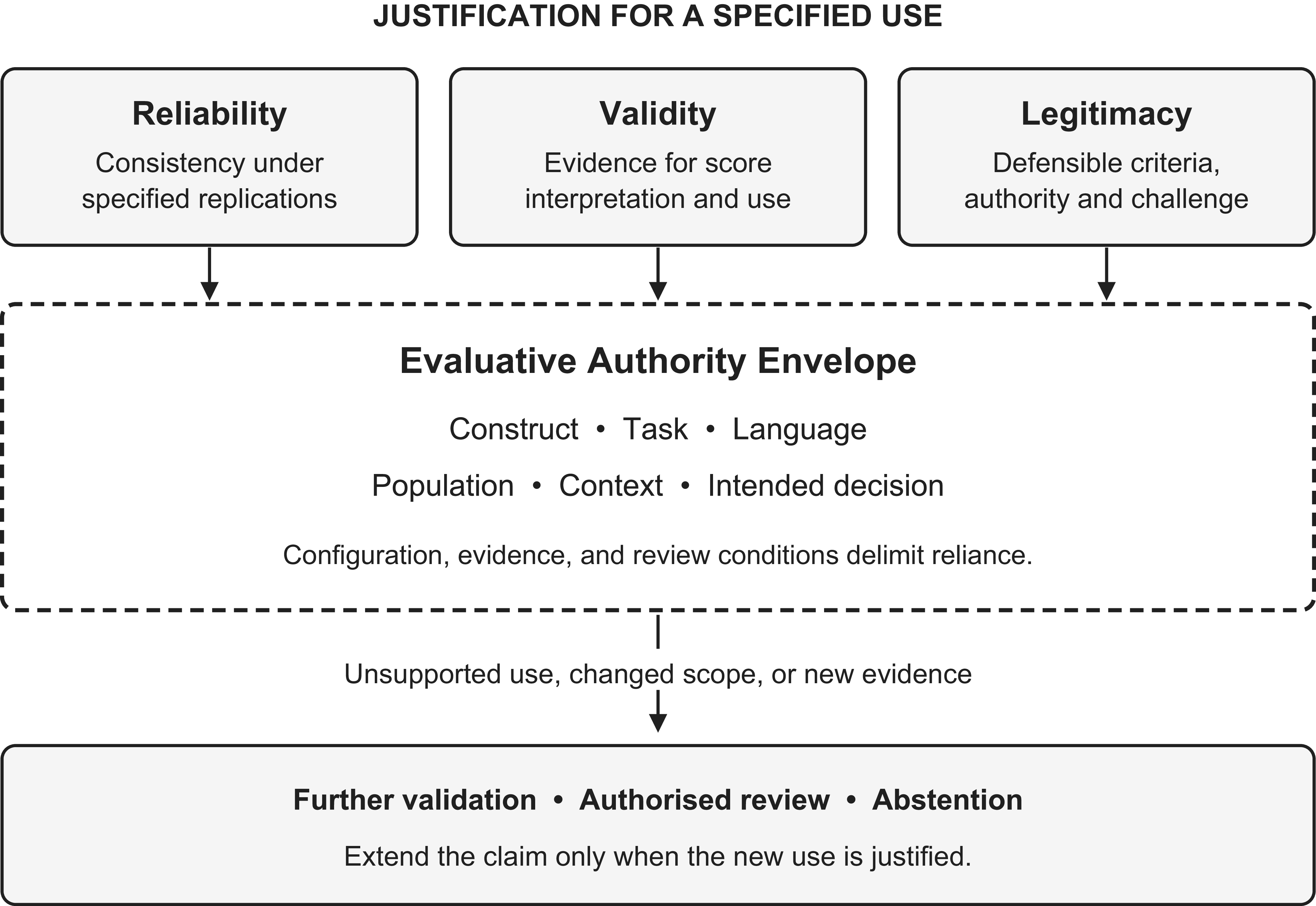
Bounded evaluative authority is the principle that reliance on an automated judgment is warranted only for interpretations and decisions supported by evidence and an accountable justification within an explicit scope. That scope specifies the construct, task, language, population, context, and intended decision, together with the evaluator configuration and review conditions. Authority here is a relationship of warranted reliance established by people and institutions. Defining a boundary therefore requires reasons both for trusting the assessment and for adopting the standard it applies.
The Evaluative Authority Envelope in Figure 1 represents this scope. Validation evidence constrains claims about measurement; accountable deliberation addresses whose criteria warrant reliance. A change of language, population, workflow, or evaluator version can require the boundary to be redrawn. An unsupported use calls for additional evidence, review by someone able to reconsider the decision, or abstention. The envelope is a conceptual aid, not a statistical confidence region or a certification scheme. Its value, and that of the accompanying commitments, lies in whether they improve scrutiny and correction.
The Evaluative Authority Envelope. Reliability, validity, and legitimacy support a bounded, revisable scope of reliance. Evidence about measurement and reasons for adopting a criterion together determine which uses can be justified.

4. Whose human judgment?
‘Human judgment’ can name several different sources of knowledge. Domain experts can assess specialised factual constraints; crowd annotators can apply agreed instructions; users can judge whether an output supports their task; and affected communities can identify exclusions that the commissioning institution overlooks. These roles may overlap, but none automatically represents the others. Expertise in checking a factual claim does not grant exclusive authority to decide which communicative values a public institution should prioritise.
What happens when these groups disagree for good reasons? In the community programme, an editor might favour brevity, an adviser might favour detailed explanations, and residents might prefer a familiar register. Once the eligibility conditions are preserved, several summaries could remain defensible. Quality is not always an objective property awaiting a better instrument. It can also express choices about what communication is for, whose needs matter, and which trade-offs are acceptable. Choosing how to combine these values helps define the quality being measured.
Plank (Reference Plank2022) argues that variation in human labels can convey meaningful differences in interpretation. Xu et al. (Reference Xu, Santosh and Plank2026) further defend preserving human label variation in post-training. These perspectives complicate the expectation that evaluation should converge on one answer. Disagreement may reveal an error, an ambiguous task, or a plurality of reasonable judgments. Distinguishing these possibilities is part of responsible evaluation.
This does not make truth a matter of preference. Whether a summary reverses a date or invents a source can often be resolved by checking evidence. Whether it is sufficiently direct, respectful, or useful may depend on its audience and purpose. Verifiable constraints should remain explicit, while conflicts among communicative values call for reasons that participants can examine. A majority label records an aggregation rule; it does not establish that the minority’s concern has been answered.
Miranda Fricker’s account of epistemic injustice sharpens the question of whose reasons receive a hearing (Fricker Reference Fricker2007). Testimonial injustice arises when prejudice unjustly diminishes a speaker’s credibility. Hermeneutical injustice concerns disadvantages in understanding or communicating social experience that arise from unequal participation in shaping shared interpretive resources. Applied here, these distinctions invite scrutiny of institutions that discount residents’ accounts because of their dialect, or rely on evaluative categories that reproduce the exclusion of their experiences. An incomplete rubric alone does not establish hermeneutical injustice; the connection to structural marginalisation matters. The concern is with the people whose knowledge is discounted or rendered difficult to express through evaluation. A system may apply a rubric accurately while an institution’s reliance on that rubric sustains these exclusions.
Who, then, may settle a conflict? Responsibility should sit with a named person or body whose mandate covers the decision, whose reasons are open to scrutiny, and whose judgment can be challenged. A benchmark’s organisers and a public service’s governing body have different remits. Neither technical expertise nor organisational ownership alone settles the legitimacy of its criteria. Those affected need a meaningful role in shaping the terms of evaluation, while relevant experts help establish what the evidence supports. The critique of participation as a superficial design remedy is pertinent: consultation has little force if it cannot alter a criterion or its use (Sloane et al. Reference Sloane, Moss, Awomolo and Forlano2022).
Even a justified decision need not resolve every disagreement. An institution may have to choose one summary without claiming that all reasonable readers should rank it first. Separate assessments, audience-specific rankings, and recorded objections can preserve what a single score would erase. Where a common ordering lacks a defensible basis, declining to produce one may be the more informative result. This is not indecision: it distinguishes closure for a particular action from agreement about value. Bounded authority makes room for both an accountable decision and continuing dissent.
Multilingual evaluation brings these questions into focus. Fu and Liu (Reference Fu and Liu2025) examine pointwise judgments across five tasks and twenty-five languages and report consistency problems, particularly in low-resource settings. Their evidence concerns the tested models and parallel data; cultural appropriateness requires further inquiry. Translating a rubric can preserve its sentences while leaving assumptions about politeness, directness, or acceptable disagreement unexamined. A national-language label may also conceal dialect variation and underrepresented communities.
Local reference populations and examples can reveal these differences. Bilingual experts can examine semantic equivalence; local users and affected communities can assess whether the criterion fits its purpose. Linguistic documentation and work on bias provide foundations for making such choices explicit (Bender and Friedman Reference Bender and Friedman2018; Blodgett et al. Reference Blodgett, Barocas, Daumé and Wallach2020). Legitimacy requires more than adding these voices to a dataset. It requires a way for their knowledge to change what the evaluation asks, and for unresolved disagreement to limit what its results can authorise.
5. When judgments return as training signals
Evaluation changes character when its outputs help produce what will next be evaluated. A prompted LLM judge typically returns a score, preference, or critique from instructions and context. A learned reward model is trained to predict a preference-related signal and may be optimised against during policy training. Their interfaces and training procedures differ. Both can become selection mechanisms, but evidence about one should not be transferred automatically to the other.
Gao et al. (Reference Gao, Schulman and Hilton2023) provide empirical evidence for a related mechanism in reward-model optimisation. In their synthetic setup, a fixed gold-standard reward model supplies labels for a learned proxy; sufficiently strong optimisation of the proxy can reduce performance measured by the gold-standard model. They examine reinforcement learning and best-of-n selection. The gold-standard model stands in for human judgment, so this study does not directly demonstrate the same effect in every prompted-judge pipeline. It does show why improvement against a proxy requires independent scrutiny.
Suppose, as a separate hypothesis, that a prompted judge favours a stylistic feature unrelated to factual accuracy. Repeatedly retaining its preferred examples could increase that feature’s prevalence in training data. Subsequent assessment with the same preference could register progress without improved factual quality. Whether this happens, how strongly, and for which groups depends on the data, optimisation process, and evaluator. These are questions for controlled longitudinal experiments, not universal consequences of synthetic feedback.
Multiple judges provide stronger evidence only to the extent that their errors and reference sources offer useful independence. Agreement can remain misleading when evaluators share training influences, rubrics, or blind spots. A human reviewer who sees only an AI-generated justification may also miss the source evidence. Evaluation should therefore retain held-out, independently assessed cases, source-grounded factual checks, and downstream task outcomes, and examine whether improvements survive these alternative assessments. In the opening example, the programme’s actual eligibility rule remains a necessary check on fluent summaries and fluent critiques alike.
This also suggests a limit to the recursion of judging judges. Another evaluator can help detect errors, but a chain of evaluations does not justify itself merely by becoming longer. At some point, the process must state what is being checked, what evidence could disconfirm its conclusion, and who is responsible for responding. Accountability gives that process a place to stop and a reason to reopen.
6. Five commitments for accountable evaluation
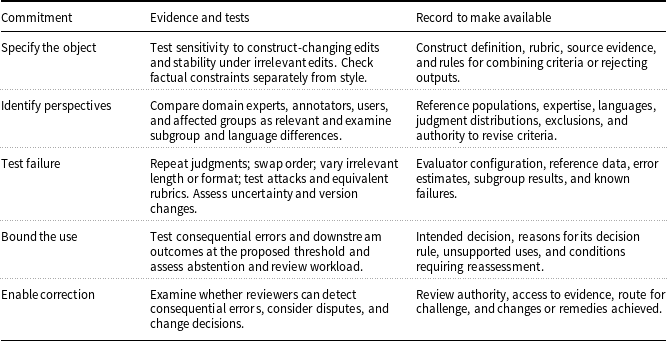
How can these questions remain visible once evaluation becomes routine? Table 1 translates bounded authority into five commitments: specify the object, identify perspectives, test failure, bound the use, and enable correction. Each keeps a reason for reliance attached to the judgment. Their purpose is to make assumptions examinable, especially when a score passes from the researcher who produced it to an institution that acts on it.
Five commitments for accountable evaluation, with illustrative evidence and records selected for the intended use. Source: author’s synthesis

Table 1. Long description
A table with five rows and three columns. The columns are labeled Commitment, Evidence and tests, and Record to make available. Row 1: Commitment, Specify the object; Evidence and tests, Test sensitivity to construct-changing edits and stability under irrelevant edits. Check factual constraints separately from style.; Record to make available, Construct definition, rubric, source evidence, and rules for combining criteria or rejecting outputs. Row 2: Commitment, Identify perspectives; Evidence and tests, Compare domain experts, annotators, users, and affected groups as relevant and examine subgroup and language differences.; Record to make available, Reference populations, expertise, languages, judgment distributions, exclusions, and authority to revise criteria. Row 3: Commitment, Test failure; Evidence and tests, Repeat judgments; swap order; vary irrelevant length or format; test attacks and equivalent rubrics. Assess uncertainty and version changes.; Record to make available, Evaluator configuration, reference data, error estimates, subgroup results, and known failures. Row 4: Commitment, Bound the use; Evidence and tests, Test consequential errors and downstream outcomes at the proposed threshold and assess abstention and review workload.; Record to make available, Intended decision, reasons for its decision rule, unsupported uses, and conditions requiring reassessment. Row 5: Commitment, Enable correction; Evidence and tests, Examine whether reviewers can detect consequential errors, consider disputes, and change decisions.; Record to make available, Review authority, access to evidence, route for challenge, and changes or remedies achieved.
Testing asks whether a criterion responds to what matters. In the opening example, removing an eligibility condition while preserving fluent wording probes a consequential distinction. Comparing only overall preference scores could leave that failure invisible. The question is whether the evidence supports the reason for which the evaluation is being used.
Statistical analysis can clarify these grounds. In their MT-Bench case study, Dubois et al. (Reference Dubois, Coppock, Giulianelli, Jorgensen, Flesch, Luettgau and Ududec2026) jointly model grader, position, and length effects using Bayesian generalised linear models. Their Section 4 reports stronger length bias for GPT-4 than for human graders, grader-specific preferences among model outputs, and mild position bias among human graders, with uncertainty estimates. These findings concern the released pairwise-preference data and the fitted models. Explaining an observed preference helps us assess its relevance; it does not decide whether that preference deserves institutional weight.
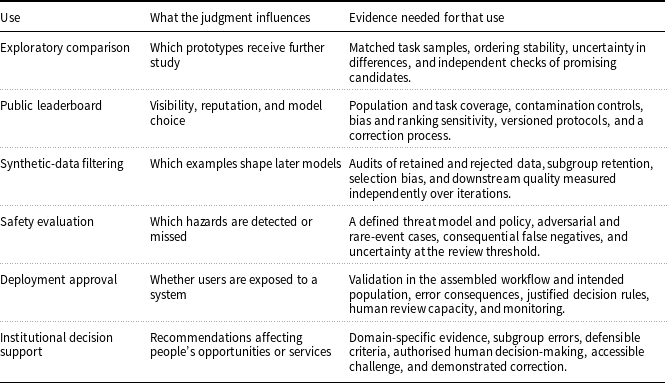
Table 2 makes this connection to decisions explicit. A prototype comparison helps select candidates for further study; publishing programme information requires confidence that readers retain consequential conditions. The distinction carries forward the earlier pieces’ arguments about performance (Lamsiyah Reference Lamsiyah2026a) and the evidence connecting systems with institutions (Lamsiyah Reference Lamsiyah2026b). The relevant question is what a judgment can reasonably support in each setting.
Different uses give judgments different consequences. The illustrative evidence below connects assessment to the decision it informs. Source: author’s synthesis

Table 2. Long description
A table with six rows and three columns. The columns are labeled ‘Use’, ‘What the judgment influences’, and ‘Evidence needed for that use’. Row 1: Use, Exploratory comparison; What the judgment influences, Which prototypes receive further study; Evidence needed for that use, Matched task samples, ordering stability, uncertainty in differences, and independent checks of promising candidates. Row 2: Use, Public leaderboard; What the judgment influences, Visibility, reputation, and model choice; Evidence needed for that use, Population and task coverage, contamination controls, bias and ranking sensitivity, versioned protocols, and a correction process. Row 3: Use, Synthetic-data filtering; What the judgment influences, Which examples shape later models; Evidence needed for that use, Audits of retained and rejected data, subgroup retention, selection bias, and downstream quality measured independently over iterations. Row 4: Use, Safety evaluation; What the judgment influences, Which hazards are detected or missed; Evidence needed for that use, A defined threat model and policy, adversarial and rare-event cases, consequential false negatives, and uncertainty at the review threshold. Row 5: Use, Deployment approval; What the judgment influences, Whether users are exposed to a system; Evidence needed for that use, Validation in the assembled workflow and intended population, error consequences, justified decision rules, human review capacity, and monitoring. Row 6: Use, Institutional decision support; What the judgment influences, Recommendations affecting people’s opportunities or services; Evidence needed for that use, Domain-specific evidence, subgroup errors, defensible criteria, authorised human decision-making, accessible challenge, and demonstrated correction.
An Evaluative Authority Statement makes that connection explicit for readers and decision-makers. Box 1 asks who will rely on the judgment, for what purpose, on what evidence, and with what possibility of challenge. Missing evidence and unresolved objections belong in the statement because they help define the limits of reliance.
Evaluative authority statement
Evaluator and scope. Configuration/version [model, prompt, rubric, settings] assesses [construct] for [task], in [languages/dialects], for [users and affected populations], within [context].
Intended reliance. Its outputs inform [specific decision] through [decision rule and human review]. [Named role or body] is responsible for this use.
Evidence. Supporting records [links/identifiers] document [reference populations and disagreements], [tests of validity and reliability], [subgroup errors and uncertainty], and [decision outcomes].
Limits and justification. [Known failures, missing evidence, and unsupported uses] limit the claim. [Participants and decision owner] justified the criteria through [process], with [unresolved objections].
Correction and renewal. Escalate or abstain when [conditions]. [Review owner] can inspect [evidence] and revise [judgment, rubric, or decision]. [Accessible route] enables challenge. Reassess after [changes or review date].
Model cards document intended uses and limitations (Mitchell et al. Reference Mitchell, Wu, Zaldivar, Barnes, Vasserman, Hutchinson, Spitzer, Raji and Gebru2019), while Judge Cards can describe evaluator-specific behaviour (Weng et al. Reference Weng, Feng and Xie2026). The statement draws on these records to explain a particular delegation of authority. For the community programme, it might restrict the judge to flagging summaries for editorial review, keeping separate checks for eligibility and readability. That limited remit would leave decisions about residents’ eligibility with the responsible institution.
The possibility of correction gives these commitments practical meaning. A reviewer needs time, relevant expertise, access to evidence, and authority to change an outcome. Smaller research groups also need practicable ways to meet these demands. Reporting the resources that validation and review require helps expose the distance between promising accountability and making it possible.
7. A research agenda for bounded evaluative authority
The argument opens five questions about where reliance is justified and how its limits become visible. Each connects empirical inquiry with a question about the authority assigned to evaluation.
RQ1: Under what conditions does judge validity transfer across languages, populations, domains, and rubrics? Comparisons across settings should examine what transfers and whose judgments cease to be represented. Local assessments of consequential errors can help distinguish technical deterioration from a change in what quality means. How far can evidence travel with a score?
RQ2: When can high human–judge agreement produce poor model-selection or deployment decisions? Evaluators with similar aggregate agreement may make different errors where decisions turn. Comparing downstream outcomes and their distribution across groups would reveal what agreement conceals. This asks when a measurement becomes an inadequate reason for action.
RQ3: How does rubric design privilege particular perspectives and quality criteria? Comparing expert, user, and community-developed rubrics can reveal whose priorities shape rankings and which disagreements persist. The central question concerns participants’ influence over quality. Participation matters when it can change the terms on which judgments acquire authority, beyond contributing labels.
RQ4: When do automated evaluation feedback loops amplify irrelevant or harmful preferences? Following repeated selection and training with independent assessments can show whether rising judge scores accompany improvement. Changes in factual quality and group representation would test whether an inherited preference is becoming a self-reinforcing standard that later evaluations fail to question.
RQ5: Which review and contestability procedures correct consequential errors? Comparisons of review arrangements should examine corrected outcomes, persistent disparities, and access to a hearing. Access to evidence and authority to change a decision are central. The question is when a formal opportunity to challenge becomes an effective means of correction.
These questions also apply to the proposals made here: do they expose unjustified reliance and enable correction at a reasonable cost? Their success should be judged by what becomes possible to question and change.
8. Conclusion
To judge language is to decide what deserves attention, what can be omitted, what should be trusted, and what requires another look. Automating parts of that work can expand our ability to examine language technologies. It also gives the design of evaluation a role in shaping the standards by which future language is valued.
A score becomes a reason for action through an argument about what it measures, whose priorities it expresses, and why others should accept its influence. Bounded evaluative authority keeps that argument open. Competence in scoring cannot settle who should define quality, and agreement among evaluators cannot remove the need to hear those whose knowledge or interests the standard overlooks. Some disagreements can be resolved by better evidence; others should continue to qualify the decision made in their presence.
Responsible NLP therefore asks more of evaluation than an increasingly convincing verdict. It asks who may speak through that verdict, who can contest it, and who must answer for its consequences. When a score travels into a new language, population, or institution, its justification must travel with it—or be rebuilt. The authority of an automated judgment should extend no further than the reasons we can give for relying on it.
Competing interests
The author declares that the manuscript complies with the ethical standards of the journal and that there are no competing interests to disclose.
Ethical statement
This piece reports no new research involving human participants or personal data. Ethical approval was not required.
Use of AI assistance
In preparing this work, we used AI-assisted tools for language editing, such as spell checking and stylistic revisions with Grammarly and ChatGPT. The author takes full responsibility for the scientific content, analyses, and conclusions presented in this work.

 Open access

