Introduction
A recent public health report published by the World Health Organisation (WHO) in conjunction with Alzheimer's Disease International (WHO 2012: 13) has suggested that world-wide the total number of people with dementia is projected to almost double every 20 years, to 65.7 million in 2030 and 115.4 million in 2050. Whilst predominantly a condition of old age (WHO 2012), young onset dementia (i.e. dementia occurring in those under the age of 65 years) is recognised as a diagnostic classification under DSM-IV criteria (American Psychiatric Association 1994), although it has recently been ascribed the status of a ‘rare condition’ (WHO 2012: 15) owing to the absence of large-scale population studies conducted at either national or international levels to determine its prevalence. Accordingly, estimates of young onset dementia vary considerably, with the authoritative Dementia UK report (Alzheimer's Society 2007: 27) suggesting that there are currently a little over 15,000 people with young onset dementia (or 2.2% of all cases) living in the United Kingdom (UK), whereas the Dementia 2010 report by the Alzheimer's Research Trust (2010: 19) put this figure at just over 64,000 people (or 8% of all cases). However, both reports agreed that Alzheimer's disease is the most common form of dementia in the younger population and that young onset dementia was more prevalent in males. In addition, these reports, augmented by other studies, suggested that the younger population are more likely to experience rarer forms of dementia such as alcohol-related brain damage, HIV-related cognitive impairment and fronto-temporal dementia (Alzheimer's Research Trust 2010; Alzheimer's Society 2007; Harvey, Skelton-Robinson and Rossor Reference Harvey, Skelton-Robinson and Rossor2003; NHS Health Advisory Service 1997; WHO 2012). Moreover, as compared to onset in older age, those diagnosed with young onset dementia are more likely to experience a more rapid progression through the ‘stages’ of dementia thus significantly shortening the lifespan (Thompson Reference Thompson2011).
Perhaps more than a dementia occurring later in the adult lifecourse, dementia in younger people is likely to have a range of detrimental effects on immediate and extended family members (Harris and Keady Reference Harris and Keady2009; Svanberg, Stott and Spector Reference Svanberg, Stott and Spector2010; Weaks, Wilkinson and Davidson Reference Weaks, Wilkinson, Davidson, McKie and Cunningham-Burley2005). The familial impact of dementia may be exacerbated by dependent children or young adults living in the home with their parents still bearing the brunt of financial obligations for the formal education of their children, including school and university costs, as well as meeting the general expenses of supporting a family (Brown and Roach Reference Brown and Roach2010; Svanberg, Stott and Spector Reference Svanberg, Stott and Spector2011; Williams, Keady and Nolan Reference Williams, Keady and Nolan1995). Indeed, Roach et al. (Reference Roach, Keady, Bee and Hope2008), in their narrative synthesis of the literature on living with young onset dementia, reported that such stressors were heightened considerably by the sheer difficulty in simply obtaining a diagnosis, a process that was generally protracted and could take several years (see also Page and Keady Reference Page and Keady2010). Moreover, even when a diagnosis is made, specialist support for younger people with dementia is recognised as being ‘patchy’ at best (Alzheimer's Society 2005; Harris Reference Harris2004; Harris and Keady Reference Harris and Keady2004; Roach and Keady Reference Roach and Keady2008; Williams, Dearden and Cameron Reference Williams, Dearden and Cameron2001) with few services available that promote everyday living within a family-centred and intergenerational value-base, or that focus on activities, rather than on providing the more traditional models of care available for supporting people with dementia, such as through day services (Davies-Quarrell, the ACE Club and Keady Reference Davies-Quarrell and Keady2010).
This lack of an intergenerational and family-centred focus is also mirrored in research, service and policy provision where the person with dementia, of whatever age, and the family of which that person is an integral member, are usually kept apart and viewed as separate entities. For example, there has been a wealth of research that has explored the experience of dementia from solely a carer's perspective (Garwick, Detzner and Boss Reference Garwick, Detzner and Boss1994; Hibberd et al. Reference Hibberd, Keady, Reed and Lemmer2009; Tsunaka and Chung Reference Tsunaka and Chung2012; Walters, Oyebode and Riley Reference Walters, Oyebode and Riley2010) or from a person with dementia's perspective (Keady and Nolan Reference Keady and Nolan1994; Keady et al. Reference Keady, Clarke, Wilkinson, Gibb, Williams, Luce and Cook2009; Kelly Reference Kelly2008a, Reference Kelly2008b; Ryan, Bannister and Anas Reference Ryan, Bannister and Anas2009). However, when the person with dementia and their family are joined together, such attention has historically focused upon exploring dyadic relationships from within that family configuration and relationship so, for instance, exploring spouse to spouse care, or adult child to parent with dementia (see e.g. Davies and Gregory Reference Davies and Gregory2007; Hellström, Nolan and Lundh Reference Hellström, Nolan and Lundh2005; Hellström, Nolan and Lundh Reference Hellström, Nolan and Lundh2007). As a consequence, these designs are unlikely to capture an accurate presentation of the experience of the family as a whole, particularly when, at times, complex dynamics need to be accounted for, such as the impact of second marriages on relational structures and how ‘care’ and ‘family’ are then constructed and enacted (Egset and Myklebust Reference Egset and Myklebust2011; Hibberd et al. Reference Hibberd, Lemmer, Keady and Reed2008).
As dementia may often be a chronic condition, it is useful to look to family systems models that propose to better understand how families interact with chronic illnesses. Rolland (Reference Rolland, Chilman, Cox and Nunnally1988) proposes a three-dimensional model to this end, with the dimensions being: (a) the psycho-social types of illness; (b) the time phases of chronic illness; and (c) components of family functioning. In the first dimension, psycho-social types of illness, each illness type is developed based on four categories: onset, course, outcome and incapacitation (Rolland Reference Rolland, Chilman, Cox and Nunnally1988). Dementia is typically a gradual onset condition, and although this may allow for extended time in which to adjust to the presence of the illness, it may lead to increased anxiety experienced by the family in the pre-diagnostic phase, as is shown in the literature (de Boer et al. Reference de Boer, Hertogh, Droes, Riphagen, Jonker and Eefsting2007; Steeman et al. Reference Steeman, de Casterle, Godderis and Grypdonck2006). This is because the person and their family members may be noticing changes in cognitive functioning, but may not have a satisfactory explanation as to why this is occurring at this particular point in time (Steeman et al. Reference Steeman, de Casterle, Godderis and Grypdonck2006). The course of dementias also tends to be a progressive trajectory, meaning that symptoms, such as memory or language difficulties, are always present and progressively worsen over time (Melbourne Neuropsychiatry Centre 2008). These changes can put strain on the family who need to be flexible and adaptable to ever-changing demands and circumstances that present themselves (Rolland Reference Rolland, Chilman, Cox and Nunnally1988). The third of the four categories, outcome, addresses whether or not the condition is a likely cause of death for the diagnosed family member (Rolland Reference Rolland, Chilman, Cox and Nunnally1988). The stress of the anticipation of this future can become difficult for families to envisage. Anticipatory grief may be experienced by the family as they struggle to remain emotionally close to the ‘ill’ family member, but at the same time want to ‘let go’ in order to facilitate their own coping and anticipated bereavement (Steeman et al. Reference Steeman, de Casterle, Godderis and Grypdonck2006). This can lead to the person with dementia feeling isolated and excluded from the family group. The final category to the illness typology is incapacitation. It is suggested that the most difficult conditions for families to adapt to are those that result in minimal incapacitation or severe incapacitation (Rolland Reference Rolland, Chilman, Cox and Nunnally1988, Reference Rolland1994). Dementia can be both, depending upon the stage and type of dementia present. The transition between these two states can also be variable and may be slow or rapid depending on the type of dementia diagnosed (Melbourne Neuropsychiatry Centre 2008), potentially allowing little time for family adjustment and placing more stressors on the family unit (Rolland Reference Rolland, Chilman, Cox and Nunnally1988).
The second dimension of the model addresses time phases of chronic illness, in this case there are three: crisis, chronic and terminal (Rolland Reference Rolland, Chilman, Cox and Nunnally1988). The crisis phase extends to the time before diagnosis through to the time of adjustment immediately following diagnosis. It is during this time that the family grieves for the family unit that existed prior to the diagnosis, reorganises themselves to cope with the new situation and tries to create meaning in the illness that is useful and relevant to their family (Rolland Reference Rolland, Chilman, Cox and Nunnally1988). The chronic phase is the adaptation to the new lifestyle that incorporates changes in role, function and structure of the family unit. Living with a person with dementia can be exhausting for families, as this phase may seem as though it has no end (without the inevitable death of the younger person with dementia) and the family may have to experience multiple changes in role and structure of the family unit (Steeman et al. Reference Steeman, de Casterle, Godderis and Grypdonck2006). The phase surrounding the death of the individual is the terminal phase, which includes the anticipation of death, bereavement, grief, resolution and moving towards resuming the family life (Rolland Reference Rolland, Chilman, Cox and Nunnally1988).
Family functioning is the third and final dimension included in Rolland's model. The first element of family functioning is that of family illness value systems. The underlying concept is that individual members of a family may have either an external or internal explanation for the presence of the illness in their lives (Rolland Reference Rolland, Chilman, Cox and Nunnally1988). Patterns and illness beliefs may be passed down through generations and influence coping and interaction in the current family structure, which in turn influences how families will function and cope with the change that a chronic illness imposes (Rolland Reference Rolland, Chilman, Cox and Nunnally1988). This history of illness will be rooted in the historical dynamics and biography of a family (Rolland Reference Rolland, Chilman, Cox and Nunnally1988); in other words, something that can be uncovered only by gaining a detailed and in-depth understanding of individual family functioning. The second element of the family functioning dimension is the interface of the illness, the individuals and the family life cycles. There are two main types of momentum in the development of families, centrifugal (family disengagement) and centripetal (family closeness) (Rolland Reference Rolland, Chilman, Cox and Nunnally1988). Centrifugal times are typically times such as adolescence or when young adult children are leaving the family home. Centripetal times are typically periods such as child-rearing or the birth of a new child (Rolland Reference Rolland, Chilman, Cox and Nunnally1988). Depending on the life stage of each family member, the onset of a serious illness can have significant developmental effects on all individuals. If the family is in centripetal phase already (e.g. raising young children) the onset of dementia could magnify this situation, leading to a prolonged phase of centripetal development or even leaving the family trapped in this stage permanently and creating long-term dysfunction (Rolland Reference Rolland, Chilman, Cox and Nunnally1988). If the family is in a centrifugal phase, the onset of the illness may disrupt the natural course of the family cycle and each person's individual needs and development may be delayed, which also can lead to dysfunction through resentment of the other family members (Rolland Reference Rolland, Chilman, Cox and Nunnally1988, Reference Rolland1994).
The family systems model provides a platform for understanding the interaction of the family and chronic illness over time and the impact illness can have on the development of a family unit. It also outlines how previous functioning and the historical development of the family can influence the coping mechanisms and strategies available to families when experiencing dementia. Despite this link between family functioning and illness, little work has so far been done with family units experiencing a dementia, regardless of age.
This omission of a family-centred approach in dementia care provision and research means that a greater understanding of the shared, lived experience of those experiencing dementia from within a family context is needed in order to expand the current knowledge and evidence base. The primary aim of this longitudinal, narrative study therefore was to locate younger people with dementia within their construction of a family, with their role in that family integral to the identification and involvement of participants. This leads to the objective of this study, which is to gain an in-depth understanding about the day-to-day experience of young onset dementia in a family-centred context.
Methods
This study uses a longitudinal, narrative approach in order to co-construct family biographies with five families experiencing young onset dementia. The biographies are co-constructed alongside families with the aim of exploring the families' experiences and day-to-day life with young onset dementia. In the following section, the design, study participants and methods of analysis are described.
Design and study participants
As little is known about how families function in young onset dementia, an inclusive approach to the research design is needed in order to capture and then compare the individual experiences of each participating family, whatever this final family system eventually is composed of, e.g. from dyad through to intergenerational and extended family members. Other authors have reported that families will interact in their own specific way and over time construct their own reality of experience (Allen Reference Allen2000; Garwick, Detzner and Boss Reference Garwick, Detzner and Boss1994). Therefore, a longitudinal, narrative design is necessary, underpinned by biographical methods that act as a springboard for narrative analysis of the generated data and enable participation of any family configuration (Lincoln and Guba Reference Lincoln and Guba1985; Roberts Reference Roberts2002). The study inclusion criteria are fourfold: (a) the person with dementia to be under 65 years of age and have dementia of any type; (b) the person with dementia to have a score of 20 or above on the Mini Mental State Examination (MMSE; Folstein, Folstein and McHugh Reference Folstein, Folstein and McHugh1975) at the time of entry – the National Institute for Health and Clinical Excellence and Social Care Institute for Excellence (2006) clinical dementia guidelines attribute such a score to mild dementia and thereby is seen to maximise the person's capacity to consent to an interview; (c) family members to be any age above the age of seven years; (d) all nominated family members to be aware of the diagnosis of dementia.
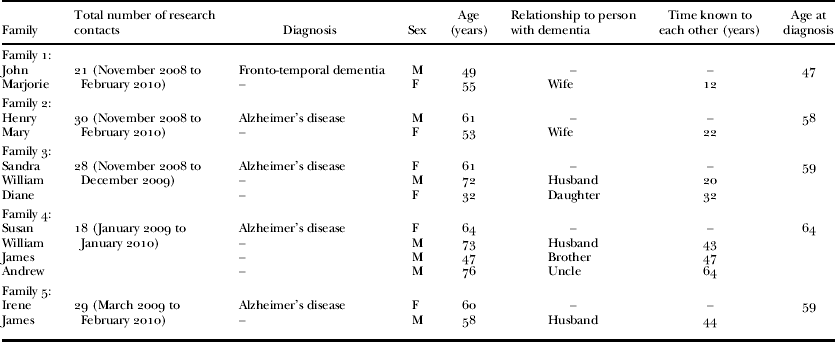
To identify the study participants, a total of 120 recruitment packs were provided to National Health Service (NHS) staff across ten services in the North West of England, including old-age psychiatrists, community mental health teams, specialist young onset dementia services, a memory clinic, a dementia treatment clinic and mental health team operational managers. From this approach, a total of five people with young onset dementia and subsequently their nominated and consenting family members were recruited. These relationships and participants are displayed in Table 1.
Participant demographics and total research contacts

Notes: M: male. F: female.
Two of the participating families are from a specialist young onset dementia service, two are from a memory assessment service and one is from a dementia treatment clinic. The latter two of these services work with people with dementia of all ages and were both referred to by participants in the study as ‘memory clinics’. Written, informed consent was taken from all study participants. The method of process consent (Dewing Reference Dewing2007) is used throughout the study with all participants. This means that ongoing consent is taken throughout the study with the first author prepared to repeatedly provide information on subsequent visits to participants if necessary, including information sheets and consent forms.
In addition to the information provided in Table 1, the time stated by families as the period between the first noticeable onset of symptoms and receiving a diagnosis ranges between six and 15 months, with the mean being just over 11 months. All younger people with dementia in the study had already retired or ceased working at entry to the study; three of the five younger people with dementia were retired or had ceased working prior to receiving a diagnosis; the other two younger people with dementia had been in employment when initially presenting with symptoms but had ceased working around the time of diagnosis. Family members were also engaged in various forms of employment at entry to the study, with four being retired, three in employment (either full-time or part-time) and one in receipt of disability benefits. All members of the sample indicated their ethnicity as ‘white-British’ which is not representative of the population of the North West of England.
The study was given approval by an independent national research ethics committee that was ‘flagged’ to consider applications where ‘capacity to consent’ is an issue (Reference No. 08/H1204/100). All participant names used in this article are pseudonyms to protect anonymity and included photographs in the Appendix have also been selected in order to maintain the anonymity of those participants in this study.
To help contextualise the findings reported later, a brief biographical sketch on each of the participating families is now provided. Family 1 is comprised of a husband and wife couple, John and Marjorie. John was diagnosed with fronto-temporal dementia at 45 years of age and lives with his wife Marjorie, whom, at the point of entry to the study, he had known for 12 years and been married to for six. There is no family history of dementia as far as John could recall. When John and Marjorie entered the study they were 49 and 55 years old, respectively. It soon became apparent that John and Marjorie have limited social contact of any kind, including with existing family members, excepting Marjorie's daughter from a previous marriage. John and Marjorie did not feel it was appropriate for Marjorie's daughter to participate as, although she visits them frequently and lives locally, she is not particularly involved in John's care or close to him. The couple considers their family unit to be ‘a pair’ and Marjorie feels very much that John's care is her responsibility.
Family 2 consists of another husband and wife couple, Henry and Mary. Henry was diagnosed with young onset Alzheimer's disease at the age of 59. Henry was 61 and Mary was 53 years old at entry to the study. Henry and Mary had known each other for 22 years and been married for 18; they also had a young daughter, Rachel, who was 14 years old when Henry and Mary began participation in the study. Henry and Mary did not want Rachel to take part and also reported that Rachel herself had declined the invitation to participate (via information sheet left with Henry and Mary). Henry's mother had Alzheimer's disease, though developed in later life, and Mary's mother had been diagnosed with young onset Alzheimer's disease at the age of 54. Shortly after Henry and Mary's participation in the study ended, Henry experienced a fall and was admitted to hospital. Mary communicated that they found the co-constructed family biography created through their participation in this study a useful tool to take into the hospital with Henry as it gives the staff a picture of their family life together.
Family 3 is made up of three individuals; wife Sandra and husband William, along with Sandra's adult daughter, Diane. Sandra was diagnosed with Alzheimer's disease at the age of 59 and was 61 years old at entry to the study; William was aged 72 at entry to the study. Diane was Sandra's daughter from her previous marriage and was 32 years old when she agreed to participate in the study. William and Sandra had known each other for 20 years, had been a couple for 15 years and married for 12 years. Diane does not live with her mother and William, but visits often and is emotionally very close to them. She is the main support for Sandra and William and was the first person William consulted when Sandra began to show signs of memory loss. Diane was also the first person that Sandra and William shared the diagnosis of young onset dementia with after receiving it. Sandra also has a son from her first marriage and, although they are close to him and his family, they do not see him as much as they see Diane, as he has had difficulty accepting Sandra's diagnosis. William has three children, two sons and one daughter from his first marriage, but due to distance they do not see one another frequently.
Family 4 includes four participating members, Susan (the younger person with dementia, aged 64), her husband William (aged 73), Susan's younger half-brother James (aged 47) and Susan's maternal uncle Andrew (aged 76). Susan had received a diagnosis of Alzheimer's disease at the age of 64. The family agreed that although it is difficult to pinpoint when they began to notice changes in Susan, it was at least 18 months to two years prior to diagnosis, and that the first change noticed was Susan's repetitive questioning. There is a history of dementia in Susan's family. Susan's mother had been diagnosed with vascular dementia; her grandmother had unconfirmed dementia of an undetermined type; and her maternal aunt has late onset Alzheimer's disease. Susan believes that there is likely to be a family link to the ‘illness’. William, however, remains unconvinced and believes Susan's diagnosis is primarily attributable to ‘bad luck’ and that the incidence of dementia in Susan's family is due to ‘coincidence’.
Family five is another husband and wife couple, Irene and James. Irene was 60 years old at entry to the study and had been diagnosed with young onset Alzheimer's disease at the age of 59; James was 58 years old at the time of the first visit. Irene had been referred through an old-age psychiatrist at a local memory clinic. They had initially taken a pragmatic approach to the changes in Irene, although this changed over time. Irene has significant issues with her physical health, the most dominant issue being the management of her diabetes. This condition caused the family much distress throughout the duration of their participation. There is no family history of dementia in either of their families. The couple have four children, two daughters and two sons. Three of these children are a product of Irene's first marriage but were adopted by James shortly after the couple married; James considers all the children to be his own.
Data collection
In this study, to maximise participation and family insights, we use the co-construction of a ‘family biography’ to primarily capture and document participation. However, the first visit to each family consists entirely of a semi-structured interview exploring their personal experience with young onset dementia. Guided categories of discussion include: when changes were initially noticed; how the changes have impacted their relationships; experiences they now find challenging; and experiences the family still feels are positive for them. As these are semi-structured interviews, many of the research visits are guided by each family's personal experience and therefore vary in overall content. In our approach, the family biography takes the form of written and non-textual data, such as photographs, that are compiled by all members of the family and constructed around the notion of ‘chaptering’ your life (Gubrium Reference Gubrium1993; see also Keady, Williams and Hughes-Roberts Reference Keady, Williams and Hughes-Roberts2007). To explain this further, and taken directly from one of the family participants in this study, a typical family biography was chronologically sequenced and authored as follows: Chapter 1: Birth, Childhood and Teenage Years; Chapter 2: First Marriage and Birth of Children; Chapter 3: Us Getting Married in 1991; Chapter 4: Being Grandparents; Chapter 5: Our Journey North; Chapter 6: Our Life These Last Few Years. Each family biography took around a year to complete and whilst input from the first author is mainly facilitative during this process (see Table 1 for researcher contacts per family; N=126 for all visits), interviews are undertaken on each visit to clarify meanings and illustrations in the produced family biography[ies]. These unstructured interviews are conducted alongside the co-construction of the biographies. Participants are given an empty scrapbook to populate with their family biography as they see fit. This is facilitated by the researcher via printing photographs for the family, helping to write parts of the family biography as the family dictate to the researcher and prompting the family to discuss photographs that they choose for inclusion. These encounters are all digitally recorded and transcribed and all research visits took place in the participants' homes.
At the final production of a family biography, the first author took a digital photograph of each page of the biography and the original family biography ‘book’ is left with the participants. It is the information contained in the digital reproduction of each family biography, coupled to the interview transcripts, which becomes the data available for narrative analysis. Some examples of the data contained within the biographies can be found in the Appendix.
Data analysis
Ongoing narrative analysis of the family biographies is undertaken contemporaneously throughout the period of data collection utilising holistic narrative analysis (Lieblich, Tuval-Mashiach and Zilber Reference Lieblich, Tuval-Mashiach and Zilber1998; Riessman Reference Riessman1993) of each family's interview data and categorical content analysis of overarching storylines. The main form of analysis undertaken is holistic, with both dialogic and thematic approaches to narrative analysis utilised to first analyse each biography as a ‘case’ before bridging of concepts between families (Riessman Reference Riessman2008). This provides opportunity for an in-depth analysis of individual storylines and biographies to understand the direction of each family's narrative. Storylines have been used extensively in narrative-based work (Keady et al. Reference Keady, Clarke, Wilkinson, Gibb, Williams, Luce and Cook2009; Plummer Reference Plummer2001; Sandelowski Reference Sandelowski1991; Strauss and Corbin Reference Strauss and Corbin1998). These methods emerge from the basic element of ‘story’ in narrative traditions and the development of its presentation and disclosure through storylines, plots and themes (Plummer Reference Plummer2001).
To uncover the transcending storylines that explained the data set (Banks Reference Banks2007; Riessman Reference Riessman2008), the descriptive narratives associated with included photographs were regularly reviewed, and were often provided by the participants during each research visit (see the Appendix for an illustration). ‘Internal’ descriptive narratives consist of a description of who or what is in the picture and a description of when and/or where the photograph was taken, and ‘external’ narratives outline the circumstances under which it was taken. The ‘internal conceptual’ narrative (Banks Reference Banks2007; Riessman Reference Riessman2008) of included photographs was also provided by participants during research visits, but required further reflection and analysis by the first author alongside the transcribed interview data. This internal conceptual narrative is a deeper narrative of what is occurring in the photograph. For example, a wedding photograph may depict a bride and groom (internal descriptive) and be taken on their wedding day by a photographer (external descriptive) but the ‘internal conceptual’ narrative of the photograph may be described as the ‘best day of their lives’, or the day when they had a conflict with a family member that precipitated further conflict within the family relationships. These internal conceptual narratives often provide details that can only be uncovered in conjunction with the personal details related during the course of in-depth interviewing. This results in the analysis of the photographic, visual data alongside the transcribed interview data in order to allow the first author and research team (all other authors) to reflect on the meanings given to the photographs by the participants.
Qualitative data were transcribed verbatim by the first author and entered into NVivo 8 qualitative data management software. Immersion in the data is a significant part of the analysis of the family biographies, consisting of repeated reading of the transcripts and listening to the taped interviews whilst analysing the photographic material. Notes and memos were made on electronic (NVivo) and printed copies of the interview transcripts and also in the primary researcher's reflective diary. Anonymised random samples of transcripts (at least two complete research interview transcripts from each family over the course of the data collection period) were shared with the research (authorship) team without the first author's notes in order to obtain independent verification of analysis. In addition, key concepts, notes and analysis were circulated to both the research team and the external advisory group for comments and reflections. As the research relationships continued with the participating families, clarification of the first author's interpretations about interview or visual data was sought and developing themes of narrative analysis were discussed with the families in order to obtain validation of the researcher's analysis.
Findings
In keeping with the process of narrative analysis (Riessman Reference Riessman2008), the overarching and transcending meanings of each family experience are conceptualised as storyline types that represent the ways in which families adjust to, and live with, their experience of young onset dementia. Below, the reporting of each storyline type is presented alphabetically and no hierarchical order should be assumed.
Agreeing storyline
An agreeing storyline refers to a family discourse presented ‘as one’ in the narratives, where role boundaries are negotiated and understood within and between family members and a strong shared narrative line of ‘togetherness’ is evident. Agreeing storylines were used to maintain openness in the family and to share experiences with one another. It was the most open and positive family storyline type found in the data. For example, an agreeing storyline was used by Henry and Mary (family 2) as follows:
… unfortunately that was the diagnosis. But … then you've got to be practical really. And we thought … well, because Henry had been through it with his mother and I with mine, uh, that had made us take whatever help you could get because it's a big burden. (Mary)
An emphasis on the ‘we’ rather than the ‘I’ emphasised the way Mary and Henry saw their experience as a family, rather than a collection of individual experiences occurring simultaneously. In some ways, Henry and Mary's previous exposure to caring for a relative with dementia (specifically young onset dementia) prepared this family for the decisions that they would have to face and for the extent to which they felt they needed to accept offers of help. Although Henry and Mary were grateful for the knowledge of knowing what may happen in the future, this direct biographical connection meant that this family lived ‘in the moment’ and did not plan too far in advance. This ability to live ‘in the moment’ became a strong driver for having everything ‘out in the open’ and to assimilating this value-base into the transcending family narrative.
A further example of an agreeing storyline was provided by Sandra, William and Diane (family 3). A shift in the family dynamics was prompted when Sandra's family experienced a ‘deterioration’ of her condition (more pronounced memory failure) which caused the family to confront the diagnosis of young onset dementia together and begin to use an agreeing storyline more predominantly:
… she [Diane] knows that I don't want to go into a home because my Mum did and it's awful … so Diane said to me ‘Well, we'll all get on with it as much as we can.’ We all agreed to that and when I am at that stage where I can't drive anymore and need more help I will go and live with Diane and she will get a garage conversion for me to stay in. (Sandra)
For Sandra, as a person living with young onset dementia, an agreeing storyline helped her to cope in the ‘here and now’ and feel supported in times to come should this offer of support continue to be necessary, or desirable.
Colluding storyline
Colluding storylines were seen in the data when two or more family members plotted with one another in order to maintain a storyline that was important to family functioning in some way. Inherent in a colluding storyline is the notion that not all family members are working towards the same goals and that there is some divergence and dissonance between family members. Effectively, a colluding storyline ‘closes off’ part of the family. To take an illustration of a colluding storyline, there was a degree of collusion between Diane and William (family 3) when they initially plotted together to share their anxieties and concerns about Sandra's memory functioning at a time before the diagnosis was reached, as these two separate examples from the data illustrate:
So I asked Diane you see, because Diane is always … Diane's my … Diane's the lynchpin. Really, I tell Diane everything, really, what's happening. And I just said ‘When you next hang out with your Mom, just listen’. And she came back and said ‘By God, she's repeating herself a lot … all the time’. (William)
… it was between me and Diane saying ‘Well, we can't keep going on like this’. Our lives were absolutely upside down. (William)
A colluding storyline was seen in other instances where its impact had a more divisive effect on family relationships. The conflict experienced (and described in the following section) by family 1, John and Marjorie, was coupled with collusion between various individuals. Marjorie felt that John's mother and brother ‘plotted against them’ with regards to John's treatment options and that they often attempted to collude against John and Marjorie in their personal, medical and financial matters. Here, Marjorie had stated on a number of occasions that John's family had colluded against John and Marjorie after he began to show symptoms of his dementia, particularly after the unexpected death of John's father, as this extract testifies:
His brother then made an attempt to get John to sign over his [father's] house to him so he could leave it in trust for his own children … John asked me to phone his brother to ask when the funeral was and he refused to say. In the end a member of staff had to phone the family as they would not speak to John or I. He [John] has since told me that he cannot forget the ‘disgusting way I was treated after my dad died’ by my mum and brother. (Marjorie)
As these examples demonstrate, a colluding storyline can be implemented in various ways and in various family combinations. As in the case of John and Marjorie, it may also be caused or exacerbated by life-long family relationships, which in turn impact on the storylines employed by families in order to adjust and cope with a diagnosis of young onset dementia.
Conflicting storyline
A conflicting storyline represents disagreement and divergence in presentation and may represent areas of hostility. Susan, William, James and Andrew (family 4) utilised a conflicting storyline throughout the time of involvement in the study. William remained acutely aware of Susan's diminishing cognitive abilities and discussed them openly during the research visits. This ‘open discussion’ disagreement between Susan and William was based on a conflicting appraisal of Susan's ‘competence’. For instance, William was confident in many of Susan's abilities, such as remembering to lock the front door and set the household alarm, and he made a point of reaffirming these positive actions, although it frequently sparked an argument if William commented on Susan's (dis)ability to socialise or use money:
William: … but you know, by and large, generally speaking, I really don't think she's that much worse than she was this time last year. And as far as her driving ability's concerned, I've had her driving more often than … sometimes she'll say ‘Oh, you drive’ and I'll say ‘No, you drive.’ (coughs) Some things that she once found easy and would take in her stride, now prove to be more difficult to come to terms with. Two examples of this are the spelling of simple words and the putting in order of coin money.
Susan: I can do coin money! I could do that if I could be bothered. It's all bloody pennies and 2p's and they're not worth nought, they're not worth counting, are they?
This conflicting storyline and position led to Susan becoming increasingly defensive in her responses and was ultimately detrimental to effective and empowering communication.
A further example of a family engaging in a conflicting storyline was evident in the case of John and Marjorie (family 1). John's family had strained relationships and had experienced much conflict throughout their family history, including prior to his diagnosis of young onset dementia, although this strain and conflict intensified after his diagnosis and admission into a NHS in-patient dementia assessment unit due to his disruptive behaviour at home. Conflicting storylines were engaged in by John, Marjorie and John's mother and brother. This conflict generally centred on John's diagnosis and care, both formal care provided by professionals and informal care provided by Marjorie. These conflicting storylines were identified by the clinical staff working with the couple and support was provided to try to mediate the issues, but ultimately was unsuccessful in resolving the dispute. This inability to reach agreement led to conflict between Marjorie and John with regards to his mother's presence in his life, and intensified ongoing disagreement between the couple and John's family which was unlikely to be resolved in the future. The use of such conflicting storylines led to long-term family dysfunction for John and Marjorie, and for John, the eventual complete breakdown of relationships with all of his immediate family members.
Fabricating storyline
Fabricating storylines are consciously used to alter details to fit into a conceptualisation of the ‘truth’ and were often used to mislead and misinform. A fabricating storyline was present in Irene and James' family life (family 5) and centred on the perceived strength of their family unit and the closeness of that bond. This was evident from the beginning of the research relationship with the couple when they consistently presented themselves as an ‘extremely close family’ with strong emotional ties to one another. This position is demonstrated in the following two quotes:
Being together. We love, we love … like, at my granddaughter's birthday, we all just love being together. That's just us, we do stupid things and we just carry on. We just … (Irene)
We've always been a bit crazy, we've always been very, very close and we do enjoy each other's company. You get families that drift as they get older, we get upset when we don't see them, you know what I mean, or if they're not on the telephone every day. (James)
The way in which Irene and James constructed their family biography reinforced this adopted position, but it was placed there, at times, through the use of a fabricated storyline. One example of this was when Irene and James described their relationship with their eldest granddaughter, whom they had not seen in many years. In previous interviews, the couple had only mentioned their ‘other’ grandchildren and had not included their first grandchild in any way, although they had raised her for the early years of her life. As their level of comfort and familiarity with the first author increased, these positions were slowly revealed, but it took a significant amount of time and trust to enable this to happen.
In John and Marjorie's family biography (family 1), the storyline of John's departure from his job is demonstrative of a fabricating storyline. Here, for almost the length of the research contact (see Table 1), John and Marjorie repeatedly indicated their frustration at no longer working due to individual illnesses and how they then had to struggle financially on disability benefits as a sole means of income. However, it transpired that this was a fabricated storyline (between John and Marjorie) as it was not the ‘illness’ that stopped John returning to work, it was him being ‘sacked’ from his job. This was due to his impulsive actions and behaviour in the workplace (due to his as yet undiagnosed dementia) but this was not the public face that the family wanted to portray.
Protecting storyline
Protecting storylines can be used to ameliorate stress and identity within the family relationships and have the potential to be disempowering to younger people with dementia or to other family members. Protecting storylines were also seen to be used in the data as a method of adjustment to the new diagnosis and balance within the family. A protecting storyline was used in this study by a younger person with dementia and her spouse in order to protect their children from the full effects her diagnosis was having on them as a couple. In this example of the use of a protecting storyline, Irene and James (family 5) believed that, as parents, they should not place demands or pressures on their own children and that it was their duty to protect their children from the effects Irene's conditions were having on the couple. This may have stemmed, in part, from Irene's experience of her own mother, who reportedly placed excessive demands on the family to provide ongoing care for her at home. As presented in the family biography, these demands ultimately contributed to Irene and James' decision to move to England from Scotland. The couple's desire to protect their children from the impact of Irene's diagnosis of young onset dementia is repeated here:
… I believe … I don't know about your Mom and Dad, but I believe that we brought the kids into the world, we don't give them our problems. And we are really, really bad for hiding things. (Irene)
I used to be … it can become too much just on your own. Quite honestly, most times I'm just on my own. (James)
Because James desperately wished to protect his children from the true impact of Irene's diagnosis, he felt increasingly isolated and alone in his experience. Irene and James indicated frequently throughout the study that most of their children and grandchildren are unaware of the severity of Irene's conditions. The couple admitted that this had created a degree of strain on them in trying to cope with Irene's symptoms alone and that although they had always enjoyed spending time together, they report that the demands of Irene's care had started to become overwhelming. The use of a protecting storyline had caused significant levels of stress for the couple whilst coping as a dyadic unit.
Discussion
At present, policy, practice and social science literature use the terms ‘family’ and ‘carer’ interchangeably to refer to a significant other who takes on caring responsibilities for a person with dementia (Department of Health 2001a, 2009; Freyne et al. Reference Freyne, Kidd, Coen and Lawlor1999; Papastavrou et al. Reference Papastavrou, Kalokerinou, Papacostas, Tsangari and Sourtzi2007). This construction can have quite serious and long-lasting implications for people with dementia and in itself create a divisive and conflicting family storyline. As an illustration, Sabat (Reference Sabat2002) has previously argued that the stigma associated with a diagnosis of dementia can allow others (including family members) to malignantly position a person with dementia as a ‘sufferer’ and therefore ‘legitimately’ question that person's competence at carrying on with long-held tasks, roles and decision-making responsibilities (see also Harré and van Langenhove Reference Harré and van Langenhove1999; Harré et al. Reference Harré, Moghaddam, Pilerton Cairnie, Rothbart and Sabat2009; Sabat et al. Reference Sabat, Johnson, Swarbrick and Keady2011). Similarly, subsequent to the diagnosis, ‘other’ members of the family may reposition their own roles from one of wife, husband, daughter and so on to one whereby ‘they’ are the ‘carers’ who are now entitled to act on behalf of the person with dementia and take over many of their previously assigned roles and responsibilities within the family unit (Sabat Reference Sabat2002).
The work reported here examines the lived family experience of young onset dementia specifically and develops a condition-specific model for understanding this lived experience. In this way, the research focus is shifted away from the biomedical aspects of the various diagnoses of dementia to the subjective, lived experience of all members of a family experiencing young onset dementia. As stated previously, earlier work in family systems and chronic illness has drawn attention to the history and values of families (Rolland Reference Rolland, Chilman, Cox and Nunnally1988) and how components of family functioning impact on a family's interaction with a chronic condition (Rolland Reference Rolland1994). The present study, however, proposes a more dynamic relationship between family functioning and the experience of a chronic condition, where family functioning affects the experience of living with a condition but the experience of living with that condition can also greatly impact on family functioning. Moreover, this interdependence between the experience of young onset dementia and family functioning will be grounded in the biographical family narrative of individual family units. This finding highlights a need for a family's individual course of development to be afforded appropriate attention from clinical services, and not reduced to generic time phases or stages of a family lifecycle (Rolland Reference Rolland, Chilman, Cox and Nunnally1988, 1994).
Additionally, the current study elevates the status of the family in order to address the potential loss of a family's sense of self via transitions in the family biography. Loss of self has been addressed previously in the literature in dementia (Sabat Reference Sabat2002), but also within the broader context of chronic illness (Charmaz Reference Charmaz1983, Reference Charmaz2002). Recognising that families may be in danger of losing their constructed unit's sense of self as a direct result of a condition such as young onset dementia provides substantial motivation to more fully integrate family-centred care into professional working practices.
In order to try to enable study participants to maintain their sense of self and ‘togetherness’, the co-construction of the family biographies in this study ensured that participants maintained a similar sense of empowerment and control over their stories and the context in which they wished them to be revealed. This form of control empowers participants to explore the meanings of their experiences and provides an opportunity for contextualising their lives through the frame of their own family's biographical history. In this way, the study contributes to the further acceptance of the experiential knowledge of the service user and study participant as a strong level of expert evidence (Department of Health 2001b; Nolan et al. Reference Nolan, Hanson, Grant, Keady, Magnusson, Nolan, Hanson, Grant and Keady2007; Keady, Williams and Hughes-Roberts Reference Keady, Williams and Hughes-Roberts2007), which has been gathering pace in the published literature (Crichton and Koch Reference Crichton and Koch2007; Hibberd et al. Reference Hibberd, Lemmer, Keady and Reed2008; Hubbard, Downs and Tester Reference Hubbard, Downs and Tester2003; Keady, Williams and Hughes-Roberts Reference Keady, Williams and Hughes-Roberts2007; Williams and Keady Reference Williams and Keady2006). Both the development of the family biographies and the identified five storyline types offer potential value to the clinical care of younger people with dementia. This was most clearly demonstrated in this study by Henry and Mary (family 2) when they used their family biography to provide clinicians with background information when Henry was admitted to an acute care ward in an NHS hospital after a fall at home. However, further work and evidence is necessary on the transferability of the family biography as an aid to clinical reasoning and decision-making.
On a positive note, significant progress has been made over the last decade to include the voice of people with dementia in academic and clinical research (Nolan et al. Reference Nolan, Hanson, Grant, Keady, Magnusson, Nolan, Hanson, Grant and Keady2007; Wilkinson Reference Wilkinson and Wilkinson2002) and the validity of the person's accounts has been supported in the literature (Nygård Reference Nygård2006). By working collaboratively with families, and through the identification of the five storylines (agreeing, colluding, conflicting, fabricating and protecting), it was possible in this study to explore the ways in which families adjust to the diagnosis of young onset dementia and how they then cope with the ensuing challenges that are presented. From the experiences shared in this study, it was clear that families who primarily adopted an agreeing storyline in their day-to-day experience of living with the condition were much more likely to find a positive way of overcoming daily challenges and find moments of pleasurable experience and ‘togetherness’ (see also Keady, Williams and Hughes-Roberts Reference Keady, Williams and Hughes-Roberts2007). In contrast, storylines that push a family apart and away from ‘togetherness’ seem to be based on the amount and degree of conflict, fabrication, protection and collusion that exist. As can be expected within many family structures, some of these less ‘together’ storylines may pre-date the diagnosis of dementia and onset of symptoms and may be based on many years of misunderstanding and family struggle (as in John and Marjorie's case; family 1).
As this study has also revealed, despite an inclusive and family-centred design, those with young onset dementia recruited into the study still largely conceptualised their family unit as a dyad. There may be several reasons for this. For example, there may well be deep-rooted ‘protective’ instincts/storylines that prevent families from participating together and as a unit. Whilst the body of evidence examining the impact a diagnosis of dementia can have on adolescent children acting as carers is limited, it does support this concept of increased stress on teenaged children of younger people with dementia (Allen, Oyebode and Allen Reference Allen, Oyebode and Allen2009; Beach Reference Beach1997; Svanberg, Stott and Spector Reference Svanberg, Stott and Spector2010). However, finding ways to lift the lid on the (understandable) protective storylines adopted by parents towards their children (and others) engaging in research is vitally important as, without it, such a storyline will effectively inhibit future family-centred designs and participation. In addition, for John and Marjorie, the diagnosis of young onset dementia only seemed to shatter already fragile family relationships and perhaps more understanding about the family dynamics at the time of diagnosis would help to contextualise post-diagnostic adjustment (Department of Health 2005; National Institute for Health and Clinical Excellence and Social Care Institute for Excellence 2006; NHS Health Advisory Service 1997). Such contextual information may be identified through pre-diagnostic counselling for example, and provide an important sensitising step in the provision of supportive interventions.
Each person, each relationship, each family is unique. Whilst each of the five storylines were present in each participating family to varying degrees, the question that we wrestled with the most was not in their identification, but about which storyline type came to seemingly ‘define’ each participating family at that moment in time. Perhaps a way forward for clinicians in operationalising these study findings is, on regular contact, to identify which of these storyline types dominates the discourse as it will be at these contacts where the opportunity to build a supportive structure for the family will be located. Storylines will change with time, as family dynamics shift and needs change when new transitions are experienced. It is therefore crucial that family-centred care is ongoing and responsive to individual families' needs.
Conclusion
In dementia care, holistic and family-centred paradigms are lacking in the published evidence base. It has been shown, however, that the intergenerational effects of young onset dementia have a far-reaching impact on the experience and quality of life of all family members (Harris and Keady Reference Harris and Keady2009; Roach et al. Reference Roach, Keady, Bee and Hope2008; Svanberg, Stott and Spector Reference Svanberg, Stott and Spector2010; Svanberg, Stott and Spector Reference Svanberg, Stott and Spector2011). This study has demonstrated that a family-centred design can be informed through biographical methods and understanding how family storylines are used can help inform post-diagnostic adjustment. Individualised and high-quality specialist young onset dementia care, as recommended by current UK dementia care policy (National Institute for Health and Clinical Excellence and Social Care Institute for Excellence 2006), is within reach if families and care providers can be supported to expand the current definition of family and integrate new ways of working into current practices.
Acknowledgements
The authors would like to acknowledge and thank Dr Kevin Hope for his contribution to the initial design and supervision of the study; and all the participating families for contributing collaboratively and openly with the research team. The study was given approval by a National Research Ethics Committee independent to the study that was ‘flagged’ to consider applications where capacity is an issue (Reference No. 08/H1204/100). This study was funded by the Medical Research Council (UK), though the Medical Research Council (UK) had no part in the design, analysis, interpretation or dissemination of this work. It is declared that all authors made a significant contribution to the design and analysis of the study, have reviewed and contributed to the writing of the submission, and have approved its submission to the journal.
Appendix
Family 1: John and Marjorie. A short description of their life now. Much of the discussion about their current life occurred throughout the interviews conducted during the home visits.
Family 2: Henry and Mary. A photograph from the first vacation Henry and Mary took after they started dating (a holiday to Russia).
Family 3: Sandra, William and Diane. The only photograph Sandra, William and Diane included. This is an electronic timer that allowed Sandra to continue to cook family meals, a role that was important to her in order to maintain her historical role in the family system.
Family 4: Susan, William, James and Andrew. An example of one of the many pages written by the family; this one describing the early signs of Susan's memory difficulties and the initial contact with her doctor.
Family 5: Irene and James. Earlier in their marriage James would write and play songs for Irene. The co-construction of their family biography inspired him to do this once again; he included this song in their biography that described his feelings for Irene and their experience since her diagnosis of dementia.