Introduction
Under what conditions do states permit regions to secede rather than fight to prevent them from doing so? Secession, which I define as the formal withdrawal from an established, internationally recognised state by a constituent unit to create a new sovereign state, has been on the rise since the end of World War II.Footnote 1 Between 1945 and 2011, the number of states more than tripled from 64 to 195. Furthermore, recent research indicates that this process is ongoing as new secessionist movements rise up to replace those that are seceding and forming new sovereign states.Footnote 2 If the rate of secession were to continue at its current pace, there would be 281 countries in the world by 2050 and nearly 384 at the end of the twenty-first century.Footnote 3 What explains this pattern of proliferation?
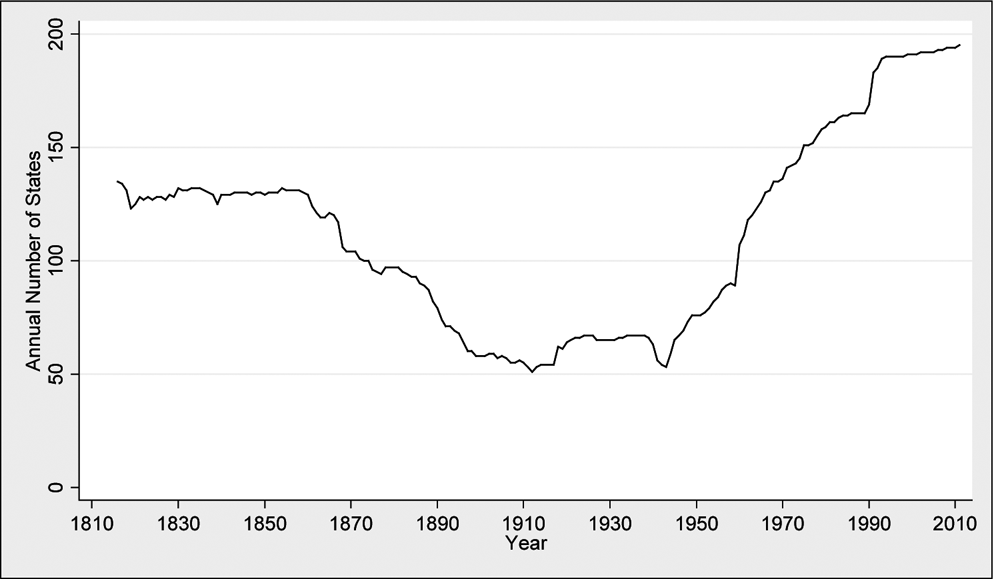
I argue that 1945 constitutes an historical inflection point from a period of state expansion to state contraction and that this transformation is primarily the result of changes at the international level. In earlier periods, competitive pressures between states incited them to expand because larger territories usually brought military advantages and economic benefits. Although these pressures appear to extend back into history for some time, they were particularly sharp in the late nineteenth and early twentieth centuries when the lead states scrambled to gather as much territory as possible. By 1912, there were only 51 states in the international system.
The inflection point in this historical pattern came in 1945 when a combination of security, ideological, and economic factors began to change the milieu in which states evaluate the costs and benefits of holding territory. First, the bipolar system (and later the unipolar system) permitted stable collaborations between strong and weak states on an inter-sovereign basis. Both superpowers preferred informal control over their respective spheres of influence, and this preference removed the zero-sum competition for territory that characterised the earlier multipolar era. It also generated an environment in which the superpowers encouraged decolonisation, and then competed for informal control over the emerging states. Second, the consolidation of the territorial integrity norm dramatically reduced the rate of conquest, reinforced the structural preference for informal control, and, by making states safer from predation, decreased the need to hold large territories. Third, the advent of the nuclear age changed the security emphasis for lead states from territorial defense to deterrence. Finally, the development of the liberal global economy reduced the need to possess large economic units. In an era of increasing globalisation, small states could survive by plugging into the global economy to secure capital and resources, and leverage their comparative advantage. Together these security and economic factors reduced the value of territory and, as a result, states have been more amenable to secessionist demands when the costs of these possessions outweigh the benefits.
The remainder of this article will proceed as follows. First, I will document the macro-historical trend from state expansion to contraction. Second, I will advance a theory for that trend and discuss a number of alternative explanations. Third, I will then test the theory in both a qualitative and quantitative format using original data on secessionist movements and internal administrative units. In doing so, I contribute to the literature which holds that state behavior is conditioned by system-level factors.Footnote 4 In all, this article provides an explanation for why sovereign states have proliferated since 1945, specifies the conditions under which central governments ought to be receptive to secessionist demands, and compiles the findings to draw conclusions about the future of secession. Surprisingly, this topic has not yet been analysed comprehensively.Footnote 5 As David Armitage writes, ‘The story of how the world came to be so thickly populated with states has hardly begun to be told.’Footnote 6
The historical record
The historical record in the international system shows a transition from an era of state aggregation to one of fragmentation. One indicator of aggregation was that the number of sovereign states was decreasing over time as countries engaged in the processes of unification, conquest, and accession. This trend reached its absolute minimum in 1912 when the international system was comprised of some 51 states (see Figure 1). That low point was nearly reached again in 1943 when the conquests of World War II reduced the number to 53. A second indicator of political aggregation is an increase in the size of states. David Lake and Angela O'Mahony found that the average state size increased steadily throughout the 1800s and reached its zenith at the turn of the century at a little less than two million square kilometers. By 2004, the average size had fallen to 854,000 square kilometers, an average size roughly similar to what it had been in 1815.Footnote 7
The number of states in the international systemFootnote 8

The process of fragmentation occurs when part of a state breaks away to form a new sovereign state. Secession is merely the voluntary (and most common) form of fragmentation, and can be differentiated from the rare instances of forced separation (for example, East and West Germany). Secession has been on the rise since 1945. Yet outside of two noteworthy episodes – the early nineteenth century when most of the Latin American states were born from the collapse of the Spanish Empire, and the end of World War I when a set of states emerged largely from the former Ottoman and Austro-Hungarian Empires – secession was a relatively rare event in the pre-World War II period.
Overall, one can discern four general periods to the trend illustrated in Figure 1. The first existed from 1816 until roughly 1860. After an initial drop from 135 states, the number held at approximately 130 for the next forty years. This period witnessed both state birth – for example, the Spanish secessions in Latin America – and state death – for example, the remaining independent Princely states in India. The second period, which ran from about 1860 until 1914, witnessed a 63 per cent reduction in the number of sovereign states. It was during these years that the number of sovereign states was reduced to unprecedented levels. This era was consonant with the so-called new imperialism and scramble for Africa. The third period, which belonged to the interwar years, is where the great historical pattern of political aggregation finally bottomed out. Indeed, there was an initial uptick in the number of states on account of the Habsburg and Ottoman collapses. This era began with the Wilsonian Moment, and it was characterised by a surge in nationalist and secessionist demands.Footnote 9 But in the end, the small increase in the number of states was nearly undone by the territorial acquisitions during World War II. The fourth and final period began in 1945 and is notable for the dramatic increase in the number of states. This era of state proliferation stands in sharp contrast to the earlier periods.
This transition from a period of state expansion to one of contraction has been noted by other scholars and appears to be part of a larger historical pattern that began well before 1816. Victor Lieberman notes that between 1340 and 1820, 23 independent Southeast Asian kingdoms collapsed into three.Footnote 10 Similarly, Charles Tilly records that between the early sixteenth and the early twentieth centuries, five hundred Western European political units condensed into 25.Footnote 11 This long wave of aggregation ended in the early to mid-1900s and gave way to a new period of fragmentation. This transition constitutes a major historical event, one that challenges theories that emphasise continuity in international relations, and one that has not been adequately explained.Footnote 12
The invisible hand of the international system
The core theory in this article fills a gap in the existing research on secession. On the one hand, there is a substantial literature that examines how nationalist groups form and the factors that drive them to attempt secession. Explanations here focus on economic grievances and ethno-national differences,Footnote 13 how potential secessionists evaluate the costs and benefits of seeking independence,Footnote 14 the degree to which secessionist groups learn from one another,Footnote 15 and how the construction of internal administrative units can create the building blocks for future states.Footnote 16 Although this research centers on different elements of secessionism, the common theme is an attention to the demand for sovereignty. On the other hand, there is a body of work that examines how the international community responds to these demands. This research has been heavily influenced by international law,Footnote 17 but recent work by political scientists has examined how state's strategic calculations – especially great powers – influence recognition,Footnote 18 and how international norms regarding recognition have changed over the last two hundred years.Footnote 19 The common theme here is how the international community chooses to supply sovereignty.
The missing link in this literature is how the state responds to secessionist demands.Footnote 20 After all, the primary obstacle to acquiring sovereignty is the state itself, not the international community that typically recognises new claimants when it has the blessing of its former sovereign. Most of the arguments in this theoretical middle-space point to domestic factors. Such explanations are intuitively appealing, and I test them as alternative hypotheses in my analysis. But none of these unit-level theories can account for the historical transition from state aggregation to fragmentation. What is needed is a system-level theory, one that draws on insights from other ‘outside-in’ accounts and explains how metropolitan responses to secessionism are shaped by the invisible hand of the international system.Footnote 21
I argue that changing conditions in the international system are responsible for the historical patterns discussed above. Central governments (that is, metropoles) undergo cost/benefit calculations when they consider the value of acquiring and/or retaining territory. Competitive pressures in the pre-1945 period drove states to shore up territory because it brought security and economic benefits.Footnote 22 This resulted in a gradual reduction in the number of states and an increase in state size. Then, new systemic conditions after World War II reduced the value of holding territory and this enabled metropoles to permit secession more easily.
My attention to the effects that changing international conditions have on the supply and demand for sovereignty borrows ideas from the literature on the size of states.Footnote 23 These arguments hold that state size is endogenous to system-level factors such as the global economy and the threat of conquest. Here, a tradeoff is posed between the benefits of size (for example, economies of scale, national defense) and local autonomy (that is, moving the locus of decision-making closer to local preferences). The optimal size of states is thus determined by the frequency of conquest and corresponding emphasis on defensive capabilities, and on the level of global economic interaction. To use a metaphor, flipping these levers in one direction will make small states more viable; flipping them in the other will select for bigger states. I adopt this approach in my analysis of state proliferation and I further specify the relevant actors. To state that political borders are endogenous to system-level constraints is correct, but it misses the trees for the forest. Who are the actors responding to these international factors? I argue that the two relevant actors in the dynamics of secession are the central governments of sovereign states (metropoles) and the potential secessionist regions inside those states.Footnote 24 To gain independence, an aspiring nation must either get the consent of its metropole or else take it by force. These outcomes – consent or violence – are the primary dependent variable in my analysis.
I conceptualise the chief causal variable as a more benign international system. Changing security and economic conditions alter the milieu in which metropoles evaluate the costs and benefits of holding territory. Although it is impossible to point to one single factor from which all of the observed changes are derived – the milieu is the product of interacting variables – I do identify four key factors: the shift to bipolarity, the consolidation of the territorial integrity norm, the development of nuclear weaponry, and growth of the global economy.
The first of these factors is polarity, which affects how states choose to control territory, a choice that has consequences for secession and the number of sovereign states. In his work on Empires, Michael Doyle noted that ‘multipolar systems tended to require formal institutions of imperial rule; bipolar and unipolar systems, to permit informal arrangements’.Footnote 25 The multipolar period of the late nineteenth century was one of intense interstate rivalry in which states scrambled to seize formal control over territory. Since a peripheral state ‘could improve its bargaining position by playing metropole against metropole … each metropole consequently had an incentive to establish more formal, more direct, and closer supervision over the periphery’. For states like England, the best response in this zero-sum game was to engage in increasingly formalised types of accession.
As the 1880s proceeded, export outlets were further reduced as her [England's] protectionist rivals began to stake out stretches of the world, occupy them, and then declare them exclusively reserved for their own traders and investors … [English businessmen] … began urging a policy of annexation on the government to prevent existing or potential markets from being lost to competitors … other countries were establishing their own, jealously guarded spheres of influence across the world, and in many instances taking control of so-called ‘empty’ areas in Africa and the Pacific.Footnote 26
Such examples abound in the literature and they help explain the reduction in the number of states leading into the twentieth century.
In contrast, bipolarity and unipolarity permit informal relationships in which the weaker party remains a sovereign state.Footnote 27 During the Cold War, the allegiance of weaker states to each superpower was more stable given that a switch tended to require a domestic revolution. The dominant factions in Soviet satellites could not easily switch allegiance to the West, nor shop around for a different patron.Footnote 28 When attempts at regime change did occur, as they did in Hungary in 1956 and Czechoslovakia in 1968, the Russians stepped in to quell dissent. It is telling that the Russian invasion of Afghanistan in 1979 was considered an intervention, much as Vietnam had been to the United States. The emphasis was not on annexation or the taking of sovereignty, but rather on the maintenance of a communist Afghanistan. Instead of acquiring territory in a formal manner, both the United States and the Soviet Union sought instead to create spheres of influence and relationships of informal rule. The United States ‘followed a complex policy intended to court pro-Western independence movements, prevent the rise of anti-Western movements for national liberation, and to facilitate, in some regions, the transformation of West European formal empires into informal empires’.Footnote 29
The US-Soviet preference over the form of rule affected other states in two important ways. First, it removed the zero-sum competition over formal territorial control. States no longer had to possess territory to prevent a competitor from seizing it, and all else equal, this reduced the benefits of holding territory. Second, the anti-colonial rhetoric of the superpowers put pressure on states to grant independence to colonies and internal nations. There was, of course, a strategy behind that pressure, and both powers attempted to draw emerging states into their respective spheres of influence. The result was state proliferation.
The unipolar world after 1991 has had similar, albeit less complicated, effects.Footnote 30 For the United States, informal relations with other sovereign states are the preferred form of control. As with the Cold War, this preference affects the overall milieu in which states evaluate the costs and benefits of holding territory. This, of course, raises the question of what happens when the system once again becomes multipolar, which it appears to be doing (if it hasn't already). I return to this issue at the end of the article. Overall, periods of bipolarity and unipolarity states will be more likely to permit peaceful secession (that is, secession without a conflict).
The second factor pertains to the post-1945 norm emphasising territorial integrity. Scholars usually trace the origins of the norm to Woodrow Wilson and the League of Nations, but argue that it was not until 1945 that it truly gained adherence. Mark Zacher argues that the norm effectively delegitimised territorial conquest and resulted in a clear reduction in wars over territory.Footnote 31 Tanisha Fazal makes a similar claim as part of her explanation for the virtual disappearance of violent state death after 1945.Footnote 32 According to Boaz Atzili, changing attitudes regarding conquest and annexation, especially among the elites, combined with other material forces to help consolidate the norm.Footnote 33 Here, Atzili highlights many of the same system-level changes that I do – the rising global economy, nuclear weapons – which acted like ‘distinct vectors pointing in the same direction’, affecting the milieu in which states evaluate the costs and benefits of holding territory.
Importantly, I contend that the consolidation of the norm was assisted by the US-Soviet preference for informal rule. Since neither side was compelled to take formal control over their satellites, both were keen to prevent their opponent from doing so. The United States may well have been the entrepreneur and chief exponent of the norm, as Fazal argues, but other states also supported it.Footnote 34 Chief among them was the Soviet Union which included a clause on the integrity of borders in the 1975 Helsinki Final Act. The result was a bipolar system premised on ‘the territorial integrity of states’ in which ‘each political champion led a “family”, i.e. a network of dependents and allies’.Footnote 35
The post-1945 emphasis on territorial integrity has had a curious effect on secession. On the one hand, the community of states has worked to maintain political borders, which by implication, presents an obstacle to secessionists who wish to change them. As Jeffrey Herbst claims, ‘state boundaries have been singularly successful in their primary function: preserving the territorial integrity of the state by preventing significant territorial competition and delegitimizing the norm of self-determination’.Footnote 36 On the other hand, the attention to political borders has made states safer from territorial predation since sovereign recognition more or less functions like an insurance policy,Footnote 37 and the territorial integrity norm like an arms control agreement.Footnote 38 This added security has reduced the need to possess large territories, and has made it easier for governments to permit secession where they deem it beneficial. Mikulas Fabry writes that one of the best ways for secessionists to gain international support is through consent from their metropole.Footnote 39 Governments may still deny independence for a number of reasons, but all else equal, they are more likely to give consent in a non-multipolar system that privileges the territorial integrity of states.
Together, these two factors – polarity and territorial integrity – yield a set of testable hypotheses. Specifically, we should expect that the United States and the Soviet Union would be more likely to permit peaceful secession during the Cold War, and that this willingness would continue with the United States when it was the sole superpower after 1989. This is a non-trivial claim since it suggests that each state was more likely to permit secession when they were powerful. In more general terms, we should expect that the preferences of these states would diffuse throughout the system and thus make peaceful secession more likely after 1945. These hypotheses will be examined in the analytical section.
H1: The United States is more likely to permit secession after 1945.
H2: The Soviet Union was more likely to permit secession after 1945.
H3: Peaceful secession is more likely in the post-1945 period.
A third factor is the development of nuclear weapons. A number of scholars have noted that nuclear weapons alter the traditional calculus of defense.Footnote 40 As a result, the perceived value of large territories and large armies declined as both the superpowers and the states within their nuclear umbrellas began to focus less on territorial possession and more on deterrence. Although Operation Barbarossa had reinforced the value that Russians placed on territorial depth, Soviet leadership in the postwar period gradually came to appreciate the ‘efficacy of nuclear deterrence, which reduces the importance of territory and economic size to security’. Indeed, Peter Liberman argues that the peaceful secession of the union republics in 1991 was made possible by a belief of Gorbachev and others that ‘nuclear deterrence was enough’.Footnote 41 For colonial powers like England, it became clear early in the Cold War that English grand strategy – as formalised in the Global Strategy of 1950 – was shifting from a reliance on territorial possession and manpower to one that emphasised nuclear deterrence and the American nuclear umbrella.Footnote 42
Two claims can be made with respect to nuclear weapons and secession. The first, narrower, claim is that states which possess a nuclear deterrent will be more inclined to give up territory, all else equal. At first blush this argument may seem counterintuitive given the presumption that it is weak states that give up territory, and nuclear weapons are usually a sign of strength. But a core theme in this article is that states do not always want to hold territory and that metropoles will often permit secession when they can. A nuclear deterrent increases their ability to do so.
H4: Peaceful secession is more likely when the metropole has nuclear weapons.
The second, broader claim is that the possession of these weapons by only a small set of states ought to affect how non-nuclear states value territory. That is, if the most powerful states are less inclined to seek and/or hold territory, the competitive pressures between states will be reduced and other non-nuclear states will tend to follow suit. Although I believe this is the case, I restrict my analysis to the narrower claim for the purpose of precision; I can code the response of every state (nuclear or non-nuclear) to an attempt at secession. Testing the broader claim would require that I code for a nuclear age, which would begin with the first use in 1945, and thus generate an implication identical in form to hypothesis 3. Teasing out those effects would require a qualitative analysis that goes beyond the scope of this article. However, validation of the following hypothesis would at least demonstrate the effects that nuclear weapons have in the narrower sense.
The fourth factor is that the development of the global economic order has further reduced the importance of large territorial units. In earlier times states had good reason to acquire territory for the material benefits it brought. Beggar-thy-neighbor policies, preferential trading systems, along with higher levels of conquest elevated the perils of autarky. In contrast, the post-1945 multilateral trading system has lowered the risk of conducting relations with other polities on the basis of sovereign equality.Footnote 43 Meanwhile, higher levels of foreign direct investment and dispersed production have gradually internationalised economic enterprise.Footnote 44 States can now plug into the global apparatus to secure capital, leverage comparative advantage, and profit in economies of scale. This development leads to three related outcomes. First, smaller, economically open states are more viable. Second, the economic value of holding territory is reduced if the relevant goods and services can be obtained on the international market. Thus, ‘as barriers to international trade declined, the need for large internal (imperial) markets declined as well’.Footnote 45 And third, this ‘decoupling of territorial control and national prosperity’ should reinforce (and be reinforced by) the changing security factors mentioned above.Footnote 46 This yields the following testable implication.
H5: The likelihood of peaceful secession increases as the metropole becomes more integrated with the global economy.
Collectively, these factors set the background conditions in which metropoles have responded to secessionist demands since 1945. They are additive in the sense that each contributes to the overall milieu, but they are not co-equal. Polarity was arguably the most important variable, and the fact that the Cold War began at a time when states were relatively large on average, and possessed of numerous internal nations, set the stage for a process of state fragmentation in which the superpowers competed for influence. The development of nuclear weapons reinforced this process partly by helping to keep the Cold War from getting hot. Combined with a postwar emphasis on territorial integrity that was bolstered by the superpowers, there was a subsequent decline in major interstate war, particularly wars of conquest. Commensurate with this decline in major war was the development of the global economy, a factor that further encouraged peaceful secession, but one that on its own could not have yielded a period of state proliferation. If the late nineteenth-century era of globalisation is any indication, high trade levels alone do not encourage states to permit secession when conquest remains common. How further change in these factors will affect secession in the future is an issue I return to at the end of the article.
This theory helps explain observed patterns in contemporary international relations where we see fragmentation within states and integration between them.Footnote 47 Evoking slogans like ‘Independence in Europe’, regions such as Scotland simultaneously push for decentralisation on one level (UK) and centralisation on another (Europe). Moreover, that movement is being negotiated with London in a remarkably non-violent manner that would have been hard to imagine in earlier times. As an article in The Economist put it: ‘Nor would independent Scots face the prospect of barbed wire, border posts and watchtowers sprouting along some latter-day Hadrian's Wall … Many things need not change were Scotland to split off from Britain – if it retained uninterrupted membership of the EU.’Footnote 48 Although European integration may one day result in complete unification – and therefore produce fewer states – the pattern thus far points to confederal arrangements of juridically sovereign states. I argue that that pattern is made possible by the systemic changes noted above.
Alternative hypotheses
One of the most commonly referenced alternative explanations points to the norm of self-determination. Although the right of a people to self-governance had been supported at least as far back as the American Declaration of Independence, its formal infusion into the international system is usually credited to Woodrow Wilson, who stated that ‘all well-defined national aspirations shall be accorded the utmost satisfaction that can be accorded them’.Footnote 49 In theory, the introduction of the norm ought to have increased both the demand for secession and the willingness of states to grant it. Analytically, the development of the self-determination norm suggests that peaceful secession would be more likely after 1918.
H6: Peaceful secession is more likely after 1918.
Another common argument points to the ideas and principles surrounding decolonisation, which had their origins in the norm of self-determination.Footnote 50 One could argue that any patterns in peaceful secession disappear once we control for decolonisation.
H7: The peaceful proliferation of states after 1945 is purely a result of decolonisation.
I test this argument in the analytical section but I offer a counter-argument here. There is no doubt that the ideas behind decolonisation assisted numerous nations in winning their independence. But I submit that decolonisation was made possible by changes in the value of holding territory. Some scholars argue against instrumental explanations for decolonisation by pointing out that the colonial powers were not so exhausted that they couldn't retain colonies, nor suddenly disinterested in the economics of territory. And if the costs of colonialism hadn't increased, as Neta Crawford argues, then why didn't states acquire the ‘territories of which other powers were prepared to divest themselves’?Footnote 51 I agree with these claims, but disagree with the conclusion that if we can't point to any change in the ‘balance of material costs and benefits, it seems as though we must resort to normative ideas to explain the change’.Footnote 52 My theory identifies these cost/benefit changes, explains why state like Britain would give up territory, and specifies why the superpowers would support decolonisation and then compete for informal influence over the emerging states.
I have argued that the system-wide historical changes require a system-level explanation, but domestic factors may also play a causal role in shaping state response. One recent study by Barbara Walter gets inside state preferences and argues that metropoles face problems of reputation.Footnote 53 Although they may judge a specific secessionist region as not worth the effort, they may nonetheless have to fight to retain the region if letting it go would establish a precedent for others. In other words, the more secessionist movements a metropole faces, the more likely it is to resist. Here, Walter argues for an important mechanism that shapes state response, one that I test in my analysis.
H8: The likelihood of peaceful secession is inversely related to the number of secessionist movements the metropole faces.
Hendrik Spruyt provides a different tack in his work on imperial contraction.Footnote 54 Not unlike the literature on the size of states, he assigns causal priority to the international system: conditions in the postwar period have rendered the retention of colonies less desirable. The key intervening variable is the number of veto points in the metropole. The fewer the number of veto points, the more adaptive state policy becomes, and the quicker it will be to permit decolonisation. Essentially, the institutional structure of the former colonial powers acts as a break on international level forces.
H9: Peaceful secession is inversely related to the number of veto points in the metropole.
Another line centers on the focal nature of internal administrative boundaries. David Carter and Hein Goemans argue that it matters when a secessionist region coheres with an existing administrative region.Footnote 55 Internal boundaries help solve the problem of where to draw borders with breakaway regions. Moreover, this is an important theme in international law where the principle of uti possidetis, or ‘as you possess’, is central to the discussion of secession and specifies that new states inherit their former administrative boundaries. The concept has become a default rule in international law and is thought to provide a clear, simple solution to the relevant parties and therefore prevent conflict.
H10: Peaceful secession is more likely when the secessionist movement lays claim to a specific administrative region.
Yet another explanation focuses on regime type. Several scholars have argued that democracy ought to yield patterns of peaceful secession.Footnote 56 There are two general reasons for this. The first pertains to liberal democratic norms such as legitimacy, freedom, and the right of self-government, which render democratic societies more amenable to secessionist demands. Second, the institutional structure of democracy provides a means to seek secession in a non-violent and institutional manner. In sum, democracy produces peaceful secessionist outcomes.
H11: Peaceful secession is more likely in democracies.
Analysis
In this section I will first describe my data on secessionist movements, internal administrative units, and secessionist conflict. I will then examine the macro record of state birth and secession between 1816 and 2005, and take a closer look at American and Russian secessionist events. Following this, I will test the hypotheses stated above using a binomial logistic regression where the dependent variable is secessionist conflict or peaceful secession. I will finish by examining the effects of the norm of self-determination.
Data
I define secession as the formal withdrawal from an established, internationally recognised state by a constituent unit to create a new sovereign state. Secessionist movements are groups of people within a state that actively seek to break away from the larger country and obtain independence. To identify this set of movements, I use Coggins's criteria, where a movement must have: (1) A formal declaration of independence; (2) A national flag; (3) A claim to an identifiable territory and population; and (4) A campaign lasting at least one week, involving at least 1,000 people, and laying claim to at least 100 square kilometers.Footnote 57 The logic behind these criteria is that the secessionist movement must be above a certain size and that the group in question actively seeks their independence by choosing a flag and by making their intentions known to the international community. I then identified 392 secessionist event years between 1816 and 2005 in which a given movement was either seceding or else beginning a secessionist conflict with its metropole. The purpose behind this dataset is to identify a set of secessionist movements and then examine their outcomes. Importantly, this set includes both the successes – for example, Estonia, Cameroon – and the failures – for example, The Confederate States of America, Casamance.
Although this conception of secessionism is consistent with much recent research,Footnote 58 it does differ from other views that restrict the label to violent, illegal, or non-colonial cases. I argue that my broad definition permits a more rigorous analysis by not biasing the outcome. It provides a base category of aspiring nations before they are awarded independence or denied it. In practice, international law has attempted to limit sovereign recognition to cases of consent, decolonisation, and dissolution, but such designations are often political, ex poste, and difficult to incorporate into a systematic analysis.Footnote 59 For example, Buganda was an African kingdom in the nineteenth century and it declared independence once again in 1960 when it was a region within the greater colony of Uganda. But like the Baluchi, the Lozi, the Bougainvilleans, and countless others, it was denied independence by its European sovereign. As Robert Jackson states, the international community limited sovereignty to colonial units rather than accommodate all colonised nations. In doing so, it created upwards of 50 independent African states rather than ‘400 or 500’, and it consigned places like Buganda ‘to the ranks of the abandoned peoples by the transformation of colonial frontiers – which never recognized them – into international boundaries’.Footnote 60 Similarly, international law recognised Georgia because it emerged from a dissolved state, and yet Somaliland is denied that same recognition by its sovereign and the African Union even though Somalia is far more dissolved than the Soviet Union was. By including all cases in my study and beginning my analysis before such designations are made, I am in a position to identify the impact of a range of causal variables.
I created an additional dataset on internal administrative units that was useful for testing alternative hypothesis 10. Here, I identified 680 administrative units with the following traits:
1. They have a minimum population of 1,000 people and a minimum size of 100 square kilometers and,
2. They either possess complete internal independence (indirect rule),
a. or they are granted specific rights in accordance with a unit-wide ethnic group or nation,
b. or they are the result of a territorial transfer in the last ten years,
c. or they are separated from the metropole by at least 150 miles.
The goal here was not to identify all administrative jurisdictions in all countries between 1816 and 2005 but rather the most likely candidates for secession.
Finally, to code for violent secession(ism), I used the criteria put forth by the Uppsala Conflict Data Program: a conflict is ‘a contested incompatibility that concerns government and/or territory where the use of armed force between two parties, of which at least one is the government of a state, results in at least 25 battle-related deaths’.Footnote 61 Although the threshold criterion of 25 battle-related deaths per year is quite low relative to other datasets, it was appropriate for my purposes. Had I selected a higher threshold such as the standard 1,000 deaths, I would have elided a number of secessionist-driven conflicts that were violent and indicative of metropolitan denial, but yet insufficiently violent to make the cut. Although this dataset only begins in 1946, I applied the criteria to all secessionist movements stretching back to 1816.
An increase in state birth and peaceful secession
There are different ways to calculate the rate of state birth. Do we look at all state births or just the secessions? Which dataset do we use? But all the methods of choice confirm statistically different rates of birth/secession at the 99 per cent confidence level. For example, the Correlates of War Project identifies 79 state births between 1816 and 1945, an average of approximately 0.6 births a year.Footnote 62 Meanwhile, there were 141 births between 1946 and 2011, an average of 2.13 births a year.
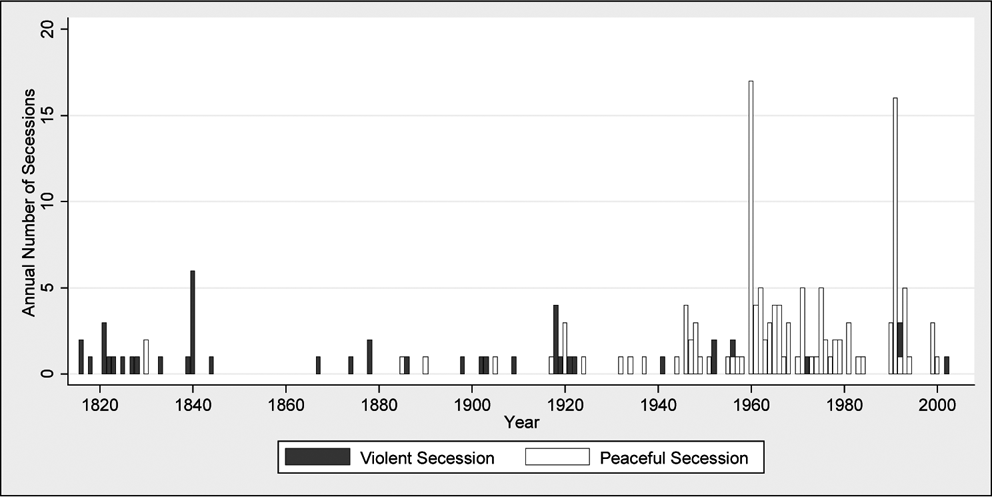
An examination of the data reveals that secession was not only significantly more common after 1945, it was also more peaceful (see Figure 2). Of the 183 cases of secession between 1816 and 2005, 56 (31 per cent) resulted in conflict. However, of the 52 cases that occurred in the pre-1945 era, fully 38 (73 per cent) were violent. Meanwhile, of the 131 cases in the post-1945 period, only 18 (14 per cent) were violent. Thus in stark contrast to the years before, peaceful secession has been more common in the post-1945 period.
Violent versus peaceful secession
Of course, there were peaceful secessions in the pre-1945 era just as there were violent secessions afterward. One of the most amiable of these breakups was Norway from Sweden in 1905. Others occurred against the background of a weakened country. These include Venezuela and Ecuador from Gran Colombia in 1830, and Finland from Russia in 1917. Other secessions occurred in a more gradual process. Luxembourg's 1890 secession from the Netherlands is an example, but perhaps the best cases are the English dominions of South Africa, Canada, Australia, and New Zealand, which obtained sovereignty as defined in this article between 1885 and 1920. Both the Dominican Republic and Haiti seceded (again) from the United States in 1924 and 1934, respectively. Finally, there were the secessions of Iraq in 1932 and Egypt in 1937, two territories that had fought for independence in the 1920s and gradually wrestled a level of consent from England prior to World War II.
Similarly, there were some 18 violent secessions after 1945 and a significant number of attempted secessions that were denied by the central government. This, however, is understandable even in an era where governments are more amenable to secession. Separatist groups may lay claim to territory considered too valuable, they may espouse an ideology that is hostile to the parent state, and metropoles may simply be trying to manage multiple secessions in a way that avoids uncontrolled fragmentation. A large-N analysis should reveal many of these dynamics.
The United States, the Soviet Union, and the preference for informal rule
Were the two most powerful states in the system more likely to permit secession after 1945? The data show nine secessionist event years for the United States between 1816 and 2005, a rather small amount relative to many states. Four of these cases occurred after World War II – The Philippines in 1946, both Micronesia and the Marshall Islands in 1986, and Palau in 1994 – and all of these were peaceful secessions. In the earlier period, the major secessionist event for the United States was the Civil War, which ended in violent denial. Lesser known cases were the secessionist efforts following US intervention in Cuba (1909), Haiti (1915, 1934), and the Dominican Republic (1916). Of these, two were peaceful – Cuba and Haiti in 1934 – and the other two were violent. Taken as a whole, these data are sparse, but they do show a general trend toward peaceful secession. It is after all striking that the most powerful state would permit the sovereign independence of four territories, most of which were small and easily suppressed.
The pattern for the Russian metropole is easier to examine given the much greater number of cases. There were 63 secessionist event years for Russia between 1816 and 2005. Of these only three occurred (all violently) prior to 1917 – Poland in 1831 and 1863, and Gagauzia in 1906. In contrast, 43 minority nations declared independence between 1917 and 1945, and all save one had a violent encounter with the state. Only in Finland was secession peaceful insofar as Moscow did not violently contest it.Footnote 63 The pattern after 1945 is different if imperfect. There were no secessionist events years until 1991 when the 14 non-Russian union republics seceded peacefully.Footnote 64 Other national groups would be denied independence and in three cases violence was the result – Chechnya in 1994 and 1999, and Dagestan in 1999. Overall, in basic statistical terms, the postwar rate of peaceful secession was much higher.
I maintain that the above patterns support my claims regarding preferences over the form of rule. For most of its history the United States aimed to acquire and keep formal control over territory where it could. It too participated in the scramble for territory in the late nineteenth century, and its rise to power resulted in a collection of new territories in the Western Hemisphere and in the Pacific. Admittedly, its hegemony in the Americas arguably dampened the need to take formal control over weaker states, especially in the Caribbean and Central America. But the fact that regional hegemony permitted patterns of informal rule only supports the polarity thesis. At the global level, at least after 1947, the United States has not taken formal control over a single territory nor fought a single secessionist group that was subject to American governance.Footnote 65
Looking back, one can discern a post-1945 change in the Soviet preference over the form of rule. Prior to 1945, memories of earlier invasions and the resulting Russian tendency to expand as a means to protect were quite evident. ‘Such memories go part of the way to explain the Soviet decision to occupy and reabsorb Estonia, Latvia, and Lithuania in 1939 and 1940 … they would serve as a shield for a German attack on the U.S.S.R.’Footnote 66 But after World War II, the incentives to take formal control over territory diminished. Moscow chose not to annex the remaining Eastern European states even though its armies had penetrated deep into Central Europe. There is no doubt that these satellite states were subordinate and engaged in a highly hegemonic relationship, but the relationship was inter-sovereign. This was evidently the preferred form of rule and the consequence was that instead of an enlarged Soviet Union there were a handful of sovereign states. Strikingly, Czechoslovakia, Poland, Albania, and (East) Germany had effectively died as states during the war, but between 1944 and 1954 Moscow permitted the restoration of their sovereign status. Informal empire was the optimal political relationship. ‘Since free elections in Eastern Europe would have produced anti-Soviet governments, and since outright annexation might have provoked another war, informal control through puppet regimes appeared the best way to protect Soviet security.’Footnote 67 Moscow could exploit and dominate these countries in a cost-effective manner even though they were sovereign members of the state system. Moscow's relationship with these states was summed up the Brezhnev Doctrine, which reserved for Russia the right to intervene and support socialist regimes from internal foes.Footnote 68
This mutual preference over the form of rule had several important consequences. First, it resulted in significantly less conquest. Second, it made these states more amenable to secession, especially if informal rule could be maintained. Finally, these choices reverberated throughout the international system and moderated the preferences of other states on these issues. There is perhaps no better example of this then the historic arc of English rule.Footnote 69 Competitive pressures in the nineteenth century spurred England to expand its perimeter where it could – horizontally across ever larger amounts of territory and vertically to intensify its form of rule. Thus, informal empire became formalised. But if the interwar years left the state attempting to preserve the status quo, the post-1945 period and the advent of the Cold War affected the costs and benefits of holding territory. Prior fears over territorial conquest had diminished and apprehensions that the release of a territory would only pave the way for a peer competitor to seize it were replaced by a focus on ensuring that the emerging unit was on the right side of the Cold War and, hopefully, a responsible member of the British Commonwealth. The international environment had changed and, as a result, the state was much more amenable to secession.
Critics might respond that the bulk of the new states after 1945 were the result of decolonisation and the dissolution of the Soviet empire. They might add that these events were to some extent sui generis, and, as such, one cannot draw larger conclusions about change in the international system. Although I recognise that there were other causal forces contributing to decolonisation and Soviet dissolution, I nonetheless maintain that these events were made possible by the system-level conditions I identify in my theory.
Logistic regressions on secessionist outcomes
I tested many of the core and alternative hypotheses using a binomial logistic regression of all secessionist outcomes between 1816 and 2005. I dichotomised the dependent variable into two categories: (1) Conflict, in which the outcome is either denial or violent secession; and (2) Peaceful secession. For cases of conflict I only used the onset year, and not any of the subsequent years for prolonged conflicts. That is, I created an onset variable as a means of dealing with serial correlation in the reference category: denial / violent secession. No observations of peaceful secession had to be dropped since these were already terminal years. All told, there were 392 cases, where 266 ended in conflict and 126 ended in peaceful secession. The logic behind this specification is straightforward: peaceful secession indicates willingness on behalf of the metropole to grant independence; conflict indicates a desire to keep the territory.
The independent variables were specified as follows. I coded a dummy variable beginning in 1946 to test the shared effects of polarity and the territorial integrity norm. Given that this is merely a time dummy, it cannot make a claim regarding causation. However, the sign and significance will be informative, particularly when combined with the qualitative findings. I coded nuclear weapons using a dummy variable beginning with the year the state first tested a bomb (USA=1945; USSR=1949; UK=1952; France=1960; China=1964; India=1974; Pakistan 1998).Footnote 70 For the trade variable I calculated each state's trade openness as a ratio of trade (imports plus exports) to GDP using trade data from the Correlates of War Project Trade Data Set and GDP data published by Angus Maddison.Footnote 71 Unfortunately, these trade data only go back to 1870 and there were a number of missing values.
The alternative variables were coded in the following manner. Hypothesis 8 expresses Walter's claim regarding precedence setting. To code this variable (deterrence), I simply summed the number of concurrent secessionist movements within the same metropole. For hypothesis 9 (veto), I used the XConst variable from Polity IV, which codes the constraints placed on the state executive on a 7-point scale, with 7 indicating the most constraint.Footnote 72 For hypothesis 10 (administrative unit) I used the data discussed earlier and coded for whether the secessionist movement cohered with an administrative unit. For hypothesis 11 (democracy), I used Polity IV data and specifically the Polity2 variable, which combines the autocracy and democracy variables by subtracting the former from the latter to produce a 21-point scale.Footnote 73
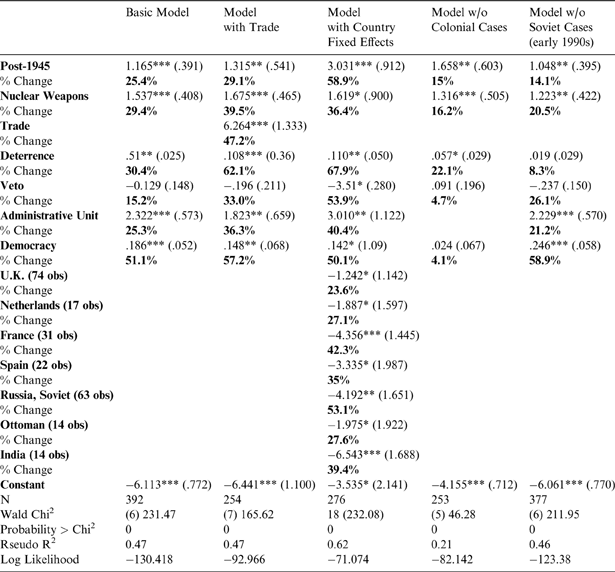
Table 1 lists the regression results. The first model excludes the trade variable to take advantage of the entire range of years. All of the variables except the one pertaining to veto points are significant. The marginal effects are particularly informative. Notably, the predicted probability of peaceful secession increases by 25 per cent in the post-1945 period. Meanwhile, the predicted probability of peaceful secession increases by a full 29 per cent when the metropole possesses nuclear weapons. The remaining findings are quite interesting. The predicted probability of peaceful secession when the group in question claims an internal administrative unit increases by 25 per cent. This supports the argument that internal administrative lines and categories help secessionists and their governments to reach a peaceful agreement. Similarly, the democracy variable has a strong impact, raising the predicted probability of peaceful secession by 51 per cent, as we move from a polity score of 1 to 20. The incremental changes are, of course, much smaller, but democracy clearly has an impact on the likelihood of peaceful secession.
Binomial logit model of secessionist outcomes
Note: *p<.10; **p<.05; ***p<.01
Note: Marginal change calculated by moving the variable from low to high while holding the other variables at their mean. The trade variable is calculated by increasing the value from 1 SD below the mean to 1 SD above.
One of the more interesting findings pertains to the deterrence variable. The results are significant, but in the opposite direction. The predicted probability of peaceful secession increases by 30 per cent as the number of parallel movements is increased from 0 to 30, the maximum number of movements. Essentially, the likelihood of metropolitan permission increases as the number of internal movements increases. Of course, the distribution is skewed insofar as the average number of parallel movements is 6.3. Therefore, it is perhaps more useful to analyse smaller, more typical increases from, say, 0 to 10 parallel movements, where the predicted probability increases by only 7.8 per cent. The implication is that deterrence does not work in quite the manner that Walter argues. On the contrary, peaceful secession seems to occur in waves. There may well be a swarm effect as a set of potential secessionist movements make a bid for independence when they perceive that conditions are ripe.Footnote 74
The second model includes the trade variable, but has fewer cases (254) on account of missing trade data. The significance of the variables is roughly the same, but in each case the marginal effects increase. Now peaceful secession is 29 per cent more likely after 1945 and 40 per cent more likely when the metropole possesses nuclear weapons. Importantly, the trade variable is statistically significant, showing strong marginal effects. The average ratio of trade to GDP is 20.5 per cent, with a standard deviation of 16.6 per cent. The probability of peaceful secession increases by a full 47 per cent when moving from one SD below the mean to one SD above. These results provide support for the core hypotheses.
The biggest change is that the marginal impact of the deterrence variable increases to 62 per cent as the number of parallel movements is increased from 0 to 30, or 26 per cent as that number is increased from 0 to 10. A closer look at the data reveals that several of the historical waves of secessionist conflict – for example, Spain between 1816 and 1822, Russia between 1918 and 1922 – are excluded here due to a lack of trade data, and thus the results are much stronger. Overall, these findings suggest a positive relationship between secessionist waves and peace. But it is likely that there are feedback effects here; groups declare independence either because they anticipate metropolitan permission or else they update their chances of success when they see multiple parallel movements challenging the government. I return to this issue below.
The third model used fixed effects to identify instances where the patterns of governmental response were uncommon and possibly the result of unobserved factors particular to that state. Overall, the main variables of interest all show results comparable to the other models. Running the regression in this manner does, however, end up dropping 116 observations clustered on 48 states, where the state displayed no variation on the dependent variable.Footnote 75 The biggest ‘dropped’ outlier, by far, was Myanmar which accounted for 21 cases of secessionist violence (and no peaceful secession). Interestingly, France, Russia, and India all show strong fixed effects, suggesting that these states were especially likely to deny secession after controlling for the other variables.Footnote 76
The last two models control for the effects of decolonisation and the Soviet collapse. In order to test hypothesis 7 – the peaceful secession of states after 1945 is purely a result of decolonisation – I dropped all cases where the secessionist region was separated from the metropole by at least 150 miles of water or foreign territory.Footnote 77 The patterns here are generally consistent with the other models. The postwar and nuclear weapons variables still possess strong and significant effects, and the deterrence variable still shows a positive relationship with peaceful secession. Finally, the administrative unit variable perfectly predicts all 37 cases of peaceful secession, implying that this factor is potentially more important where geographically proximate cases are concerned.Footnote 78
The exclusion of the Soviet cases in the early 1990s yields similar results.Footnote 79 The core hypotheses retain strong and significant effects. Notably, the deterrence variable is now rendered insignificant, suggesting that the Soviet secessions were an important cause of the positive relationship between the number of movements and peaceful secession.
The norm of self-determination
A common explanation for the rise in secession is the introduction of the norm of self-determination in 1918. My analysis shows that during the interwar period, particularly in the first decade, the introduction of the norm and its attendant vocabulary corresponded with a rise in secessionism but not secession. Whereas in 1900 there were approximately 13 secessionist movements around the world, that number increased dramatically at the end of World War I, reaching a peak of some 53 movements in 1920. Although such levels of secessionism were unprecedented in prior years, similarly high numbers of independence movements would endure for the remainder of the twentieth century. The striking difference between the immediate post-1918 and post-1945 periods was not the number of secessionist movements – both saw nearly identical levels – but rather the number of secessionist conflicts. There were some 26 secessionist conflicts between 1918 and 1920, a wave of violence that outmatched the former peak of 11 conflicts in 1816. Meanwhile, the immediate post-1945 peak was seven conflicts, a figure that was not reached again until the 1991 when there were eight conflicts. In essence the rate of secessionist conflict was 49 per cent between 1918 and 1920, and only 13 per cent between 1945 and 1947. It seems that secessionism increased after 1918, but so too did secessionist conflict, which provides evidence against the self-determination hypothesis.
The connection between the arrival of the norm and the spike in secessionism has been made persuasively by other scholars. Armitage contends that Wilson's ideas not only inspired a significant number of stateless nations to declare independence, they also shaped the content of the declarations; ‘during this moment, individualistic accounts of rights gave way to movements for the rights of nations and peoples’.Footnote 80 But Erez Manela writes that while the ‘Wilsonian Moment’ fired the imagination of aspiring nations, disillusionment followed once it became clear that the lead states had no intention of honoring claims to self-determination if they ‘ran against their own interests’.Footnote 81 In truth, the self-determination norm has had a much bigger impact on the desire of minority nations to demand sovereignty than it has on the willingness of states to supply it. Even in the post-1945 world, the sovereign right of states to maintain their territorial integrity has all too often been used as an argument against self-determination.Footnote 82 Obtaining the consent of the central government is the surest way to independence, but, as I have argued, other systemic factors in the post-1945 world made states more likely to assent.
Conclusion
The historical transition from state expansion to contraction is an important moment in International Relations. I have found evidence for a general theory explaining that transition, one that assigns causal importance to the invisible hand of the international system. Just as security and economic pressures drove lead states to expand in earlier times, changing conditions in the post-1945 period enabled metropoles to permit secession more frequently and the result has been state proliferation.
I conceptualised these conditions as a milieu in which metropoles respond to secessionist demands, and I identified four factors that could be tested analytically. First, polarity has structural consequences on secession and the number of sovereign states. Multipolarity incites states to expand; bipolarity and unipolarity permit them to contract. Second, the norm of territorial integrity makes states safer from predation and decreases the need to hold territory. Third, the possession of nuclear weapons shifts the emphasis from territorial defense and large armies to deterrence. Fourth, high levels of economic integration in the global economy reduce the need to possess a large internal economy. The qualitative examination in this article, more telegraphic than exhaustive, showed some evidence for the first two factors and the statistical results indicated that peaceful secession is more likely after 1945. The regressions also showed that trade and nuclear weapons were highly significant.
Importantly, the internal composition of states may moderate how they respond to changing international conditions. The analysis showed that states are more likely to permit secession when the secessionist group lays claim to an administrative region. This suggests that the administrative structure of states provides governments with a blueprint for how to disassemble. Another finding suggests that there is something of a democratic peace with respect to regime type and secessionism. Further work needs to determine whether it is liberal democratic norms that make states more tolerant of secessionist demands, or whether democratic institutions dampen such demands by drawing the relevant parties into the political process.
One final result points to deterrence and precedent setting. Despite the argument that metropoles must show resolve in the face of multiple secessionist groups, these findings indicate that in the post-1945 period peaceful secession has tended to occur in waves. Admittedly, this finding is driven by several large waves, particularly the secessions from the Soviet Union, but there appear to be selection effects insofar as potential and actual secessionists moderate their activities in anticipation of the metropole's response. That anticipation could generate a violent wave of secession if each group ultimately expects victory, and it could generate a wave of peaceful secession when groups calculate that consensual exit is an option. Indeed, these calculations could occur in the context of state collapse where even half-hearted groups conclude that political exit is the best option.
International conditions in the post-1945 period have led to state proliferation, but such conditions are not static. Of the systemic factors I identify, polarity is the most likely to change in the near future, if it hasn't already. My theory suggests two potential outcomes following a return to multipolarity. First, in a multipolar world that is occupied by nuclear armed, economically interdependent states that honor the norm of territorial integrity, we ought to see continued state proliferation, but at a reduced rate. If ascendant powers like China and India continue to support the territorial integrity norm – and thus far they seem keen to do so – state death should remain rare. In such a world the security and economic benefits of holding territory would be roughly similar to the bipolar and unipolar periods. The main difference and cause of the reduced rate of secession would be the competition for control over emerging states. As Doyle pointed out, weaker states in a multipolar system can play one power off another.Footnote 83 Anticipating the difficulties of maintaining informal relations over new states, the great powers ought to be more likely to deny undesired secessions at home and abroad. Indeed, they would probably appeal to the norm of territorial integrity when denying these efforts.
The second outcome is a return to a past in which conquest is frequent, secession rare, and where state aggregation is more common than fragmentation. I contend that that future is far less likely given that it would require abandonment, at the least, of the territorial integrity norm and perhaps a closure of the global economic system. Even then, the possession of nuclear weapons might deter many states from engaging in traditional conquest. Thus, to a large extent, the general conditions permitting state fragmentation are locked in. The advent of the bipolar system helped create an environment in which the long trend toward state aggregation could be reversed, but the new trend is unlikely to be undone by a return to multipolarity.