Substantial improvement in the cycling efficiency of energy storage devices is necessary to increase their overall performance, requiring a focused effort in the development of new nanoscale materials. Recently, ultracapacitors have attracted attention because, in contrast to batteries, they exhibit high power delivery (10 kW/kg) and a long life cycle.[Reference Park and Ruoff1] Ultracapacitors typically consist of two porous carbon electrodes separated by an ion porous polymer membrane. When a supporting electrolyte is added, an ionic current can flow between the electrodes.[Reference Stoller, Park, Zhu, An and Ruoff2] The performance of ultracapacitors can be improved by using new kinds of electrode materials and electrolytes, such as graphene-based nanomaterials, that possess high intrinsic surface areas and are chemically inert under a wide range of applied potentials.[Reference Park and Ruoff1] Moreover, the energy density of ultracapacitors increases at higher cell voltages, although increased applied potentials require highly stable electrolytes to avoid decomposition under operating conditions.[Reference Simon and Gogotsi3] To this end, ionic liquids (ILs) are now widely explored as electrolytes as they exhibit excellent electrochemical stability, high ionic conductivity, and thermal stability, as well as non-volatility, non-flammability, and low toxicity.[Reference Liu, Yu, Neff, Zhamu and Jang4]
Reduced graphite oxide (RGO) is one of the most commonly used precursors for modified graphene and can be prepared either by chemical reduction or thermal annealing of graphene oxide (GO).[Reference Zhang, Mao, Zhang, Chan, Zhao and Wu5, Reference Dreyer, Park, Bielawski and Ruoff6] Indeed, good capacitance values can be achieved using chemically or thermally modified graphene electrodes with either aqueous or organic electrolytes.[Reference Liu, Yu, Neff, Zhamu and Jang4] However, despite the widespread utilization of ILs as electrolytes in graphene-based ultracapacitors, there is still a lack of fundamental understanding of the interactions between the two components. Therefore, it is important to investigate the interlayer interactions in modified graphene–IL composites to properly optimize graphene-based ultracapacitors with ILs as electrolytes.
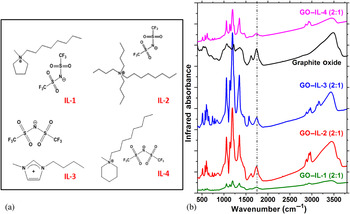
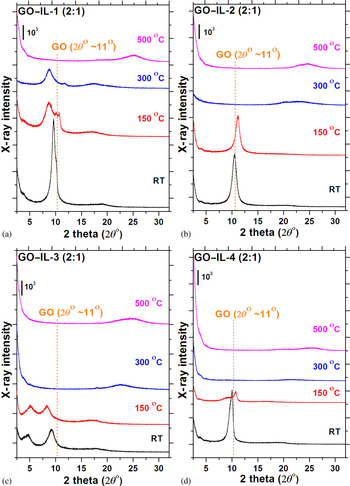
To study the interlayer interactions between RGOs prepared by thermal annealing in the presence of ILs, four different ILs were selected. These ILs were specifically designed to study the role of cations in interlayer interactions. To that end, the same anion was used, namely bis(trifluoromethanesulfonyl)imide [Fig. 1(a)]. GO was synthesized according to the modified Hummers' method[Reference Gilje, Han, Wang, Wang and Kaner7] and intercalated with each IL at a GO-to-IL (GO–IL) ratio of 2:1 (w/w) in 4 mL of deionized (DI) water by magnetically stirring overnight to prepare a GO–IL composite. X-ray diffraction (XRD) patterns (Fig. 2) of the recovered products indicated that intercalation of each IL took place, as evidenced by a variation of the interlayer distance of the original GO [Figs. 2(a)–2(d)]. The original GO exhibited a 2θ value of 11°, while intercalation of various ILs led to lower values, namely 9.6° for GO–IL-1 [Fig. 2(a)], 10.4° for GO–IL-2 [Fig. 2(b)], 9.2° for GO–IL-3 [Fig. 2(c)], and 10.0° for GO–IL-4 [Fig. 2(d)], confirming that the ILs penetrated into the GO interlayers. GO–IL-3 [Fig. 2(c)] showed the largest shift of all due to the strong interactions between IL-3 and GO (with the smallest molecular volume of 326.85 Å3). The lowest intercalation efficiency was observed for IL-2 [Fig. 2(b)] with an ammonium-based cation and long-chain alkyl substituents, which was attributed to its large molecular volume (553.04 Å3), the largest of the four ILs investigated herein.
(a) Chemical structures of the ILs studied: IL-1 (N-methyl-N-octylpyrrolidinium bis(trifluoromethanesulfonyl)imide), IL-2 (N-octyl-N,N,N-tributylammonium bis(trifluoromethanesulfonyl)imide), IL-3 (1-butyl-3-methylimidazolium bis(trifluoromethanesulfonyl)imide), IL-4 (N-octyl-N-methylpiperidinium bis(trifluoromethanesulfonyl)imide) and (b) infrared transmission absorbance spectra of GO and GO–IL composites in 2:1 ratios (w/w) prepared in deionized water at room temperature: GO–IL-1, GO–IL-2, GO–IL-3, and GO–IL-4.

X-ray diffraction patterns (XRD) of GO–IL composites for (a) GO–IL-1, (b) GO–IL-2, (c) GO–IL-3, and (d) GO–IL-4 at room temperature, and after annealing at 150, 300, and 500 °C. Orange dashed line indicates XRD pattern of as-synthesized graphite oxide (GO) with a (002) orientation at 2θ = 11°, corresponding to an interlayer spacing of approximately 9 Å.

To further investigate the interactions between GO and the ILs, a series of Fourier transform infrared (FT-IR) measurements were performed on the starting GO and IL-intercalated GO for each IL. The infrared absorbance spectrum of the as-synthesized GO [black curve in Fig. 1(b)] collected at room temperature is characterized by the vibrational stretch modes of C–O (1000–1200 cm−1), C–O–C (1230–1330 cm−1), sp2–C (1580–1600 cm−1), COOH (1650–1750 cm−1), C = O (1750–1850 cm−1), and total C–OH at ~3600–3750 cm−1. After IL intercalation in the as-synthesized GO, there is a substantial absorption intensity increase of the sp3–C stretching modes of CH2 and absorption related to the CH3 alkyl groups of the cations in the frequency range of ~1000–1500 cm−1 and additional weaker contributions in the ~2800–3000 cm−1 range [Fig. 1(b)]. The infrared (IR) data suggest that there is no covalent functionalization of GO by the ILs at room temperature, i.e., GO remains chemically stable.
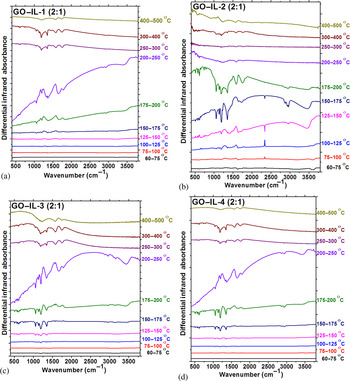
Next, in situ IR analysis was performed on the composites as a function of annealing temperature. The differential spectra in Fig. 3 show the variation in the GO–IL composite structures as a function of annealing temperatures (60–500 °C). Upon annealing to 150–250 °C, there is formation of ketone moieties (C = O) with modes in the ~1100–1400 and ~1500–1850 cm−1 ranges, as seen in the spectra of GO–IL-1 [Fig. 3(a)], GO–IL-3 [Fig 3(c)], and GO–IL-4 [Fig. 3(d)], indicative of interactions between water and the defective sites of the RGO graphitic backbone, as discussed in our previous study.[Reference Acik, Mattevi, Gong, Lee, Cho, Chhowalla and Chabal8]
Infrared transmission differential spectra of GO–IL (2:1) composites of (a) GO–IL-1, (b) GO–IL-2, (c) GO–IL-3, and (d) GO–IL-4 annealed stepwise in the temperature range of 60–500 °C.

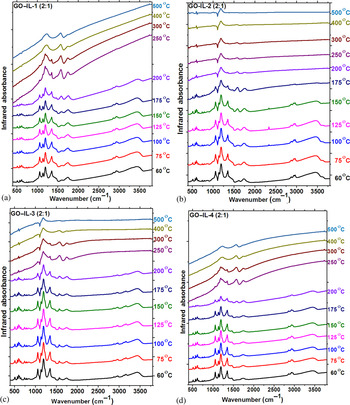
Notably, ketones (C = O) form at lower temperatures (60–150 °C) in the case of GO–IL-2 [Fig. 3(b)] compared with other GO–IL composites. This experimental finding indicates that water is not completely replaced by IL in the interlayer when GO is exposed to IL-2 under the conditions explored. This indicates that IL-2, composed of a bulky and highly substituted ammonium-based cation [Fig. 1(a)], cannot fully displace water from the interlayer of GO during the intercalation process, whereas other ILs can to a greater extent. In fact, the evolution of CO2 [~2300 cm−1 in Figs. 3(b) and 4(b)] is observed during annealing in the presence of trapped water in the interlayer spacing of GO–IL-2, believed to be a result of defect formation in RGO, and can indirectly be used to determine the presence of water in GO. CO2 formation was not observed upon annealing GO–IL-1 [Fig. 3(a)], GO–IL-3 [Fig. 3(c)], or GO–IL-4 [Fig. 3(d)], indicating that defects did not form in these composites, thus confirming the prior removal of water during IL insertion. In contrast, CO2 was produced when GO–IL-2 was annealed at 60–100 °C, and was then consumed at 125–175 °C [Figs. 3(b) and 4(b)]. This experimental finding showed that water, initially present in the case of GO–IL-2, was not removed and could therefore react with the graphitic backbone, generating defects similarly to what occurs in pure GO. However, the trapped water was then removed after annealing at 125 °C, as evidence by a sharp decrease in CO2 formation [Fig. 3(b)]. Although IL-1, IL-3, and IL-4 do not develop defects similar to IL-2, they induce a large expansion of the reduced GO layers. In particular, IL-1 and IL-3 expand the GO layers upon annealing at 150 and 300 °C [Figs. 2(a) and 2(c)]. In contrast, GO–IL-2 does not expand RGO, as evidenced by a small 2θ shift in the XRD patterns after annealing at 150 °C [Fig. 2(b)].
Infrared transmission absorbance spectra of GO-IL (2:1) composites of (a) GO–IL-1, (b) GO–IL-2, (c) GO–IL-3, and (d) GO–IL-4 annealed stepwise in a temperature regime of 60–500 °C.

Overall, the stability of GO functional groups is strongly dependent on the interlayer interactions of RGO with ILs during annealing. For instance, IL-1 promotes the removal of GO oxygen groups when the intercalation compounds are annealed at temperatures up to 400 °C. In addition, hydroxyl desorption is observed at annealing temperatures of 150–250, 60–200, 175–250, and 175–250 °C for GO–IL-1, GO–IL-2, GO–IL-3, and GO–IL-4, respectively [Figs. 3(a) and 3(d)]. These results indicate that the stability of OH groups is significantly decreased as the water molecules are removed from the interlayer, compared with when water remains trapped without ILs in the interlayer. When ILs are absent from the interlayer (i.e., as-synthesized GO), hydroxyls remain thermally stable up to an annealing temperature of 300 °C.[Reference Acik, Lee, Mattevi, Pirkle, Wallace, Chhowalla, Cho and Chabal9]
In summary, we have investigated the interlayer interactions in GO–IL composites prepared from GO and several ILs composed of a common anion (bis(trifluoromethanesulfonyl)imide) and one of several cations intercalated into the GO interlayer spacing. Bulky ILs cannot be efficiently intercalated due to their large size. Experimental findings from in situ infrared spectroscopy combined with XRD studies show that IL with bulky and highly substituted ammonium-based cations (IL-2) promotes defect formation in the graphitic basal plane during annealing at 60–500 °C. In addition, imidazolium- and pyrrolidinium-based ILs (IL-1 and IL-3) promote strong interlayer interactions that minimize the expansion of RGO layers. Differential IR spectra also confirmed that these cations stabilize the GO oxygen functional groups during thermal annealing, with minimal decomposition at temperatures up to 400 °C.
Acknowledgments
The authors acknowledge the full financial support of the U.S. Department of Energy, Office of Basic Energy Sciences, Division of Materials Sciences and Engineering under Award DE-SC001951.