I. Justificatory Liberalism and Substantive Liberal Conceptions
In the last few decades, a new conception of liberalism has arisen—“justificatory liberalism”Footnote 1—which developed out of the social contract tradition. The social contract theories of Thomas Hobbes, John Locke, and Jean-Jacques Rousseau all stressed that the justification of the state depended on showing that everyone would, in some way, consent to it. By relying on consent, social contract theory seemed to suppose a voluntarist conception of political justice and obligation: what is just depends on what people choose to agree to—what they will. As David Hume famously pointed out, such accounts seem to imply that, ultimately, political justice derives from promissory obligations, which the social contract theory leaves unexplained.Footnote 2 Only in the political philosophy of Immanuel Kant, I think, does it become clear that consent is not fundamental to a social contract view: we have a duty to agree to act according to the “idea” of an “original contract” to which all agree.Footnote 3 John Rawls's revival of social contract theory in A Theory of Justice did not base obligations on consent, though the apparatus of an “original agreement” of sorts persisted. The aim of his famous “original position,” Rawls announced, was to settle “the question of justification … by working out a problem of deliberation.”Footnote 4 As the question of justification takes center stage (we might say: as contractualist liberalism becomes justificatory liberalism), it becomes clear that posing the problem of justification in terms of a deliberative problem or a bargaining problem is a heuristic: the real issue is “the problem of justification”Footnote 5—what principles can be justified to all rational and reflective persons seeking to live under impartial principles of justice.
Justificatory liberalism rests on a conception of members of the public as free and equal. To say that each individual is free implies that each has a fundamental claim to determine what are her obligations and duties. To say that each is equal is to insist that members of the public are symmetrically placed insofar as no one has a natural or innate right to command others or to impose obligations on them. Free and equal persons thus recognize no claims to natural authority over them. As Locke insisted, “the natural liberty of man is to be free from any superior power on earth, and not to be under the will or legislative authority of man, but to have only the law of Nature for his rule.”Footnote 6 Given this conception of persons as free and equal, it follows that laws, because they use (and threaten to use) force, are deeply problematic: state functionaries employ power to force others to conform to the law, or they employ threats of force for the same purpose. On what grounds could anyone exercise such power and yet still claim that he is respecting the person (as free and equal) who is imposed upon?
In Kant's eyes, a crucial and necessary condition is that the person imposed upon by the law endorses the law as the thing to do: it is what her own reason instructs her to do, and so, as a rational person, it is what she wills to do. In Kant's terms, the person who is subject to the law may also be the legislator: because the law is endorsed by her own reasoning, she wills that the law be imposed, and is in this sense the legislator as well as a subject. A law that is rationally willed by a person, Kant and his followers have insisted, treats her as free and equal (qua legislator) even though (qua subject) she is bound to obey. “A rational being belongs to the realm of ends as a member when he gives universal laws in it while also himself subject to these laws. He belongs to it as sovereign when he, as legislator, is subject to the will of no other.”Footnote 7 Justificatory liberalism thus starts out with the idea of “free persons who have no authority over one another”Footnote 8 and seeks to see how their reason can lead each of them to freely accept common laws to which they are subject.
When the state issues a law, it typically commands citizens to act and, further, threatens them with fines and imprisonment unless they obey. Such laws are clearly not simply pieces of advice or guidelines: they are required courses of action that the state insists upon whether or not a citizen agrees. As such, it seems that the citizen is simply subject to the authority of the state, and is certainly not treated as free and equal in relation to the will of the governors. If, however, qua impartial, rational, and reflective agents (which may not be the same as actual citizens with all their biases and short-sightedness), the citizens rationally endorse the law and its penalties, then the citizens also can be seen as its legislators. Only laws that are “publicly justified” in this way—those that can be shown in some way to be endorsed by the reason of all members of the public (see Section III below)—can respect all citizens as free and equal. Laws that cannot be endorsed by the reason of some citizens are authoritarian: some individuals claim the right to rule others and determine their obligations, and thus do not respect those others as free and equal persons. “Respect for others requires public justification of coercion: that is the clarion call of justificatory liberalism.”Footnote 9
My concern in this essay is not to provide a case for justificatory liberalism, but to investigate its relation to what we might call “substantive” liberalisms. Justificatory liberalism is liberal in an abstract and foundational sense: it respects each individual as free and equal, and so insists that coercive laws must be justified to all members of the public. The liberal tradition, however, is typically associated with an enumeration of substantive commitments. Or rather, the liberal tradition evinces enduring disputes about the nature of its substantive commitments. Most fundamentally, since the end of the nineteenth century, liberals have disagreed about the proper extent of the state. On the classical view, the main tasks of the justified state are to protect individual freedom and secure a regime of extensive private property rights—that is, an economic system in which owners have an extensive bundle of rights over their property and in which the range of resources and assets subject to private ownership is extensive.Footnote 10 While in classical liberalism these are the core functions of the justified state, it is by no means a dogma of classical liberalism that they are the sole functions: classical liberals also typically endorse the provision of public goods and improvements, education, poor relief, as well as financial, health, and safety regulations.Footnote 11 Still, though classical liberalism is not committed to a “minimal state,”Footnote 12 it certainly endorses a far less extensive state than most contemporary “egalitarian” or “social justice” liberals insist is required. It is widely thought today that core liberal values require that the state regulate the distribution of resources or well-being to conform to principles of fairness, that all citizens be assured of employment and health care, that no one be burdened by mere brute bad luck, and that citizens' economic activities must be regulated to insure that they do not endanger the “fair value” of rights to determine political outcomes.Footnote 13 In John Rawls's canonical formulation of this expansive version of liberalism, a variety of new “branches” of government are added to the liberal state: a branch to keep the price system competitive, a branch to bring about full employment, a transfer branch to ensure that the least well off have the resources demanded by justice, and a distribution branch that adjusts the rights of property “to prevent concentrations of power detrimental to the fair value of political liberty and fair equality of opportunity.”Footnote 14
It is widely thought that all forms of justificatory liberalism must endorse this latter, expansive understanding of the liberal state. No doubt this partly can be explained by the fact that Rawls's theory is both the most prominent instance of justificatory liberalism and the preeminent defense of the expansive conception of the liberal state. Moreover, both Rawls and his followers have insisted that the more extreme, “libertarian,” versions of the classical view are not genuinely liberal, reinforcing the supposition that the justificatory liberal approach is hostile to substantive liberalisms that endorse wide-ranging limits on government authority.Footnote 15 Indeed, Rawls condemns classical liberalism and welfare state capitalism as unjustifiable political-economic systems.Footnote 16 According to Rawls, “laissez-faire capitalism” (or, as he sometimes calls it, “the system of natural liberty”) is unjust: its regulative principles would not be agreed to by free and equal persons seeking impartial principles of justice. Because laissez-faire capitalism (1) does not require constitutional guarantees of “the fair value of the equal political liberties,” so that all have real political power (more on this in Section IV.A below), and (2) allows only “a low social minimum” and thus does not have institutions in place that aim to maximize the long-term prospects of the least well-off, it follows that less-advantaged free and equal persons do not have reasons to endorse it. More surprisingly, Rawls holds that even “welfare-state capitalism” fails the test of justifiability. It too allows for inequalities of wealth that, in Rawls's eyes, undermine the fair value of citizen's political rights. “It permits very large inequalities in the ownership of real property (productive assets and natural resources) so that the control of the economy and much of the political life rests in a few hands.” Of the five political-economic systems he discusses—laissez-faire capitalism, welfare-state capitalism, state socialism, liberal (market) socialism, and a “property-owning democracy”—Rawls rejects as unjust both systems that he describes as “capitalist.” He allows as possible just regimes one form of socialism (market socialism) and a “property-owning democracy” that allows private property but works “to disperse the ownership of wealth and capital, and thus to prevent a small part of society from controlling the economy and, indirectly, political life as well.”Footnote 17
Classical liberals who are also justificatory liberals must address two questions. First, is there a sound case for the classical version in justificatory liberal terms, or is classical liberalism somehow at odds with the justificatory project, so that all reasonable versions of justificatory liberalism must reject what Rawls calls “the system of natural liberty”? In a previous essay, I have argued that there is a strong justificatory liberal case for classical liberal rights.Footnote 18 This, I think, defeats the claim that justificatory liberalism necessarily endorses a strongly egalitarian theory of justice or even (what Rawls considers insufficiently egalitarian) an expansive welfare state. It may appear, however, that the upshot of this is that justificatory liberalism is an entirely neutral framework with respect to this long-running dispute within liberalism—the very nature of the justificatory project, it may be thought, does not incline toward either view, but reasonable defenses of both versions can be accommodated within justificatory liberalism. Hence the second question that classical liberals who are also justificatory liberals must address: Is justificatory liberalism a neutral framework, or does it incline toward, or tend to favor, some substantive liberalisms?
In this essay I argue for two main claims. (1) Rawls and his followers are fundamentally mistaken when they claim that free and equal persons seeking impartial principles of justice would reject all forms of “capitalism” (either the system of natural liberty or the welfare state). Quite the opposite: there is an overwhelming case that such persons would insist on either some form of capitalism or, perhaps, a property-owning democracy (it is hard to know precisely what such a system would look like.)Footnote 19 They would conclusively reject all forms of socialism, including market socialism. (2) The core principles of the justificatory project, I shall argue, incline toward the classical end of the continuum regarding the redistributive functions of the state. The very nature of the project does not exclude the welfare state or even more egalitarian versions of capitalism, but, pace Rawls, those versions are more, not less, difficult to justify than a more limited governmental authority.
I begin in Sections II and III by reviewing the core commitments of justificatory liberalism, understood as a family of political views: the presumption in favor of liberty (Section II), and the principle of public justification (Section III). Section IV examines an ambitious thesis: properly understood, justificatory liberalism only justifies the classical version of liberalism and its stress on the primacy of ownership. I argue that, while this ambitious thesis involves an important insight, it fails. Section V builds on this insight and establishes a more moderate thesis: while justificatory liberalism admits as reasonable both classical, welfare-statist, and some egalitarian liberalisms, it inclines toward classical formulations. Section VI argues that the spirit of justificatory liberalism is neither egalitarian nor libertarian, but Millian.
II. The Political Liberty Principle
A. The presumption in favor of liberty
A wide variety of philosophers have held that basic to any genuinely liberal view of politics is a general presumption in favor of liberty and, thus, against legal restrictions. As Joel Feinberg puts it, “liberty should be the norm, coercion always needs some special justification.”Footnote 20 Stanley Benn states the principle even more expansively, in terms of a presumption against all “interference,” not simply coercion by the law. His grounding principle of morality is that one who is simply acting as he sees fit is under no standing obligation to justify his actions to others, while those who interfere with his actions are under an obligation to justify their interference.Footnote 21 Rawls agrees with Feinberg in focusing on the law (though perhaps making room for Benn's concern with non-legal interferences) but clearly follows Benn in extending the principle beyond mere coercion, identifying legal “restrictions” as requiring justification: “there is a general presumption against imposing legal and other restrictions on conduct without sufficient reason.”Footnote 22 Since we are concerned here with liberalism as a political doctrine, and in particular with the legitimacy of state activities, it will help if we restrict our attention to the presumption in favor of liberty as it applies to the law; and let us further restrict our attention to the law's use of force and coercion. Let us, then, focus on liberalism's commitment to the Political Liberty Principle:
(1) A citizen is under no standing obligation to justify her actions to the state.
(2) All use of force or coercion by the state against the persons of its citizens requires justification; in the absence of such justification, such force or coercion by the state is unjust.
The Political Liberty Principle regulates political justification, and deems state force or coercion without the requisite justification to be a case of injustice.Footnote 23 As Benn says, “justifications and excuses presume at least prima facie fault, a charge to be rebutted.”Footnote 24 If I have no justificatory burden, I am permitted to act without justification—I have no charge to rebut, no case to answer. If the onus is on you, the failure to justify condemns your act. Conceivably, a conception of political morality might place the onus on the actor: “Never act unless one can meet the justificatory burden by showing that one is allowed to act.”Footnote 25 The liberal insists that citizens have no such general burden to bear, though of course they may bear the onus of justification in special contexts in which a restriction already has been established (say, trusteeships).
Now as Rawls rightly insists, “this presumption creates no special priority for any particular liberty”: it does not serve to identify some liberties as especially important. To identify a particular liberty as having a priority in the sense of an enforceable right itself requires justification. Suppose Alf claims to possess an enforceable right to speak in a political forum, and Betty exercises her freedom to play loud music at the same time and place. By claiming that his freedom is a right, Alf claims a ground to interfere with Betty's playing of music—he claims that she can be made to stop, by the police if necessary. But that, of course, is to call on the state to coercively interfere with her actions, and, like all such interferences, claims of rights must be justified.Footnote 26 The presumption in favor of liberty does not, then, identify special liberties as deserving special protection. Nevertheless, Rawls acknowledges that even when a basic protected liberty is not at stake, “liberties not counted as basic are satisfactorily allowed for by the general presumption against legal interference.”Footnote 27 There is always a standing presumption against legal interference: those who endorse a legal interference must bear a justificatory burden, not those who wish to remain free.
The presumption in favor of liberty, and thus against coercive laws, is easily misunderstood. Some view it as a libertarian principle because it “privileges” liberty. But this is to confuse liberalism with libertarianism. Libertarianism is a wide-ranging doctrine about the strength and priority of certain liberty or property rights in relation to other claims. The presumption of liberty does not imply that liberty always, or even usually, trumps other values: the presumption identifies what does, and what does not, stand in need of justification. The liberal does not remain neutral between those who would use the law to regulate the lives of others and those who wish to remain unregulated: it is the would-be regulator who must bear the justificatory burden. (That Benn, Feinberg, and Rawls—none of whom are remotely libertarian—advocate the principle itself should make us doubt the force of the claim that the presumption presupposes a libertarian view.)
Others dispute the presumption on the grounds that “there is no standing duty to justify morally relevant actions.”Footnote 28 We might interpret this objection as involving four different claims:
(1) If the state has shown that φ is a morally required or permitted action, the state is under no burden to show that φ-ing is justified.
(2) If, as a matter of fact, φ is a morally required or permitted action, there need not be a justification for the state φ-ing.
(3) If the state believes that φ is a morally required or permitted action, the state need not have a justification for its belief and for acting on it.
(4) If the state reasonably believes that φ is a morally required or permitted action, the state need not show it has a justification for φ-ing.
Interpretation (1) is not a coherent challenge to the presumption: to show that one has a morally relevant ground for interference simply is to justify one's action, so this does not dispute the presumption. This is important: showing that something is morally permitted simply is showing that one has a justification of doing it. Nor does interpretation (2) offer a plausible basis for disputing the presumption. If, as a matter of fact, φ is morally required, then there is, in principle, a justification for φ—viz., the reasons why it is morally required. To be sure, one might hold that φ is required but no one knows why, and so there is no justification for it, but this is hardly a compelling view of political morality. Interpretation (3) involves, I think, a genuine substantive disagreement. Here it is being said that, if the state holds that φ is morally permitted or required, it may go ahead and φ even if it has no justification for its belief or for acting on that belief. For the state to have no justification for φ-ing amounts to it not having access to good reasons for its conclusion that φ is morally required or permitted. Here, I think, the liberal parts ways with the objector, if the objector holds that there is nothing wrong when the state goes ahead and uses coercion on the grounds that doing so is morally permitted, even though it does not itself have access to the considerations that establish why it is morally permitted. It is not enough that there be some unknown moral grounds that allow coercion. At least some state actors—those who have authorized the act—must be cognizant of the grounds. The point of morality is essentially practical: we seek to employ it as the basis for our reasoning and choices. Unless the state has access to these reasons when it makes choices, it acts with manifest disrespect for the freedom and equality of its citizens. Recall Rawls's key insight: we start out with the assumption of free and equal persons who have no authority over one another, and thus all claims to authority—including the authority to interfere with others on moral grounds—are subject to the requirement that they be justified.Footnote 29 Interpretation (4) is more reasonable. Of course, the state (all the agents of the state involved in the action) need not always show each and every person that the relevant actors have good moral reasons for what they are doing whenever they are challenged. Certainly, however, a government of free citizens—a government that respects citizens as free and equal persons—must include forums where citizens are shown these justifying reasons.
It is also important to stress that the presumption in favor of liberty does not ignore the fundamental truth that state force and coercion often prevent a great deal of private force and coercion. Some argue that, if the state does not act through coercive laws, there will be great private coercion, and thus the presumption in favor of liberty does not really protect liberty: people will simply be subject to private rather than public coercion. The great insight of the social contract theorists was that preventing unjustified private force and coercion is the main justification of state force and coercion. As Kant understood it, the state replaces private force and coercion with “public lawful coercion.”Footnote 30 That state coercion must be justified only requires that a sufficient reason for it be advanced: that it is the best way to prevent a great deal of unjustified private coercion is certainly such a reason.
B. Coercion and rights of the person
The Political Liberty Principle supposes that we can make sense of the idea of legal force and coercion. Many, though, are skeptical that this can be done. The last forty years have witnessed a number of fundamentally divergent accounts of coercion.Footnote 31 It is widely agreed that coercion typically involves some sort of threat of harm by which the “coercer” gets (or aims at getting) the “coercee” to do as he wishes, but there is considerable disagreement about what constitutes a threat of harm, whether all such threats are coercive, and so on. Now it might be thought that if we cannot agree on a general account of coercion, we cannot usefully employ the idea in the Political Liberty Principle. But this would be far too skeptical a conclusion: philosophical theories that seek to provide a biconditional analysis of a concept (i.e., A is an act of coercion if and only if conditions C 1 … C n are met) are notoriously subject to counterexamples and controversy; we typically have a far better grasp of the use of an idea than we have of the philosophical analysis of it. Moreover, the Political Liberty Principle does not require a general analysis of coercion, but only an analysis of its application to the actions of the state against its citizens.
What makes the state—even a legitimate one—especially morally problematic to the liberal is that it employs force, or threatens to use force, against the persons of its citizens.Footnote 32 This is certainly only a subset of the many ways in which one can coerce another. If Alf threatens to destroy Betty's beloved painting—which he owns—if she does not agree to move to Australia with him, he may plausibly be said to coerce her into moving without threatening her person (he threatens to harm his own property). To be sure, some states do employ similar means (we are tempted to label them as “blackmail”): they threaten, for example, a dissident's family or friends with harm to get her to conform, or they threaten to banish her children from university if she does not cooperate with the regime. These uses of coercion are subject to special condemnation: they are not the modus operandi of the liberal state. Liberal legal restrictions require compliance, and if compliance is not forthcoming the citizen is typically threatened with the use of force against his person, not simply a harm to what he cares for. The police will come and use force against his person, and may imprison him. This, indeed, is a quintessential case of coercion. A reason to reject the claim that all instances of coercion involve a threat to violate the rights of anotherFootnote 33 is that, even in a condition such as Hobbes's state of nature (in which everyone has a blameless liberty to do as he thinks necessary, and thus no one has claim rights to noninterference), we can sensibly and importantly say that people are coercing each other.Footnote 34 Indeed, the idea of replacing such private, lawless coercion with public, lawful coercion is an important theme in Kant's social contract theory.Footnote 35 Applying the concept of coercion (and, of course, force) makes sense even in relations among purely “natural persons”—those whom we do not consider bearers of rights.
However, coercion by the state typically does involve a threat against a citizen's rights, for in political society one's person is largely defined—and expanded—by one's rights. This idea of the expansion of legal personhood through rights was central to Kant's analysis of property. To own a thing is not simply to have possession of it, or even stable, secure, recognized possession. It is to enter into a juridical relation such that “any hindrance of my use of it would constitute an injury to me, even when I am not in [physical] possession of it (that is, when I am not a holder of the object).”Footnote 36 Once property rights are justified, a threat by the state to take my property is a threat against me: to take my property is to do an injury to me as a juridical person. Without property rights, you only do injury to me by taking my possession if you use force against my person (narrowly construed), or threaten to, when taking it. If I should put it down and walk away, it would be no injury to me for you to take it, and so it would be no threat against my person to threaten to take it away under these circumstances.Footnote 37 However, if it is my property, the injury is done not by reason of physical possession but by an extension of the bounds of my person to include my relation to it. Thus, when the state threatens to fine me for noncompliance, it threatens me, just as surely as if it threatens imprisonment.
C. The order of justification
If our core concern is the state's use of force or the threat of force against the person of the citizen, and if the juridical boundaries of the person expand with her set of rights, then what constitutes a coercive threat against her person will also expand. This implies that the order of justification may affect the outcome of what is justified. On the one hand, if we assume, say, only natural personhood, or even simply rights of bodily integrity narrowly construed, then the state's demand that you conform to law L or else it will take away your “property” (qua stable, recognized possessions) will not involve a direct threat against your person, since you have no juridical relation to such “property.” Thus, there would be no onus of justification on the state: it could, say, tax away those possessions at will (see Section IV.D below). On the other hand, if we understand you to have a justified property right, then the state would bear such an onus, and it must justify this threat against you.
Despite first appearances, this is not, I think, a counterintuitive implication of the Political Liberty Principle. We will see in Section IV that many of the disagreements between classical and egalitarian liberals stem from disputes about the order of justification, and, in particular, about where the justification of the rights of ownership enters into an account of liberal justice. All liberals agree that at the core of their theory are persons with rights to bodily integrity, freedom of association, and freedom of conscience and speech. As we will see, the question is: At what point does the person include her property?
III. Public Justification and the Deliberative Model
A. The Public Justification Principle
The Political Liberty Principle places the onus of justification on the state for the use of force and coercive threats against the persons of its citizens. The (Generic) Public Justification Principle determines how this onus can be met:
L is a justified coercive law only if each and every member of the public P has conclusive reason(s) R to accept L as binding on all.
An unjustified law fails to treat each person as free and equal.Footnote 38 Our question is: When, if ever, does a coercive law treat all as free and equal?
Because I am concerned with a family of justificatory liberalisms, I focus on a generic formulation of the Public Justification Principle. Because this is a generic principle, I leave open the crucial problem of just how to specify P (whether the members must all be reasonable, fully rational, etc.). The Public Justification Principle supposes that the relevant justificatory public is an idealization of the actual citizenry (throughout, I will use “member of the public” as a term of art to identify this idealized public). Whereas many in the actual citizenry may act on pure self-interest, hate, or spite, or may reason on the basis of obviously false empirical theories, or may make manifestly invalid inferences, the idealized members of the public make sound inferences from appropriate and relevant values, drawing on sound empirical claims. Justificatory liberals differ in just how far they press this idealization. One Kantian specification of P is highly idealized—the realm of rational beings—and insofar as we act as members of P, we act fully in accord with our status as rational moral beings. Rawls relies on a more modest idealization: a conception of persons who, as reasonable, recognize the severe limits of human reason. In filling out a justificatory view, it is critical to provide a compelling specification of P; because our interest here is in a family of justificatory views, we can for the most part leave this issue open (see, though, Section III.B).
Note that the Public Justification Principle maintains that a coercive law L applying to public P is justified only if every member of P has conclusive reason to endorse L as binding. This is crucial. To sees its motivation, assume that Alf and Betty are both members of P, and Alf proposes law L A. Suppose that Alf can advance a reason R 1 for Betty to endorse L A, but Betty's system of beliefs and values is such that while as a member of P she acknowledges that R 1 is a reason for endorsing L A, she also holds that she has reason R 2, which is a reason to endorse L B over L A (where L A and L B are incompatible alternatives). Suppose that, exercising her reason as a free and equal member of the public, Betty concludes that R 2 outweighs (or defeats) R 1, and thus she concludes that L B is better than L A. Now some insist that, nevertheless, Alf has provided a justification of L A insofar as he has offered a nonsectarian reason R 1 in support of L A—a reason that, as a free and equal member of the public, Betty can appreciate.Footnote 39 Yet, exercising her capacities as a free and equal person, Betty has concluded that, when compared to L B, L A is inadequately justified in the sense that it is not choice-worthy; as she understands it, she has more reason to endorse L B. For Alf (even if Alf is the head of state) to simply impose L A on Betty is inconsistent with treating her as a free and equal member of the public. The critical question is not whether Betty has some reason to endorse L A, but whether, all things considered, she has reason to endorse L Aover the alternatives, or even over no law at all. If she has some reason to endorse L A, but more reason to endorse an alternative, then what economists call the “opportunity costs” of choosing L A exceed the benefits: she would be opting for a law that achieves less of what she values over one that achieves more. Therefore, only a justification that showed she had conclusive reasons—the benefits outweighed the opportunity costs—would show that she has reason to endorse the law.
B. Reasonable pluralism
Most political theories can endorse the Public Justification Principle as I have stated it: if the members of the public are so specified that they all accept, say, a certain substantive moral theory, the laws justified by that theory would also be justified by the Public Justification Principle. The principle would do little or no work. The Public Justification Principle becomes an interesting test—and also more obviously part of the liberal tradition—if we accept Rawls's claim that a wide range of rational disagreement is the “normal result of the exercise of human reason.”Footnote 40 Suppose, then, that we accept pluralism in the sense that our characterization of P's deliberation includes the fact that the members of the public reason on the basis of a wide variety of different values, ends, goals, etc. This does not prejudge whether values are “ultimately” plural, or whether some values are truly “agent-neutral.” Perhaps fully rational, omniscient beings would agree on what is valuable, or recognize agent-neutral values. The important point is that, at the appropriate level of the idealization, members of P will be characterized by diversity in the basis of their reasoning about what laws to accept. That, after all, models the core problem of our pluralistic liberal societies.
Abstracting from the notions of goods, values, moral “intuitions,” and so on, let us say that Σ is an evaluative standard for Alf qua member of P if holding Σ (along with various beliefs about the world) gives Alf a reason to endorse some law L. Again, different justificatory liberalisms advance different characterizations of evaluative standards: some may focus largely on self-interest; others on conceptions of the good or value; and others will also allow members of P to employ “moral intuitions” (though these will only provide reasons for those members of P who hold them). Evaluative standards are to be distinguished from justified laws. Evaluative standards need not meet the test of Public Justification, but they are the reasons for some member of the public to endorse or reject a law. Our problem is how to achieve the public justification of uniform coercive laws based on disparate individual evaluative standards.
Any plausible liberal justificatory account must acknowledge the diversity of evaluative standards in political justification (and thus recognize the importance of reasonable pluralism), but it also must limit the range of considerations that may be drawn upon in justification. Some limits are implicit in the very idea of public justification. Our concern is not simply whether the government and its officials respect each citizen as free and equal, but whether each citizen respects her fellows when she calls on the coercive force of the law. If each citizen is to respect her fellows as free and equal, each must have reason to suppose that the Public Justification Principle is met when calling on the force of the law; but that means that each citizen must think that the relevant evaluative standards, which are the grounds of each member of the public's deliberation, provide her with conclusive reasons to endorse the law. Qua member of the public, I cannot think that your deliberation based on standard ΣX provides you (as another member of the public) with a reason to endorse a law as binding unless, in my view, ΣX is an intelligible and reasonable basis for deliberation. That your unreasonable standard leads you to endorse L cannot lead me to think you have a reason to endorse L: garbage in, garbage out. Plausible justificatory liberalisms, then, must at least accept what we might call “mutually intelligible evaluative pluralism” at the level of members of P. Members of P will see themselves as deeply disagreeing about the basis for a law's acceptance, but will acknowledge that the bases of others' reasoning is intelligible and is appropriate to the justificatory problem.
C. The deliberative model
One of Rawls's fundamental insights was that the justificatory problem—what legal requirements (or social principles) do members of P have reason to endorse?—can be translated into a deliberative problem.Footnote 41 Suppose we understand a member i of P as consulting her relevant evaluative standards—the full set of considerations that are relevant to her decision about whether to endorse a law as binding. After consulting her evaluative standards, i proposes her preferred law, L i—the law that, on her (somewhat idealized) reasoning, best conforms to her evaluative standards. (This procedure parallels the one utilized by Rawls in his essay “Justice as Fairness.”)Footnote 42 At no point do the parties bargain: each member of P consults her evaluative standards and proposes what she understands to be the best law. Suppose that, having each proposed her preferred candidate, each then (sincerely) employs her evaluative standards to rank all proposals.
This simple statement of the deliberative problem has decisive advantages over more familiar formulations. One of the shortcomings of much contemporary contractualism is that it employs a notion of reasonable acceptability (or rejectability) without being clear about the option set: to ask what one can reasonably accept (or reject) without knowing the feasible alternatives is an ill-formed choice problem. The crucial question is: “Rationally rejectable in relation to what options?” In our deliberative problem, the feasible set is defined by the set of all proposals. Rawls never made this common contractualist mistake: the parties to his original position in A Theory of Justice choose among a small set of traditional proposals, so their choice problem is well-defined. However, Rawls built into his later and more famous formulations of the deliberative problem a host of controversial conditions. In contrast, we can depict the deliberative problem as a straightforward articulation of the Political Liberty Principle and the Public Justification Principle, which it is meant to model: if one accepts that these principles pose the correct justificatory problem, there is strong—indeed, I think compelling—reason to accept this deliberative model. The only element the model adds is the interpretation of what one has a reason to accept in terms of a ranking of the proposals advanced by each member of P, translating the idea of having “a reason to accept” as “each member of P's ordinal rankings based on her evaluative standards.”
Because justificatory liberalism is committed to a widespread evaluative pluralism among members of P, we should expect that their deep disagreements in their evaluative standards will usher in deep disagreements about which law is best—that is, which law is conclusively justified. If members of the public employ plural evaluative standards to evaluate different proposed laws, and if their evaluative standards are fundamentally at odds, these differences will inevitably result in great disagreement in their rankings of proposed laws. But given such deep disagreements in the rankings of the members of the public, it looks as if nothing can be conclusively justified, since for every proposal there will be someone who evaluates it as worse than another alternative.
The problem is this: If justificatory liberalism (i) adopts a strong standard of justification to each member of the public (some version of conclusiveness) while also (ii) insisting that members of the public have diverse bases for deliberations about what is justified, then it is hard to see how we can get a determinate result. Justificatory liberals have tended to generate determinacy either by weakening (i)—the balance of values specified by a justified political conception must be only “reasonable,”Footnote 43 and so need not be conclusively justified—and/or by weakening (ii) and maintaining that, in the end, we share a common basis for reasoning about political right, say, based on a shared index of primary goods, thus greatly qualifying the pluralism underlying the parties' deliberations. Rawls himself acknowledges that his restrictions on particular information in the original position are necessary to achieve a determinate result.Footnote 44
Suppose we refuse to take either of these routes, and allow each member of the public to rank all proposals, resulting in a set of options. Is there any way for them to agree to reduce the set of acceptable proposals? Members of P would unanimously agree to apply the Pareto principle: if in every member of P's ordering L X is ranked higher than L Y, all would agree that L X is better than L Y. Being strictly dominated by L X, L Y can be eliminated from the set of options to be considered. Once all such dominated proposals are eliminated, the members of the public would be left with an optimal set of proposals. Can they eliminate any other proposals? In the eyes of each member of P, some of the remaining proposals may be marginally worse than her favored law; other proposals she may find highly objectionable. But how objectionable is too objectionable? All members of P accept our two liberal principles (Political Liberty and Public Justification), so they believe that liberty is the norm unless coercion can be justified. What this means, then, is that in evaluating a proposal in terms of her evaluative standards, a person will find a proposal unacceptable if it is worse than a condition of liberty. For a law to be acceptable to a member of the public, it must be a net improvement on liberty. Consulting her own standards, each must hold that the law, in comparison to a condition of liberty, brings more benefits than costs. If a condition of liberty—no law at all—would be better, given her evaluative standards, then she has no reason to accept the law. Self-legislating such a proposal would be manifestly irrational: it would create net losses as judged by her evaluative standards.
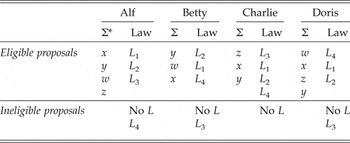
On the one hand, no member of the public can have reason to accept a law that is worse than no law at all. On the other hand, a member of the public does have some reason to accept laws that are better than no law at all: all things considered, her evaluative standards are better advanced by such laws than by “anarchy” over this area of life. Our members of the public will thus divide the proposals into eligible and ineligible sets, as in table 1.
Orderings distinguishing eligible from ineligible proposals

* Evaluative standards
In this case either member of the set {L 1, L 2} is preferred by every member of P to no law at all on this matter. Footnote 45 They all have conclusive reason to select from this set, for both L 1 and L 2 are, from everyone's evaluative standards, improvements on the absence of legislation or the condition of liberty. We now have an optimal eligible set: some choice from this set is justified, though (until more is said) no choice of any single option is justified. When we are faced with an optimal eligible set, there is still justificatory work to be done: members of the public need to arrive at some procedure for selecting one of the options. While I do not want to minimize the problem of selecting one option from the set, I have argued elsewhere that certain formal and informal procedures may justifiably do the job.Footnote 46 My concern here is the extent of the optimal eligible set in matters concerning ownership and redistribution: what is the range of possible laws from which citizens may legitimately choose? Rawls believed that it included property-owning democracy and socialist systems, but no capitalist systems.Footnote 47 I believe that Rawls implausibly constrains the range of systems in the optimal eligible set while extending the set implausibly far in a statist direction.
IV. The Ambitious Case for Classical Liberalism
A. Relevant information about the liberty effects of economic systems
An adequate deliberative model must include a specification of the information set available to members of P. Given the canonical liberal order of justification, in which rights of the person and civil liberties are prior to the justification of property arrangements, in ranking property regimes members of the public must have available to them sound information about the effects of property regimes on maintaining schemes of civil rights. If, for example, we know that some economic systems tend to undermine the effective establishment of civil rights, this is relevant and important to the deliberators' choices. However, to say that it is important for the deliberators to have knowledge of the effects of economic systems on effective schemes of civil liberty does not itself tell us the rational response of deliberators to such knowledge. Contrast two cases. In case A, a deliberator knows that economic scheme S 1 has some small advantage in protecting civil liberties over S 2 in the sense that, given probabilistic information, S 1 has a slightly higher chance of performing a little better in protecting civil liberties than S 2. For example, S 1 may have a higher probability of faster economic growth rates than S 2, and there may be evidence that, say, richer societies tend to better ensure a right to a fair trial. Even if this were so, some deliberators could hold that S 2 still has advantages that more than compensate—say, it better conforms to their idea of economic justice. There is nothing unreasonable about such a judgment. In case B, by contrast, there is evidence that S 2 has a very high probability of doing much worse than S 1 in protecting the broad range of civil liberties, such that it is extremely likely that S 2 will be characterized by widespread violations of civil liberties. Here, given the order of justification, reasonable deliberators must reject S 2. It almost certainly will fail to honor already justified civil liberties. It would do no good to first insist on a regime of civil liberties and then admit economic systems that have a very high probability of undermining them.
To be sure, there will be many cases that fall between A and B, where the probability that an economic system may endanger civil liberties is significant, but not so high that it would be unreasonable for a deliberator to decide that the significant dangers are compensated by perceived benefits. The order of justification does not establish a lexical priority such that no possible costs to a regime of civil liberty could ever be justified by, say, economic benefits. At the same time, rational deliberators must, in cases like B, reject economic systems that pose not only some probability, but a very high one, that the core personal and civil liberties will be threatened.
B. The first step: Private property regimes dominate socialist regimes
There is powerful evidence that extensive private ownership—including private ownership of capital goods and financial instruments and institutions—is for all practical purposes a requirement for a functioning and free social order that protects civil liberties. It is, I think, astounding that Rawls never appreciates this, and simply assumes, on the basis of economic theory, that well-functioning markets can be divorced from “private ownership in the means of production.”Footnote 48 There has never been a political order characterized by deep respect for personal freedom that was not based on a market order with widespread private ownership in the means of production. Figure 1, drawn from James D. Gwartney, Robert Lawson, and Seth Norton's Economic Freedom of the World: 2008 Annual Report, gives the summary relation between economic freedom (an index summarizing data about the extent to which a state protects personal economic choice; voluntary exchange coordinated by markets; freedom to enter and compete in markets; and protection of persons and their property) and Freedom House's ranking of states that protect civil rights.Footnote 49
The general relation between economic freedom and protection of civil rights

Table 2 gives a country-by-country breakdown, using data from Freedom House, Gwartney et al., and the Heritage Foundation.Footnote 50 It presents data on thirty-six countries that, according to Freedom House, ranked highest in 2008 in terms of their protection of civil rights (that is, they were rated in category 1 on Freedom House's 1–7 scale). As the table shows, none of these thirty-six countries scored less than 50 on the Heritage Foundation's rating of their protection of property rights (column 2). No state that does the best job in protecting civil rights scores less than 59 in the Heritage Foundation's ratings of overall economic freedom (column 4). With the (close) exception of Cape Verde, all states recognized by Freedom House as the best protectors of civil rights were classified as free or mostly free in the Heritage Foundation scores. Gwartney et al.'s rankings show a comparable story (columns 1 and 3).
Economic freedom in thirty-six states that best protect civil rights

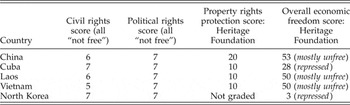
Rawls, it will be recalled, argues that welfare-state capitalism should be grouped along with state socialist systems as socioeconomic arrangements that do not adequately protect the fair value of political rights (see Section I above). Of course, it is hard to evaluate Rawls's claim that such systems do worse than his preferred alternatives, since none of his preferred systems have ever existed. As figure 2 and table 3 show, however, in the world as we have known it, the protection of economic liberty and private property is associated with states that do a better job of institutionalizing effective political rights (as well as civil rights).Footnote 51
The general relation between economic freedom and protection of political rights

Civil rights scores and economic freedom in remaining socialist states

Table 3 presents the scores of the remaining state socialist regimes on the protection of civil and political rights and economic freedom. The evidence indicates that private property–based regimes that protect property rights and overall economic freedom are the best protectors of civil liberties and, indeed, of political rights. Given the evidence, because our deliberators have a deep commitment to civil liberties, they must reject socialism in favor of private property regimes and, further, must favor private property regimes with considerable economic freedom.
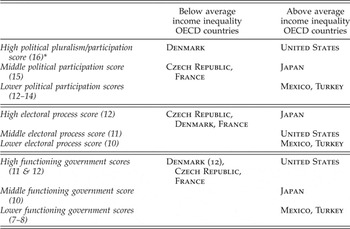
It might appear that Rawls and his followers have an effective rejoinder to this line of argument. Rawls consistently claims that large inequalities in wealth allow situations in which the fair value of political liberty is undermined.Footnote 52 So even if private property regimes are necessary for protecting civil liberty, private property systems that allow economic inequalities are a grave danger to political liberty. It is seldom appreciated how important this claim is to Rawls's case for equality: he believes that inequalities allowed by his “difference principle”—which requires that a just social order must maximize the economic prospects of the least advantaged citizens—may threaten the fair value of political liberty, and thus further equalization may be required.Footnote 53 As we saw in Section I, Rawls went so far as to propose a branch of government to readjust property rights, partly to ensure the “fair value” of political liberty. But while it may seem obvious to some that large inequalities of income and wealth undermine the worth of the “least advantaged” citizens' political liberties, this claim is in fact conjectural. Whether citizens have real input—whether their political rights actually have “fair value”—is a matter of complex sociology, involving the features of political culture, including levels of civic participation, institutional structures governing the relations between business and government, the existence of power centers outside of government, levels of overall wealth, and so on. Table 4 shows some of this complexity, charting the relation between income inequality and political rights in selected countries in the Organization for Economic Cooperation and Development (OECD).Footnote 54
The relation between income inequality and effective political rights in selected OECD countries

* Raw scores
Table 4 offers little ground for accepting a strong relation between income inequality and a lesser value of political rights. To be sure, there is some positive correlation: below average income inequality countries always score in the high or middle range on political rights, while above average income inequality countries scored both high and low. The United States, though, scores high on OECD income inequality, but also high on political participation/political pluralism, outperforming more egalitarian countries. In any event, the differences between the Czech Republic, Denmark, France, Japan, and the United States are very slight. The real outliers are Mexico and Turkey, countries that score low on the protection of political rights and have high income inequality combined with significantly lower overall levels of wealth and income.
Perhaps the real danger to political rights is not income inequality but wealth inequality. Calculating wealth inequality is a difficult task, mainly because the idea of “wealth” is open to numerous interpretations. However, income and wealth inequality appear to be strongly correlated in OECD countries,Footnote 55 so we should not expect a great deal of difference. Table 5, employing a different data set from selected OECD countries concerning wealth inequality, arrives at results comparable to those in table 4.Footnote 56
The relation between wealth inequality and effective political rights in selected OECD countries

In light of figures 1 and 2 and tables 2 through 5, we must view as unfounded Rawls's claim that laissez-faire capitalism, welfare-state capitalism, and state socialism with a command economy all are unjustifiable partly because they fail to secure the fair value of political liberties.Footnote 57 The most we can discover is a modest real correlation between wealth and income inequalities and political rights protection scores. Welfare capitalist states such as the United States and the United Kingdom score “1” (the best at protecting rights) and all socialist states score “7” (the lowest possible score) on Freedom House's scale of effective political rights. Table 5, of course, does not include market socialist systems, which are one of Rawls's favored alternatives (since none exist). However, the only large-scale market socialist system in history—Yugoslavia under Tito—also repressed civil liberties and political rights. Of course, this data is merely indicative, and much work needs to be done, but it is dubious indeed that there is any powerful empirical evidence for a strong correlation in wealthy countries between economic inequalities and less than a fair value of political liberty. Again, this is not to say that there is no correlation at all, but excluding a whole set of economic arrangements on the basis of a modest correlation over a small range of variance is unjustified.Footnote 58 There is good reason to think that, in the countries of the OECD, the most important variable explaining high political rights scores is simply high levels of wealth and income, and that the degree of equality is a relatively minor factor.
This knowledge must be relevant to the deliberations of members of P. We suppose that they have already justified civil rights and rights of the person: such rights are basic for all liberals, and thus would be prior in the order of justification (see Section II.C above). Knowing the importance of these rights, when selecting schemes of economic cooperation, the members of the public will rank all systems with extensive private ownership and economic freedom as superior to socialist systems. Not only does everything we know about economic prosperity indicate that private ownership is far superior to socialist systems,Footnote 59 but, as we have seen, the shared commitment of all liberals to civil rights provides a decisive reason to rank such systems above socialism. Moreover, as we have seen, the Rawlsian counterclaim that strong private ownership systems endanger political rights is questionable. Socialist systems would be dominated by private ownership systems and, thus, would not be in the optimal set.
C. The second step: Redistribution is not in the optimal eligible set of all members of P
Once it has been concluded that systems with private ownership in the means of production (with great economic freedom to invest, start businesses, and so on) are in the optimal eligible set of all members of P, it looks as if the proponent of classical liberalism has won the day. Egalitarian, redistributive proposals will not be in the eligible set of all members of the public. We must suppose that some members of the public have egalitarian intuitions (evaluative standards) and some are welfare statists, while others are more strictly classical liberal. The classical liberal members of P are apt to hold that almost every redistributive plan or scheme of social justice is worse than no redistributive/social justice laws at all. Recall that, given the basic Political Liberty Principle, the baseline for liberals must be the absence of legislation (see Section III.C above). Unless a law is endorsed by every member of the public as an improvement (from the perspective of her own evaluative standards) over no law at all, the law cannot possibly be one that all members endorse as free and equal persons. But citizens who are inclined toward classical liberalism will rank few if any redistributive laws as better than no laws at all, and so such laws will be excluded from the eligible set. It seems, then, that the optimal eligible set will contain only laws with a strong commitment to private ownership and economic freedom.
It is important to stress that once an extensive system of private ownership has been justified, redistributive proposals are manifestly coercive. To take away one's property infringes one's rights; the threat to do so is coercive. This is not, of course, to say that taxation cannot be justified; but as an exercise of coercion by the state, it stands in need of justification. This “everyday libertarian” view of ownership—that when the government taxes me, it takes away my property—is criticized by Liam Murphy and Thomas Nagel as a “myth”:
There is no market without government and no government without taxes; and what type of government there is depends on laws and policy decisions that government must make. In the absence of a legal system supported by taxes, there couldn't be money, banks and corporations, stock exchanges, patents, or a modern market economy….
…It is therefore logically impossible that people should have any kind of entitlement to all their pretax income. All that they can be entitled to is what they would be left with after taxes under a legitimate system….Footnote 60
This is an error. I logically can have an entitlement to all my pre-tax income in the sense that taking away any of it must be publicly justified: since my pre-tax income is something I have a right to, any infringement of that right must be justified. Murphy and Nagel are certainly correct that some activities of the state are necessary for my property rights to exist: funds required for those activities are justified claims against my property. But that someone has a justified claim against some of my property does not show that I do not have “any kind of entitlement” to that part of my property. Alas, my creditors have claims against a good deal of my current income, but it hardly follows that I have no entitlement to that income: even my creditors may not simply raid my bank account. They have claims that can justify overriding my entitlements if so authorized by a justified law, but having liabilities is not the same as not having the property needed to discharge those liabilities.
D. Property, redistribution, and the order of justification
Murphy and Nagel suggest a rather more comprehensive criticism of the “everyday” conception of ownership. Property rights are really simply conventional arrangements defined by governments, so governments cannot possibly violate them. As Kant was well aware, even if there is a basic moral right to have private property, this right cannot be implemented without a political order that specifies it, provides the economic institutions necessary for it be effective, and so on. Kant held that, although we can have a “provisional” right to property in the state of nature, justified rights to property only become actual in a juridical condition which determines the shape of property rights.Footnote 61 The aim of jurisprudence, Kant says, is to precisely specify “what the property of everyone is”; only in civil society is property adequately defined through public law.Footnote 62 Now if the state is in the business of determining the shape of property, it may seem that everything it does—including taxing as it sees fit—is part of this job of specifying property rights. If so, it might appear that nobody could be in a position to argue that the state is taking away his property, since until the state specifies the right, there really is no effective right to property. There is, on this way of thinking, no Archimedean point outside of the state's determinations of your property rights (or any other rights?) from which to criticize the state's activity as taking away what is yours; for its decisions determine what is yours.
This conclusion does not follow from recognizing that effective property rights are conventional and depend on the state. As I have stressed, all laws are to be justified. This justification occurs against a background of one's already justified rights, what I have called the order of justification. Property rights, if not the most basic rights in the liberal order of justification, are certainly prior to many state laws and policies, such as, say, funding museums. Hobbes, Locke, Rousseau, and Kant all recognized that distinguishing “mine” and “thine” is one of the first requisites of an effective social order. In seeking to fund museums, representatives of the state cannot simply say that citizens have no entitlement to their incomes because they, the representatives, determine property rights, and thus they may tax for these purposes without justification. “Without us, there would be no property, so you have no property claims against us!” Once property rights have been justified, they form the background for further justifications; they can be overridden in order to tax, but this must be justified.
All political theories must recognize an order of justification: some things are settled, and that settlement provides a background for further justification. Of course, “settled” does not mean that we cannot go back and rethink the answers we have given, but we must decide the more basic issues before going on to others. That is the key insight of Rawls's focus on “constitutional essentials”: once we have justified these essentials, we have a fixed point for further justification. The problem with the case for classical liberalism that we have been examining is not that it relies on an order of justification in which determining property rights is fairly basic, but that it insists that we first justify ownership rights and then, taking these as settled, look at the justification of all redistributive proposals. It is only because the classical liberal first fixed private ownership that she was able to eliminate redistributive proposals. That is arbitrary. The history of debate about economic justice and redistribution has been about the shape of a justified system of private ownership. Many members of P could not possibly evaluate and rank schemes of private ownership unless they knew their distributive implications:Footnote 63 for many members of the public, these issues are tightly bound together. If the classical liberal is not to beg the question, she must show that even when we justify private property and redistributive proposals at the same time (i.e., at the same point in the order of justification), justificatory liberalism still favors the classical view.
V. Coercion, Taxation, and the Redistributive State
A. The Political Liberty Principle, degrees of coercion, and the costs of coercion
Recall our two foundational principles—Political Liberty and Public Justification. Liberalisms based on these principles hold that the first problem of a morally acceptable legal regime is that its coercion must be justified to everyone; in the absence of such justification, people are to be left free. Now if coercion requires justification—if, as Benn says, one who coerces others has a case to answer—then those who engage in more coercion must have a greater case to answer.Footnote 64 The more coercive the law, the greater must be the gains from the law if it is to be justified. A law that instructs all to X based on the threat of a small fine may be publicly justified, while a law instructing all to X based on a threat of years of imprisonment may not be. Draco (who codified the first set of laws for Athens) is said to have insisted that even the smallest infractions, such as stealing an apple, should be punished by death: Draconian laws are objectionable not necessarily because their aims are unjustifiable, but because the degree of coercion employed cannot be justified. To say, however, that a law that coerces to a higher degree requires a higher level of justification must be to say that coercion is a moral cost that triggers justification, and the higher that cost, the greater must be the law's benefits if it is to be justified.
Coercion limits liberty, and greater coercion limits liberty more. As Feinberg observes:
There is a standing presumption against all proposals to criminalize conduct … but the strength of this presumption varies … with the degree to which [the] interest in liberty is actually invaded by the proposed legislation. Invasions of the interest in liberty are as much a matter of degree as invasions of the interest in money, though we lack clear-cut conventional units for measuring them. The interest in liberty as such … is an interest in having as many open options as possible with respect to various kinds of action, omission, and possession.Footnote 65
A coercive law that closes off only one or two options is, other things equal, less coercive than a law that makes the same threats but closes off many options. F. A. Hayek stresses this perhaps more than any recent liberal theorist: “coercion occurs when one man's actions are made to serve another man's will.”Footnote 66 For Hayek, the more one's options are restricted to one or a few options—the more the coercer succeeds in getting you to do the thing she seeks—the more you are serving another's will, and so are coerced. In contrast, if the coercion forecloses few options—say, it attaches to a law that simply forbids you to take up one of your many options—you are only minimally subject to the will of another.Footnote 67 As Benn points out, coercive laws seek to render some options ineligible by “threatening penalties for a prescribed action, attaching to it costs which make it significantly less attractive an option than alternative ones.”Footnote 68 Coercive laws restrict freedom by rendering options considerably less eligible as choices; as the law renders a larger set of actions less eligible in this way, it is more coercive and its cost to liberty increases.
B. The redistributive state and coercion
Classical liberals have long maintained that the redistributive state is more coercive than the classical liberal state. The debate between classical and egalitarian liberals on this matter has been extensive, protracted, and often confusing. Some of the familiar claims made are the following:
• Classical liberals such as Jan Narveson insist that we cannot distinguish liberty and property: “Liberty is Property.”Footnote 69 For Narveson, “[it] is plausible to construe all rights as property rights.”Footnote 70 Others insist that property rights simply are a type of liberty rights.Footnote 71 Thus, any redistribution of property is ipso facto an interference with personal liberty, and so needs to be justified. I believe that it can be readily shown that the conception of property rights underlying this view is, at best, dubious.Footnote 72
• Libertarians such as Eric Mack hold that basic to a person's claim to live her own life in her own chosen way is both a natural right of self-ownership and a natural right to acquire property.Footnote 73 Actions that deprive, or threaten to deprive, a person of property that she has acquired through the exercise of this latter right infringe her basic right to lead her own life in her own way. This, however, is the crux of the ambitious case for classical liberalism, which we have rejected (see Section IV above).
• Advocates of more redistributive forms of liberalism argue that, since property rights are purely conventional, the state may determine their shape as it sees fit, and this includes determining the level of taxation. We have seen that this argument too should be rejected (Section IV.D).
It is often wondered how increasing a marginal tax rate increases coercion. Will Wilkinson, a philosopher specializing in public policy matters, poses a challenge:
[L]ibertarians and many conservatives often talk about lower taxes as a matter of liberty. But a higher tax isn't more coercive than a lower one. You're either being coerced or you're not. A guy who mugs five people with thin wallets is no less guilty of coercion than a guy who mugs five people with thick wallets. The harm from coercion might be greater if more is taken, but there is no more or less coercion.Footnote 74
Once we get beyond paradigmatic instances of coercion, claims about what constitutes coercion are, notoriously, open to dispute. Let me explore one reasonable understanding of coercion. I do not claim that it is philosophically incontrovertible; it is, though, clearly a plausible and in many ways a compelling view. Begin with a simple contrast between two states with a flat-rate income tax: a low-rate and a high-rate state. To make the distinction stark, suppose that the low-rate state has a flat rate of 20 percent, the high-rate state of 80 percent. Otherwise, the tax codes are identical, including both monetary penalties and prison terms. For at least two reasons, the high-rate state will, other things equal, seem more coercive.
(i) As tax rates rise, noncompliance will also rise; it is hopelessly utopian not to expect increased noncompliance as tax rates increase. As tax rates rise, so does the opportunity cost of voluntarily complying; self-interested citizens have increasingly strong incentives to become noncompliers, and we must assume that in the real world a significant number of citizens will be so motivated. As noncompliance increases, the state will increasingly turn its attention to identifying and coercing noncompliers. The amount of money involved will be enormous, and we can expect states to turn increasingly to the criminal law. Something along these lines has occurred in the United States. In the last twenty years, the United States Internal Revenue Service developed the concept of a “tax gap”—“the difference between the amount of tax owed and the amount paid.”Footnote 75 In 2001, the Internal Revenue Service estimated that the total tax gap in the U.S. was approximately $312 to $353 billion, resulting from a very significant noncompliance rate of roughly 16 percent.Footnote 76 As the tax gap has grown, the Internal Revenue Service has undertaken a “zealous fight” to close the gap, implementing a “Tax Gap Strategy” that involves increased efforts to detect violations and criminal law enforcement.Footnote 77 Tax enforcement thus increasingly comes to stress criminal penalties. The problem clearly is that taxpayers do not at present sufficiently fear detection.Footnote 78
(ii) The criminal law seeks to make options ineligible—no longer choice-worthy—because of the threatened costs to one's person. In our 80 percent rate state, tax policies have the effect of making a large number of options basically ineligible. To be sure, the threat is conditional: if you engage in a range of activities that generate detectable income, you must either pay 80 percent to the state or be punished. The state essentially demands that one pay 80 percent to take up an option, and threatens one's person if one does not. And indeed a wide range of options are made less eligible. Market transactions involving traceable monetary transfers become far less eligible than alternatives such as informal bartering, leisure activities, writing philosophy, artistic pursuits, and political activities. As the state radically increases the costs of a wide range of market activities, these activities are made far less eligible as a result of the state's power to coerce. If we adopt a metaphor of Feinberg's, and think of one's options as a series of railroad tracks that one might follow, high tax rates make it very difficult to follow a great many routes; given the costs involved in taking those routes, they are effectively closed.Footnote 79 Of course, one still can engage in these activities if one is willing to pay the 80 percent, but it is equally true that one still can engage in criminal activities if one is willing to pay the penalties.Footnote 80
As a rule, we should expect that increases in taxation (and, generally, the redistributive activities of the state) will be strongly positively correlated with increases in coercion.Footnote 81 Both the variables I have noted—increasing noncompliance and decreasing eligibility of options—are continuous, and we should expect that throughout most of their range, the effects noted here will be monotonically related to tax rates. This is not to say that the relation between taxation and coercion is linear: coercion may be insignificant at very low levels of taxation and become really oppressive at very high levels. And, of course, the overall relation between the degree of coercion and tax rates may differ depending on historical circumstances. In the Great Depression, for example, an attempt by the state to enforce basic property rights with no significant redistribution against, say, a general population in great economic distress might have required a great amount of coercion, while a state that engaged in modest redistribution may well have secured social peace with much less need for threats. We must not succumb to the simple idea that tax rates and the degree of coercion are perfectly correlated in all circumstances. Nevertheless, based on the plausible analysis we have been examining, classical liberals have strongly favored property regimes that typically employ less coercion, while the heavy reliance on the expansive state favored by Rawls and his followers would seem to rely on relatively high levels of taxation, and thus favor more coercive states. Let me stress that I do not contend that this is the only plausible view of the relation of coercion to taxation; as we are about to see, even though it is simply one plausible view, it has important consequences for justificatory liberalism.
C. A formal analysis of justification given the costs of coercion
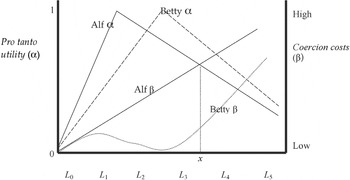
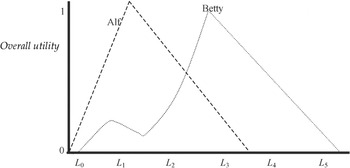
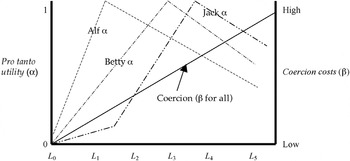
Recall the deliberative model (Section III.C). Members of the public rank all proposals; this would yield for each an ordinal utility function. It is absolutely crucial to keep in mind that the idea of a “utility function” is simply a mathematical representation of a member of P's views about the choice-worthiness of a proposal based solely on her reasonable evaluative standards (Section III.B). This point is of the first importance; utility is not an independent goal, much less self-interest, but a mathematical representation of an ordering of the choice-worthiness of outcomes.Footnote 82 It will help to translate each person's ordinal ranking of the alternatives (based on her set of evaluative standards) into a cardinal function.Footnote 83 Because our interest is in the way that the costs of degrees of coercion figure into the deliberations of members of P, let us take the costs in terms of the coercion imposed by a law and separate them out from each member of P's utility function. For each person, we then have (α) her evaluation of all the costs and benefits of the law (based, as always, on her evaluative standards) except for the element we have separated out: namely, (β) her evaluation of the coercive costs of the proposal. Members of P, I assume, will disagree about the level of costs. For now (but see Section V.D), I suppose they agree that the costs increase as coercion increases. Call (α) the member of the public's pro tanto evaluation of the law (1 = best law; 0 = a law that is not better than no law at all), and call (β) her estimate of the coercion costs of the law. It is important that (β) concerns simply the coercion costs imposed by the law: we do not count as part of the coercion costs of a law nonstate coercion that might occur under a law. A law that itself imposes low coercion may fail to stop nonstate coercion; a law that imposes greater coercion may do a better job at halting nonstate coercion. But nonstate coercion that is reduced by a law falls under the benefits of that law; if nonstate coercion is rampant under a law, that will reduce its pro tanto utility.
In figure 3, Alf and Betty are members of the public deliberating about five systems of law concerning property rights/redistribution. (Recall that we have accepted the argument that ownership cannot be justified prior to distributive justice.) L 1 involves the least state coercion; L 5 the most. If we consider only their pro tanto evaluations, each of the five laws is better than no law at all (L 0). But the costs of increasing coercion have been omitted from the pro tanto utility. Once we factor in these costs, as long as the pro tanto evaluation stays above the costs-of-coercion curve, the member of the public holds that the overall benefits of the law exceed the costs; once the pro tanto curve dips below the coercion-costs curve, the costs of coercion outweigh the other net benefits of the proposal. We can see that point x defines the boundary of the eligible set: at point x, the total coercion costs of the law just equal the total net benefits for Alf; after that point, the costs of the law (measured as always in terms of the satisfaction of Alf's evaluative standards) exceed the benefits, and so he has no reason to endorse the law.
Two utility functions, each split into two parts (α and β)

In figure 3, Alf's ordering is L 1 > L 2 > L 3 > L 0 > L 4 > L 5; Betty's is L 2 > L 3 > L 1 > L 4 > L 0 > L 5. The additional coercion required for L 4 or L 5 is such that now the total costs exceed the total benefits. Alf does not see as justified the additional coercion required for L 4 or L 5. Given his evaluation of the coercion costs involved, and the benefits that the coercion yields, for Alf the costs of coercion outweigh the pro tanto utility of L 4 or L 5, and so they are not in the eligible set.Footnote 84What we see here is that, as proposals involve higher degrees of coercion, they tend to be dropped from the eligible set because of the evaluations of those such as Alf, who evaluate the proposals' coercion costs as high and are more skeptical about the benefits. Thus, in this version of the model, we witness a tilt toward the least coercive options. Note that this version of the model (1) assumes members of the public agree on the ordering of proposals from least to most coercive but (2) incorporates disagreement about the costs of coercion: some may see coercion as a less serious matter than others.
D. Formal analysis II: Disagreement about rising coercion
The first assumption—that members of the public agree on the ordering of the proposals from least to most coercive—is too strong.Footnote 85 As I have stressed, the thesis that coercion rises as redistribution increases is subject to reasonable disagreement. Some have advanced analyses of coercion according to which redistributive states with high tax rates are not necessarily more coercive than states that tax much less.Footnote 86 Let us accept this as a reasonable view. We now need to build reasonable disagreement about the relation of coercion and the extent of the state into the formal analysis. Figure 4 models the revised situation.
Two utility functions, disagreeing about the nature of coercion

In figure 4, Alf's utility function remains as it was before; the laws are arranged in his order of increasing coerciveness (so his utility function is single-peaked). Betty holds that the net benefits are highest at L 3, and the costs of coercion are also lowest around L 3. In Betty's judgment, the redistributive effects of L 3 are, overall, coercion-minimizing.
Note that this weakening of the model's assumptions does not change the result: Alf's judgments of the range of the laws in which the benefits of coercion outweigh the costs are still decisive. This is so because the limits of the eligible set (x) are defined by those reasonable members of the public whose evaluative standards are such that they see the least benefits and the most costs of coercion: that is, classical liberals. This is clearer if we recombine each person's utility function to reflect all costs and benefits—that is, if we no longer separate out the costs of coercion (see figure 5). Ultimately, the important point is that, given Alf's views about the rising costs of coercion and his modest evaluation of coercion's benefits, the eligible set still shrinks to {L 1, L 2, L 3}.
Overall utility functions

VI. Justificatory Classical Liberalism
A. The influence of classical liberal standards in public justification
One interesting result thus far is that for a justificatory liberalism, the presence of members of the public whose evaluative standards lead them to assign higher costs to coercion will push the eligible set toward less coercive laws. Classical liberals such as John Stuart Mill have stressed that a central element of their evaluation of laws is the laws' coercive character. This is basic to the argument of Mill's On Liberty but, importantly, also to Mill's defense of laissez-faire in The Principles of Political Economy:
To be prevented from doing what one is inclined to, or from acting according to one's own judgment of what is desirable, is not only always irksome, but always tends, pro tanto, to starve the development of some portion of the bodily or mental faculties, either sensitive or active; and unless the conscience of the individual goes freely with the legal restraint, it partakes, either in a great or in a small degree, of the degradation of slavery. Scarcely any degree of utility, short of absolute necessity, will justify a prohibitory regulation, unless it can also be made to recommend itself to the general conscience; unless persons of ordinary good intentions either believe already, or can be induced to believe, that the thing prohibited is a thing which they ought not to wish to do.Footnote 87
Because coercion has such high costs, Mill repeatedly stresses that it should be used sparingly, and only where there is great social benefit to be obtained.Footnote 88 To justify legal coercion, we must show real necessity, “and there are large departments of life from which it must be unreservedly and imperiously excluded.”Footnote 89
The presence in the public of those with this sort of Millian view pushes the eligible set toward less coercive laws: they will be the first to come to the conclusion that the benefits of increased coercion are less than the additional costs of coercion. They will not be dictators: the optimal eligible set may well contain proposed laws far from their ideal proposal. As long as for everyone the benefits of endorsing the law as authoritative exceed the costs, the law is in the eligible set. It will be important that some matters be regulated by an authoritative law, and thus the conclusion that some proposed law is worse than no authoritative law at all on a particular matter will not be quickly reached.Footnote 90 Indeed, on many basic matters even Millians may place outside their eligible set only extremely coercive proposals. (It is also important to keep in mind that we are not concerned with strategic and other bargaining behavior, but with people's sincere evaluations of whether the reasons for legal regulation outweigh the reasons against.) Nevertheless, insofar as laws can be arranged from least to most coercive, Millian members of the population will move the eligible set in a classical liberal direction.
Some are apt to insist that this is unfair. Why should Millians, whose evaluative systems strongly disvalue coercion, have so much influence in public reasoning? Shouldn't they have to compromise with those who think that coercion is relatively benign? As Rawls might say, shouldn't Millians be concerned that their views on coercion be acceptable to others, and shouldn't they exercise the virtue of meeting others halfway?Footnote 91 Rawls is undoubtedly correct that in public justification we must only appeal to evaluative standards that are not outrageous or absurd. More than that: we have seen (in Section III.B) that when I am justifying myself to another, I must understand his deliberation to be based on intelligible and reasonable values. However, Mill's view of the dangers of coercion is manifestly an intelligible and reasonable basis for deliberating about laws; it connects up with a wide range of basic and intelligible human values.Footnote 92 To reason in a way that is intelligible to others and relevant to the problem of the justification of laws need not mean that others agree with your reasoning: that is the very point of evaluative pluralism. There is no good reason, then, to think that Millian anticoercion values would have been excluded by a plausible specification of the extent of reasonable pluralism in the deliberative model. Once the standards of some member of P are acknowledged as a reasonable basis for the evaluation of laws, it is objectionable to add a further requirement that she must seek to meet others halfway or compromise with them in order to reach an agreement. This is to turn justification and self-legislation into a bargain. Because our members of the public are committed to adopting only publicly justified laws, they already are taking account of each other's evaluations, and refuse to impose any law not validated by everyone's reasons. Respect for the reasons of others is built into the public justification requirement.
B. A critique of the small state
Because the classical liberal suspicion of coercion is entirely reasonable, and thus is a part of the evaluative standards of some members of the public, classical liberals exercise an important influence on the range of the eligible set. However, there may seem to be the possibility that their influence could be countered by critics of the “small state” whose evaluative standards are such that they conclude that laws characterized by low levels of coercion do more harm than good. Consider, for example, Jack's utility function in figure 6 (for simplicity, I assume agreement about the costs of a law's coercion). For Jack, the costs of coercion exceed the pro tanto net benefits until L 2; when he is included in the public, the eligible set contracts to {L 2, L 3}; importantly, L 1 is now excluded. Suppose that we are justifying a property rights regime: Jack might hold that a classical liberal state that enforces property rights with a modest provision for the poor imposes coercion costs on the poor that exceed the benefits, and thus that such a state is not justified. We can easily imagine more radical versions of Jack's position, contending that in no state short of total egalitarianism would the positive values brought about by inegalitarian states compensate for the costs of coercion. What is important about Jack is that he accepts Alf's “Millian” evaluation of the costs of coercion, but nevertheless rejects the least coercive option.
An anti–small state utility function

Classical liberals need not, and should not, insist that utility functions such as Jack's are intrinsically unreasonable. Some regimes might employ coercion so selectively and unfairly that, even though they employ it sparingly, their laws may be ranked as worse than no law at all by some members of P. The eligible set need not include the least coercive laws for just this reason. However, we have seen (in Section IV) that the evidence strongly indicates that private ownership is a necessary foundation for core liberal values. As a general rule, positions such as Jack's will not undermine justificatory liberalism's classical tilt, since all reasonable persons devoted to the basic liberal rights of the person, bodily integrity, speech, and so on accept that the benefits of private ownership exceed the costs across a wide range of private ownership systems. Given the canonical liberal order of justification, the basic liberties of the person and civil rights themselves ground a social and economic order based on extensive rights of ownership. As I have stressed, political orders based on the protection of property rights and economic freedom provide the only known basis of a regime that effectively protects the basic rights of persons. This is a great political value, and all reasonable members of the public must acknowledge it. Consequently, while some may reasonably believe that a larger (more coercive) state would better satisfy their evaluative standards, liberal critics will not generally be in a position to reasonably claim that a small state does more harm than good.
VII. Conclusion: The Odd Turns of the Dominant View
Justificatory liberalism tilts toward classical positions. Widespread private ownership will be endorsed by all reasonable members of the public as necessary for a liberal regime. Property institutions that include significant redistributive elements certainly may be justified, but as they become increasingly coercive, they are almost sure to be deemed ineligible by those whose evaluative standards deem coercion to be a great cost, which can only be justified if it brings great benefits. Justificatory liberalism leads not to socialism, or a thoroughgoing egalitarian liberalism, or to libertarianism, but to the more nuanced approach to legislation we find in the fifth book of Mill's Principles of Political Economy, allowing that there are a number of tasks that government justifiably performs, but having a strong overall inclination toward less rather than more “authoritative” (i.e., coercive) government.
I have deployed both empirical evidence and formal arguments to show why this is so. The basic idea, though, is intuitively clear and compelling. What I have called justificatory liberalism rests on five main claims: (1) in a fundamental sense, individuals are free and equal; (2) there is a presumption against coercing free and equal individuals to induce them to do what we want—coercion must be justified; (3) the greater the coercion, the stronger must be the justification; (4) free and equal persons reasonably disagree on many matters involving degrees of coercion, but many reasonable people believe that states with high rates of taxation and redistributive institutions are more coercive; and (5) only laws that can be justified to all can reconcile coercion and respect for everyone's freedom and equality. Given these commitments, justificatory liberalism must “tilt” against more coercive states, and it must at least be a crucial concern of justificatory liberals that they show that their favored proposals deploy coercion efficiently: that its benefits clearly outweigh its costs in the evaluation of all reasonable citizens. In my view, it is remarkable that this line of reasoning is barely even acknowledged within contemporary justificatory liberalism. Let me close by suggesting two reasons for this odd state of affairs.
First, at least since Rawls's 1967 essay “Distributive Justice,” and certainly in his 1971 book A Theory of Justice, the main aim of appealing to principles which all free and equal persons can accept has been to justify a certain egalitarian account of distributive justice. Rawls saw that his early formulations of his model led to the indeterminate results I have analyzed here: the parties would endorse (what I have called) an eligible set of economic arrangements, all of which would work in some way to everyone's advantage.Footnote 93 Rawls, though, explicitly sought a determinate solution to the deliberative problem; in order to generate a determinate egalitarian result, he constrained the reasoning of the parties and the basis of their deliberations so that each reasoned in an identical way.Footnote 94 What started out as a collective legislation problem under conditions of disagreement became an account in which everyone cares about the same things, and reasons about them in the same way. Even though Rawls continued to describe his account as requiring “unanimous choice,”Footnote 95 the essence of a unanimity requirement has been lost: the outcome of the agreement is no longer in any way limited by deliberators whose reasonable evaluations of the costs are highest and whose evaluations of the benefits are lowest. We simply stipulate the correct single motivation in order to get the result we want, so that the unanimity requirement becomes a complete fiction. The theorist can generate a “unanimity result” justifying any state, even though we know that many reasonable people do not think this is the optimal result. Given this, the main contemporary versions of justificatory liberalism see no connection at all between a unanimity requirement and a more limited government. Think how odd this is: we start out with a deep respect for freedom, add a unanimity requirement, and we do not get a theory of limited government. Those who advocate such versions of justificatory liberalism proclaim that they respect the reasonable concerns of all, and then proceed to specify what these are in ways that allow them to justify precisely the range of government activities they privately endorse. At best, this is remarkably fortuitous.
Second, those engaged in the contemporary project of showing what systems of property holding can be justified to all have seldom even worried about the use of coercion, or have seldom thought hard about the relation of private property and the protection of basic liberal rights. Indeed, some of Rawls's followers have explicitly denied that there is anything presumptively wrong with coercion,Footnote 96 thus rejecting a fundamental liberal idea that runs from Locke through Kant and Mill to contemporaries such as Feinberg and Benn. We confront another odd turn: an account of liberalism that tells us how important it is to treat persons as free and equal, but sees no presumption against forcing them to do things. Or else, under the guise of doing “ideal theory” according to which we assume perfect compliance with our preferred distributive principles, we are licensed to ignore the fact that, say, market socialist regimes would almost surely employ a great deal of coercion to prevent people from starting and expanding businesses, or that the governments of such states, controlling all sources of investment, would almost certainly have tremendous political power that would endanger the basic rights of their citizens. Thus, Rawls can say, without evoking stunned disbelief, that market socialism, which has only been institutionalized by General Tito's repressive Yugoslav state, is within the class of acceptable regimes partly because it protects political liberties, whereas a welfare state such as the United Kingdom, which probably protects political rights as well as any regime in history, is unjust because it fails to protect the fair value of political rights. Given this cavalier disregard for political reality, contemporary justificatory liberalism has been remarkably hostile to private property regimes, including even the contemporary welfare state.
A dominant view that has accumulated so many odd positions must be questioned. The time has come to free ourselves of the straightjacket of the Rawlsian formulation and rethink the justificatory liberal project afresh. In doing so, we should follow all of Kant's maxims of human understanding: to think from the standpoint of the public, to think consistently, and to think for oneself.Footnote 97