

Introduction
As Heaney and Lorenz (Reference Heaney and Lorenz2013: 252) recently noted, ‘working together in coalition is one of the most common tactics that groups use in attempting to influence policy’ (Loomis, Reference Loomis1986; Schlozman and Tierney, Reference Schlozman1986; Hojnacki et al., Reference Hojnacki, Kimball, Baumgartner, Berry and Leech2012). Lobbying is, by definition, based upon an exchange of information, which, in turn, is strongly linked with networking among lobbyists and policymakers, and also between lobbyists and lobbyists (Mahoney, Reference Mahoney2007). Generally, interest groups do not mobilize in a vacuum, and are more or less forced to share their battlegrounds with a certain number of both ‘allied’ and ‘rival’ organizations. Indeed, in their daily activities, groups are constantly called to decide whether to lobby together with like-minded groups (‘friends’), or engage in networking activity with groups that have conflicting interests (‘foes’), in order to influence public policy. This is even more the case in times of increasing complexity in policymaking (Baumgartner and Jones, Reference Baumgartner and Jones1993; Jones and Baumgartner, Reference Jordan and Greenan2005), given the growing difficulties for individual groups to attain prominence when acting alone (Salisbury, Reference Salisbury1990), as well as of more and more crowded interest systems, where rising competition challenges interest groups’ individual autonomy (Berkhout and Lowery, Reference Berkhout and Lowery2010; Schlozman, Reference Schlozman and Tierney2010; Messer et al., Reference Messer, Berkhout and Lowery2011; Berkhout et al., Reference Berkhout, Carroll, Braun, Chalmers, Destrooper, Lowery, Otjes and Rasmussen2015).
There are at least two reasons that may lead an interest group to join a coalition: first of all, it is a very useful instrument to pool (and, in turn, to broaden) organizational resources (Hula, Reference Hula1999) and political intelligence (Heaney, Reference Heaney2006). Second, the formation of a coalition can signal to policymakers that a policy position has the support of a large and varied group of interests (Mahoney, Reference Mahoney2007, Reference Mahoney2008; Nelson and Yackee, Reference Nelson and Yackee2012). Yet, the choice to build a coalition is anything but a ‘by default’ option for interest groups: sometimes, in fact, interest groups choose not to participate in coalitions. This happens for one reason: coalition building implies both benefits and costs. More precisely, a potential list of those costs includes: (i) the need to compromise with coalition partners; (ii) the fact that groups building a coalition necessarily have to face reduced autonomy with respect to their strategic actions; (iii) the potential risks that the group may suffer from the coalition’s missteps (Browne, Reference Browne1990; Wilson, Reference Wilson1995; Hojnacki, Reference Hojnacki1997; Holyoke, Reference Holyoke2011). The choice to build a coalition, therefore, depends on the evaluation by the interest group under scrutiny of both the benefits and the costs that are associated with that choice: when interest groups judge that the costs of participation outweigh their potential benefits, they prefer to lobby individually, and vice versa. Similar considerations can be drawn for networking.
Despite its importance, there are, however, surprisingly few studies systematically analyzing why groups form alliances with other organizations (Hojnacki, Reference Hojnacki1997, Reference Hojnacki1998; Hula, Reference Hula1999; Heaney, Reference Heaney2006; Mahoney, Reference Mahoney2007, Reference Mahoney2008; Heaney and Lorenz, Reference Heaney and Lorenz2013; Beyers and De Bruycker, Reference Beyers and De Bruycker2017). Furthermore, to date nothing has been said on the reasons pushing groups to engage in networking with their ‘foes’. This paper aims to address exactly this lacuna, both from a theoretical and an analytical point of view.
As for the theoretical contribution, the main argument of this paper is that – in contrast to what has been commonly assumed in the literature so far – organizational resources do not matter either in the absolute or in ‘objective’ terms. In other words, interest groups’ choice as to whether they recur to joint lobbying and networking does not depend on the amount of the resources they hold, but on their perception that those same resources are sufficient to counterbalance opponents’ policy influence, and to overcome environmental challenges that may put the continued existence of the group as an organization at risk. In doing so, it is therefore possible to introduce a dynamic element to the analysis, which may represent a step further for studying interest groups’ lobbying behaviour.
From an analytical point of view, the ‘traditional’ analysis of coalition building with (more or less) like-minded organizations is flanked by the parallel study of networking with ‘rival’ groups. In this way, it is possible to present a more fine-grained picture of lobbying activity: when groups decide to interact with other organizations, in fact, they do not only recur to coalition building; they may also choose to have direct contacts with their opponents, mostly with the aim of confronting different policy positions and, in turn, reaching policy compromises. When (and why) does it occur? To broaden the focus of analysis could therefore represent a good research strategy to better understand (and, in turn, to explain) interest groups’ lobbying behaviour.
Yet, together with the theoretical and analytical contribution, there is a third added value of this paper, which lies in shedding light on the Italian case. While interest groups’ lobbying behaviour in many Western European countries is well-documented in the literature (Bunea and Baumgartner, Reference Bunea and Baumgartner2014), the decision to focus on Italy represents a true novelty of this paper. To date, scholars know very little about interest groups’ lobbying behaviour in Italy in general, or about their tendency to recur to coalition building and/or to networking, in particular. What scenario characterizes Italy? Are there any differences among group categories? And, finally, what are the reasons behind interest groups’ choices? In order to answer these questions, original data, drawn from a national survey conducted from January to March 2017 on 1277 Italian interest groups, are provided and extensively discussed. On the one hand, empirical findings substantially confirm that interest groups’ own perceptions about how much they are influential in policymaking as well as subject to environmental challenges are crucial factors in explaining their lobbying behaviour; on the other hand, empirical results also pave the way for a more fine-grained understanding of the phenomenon of lobbying, which cannot be satisfactorily studied without taking into account how (much) perceived external factors constrain individual choices.
This paper is arranged as follows: in the second section I briefly review the most relevant literature on interest group coalition formation, while in third section I develop several hypotheses that try to explain how and why groups decide to join other organizations in a lobbying effort. The fourth section explains the research design, while the fifth section offers descriptive statistics. Sixth section then consists of the multivariate statistical analysis and the discussion of the empirical findings, while in the last part of the paper (seventh section) I offer some concluding remarks and propose directions for future research.
When and why interest groups do (not) build coalitions: the literature so far
Although a certain degree of networking is almost ubiquitous in interest group politics, empirical studies on whether groups recur to coalition formation are relatively scarce (Salisbury et al., Reference Salisbury, Heinz, Laumann and Nelson1987; Hojnacki, Reference Hojnacki1997, Reference Hojnacki1998; Heaney, Reference Heaney2006; Mahoney, Reference Mahoney2007, Reference Mahoney2008; Heaney and Lorenz, Reference Heaney and Lorenz2013). This is even more the case in respect of the reasons behind the decision to network with rival organizations: in this case, what drives groups’ choices is fundamentally unknown in the literature so far.
Overall, the most relevant studies to date are likely to link the likelihood of building an interest group coalition to: (i) the group type; (ii) group’s organizational resources; (iii) the policy context; (iv) institutional settings.
First of all, the type of interests a group represents may influence the appeal of allied activity (Hojnacki, Reference Hojnacki1997: 69). In this respect, the main distinction deals with the very well-known dichotomy between ‘special interest groups’ and ‘public interest groups’ (Salisbury, Reference Salisbury1975), or, as Klüver (Reference Jenkins-Smith, St. Clair and Woods2013) has more recently proposed, ‘sectional groups’ and ‘cause groups’. The former category includes groups whose main interests are based on something tangible that is shared among members, whereas organizations belonging to the latter category seek to represent the more expressive interests of a less concretely defined clientele; moreover, their members generally share only social or ideological perspectives. Originally, scholars suggested that precisely the ‘ideological’ nature of the interests advocated by public interest/cause groups should have been the main reason for them not to engage in coalition building (Salisbury, Reference Salisbury1990; Jenkins-Smith et al., Reference Jones and Baumgartner1991). For those groups – scholars assumed – the costs connected with the need to reach compromises with other organizations would have been too high (Clark and Wilson, Reference Clark and Wilson1961: 162). More recently, this theoretical expectation has been also stressed by Mahoney (Reference Mahoney2007), who argues that ideological citizen groups should be less likely to build coalitions with other organizations.
Yet, the literature is not univocal on this: Hojnacki (Reference Hojnacki1997: 70), for example, claims that ‘…groups representing expressive interests […] are likely to seek the most efficient means of using their scarce resources for advocacy, and coalition membership might provide a low-cost way of becoming “involved” on an issue.’ Regardless of what perspective appears to be more convincing from a theoretical point of view,Footnote 1 there is no doubt that group type may count in coalition formation.
Another important stream of literature, rather than focusing on group type, stresses the relevance of groups’ organizational resources on their decisions as to whether to build a coalition with other organizations (McCarthy and Zald, Reference McCarthy and Zald1978; Caldeira and Wright, Reference Caldeira and Wright1990; Cress and Snow, Reference Cress and Snow1998). The effects of two organizational resources in particular have been scrutinized at length, namely economic and financial resources (budget), and size of staff (expertise). The argument in this case is rather straightforward: since coalitions pool resources, resource-poor groups will look at them as an opportunity to broaden their strength, whereas wealthy organizations, on the contrary, will be particularly concerned by the loss of autonomy a coalition generally implies. In other words, resource-rich groups do not need to rely on like-minded interests to mobilize: they have the strength to lobby efficaciously even on their own (Mahoney, Reference Mahoney2007: 372).
More recently, choosing to build a coalition has been alternatively or complementarily connected with the main features of the policy field (and/or of the policy issue) in which the group under scrutiny operates (Hojnacki, Reference Hojnacki1997; Mahoney, Reference Mahoney2007) and – particularly with regard to comparative research designs – to the institutional settings characterizing different political systems (Coen, Reference Coen2004; Mahoney, Reference Mahoney2008). Where the policy field is concerned, the main aspect that has been stressed relates to how crowded it is: both Baumgartner and Jones (Reference Baumgartner and Jones1993) and Hojnacki (Reference Hojnacki1997) in fact suggest that the higher the ‘density’ (Lowery and Gray, Reference Lowery and Gray1993) of the policy field and, in turn, the stronger the degree of competition that groups pertaining to that same policy field have to face, the less likely it is that those same groups recur to coalition formation. In their view, this is because groups facing greater competition are expected to be more concerned about maintaining a unique identity and, therefore, less likely to join coalitions.
In terms of the issue around which a coalition may be formed, the literature is full of interesting sparks: in particular, Mahoney (Reference Mahoney2007) argues that both highly conflictual issues and highly salient issues may be more likely to lead to coalition formation. In the first case, the reason lies in the fact that conflict gives groups an incentive to band together to face a common threat (Gais and Walker, Reference Gais and Walker1991; Hojnacki, Reference Hojnacki1997; Whitford, Reference Whitford2003). In the second case, the argument is that salient issues frequently require that advocates demonstrate a broad base of support for their instances. Moreover, the same author posits that the scope of the issue may play a role. In her words: ‘…larger scope issues that affect large portions of the population can be costly […and…] should drive groups to signal their strength to policymakers through allying in a coalition’ (Mahoney, Reference Mahoney2007: 372). In sum, the more the issue is conflictual, salient and characterized by a ‘broad’ scope, the more likely it is that interest groups lobbying on that same issue will join forces through coalition formation.
Finally, scholars also suggest that institutions matter a great deal in interest group coalition building: the higher the democratic accountability of policymakers, the more useful it will be for interest groups to build a coalition. Indeed, when policymakers are directly accountable to their constituents, the expectation is that they are more susceptible to claims about the broad support of interests for a specific proposal. This theoretical hypothesis rests mainly on the assumption that the first and foremost aim of elected policymakers is to be re-elected: in this case, between the two benefits that are usually connected with coalition formation – namely, pooling resources and political intelligence, and signalling that a particular issue is sustained by a broad consensus – the latter in particular is considered to be relevant.
The impact of perceived rivals’ policy influence and environmental challenges on lobbying behaviour
Any lobbying activity implies both costs and benefits: the more the latter exceed the former, the more likely it is that a group will undertake that particular strategy, and vice versa. However, costs and benefits are anything but unchanging and – above all – they are perceived differently by different groups in different contexts. This prompts the question: what are the determinants of interest group coalition formation? And what leads to networking with ‘rival’ organizations? The core of my argument is based on the assumption that neither activity – coalescing with ‘friends’, on the one hand, and networking with ‘foes’, on the other – depends on the resources groups hold, as is commonly assumed in the literature (McCarthy and Zald, Reference McCarthy and Zald1978; Caldeira and Wright, Reference Caldeira and Wright1990; Cress and Snow, Reference Cress and Snow1998). Rather, they depend on the group’s perception that those same resources are (or, on the contrary, are not) sufficient to counterbalance rival groups’ policy influence as well as environmental challenges that the group has to face in its daily activities. In other words, resources do not matter in absolute but in relative terms, and – above all – they do not condition a strategic choice, such as forming a coalition with like-minded associations, on the one hand, or networking with ‘rival’ groups, on the other, ‘objectively’. On the contrary, any given group decides to ‘pool resources’ (Hula, Reference Hula1999; Heaney, Reference Heaney2006) and/or to ‘signal that a particular policy position benefits from a broad consensus’ (Mahoney, Reference Mahoney2007, Reference Mahoney2008; Nelson and Yackee, Reference Nelson and Yackee2012) if and only if it perceives that its own resources and its own consensus are insufficient to ensure its lobbying effort has a successful outcome.
This approach looks mainly at the decision to shift from individual lobbying as a second-option strategy: indeed, to build a coalition necessarily implies a deviation from the core interests the group advocates; similarly, the choice to have direct relationships with rival organizations is anything but frequent, and is often led by a lack of alternatives (Browne, Reference Browne1990; Wilson, Reference Wilson1995; Hojnacki, Reference Hojnacki1997; Holyoke, Reference Holyoke2011). Both activities, as previously said, are characterized by trade-offs between costs and benefits, yet these trade-offs do not deal with ‘objective’ costs and ‘objective’ benefits, but with ‘perceived costs’ and ‘perceived’ benefits. Of course, groups’ perceptions often go hand in hand with reality, and groups are usually able to evaluate whether their resources are sufficient to lobby individually, on the one hand, or need to be pooled with others, on the other. However, we cannot assume a priori that these perceptions are always correct. If a group believes that it needs help, it will pursue any option to obtain that help, whether or not the help is ‘objectively’ necessary for reaching its policy aims.
More precisely, I also argue that perceptions are influenced by two main factors: first, they depend on the extent to which the group considers itself as being influential in policymaking in comparison with its opponents. Indeed, if an organization considers itself to be weaker than their rivals, it is more likely to recur to coalition formation, as it thereby increases the resources at its disposal and, in turn, the chances to reach its policy objectives. In reverse, organizations that perceive themselves as stronger than their ‘foes’ are less likely to look for partners, because each new addition to the network implies more costs (above all, with regard to the necessity to reach compromises with different groups) than benefits.
Yet, it is not only a matter of policy influence; it is also a matter of surviving: the first and foremost aim of any complex organization – among which, of course, are also interest groups – is in fact to survive as an organization (Meyer and Rowan, Reference Meyer and Rowan1977). There are many external challenges that may threaten the very existence of an interest group: competition for members from other like-minded organizations; decreasing resources and/or public subsidies; public opinion changes about the issues which are important for the group; etc. On this, my theoretical hypothesis is that the more a particular group is (or, better, believes to be) threatened by environmental challenges, the more it will try to broaden its resources by recurring to coalition formation. In fact, as soon as those same resources increase, the less likely the survive of the group as an organization should be at risk.
Similar considerations also apply with regard to networking with ‘foes’: groups believing that rival organizations are more influential than they are have an incentive to avoid open disputes and conflicts with them; instead, they are pushed to reach a compromise. Mostly, the first step in this direction is to arrange a (formal or informal) contact to try and find potential points of convergence among different policy positions. On the contrary, groups that believe they are more influential than their rivals in policymaking have an incentive to avoid any kind of compromise with them, and to follow all their policy objectives without any concession: they (believe they) have the strength to do so. We can suppose environmental challenges to work in the same way: the more groups feel that their existence is at risk, the more they will believe that they are not in a position to simply impose their will. In broader terms: weaker organizations are more likely to look for help (coalition formation with ‘friends’) and to reach compromises (networking with ‘foes’), whereas stronger organizations neither need help nor try to reach compromises.Footnote 2
All this therefore leads to two theoretical hypotheses:
Hypothesis 1 Interest groups perceiving that their opponents are more influential than them in policymaking are more likely to build coalitions with like-minded organizations and to engage in networking with rival groups.
Hypothesis 2 Interest groups perceiving they are threatened by many environmental challenges are more likely to build coalitions with like-minded organizations and to engage in networking with rival groups.
Research design
This paper focuses on Italy: it thus represents a case study. Even though scholars generally look askance at case studies and often prefer comparative research designs when they are called to test theories and hypotheses, this is somewhat less true for interest group research, where the ‘case study’ still represents the most widespread research design (Bunea and Baumgartner, Reference Bunea and Baumgartner2014: 1425). Anyway, the rationale behind focussing on the Italian case is twofold. First, it is almost unknown in the literature: with a very few recent exceptions (Capano et al., Reference Capano, Lizzi and Pritoni2014; Lizzi and Pritoni, Reference Lizzi and Pritoni2017; Pritoni, Reference Pritoni2017), scholars devoted little attention to interest group politics in Italy so far. However, simply adding the Italian case to the existing literature would not be a sufficient contribution. Therefore, the second (and main) reason for studying Italian interest groups has to do with the very nature of case studies more generally: to investigate something that has significance beyond the boundaries of the case itself. In other words, this case study represents the first step in developing ‘cautious comparison’ (Lowery et al., Reference Lowery, Poppelaars and Berkhout2008) in the near future, and may also contribute to specifying theories and hypotheses that have been already tested (and verified) elsewhere. In fact, the hypothesis that perception of self-strength is fundamental to predicting the likelihood of interest groups’ building coalitions together with ‘friends’, and engaging in networking with ‘foes’, could be expanded beyond the Italian case and may represent a framework to be tested in a comparative perspective too.
Focusing on the Italian interest system as a whole means that all interest groups involved in some political activity in Italy must be taken into account. But what kind of interest groups? In the literature, a key distinction can be made between a ‘behavioural definition’ (Baumgartner et al., Reference Baumgartner, Berry, Hojnacki, Kimball and Leech2009) and an ‘organizational definition’ (Jordan and Greenan, Reference Klüver2012). In the first case, groups are defined based on their observable, policy-related activities; in the second case, the ‘interest group’ term is reserved only for membership associations. In this paper, the latter definition is preferred. Accordingly, it was decided to sample interest associations into eight categories, following the well-known INTERARENA coding scheme (Baroni et al., Reference Baroni, Carroll, Chalmers, Muñoz Marquez and Rasmussen2014): business groups, identity groups, institutional groups, leisure groups, occupational groups, public interest groups, religious groups, and unions.Footnote 3
However, in contrast to the United States and the EU, lobbying registers do not exist in Italy: there has never been any formal registration nor an official list of interest groups. At best, a (partial) list of interest groups with media access is now available thanks to the analysis recently developed by Lizzi and Pritoni (Reference Lizzi and Pritoni2017). Yet their population consists of 594 interest groups and does not appear to be complete. In any case, their decision to recur to ‘Guida Monaci’ – which is a data set containing basic information on Italian companies, associations, public administrations, non-territorial bodies, and non-profit organizations – as a natural starting point for any analysis that focuses on the Italian interest system appears to be perfectly reasonable.Footnote 4 Following their sampling procedure, 1551 interest groups that are currently active in Italy at the national level were identified.
However, Guida Monaci cannot be used as the sole source of information. This is basically due to the fact that the registration of the various organizations is carried out on a voluntary basis only. Thus, it may be that a lobbying organization prefers not to register, and thus remains invisible to the Guida. In order to minimize this problem, three more sources of information have been added: first, the Transparency Register, set up by the MISE (Italian Ministry of Economic Development) in October 2016Footnote 5 ; second, all interest groups (which were not already listed in the Guida) participating in a parliamentary hearing (either in the Chamber of Deputies or in the Senate of the Republic) from the beginning of the XVII legislature (March 2013) until the end of 2016; third, any interest group I personally know but which was not yet otherwise part of the overall list. In this way, I have been able to add 43 additional organizations to the above-mentioned list of 1551 interest groups, bringing the total sample to 1594 groups.
However, given that only 1277 of them have a national website and a valid e-mail address, I was not able to send the online questionnaire on which this study is based to the whole sample of groups. On the contrary, the invitation to participate in the survey was exclusively sent to those 1277 interest groups with e-mail address; 478 of them returned the questionnaire either totally or partially filled out, for a response rate of 37.4%,Footnote 6 which is quite satisfactory (Marchetti, Reference Marchetti2015).
In the literature, online surveys have been criticized for (potential) non-response bias (Armstrong and Overton, Reference Armstrong and Overton1977). If respondents differ substantially from non-respondents, the results do not directly allow one to say how the entire sample would have responded. Yet I am quite confident that in this case results are not biased: indeed, response rates among group categories are not particularly uneven, ranging from 29.6% of occupational groups to 45.8% of identity groups.Footnote 7 Moreover, respondents and non-respondents are also similar with respect to their age: groups returning the questionnaire display a mean age of 38.7 years, whereas groups that decided not to participate in the survey are characterized by a mean age of 36.2 years.
That said, statistical models are operationalized as follows. Where dependent variables are concerned – namely, joint lobbying with like-minded organizations, on the one hand, and networking activities with groups having conflicting interests, on the other – the former has been operationalized by recurring to an additive index that takes into account whether groups collaborated (during the year 2016) with like-minded organizations in: (a) representing stakeholders on committees, government, advisory bodies, etc.; (b) publishing joint statements, such as joint press statements or position papers; (c) coordinating political strategies. For each question, respondents were allowed to answer in yes/no terms; thus, this ‘index of joint lobbying’ varies between 0 (for respondents answering ‘No’ to all questions) and 3 (for respondents answering ‘Yes’ to all questions).
As for the latter dependent variable – networking with ‘foes’ – data have been collected thanks to the answers to the following question: ‘During the last 12 months, how often has your organization been involved in networking with groups that have conflicting interests to your organization?’. In this case, respondents were allowed to indicate one of the following options: (i) ‘we did not do this’; (ii) ‘at least once’; (iii) ‘at least every 3 months’; (iv) ‘at least once a month’; (v) ‘at least once a week’. Yet, I changed this ordinal scale into a cardinal one, by attributing the values of 0, 1, 4, 12, and 52, respectively, to the above-mentioned categories of response. As a consequence, the statistical method that is used to test the analytical framework (with respect to both models) is the ‘traditional’ ordinary least square (OLS).
With respect to the two hypotheses I want to test in this paper – claiming that self-perceptions of rivals’ influence and environmental challenges have an impact on the likelihood that groups form coalitions and engage in networking with opponents – the respective independent variables have been operationalized as follows: for the variable ‘Influence of rivals’, data have been collected thanks to the answers to the following question: ‘How would you rate your organization’s influence on public policy compared to that of your opponents?’. In this case, respondents were allowed to indicate one of the following options: (i) more influence; (ii) roughly the same influence; (iii) less influence.
The variable ‘Environmental challenges’ has been operationalized by recurring to an additive index taking into account how muchFootnote 8 groups considered as being important eleven potential environmental challenges that they had to face in their daily activities.Footnote 9 This index varies between 11 (all external challenges considered as being ‘not at all important’) and 55 (all external challenges considered as being ‘very important’).
Yet, as shown in second section, in the literature many more potential determinants of the likelihood that a particular interest group participates in coalition formation have been proposed. Among them, especially organizational resources – above all, budget and the size of the staff – are generally considered as being relevant. Therefore, ‘Annual budget’ and ‘Expertise (paid staff)’ represent two control variables taking into account the annual operating budget (in Euros) of the group, as well as the total amount of paid staff (full time equivalent), externally paid professionals and interns/trainees at group disposal, respectively.
In addition, older groups generally have greater status and prestige than younger organizations (Hannan and Freeman, Reference Hannan and Freeman1993); they have had more time to develop organizational capabilities and are better embedded in social and institutional networks. As a result, they are more familiar to policymakers, enjoy more access (Fraussen et al., Reference Fraussen, Beyers and Donas2015) and exert more influence (Heaney and Lorenz, Reference Heaney and Lorenz2013). In other words, it could be that older groups do not recur to coalition formation simply because coalitional benefits are expected to be marginal, while costs may also be huge. Similarly, they are also expected to compromise less with their rivals, given their strength. To control for this, the control variable ‘Age’ is operationalized through the year of foundation of each single interest group.
Coalition formation might also be linked to the breadth of policy activity (Heaney and Lorenz, Reference Heaney and Lorenz2013): the more you specialize in a particular policy field, the less you need allies; while the more you ‘dance at many weddings’, the more you face incentives to coalition formation. This is because – all else being equal – when a group is interested in fewer policy issues, it can focus its resources only on those specific issues instead of scattering its lobbying effort on (too) many tables. Thus, to control for this, the control variable ‘Breadth of policy engagement’ takes into account the number of issue areas the group is actively involved in.
Finally, in order to control for the potential impact of group type, seven dummy variables (one for each group category, with ‘business groups’ as the reference category) enter both statistical models (with Model 1 testing which variables influence the likelihood to recur to joint lobbying with like-minded organizations, and Model 2 verifying which variables have an impact on how much Italian interest groups decide to interact with groups having conflicting interests).
Descriptive statistics
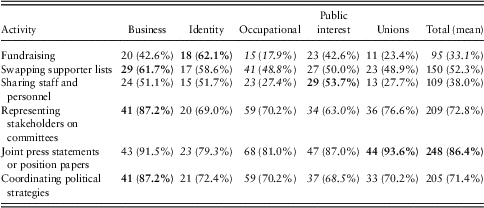
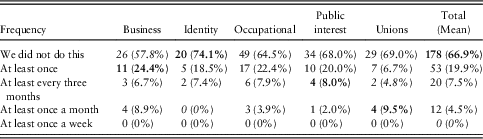
As previously noted, this paper represents the first empirical study that takes into account when and why Italian interest groups decide to build a coalition of interests with like-minded organizations, or to engage in networking activity with other groups that have conflicting interests: this kind of data does not exist in the literature to date. Therefore, while the theoretical contribution of this paper remains the main added value of this work, also the descriptive aim is still crucial. With respect to this, I present two tables: the first (Table 1) samples groups on the basis of whether they ever collaborate with other organizations in conducting relevant activities (i.e. fundraising, sharing staff, coordinating lobbying, etc.); the second (Table 2) shows the frequency with which different groups recur to networking with ‘foes’.
Does your organization ever collaborate with other organizations in any of the following activities?

χ²=22.51; V (Cramèr)=0.08; year of reference: 2016.
Bold indicates the highest value among categories of interest groups; italics indicates the lowest value among categories of interest groups.
During the last 12 months, how often has your organization been involved in networking with groups that have conflicting interests to your organization?

χ 2=8.08; V (Cramèr)=0.09; year of reference: 2016.
Bold indicates the highest value among categories of interest groups; italics indicates the lowest value among categories of interest groups.
However, in contrast to the next multivariate analysis (sixth section), descriptive statistics that group interest associations in all the categories of the INTERARENA coding scheme are not presented. This is because the number of institutional groups, leisure groups and religious groups that answered the survey on this is too limited to allow for meaningful observations. Instead of presenting percentages that make little sense, I thus prefer to focus on broader categories of respondents: business groups, identity groups, occupational groups, public interest groups, and unions.
The observation of Table 1 leads to a good number of interesting considerations. Overall, the variance among different activities is rather high: on the one hand, Italian interest groups appear to frequently collaborate among themselves in representing stakeholders in committees (72.8%), in producing joint statements and/or position papers (86.4%), and in coordinating political strategies (71.4%); on the other hand, they are much less likely to join forces in swapping supporter lists (52.3%) and, above all, in sharing staff and personnel (38.0%) as well as in fundraising (33.1%). In other words, it appears that, on average, Italian interest groups are much more likely to share lobbying strategies than organizational resources, which on the contrary they safeguard jealously. Thus, the main incentive for coalition building in Italy appears to be to signal that a particular issue is sustained by a broad consensus (Mahoney, Reference Mahoney2007, Reference Mahoney2008; Nelson and Yackee, Reference Nelson and Yackee2012), whereas pooling resources and political intelligence is much less appealing (Hula, Reference Hula1999; Heaney, Reference Heaney2006).
Second, business groups show – on average – the highest tendency to promote and develop common actions with other organizations: they represent the group category which swaps supporter lists, represents stakeholders in committees, and coordinates political strategies the most. With regard to this latter activity especially, the leadership of business groups is very clear: 87.2% of Italian business groups collaborate with other associations in organizing their lobbying efforts, whereas all other group categories show percentages – on this – close to 70%. On the contrary, occupational groups are less likely to share political strategies or, above all, organizational resources: indeed, the percentages of occupational groups are the lowest with regard to fundraising, swapping supporter lists, and sharing staff and personnel. If, as previously claimed, Italian interest groups are generally jealous of their own resources, Italian occupational groups are the most jealous of them all.
However, and this is the third consideration rising from the data, the variance among different group categories is not particularly high. In other words, groups do not differ very much in their behaviour. I can affirm this because of the 0.08 value characterising Cramér’s V in this case.Footnote 10 At first sight, at least with respect to the list of activities listed above, group type does not have an impact on the varying tendency to promote and develop common efforts among interest groups.
Yet, also the decision to engage in networking with ‘foes’ represents a main focus of this study. With respect to this, please look at Table 2.
When observing the table above, three aspects jump out: first, group type does not appear to be particularly relevant. Indeed, Cramér’s V is very low. Second, networking with groups having conflicting interests is anything but frequent: the modal response category, in this case, is by far ‘we did not do this’.Footnote 11 Third, even in a context of scarce differentiation, business groups and unions seem to recur to networking with ‘foes’ more frequently than others. This makes perfect sense, since they are the natural counterparts in many social policy processes, where compromises are often necessary.
Multivariate analysis and discussion of the findings
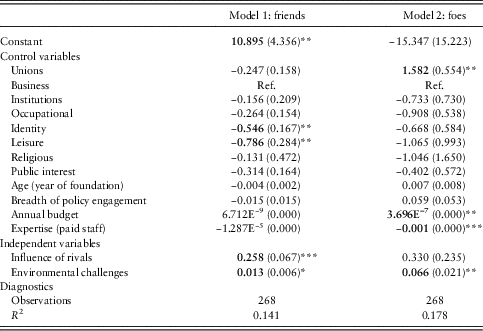
I estimate two sets of OLS regression models on the tendency to work in a coalition with like-minded organizations shown by Italian interest groups (Model 1) and to interact with groups that have conflicting interests (Model 2), respectively. In both cases, independent (i.e. perceived rivals’ influence and environmental challenges) and control (i.e. year of foundation, budget, expertise, age, breadth of policy activity, and group type) variables are the same, while only the dependent variable varies. Unfortunately, not all groups participating in the online survey could/wanted to respond to the set of questions on which this study is based: thus, the number of cases included in the regressions is 268. That said, please see Table 3.
Multivariate regressions (ordinary least square)

*P<0.05; **P<0.01; ***P<0.001.
Dependent variable for Model 1: Index of joint lobbying (0–3).
Dependent variable for Model 2: Frequency of networking activities in 2016 (0–52).
Bold indicates coefficients with significant statistical correlation.
Table 3 presents rather good results: Hypothesis 1 is partially confirmed, while empirical findings seem to openly confirm Hypothesis 2. The role of environmental challenges especially has been hypothesized properly: in both models, the sign of the coefficient is in fact positive and statistically significant. In other words, as expected, the more groups mobilize in (what they believe to be) a risky environment, the more they work in coalition with like-minded organizations and the more they engage in networking with rival groups.
The impact of opponents’ influence on those choices is somewhat less clear, but still present: in Model 1 on joint lobbying, in fact, the coefficient is strongly positive, and statistically significant at the highest level (P<0.001). This means that the perception that rival organizations are in a better condition to reach their policy aims represents a strong incentive to pool resources with like-minded interest groups in order to counterbalance that (perceived) strength. On the contrary, the effect of opponents’ influence on networking (Model 2) is less evident: again, as expected, the sign of the coefficient is positive, but not statistically significant. Actually, it makes sense: although it appears to be rational to try to reach a compromise with a stronger rival, who is otherwise expected to obtain much more, this strategy may be yet difficult to undertake, especially if that same rival has the same impression that it is stronger than its opponents. In this case, in fact, its best strategy would be not to reach any compromise and to remain resolute on its policy positions.
Overall, the theoretical framework proposed in the third section proved to be rather useful to explain interest groups’ lobbying behaviour. This represents a clear contribution to existing literature: (Italian) groups assess their opponents with regard to their impact on political decision-making, as well as their own long-term survival chances, and adjust their networking tactics accordingly. In other terms, perceptions (both of rivals’ policy influence and environmental challenges) matter a great deal, and interest groups’ lobbying behaviour cannot be satisfactorily understood without taking into account how (much) perceived external factors constrain individual choices.
Interestingly, a very few control variables have a statistically significant impact on both lobbying in coalition and networking. As for Model 1 (joint lobbying), only group type seems to matter: all group categories – when compared with business groups – are characterized by negative coefficients, and the coefficients of identity groups and leisure groups are both statistically significant. In other words, as repeatedly argued in the literature (Salisbury, Reference Salisbury1990; Jenkins-Smith et al., Reference Jones and Baumgartner1991; Hojnacki, Reference Hojnacki1997: 69), in Italy, too, business groups are more likely to form coalitions with like-minded organizations than other kinds of group do. Where Model 2 (networking) is concerned, the strongest effect is the prerogative of organizational resources: budget and number of staff. Both economic and financial resources, and expertise, are key factors for the likelihood that interest groups will engage in networking with rival organizations. However, and this is very puzzling, those same organizational resources have opposite impacts: while the former is positively correlated with networking activities, the latter presents a negative sign. This means that groups with more economic and financial resources, as well as groups with less expertise, recur more frequently to networking with rivals. This is tricky, given that – very often – budget and expertise covariate positively. This unexpected finding thus merits further research in the future.
Conclusions and directions for further research
In recent years, interest group research has grown impressively (Hojnacki et al., Reference Hojnacki, Kimball, Baumgartner, Berry and Leech2012; Bunea and Baumgartner, Reference Bunea and Baumgartner2014). However, within this bulk of literature, empirical studies on whether interest groups recur to coalition formation are relatively scarce (Hojnacki, Reference Hojnacki1997, Reference Hojnacki1998; Heaney, Reference Heaney2006; Mahoney, Reference Mahoney2007, Reference Mahoney2008; Heaney and Lorenz, Reference Heaney and Lorenz2013; Beyers and De Bruycker, Reference Beyers and De Bruycker2017), and scholars have seldom addressed the question of why some organizations perceive it advantageous to join alliances to advocate their interests, while others opt to work alone. This is rather surprising, though, given that much of lobbying consists to a certain extent of networking among many (different) actors (Schlozman and Tierney, Reference Schlozman1986; Heaney and Lorenz, Reference Heaney and Lorenz2013).
This lack of empirical research is particularly problematic with respect to Italy: with a very few recent exceptions (Capano et al., Reference Capano, Lizzi and Pritoni2014; Lizzi and Pritoni, Reference Lizzi and Pritoni2017; Pritoni, Reference Pritoni2017), Italian scholars have not paid sufficient attention to interest group politics and the Italian case is still absent from any comparative research. This paper aimed to address precisely this lacuna, both from a descriptive – ascertaining how much Italian interest groups either coalesce with ‘friends’ or network with ‘foes’ – as well as an explanatory – hypothesizing why Italian interest groups do what they do with respect to those lobbying decisions – point of view. While the empirical test of the proposed theoretical framework undoubtedly represented the main added value of this paper, also the descriptive aim was still crucial.
More precisely, the main finding of this work is that groups perceiving themselves to be threatened by rivals’ influence in policymaking, or by environmental challenges, are more likely to work in coalitions and to engage in networking. As expected, resources do not matter in ‘absolute’ and ‘objective’ terms, but in ‘relative’ and ‘subjective’ ones. Moreover, from a descriptive point of view, it is relevant to ascertain that – even in a context of low variance among group categories – business groups are more likely to engage in joint lobbying than other group types, whereas the same holds true for unions with respect to networking with rival organizations.
Precisely because of the above-mentioned lack of empirical studies on the Italian case, there is chance that more studies will soon follow as many fascinating questions remain open. First of all, there is the necessity to go beyond this case study, and to insert the Italian case into a comparative perspective. To what extent are the empirical findings presented here ‘Italian peculiarities’? To what extent, on the contrary, do Italian interest groups behave similarly to their equivalents in other democratic (Western European) countries? With regard to this, for example, it is not possible to exclude that some peculiarities of the Italian political system – above all party system fragmentation (Chiaramonte and Emanuele, Reference Chiaramonte and Emanuele2013) and government instability (Curini, Reference Curini2011) – have an impact on the likelihood that interest groups build coalitions with like-minded organizations and engage in networking activities with their opponents. More precisely, both aspects might be linked with more coalition formation and more networking, given that this very fragmentation and instability (in other terms, this extreme uncertainty) could exaggerate groups’ concerns and, in turn, their perceptions to need more ‘friends’ and to compromise more with ‘foes’. Moreover, the literature has convincingly demonstrated that institutional settings do matter for interest group coalition formation (Mahoney, Reference Mahoney2007, Reference Mahoney2008): only with a comparative research design can the effects of those same institutions be ascertained (or, at least, controlled for).
Yet, as claimed in second section, the literature has also stressed the impact of issues’ characteristics on interest groups’ decisions to ally or not to ally (Hojnacki, Reference Hojnacki1997; Mahoney, Reference Mahoney2007): therefore, another very relevant direction for future research is focusing on policy processes more in-depth. Different patterns could be ascertained by distinguishing – for example – between highly salient and less salient policy processes, as well as between highly conflictual and less conflictual ones.
The ‘to ally or not to ally question’, in sum, still needs a comprehensive answer, and that very answer will not be of scarce relevance for both interest group research in general and democratic performance more broadly. In fact, since lobbying in coalitions is the most widespread tactic that interest groups employ to be influential in the policymaking (Heaney and Lorenz, Reference Heaney and Lorenz2013: 252), fully understanding what pushes to form coalitions (as well as to engage in networking with rival organizations) becomes crucial to explain who wins and who loses in the policy process and, in doing so, to assess whether interest group politics contribute positively or negatively to democratic quality (Lowery et al., Reference Lowery, Baumgartner, Berkhout, Berry, Halpin, Hojnacki, Klüver, Kohler-Koch, Richardson and Schlozman2015).
Acknowledgements
The author would like to thank the two anonymous reviewers for their comments. Following their suggestions, I included several improvements in the article.
Financial Support
The research has been funded by the Italian Ministry of Education, University and Research (MIUR), and by Scuola Normale Superiore (grant no. GR16_B).
Conflicts of Interest
None.
Data
The replication data set is available at http://thedata.harvard.edu/dvn/dv/ipsr-risp