Approximately 10–20% of children are readmitted following congenital heart surgery. Readmissions are now being viewed as preventable complications of the original surgery or hospitalisation, and there have been proposals by insurance agencies to deny coverage of the additional expenses incurred by the readmission. 1
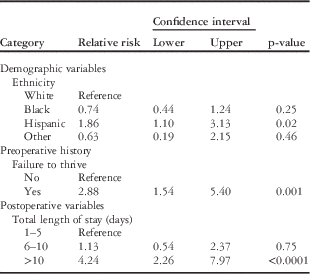
There are increasing efforts nationwide to identify high-risk patients and to develop interventions targeted at reducing the frequency of hospital readmissions. In 2011, we identified and published risk factors for readmission following congenital heart surgery for 685 children who underwent congenital heart surgery in 2009. Hispanic ethnicity, failure to thrive, and original hospital stay more than 10 days were identified as key risk factors for readmission (Table 1).Reference Kogon, Jain, Oster, Woodall, Kanter and Kirshbom 2 As part of a quality initiative with the goal of reducing readmissions, the following changes were made in the discharge process for patients falling into these three high-risk groups: all discharges were carried out with an interpreter for non-English speaking families, regardless of their stated understanding of the English language; medications were delivered to the hospital before discharge, and a full medicine reconciliation was performed between the family and discharge nurse; and phone calls were made to families within 72 hours following discharge by a midlevel provider, at which time a status update was obtained, and a medicine reconciliation was performed again. Whether this quality initiative has made a difference in readmissions is unknown.
Multivariate regression analysis – 2009 cohort.

Therefore, the purpose of our study was to determine the risk factors for readmission following our intervention, and compare readmission rates before and after our intervention. We hypothesised that these changes in the discharge process would decrease readmissions following surgery.
Methods
The current cohort of patients was discharged following congenital heart surgery performed at Children’s Healthcare of Atlanta in 2012. Institutional Review Board approval was obtained to conducted this retrospective study, and individual patient consent was waived.
Study variables
The primary outcome variable was readmission, defined as a repeat admission to Children’s Healthcare of Atlanta occurring within 30 days following discharge from a surgical encounter. The predictors of interest evaluated were the same as those in our 2011 study, including various demographic, preoperative, operative, and postoperative characteristics. Demographic data included patients’ age at surgery (<30 days, 30 days–1 year, and >1 year), weight at surgery (<5, 5–10, and >10 kg), gender, and race/ethnicity (Caucasian, African-American, Hispanic, and other). Preoperative risk factors included the presence of a genetic syndrome, failure to thrive, developmental delay, gastroesophageal reflux disease, mechanical ventilation, arrhythmia, and asplenia/polysplenia. The most common genetic anomalies were Down’s, DiGeorge, Noonan, Jacobsen, and CHARGE syndromes; however, rare miscellaneous mutations were considered as well. Operative factors included surgeon and type of operation. Type of operation was categorised by the risk-adjusted congenital heart surgery method.Reference Jenkins, Gauvreau, Newburger, Spray, Moller and Iezzoni 3 Surgeries for which a category could not be assigned were considered as a separate category. No operations met the category 5 criteria. Postoperative factors included nasogastric feeds at discharge, the number of functional ventricles, the presence of palliated physiology, duration of intensive care unit stay (none, 1–2, 3–5, and >5 days), and total length of stay (<5, 5–10, and >10 days).
Statistics
We first performed summary statistics for the population as a whole. A Fisher’s exact test was used to perform univariate analyses of the candidate predictor variables. For the multivariate analysis, we constructed a generalised estimating equation Poisson regression model that included the variables that were significant α=0.10 in the univariate analyses. Interaction terms were tested, and the model was evaluated for potential collinearity. From the multivariate model, we determined risk ratios and 95% confidence intervals. Significance was considered at α<0.05. Comparisons were then made between the 2009 cohort and the 2012 cohort. All analyses were performed using SAS Version 9.2 (SAS Institute, Cary, North Carolina, United States of America).
Results
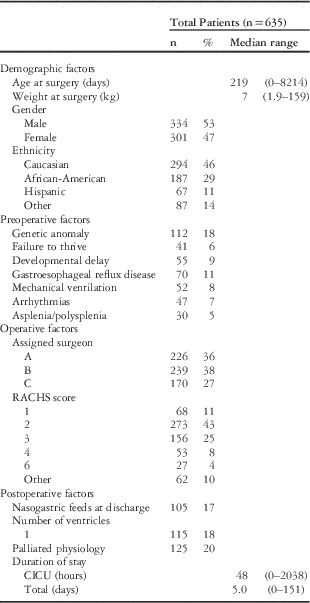
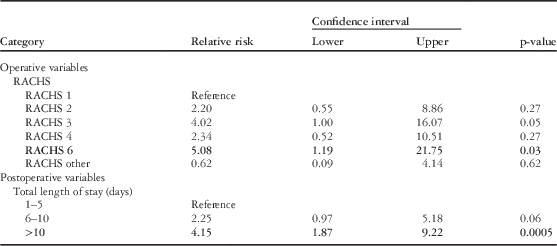
There were a total of 635 eligible patients who underwent surgery in 2012 and were discharged home from our institution. The list of demographic, preoperative, operative, and postoperative variables, as well as the summary statistics, are shown in Table 2. In this cohort, there were 86 readmissions of 77 patients. Multivariate risk factors for readmission were risk adjustment for congenital heart surgery score 6 [risk ratio 5.08; 95% confidence interval (1.19–21.75); p=0.03] and initial hospital stay >10 days [risk ratios 4.15; 95% confidence interval (1.87–9.22); p=0.0005]. (Table 3)
Summary of demographic, preoperative, operative, and postoperative factors.

CICU=cardiovascular intensive care unit; RACHS=risk adjustment for congenital heart surgery
Multivariate regression analysis – 2012 cohort.

RACHS=risk adjustment for congenital heart surgery
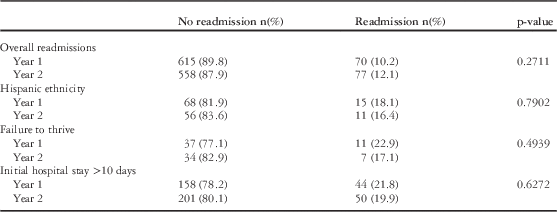
In comparing the 2009 cohort with the 2012 cohort, there were no significant differences in the preoperative risk factors or case mix. The overall readmission rate was similar (10 versus 12%, p=0.27). Although there were slight decreases in the readmissions for those patients with Hispanic ethnicity (18 versus 16%, p=0.79), failure to thrive (23 versus 17%, p=0.49), or initial hospital stay>10 days (22 versus 20%, p=0.63), they were not statistically significant. (Table 4)
2009 and 2012 cohort comparisons.

Discussion
In this study comparing readmission rates following congenital heart surgery in children at two different time points, and following a quality improvement initiative, we found no difference in readmission rates, despite our targeted efforts. Efforts geared towards reducing readmissions in the high-risk group were not found to have a significant impact. These similarities in readmission rates may reflect either (a) that our readmission rate is already at or near its nadir and may not be able to be reduced effectively, or (b) that the risk factors for readmission that were targeted in our campaign are not modifiable, at least by the efforts that we used.
In addition, we do recognise that some rate of readmission is beneficial. Attempts to eliminate readmissions entirely may have unintended consequences such as out-of-hospital morbidity and mortality.
Identifying risk factors for readmission
Reducing hospital readmissions is a national health-care priority and financial penalties for institutions with high readmission rates have been proposed.Reference Kripalani, Theobold, Anctil and Vasilevskis 4 This has led to intensified efforts to reduce readmissions. Hospitals across the country, including ours, have tried to identify reasons for readmission and implement successful strategies to reduce them.Reference Kripalani, Theobold, Anctil and Vasilevskis 4 – Reference Yam, Wong and Chan 10 Identification of patients at high risk for readmission is a crucial step towards improving care and developing possible interventions to reduce readmissions. At our institution, we identified patient risk factors for readmission following paediatric cardiac surgery – Hispanic ethnicity, failure to thrive, and original hospital stay more than 10 days.Reference Kogon, Jain, Oster, Woodall, Kanter and Kirshbom 2 Other studies, looking specifically at patients undergoing arterial switch and Norwood operations, identified other patient risk factors.Reference Mackie, Gauvreau, Newburger, Mayer and Erickson 11 They showed that patients who began full oral feeds less than 2 days before discharge, patients who had residual hemodynamic lesions following surgery, and patients with an intensive care unit stay more than 7 days were at a significantly higher risk of readmission within 30 days after discharge.Reference Mackie, Gauvreau, Newburger, Mayer and Erickson 11
Unfortunately, patient factors vary across institutions and specialties and are not the only cause of readmissions. There have been a number of studies examining factors for readmission in different patient populations. These factors can be grouped into four categories: patient, clinician, social, and system factors.Reference Yam, Wong and Chan 10 Patient factors associated with readmissions include health status, socio-economic status, and patients’ behaviour such as non-compliance with treatment.Reference Yam, Wong and Chan 10 , Reference Halfon, Eggli, Melle, Chevalier, Wasserfallen and Burnand 12 Clinician factors refer to the adequacy and appropriateness of the assessment, management, treatment, and resolution of medical problems.Reference Yam, Wong and Chan 10 , Reference Frankl, Breeling and Goldman 13 , Reference Oddone, Weinberger and Horner 14 Social factors include coping, support systems, and community services.Reference Yam, Wong and Chan 10 , Reference Gautam, Macduff, Brown and Squair 15 , Reference Maurer and Ballmer 16 System factors refer to the availability, accessibility, and coordination of care in the health-care delivery system.Reference Yam, Wong and Chan 10 , Reference Frankl, Breeling and Goldman 13 , Reference Oddone, Weinberger and Horner 14 Using this classification system, one study showed that avoidable readmissions were owing to clinician factors (42.3%), patient factors (41.9%), system factors (14.6), and social factors (1.2%).Reference Yam, Wong and Chan 10
Because of the extreme variability in the readmission profile, methods are needed to easily identify those patients at risk for readmission. Some institutions have introduced programmes into the electronic medical record to help identify these high-risk patient groups. One health-care system involving three hospitals introduced an automated readmission risk flag into the electronic health record.Reference Baillie, VanZandbergen and Tait 17 They effectively integrated an automated prediction model into an existing electronic health record and identified patients on admission who were at risk for readmission within 30 days of discharge.Reference Baillie, VanZandbergen and Tait 17
Targeting interventions
Even after identifying an institution-specific and specialty-specific group of patients at risk for readmission, targeting interventions to minimise these readmissions may continue to be challenging. Some risk factors are modifiable and some are not. Clinical conditions such as principal diagnosis at index admission, comorbidities, and acuity are not modifiable. 1 Patient characteristics such as gender, age, distance from hospital, insurance status, literacy level, and support systems are not modifiable. 1 On the other hand, numerous hospital operations are modifiable.
Various interventions have been proposed to help address these modifiable components of hospital readmissions. Pre-discharge interventions include patient education, medication reconciliation, discharge planning, and scheduling of follow-up appointments before discharge.Reference Hansen, Young, Hinami, Leung and Williams 7 Post-discharge interventions include follow-up telephone calls, patient-activated hotlines, timely communication with ambulatory providers, timely ambulatory provider follow-up, and post-discharge home visits.Reference Hansen, Young, Hinami, Leung and Williams 7 Bridging interventions included transition coaches, physician continuity across the inpatient and outpatient setting, and patient-centred discharge instruction.Reference Hansen, Young, Hinami, Leung and Williams 7 There is a recent shift in increased attention to the role the primary care provider, including a more prominent role during the actual hospital admission and more involvement in the post-discharge interventions.Reference Tang 18
We recognise that we could have chosen interventions to target the most common aetiologies for readmission – pleural/pericardial effusions and gastrointestinal problems. Unfortunately, many of the patients readmitted for these issues had no predictive signs or symptoms at the time of discharge that a specific intervention would address. We were also concerned that the potential interventions would adversely affect the length of hospital stay.
Success?
After performing a risk factor analysis in our 2009 cohort, we made the following targeted changes in the discharge process for patients falling into a high-risk group: all discharges were carried out with an interpreter for non-English speaking families, regardless of their stated understanding of the English language; medications were delivered to the hospital before discharge, and a full medicine reconciliation was performed between the family and discharge nurse; and phone calls were made to families within 72 hours following discharge by a midlevel provider, at which time a status update was obtained, and a medicine reconciliation was performed again. Despite these interventions, the overall readmission rate was similar in 2009 versus. 2012 (10 versus 12%, p=0.27). Although there were slight decreases in the readmissions for those patients with Hispanic ethnicity (18 versus 16%, p=0.79), failure to thrive (23 versus 17%, p=0.49), and initial hospital stay >10 days (22 versus 20%, p=0.63), they were not statistically significant. Although the interventions used in this study did not result in statistically significant decreases in the rates of readmission, we continue to utilise them and feel that they have a beneficial role in the discharge process.
Numerous other programmes have embarked on efforts to reduce hospital readmissions. Many of the aforementioned interventions have been implemented individually or in a bundled manner with varying degrees of success. Some programmes and disciplines have shown statistically significant reductions in readmission rates, whereas others, such as ours, have not achieved such success.
One study gathered data from a web-based survey of hospitals participating in national-quality initiatives to reduce hospital readmissions.Reference Bradley, Curry and Horwitz 5 Strategies associated with a lower hospital readmission rates included the following: partnering with community physicians or physician groups to reduce readmission (0.33% reduction; p=0.017); partnering with local hospitals to reduce readmissions (0.34 reduction; p=0.020); having nurses responsible for medication reconciliation (0.18 reduction; p=0.002); arranging follow-up appointments before discharge (0.19 reduction; p=0.037); having a process in place to send all discharge paper or electronic summaries directly to the patient’s primary physician (0.21 reduction; p=0.004); and assigning staff to follow-up on test results that return after the patient is discharged (0.26 reduction; p=0.049).Reference Bradley, Curry and Horwitz 5 The authors concluded that the magnitude of change with individual strategies was modest – less than half a percentage point reduction in readmissions; however, hospitals that implemented more strategies had significantly lower readmissions – 0.34 reduction for each additional strategy.Reference Kripalani, Theobold, Anctil and Vasilevskis 4 , Reference Bradley, Curry and Horwitz 5 Kripilani et alReference Kripalani, Theobold, Anctil and Vasilevskis 4 also showed that the effect of interventions on readmission rates was related to the number of components implemented and that single-component interventions were unlikely to reduce readmissions significantly.
Limitations
There are some important limitations in our study. We conducted a review of medical records to examine the potential factors contributing to readmissions. We did not gather comprehensive information regarding system-related and social-related contributing factors. Our results only represent patients from a single institution within a surgical subspecialty. Patients from other institutions or within other surgical /medical specialties might have different factors that contribute to readmissions. Our readmission rates may already be well balanced with a short length of stay, and any further reduction in readmission may occur at the expense of a prolonged hospitalization. Finally, our readmission rates may be at a level that is hard to reduce regardless of the intervention.
Conclusions
Our study characterises the risk factors for readmission following paediatric cardiothoracic surgery in a large academic centre. Although targeted modifications in discharge processes can be made, they may not reduce readmissions. Efforts should continue to identify modifiable factors that can reduce the negative impact of hospital readmissions.
Acknowledgements
None.
Financial Support
This research received no specific grant from any funding agency, commercial, or not-for-profit sectors.
Conflicts of Interest
None.
Ethical Standards
Institutional Review Board approval was obtained to conduct this retrospective study, and individual patient consent was waived.