Andrew Guzman’s How International Law Works is an ambitious effort to understand international law using rational choice international relations theory. The central question animating the book is why states would choose to comply with international law when, unlike in the case of domestic law, there is no international institution with enough coercive strength to compel them to. Drawing from theoretical work on the Repeated Prisoner’s Dilemma (Axelrod, Reference Axelrod1984), he develops a theory of how the desire to achieve gains from cooperation in the future can lead states to forgo maximizing their short-term gains in ways that injure other states. He considers how a reputation for respecting international law can be helpful in achieving greater long-term cooperative gains, why treaties are framed the way they are, and the role of unwritten, or customary international law (CIL). The book is a valuable contribution to the literature bridging international relations theory and international law. In my response, I will focus on ways this worthwhile program can be further developed.
I argue that Guzman makes three theoretical choices that unduly constrict the scope of his analysis. First, he bases his theory on an implicit contractarian model in which states consent to an agreement, and violators pay a reputational cost because they fail to live up to their word. But a reputation for honoring one’s word is only one kind of reputation at stake in repeated interactions and may not be the most important. This approach obscures what honesty is really good for, and makes it hard to explain why states join treaties they had no hand in negotiating, why they could suffer reputationally for violating laws they never agreed to, and why CIL exists, which arises without explicit agreement. Second, he builds his theory at the state level of analysis, leaving out domestic politics, which makes it hard to understand the importance of ratification, why democratic states behave differently with relation to international law than authoritarian ones, and the role of non-state actors such as international lawyers. Third, he neglects multilateral settings, which is unfortunate since the number of actors can strongly affect the ease or difficulty of achieving cooperation. While these three choices limit Guzman’s analysis, they are not mandated by rational choice theory, and thus a broader rational choice analysis of international law can be constructed consistent with Guzman’s but wider in scope. In what follows, I will outline these choices, how they limit the analysis and offer a few ideas on how to move ahead.
Cooperation, consent, and reputations
Guzman focuses mainly on explicit agreements negotiated between two states. Failing to abide by such an agreement damages one’s ‘compliance reputation’ or reputation for complying with international law. This will make others in the future less willing to take a risk by cooperating with you. This in turn makes compliance more attractive in the present. The model Guzman draws upon is the Repeated Prisoner’s Dilemma. In that model, if a state fails to cooperate, others will retaliate in the future, lowering the expected payoff. If the state cares enough about future payoffs, it will wish to cooperate now, to preserve its reputation for compliance.
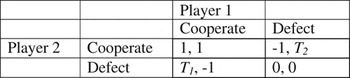
This approach conflates two different reputations that may be at stake in repeated interactions and fails to really explain the role of consent. First, and most fundamental, is a reputation for cooperativeness, or overall propensity to cooperate across different issue areas. A state tends to be cooperative if it often has preferences that make cooperation more attractive, and if it tends to care so strongly about the future that it is willing to look past short-term temptations to defect. For instance, consider the game illustrated in Figure 1. If both players defect, they get a payoff of zero, representing a lack of international cooperation. If both players cooperate, they get a payoff of 1, indicating the joint gains to be had from cooperating. If one side cooperates and the other side defects, the co-operator loses 1 and the side that exploits the other side’s cooperation gets a payoff of T, for the temptation to defect. The higher a state’s temptation to defect, T, the greater incentive it has to defect. States with low values of T, therefore, have more cooperative preferences than states with high values of T. States may be uncertain of each other’s value for T, and consequently uncertain if they face a state that might be willing to cooperate or one that is likely to defect.Footnote 1
The cooperation game.

Second, is a reputation for honesty, or in this context, cooperating if one has promised to do so. States with a reputation for honesty abide by their commitments. If they say they will cooperate, they are very likely to do so. If they say they will not cooperate, they are likely to defect. Most importantly, they do not promise to cooperate in order to persuade another state to cooperate, and then defect, hoping to exploit their gullible partner. It is the reputation for honesty that is at stake in international legal contexts where states give their word that they will behave in a certain fashion. But their reputation for cooperativeness is at stake regardless of what they say about their behavior. If a state promises to cooperate and does so, its reputations for both cooperativeness and honesty will be improved, or if they are already high then they will at least not be diminished. If a state does not promise to cooperate but cooperates anyway, then its reputation for cooperativeness will be improved, but not its reputation for honesty.Footnote 2 If a state does not promise to cooperate and defects, it’s reputation for cooperativeness will decline even though it never promised to cooperate, but its reputation for honesty will be unharmed. Finally, if a state promises to cooperate and defects then its reputation for both honesty and cooperativeness will decline.
A state’s propensity to cooperate, or T payoff in Figure 1, may differ from issue to issue. The temptation to defect may be strongly correlated in related issues, and less highly correlated in unrelated issues. For instance, in the 1970s, Soviet violations of SALT I, such as the Krasnoyarsk radar, should have given western observers pause about the Soviet disposition to cooperate over less-observable arms control treaty obligations, such as the Biological Weapons Convention. Indeed, we discovered after the Cold War that the Soviets accelerated their offensive biological weapons research program even as they promised to eliminate it. Other issue areas will be less highly correlated. US violations of Cambodian neutrality during the Vietnam War were not taken as indicative of uncooperative preferences in relation to relations with Europe. The more highly correlated the issues, the more failure to cooperate in one issue harms one’s reputation for cooperativeness with respect to the other. Thus, failing to cooperate in one issue will harm any effort to gain cooperation in related issues, regardless of whether any treaty has been signed.
States care fundamentally about the cooperativeness of other states. If another state is cooperative, one can cooperate with it even if it (oddly) lies and says it plans to defect when it intends to cooperate. It is cooperativeness, and beliefs about cooperativeness that make cooperation possible. So what value does consent to legal obligations have in promoting international cooperation? It can have value if it either communicates information about preferences or alters preferences over cooperation. It could communicate information about preferences in two ways, either as cheap talk or as a costly signal. First, if there is uncertainty about whether a group of states is cooperative enough to cooperate in a particular issue area, and if the states have a reputation for honesty, signing a treaty can work as a cheap talk mechanism that communicates that the parties do wish to cooperate over the issue at hand.Footnote 3 Cheap talk would normally be ineffective in one-shot games of this kind, because uncooperative types would have an incentive to signal that they have cooperative preferences in order to gull the other state into cooperating and providing an easy target for exploitation. For cheap talk to work, the game must be repeated so that states have an incentive to honestly reveal when they have uncooperative preferences, so that when they say they have cooperative preferences they will be believed. Lying in the present makes one’s subsequent communications suspect. A reputation for honesty is therefore valuable because it enables cheap talk communication about preferences over cooperation to be credible.
Second, signing and especially ratifying a treaty can function as a costly signal of states preferences if there are reasons why an uncooperative type would find it more costly to sign or ratify the treaty than a cooperative type. For instance, if a treaty requires diplomatic recognition of an adversary that a hardline section of the population still rejects, then signing it can signal that the hardliners have been marginalized, so preferences are more cooperative. The 1979 Camp David accords may have had such an effect for Egypt and Israel. Note that costly signaling is not dependent on a reputation for honesty. The costs are paid upon signing, and costly signaling can work in a one shot game. Neither repetition nor reputation is needed for treaties to serve as costly signals of cooperative preferences.
Finally, if signing or ratifying a treaty actually alters the payoffs, by adding an additional cost for violating an agreement, then it can act as a commitment mechanism, turning borderline non-cooperative types into cooperative types (lowering T) and so fostering greater cooperation. An example here would be domestic ratification. If ratification by a domestic legislature writes a treaty into domestic law, it simply becomes more costly for an executive to renege on it later. Once again, altering preferences towards cooperativeness has nothing to do with a reputation for honesty. Commitment mechanisms work in one-shot games and so need no reputational backing.
Therefore, a reputation for honesty is important because it enables cheap talk communication about preferences over cooperation. The degree of importance of a reputation for honesty depends on a state’s reputation for cooperativeness. States that have a very bad reputation for cooperativeness can gain moderately from a reputation for honesty. Such states are believed to be generally uncooperative, so states will usually avoid cooperating with them. However, if such a state were believed to be honest, on the rare occasions in which it is more cooperatively minded, it would be able to signal that and establish cooperation with other states. The value of this option would be moderate, however, because of the rarity of the cooperative disposition. If a state had a strong reputation for cooperativeness, its value for a reputation for honesty would be low. This is because other states would believe it to be positively disposed to cooperation in the first place, and would not need additional reassurance to this effect. Since they would be willing to cooperate anyway, the benefit of a reputation for abiding by specific commitments would be limited. A state with a middling reputation for cooperativeness can really benefit from a reputation for honesty in abiding by commitments. In this case, other states are uncertain whether the state is going to be cooperative over a certain issue, so the additional information provided by a credible communication could actually tip the balance between being unwilling to cooperate to being willing to. Therefore, it is states that may or may not be willing to cooperate that most benefit from a reputation for honesty, because such a reputation enables them to signal their preferences, and get cooperation going if indeed they are disposed to cooperate.
How does all this affect our appreciation of Guzman’s discussion of international law? Guzman speaks generally of the reputational ‘payoff’ of abiding by a commitment to an international legal obligation. This discussion allows us to unpack exactly what this benefit is and when it is valuable. The reputational payoff is the ability to credibly signal through cheap talk that one has cooperative preferences in future issues that are uncorrelated with the present issue, so that one’s mere behavior today will not be sufficiently informative of one’s future preferences. This is a more limited and precise conception of the role of reputation than Guzman conveys. It also helps clarify the role of uncertainty and reputation. Guzman argues that uncertainty about preferences reduces the value of reputation (Guzman, Reference Guzman2008: 97), because states will be uncertain if another state defects because of its preferences over the issue at hand or because it does not value reputation. In fact, uncertainty about preferences is what makes a reputation worth having in the first place. If there were no uncertainty about preferences, there would be no point in attempting to acquire a reputation for honesty, since everyone would already know whether or not a state has cooperative preferences in any given issue area, and hence whether or not it would be a suitable cooperation partner.
This discussion also provides a more unified framework for thinking about treaty law vs. norms and CIL. If norms and CIL arise from observed behavior without explicit commitments, then the reputation for cooperativeness would still be engaged, as discussed above. States that act uncooperatively in a certain issue will acquire a reputation for uncooperativeness that extends to issues that are correlated with it. It also points the way towards a theory of why the ability to make commitments is valuable, and when this ability is sustainable in equilibrium.
Inside the state
Perhaps the biggest mismatch between Guzman’s book and current international relations theory results from his decision to remain at the state level of analysis rather than consider domestic politics. This step debars him from taking advantage of the substantial literature that has arisen in the past 15 years on how domestic audiences condition the behavior of state leaders, how democracies behave differently from non-democracies, and how domestic institutions like legislatures and courts interact with national decision-makers, their foreign counterparts, and international law. Democracies have been shown to rarely, if ever, go to war with each other, to fight better when they do fight, to make firmer alliance commitments, and to signal their preferences and intentions better in international conflicts and crises.Footnote 4
Legislatures in democracies play a crucial role in signaling state preferences and in making international commitments.Footnote 5 Ratification, after all, forms the basis for the distinction between hard and soft international law. Here Guzman’s state centrism leads him astray, as he argues that the difference between treaties that are ratified and soft law that is not, is a matter of cheap talk, akin to using different colored paper for the document (Guzman, Reference Guzman2008: 59). While it is possible that states differentiate between certain forms of agreement via cheap talk mechanisms, domestic ratification is clearly not cheap talk. Ratification secures the consent of another political institution, the legislature, often of political parties beyond the executive’s, and writes the agreement into domestic law where it can be enforced by domestic courts. All these factors raise the costs for subsequent executives, and for the same executive, for that matter, to act contrary to the treaty beyond the international reputational consequences (Lipson, Reference Lipson2005). Ratification, therefore, goes beyond cheap talk and even costly signaling to act as a commitment device, altering future payoffs to make certain courses of action more costly to pursue for future leaders. The contrast with authoritarian regimes with rubber stamp parliaments is clear. Soviet ratification of an agreement during the Cold War had much less meaning than US ratification of the same agreement, since no proposal of the Politburo could meet with anything other than enthusiastic acceptance.
Another issue where delving below the state level appears mandatory is to understand the role of international lawyers. A prominent aspect of international law is the existence of a well-paid cadre of experts that study these rules. Even more remarkably, states consult these experts and modify their behavior based on their writings. The question then becomes, not why states obey international law, but why states obey international lawyers. If a US President wants to invade a certain country, why bother asking some State Department lawyer whether it is legal or not, why not just form his or her own opinion? Some answers can be found in the literature on expertise, advice, and cheap talk. Because the world and the rules themselves are complex, uncertain, and subject to interpretation, time must be expended in order to form opinions about the legality of a contemplated act. A President’s time being more valuable, he will not find it expedient to study the legality of the issue as thoroughly as the lawyer. The lawyer therefore, probably, has a better estimate of whether the contemplated act is legal, and hence will be perceived by other states to be legal. For instance, if preemptive war is justified to counteract an imminent attack, then how soon is imminent and how much of an attack is required to justify war? Therefore, states will need to retain legal experts and modify their behavior in accordance with their scribblings, because the world and the law are too complex and uncertain to be transparent to decision-makers.
However, the lawyer may have his or her own biases, which may slant the advice given. A dovish lawyer will err on the side of a declaration of illegality, so hawkish presidents will want hawkish lawyers (Calvert, Reference Calvert1985). States will also want to retain lawyers to persuade others of the legality of their actions, as part of an effort to gain political support. Lawyers that share a leader’s point of view will be useful here too, as the Bush Administration Department of Justice legal opinions on the treatment of prisoners captured in Afghanistan, torture, and domestic surveillance in the US attest. However, if the lawyer is seen as merely a spokesman for administration policy, he or she would lose credibility with the intended domestic and international audiences and fail to alter anyone’s opinion of the legality of administration conduct.
Beyond ratification and the role of lawyers, a host of issues relating to international law can hardly be understood without reference to domestic political actors. In the World Trade Organization context, what issues do governments attempt to litigate, what industries do they attempt to protect, why do they advance claims and then drop them before trial, why are industries that are powerful enough to secure protection before a tribunal ruling stripped of protection if the tribunal rules against them, etc. Guzman’s primary concern, compliance, is also being investigated in the context of domestic politics; international agreements can generate distributional benefits for constituencies that will then support national compliance (Dai, Reference Dai2005). While international law arose in a state centric world, its development and workings today are strongly conditioned by domestic politics.
Multilateral contexts
Guzman does discuss multilateral interactions, arguing that multilateral settings make punishment difficult (see Thompson’s response for a critique). I argue however, that he misses two important aspects of multilateral contexts. First, when some states get together and set up a multilateral treaty, this alters the information context for other states whether they like it or not, and may serve to reveal information that they would have preferred to keep ambiguous. Second, in multilateral treaties, a state’s preferences over whether to join or not depend on the number of other states that join, which can lead to interesting tipping dynamics that are often observed.
First, when a group of states establishes a multilateral treaty and invites others to join, they effectively ask them for a statement of whether they intend to comply with its terms or not. In this case, a decision to not join is tantamount to an announcement that one intends to violate the treaty, especially as more and more other states join. In the case of the Nuclear Non-Proliferation Treaty, the number of non-signers dwindled over time until it became precisely the number of states with non-allowed nuclear weapons programs (Israel, India, and Pakistan). Not joining enables one to preserve a reputation for honesty; we think of Israel as more honest than Iraq, for instance, which signed the NPT but had a covert nuclear weapons program in the 1980s. But one’s reputation for cooperativeness does decline, and hence the behavioral implication is similar; the state reveals that it has non-cooperative preferences on the issue and will likely defect, leading other states to defect on that and related issues.
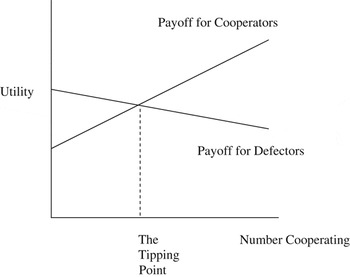
Finally, in multilateral contexts, the number of states cooperating can affect the payoffs for cooperation and defection. This dynamic is explored in the tipping model, illustrated in Figure 2. Tipping models are n-person games in which the payoffs for cooperation and defection depend on how many others are cooperating and defecting, such that the payoff for cooperating rises with the number of other cooperators (Schelling, Reference Schelling1978). In the canonical setup, the payoff for defection exceeds the payoff for cooperating if no or only a few others cooperate, while if many or all cooperate then cooperation beats defection. In between is a tipping point, at which the payoffs for cooperation and defection are equal. Get over the tipping point and you are on a glide path to full cooperation. Different actors may have different tipping points, with more enthusiastic cooperators cooperating early, helping others reach their tipping points (Karklins and Petersen, Reference Karklins and Petersen1993). Cooperation can also get stuck if some actors are willing to cooperate but a hard core of remaining defectors will not cooperate even if all the others do.
The tripping model.

Multilateral treaties and CIL may be heavily influenced by tipping dynamics. For instance, a state may not consent initially to the treaty, but once it gets past the tipping point it will have an interest to cooperate nonetheless. As with CIL, it may even be that no one has to explicitly negotiate or agree to the rule; if enough states are following it then you want to as well. One could argue that the diplomatic system as a whole provides large positive network externalities for joiners in terms of increased information flows; benefits that only increase the more other states join the system.
Of course some issue areas feature reverse tipping effects; that is, the more people cooperate, the greater the incentives to defect. Economic sanctions are one example, where if almost everyone embargoes a certain state, the few violators stand to make a lot of money. Environmental issues are another, where if few others pollute, then pollution is relatively costless, whereas it become more costly the more others pollute. Thus, careful examination of the specific type of externalities involved in each issue is needed to determine if it is subject to tipping dynamics, in which case cooperation may propagate outward from small groups, or reverse tipping dynamics, in which case broad participation from the outset may be needed.
Conclusion
Guzman’s book will help shape the agenda for future research for many years. By laying out a systematic case for understanding international law from a rational choice perspective, he brings together two formerly disjoint theoretical realms and the collision will undoubtedly prove fruitful. The book illuminates many issues related to why states comply with international agreements and why they design them the way they do. Subsequent scholarship will explore further the paths laid out here, and the ones not taken, to understand how international law affects cooperation, how it interacts with domestic politics and how states cope with the inherited body of international law, and deal with multilateral settings.