Introduction
In some countries which are badly affected by the epidemic, a large percentage of all orphaned children – for example 74% in Zimbabwe and 63% in South Africa – are orphaned due to acquired immune deficiency syndrome (AIDS). Loss of parents permeates all aspects of a child's life and often marks the beginning a drastic change in their lives. Prior work has highlighted that children orphaned by AIDS are at risk for a range of adjustment difficulties including emotional problems (Cluver et al. Reference Cluver, Gardner and Operario2007; Doku, Reference Doku2010; Govender et al. Reference Govender, Reardon, Quinlan and George2014), behavioural difficulties (Delva et al. Reference Delva, Vercoutere, Dehaene, Willems, Temmerman and Annemans2005; Doku, 2009), lower self-esteem (He & Ji, Reference He and Ji2007; Kirkpatrick et al. Reference Kirkpatrick, Rojjanasrirat, South, Sindt and Williams2012), anxiety (Rotheram-Borus et al. Reference Rotheram-Borus, Weiss, Alber and Lester2005), conduct problems, suicide ideation, post-traumatic stress disorder (Cluver et al. Reference Cluver, Gardner and Operario2007), delinquency problems (Nyamukapa et al. Reference Nyamukapa, Gregson, Lopman, Saito, Watts, Monasch and Jukes2008; Cluver et al. Reference Cluver, Orkin, Gardner and Boyes2012), educational and sexual risk (Cluver et al. Reference Cluver, Orkin, Boyes, Sherr, Makasi and Nikelo2013) and residing in less supportive environments (Braitstein, Reference Braitstein2015; Doku et al. Reference Doku, Dotse and Akohene2015).
Most of these studies, however, were unable to establish if the AIDS-related cause of death of parents confers effects additional to those of parent-bereavement because they compared the plight of the so-called AIDS orphans with non-orphaned children only without a comparison group of children orphaned by causes other than AIDS (Delva et al. 2005). Furthermore, the evidence almost entirely came from urban towns in Africa with high human immunodeficiency virus infection (HIV)/AIDS prevalence (the so-called hardest-hit countries). The current paper addresses the bias of HIV/AIDS-affected children literature towards highly prevalent countries and differs from earlier work in many ways. First, the present paper focused on children affected by HIV/AIDS in a low- or moderate-prevalence country. Second, the geography of the HIV/AIDS infection is changing rapidly and research must keep to this flow. Ampofo et al. (2014) and UNAIDS (2006) both stated that in Ghana antiretroviral therapy (ARVT) is available but it is not readily accessible as costs remain prohibitive and unaffordable even with government subsidies. Currently only 5% of people that are in need of ARVT have access to it (Tenkorang & Owusu, Reference Tenkorang and Owusu2010; Ampofo et al. Reference Ampofo, Nyarko, Asare, Antwi and Essah2014).
Unfortunately, there is limited and scanty work on HIV/AIDS-related stigma in Ghana (Mwinituo & Mill, Reference Mwinituo and Mill2006; Ulasi et al. Reference Ulasi, Preko, Baidoo, Bayard, Ehiri, Jolly and Jolly2009). It is, however, reasoned that because HIV/AIDS prevalence is low in Ghana and it is mainly transmitted through heterosexual affairs, this could increase community intolerance of persons with HIV/AIDS and hence place high stigma on these few people and the children of their families. In these instances of high stigma, AIDS orphans and children living with HIV/AIDS-infected adults in Ghana could feel more isolated and distressed. Things would seemingly be different in the hardest-hit countries or in Asia where transmission is mainly through poverty-driven blood donation or transfusion. This is another reason why study on these children in Ghana is much needed.
Furthermore, most studies collected data from either the affected children or their caregivers. The current study is the first elsewhere to focus on reports from multiple informants (children and their caregivers). This strategy increases the validity and reliability of variables of interest and also captures important information about contextual effects that may have implications for interventions (Lochman, Reference Lochman2004). Because child and caregiver reports could account for unique variances in predicting relevant child outcomes (Ferdinand et al. Reference Ferdinand, Hoogerheide, van der Ende, Heijmens Visser, Koot, Kasius and Verhulst2003), the findings in this paper reflect more accurate child behaviours across settings that could be generalized. The study employed a battery of widely used standardized scales that are culturally sensitive to assess symptoms of common mental health disorders.
Method
Research design and setting
The study was given ethical approval by the institutional Research Ethics Review Boards of the University of Glasgow and the Research Unit of the Ghana Health Service. The details of the study's methodology including the study settings, participants and sampling have been described elsewhere (Doku et al. Reference Doku, Dotse and Akohene2015). But briefly, the present study was designed and conducted as a community-based cross-sectional survey design utilizing questionnaires. The study was conducted in the rural and urban areas of the Lower Manya Krobo District of Ghana. An orphan in the present study refers to a child between 10 and 17 years who is bereft of at least one parent to death. The term ‘orphaned and vulnerable children’ (OVC) is used to identify a child who is 17 years or below and has either lost at least a parent or is living with HIV/AIDS-infected parents whilst ‘AIDS-orphans’ is defined as children who have lost at least one parent to AIDS. The latter term is used interchangeably as children orphaned by AIDS or AIDS-orphaned children.
Measures
Mental health problems
These were assessed using the Strengths and Difficulties Questionnaire (SDQ) which has been well validated against other screening instruments and against psychiatric diagnosis (Goodman et al. Reference Goodman, Meltzer and Bailey2003). It is a 25-item self-report and relevant informant screening instrument for investigating common child mental health problems. The SDQ is an internationally recognized measure, translated into 62 languages and used already in 40 countries. It contains five subscales, namely, emotional problems (depression and anxiety), conduct problems, hyperactivity, peer relationships problems and prosocial behaviour. The present study found Cronbach's α reliability coefficient of 0.76 for the overall scale, and 0.73, 0.64, 0.82, 0.68 and 0.83 for the subscales emotional problems, conduct problems, hyperactivity, peer problems and prosocial behaviour, respectively.
Demographics
A number of sociodemographic factors such as age, gender, family size, number of other minors living at home, number of changes in residence and age at which children were orphaned (where applicable) were measured using items from the Demographic and Health Survey Questionnaire (International Household Survey Network, 2013).
Study procedures
There was a pilot study preceding the present study to validate the study instruments in the research setting. The main surveys worked with four categories of households: ‘AIDS-orphaned households’ (those that contained orphans only); ‘other orphan households’ (those containing orphans from causes other than AIDS); ‘HIV/AIDS-infected caregiver households’ (those containing a caregiver infected with HIV/AIDS); and ‘non-orphan households’ (those containing no orphaned children). Participants were first screened for study eligibility. Written informed assents and consents were then obtained from both the participants and caregivers, respectively. Upon assenting/consenting, participants completed the survey questionnaires separately that followed the steps described by Thomas (Reference Thomas2006). The entire assessment inventory took about 30–45 min to complete. ‘Caregiver’ was defined as the adult in the household who primarily cared for the child participant and was not necessarily a biological parent. Caregiver is used interchangeably as parent in this study. To identify whether children lost one or both parents from AIDS, a verbal autopsy was used (Lopman et al. Reference Lopman, Cook, Smith, Chawira, Urassa, Kumogola, Isingo, Ihekweazu, Ruwende, Ndege, Gregson, Zaba and Boerma2010) because caregivers were often unaware of or did not wish to disclose the parental cause of death and there was difficulty in obtaining accurate death certificates.
Statistical analyses
The analyses followed five key steps. First, the relationships between the various sociodemographic factors and the continuous psychological outcomes were examined using independent t tests, Pearson correlations, χ2 and analysis of variance (ANOVA). Second, differences between the OVC groups on sociodemographic factors were also established using ANOVA and χ2. Third, linear regressions were performed to develop models that investigate the association between vulnerability types and psychological outcomes controlling for relevant sociodemographic factors. This was done independently for children orphaned by AIDS, other-orphans and living with HIV/AIDS-infected parents compared with non-OVC for each of the psychological outcomes. Inclusion of sociodemographic co-factors into the models was guided by their significant association (p < 0.05) with the psychological outcome or significant differences between the OVC groups. Analyses of data from children and caregivers present similar results and so the present paper reports only the findings from the children. Fourth, proportions of children scoring within the clinical range using standardized recommended clinical cut-off scores for each of the psychological outcome scales were investigated. Finally, paired-sample statistics and Pearson correlations were used to establish whether reports of young people differed from those of their parents and caregivers.
Results
Sociodemographic characteristics of participants (Table 1)
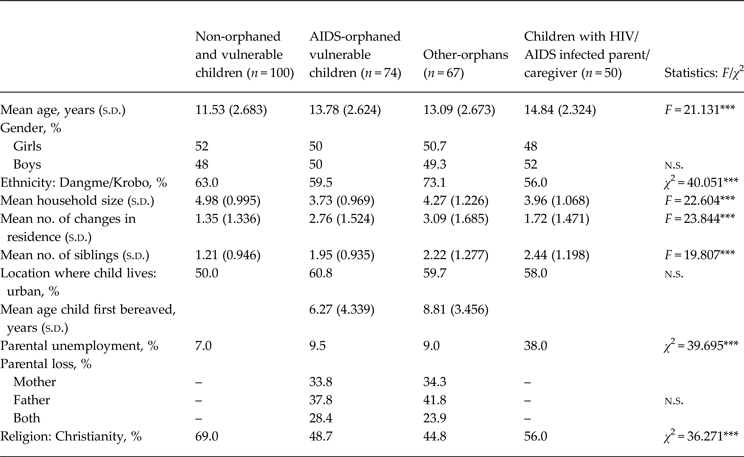
The majority of the children (81.8%) were currently attending school. Approximately 58% of caregivers had no more than senior secondary-level education. The children had a mean age of 13.03 (s.d. = 2.87) years, with an age range of 10–18 years, there were 51% female, and ethnic origin was 63% Krobos. There was an average of 4.3 people living in each household. Overall, 62% of all children had moved two or more times. The majority of caregivers (62%) worked mainly in farming, driving, trading or as artisans whilst 13% of them were unemployed. The proportion of households with unemployed parents was higher among children living with HIV/AIDS-infected parents (38%) than AIDS-orphans (9.5%), other-orphans (9%) and non-orphaned children (7%). The sociodemographic statistics of the participants are summarized in Table 1.
Sociodemographic characteristics of the participants

AIDS, Acquired immune deficiency syndrome; HIV, human immunodeficiency virus infection; s.d., standard deviation; n.s., non-significant.
*** p < 0.001.
Association between sociodemographic factors and psychological outcomes
Age was positively associated with scores on all the psychological variables (p < 0.001) except for pro-social behaviours where the correlation was negative (p < 0.001). Similarly, smaller household size was correlated with higher depression, delinquency, conduct problems, peer problems and hyperactivity. Girls were higher on depression than boys (p < 0.001). Furthermore, the age at bereavement was positively correlated with depression, conduct problems, peer problems and hyperactivity. Unadjusted regression analyses indicated a strong association between the various vulnerability groups and psychological outcomes.
OVC's mental health outcomes when controlling for relevant sociodemographic factors (Tables 2 and 3)
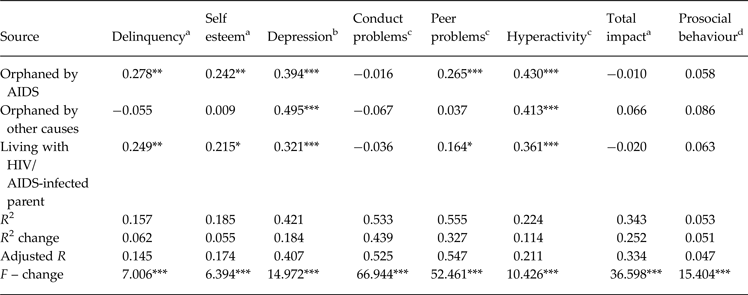
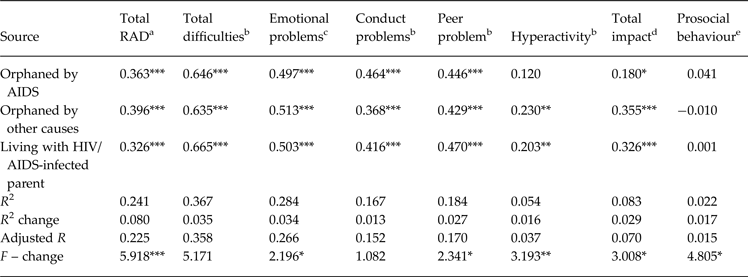
Multivariate regression analyses of the children's self-reports indicate that orphanhood by AIDS, orphanhood by other causes and living with HIV/AIDS-infected parents were all, independently, significantly associated with total difficulties in the adjusted model (Table 2) that controlled for relevant sociodemographic factors. Results of the analyses of the subscales of the SDQ revealed a similar pattern except for prosocial behaviour where there were no significant associations between the OVC groups and self-reported prosocial/helping-out behaviours in both the unadjusted and adjusted models. Similar results were obtained from the caregivers’ reports (Table 3).
Adjusted models on associations between orphanhood by AIDS, orphanhood by other causes, living with an HIV/AIDS-infected parent, and psychological outcomes based on children's self-reports

AIDS, Acquired immune deficiency syndrome; HIV, human immunodeficiency virus infection.
a Adjusted model controls for age, household size, no. of changes in residence.
b Adjusted model controls for age, household size, no. of changes in residence, gender, no. of children at home, presently in school.
c Adjusted model controls for age, household size, no. of changes in residence, no. of children at home.
d Adjusted model controls for age.
*p < 0.05, ** p < 0.01, *** p < 0.001.
Adjusted models on associations between orphanhood by AIDS, orphanhood by other causes, living with an HIV/AIDS-infected parent, and psychological outcomes based on caregivers’ reports

AIDS, Acquired immune deficiency syndrome; HIV, human immunodeficiency virus infection; RAD, reactive attachment disorder.
a Adjusted model controls for age, household size, no. of changes in residence, presently in school.
b Adjusted model controls for age, household size, no. of changes in residence, no. of children at home.
c Adjusted model controls for age, household size, no. of changes in residence, gender, no. of children at home, presently in school.
d Adjusted model controls for age, household size, no. of changes in residence.
e Adjusted model controls for age.
* p < 0.05, ** p < 0.01, *** p < 0.001.
Applying recommended the SDQ self-report clinical cut-off for overall psychological distress in the sample, 72% of children living with HIV/AIDS-infected parents, 76% of children orphaned by AIDS, 49% of children orphaned by other causes, and 28% of non-orphaned children met the criteria for ‘likely psychiatric diagnosis’.
Cross-informant agreements (Tables 4 and 5)
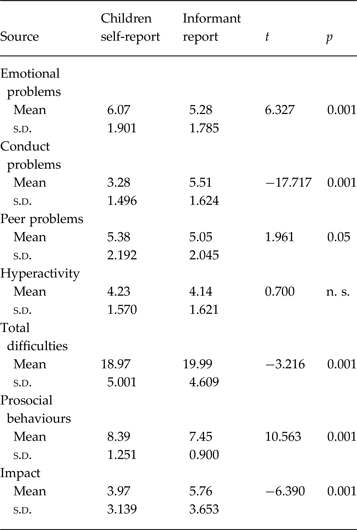
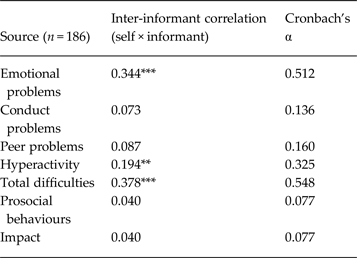
The inter-informant correlations for the SDQ scores in the present sample were low (Table 5). There were significant positive correlations between children's self-reports and caregivers’ accounts on total difficulties, emotional problems and hyperactivity. Compared with children's self-reports, caregivers reported significantly higher total difficulties, conduct problems and impact (all at p < 0.001) but lower prosocial behaviours (p < 0.001). However, children's self-reports indicated significantly higher depression and peer problems than caregivers’ scores (Table 4).
Comparisons of Strengths and Difficulties Questionnaire scores across respondents using the t test statistics (n = 286)

s.d., Standard deviation.
Cross-informant Pearson correlations for Strengths and Difficulties Questionnaire scores for children and adolescents in the sample

** p < 0.01, *** p < 0.001.
Discussion
Overall, depressive symptoms, peer problems, delinquency, self-esteem and future orientation were all higher amongst both AIDS-orphaned children and those living with HIV/AIDS-infected parents than other orphaned children and non-OVC. This suggests that children living with HIV/AIDS-infected parents, who face the potential of losing their parents, and children orphaned by AIDS are at statistically equal, heightened risk of psychological difficulties compared with orphans of other causes. The clinical cut-offs applied in the present study indicated very high proportions of likely psychiatric disorders in both externalizing and internalizing domains. Although it may be contested that the recommended clinical cut-offs were not validated for the Ghanaian population, the observed proportions are far above expectations. Goodman et al. (Reference Goodman, Meltzer and Bailey2003) demonstrated that these clinical cut-offs perform very well in most cultures. These indicate that there is likely to be a high prevalence of psychiatric disorders among OVC within the study area (Kirkpatrick et al. Reference Kirkpatrick, Rojjanasrirat, South, Sindt and Williams2012; Cluver et al. Reference Cluver, Orkin, Boyes, Sherr, Makasi and Nikelo2013; Govender et al. Reference Govender, Reardon, Quinlan and George2014).
The findings support a growing global literature, largely quantitative self-reports and qualitative, that children orphaned suffer heightened internalizing problems such as depression, fear, suicide ideation, anxiety, anger and hopelessness than children who do not experience AIDS in their families (Cluver et al. Reference Cluver, Gardner and Operario2007; He & Ji, Reference He and Ji2007; Nyamukapa et al. Reference Nyamukapa, Gregson, Lopman, Saito, Watts, Monasch and Jukes2008; Doku, Reference Doku2009, Reference Doku2010; Cluver et al. Reference Cluver, Orkin, Gardner and Boyes2012, Reference Cluver, Orkin, Boyes, Sherr, Makasi and Nikelo2013; Govender et al. Reference Govender, Reardon, Quinlan and George2014). The high levels of conduct problems found in the present study as reported by informants are worrying when the low crime and non-violent context within which the present sample was drawn is considered.
The present study reported none to low inter-informant agreement on the SDQ scores. The non-significant correlations between adult reports and child self-reports indicate that children's self-reports are not providing the same data as adult informants, and therefore both perspectives are important (Achenbach et al. Reference Achenbach, McConaughy and Howell1987). This suggests that emotional and behavioural problems probably exist as situation-specific variables that may not be easily compared across different informants even within the same setting (Cluver et al. Reference Cluver, Orkin, Boyes, Sherr, Makasi and Nikelo2013).
In this study, the informants rated children higher on scales assessing externalizing problems compared with youths themselves, whereas youths reported higher internalizing symptoms about themselves than informants did about them. This finding should be taken with caution as it points to a two-fold interpretation. It is either that the children in the present study were less able to identify their individual behavioural problems and deficits that were rightly identified by informants or that the informants exaggerated these symptoms in the children (Synhorst et al. Reference Synhorst, Buckley, Reid, Epstein and Ryser2005). Consequently, an important implication for health service workers and researchers is that no one should place more value on one information source compared with another but rather see both self-reports and informant reports as complementary sources offering vitally differing perspectives of psychological symptoms within the same setting (Myers & Winters, Reference Myers and Winters2002).
Limitations
The first limitation of this study is that all the data reported in this present study were based on self-reporting by both children and their parents or caregivers. With self-reported data, the shortcomings are related to self-selection, recall bias and the social desirability effect. The second limitation is related to the nature of cross-sectional study designs. The direction of any causation is problematic in cross-sectional associations. Third, the study population included only samples from one district in Ghana. The findings of this study, therefore, may not be generalizable to other settings. Future research needs to recruit samples from other districts. Finally, the findings should be interpreted cautiously as assessments of mental health outcomes were not diagnostic but pencil-and-paper measures. These measurement tools do not identify specific mental disorders but symptoms of psychological illnesses. Despite these limitations, the present study is the first to use multi-informant techniques within an epidemiological framework to demonstrate that both children orphaned by AIDS and those living with HIV/AIDS-infected parents suffer higher internalizing problems compared with other children. This strategy increases the validity and reliability of the constructs measured.
Conclusion
Findings from this study speak to both theoretical and practical issues of current importance. At a theoretical level, we have provided good evidence for the plausibility of viewing the effects of HIV/AIDS on children as starting early in life before they are orphaned. At a practical level, one implication of the present findings is that efforts aimed at improving the psychological wellbeing of AIDS-affected children should be a holistic approach that is applicable to all children affected by AIDS and not the usual ‘selective action’ targeted at only AIDS-orphaned children (Meintjes & Giese, Reference Meintjes and Giese2006). Many have argued that formulating interventions for only AIDS-orphaned children places a tag on these children. Consequently, such interventions are not only recipes for discrimination and stigmatization but also highlight the danger of failed efforts for other vulnerable children affected by the HIV/AIDS pandemic in our society (Delva et al. 2005; Meintjes & Giese, Reference Meintjes and Giese2006).
Acknowledgements
We are grateful to the Glasgow-Strathclyde Universities Scholarships and the Overseas Research Scholarship, the Parkes Foundation and Brian Rae, former NHS Manager, Glasgow for funding the research fieldwork project.
Declaration of Interest
None.