British dress has been profoundly shaped by the country's two-hundred-year-long colonial encounter with India. This effect is abundantly evident in military dress codes, as in the use of the cummerbund (from the Persian kamarband) as part of mess dress uniforms, for example. But this influence is also widely reflected in the civilian sphere. Whether in particular styles of clothing (such as pajamas), materials (such as muslin), or motifs (such as paisleys), Indian sartorial practices have exercised a significant influence on British fashion. Changes in how Britons dressed therefore offer a useful lens through which to view the role that colonialism in India has played in British consumption and conceptions of fashionability.
At the same time, the playful adoption of exotic Indian fashions remained firmly embedded in entrenched imperial hierarchies. British officers, both in India and after their return home, were readily able to appropriate sartorial traditions of Indian royalty such as certain styles of robes and turbans. Elite Indians, on the other hand, could not participate in these material culture exchanges on equal terms: when Indians adopted European manners of dress, they were harshly censured for subverting markers of political status and social difference. Rather than pointing to syncretism, therefore, the history of India's influence on British fashion must be viewed against the colonial context in which it took place.
A particularly illuminating example of this are jodhpurs, which were not only transposed from India to Britain but have become an iconic visual marker of elite British culture. Jodhpurs are an invention of the colonial period, thought to have originated in northwestern India during the latter half of the nineteenth century. They derive their name from the princely state of Jodhpur in Rajasthan, which was brought under British control in 1818. Originally designed specifically for horse riding, jodhpurs are tight fitting from the ankle to the knee but flared at the hip to provide comfort and mobility in the saddle. They are a variation on churidars (known to the British as “Moghul breeches”), a style of trousers common across the subcontinent, tapering tightly at the ankles and typically worn under a tunic (kameez) or loose overshirt (kurta). Jodhpurs, however, in keeping with their equestrian purpose, are buttoned rather than tied at the waist, made from heavier material (often corded cotton or cotton twill) to prevent chafing, and reinforced at the knee and inner calf. They also feature the characteristic “wings” of extra material around the hips to allow for freedom of movement before the invention of stretch fabrics.
Jodhpurs (ca. 1899), worn by a sergeant in the New Zealand Mounted Rifles during the Second Boer War. Image courtesy of the Auckland War Memorial Museum.

Jodhpurs have long been associated with equestrian sports such as hunting and polo, which were regarded in both cultures as fitting pursuits for royalty and nobility and served as a common interest and point of contact for British and Indian elites. Variations of polo have been played in many cultures since ancient times to develop and demonstrate skills of horsemanship.Footnote 1 The modern game of polo is believed to have originated in the Himalayan hill states, where it was encountered by British military officers and propagated across the empire. The first club was established in Calcutta, the capital of the British-held territories in India, in 1862. From there “the game spread rapidly amongst cavalry officers and Indian princes, who spent vast fortunes on it to demonstrate their importance within the Raj.”Footnote 2 This “polo cult” that swept across India in the late nineteenth century was so pronounced that some military commanders selected only players as their officers—no doubt to make their unit's team more competitive but also because the lessons inherent in the game were seen as formative.Footnote 3 Alongside horse racing, polo matches became a mainstay of the social calendar of the British elite in India.Footnote 4 The sport also provided an important intersection between the military class and princely rulers. For Indian rulers, the ability to field victorious polo teams was a means of demonstrating wealth, status, and military readiness, as well as personal character.
Polo thus formed an important element in the negotiation of colonial encounters between British and Indian elites. The confluence of British military and Indian regal investments in the sport was particularly significant in the context of post-1857 India, when the Indian princes were increasingly seen as guarantors of stability and instrumentalized to provide a native imprimatur on imperial rule. The regular ceremonial affirmations of this relationship—during the bestowal of British knighthoods on Indian princely rulers and as part of displays of obeisance by these princes at imperial durbars and jubilees—presented a striking admixture of British and Indian rituals. This symbolic continuation between British and Indian displays of kingship, hierarchy, and investiture extended to the shared interest and investments in polo as “the sport of kings.”
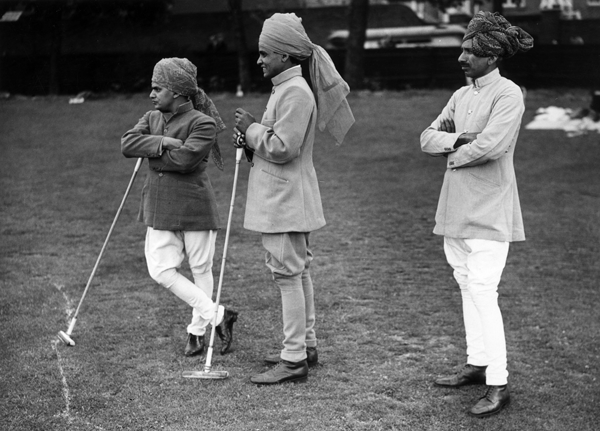
A group of Indian servants watching their masters play polo at Roehampton, May 1939. Image courtesy of Hulton Archive/Getty Images.

The development of a new style of riding breeches better suited to the demands of the sport is generally traced to Pratap Singh of Idar, who served as prime minister and later as regent of Jodhpur during the late nineteenth and early twentieth centuries. Singh was commissioned into the British Indian Army in 1878 and participated in many imperial campaigns, including in Afghanistan, China, Belgium, and Palestine, earning numerous medals and honors for his service. He was also an avid and accomplished polo player; his team won the Indian championship in 1893. The new style of riding breeches sported by his team was quickly adopted by other polo teams in different parts of India and became known as jodhpurs for their purported place of origin. In 1897, as part of Singh's visit for Queen Victoria's diamond jubilee, the Jodhpur polo team toured England to play exhibition matches—the first Indian team to play on British soil. The team's exotic appearance, coupled with its sporting success, prompted high-society tailors across the country to imitate their polo uniforms, including the new style of trousers. Singh's service as aide-de-camp to the Prince of Wales, himself a keen equestrian and trendsetter among the British elite, further popularized jodhpurs among Britain's high society.
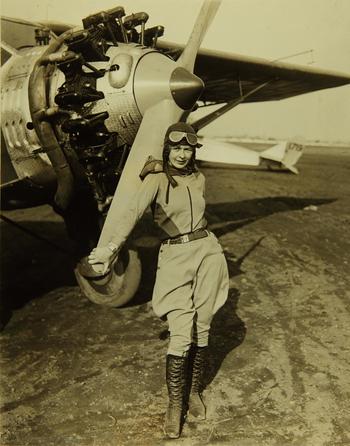
In keeping with polo's history as a military sport, in the early twentieth century jodhpurs made the transition from sporting gear to regular military uniform. Both in Europe and North America, jodhpur trousers became standard issue for mounted troops (first on horseback, later on motorized vehicles), lending the garment an additional air of martial rigor and authority. When worn by the British military in India, they thus became part of the apparatus of colonial authority, which was increasingly concerned with suppressing India's nationalist movement. In other settings, however, jodhpurs could also be deployed as a form of resistance to the prevailing social order. By the 1920s, jodhpurs had become fashionable among progressive women, who saw them as more practical and less normatively gendered than skirts. The American aviation pioneers Elinor Smith and Amelia Earhart were two of many such “modern women” regularly photographed in jodhpur-style trousers.
Aviation pioneer Elinor Smith, known as “The Flying Flapper of Freeport,” April 1929. Image courtesy of the San Diego Air and Space Museum Archive.

If the British appropriated Indian clothing for their own purposes, at the same time they expressed a profound unease about Indians’ embrace of western fashions. Many European accounts of the period describe not just disappointment but stern disapproval of Indian princes who appeared not in the expected oriental splendor of silks, muslins, and jewels but in European-style morning dress.Footnote 5 The late Victorian period saw the apogee of colonial arrogance and racism that was frequently manifested in scathing and derogatory critiques of elite, educated Indians whose patterns of speech, mannerisms, and dress reflected an uncomfortable degree of cultural proximity to their British colonial masters. Sartorial adaptation, imitation, and exchange in the imperial context were a visible form of what Homi Bhabha has termed “colonial mimicry”; but like other forms of cultural borrowing, the stakes and consequences of these exchanges were neither equal nor neutral between colonizers and colonized.Footnote 6 While fashionable Britons indulged in playful experimentation with Indian sartorial norms, Indians, even those of the most elevated status, could not unproblematically adopt the sartorial idioms of their colonial masters.
The intimate entanglements of social, national, and imperial histories are reflected in the material culture produced by colonial encounters and exchanges. Global, “new imperial,” and transnational historiographies have advanced our efforts to enlarge and reconfigure our conceptions of global networks as well as of the consumer and cultural geographies of the colonial period. The history of jodhpurs serves as a reminder that these networks were not open-ended but reflective of, and directed by, inherently and profoundly unequal relationships of power.