On 15 February 1935, the sculptor Alexander Calder writes a letter to Alice Roullier, the chair of exhibitions for the Arts Club of Chicago. The club is exhibiting some of Calder's work, which had previously been at the Renaissance Society, a space affiliated with the University of Chicago. In the letter, Calder – or “Sandy,” as he signed this letter and subsequent ones – thanks the club for covering the cost of shipping his “circus” back to him. Calder had begun his transformation from engineer into artist with the creation a couple of years before of a miniature circus made up of a ringmaster, dogs, strongman, lions, tightrope walkers, horses – all the people and creatures one expected – constructed out of wire, cork, cloth, and wood. Several of these small sculptures he could animate by tugging on an attached thread or flicking a coiled wire, and he brought the whole thing to life with his own voice, the bellowing ringmaster one moment and the roaring lion the next. During his time in Chicago, he performed the circus at the university. The letter also contains a playful drawing of a sculpture from the exhibition at the Arts Club, which if unsold should be given to a friend, and news of a visit to Concord, MA, where “cocktail parties and questions of ‘Are you a Sewer-Realist?’ seem very far away.” Reading the letter one does not suspect it is the first between Calder and the Arts Club, although it is the first in a collection of letters at the Newberry Library that extends from the 1930s until within a few years of Calder's death in 1976.
I begin with this letter and will work my way through the remaining ones. The Newberry houses the records for the Arts Club, and I am working on a public program that is part of the club's centennial celebration. Out of these first interactions in the 1930s will develop a relationship that leads the club to commission Calder to produce an original work for them, one that it still possesses and is highly valued. My task is to figure out how to animate this relationship and bring what is on the page into the world.
This is the third and final program I am doing for the Arts Club's centennial. These programs are a postscript to a series of public history projects, collectively called Pocket Guide to Hell, which I'd intentionally ended nine months before, having done this work for the previous seven years. I feel ambivalent about the Calder program – the final product I later call a “chamber reenactment,” a description I make up moments after it's ended while talking to a member of the audience – since it's different in many ways from what preceded it and because I'm tired of the reenactment form. But, as Calder admits in one letter, sometimes you need the money and sometimes you do work as a favor. Both are true in my dealings with the Arts Club, as they were for him.
On 3 March 1942, the Arts Club sends a letter to Calder and his dealer informing them of the reception of a “bequest for the purchase of a fine arts piece for the clubrooms.” The club would like to commission him to produce an original “mobile” for them. They name a price and also list certain conditions – the sculpture must be free-standing and made of “durable material,” fit within a particular clubroom, and match its color scheme. They enclose a photograph of the room and its measurements. They ask if the artist “can accept this order.” Within three days, Calder writes back that he'd be “delighted to make the mobile” and includes a sketch that is more or less the final product, the focus of my program.
Two things strike me about this exchange: one, the conditions imposed by the Arts Club, which make the mobile seem more made to order than an original creative expression, and two, the swiftness of Calder's response. As I sit there in the library, I am left wondering where his vision of the mobile came from. Was he suddenly struck with inspiration upon receiving the letter from the Arts Club? Was the work a quick throwaway? Did he already have the mobile in mind and did it happily align with the club's desires? In other words, what was the precise point when work on this piece of art began?
I have been asked from time to time how my work on Pocket Guide to Hell began. The idea of me leading interactive walking tours or staging large-scale participatory reenactments seemed at one time as unlikely as Calder making circuses and mobiles. Usually, I am asked this question because I came to Chicago, the focus of this work, to pursue a PhD in English and the tenure-track position certain to follow my degree. I give different answers depending on whether I am speaking publicly or privately. In public, I say it was because, having reached the dissertation-writing stage, I longed for work that kept me out in the world and engaged with a non-academic community. Since I consider this writing partially private, I admit that the work served as a distraction after the end of a relationship. Both answers are true, and one thing is certain: I never had a preformed plan in my head. I started doing and didn't stop until seven years had passed.
In the fall of 2008, I gave my first walking tour. I created the name “Pocket Guide to Hell” for a fake tour company, and it would later be given to the project as a whole; the phrase derives from an observation made by a British labor leader while visiting Chicago at the turn of the twentieth century. At the time I was searching for a way to share with a public some of the research I'd been doing which didn't fit within my academic life; a walking tour seemed like a good way to do so. Not that I'd been on many walking tours that I could use as models or as objects of critique. It all started out very low-key, just a few dates, made up of participants from the university community. Awareness of the tour spread through word of mouth; people outside the university community started inquiring about taking one, and so I added more dates and, later, more tours. I started to play around with the form in an attempt to decenter myself as the guide, the expert, and to make the experiences more interactive and communal. Costumes, props, and music got added. I played with scale – capping some tours at seventy participants, so we became more of a visible procession through a neighborhood where the story being told had been effaced from the built environment. These were guerilla walking tours, but in time they got noticed by the city's cultural organizations, which is how, years later, I end up in the Newberry Library reading through the letters between Calder and the Arts Club.
Readily apparent is how different in appearance and tone a letter is depending upon the writer. Not surprisingly, the Arts Club's letters are typed, formal in language and tone, addressed to Mr. Calder, and signed by the president, Mrs. Alfred P. Shaw. Calder's letters are handwritten, in pencil and in some cases in crayon, playful and funny, addressed to Rue (Mrs. Alfred P. Shaw), and signed by Sandy. I think again of all of the conditions imposed on Sandy in the letter offering the commission. History seems to be repeating itself. The Arts Club wants me to do my thing as part of its centennial but not in the way I normally do it: public, participatory, and collaborative.
The Arts Club wants me to create out of these letters a historical reenactment. I had previously done two for the club. The original idea had been to restage select lectures and performances from over the course of the previous hundred years. The club has had several different homes over the years, and each reenactment would mark a movement in time and space. The club had originally formed as a response to the conservative backlash that had followed the 1913 exhibition of the Armory Show at the Art Institute of Chicago and had two goals: one, to provide an exhibition space for modern art and performance, and two, to promote the “mutual acquaintance of art lovers and art workers.”Footnote 1 A hundred years later, the members were a graying lot of mostly “art lovers” who favored more traditional work. The first two reenactments aligned with the spirit of my previous work. Creating a program around the Calder letters came with certain conditions.
One was that I didn't get to choose the subject matter. Ever since I started doing walking tours, I had picked the focus of the projects. A cultural institution might ask me to do something with them or for them, but I usually was allowed to select the historical narrative I wished to engage. Giving the walking tours had led to several of these requests to do programming by this or that organization or institution. At first, these requests were just for more walking tours, but then a friend asked if I'd like to do something in her nomadic gallery and community center, which made use of abandoned commercial spaces in her neighborhood. At that moment, she and her collaborators were occupying a former Hollywood Video, which, before that, had been a savings and loan. The building had a vault in its basement, and the anniversary of an infamous Chicago event was approaching. I decided to stage a reenactment.
Like walking tours, I hadn't really given historical reenactments much thought before attempting one. Reenactments of historical events are almost as old as historical events. Ancient Romans and nineteenth-century Englishmen staged them. In the United States, the reenactment form is associated with Civil War battles and living-history villages like Colonial Williamsburg. Artists like Allison Smith and others have drawn inspiration from the impulse to embody past experiences and the material culture – the costumes, props, foodstuffs, etc., that no matter how painstakingly reproduced only approach but never fully reclaim a past – that support these embodiments. While I was puzzled by this impulse and, like Smith, critical of the reenactment form, I did want to think through all of its potential. The walking tours had been fun, but we were only passing through a given story and space. The rootedness of the reenactment – people doing the same things other people had done, on the actual spot where these things had occurred – attracted me.
My first attempt, The Mystery of Al Capone's Vaults, reenacted an ill-fated live television broadcast from 1986. It was silly but allowed me the opportunity to portray Geraldo Rivera. It also allowed me to collaborate with other performers, artists, and fabricators. This would be a key feature of later reenactments that sought to foster collaboration between community organizations and cultural institutions around a shared narrative. I began to think about the reenactment as an opportunity for encounter and convening, for collective storytelling and meaning-making. The form didn't have to be used to tell stories only of war. It didn't have to be populated by enthusiasts who knew the meaning of every medal they wore or the caliber of every rifle they fired. The reenactment could be used to engage the past as if it were a public space, accessible and belonging to all.
Not long after this first attempt, I began working with my new collaborators on the project that gave Pocket Guide to Hell a purpose and direction. It was 2010. Immigration, inequality, trade, terror – issues that impact the contemporary moment – were just as present, particularly in a city like Chicago. To the north of us in Wisconsin, the collective bargaining rights of public-employee unions were under attack, which would later extend to Illinois and other states in the region. These rights and others that had long seemed like givens were in danger of disappearing. But how had these rights come into being? Were they worth fighting to preserve? The reenactment offered a chance to take up these questions collectively by bringing the past into an embodied, situated present.
This second reenactment also brought my academic work, with which I was increasingly losing a connection, into contact with my diversion-turned-side-project-turned-passion. While working on my dissertation, I came across an account of the 1877 national railroad strike written a year after the event by Allan Pinkerton. In the chapters dealing with Chicago, Pinkerton recounts an incident known as the “Battle of the Viaduct,” which occurred less than two blocks from where I was living.Footnote 2 Even though some historians believe thirty people lost their lives in this battle between police and striking railroad workers, even though it represents one of the first instances of pan-ethnic solidarity in Chicago, even though the strike as a whole spurred the rise of labor unions, I'd never heard of the incident before reading Pinkerton's account, which I discovered because of its relevance to my dissertation. No memorial plaque stood on the site. None of my neighbors knew the story. Yet it seemed important in understanding how we'd arrived at our present.
I went to the Newberry just as I would for the Calder project, as I would for so many others. Over the years, I've become quite familiar to the special-collections librarians there and at other institutions. One aspect of academic life I love is archival research. In preparing to reenact the Battle of the Viaduct, which occurred in the yards of the Chicago, Burlington, and Quincy Railroad, I found in the Newberry the employee records for that year, which contained the names, ages, addresses, and fates of all those involved in the strike. Pinkerton's “howling mob” became real people, not so unlike those who live in the neighborhood today. One thing I love about the archive is its openness; it preserves but rarely interprets. The reenactment incorporates some details and excludes others in order for the past to be performed and take on meaning in the present. In the archive, I search for the details that don't fit with the story I'm developing for a given reenactment but seem resonant. In the reenactment these details can serve as tears in the narrative fabric, brief reminders that there is so much that the form can't contain, that all we're doing is playing with the past to make meaning in the present. We always take what we need from the past while leaving the rest behind.
While I am working on the Calder project, I start to fixate on details outside the story I've been asked by the Arts Club to tell. Some of the letters to Calder pertaining to the commission are written by the club's secretary, Isabel Jarvis, while the president, Rue Shaw, is vacationing for the summer. I decide to look into Jarvis's life a bit. The club's records contain nothing on her; after all, she was a mere functionary. The openness of the archive is matched by the capaciousness of the Web. Newspapers from both cities and small towns, scanned and searchable, reveal that Jarvis had attended the University of Chicago, had worked for the Arts Club for over twenty years, and, during that time, developed a somewhat singular hobby – on her vacations, she traveled to rural counties to sketch their courthouses. Over her life, she sketched well over a hundred courthouses collected under the title “Courthouses I Have Seen.” In one newspaper from a small town, I came across a photograph of an elderly Jarvis (she lived to be ninety-six) standing in front of a courthouse and holding up her sketch. She never married. The Smithsonian Institute acquired her drawings in 1973; you can find scanned copies of them on its database. Now what does this have to do with the Calder project? Very little, but it's a thread I follow for as long as I can. And I do include some of her story at a moment when I want to suggest that there were more than the artist genius, Calder, and the wealthy patron, Rue Shaw, involved in the creation of this work of art.
In the reenactment of the Battle of the Viaduct, I made use of the information gathered from the Chicago, Burlington, and Quincy Railroad ledger. For the battle, I recruited twenty-five friends to portray 1877 Chicago policemen, but the “howling mob” was the audience themselves – men, women, and children encouraged to appear in costume or helped along with some hats, vests, and mustaches of our providing. We also gave certain participants red and black armbands to wear; we didn't explain the significance when we distributed them. At the conclusion of the battle, people wearing red armbands received specific identities of striking workers who'd died in the incident; those wearing black armbands learned that they were workers later blacklisted and driven further into poverty.
This reenactment marked a turning point for the Pocket Guide to Hell project as a whole. Several future reenactments had moments from labor history as their focus – the 1886 Haymarket bombing and the 1915 Parade of the Unemployed, to name just two. On the one hand, they acknowledged the tendency to reenact moments of martial strife and the form's understandable attachment to spectacle; on the other, these particular projects reanimated struggles different to those between two more or less evenly matched forces, on sites where such struggles were not memorialized. There are plenty of signs and interpretive markers telling you when you're at Gettysburg or Antietam, not so with the Battle of the Viaduct; Haymarket is a notable, if contested, exception, as I'll explain. These past struggles were relevant to the contemporary moment; they'd played a part in producing the present we all inhabited and could perhaps help in imagining potential futures. They served as both warning and inspiration.
As we discovered, participants enjoyed taking an active part in the telling of the story. For the battle, we outfitted both sides with squirt guns while the “howling mob” received additional foam bricks and rocks. Individuals portraying Allan Pinkerton and labor leader Albert Parsons presented very different interpretations of the event. After learning from the narrators about the larger 1877 strike and Chicago's role in it, the two sides went at each other for the approximate time that the original battle lasted, fifteen minutes. It was short and chaotic, deliberately so. The mob chased the police away from the viaduct to a predetermined point; we were supposed to end there, but the two sides, entirely by their own volition, decided to violate history and go at each other again. And that was fine: participants had gotten into the story and had felt a connection with it; they were making it their own. Something similar would happen during the reenactment of the bombing in Haymarket Square.
As I sit in the Newberry's reading room, shifting through the letters between Calder and the Arts Club, I am trying to figure out what sort of role the audience can play. I don't want them to be mere spectators, but what is going to be reenacted is a very private affair. Moreover, while the program would be open to the public, many in attendance would be Arts Club members, who were accustomed to being spectators; we'd be producing something for them rather than with them. Of course, Calder had done the same, without a great deal of hesitancy. After sending the initial sketch, Calder went back and forth with the club over the proposed sculpture's dimensions and materials, and he seemed pretty open to giving them what they wanted. And when he later ran into some complications, the club adjusted its desires. The letters revealed a relationship I hadn't expected, one that was much more cocreative. The reenactment that would come out of this research felt only partially so.
Cocreation became a guiding principle for Pocket Guide to Hell projects after the Battle of the Viaduct. I wanted the past to feel open and accessible, something one can connect with physically and emotionally as well as intellectually. I wanted it to feel like a space that could be inhabited where one could bring in what they wanted: additional research or knowledge, personally designed costumes and props, even, in some cases, newly imagined characters. One could also take away what was needed: new knowledge, new relationships or connections, a stronger connection to place. This cocreation depended on whomever showed up to participate, but subsequent reenactments also fostered more planned collaboration. I began to see them as an opportunity to have different community organizations, cultural institutions, and even businesses come together in telling a shared narrative.
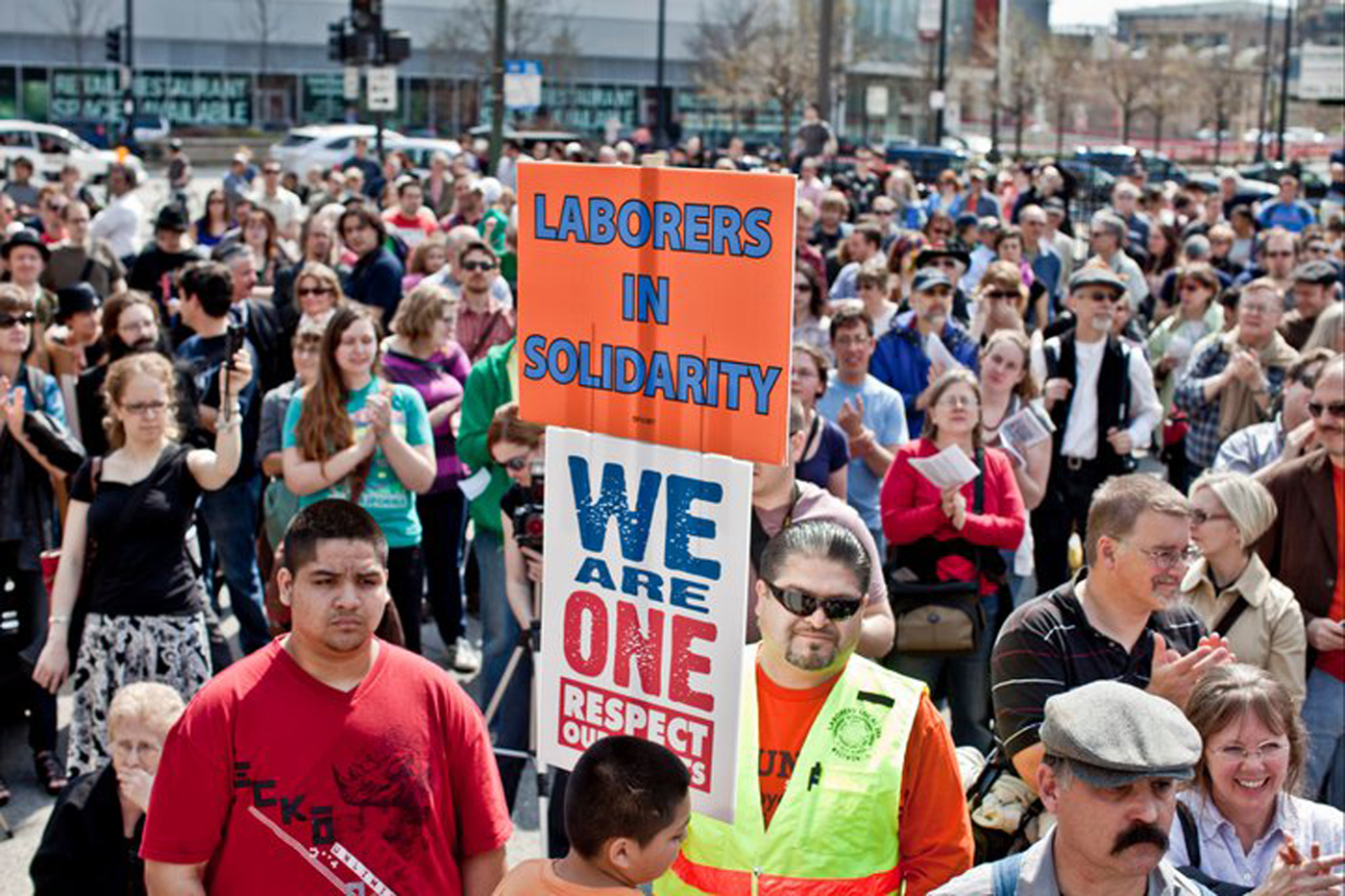
This would be the case with the Haymarket reenactment, which was staged to mark the event's 125th anniversary and, given its significance, done to scale. The bombing in Haymarket Square had a profound effect on the labor movement not just in Chicago and the United States, but also in the world as a whole. On 4 May 1886 a bomb went off in Haymarket Square in Chicago, killing one police officer instantly and wounding over sixty others, seven of whom would later die as a result. The officers were part of a contingent of almost 180 who were in the Haymarket to break up what at its height had been a gathering of some three thousand striking workers and the merely curious that had dwindled to about three hundred when someone threw a bomb into the crowd. That night three men had mounted an empty wagon to speak out against an act of police violence that had occurred the day before and in favor of a nationwide strike in support of an eight-hour workday that had begun on the first of the month. In the aftermath of the bombing, what today would be called an act of domestic terrorism, the remaining police made over a hundred arrests, rounding up labor leaders of various political persuasions and ethnicities. The state could never identify the bomber, so eight anarchists, including the three who had spoken that night, went on trial, charged with using incendiary language that provoked the bombing. Four of them would be executed a little over a year later; a fifth committed suicide before he could be hung; and the remaining three, having been sent off to the state penitentiary, were pardoned in 1893 by a governor who regarded their trial as a miscarriage of justice. To honor the eight Chicago anarchists, the Second International proclaimed the first of May a workers’ holiday, which is what May Day became in most countries around the world. In Chicago, a memorial to the dead police – a statue of one officer with his arm upraised, urging order – stood in Haymarket Square for several years. Police and city officials placed wreaths at its base. A different generation of radicals would blow it up, multiple times, amid the tumult of the late 1960s.
To tell Haymarket story on the site where it had occurred involved working closely with the city and also four main partners – a labor history society, the neighborhood chamber of commerce, an arts festival, and a brewery named for the event. Each had strong ideas about what the project should mean. The audience who showed up portrayed the 1886 audience who'd listened to the three labor leaders speak before the police marched up to disperse the crowd; the police were portrayed by representatives from twenty-five arts and community organizations from across Chicago. As a result of these relationships, the Haymarket reenactment unfolded as a shared effort that offered multiple responses and interpretations – in this respect, it was like the actual event being reenacted.
The Calder reenactment is going to be much smaller in scale. I decide to stress the intimacy of the relationships by keeping the number of participants small. Calder and Shaw are going to write and dictate their letters respectively, while Jarvis, the secretary, dutifully types away. A fourth character, a postman, will deliver the letters between the correspondents, breaking the fourth wall to provide the audience with some historical context. In the past, I've tried to find contemporary analogues to portray historical figures; for example, the modern-day water reclamations district commissioner once portrayed her 1890 counterpart and even agreed to wear a mustache for the sake of accuracy. But the Calder reenactment is different. For one thing, getting anyone associated with the Arts Club itself to participate proves impossible, and there is pressure to use professional actors who will memorize their lines, derived from the content of the letters.
The use of analogues and amateurs, cast regardless of the age, race, or sex of the historical figures being portrayed, has also been a consistent feature of Pocket Guide to Hell projects. It seemed critical to keeping the experiences open and accessible; unlike a Civil War reenactment or an academic conference, one didn't need to be an expert in order to participate. It also allowed the past to feel personal and intimate. This was certainly true during the Haymarket reenactment. While the police officers in 1886 were all men, many of them immigrants from Western Europe, the two hundred volunteers who played them in the reenactment were men, women, and children, ranging in age from seven to seventy-eight, coming from all parts of the city. One of them, Caroline Picard, tweeted her experiences throughout the reenactment and later wrote a blogpost for the arts news site Bad at Sports.
Participants in the Haymarket reenactment portrayed the 1886 audience but reflected the concerns of 2011. Photograph by Yoni Goldstein.

Like many there, she'd agreed to participate because the reenactment looked like it might be fun. While a significant number of tweets expressed Picard's regret at not using the bathroom before getting into position to march, determining whether or not she'd suffer an abdominal wound from shrapnel or friendly fire, and the difficulty in hearing what was being said in the square while standing at the former site of the police station a block away, the tone shifted noticeably as she and the others marched in formation toward the crowd. Suddenly the prop bomb went off, chaos briefly ensued, and Picard, along with several other police volunteers, fell to to the street. The reenactment, she would later conclude, “created a different rubric for education”:
By participating in a reenactment like this, one is directly implicated in the action of history. Furthermore, at least for me, I felt pretty carefree throughout all of it. I don't think I was taking it seriously, exactly, swept up as I was in the energy of a group. Yet suddenly, I found myself hearing the script, hearing that only one policeman died on the scene. Realizing that I probably would not have been that policeman (despite my dramatic pose), I bumped into historical accuracy in such a way that, I expect, I will always remember those dead and wounded.
Her direct participation in the experience also influenced her response to a later scene in the reenactment, the restaging of the 1887 execution of the men who'd organized the meeting in Haymarket Square, the “suddenly somber” mood in part created by her own previously “cavalier” tone. In the moment when the hoods were placed over the heads of the four men, Picard writes that “everything felt real and I was overwhelmed with a tactile experience of how our lives today have been so directly impacted by this short historical blip.”Footnote 3
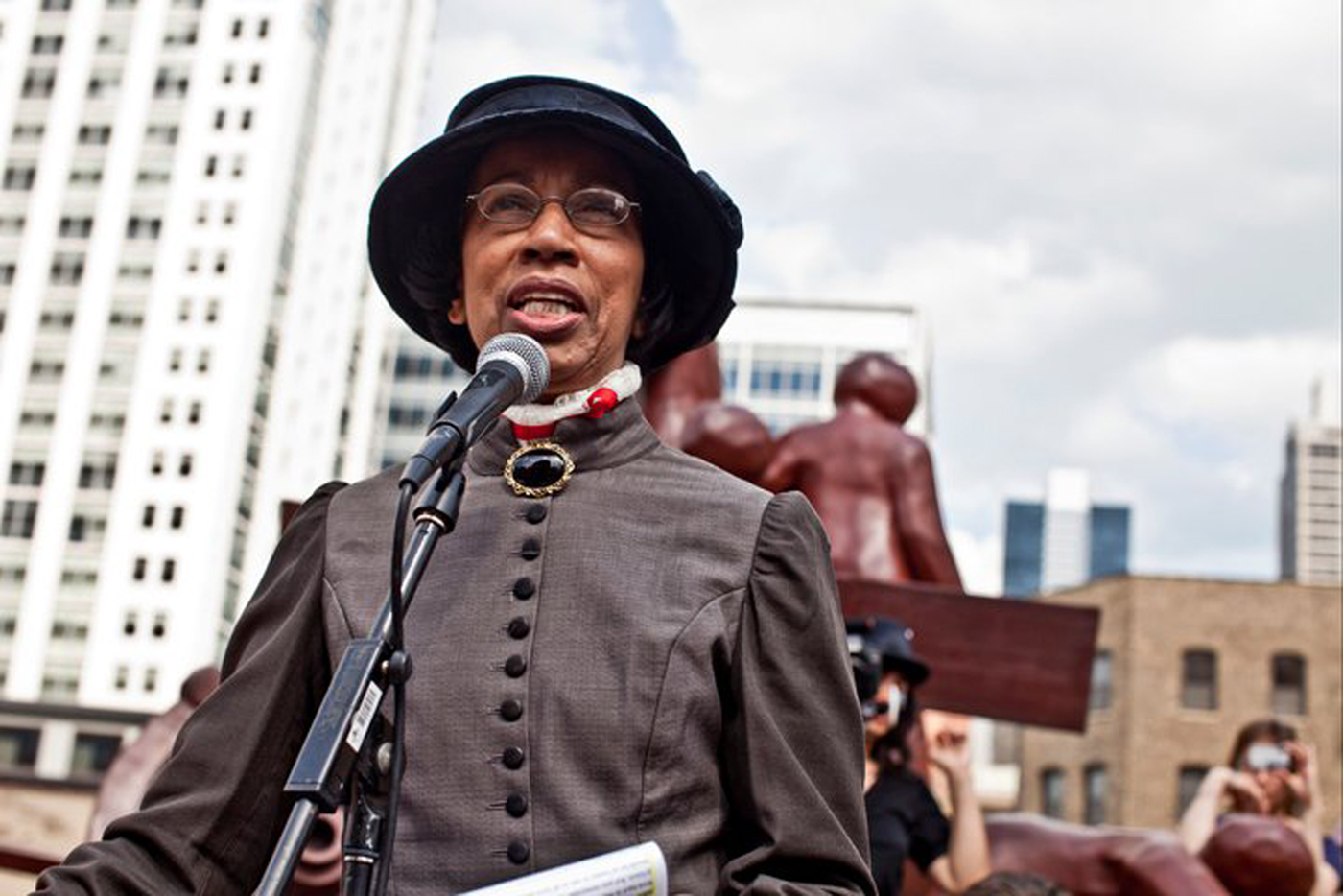
Alma Washington in the character of Lucy Parsons, widow of executed anarchist Albert Parsons, narrates Part Three of the Haymarket reenactment, 30 April 2011. Photo by Yoni Goldstein.

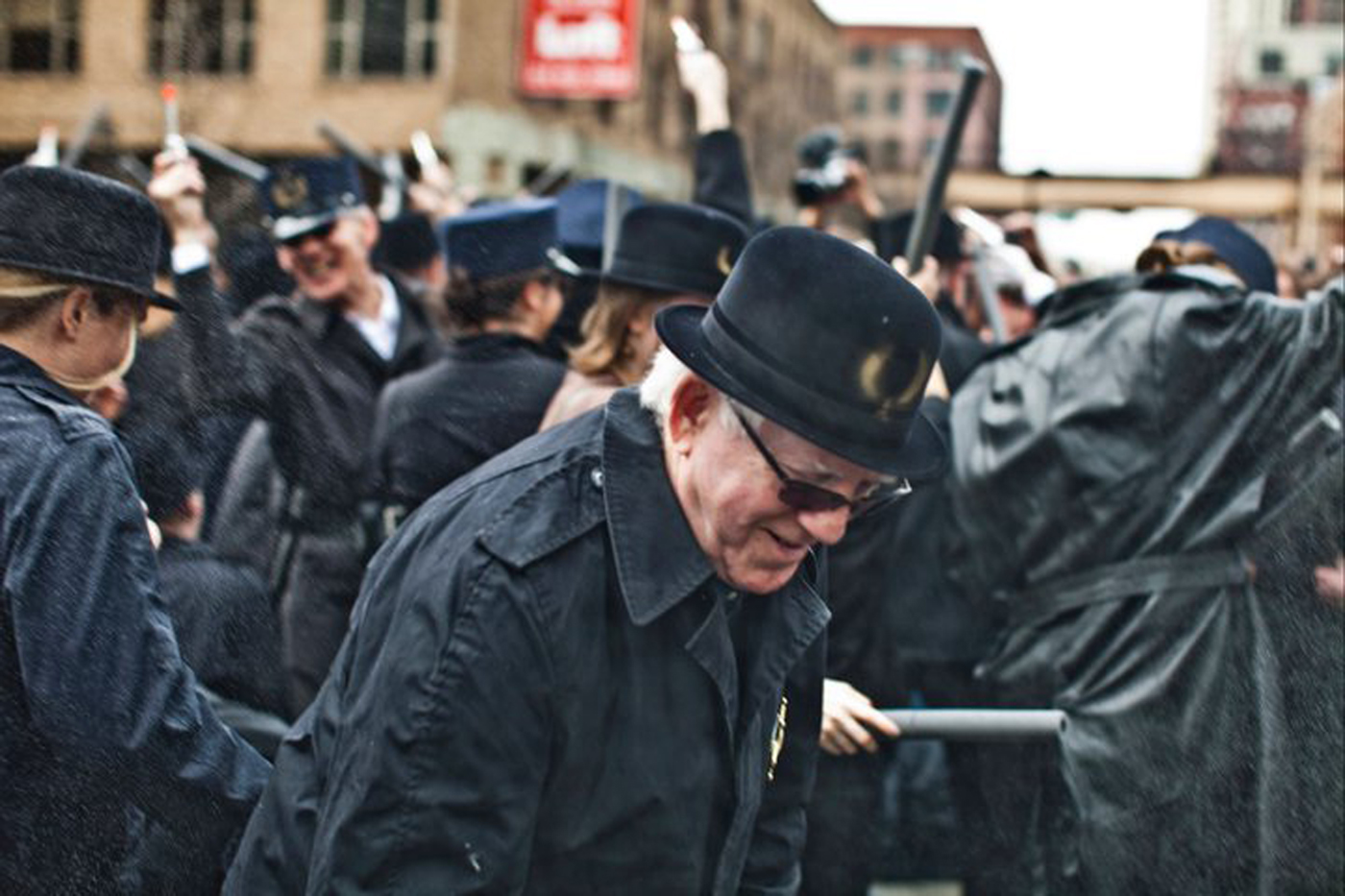
The police open fire after the bomb explodes at the Haymarket Reenactment, 30 April 2011. The police were portrayed by volunteers from twenty-five arts and community organizations and also by members of the general public. Photo by Yoni Goldstein.

I include Picard's comments at length because they reflect something I said that day at the conclusion of the reenactment. While in the middle of thanking the many people who had made the project possible, I suggested for the first time that the past could be thought of as a public space – it could be inhabited by and belong to everyone; it could connect one to past struggles and help one imagine possible futures. Over the years, the meaning of the Haymarket story had been claimed by historians, unions, city officials, and the police; each had reasons for asserting their authority to interpret the story. The reenactment had retained all of these interpretations – members of each of these communities had participated – but also generated new, more open-ended ones. As a result of the embodied and spatially specific experience of the reenactment, individuals like Picard could think through “how our lives today have been so directly impacted” by what seemed like a removed and remote past.
The Calder sculpture at the Arts Club is kinetic. The red petals attached to its black base move with the air itself, and, in one letter, the artist jokes that the famously windy city of Chicago might overwhelm the delicacy of his work. The Arts Club keeps it at the base of a “floating staircase,” designed by the architect and former member Ludwig Mies Van der Rohe. The staircase had traveled from the club's old home to its current one. It is encased behind two large glass doors. Very little air circulates through this space, so the petals no longer move. The reenactment we produce is similarly static. We stage it on three levels of the “floating staircase,” making it somewhat visually interesting, and I am able to work with individuals who match the spirit of past projects. As the postman, I share the historical background in a manner that comes across as extemporaneous. But there we are, in our period-appropriate costumes, sharing the content of the letters from the Newberry before a seated audience who appear alternately amused and bored, and I can't help thinking back to high-school theater productions. The experience reminds me of everything I dislike about the reenactment form. The story feels over, its meaning fixed, from the moment it begins. The aesthetic rings false despite a painstaking attention to detail. The audience sits there, absorbing it like any other history lesson, one that has very little to do with them or the present they inhabit.
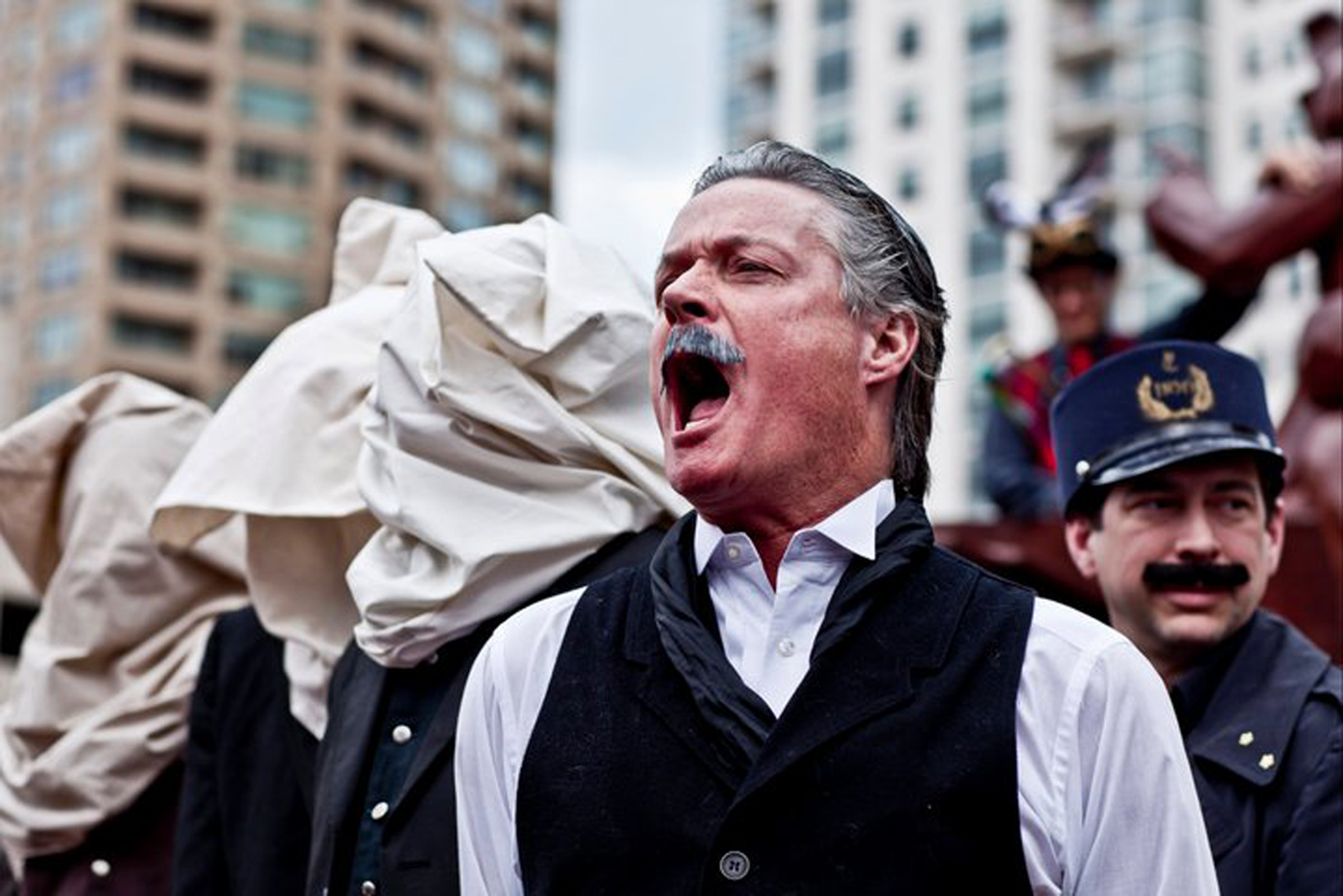
Matt LaPierre as Albert Parsons delivers his last words before his execution. LaPierre was a staff representative of the American Federation of State, County, and Municipal Employees (AFSCME), one of the unions whose collective bargaining rights were being challenged at the time of the Haymarket Reenactment. Photo by Yoni Goldstein.

And yet there are some curious details to the story. The Arts Club wanted Calder to use the best of materials for his mobile, but the year was 1942. Steel was scarce on account of the war. He had to go to a junkyard in Waterbury, CT, where he found an old boiler that he had melted down at the nearby ironworks into the form he desired. He decided that the texture of the boilerplate, which he likened to an elephant's hide, made the final sculpture vastly more interesting than what he'd planned. Not long after this, he was designated 1-A, fit for service, but wasn't drafted. He attempted to enlist in the Marines in order to use his artistic talents to design new forms of camouflage, but nothing came of this. Later, he and his wife were active in opposing the Vietnam War, even going so far as to take out a page in the New York Times in order to denounce it. That last part I don't share with the audience during the reenactment.
I do, however, take the time to notice the texture of the sculpture after the reenactment concludes. I like that Calder's improvisation with materials, born out of necessity, produced the better result. It reminded me of what I wanted the reenactments to be like: planned and researched in advance but also open and unpredictable in the moment. The best example of this was the Haymarket reenactment, developed over the course of a year but finding its conclusion altered by someone who'd just shown up that day. He called himself the ninth anarchist. History hadn't recorded his presence, and yet there he was up on the speakers’ wagon with the other eight. We could have asked this young man, not in period attire and with large headphones over his ears, to step back down into the crowd; he wasn't part of our script. But if we meant what we said about the reenactment being a community experience where the past functioned as a common, then he belonged up there on the wagon. As one scene shifted to the next, he moved along with us, making his own meaning, becoming part of the story.