


Resource scarcity, energy security, and anthropogenic environmental change necessitate new technologies for sustainable electricity production. Solid oxide fuel cells (SOFCs) meet this challenge by efficiently and cleanly generating electrical power using electrochemistry.[Reference Minh1] Unfortunately, high cathode overpotentials cause voltage losses that hinder the widespread use of SOFC devices.[Reference Adler2] High operating temperatures (T op > 800 °C) can offset slow cathode kinetics to obtain useful power densities, but high T op detrimentally leads to short cell lifetimes[Reference Steele and Heinzel3] and requires high energy input, long start-up times, and expensive interconnect materials (e.g. La1−xSrxCrO3).[Reference Huang, Wan and Goodenough4] Therefore, developing cathode materials that facilitate faster kinetics will enable intermediate T op (600–800 °C), leading to more efficient devices, longer cell lifetimes, and lower material costs.
Recently proposed cathode materials such as La1−xSrxCo1−yFeyO3 (LSCF), Sr2Fe2−xMoxO6 (SFMO) and Ba1−xSrxCo1−yFeyO3 (BSCF) successfully enable intermediate temperature operation.[Reference Rembelski, Viricelle, Combemale and Rieu5] The works of Adler[Reference Adler2] and Kuklja et al. [Reference Kuklja, Kotomin, Merkle, Mastrikov and Maier6] offer broad perspectives on the different processes governing oxygen reduction at SOFC cathodes. Mixed ion-electron conducting (MIEC) capability, defined by bulk oxygen ion and electron conduction, enables these promising cathode materials to operate at reduced temperatures. Allowing oxygen diffusion through the cathode increases the active areas[Reference Lu, Hardy, Templeton and Stevenson7] for these materials compared with traditional (La1−xSrxMnO3-based) SOFC cathodes because traditional cathodes restrict activity to the relatively scarce triple phase boundaries (where gas, cathode, and electrolyte meet).[Reference Adler2] Therefore, effective MIEC cathodes require facile bulk oxygen transport. Among the MIEC cathodes, LSCF remains the reference cathode material; however, the relationship between its composition and oxygen diffusivity remains unclear. For example, electrochemical analysis of LSCF and La1−xSrxFeO3 (LSF) indicates that small concentrations of La vacancies can improve these materials' cathode performance.[Reference Striker, Ruud, Gao, Heward and Steinbruchel8] Understanding how such compositional variations affects, e.g., bulk oxygen transport is a key requirement for optimizing LSCF cathodes.
Rational cathode material design requires atomic-level insight regarding how the composition affects the oxygen diffusion process. Several studies have already provided theoretical insight into the oxygen vacancy formation process in materials related to LSCF.[Reference Lee, Kleis, Rossmeisl and Morgan9–Reference Jones and Islam11] We recently showed that Sr substitution promotes oxygen vacancies in La1−xSrxFeO3 by introducing holes (h •) into the lattice which favorably compensate the electrons arising from an oxygen vacancy (V O••). Here, we employ the Kroger–Vink notation for the lattice defects. Our work also included a quantitative analysis of the oxygen migration pathway in LaFeO3 and obtained reasonable agreement with the experimental reaction and migration enthalpies.[Reference Ritzmann, Muñoz-García, Pavone, Keith and Carter12] Recently, Mastrikov et al. [Reference Mastrikov, Merkle, Kotomin, Kuklja and Maier13] published theoretical results for oxygen vacancy formation energies and migration enthalpies (barriers) in numerous materials related to LSCF (including LaFeO3, the focus of this communication). Our value for the absolute-zero oxygen vacancy formation enthalpy (ΔH f,vac = 4.01 eV) is lower than Mastrikov et al.'s result (4.41 eV). The difference in ΔH f,vac values arises from significant methodological differences between our work and Ref. Reference Mastrikov, Merkle, Kotomin, Kuklja and Maier13, namely our use of a more accurate oxygen projector-augmented wave potential and our proper treatment of the antiferromagnetic state of LaFeO3 instead of assuming ferromagnetic spin ordering. Our computed oxygen migration enthalpy (ΔH mig = 0.79 eV) agrees quite well with Mastrikov et al.'s value (0.75 eV). See Ref. Reference Ritzmann, Muñoz-García, Pavone, Keith and Carter12 for more details of how our methodology differs from, and outperforms, the methodology used by Mastrikov et al. [Reference Mastrikov, Merkle, Kotomin, Kuklja and Maier13]
Despite quantitative agreement between experimental values and the computed reaction enthalpies and migration barriers in Refs. Reference Ritzmann, Muñoz-García, Pavone, Keith and Carter12 and Reference Mastrikov, Merkle, Kotomin, Kuklja and Maier13, we found that the predicted LaFeO3V O•• concentrations were orders of magnitude below the experimental values (vide infra). Therefore, some additional factor not yet considered is necessary to account for the experimentally observed V O•• concentrations. Vibrational and other thermal effects do not sufficiently explain the disagreement, as they were part of our initial calculations. Accounting for the known overbinding of the O2 molecule by density functional theory (DFT) only increases deviation from the experiment. However, as mentioned above, samples of LaFeO3 tend to be slightly substoichiometric in La,[Reference Mizusaki, Yoshihiro, Yamauchi and Fueki14] which had not been accounted for in previous modeling and could be responsible for the discrepancy. In this Communication, we demonstrate that small concentrations of lanthanum vacancies (V La///) raise the V O•• concentration by several orders of magnitude relative to perfectly stoichiometric (La/Fe = 1) LaFeO3. Electronic structure analysis reveals that V La/// create hole states, which favorably compensate the electrons released upon V O•• formation, driving the formation of a much higher concentration of vacancies than would normally occur in stoichiometric LaFeO3. This finding demonstrates that A-site substoichiometry can be deliberately used as an alternative strategy to p-type substitutions (e.g. Sr substituting for La) for increasing oxygen diffusivity in SOFC cathodes.
We performed DFT + U[Reference Anisimov, Zaanen and Andersen15] calculations using the ab initio value of U eff = 4.3 eV for Fe3+ in Fe2O3 determined by Mosey et al. [Reference Mosey, Liao and Carter16] and previously validated for G-type antiferromagnetic LaFeO3.[Reference Ritzmann, Muñoz-García, Pavone, Keith and Carter12] These calculations used the generalized gradient approximation exchange-correlation functional of Perdew, Burke, and Ernzerhof (PBE)[Reference Perdew, Burke and Ernzerhof17] as implemented in the Vienna ab initio Simulation Package (VASP).[Reference Kresse and Furthmüller18]V La/// formation and V O•• formation (in the presence and absence of V La///) were treated in a 160-atom supercell [Fig. 1(b)], which converges the defect formation energies to 0.03 eV. A 40-atom supercell was used for the oxygen migration calculations [Fig. 1(a)]. Our total energies are converged to 5 meV/formula unit (for full numerical parameters, see the supporting information).
(a) 40-atom and (b) 160-atom supercells of LaFeO3 used in our calculations. Oxygen and La vacancy formation energies are reported for the 160-atom cell while oxygen migration was modeled in the smaller cell. The 160-atom supercell was constructed from the orthorhombic unit cell (a o, b o, c o) of LaFeO3[24] with the following lattice vectors (a s, b s, c s): a s = −2a o − b o − c o, b s = −2a o + b o + c o, and c s = 2a o + b o − c o. Structures visualized with VESTA.[25]

V La/// formation free energies [∆G f,vac,La, Eq. (1)] involve the free energy difference between defective (G defective) and perfect (G perfect) crystals plus a lanthanum atom (referenced to the lanthanum chemical potential, μ La, that depends on the external conditions).
 $$\Delta G_{{\rm f\comma vac\comma La}}=G_{{\rm defective}} - G_{{\rm perfect}}+\mu _{{\rm La}}$$
We propose two different limits for calculating μ La. Under oxygen-poor conditions (e.g. ultra-high vacuum experiments), La metal provides the reference for μ La. Oxygen-rich conditions require referencing μ La using La2O3 and the free energy per molecule of O2. These two limits, respectively, correspond to the defect formation reactions shown in Eqs. (2) and (3) in which  ${\rm La}_{{\rm La}}^x $ represents a lanthanum ion in its normal, +3, oxidation state in the host material.
 $${\rm La}_{{\rm La}}^x \to V_{{\rm La}}^{{\rm ///}}+ 3h^ \bullet+{\rm La}\; {\rm \lpar metal\rpar }\; \hbox{[oxygen-poor]}$$
 $${{\rm La}_{\rm La}^x} +\displaystyle{ 3 \over 4}{\rm O}_2 \lpar g\rpar \to {V_{\rm La}^{\rm ///}}+ 3h^{\bullet} + \displaystyle{ 1 \over 2}{\rm La}_2 {\rm O}_ 3 \, \lpar s\rpar \hbox{[oxygen-rich]}$$
For the purpose of calculating ∆G f,vac,La, we neglect the vibrational contributions from solids. We previously showed that solid vibrations contribute negligibly to the oxygen vacancy formation free energy (∆G f,vac,O) in LaFeO3.[Reference Ritzmann, Muñoz-García, Pavone, Keith and Carter12] We account for vibrational, rotational, and translational contributions from the O2 molecule through the harmonic oscillator, rigid-rotor, and ideal gas approximations (see the supporting information). Further analysis of possible coupling between oxygen transport and low-energy, anharmonic crystal modes (such as octahedral rotations) requires accurate, detailed dynamics simulations which are beyond the scope of this study. We believe that the results obtained by including the most relevant thermal contributions (specifically, the thermal variation of the chemical potential arising from the large entropy of a gas phase species) provide a sufficiently accurate description of the LaFeO3 system. Although geometrical distortions around V La/// do not affect our arguments, a discussion of the strain relaxation associated with V La/// formation can be found in the supporting information. We find that, at 700 °C, the free energies for reactions 2 and 3 are 11.4 and 4.33 eV, respectively. Since the SOFC cathode operates under oxygen-rich conditions, we confine our analysis of V La/// formation to Eq. (3) for the remainder of this work. V La/// formation is more endoergic than V O•• formation in stoichiometric LaFeO3 (3.04 eV at 700 °C).[Reference Ritzmann, Muñoz-García, Pavone, Keith and Carter12] While this seems to validate neglecting V La///, we will prove this assumption wrong for LaFeO3.
We now consider the effect of V La/// on the electronic structure of LaFeO3. One V La/// (per 32 formula units) introduces three hole states which extend just above the Fermi energy (Fig. 2). The modeled concentration of V La/// (3.125%) exceeds the estimated experimental V La/// concentration (approximately 0.07%).[Reference Mizusaki, Yoshihiro, Yamauchi and Fueki14] However, this concentration yields V La/// formation energies within 0.03 eV of a larger calculation containing 320-atoms ([V La///] = 1.5625%). This indicates that our model is converged with respect to the limit of infinitely dilute V La///. The lack of discrete peaks in the gap indicates that the hole states delocalize. Bader charge analysis[Reference Bader19] indicates that the iron ions retain their charge (q Fe = 1.70 with and without V La///) while the oxygen sublattice loses charge (q O = −1.24 with V La/// versus q O = −1.26 without V La///). While the Bader charges for oxygen seem similar, the small difference adds up to 1.76 electrons (over the entire 160-atom supercell), accounting for the majority of the Bader charge of the La ion before the V La/// is created (q La = 2.08 before V La///). Therefore, the holes delocalize over the oxygen sublattice. This result agrees with the behavior we found for hole states introduced by Sr substitution in La1−xSrxFeO3.[Reference Ritzmann, Muñoz-García, Pavone, Keith and Carter12]
Projected density of states (PDOS) for LaFeO3 with a lanthanum vacancy (1/32 La sites vacant). For ease of viewing, positive PDOS values indicate majority spin states while negative PDOS values correspond to minority spin states. The zero of energy is the Fermi level (vertical dashed line), with occupied states at negative energies. Fe 3d states in black and O 2p states in red. The inset plot shows the region around the Fermi level showing the mixed Fe 3d/O 2p nature of the hole states (the states to the right of the dashed line).
The presence of holes in the lattice dramatically changes the defect chemistry of LaFeO3. Without V La///, we found[Reference Pavone, Ritzmann and Carter10, Reference Ritzmann, Muñoz-García, Pavone, Keith and Carter12] that V O•• formation involves reducing the adjacent Fe ions [Eq. (4)]. However, charge compensation [Eq. (5)] between the electrons from V O•• and the holes from V La/// should result in a decrease in ∆G f,vac,O in the same way that holes introduced by Sr substitution lowered ∆G f,vac,O in La1−xSrxFeO3.[Reference Ritzmann, Muñoz-García, Pavone, Keith and Carter12] In reactions (4) and (5), nil represents the LaFeO3 crystal without defects,  ${\rm Fe}_{{\rm Fe}}^{\rm /} $indicates an Fe2+ ion, and
 ${\rm \lcub Fe}_{{\rm Fe}}^{\rm /} - V_{\rm O}{}^{ \bullet \bullet } - {\rm Fe}_{{\rm Fe}}^{\rm /} {\rm \rcub }$ indicates an oxygen vacancy associated with two adjacent Fe2+ ions.
 $${\rm nil} \to {\rm \lcub Fe}_{{\rm Fe}}^{\rm /} - V_{\rm O}^{ \bullet \bullet } - {\rm Fe}_{{\rm Fe}}^{\rm /} {\rm \rcub }+\displaystyle{ 1 \over 2}{\rm O}_ 2 {\rm \lpar g\rpar }$$
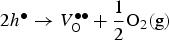 $$2h^ \bullet \to V_{\rm O}^{ \bullet \bullet }+\displaystyle{ 1 \over 2}{\rm O}_ 2 {\rm \lpar g\rpar }$$
We find a significant reduction in ∆G f,vac,O in the presence of V La/// (∆G 5 = −0.34 eV compared with ∆G 4 = 3.04 eV at 700 °C, where the subscripts refer to the numbered equations above). V O•• is slightly more stable adjacent to V La/// compared with far away from V La/// (only 0.06 eV different at 700 °C). This small energy difference provides thermodynamic evidence that V La/// do not strongly trap V O••. Our results show how V La/// promote faster oxygen diffusion by making V O•• formation energetically favorable without trapping V O••.
A full analysis of the defect chemistry of LaFeO3 requires considering the equilibrium between each of the defect formation reactions in Eqs. (3–5). The equilibrium constants can easily be computed from the free energies [∆G o(T)] for each of these reactions. We express these constants in terms of the extents of the three reactions (ξ 3, ξ 4, and ξ 5) which are related to the concentrations of different defects as described below [Eqs. (6–8)]. In these equations, k B is Boltzmann's constant and T is the absolute temperature.
 $$K_3={\rm e}^{\lpar - \Delta G_3^0 /k_{\rm B} T\rpar }=\displaystyle{{\left[{V_{{\rm La}}^{{\rm ///}} } \right]\left[{h^ \bullet } \right]^3 } \over {\left({1 - \left[{V_{{\rm La}}^{{\rm ///}} } \right]} \right)P_{{\rm O}_ 2 }^{{\rm 3/4}} }}=\displaystyle{{\xi _3 \left({3\xi _3 - 2\xi _5 } \right)^3 } \over {\left({1 - \xi _3 } \right)P_{{\rm O}_ 2 }^{{\rm 3/4}} }}$$
 $$K_4={\rm e}^{\lpar - \Delta G_4^0 /k_{\rm B} T\rpar }=\left[\left\{ {\rm Fe}_{\rm Fe}^{/} - V_{\rm O}^{ \bullet \bullet } - {\rm Fe}_{\rm Fe}^{/} \right\}\right]P_{{\rm O}_ {2}}^{1/2} = \xi _4 P_{{\rm O}_ {2}}^{1/2}$$
 $$K_5={\rm e}^{\lpar - \Delta G_5^0 {\rm /}k_{\rm B} T\rpar }=\displaystyle{{\left[{V_{\rm O}^{ \bullet \bullet } } \right]P_{{\rm O}_ 2 }^{{\rm 1/2}} } \over {\left[{h^ \bullet } \right]^2 }}=\displaystyle{{\xi _5 P_{{\rm O}_ 2 }^{{\rm 1/2}} } \over {\left({3\xi _ 3 - 2\xi _5 } \right)^2 }}$$
In these expressions, the concentrations are expressed in terms of occupancies (mole fractions) and the extents of the reaction correspond to the numbered equations above. We solve for the extents of the reaction using Mathematica[20] and reject solutions which fail to meet the criteria that 0 ≤ ξ i ≤ 1 (i = 3, 4, and 5) and 3ξ 3 − 2ξ 5 > 0 (which ensures that the hole concentration is positive). All ∆G o values are calculated with  $P_{{\rm O}_ 2 }=1$ atm meaning that the
 $P_{{\rm O}_ 2 } $ values entering the expressions above are expressed in atmospheres.
Comparing two calculations side-by-side shows that V La/// play a significant role in promoting V O•• in LaFeO3 (Fig. 3). Neglecting V La/// corresponds to solving only for ξ 4 using Eq. (7). When V La/// contribute to the defect chemistry, the calculation involves solving the coupled Eqs. (6) and (8). This leads to calculated [V O••] in far better agreement with the experiment. Our calculated values (black line, Fig. 3) lie approximately one order of magnitude below the experimental values; however, this represents a very substantial improvement over the values computed neglecting the V La/// contribution.
Calculated and experimental[21] oxygen vacancy concentrations (mole fraction) over the range of experimental temperatures. Experiments in Ref. Reference Ishigaki, Yamauchi, Mizusaki, Fueki, Naito and Adachi21 were carried out between 600 and 1200 °C, but the experimental data was only tabulated between 900 and 1100 °C. Computed values and experimental values at  $P_{{\rm O}_ 2 } = 53$ torr. Experimental data (red circles), computed data considering V La/// (black line with squares), and computed data neglecting V La/// (dashed blue line with triangles).
Having established significantly better quantitative agreement with experimental V O•• concentrations,[Reference Mizusaki, Yoshihiro, Yamauchi and Fueki14, Reference Ishigaki, Yamauchi, Mizusaki, Fueki, Naito and Adachi21] we can calculate the oxygen diffusion coefficients. The basic relationship for vacancy-mediated diffusion dictates that the oxygen diffusion coefficient (D O) is the product of the vacancy diffusion coefficient (D v) and the oxygen vacancy concentration (C v).[Reference Ishigaki, Yamauchi, Mizusaki, Fueki, Naito and Adachi21]
 $$D_{\rm O}=C_{\rm v} D_{\rm v}$$
Following previous work in our group,[Reference Marino and Carter22, Reference Muñoz-García, Pavone, Ritzmann and Carter23] we use transition state theory to express D v in terms of the activation barrier (∆H m = 0.79 eV),[Reference Ritzmann, Muñoz-García, Pavone, Keith and Carter12] the jump length (a = 2.96 Å), the attempt frequency (ν 0 = 5.28 × 10¹² Hz) and the entropy of activation (∆S ‡ = −2.50 k B at 700 °C) where k B is Boltzmann's constant [Eq. (10)].
 $$D_{\rm v}=\displaystyle{1 \over 6}\nu _ 0 a^2 {\rm e}^{\Delta S^ \pm /k_{\rm B} } {\rm e}^{ - \Delta H_{{\rm mig}} /k_{\rm B} T}$$
Our computed values of D v agree extremely well with the experimental data [Fig. 4(a)], indicating that we have properly modeled the migration process. Since V La/// in reality exist in extremely low concentrations (less than ppm), the migration calculation was performed in the absence of V La///.
Computed and experimental diffusion coefficients: (a) vacancy diffusion coefficients (D v) and (b) oxygen diffusion coefficients (D O). Experimental data[21] (red circles/triangles and black lines), computed D v (solid blue line), computed D O considering V La/// (dashed blue line with squares), and computed D O neglecting V La/// (green line with triangles).
When we combine the C v values from above with the D v values, we obtain results that clearly affirm our assertion that V La/// play an integral role in increasing the oxygen diffusivity of LaFeO3. The D O values calculated without considering V La/// differ from experiment by orders of magnitude whereas our values including the effects of V La/// show significantly better agreement with experiment [Fig. 4(b)]. From this graph, we can see that the small concentration of V La/// (approximately 6.6 × 10⁻⁷ at 700 °C) raises the oxygen diffusion coefficient by six orders of magnitude.
This work clearly demonstrates the enormous impact of La vacancies in raising the oxygen vacancy concentration in LaFeO3. This effect, in turn, increases the observed oxygen diffusion coefficient. Specifically, the La vacancies introduce holes that compensate the electrons released when an oxygen vacancy forms. This results in favorable oxygen vacancy formation free energies leading to orders of magnitude higher oxygen vacancy concentrations than would be expected if La vacancies were not present. This also indicates a methodological point that La vacancies must be accounted for when computing oxygen vacancy formation energies in stoichiometric materials. In cases where Sr substitution dramatically lowers the oxygen vacancy formation energy, the La vacancies in the pure material (no Sr substitutions) are likely to play a large role in enhancing oxygen diffusivity. Our results also indicate that A-site substoichiometry offers a powerful way to increase oxygen diffusivity.
Acknowledgments
HeteroFoaM, an Energy Frontier Research Center funded by the US Department of Energy, Office of Science, Office of Basic Energy Sciences, under the award DE-SC0001061 provided funding for this work. The simulations carried out in this work were performed (in part) on computational resources supported by the Princeton Institute for Computational Science and Engineering (PICSciE) and the Office of Information Technology's High Performance Computing Center at Princeton University. Research was carried out in part at the Center for Functional Nanomaterials, Brookhaven National Laboratory, which is supported by the U.S. Department of Energy, Office of Basic Energy Sciences, under Contract No. DE-AC02-98CH10886.
Supplementary materials
For supplementary material for this article, please visit http://dx.doi.org/10.1557/mrc.2013.28



