In many parts of the world, teachers and other child educators are ‘mandated reporters’ of child abuse, meaning that they are required by law to report suspected abuse and failure to do so may result in civil or criminal charges. For example, in the United States, all states now have mandated reporting laws (Child Abuse Prevention and Treatment Act, 1974; see Mathews & Kenny, Reference Mathews and Kenny2008 for a review of mandated reporting laws in Australia, Canada and the United States). Teachers have daily contact with children for long periods of time, and so it has been suggested that these professionals are in a particularly advantageous position to identify maltreatment among their students (Abrahams, Casey, & Daro, Reference Abrahams, Casey and Daro1992; Briggs & Hawkins, Reference Briggs and Hawkins1997; Farrell & Walsh, Reference Farrell and Walsh2010; O’Toole, Webster, O’Toole, & Lucal, Reference O’Toole, Webster, O’Toole and Lucal1999; Schols, de Ruiter, & Öry, Reference Schols, de Ruiter and Öry2013; Tite, Reference Tite1993). Additionally, given the rates of child abuse (e.g., 2.3–14.2 children per 1,000 in Australia, Canada, and the United States [Australian Institute of Health and Welfare, 2006; Trocmé et al., Reference Trocmé, Fallon, MacLaurin, Sinha, Black, Fast and Holroyd2010; US Department of Health and Human Services, Administration for Children, Youth and Families, 2011]), it is very likely that teachers will, at some point in their careers, come into contact with abused children.
Research has indeed shown that teachers are among the largest group of professionals reporting child abuse and maltreatment. Lung and Daro (Reference Lung and Daro1996) found that two thirds of cases investigated by Child Protective Services were referred by the following four groups of mandated reporters: medical, legal, social, and education professionals. In fact, both the Third and Fourth National Incidence Study of Child Abuse and Neglect found that schools reported more cases of child maltreatment than any other institution (Sedlak & Broadhurst, Reference Sedlak and Broadhurst1996; Sedlak et al., Reference Sedlak, Mettenburg, Basena, Petta, McPherson, Green and Li2010). Yet, in both the third and fourth cycles, the lowest rates of investigation occurred for cases reported from schools and daycare facilities. One reason for this discrepancy may be because most teachers report suspicions to school administrators rather than directly to Child Protective Services, either because the school policy does not permit them to make direct reports or because the teachers feel unprepared to do so (Abrahams et al., Reference Abrahams, Casey and Daro1992; Sedlak et al., Reference Sedlak, Mettenburg, Basena, Petta, McPherson, Green and Li2010).
A large corpus of research now exists characterising teachers’ perceptions of their ability to recognise and report abuse. Often teachers do not receive extensive training regarding the identification of abuse and thus feel they lack the ability to accurately detect such occurrences (Abrahams et al., Reference Abrahams, Casey and Daro1992; Mathews, Reference Mathews2011; Schols et al., Reference Schols, de Ruiter and Öry2013), or they are concerned about making an inaccurate report (e.g., Kenny, Reference Kenny2001). Crenshaw, Crenshaw, and Lichtenberg (Reference Crenshaw, Crenshaw and Lichtenberg1995) have similarly found that teachers feel ‘barely adequate, poorly or not at all prepared’ to recognise and report child abuse, while a study conducted in Queensland, Australia revealed that teachers did not feel prepared for their role as a mandatory reporter of child sexual abuse (only 26% agreed they did feel prepared), but 90% of the teacher respondents believed that they had an important role to play in addressing child sexual abuse. Nearly 41% felt obligated to obtain ‘proof’ of child abuse (Goldman, Reference Goldman2007), but very little is known concerning how teachers would approach that task.
King, Reece, Bendel, and Patel (Reference King, Reece, Bendel and Patel1998) found that one of the strongest predictors of whether professionals (pediatricians, social workers and physician assistants) reported child abuse was the amount of training received with respect to child abuse and maltreatment: at least up to 19 hours of professional education (i.e., hours beyond this figure did not contribute significantly to lifetime reporting proportion). Research with teachers has also demonstrated the benefits of training. In South Australia, a mandated notification program exists requiring completion of a 1-day training program for anyone employed with the state education system (Department of Family and Community Services, 1997). Hawkins and McCallum (Reference Hawkins and McCallum2001) assessed the effectiveness of this program. They sent questionnaires to three groups of teachers: (a) teachers who had not yet completed the program; (b) teachers who had recently completed it; and (c) teachers who had completed it more than a year earlier. The questionnaires assessed awareness of reporting responsibilities, what evidence constituted reasonable grounds for reporting and confidence in recognising indicators of abuse, and how to respond to abuse disclosures. Compared to 81% of teachers who had not received the program feeling poorly prepared, 93% who recently took the program felt they were fairly or very well prepared, and those who recently took the program felt more prepared than those who had taken it more than a year earlier. Participants who had received training (recently or previously) were significantly more confident in their ability to identify indicators of physical, emotional, sexual abuse and neglect. The mandatory notification program, however, does not deliver training in asking children questions about their experiences.
There is some evidence that the both the level and confidence of reporting differs for various kinds of maltreatment. Kesner and Robinson (Reference Kesner and Robinson2002) analysed a random and representative sample of cases from the 1997 National Child Abuse and Neglect Data Systems (NCANDS) and found that teachers were more likely to report cases of physical abuse than were medical, legal and social service professionals, and they were less likely than social workers to report sexual abuse. Physical abuse and neglect will often (but not always) have visible symptoms to a child's regular classroom teacher, but child sexual abuse is frequently a hidden crime. Indeed, Kesner and Robinson (Reference Kesner and Robinson2002) speculated that teachers with little training likely feel more confident reporting physical abuse as compared to other types because the evidence tends to be more visible (Turbett & O’Toole, Reference Turbett and O’Toole1983).
Clearly, much more is understood about teachers’ perceptions of their ability and preparedness to recognise and report child abuse than is known about the methods they use to question children prior to reporting, despite the fact that teachers have identified questioning the child as a way to find out about abuse when circumstances are ambiguous (e.g., Tite, Reference Tite1993; Schols et al., Reference Schols, de Ruiter and Öry2013). It is known that many children who arrive at a formal forensic interview to be questioned about their alleged abuse have often been already questioned by multiple others, including parents and teachers (see Roberts & Powell, Reference Roberts and Powell2001, for a review of sources of error contributing to children's memory reports). It is also clear that the manner and type of questions asked of children can affect their later reports (Phillips, Oxburgh, Gavin, & Myklebust, Reference Phillips, Oxburgh, Gavin and Myklebust2012; Rocha, Marche, & Briere, Reference Rocha, Marche and Briere2013; Stolzenberg & Pezdek, Reference Stolzenberg and Pezdek2013; see Bruck & Ceci, Reference Bruck and Ceci1999, for a review). Thus, it is critical to find out how teachers ‘interview’ children when they suspect that a child is a victim or witness of wrongdoing, which was the purpose of the present study.
How Should Teachers Interview Children?
Before describing the current research, we briefly review best-practice guidelines for questioning children (see Lamb, Hershkowitz, Orbach, & Esplin, Reference Lamb, Sternberg and Esplin2008; Malloy, Johnson, & Goodman, Reference Malloy, Johnson and Goodman2013). It is clear that the best questions are those that are ‘open’ (e.g., ‘tell me what happened’). These prompts do not suggest any particular response and contain only information already mentioned by the child (Lamb, Reference Lamb1996; Lamb et al., Reference Lamb, Sternberg, Orbach, Esplin, Stewart and Mitchell2003; Orbach & Pipe, Reference Orbach, Pipe, Lamb, La Rooy, Malloy and Katz2011; Peterson & Bell, Reference Peterson and Bell1996). That is, interviewers are cautioned to avoid as much as possible questioning children about details that have not yet been reported; these kinds of questions are typically considered ‘leading’ or ‘suggestive’ (see Bruck & Ceci, Reference Bruck and Ceci1999; Bruck, Ceci, & Hembrooke, Reference Bruck, Ceci and Hembrooke1998, for reviews of the dangers of asking leading/suggestive questions). Open-ended questions elicit memories from free recall, and thus are more likely to be answered accurately, as compared to specific questions (e.g., ‘How many girls were there?’) that narrow the type of information that can be recalled, or those that contain an answer embedded within the question (e.g., ‘Were you alone or was someone else there?’; see Lamb, Sternberg, & Esplin, Reference Lamb, Sternberg and Esplin1998; Powell & Snow, Reference Powell and Snow2007).
Good interviewing practice also places emphasis on encouraging the child to do most of the talking; thus interviewers should try to elicit narrative information with few questions (Burrows & Powell, Reference Burrows and Powell2014; Lamb et al., Reference Lamb, Hershkowitz, Orbach and Esplin2008; Powell, Reference Powell2002; Wilson & Powell, Reference Wilson and Powell2001). This procedure allows both the time to engage in memory retrieval and reduces the extent to which the interviewer frames the resultant narrative (Jovchelovitch & Bauer, Reference Jovchelovitch, Bauer, Bauer and Gaskell2000; Lamb, Orbach, Hershkowitz, Esplin, & Horowitz, Reference Lamb, Orbach, Hershkowitz, Esplin and Horowitz2007; Powell, Fisher, & Wright, Reference Powell, Fisher, Wright, Brewer and Williams2005; Powell & Snow, Reference Powell and Snow2007).
Current Study
In the present study, teachers played the role of interviewers and a research assistant played the role of a child who had experienced or witnessed wrongdoing. Mock interviews can be highly effective in evaluating performance because they control for a variety of factors (e.g., motivation of interviewee to share information, delay, nature of the offence) and thus allow a more pure examination of interviewer technique (see Powell, Reference Powell2002; Powell, Fisher, & Hughes-Scholes, Reference Powell, Fisher and Hughes-Scholes2008a, Reference Powell, Fisher and Hughes-Scholes2008b; Smith, Powell, & Lum, Reference Smith, Powell and Lum2009). Teachers were also asked to predict their performance prior to the mock interview, and then to rate it again afterwards. Finally, on a written quiz they provided what they thought would be the best initial question to ask a child, for 10 different scenarios of potential wrongdoing (e.g., A student tells you, ‘I don't like going to Joe's house’).
The primary goal of the present research was to illustrate, for the first time, the types of questions teachers use when attempting to elicit information from children. The analyses were therefore largely exploratory. We predicted, however, that teachers who had university-level qualifications (i.e., bachelor's or master's degrees) would ask proportionally more open and fewer leading questions than teachers with a Diploma of Education because the former group was expected to have broader knowledge of child development and memory principles (e.g., through various psychology or education courses). Related research has also demonstrated that holding a higher-level degree is associated with identifying and reporting abuse and neglect by teachers (Goebbels, Nicholson, Walsh, & De Vries, Reference Goebbels, Nicholson, Walsh and De Vries2008). We also predicted that performance on the mock interview and 10-item quiz would be related, but that superior performance (i.e., a greater proportion of open questions) would be observed on the quiz because the quiz is a situation of reduced pressure. During the mock interview, working memory demands are present as teachers must hold the child's previous responses in mind while formulating subsequent questions, but this challenge is removed during the quiz, as is the social pressure of the presence of the research assistant (McCroskey, Reference McCroskey and Burgoon1982; Zeidner & Bensoussan, Reference Zeidner and Bensoussan1988).
As a final note, the research presented here is in no way intended to criticise the efforts of teachers. It is clear that educators place very high value on the wellbeing of the children in their schools and indeed many of our participants made such remarks. We hope that this research will provide a solid understanding of teachers’ current interviewing practices from which new training and intervention-based research can evolve.
Method
Participants
General information about the study was circulated to principals of schools in Victoria, Australia. Of those, 49 principals requested specific study details and 12 schools ultimately decided they had the time and desire to participate. Consent forms were distributed to teaching staff in the 12 schools, and those wishing to partake in the research returned their signed consent form to the principal or directly to the researchers. Participants were 47 primary/elementary school teachers. There were 31 females (66%) and 16 males (34%). Their teaching experience ranged from 1–41 years (M = 14.44, SD = 12.41). Eighteen teachers had experience teaching children across the range of elementary grades (i.e., Prep through Grade 7), 19 had taught only primary grades (i.e., Prep through Grade 4), 6 had taught only senior grades (Grade 5 through Grade 7), and responses were missing from 4 teachers. Seventeen teachers had received a Diploma of Education, 26 a bachelor's degree, 3 a masters degree and one did not have post-secondary training. Female and male respondents differed neither in their teaching experience (t < 1, p = ns, Cohen's d = .06), nor in their qualification level, χ2(3, N = 47) = 2.39, p = ns. Gender was not a significant variable in any analyses (ts ≤ 1.50, ps = ns, Cohen's ds ≤ .60), and years of teaching experience was unassociated with any other variables (rs ≤ .26, ps = ns); these were thus not considered further.
Materials and Procedure
All interviews occurred on school grounds in a quiet office space. Each teacher was relieved of his/her usual teaching responsibilities by a casual relief teacher (funded by the authors) during the session. After completing the demographic questionnaire, which asked teachers about the number of years they had been teaching and their qualification level, they were asked to estimate how well they expected to perform on a subsequent ‘mock interview’. The scale ranged from 1 (very poor) to 10 (excellent). The teachers were aware that they would be presented with a scenario of a child with access to information and they were to find out what happened; on that basis they were to estimate how they expected to perform.
The teachers then began the mock interview with a member of the research team playing the role of the child. Interviews were audio-recorded only. In each case the research assistant (RA) who conducted the mock interview was also responsible for briefing the teacher and conducting the quiz. The RA was highly trained in delivering the mock interview, having undergone extensive training (>20 hours) consistent with the procedure in Powell and colleagues (Reference Powell, Fisher and Hughes-Scholes2008a). The interview lasted a maximum of 10 minutes. The same assistant played the role of all ‘children’ but there were three different scenarios (assigned randomly to teacher, with the exception that interviewer gender was balanced as much as possible across the ‘child’ gender, χ2 < 1): ‘Emily’, a 6-year-old girl, witnesses the accidental injury of a classmate who was playing where he was not allowed to be (n = 17, 11 female teachers); ‘Jane’, a 6-year-old girl, is the victim of bullying by classmates (n = 17, 11 female teachers); and ‘James’, a 6-year-old boy, witnesses his classmate's pants pulled down in the toilet by a group of older boys (n = 13, 9 female teachers).
The teachers were again invited to rate their performance after the interview on the same 10-point scale. Finally, they received a 10-item quiz with various scenarios and were asked to write down what they thought to be the most appropriate initial question to find out what happened. Scenarios ranged from relatively vague remarks (e.g., ‘I don't like going to Joe's house’; ‘I just went to after-school care, nothing happened’) to strong suggestions of abuse or maltreatment (e.g., ‘He hurt my arm’; ‘He touched my rude spot’). Interviewers should always avoid bias or preconceived notions of what they think may have happened so, regardless of the child's statement, further information should be elicited via open-ended prompts (e.g., Lamb et al., Reference Lamb, Hershkowitz, Orbach and Esplin2008; Powell et al., Reference Powell, Fisher, Wright, Brewer and Williams2005).
Coding
Two postgraduate researchers coded the teachers’ mock interviews for question/prompt type. Because interviews were audio-recorded only, it was not possible to code non-verbal behaviors. Every conversational turn by the teacher was coded into one of the following categories: open-ended, minimal encourager, specific, and leading. Open-ended prompts are those that encourage an elaborate response but do not restrict the range of possible answers; for example, ‘Tell me more.’ Minimal encouragers are indications that the interviewer is listening and understands what is being said (e.g., ‘Mmm-hmm’, ‘uh huh’). Minimal encouragers were not coded when they were immediately followed by a question (e.g., ‘Uh huh. So, what happened next?’); instead the final question was coded, because when used in this way minimal encouragers do not function as such. Specific questions are those that specify what precise information should be reported, including wh- questions, (e.g., ‘What colour was the couch?’) and forced choice questions (offering two or more alternatives as a response; e.g., ‘Were there two boys or three?’, including yes-no questions). Finally, leading questions were coded in any situation where the teacher referred to an aspect or detail of the event that had not already been mentioned by the child (e.g., ‘What happened when he climbed onto the slide?’ when it was not stated that the child climbed onto the slide) or when a presumptive tag was included (‘he was pushed, wasn't he?’).
In addition to assigning teacher utterances to question-type, statements made by teachers were also counted (i.e., phrases not seeking information), as well as the number of times teachers asked multiple questions in a single turn (e.g., ‘What happened to Charlie's leg? Did he say that he was hurt?’). The 10-item quiz was similarly coded for question-type and the number of items for which teachers wrote multiple questions, but minimal encouragers and statements did not occur on the quiz.
Reliability
Coders were blind to the study hypotheses but were already well trained in coding question type, thus none of the transcripts in the current sample were used for training. Twenty per cent of the transcripts were double-coded to assess reliability. Interrater reliability, calculated as agreements/(agreements + disagreements), was obtained; agreement was at least 90% for each of the categories listed above. Disagreements were resolved through discussion.
Design
We analysed both the proportions and raw totals of open, specific and leading questions in a series of multiple regressions. Proportions were analysed because they characterise the relative frequency with which each question type was used, but raw numbers are also important to consider because good interviewing tends to be associated with fewer questions (of any type). The predictor variables were qualifying level (0 = pre-graduate education, 1 = graduate [bachelor's or master’s]), and expected performance rating pre- and post-mock interview. In each analysis we also included the matching variable from the 10-item quiz (e.g., to predict open questions in the mock interview, the number of open questions on the 10-item quiz was included as a predictor).
Results
In advance of presenting the regression analyses, we provide descriptive statistics to illustrate the types of questions asked by teachers in the mock interview and 10-item quiz. Prior to conducting the regression analyses, we performed multiple Analyses of Variance (ANOVAs) to verify that there was no effect of scenario on any of the variables. All were non-significant, Fs ≤ 1.97, ps ≥ .152, ηp2s ≤ .086, with the exception of the proportion of specific questions asked in the mock interview, F(2, 44) = 3.77, p = .031, ηp2 = .146. A greater proportion of specific questions were asked to ‘Jane’ (M = .59, SD = .10) than ‘Emily’ (M = .51, SD = .08); the proportion asked to ‘James’ did not differ from either (M = .52, SD = .10). Including scenario in the regression model had no effect on the results, however, so it was omitted.
Descriptive Data
Mock interviews
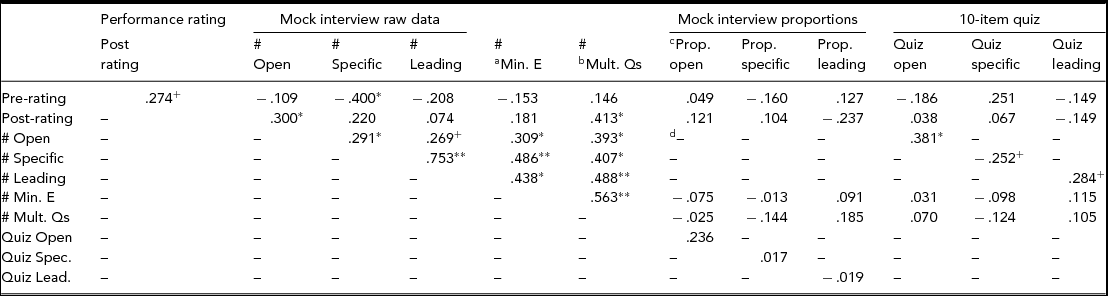
Teachers asked an average of 42.32 questions (SD = 21.39; range 6–99 questions) in their mock interviews. Of those, 13% were open (SD = 9%, range 0–41%); 54% were specific (SD = 10%, range = 35–78%); and 33% were leading (SD = 9%, range 13–52%). Of the 47 mock interviews, 34 (72%) began with an initial open-ended invitation to describe what happened; of those, however, 19 (56%) were asked in the format ‘Can you . . .’ (e.g., ‘Can you tell me what happened with Charlie?’). The remaining 28% began with a highly specific or leading question (e.g., ‘Did you see Charlie hurt?’ ‘So did something bad happen in the boys’ toilets today?’ ‘Has someone hurt your body?’). Teachers used an average of 5.72 minimal encouragers to carry on the conversation (SD = 4.68; range 0–19), and a bivariate correlation revealed that teachers who used more minimal encouragers also asked more open questions (see Table 1 for a correlation matrix of all variables included in the analyses). However, the use of minimal encouragers was also positively correlated with asking specific questions, leading questions, and multiple questions. Recall that minimal encouragers followed immediately by a question were not coded. Finally, multiple questions in a single utterance occurred relatively infrequently; an average of 2.32 times per interview (SD = 2.35; range 0–10). Thirteen interviewers never asked multiple questions; the mode was two per interview (n = 10).
Correlation Matrix of Study Variables

Note: +p < .10; *p < .05; **p < .001. a Min. E = minimal encouragers;bMult. Qs = multiple questions; cProp. = proportion; dInappropriate correlations omitted (e.g., raw totals and proportions).
Expectations of performance
Performance ratings were missing from two teachers. Of the 45 teachers who responded, they expected their performance to be adequate before they engaged in the mock interview (M = 5.94, SD = 1.22) and their impressions of their performance increased after they completed it (M = 6.87, SD = 1.39), t(44) = 3.92, p < .001, Cohen's d = .71. Their scores ranged from 3 to 9 at both time points.
10-item quiz
Teachers asked 26% open questions (SD = 16%, range 0–80%), 61% specific questions (SD = 20%, range 20–100%), and 13% leading questions (SD = 13%, range 0–50%) on the quiz. Three paired-samples t tests (alpha corrected .017) revealed that teachers asked more open questions on the quiz than in the mock interview, while the reverse was true for leading questions as predicted, ts ≥ 5.07, ps < .001, Cohen's ds ≥ .95; Specific questions did not differ at the corrected alpha level, t(44) = 2.07, p = .045, Cohen's d = .43.
We explored the teachers’ quiz responses for mention of any specific techniques beyond verbal questioning, but found these to be very infrequent. Two teachers suggested using props. In both cases, it was in response to Case 1 in which the child reported being touched on the ‘rude spot’, and both teachers proposed using a clothed image of a person. Three teachers suggested asking the child to draw what happened (one of these was a teacher suggesting the use of a prop); these were in response to Case 1, Case 6 (Simon does rude things), and Case 7 (child does not want to go to music class). Both genders, all levels of education, and a wide range of years of teaching experience were represented among these four teachers.
Inferential Analyses
We ensured that all variables were normally distributed and that there were no violations of homogeneity or multicollinearity. Variables were included in analyses using the enter method. We did not predict interactions among the variables, and so interaction terms were not created.
We first conducted a set of three multiple regression analyses to predict the proportions of open, specific and leading questions asked during the mock interview. The predictor variables were qualification level, pre- and post-performance ratings, and the associated question-type variable from the 10-item quiz (e.g., in the analysis concerning the proportion of open questions asked in the mock interview, the number of open questions on the quiz was included as a predictor variable). When the outcome variables were proportion question-type, none of the models were significant Fs ≤ 1.02, ps = ns, Cohen's f2s ≤ .10. Contrary to expectation, qualification level was neither associated with a greater proportion of open questions nor with a lower proportion of specific questions.
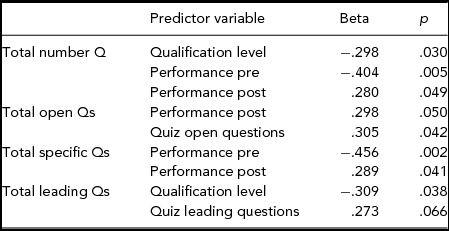
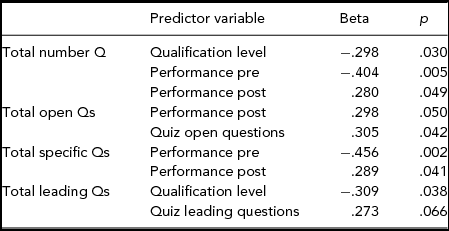
We then conducted the same set of analyses using the raw totals as outcome variables. The results of these analyses are presented in Table 2 in terms of significant standardised regression coefficients (betas). In the first analysis, we predicted the total number of questions asked in the interview. The model was significant, F(3, 41) = 6.08, p = .002, f 2 = .445, adjusted R square = .257. All predictors were significant. Teachers with the higher qualification level asked fewer questions. Asking questions in the mock interview was negatively associated with performance rating before the interview and positively associated with the post-performance rating. In other words, as teachers’ expected performance rating increased, the number of questions they asked in the mock interview decreased. But, asking fewer questions in the mock interview was related to a lower post-interview performance rating.
Variables Associated With Question-Type: Results of Multiple Regression Analyses
Note: Q = question.
We then conducted the regression analysis to predict the total number of open questions; the predictor variables were the same, but the number of open questions on the 10-item quiz was also added. The model was significant, F(4, 39) = 3.02, p = .030, f 2 = .307, adjusted R square = .16. The significant predictors were the post-performance rating and number of open questions on the quiz. Specifically, asking more open questions in the mock interview was positively associated with both a higher post-performance rating and with asking more open questions on the quiz. The remaining predictors were not significant (betas ≤ .13, ps = ns).
The regression analysis was significant for specific questions, this time substituting the number of specific questions on the quiz, F(4, 39) = 5.11, p = .002, f 2 = .524, adjusted R square = .276. Significant predictors were pre- and post-performance ratings. Qualification level and number of specific questions on the quiz were not significant (betas ≤ .23). Similar to the overall patterns for number of questions, expecting to do well on the mock interview was associated with asking fewer specific questions during the interview. Asking fewer specific questions during the mock interview, however, was associated with lower post-performance ratings.
Finally, the model for leading questions was significant, here inserting the leading questions variable from the 10-item quiz, F(4, 39) = 2.74, p = .042, f 2 = .282, adjusted R square = .14. Teachers at the higher qualification level asked fewer leading questions in the mock interview, and the number of leading questions on the 10-item quiz was marginally positively correlated with leading questions in the mock interview.
Discussion
The present research sought to characterise the ways in which teachers question children about witnessed or experienced wrong-doing. As predicted, teachers performed better (i.e., asked a greater proportion of open and a lower proportion of leading questions) on the quiz than during the mock interview when cognitive and social pressures were increased. There was some evidence that performance across the two testing situations was related; specifically, a significant positive correlation between open questions, and a marginal positive relationship between leading questions, was observed. The hypothesis that a higher qualification level would be associated with asking proportionally more open and fewer leading questions was not supported. When considering the raw data, however, the higher qualification level was associated with asking fewer questions overall, and fewer leading questions. In the subsequent section, we review the teachers’ performance and highlight both the positive aspects of their interviewing skills as well as identify areas for improvement.
How Did Teachers Question Children?
It was evident that teachers asked many questions in their mock interviews, although there was little evidence of asking multiple questions per turn, which is a positive feature of this set of interviews (Katz & Hershkowitz, Reference Katz and Hershkowitz2012; Korkman, Santilla, Drzewiecki, & Sandnabba, Reference Korkman, Santtila, Drzewiecki and Sandnabba2008; Saywitz, Camparo, & Romanoff, Reference Saywitz, Camparo and Romanoff2010). In a 10-minute interview, teachers asked an average of 4.2 questions per minute and the majority of these were of the specific type. The relative distribution of question types bears some similarity to that observed by Sternberg, Lamb, Davies, and Westcott (Reference Sternberg, Lamb, Davies and Westcott2001), who characterised the proportions of questions found in low quality interviews with 4- to 13-year-old children. Their police and social worker participants asked 6% Open, 76% Specific, and 5% Suggestive. (The remaining 13% were minimal encouragers; for purposes of our comparison with the quiz in which minimal encouragers were impossible, we did not include these in our proportion calculations.) Very similar to Sternberg and colleagues’ (Reference Sternberg, Lamb, Davies and Westcott2001) sample where approximately two thirds of the interviewers began with an open question, 72% of the mock interviews conducted by our teachers also began with an invitation, which we consider a very positive feature of their mock interviews. Nevertheless, the proportion of leading questions asked by our teachers was concerning.
Teachers asking their students leading or suggestive questions may be especially problematic. One reason that forensic interviews can be difficult for children is because they are such a novel situation. That is, children are very used to being questioned by people who already know the answer, who are aiming to ‘test’ children's knowledge and/or enhance their learning (Poole & Lamb, Reference Poole and Lamb1998). It is probably safe to assume that of all of the people in elementary- and primary-school children's lives, teachers are the most likely to engage in this kind of questioning. Although not as dangerous as leading questions, specific questions (e.g., ‘What did Charlie say?’) can also cause inaccuracies to arise in interviews because they imply that certain details are important (King & Yuille, Reference King, Yuille, Ceci, Toglia and Ross1987; see Zwiers & Morrisette, Reference Zwiers and Morrissette2013, for a review). Children may feel especially obligated to provide such information to their teachers (regardless of whether or not they have access to the information). It is also known that children's suggestibility is increased when questioned by someone they believe to be an authority figure (e.g., see Ceci, Ross, & Toglia, Reference Ceci, Ross and Toglia1987; Odegard, Cooper, Holliday, & Ceci, Reference Odegard, Cooper, Holliday, Ceci, Lampinen and Sexton-Radek2010; Waterman, Blades, & Spencer, Reference Waterman, Blades and Spencer2001).
When the proportions of open, specific and leading questions served as outcome variables in our analyses, we were surprised to discover the lack of associations. (These analyses were repeated including the verbal minimal encouragers as prompt-types and recalculating the proportions, and there were no differences.) That qualification level and performance ratings were unassociated with the proportions of each question-type asked is an important finding. The absence of relationships between the proportions of question-types on the mock interview versus quiz implies that teachers may simply be using a hit-or-miss strategy, approaching every situation in a unique way, with no internal strategy to guide them.
In a preliminary investigation of this nature, it was very important to repeat the analyses using the total numbers of each question type asked. The proportions characterise the overall patterns, but the number of questions themselves can be associated with the quality of interviews (Poole & Snow, Reference Powell and Snow2007). There is arguably a practical difference between asking 1 leading question out of 10 (10%) and 10 leading questions out of 100 (10%). Using the raw numbers provided greater insight into the relationships among qualification level, performance ratings and types of questions asked. Interestingly, qualification level only predicted leading questions (and the overall total); that is, teachers with a higher education level asked a smaller number of the most dangerous question-types — but not a lower proportion. Expected performance rating prior to the mock interview only predicted asking specific questions (and the overall total). In this case, the better teachers expected to perform, the fewer specific questions they asked during the mock interview, and the fewer questions overall. Teacher's ratings of their performance after the interview were associated with both open and specific questions, in the same direction. That is, the more of both of these question-types they asked (and the more overall), the better they thought they had done.
Differences between the mock interview and quiz were revealing. On the quiz, teachers were proportionally twice as likely to ask open questions as in the actual interview, and they were just over one third less likely to ask leading questions. Although the proportion of open questions on the quiz (26%) is still less than desirable, this finding may indicate that teachers have some implicit awareness of the quality of their questions. It is possible that participating in the mock interview may have heightened the teachers’ conscious thinking about the types of questions they asked, or that when they had time to think more carefully about questions they asked better ones (or both). This notion is consistent with research showing that knowing what to do does not translate to actual online practice without training (Aldridge & Cameron, Reference Aldridge and Cameron1999; Warren et al., Reference Warren, Woodall, Thomas, Nunno, Keeney, Larson and Stadfeld1999; see Bull, Reference Bull2010, for a review). Further evidence that teachers have at least an implicit understanding of good questioning technique comes from the low frequency of multiple questions observed, and the very high percentage of interviews that began with an open invitation (72%) to describe what happened, although the practice of adding ‘can you’ to the beginning of open prompts is discouraged (Davies & Westcott, Reference Davies and Westcott1999). In addition, only four teachers in the sample suggested using props or asking children to draw, procedures that are considered to be non-effective at minimum, or highly risky in certain circumstances (Salmon, Pipe, Malloy, & Mackay, Reference Salmon, Pipe, Malloy and Mackay2012; see Goodman & Melinder, Reference Goodman and Melinder2007, for a review).
Minimal encouragers (also referred to as ‘facilitators’) have an important function in narrative interviews; they provide the interviewee with a sense of being listened to and permission to continue the narrative, without the contribution of further dialogue from the interviewer (Hershkowitz, Reference Hershkowitz2002). The teachers in the current research did not make effective use of minimal encouragers. They used an average of 5.72 of these in their 10-minute interviews, but greater use of minimal encouragers was correlated with asking more of all question types, suggesting that these prompts were used to a greater extent by teachers who spoke more, generally.
Giving Teachers the Tools to Ask Good Questions
Some efforts are underway in Australia to train teachers to deal with cases of child maltreatment. For example, Farrell and Walsh (Reference Farrell and Walsh2010) involved first-year early childhood students in the Toby Study. ‘Toby’ was a fictitious boy suspected of being physically abused at home. Teachers worked collaboratively, either via online or face-to-face means, to determine whether Toby was abused and how they should respond. Some teachers had access to ‘Toby’s’ records, others to school policy and information about the prevalence of child abuse in Australia. Collaboration enhanced learning in both groups, but the reports from the online groups were more comprehensive. Notably, however, ‘Toby’ had obvious physical manifestations of his abuse and the focus of Farrell and Walsh's (Reference Farrell and Walsh2010) study was on increasing abuse awareness rather than questioning techniques to find out what had happened. Nevertheless, this research points to the benefits of using simulations to prepare teachers in dealing with child abuse.
Since teachers play such a large role in the lives of children and are in an advantageous position to identify abuse and maltreatment, it is critical to provide them with some training regarding the effects of various question-types, which we propose to be the next step in this line of research. There is no doubt that teachers feel responsible for the wellbeing of children in their care, and indeed 81–85% of teachers in Hawkins and McCallum's (Reference Hawkins and McCallum2001) survey agreed with such a statement, regardless of how much training they had received in child protection issues. Anecdotally, in our interviews, teachers not only tried to find out what had happened, but also asked questions about the child's feelings (asking if the child was upset, or if she was now feeling better) and problem-solving (e.g., asking the child to produce strategies to deal with wrongdoing, like telling a teacher). We suggest that with increased awareness of best-practice interviewing strategies, teachers will feel more empowered in their roles as mandated reporters.
Conclusions
The current findings suggest that teachers in this sample asked more leading and specific questions, and proportionally fewer open questions, than is desirable. On a positive note, many of the teachers began their mock interview investigations with an open invitation to explain what had happened, rarely asked multiple questions in a conversational turn, and very infrequently suggested using props. Just as in the pioneering work done in the area of forensic interviews with children (e.g., see Lamb et al., Reference Lamb, Orbach, Hershkowitz, Esplin and Horowitz2007; Powell, Wright, & Clark, Reference Powell, Wright and Clark2010; Yuille, Cooper, & Hervé, Reference Yuille, Cooper, Hervé, Casonato and Pfafflin2009), this study serves as a preliminary foundation to understanding how teachers currently question children about wrongdoing such that training programs and interventions can be developed. Further research assessing the best and most time- and cost-effective ways of training delivery is now warranted. The potential outcomes of such programs would be numerous and should lead to increased confidence in dealing with suspicions of abuse, in turn resulting in higher-quality interviews and reports from the children. Good interviewing technique not only helps to elicit reports of abuse when it has happened, but also avoids contaminating children's narratives, such that fewer incorrect reports are filed. Consequently, the proportion of abuse reports submitted by schools that are eventually investigated should increase.