Implications
In Asia and Africa, the straw harvested from rice cultivation areas is the main roughage available to ruminants for a significant part of the year. However, it is poorly degraded in the rumen because of its low crude protein and high lignin and silica contents. In the present study, the effects of ammonia pretreatment and lucerne extract supplementation on the digestion of cell wall monosaccharides and uronic acids were assessed. The simultaneous use of treatment and supplementation is expected to improve the feeding value of rice straw for ruminants.
Introduction
In Asia and, to a lesser extent, in Africa, the straw harvested from rice cultivation areas is the main roughage available to cattle and small ruminants for a significant part of the year. Like other cereal residues, rice straw contains large amounts of polysaccharides that are a potential source of energy for the rumen microbiota. Its low nutritive value, linked to low crude protein (CP) and high lignin and silica contents, has prompted the use of various strategies to improve its utilisation by microbes (Van Soest, Reference Van Soest2006). Polysaccharide solubilising processes calling upon alkali-based agents have increased cell wall and sugar degradabilities in rice straws by facilitating microbial access (Schiere and de Wit, Reference Schiere and de Wit1995; Harada et al., Reference Harada, Nakamura and Minato1999; Nguyen et al., Reference Nguyen, Kim, Han, Cho, Kim, Park, Park and Sim2010). By-products from local gardening and the agro-industry have been supplied to provide rumen microbes with limiting nutrients in semi-intensive production systems in Africa and in Asia. The nutritional values of local leguminous trees and vegetables are well documented in this regard (Kaitho et al., Reference Kaitho, Umunna, Nsahlai, Tamminga and Van Bruchem1998; El-Nor and El-Sayed, Reference El-Nor and El-Sayed2000; Orden et al., Reference Orden, Abdulrazak, Cruz, Orden, Ichinohe and Fujihara2000; Pamo et al., Reference Pamo, Boukila, Fonteh, Tendonkeng, Kana and Nanda2007).
In an in vitro experiment on the effect of rice straw ammoniation and supply of fresh lucerne extract – a model of legume supplementation – on rumen metabolism, we observed that at low input levels of lucerne extract both ash-free NDF (NDFom) and ash-free ADF (ADFom) degradabilities tended to be lower with treated rice straw (e.g. 0.30 v. 0.46 for ADF), whereas at higher input levels they were not modified by straw treatment (Broudiscou et al., Reference Broudiscou, Agbagla-Dohnani, Papon, Cornu, Grenet and Broudiscou2003). The present work was aimed at addressing the origin and extent of this interaction with respect to cell wall constituents. We studied the effects of ammonia pretreatment and lucerne extract supplementation on the digestion of cell wall neutral monosaccharides and uronic acids (UAs) for a better understanding of how cell wall monomers were made available to microbial fermentation by these two factors.
Material and methods
Experimental design
The chemical compositions of lucerne (Medicago sativa L.) and African legumes, such as Vigna unguiculata, consolidated in phytochemical databases are similar, especially for β-carotene, niacin, riboflavin, thiamine and mineral concentrations in their aerial parts (Duke, Reference Duke1992). These data only indicated one major difference with respect to the concentration of ascorbic acid in V. unguiculata, one-third of that found in lucerne. Lucerne extract was thus used as a model in response to the lack of fresh material from V. unguiculata in France.
Two types of rice straw (Oryza sativa, variety Thaïbonnet), either native (untreated rice straw (URS)) or ammonia-treated rice straw (TRS), were used. Lucerne extract was introduced into continuous cultures at three levels: 0, 0.227 and 0.454 ml/g straw dry matter (DM). This corresponded to an incorporation level of whole lucerne in the diet up to 100 g/kg DM. The six combinations of experimental treatments were randomly assigned to six fermentors (working volume of 1.1 l) for two consecutive periods of 7 days. This randomised complete block design allowed the estimation of all main effects, interaction and quadratic effect of lucerne supply. Second-order polynomials have been shown to correctly describe the action of lucerne extract on rumen microbial metabolism (Broudiscou et al., Reference Broudiscou, Agbagla-Dohnani, Papon, Cornu, Grenet and Broudiscou2001).
Experimental feeds and incubation procedure
Rice straw was harvested from the Camargue region of France. A batch of straw was treated with ammonia as described in Broudiscou et al. (Reference Broudiscou, Agbagla-Dohnani, Papon, Cornu, Grenet and Broudiscou2003). The TRS and a batch of URS were both ground through a hammer mill (screen aperture of 8 mm) and pelleted (Unité de Préparation des Aliments Expérimentaux, INRA Jouy-en-Josas, France). Before the experiment, a batch of lucerne at the beginning of flowering (first growth) was coarsely chopped and divided into portions of 200 g, immediately stored at −20°C in air-tight plastic bags until use. On each day of incubation, a portion was thawed and extracted as described in Broudiscou et al. (Reference Broudiscou, Agbagla-Dohnani, Papon, Cornu, Grenet and Broudiscou2003). The soluble sugars and CP contents of the extract were 12.0 and 15.93 g/l, respectively. When lucerne extract was introduced at 0.454 ml/g straw DM, it supplemented the fermentor with 0.12 g/day soluble sugars and 0.159 g/day CP.
Three wethers fitted with rumen cannula and fed 1200 g/day rice straw and 100 g/day soybean meal served as rumen fluid donors to inoculate fermentors at the beginning of each period. Animal care and use procedures were approved by the French Ministry of Agriculture in agreement with French regulations for animal experimentation (guideline 19/04/1988). The fermentor design and incubation procedure is detailed in Broudiscou et al. (Reference Broudiscou, Agbagla-Dohnani, Papon, Cornu, Grenet and Broudiscou2003). The dilution rates of particle and liquid phases were set at 0.03 and 0.06/h. Because 65% to 75% of the nitrogen (N) fixed on roughage through ammonia treatment was readily available to microbes (Dulphy et al., Reference Dulphy, Komar and Zwaenepoel1984), the amounts of available N were equalised among diets by pipeting into URS fermentors 5 ml of a 30.57 g/l NH4Cl solution simultaneously with the supply of substrate every 12 h.
Chemical analysis
After a 5-day adaptation period, the displaced and filtered effluents were collected during 2 days, pooled and freeze-dried. Feeds and effluents were ground before analysis in a Culatti grinder (Zurich, Switzerland) with a screen of 0.8 mm aperture. They were analysed for DM, organic matter, NDF (assayed without sodium sulphite and with alpha amylase), ADF and ADL (Robertson and Van Soest, Reference Robertson and Van Soest1981). NDFom and ADFom were calculated from the determination of their ash content (550°C, 5 h). Hemicellulose contents were calculated from NDFom and ADFom. Lucerne extract did not interfere with the measurement of straw cell wall constituent degradabilities, as its contribution to the inflow of cell wall constituents was below the determination level of the method. Total N was determined by the Dumas technique (Sweeney and Rexroad, Reference Sweeney and Rexroad1987) and CP was calculated as N × 6.25.
The data used in the calculation of cell wall component degradabilities were collected as follows. Cell wall residues (CWR) from URS, TRS and effluents were obtained by extraction in ethanol and ethanol/toluene (Jarrige, Reference Jarrige1961) after a thorough washing with deionised water at 40°C. This method was preferred to the more widely used NDF method because the neutral detergent dissolves a fraction of cell wall polysaccharides, especially pectic substances (Jarrige, Reference Jarrige1980). Before quantitative determination of monosaccharides, CWR were finely ground in a ball mill. UA concentration was determined colorimetrically (Blumenkrantz and Asboe-Hansen, Reference Blumenkrantz and Asboe-Hansen1973) after a sulphuric acid hydrolysis step (Englyst et al., Reference Englyst, Wiggings and Cummings1982). Cell wall neutral monosaccharides were analysed by gas chromatography of alditol acetates (Englyst and Cummings, Reference Englyst and Cummings1984). All analyses were in triplicate.
Calculations and statistical analysis
For both straws, the degradability of a given cell wall component dT was calculated using the following formula:

where O being the component daily outflow and IT its total daily inflow, that is, the amount supplied by URS. In this way, the calculation of dT included the TRS cell walls already solubilised by ammoniation and it accounted for the effects of our experimental factors on the degradability of the entire cell wall fraction. In the following text, CWRt refers to the CWR degradability calculated using formula (1).
The degradability of a given CWR component dR was calculated by using as the denominator its daily inflow IR calculated for each type of straw:

The variation of dR in function of experimental factors would specifically highlight differences in CWR nutritional properties such as the accessibility to microbial attack.
Results were subjected to multiple linear regression using a MINITAB procedure (Minitab, 1998). The variables were straw ammoniation (S) and lucerne extract supplementation (L). Period (P) was included as a randomising block. The variable S was set to −1 for URS and +1 for TRS. The variable A was related to the actual amount of lucerne supplied L′ (in ml/g straw DM) by the equation:

Thus, for values of L′ of 0, 0.227 and 0.454 ml/g straw DM L was −1, 0 and 1, respectively. Data were fitted to the following second-order polynomial model:

where Y was the response; S, L and P the three coded variables described above; and b 0, b 1, b 2, b 3, b 4 and b 5 the six regression coefficients to be estimated. As an illustration, when fermentors were supplied with TRS and lucerne extract at maximal level, the variables S and L were set to +1 and, according to the regression coefficients, the predicted CWR degradability equalled:

When fermentors were supplied with URS and no lucerne extract, the predicted CWRt degradability was

The regression coefficient estimates were compared to zero by a student t-test.
Results
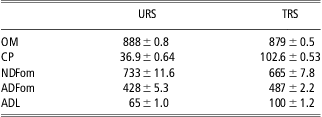
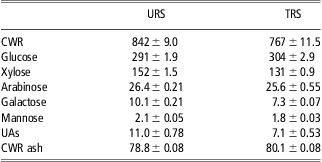
The compositions of URS and TRS are given in Table 1. Ash contents were similar in both straws (112 and 121 g/kg DM). Ammonia treatment decreased ash-free NDF content of rice straw by 68 g/kg DM and increased ash-free ADF and ADL contents by 59 and 35 g/kg DM, respectively, along with an expected increase in CP. Concentrations of monomers in URS and TRS are given in Table 2. URS exhibited higher contents of ash-free CWR (763 v. 687 g/kg DM) and non-cellulosic sugars (191 v. 166 g/kg DM). Ammonia treatment preferentially removed xylose, which led to a lower xylose-to-arabinose ratio in TRS (5.1 v. 5.8).
Composition of rice straw with (TRS) or without (URS) ammonia treatment (g/kg DM)

TRS = ammonia-treated rice straw; URS = untreated rice straw; DM = dry matter; OM = organic matter; CP = crude protein; NDFom = ash-free NDF; ADFom = ash-free ADF.
The s.e.m. (n = 4) is given for each determination.
Concentrations of neutral monosaccharides and UAs in URS and TRS (g/kg DM)

UA = uronic acid; URS = untreated rice straw; TRS = ammonia-treated rice straw; DM = dry matter.
CWR: cell wall residue according to Jarrige (Reference Jarrige1961).
The s.e.m. (n = 3) is given for each determination.
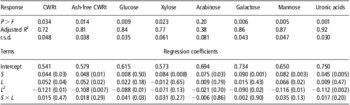
The effects of ammonia treatment and lucerne extract on the degradabilities of cell wall components are given in Table 3. The most degraded compounds were galactose (dT from 0.57 to 0.83), arabinose (dT from 0.59 to 0.77) and UAs (dT from 0.59 to 0.80). Glucose and xylose degradabilities were much lower, from 0.46 to 0.64 and from 0.36 to 0.63, respectively, whereas mannose dT was intermediate, from 0.49 to 0.74. The model fitted well to all data except for arabinose. Ammonia treatment had a positive impact on all degradabilities without any significant S × A interaction term, with the noticeable exception of glucose. CWRt, ash-free CWRt and mannose degradabilities were increased mainly by ammonia treatment. As an example, for an intermediate lucerne extract supply of 0.227 ml/g straw DM, CWRt degradability shifted from 0.497 to 0.585 (+18%) following ammonia treatment. CWRt, ash-free CWRt and mannose degradabilities were also increased by lucerne extract in a curvilinear way, the optimal value of lucerne extract input being estimated at 0.28 ml/kg straw DM. In contrast, this factor had no effect on xylose, arabinose and galactose degradabilities. Glucose degradation showed a particular pattern of variation as it was mainly influenced by the level of lucerne extract in significant interaction with the type of straw. This curvilinear effect, overall, was more favourable with TRS, shifting the optimal level of lucerne input from 0.20 to 0.31 ml/g straw DM.
Effects of ammonia treatment and lucerne supplementation on the degradability dT of cell wall components

CWRt: the reference value is the URS cell wall residue according to Jarrige (Reference Jarrige1961).
P > F: P-value associated with the F-statistic.
Coded variables: S, straw ammoniation; L, lucerne extract supplementation.
For each regression coefficient, P-value for the null hypothesis is in brackets.
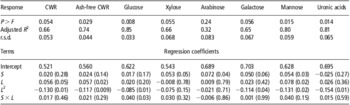
The effects of ammonia treatment and lucerne extract on the degradabilities of CWR components are given in Table 4. CWR degradability varied from 0.33 to 0.56. Among monomers, glucose (dR between 0.48 and 0.66) and xylose (dR between 0.36 and 0.57) were the least degraded, followed by mannose (dR from 0.42 to 0.70) and UAs (dR varying from 0.47 to 0.70). The highest degradabilities were found for galactose (dR from 0.57 to 0.77) and arabinose (dR from 0.59 to 0.76). The polynomial model explained most of the variability in sugar degradabilities except for arabinose. CWR and ash-free CWR degradabilities were only modified by the lucerne extract in a curvilinear way. Glucose degradability in CWR followed the same trend as in the entire cell wall fraction, that is, linear effect of lucerne extract supplementation and a significant interaction with straw treatment. Non-cellulosic sugars had dR influenced mainly by straw treatment. However, the positive effect of ammoniation on xylose, galactose and mannose degradation was 40% lower than that when the entire cell wall fraction was considered.
Effects of ammonia treatment and lucerne supplementation on the degradability dR of CWR components

CWR: cell wall residue according to Jarrige (Reference Jarrige1961).
P > F: P-value associated with the F-statistic.
Coded variables: S, straw ammoniation; L, lucerne extract supplementation.
For each regression coefficient, P-value for the null hypothesis is in brackets.
Discussion
The decrease in NDFom content following ammoniation was consistent with the existing data (Bae et al., Reference Bae, McAllister, Kokko, Leggett, Yanke, Jakober, Ha, Shin and Cheng1997). As expected, the most important effects of ammonia treatment were on cell wall structure. Hemicelluloses accounted for 42% ash-free NDF in URS and only 27% in TRS. Comparable decreases in concentrations of hemicelluloses and arabinose residues after ammonia or urea treatment have also been reported in maize stover (Sewalt et al., Reference Sewalt, Fontenot, Allen and Glasser1996) and barley straw (Caneque et al., Reference Caneque, Velasco, Sancha, Manzanares and Souza1998). During ammoniation, ammonia cleaves ester linkages, such as diferulic bridges between arabinoxylan chains, but does not release the degrafted polymers, which are subsequently washed away during the first step of cell wall analysis procedure with water or neutral detergent. In our conditions, about 9% CWR and ash-free NDF were alkali labile, a ratio similar to those previously found in wheat, barley and oat straws (Mason et al., Reference Mason, Roy, Hartley, Keene and Cobby1988). We took this alkali-labile fraction into account in the calculation of dT in order to differentiate these cell wall polymers from actual cell contents.
The major neutral sugars and the ash-free cell wall fractions were degraded to a similar extent and in agreement with published data. Glucose and xylose basal degradabilities, from URS with no lucerne extract supplementation, equalled 0.54 and 0.46, respectively, close to the values of 0.61 and 0.50 previously reported in continuous fermentors receiving URS (Karunanandaa and Varga, Reference Karunanandaa and Varga1996). The other monomers, either xylan substituents (UAs and arabinose) or constitutive of other hemicelluloses, had much greater degradabilities. A similar ranking of cell wall monosaccharides on the basis of ruminal digestibilities was reported in steers fed wheat or barley straw supplemented with flaked maize and various N sources, after correction for microbial contribution (McAllan and Smith, Reference McAllan and Smith1976; McAllan, Reference McAllan1991). Similarly, in dairy cows fed ear and husk meal maize silage and grass hay, xylose had the lowest rumen apparent digestibility (0.46 to 0.66), followed by glucose (0.61 to 0.72) then arabinose (0.75 to 0.85), galactose (0.81 to 0.87) and mannose (0.80 to 0.84; Südekum et al., Reference Südekum, Puls, Brandt and Vearasilp1992).
Our empirical modelling of the degradation extent of structural monosaccharides provided new insights into the origin of the interaction specific to cell wall fractions, because cellulose and hemicelluloses were clearly differentiated on the mode of action of our experimental factors. In the cell wall and in CWR, glucose was the only monomer whose degradability was affected by straw pretreatment through the interaction with lucerne extract, suggesting a role for microbial interspecies competition under the control of cellulose availability. In continuous or batch culture, Ruminococcus flavefaciens predominated in coculture with either Fibrobacter succinogenes or Ruminococcus albus under cellulose limitation, whereas coexistence was observed in cellulose-excess conditions (Shi et al., Reference Shi, Odt and Weimer1997). These species differ slightly in their nutritional requirements (Hungate, Reference Hungate1966) and a shift in their relative populations caused by ammoniation through an increased cell wall accessibility might explain the differential impact of lucerne extract on cellulose digestion. Cytoplasmic contents other than nitrogenous compounds or macrominerals may be involved in these effects on cellulolytic bacteria. In the present study, a similar amount of N was available to microorganisms whatever the continuous culture and it met the requirement for microbial growth set in the INRA feeding system (Vérité and Peyraud, Reference Vérité and Peyraud1988) at 145 g CP/kg fermented organic matter (FOM). This ratio averaged 191 and 145 g CP/kg FOM with TRS and URS, respectively. Besides, phosphorus and sulphur inputs from artificial saliva provided microbial metabolic requirements (Durand and Kawashima, Reference Durand and Kawashima1980). The curvilinear influence of lucerne supplementation has been observed on other rumen variables such as microbial protein synthesis efficiency and microbial biomass production (Broudiscou et al., Reference Broudiscou, Agbagla-Dohnani, Papon, Cornu, Grenet and Broudiscou2001). Similar effects of lucerne hay supplementation of a roughage-based diet have also been reported in vivo (Wang et al., Reference Wang, Fan, Xing and Yang2008).
Ammonia treatment had a positive effect on the degradation of hemicellulosic sugars. The positive link between hemicellulose solubilisation and fibre degradability is well documented in barley straw (Caneque et al., Reference Caneque, Velasco, Sancha, Manzanares and Souza1998) and in lucerne (Ballet et al., Reference Ballet, Besle and Demarquilly1997). When regression coefficients were compared in cell wall and CWR models for a given monomer, it suggested that ammoniation improved the degradabilities of xylose, galactose and mannose by solubilising a hemicellulose fraction and by improving the susceptibility of the remaining fraction to microbial colonisation and enzymatic attack. In contrast, ammoniation appeared to affect each xylose substituent in a single way. It increased arabinose degradability by favouring microbial attack, whereas it acted on UAs mostly by solubilising the related polymers. This differential effect of ammonia treatment on monomeric compounds might be related to the cell wall structural heterogeneity at the molecular level and the type and number of ester linkages differing between hemicelluloses (Cornu et al., Reference Cornu, Besle, Mosoni and Grenet1994). It might also stem from differences in chemical composition and accessibility between plant tissues and parts (Bourquin and Fahey, Reference Bourquin and Fahey1994). It has been observed that alkali treatment damages the silicified cuticular layer of leaf blades (Wang et al., Reference Wang, Liu, Li, Wu and Ye2007) and lowers the physical strength of rice straw particles (Selim et al., Reference Selim, Pan, Takano, Suzuki, Koike, Kobayashi and Tanaka2004), allowing microbial access to inner tissues.
Conclusion
The analysis of cell wall degradation at a monomer level allowed the drawing of inferences about the respective roles of ammoniation and legume supplementation on rice straw rumen digestion in relation with the nature of the structural polysaccharide degraded.