The Institute of Medicine's 2006 report Hospital-based Emergency Care: At the Breaking Point defines a disaster as “an event that creates a significant, short-term spike in the demand for emergency care services requiring extraordinary measures.”1 Adequacy of the workforce, as a function of both quantity and availability of specialized care, is described as a key aspect of disaster response.1 However, to varying degrees, workforce attrition during disasters and public health emergencies should be expected. Reference Alexander and Wynia2–Reference Qureshi, Gershon and Sherman4 Exploring alternatives for fulfilling workforce requirements is essential to meeting surge capacity demands that may arise during disasters.Reference Rothman, Hsu, Kahn and Kelen5
Development of a robust, skilled medical and public health workforce has often been identified as a cornerstone of optimizing response.Reference Nelson, Lurie, Wasserman and Zakowski6 Future physicians, given the proper education and training, may serve as a major untapped valuable resource that can support workforce needs during times of emergency. According to the Association of American Medical Colleges (AAMC) and the American Association of Colleges of Osteopathic Medicine, approximately 83,600 medical students are enrolled in either allopathic or osteopathic medical schools in the United States.7, 8 Following World War II, the Committee on Medical Education in Time of National Emergency outlined recommendations to “reorganize the curriculum to give proper emphasis to subjects of particular importance for the national health, security, and welfare in time of national emergency.”Reference Brown9 In 2003, the AAMC renewed calls for disaster medicine and public health preparedness to be introduced into the medical school curriculum through the release of a report charging medical schools to integrate weapons of mass destruction education into the curriculum.10 Since then, medical schools have stepped up efforts to incorporate disaster medicine and public health preparedness into their curricula with an all-hazards emphasis.11
Although emphasis on incorporating disaster medicine and public health preparedness into medical school curricula has increased, to our knowledge, no studies have described the viewpoints of medical students on education and training. To better clarify the role of future physicians in preparedness and response, we explored their perspectives on education and training in disaster medicine and public health preparedness, their willingness to participate during disasters, and their attitudes and beliefs regarding the roles of health professionals during such events.
METHODS
A survey instrument was developed by the working group to assess medical student perspectives on knowledge, skills, and attitudes concerning disaster medicine and public health preparedness; personal preparedness efforts; and disaster-related volunteer experience. The survey consisted of 82 items, including 6 demographic questions, 61 ordinal questions using a 10-point Likert scale (ranging from 1 = “strongly agree” to 10 = “strongly disagree”), 9 binomial questions, and 6 open-ended short-answer questions with a response field. Three representative scenarios followed by a series of questions were included: a natural disaster, pandemic influenza, and a radiological dispersal device (“dirty” bomb). Each of the scenarios invoked different hypothetical planning, response, and recovery efforts and was specifically chosen to assess respondent views from an all-hazards approach. Internal review board exemption was granted by the Johns Hopkins Bloomberg School of Public Health review board.
The survey instrument was translated into a Web-based format, pilot tested at a medical student workshop, and revised. All of the individuals enrolled in an allopathic or osteopathic medical school in the United States met inclusion criteria. Participants were recruited through the American Medical Association-Medical Student Section (AMA-MSS), the AAMC Office of Student Representatives (OSR), and the American Osteopathic Association's Student Osteopathic Medical Association (SOMA) using general, nonorganizational specific medical school listservs. The AMA-MSS has chapters and membership from 144 accredited allopathic and osteopathic schools.12 The AAMC-OSR's representatives are from each of the 129 allopathic medical schools in the United States.13 SOMA has chapters at all accredited osteopathic medical schools.14 The final Web-based survey was available online November 2007 to March 2008 through a freely available Web service (SurveyMonkey.com, Portland, OR).
Data analysis was performed using commercially available software (Stata Intercooled version 10; StataCorp, College Station, TX). Descriptive data analysis was used to describe characteristics of respondents by calculating the frequencies and proportions for categorical variables. For ordinal questions, the working group dichotomized the Likert scale to facilitate statistical analysis. Responses to the statement provided that ranged from 1 to 5 were classified as indicating agreement, and responses that ranged from 6 to 10 were classified as indicating disagreement. Based on the sample size, precision for a dichotomous response was within ±4%. Logistic regression was used to calculate crude odds ratios (ORs) to evaluate the association of attitudes and beliefs with self-described likelihood to respond for each disaster scenario. Multivariate logistic regression was performed to compute adjusted ORs in identifying factors associated with self-described likelihood to respond for each disaster scenario. The model was adjusted for age, sex, and year of medical school enrolled. ORs based on discordant pairs were calculated using McNemar's test to compare self-described likelihood to respond across the disaster scenarios.
RESULTS
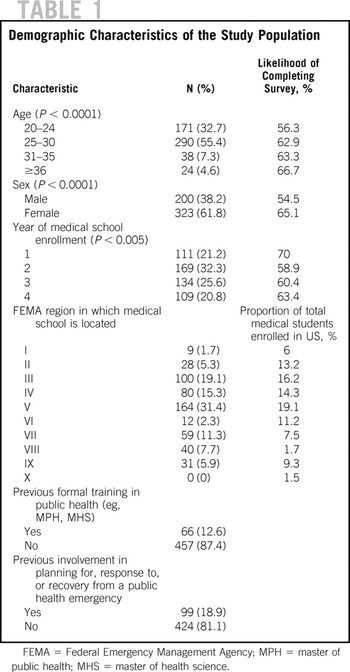
A total of 523 medical students nationwide completed the survey in its entirety. Among those who accessed the survey (523/863), the overall response rate was 60.6%. The largest proportion of surveys was completed by second-year medical students (32.3%). Approximately 61.8% of respondents were female and half of all respondents were between 25 and 30 years of age (Table 1).
Demographic Characteristics of the Study Population

Knowledge and Skills
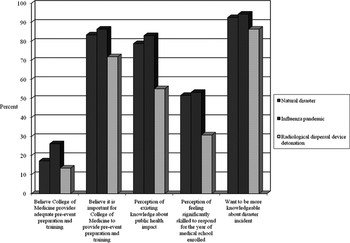
Of the 523 medical students who responded, 90 (17.2%) believed that they were receiving adequate preevent preparation and training for natural disasters, 137 (26.2%) for pandemic influenza, and 71 (13.4%) for radiological events. A total of 270 (51.6%) believed that they were sufficiently skilled for their level of medical education to respond to a natural disaster, 278 (53.2%) for pandemic influenza, and 161 (30.8%) for a radiological dispersal device, respectively. Of the respondents, 484 (92.5%) desired becoming more knowledgeable about natural disasters, 493 (94.3%) about pandemic influenza, and 452 (86.4%) about radiological events (Fig. 1).
Proportion of medical students who agreed with knowledge and skills constructs by disaster scenario.

Attitudes and Beliefs
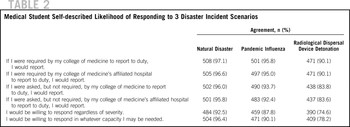
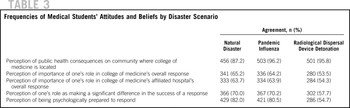
Regardless of severity, a total of 484 (92.5%) participants would be willing to respond in the event of a natural disaster, 459 (87.8%) would be willing to respond in the event of pandemic influenza, and 390 (74.6%) would be willing to respond to a radiological event. Regardless of the capacity in which they would be expected to perform, 504 (96.4%) would be willing to respond to a natural disaster, 471 (90.1%) would be willing to respond in an influenza pandemic, and 409 (78.2%) would be willing to respond to a radiological event (Table 2). In terms of psychological readiness, 429 (82.0%) believed they were prepared to respond to a natural disaster, 421 (80.5%) for pandemic influenza, and 302 (54.7%) for a radiological event (Table 3).
Medical Student Self-described Likelihood of Responding to 3 Disaster Incident Scenarios

Frequencies of Medical Students' Attitudes and Beliefs by Disaster Scenario

Overall, medical students were more likely to respond to a natural disaster than an influenza pandemic regardless of severity (OR 2.6, 95% confidence interval [CI] 1.4–4.9) or required capacity (OR 7.6, 95% CI 3.0–24.7). They were, however, less likely to respond to a radiological event as compared with an influenza pandemic regardless of severity (OR 0.17, 95% CI 0.09–0.30), or required capacity (OR 0.18, 95% CI 0.10–0.33).
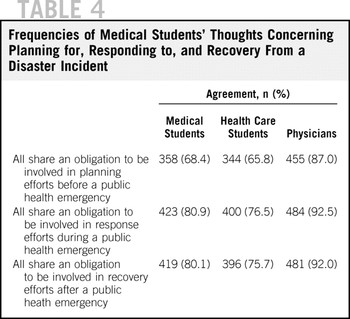
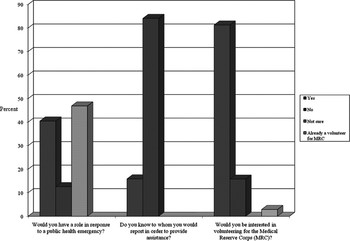
Among the respondents, 358 (68.4%) believed all medical students share an obligation to be involved in public health emergency planning efforts, 423 (80.9%) in response, and 419 (80.1%) in recovery efforts after a public health emergency (Table 4). A total of 366 (70.0%), 367 (70.2%), and 302 (57.7%) perceived their role as making a significant difference in the success of a response to a natural disaster, pandemic influenza, and a radiological event, respectively. Among respondents, 212 (40.5%) believed they have a role as medical students in a public health emergency, but 440 (84.1%) did not know to whom they would report to provide assistance if it should occur. Although only 15 (2.9%) are volunteers with the Medical Reserve Corps (MRC), 423 (81.3%) expressed interest in volunteering for the MRC (Figure 2).15
Frequencies of Medical Students' Thoughts Concerning Planning for, Responding to, and Recovery From a Disaster Incident

Proportion of medical students' thoughts on roles in, reporting to, and volunteering for the Medical Reserve Corps.

In multivariate analysis adjusted for age, sex, and year in medical school, increased self-described likelihood of responding for all 3 scenarios was associated with belief in the importance of one's role (natural disaster OR 7.6, 95% CI 2.7–21.7; pandemic influenza OR 5.3, 95% CI 2.4–11.6; radiological event OR 4.1, 95% CI 2.4–6.9), belief that one's role affects the success of a response (natural disaster OR 4.0, 95% CI 1.6–10.0; pandemic influenza OR 5.3, 95% CI 2.5–11.3; radiological event OR 5.8, 95% CI 3.4–10.1), and confidence about personal safety (natural disaster OR 3.3, 95% CI 1.4–8.2; pandemic influenza OR 3.7, 95% CI 1.8–7.6; radiological event OR 2.8, 95% CI 1.7–4.6). Feeling psychologically prepared was significantly associated with an increased likelihood to respond upon request to both an influenza pandemic (OR 9.4, 95% CI 4.3–20.7) and a radiological event (OR 6.8, 95% CI 3.8–12.3). Perception of being knowledgeable about the potential public health impacts of a disaster was significantly associated with an increased likelihood to respond upon request to a natural disaster (OR 4.0, 95% CI 1.6–9.9) and a radiological event (OR 2.7, 95% CI 1.6–4.4).
Personal Preparedness
Only 93 of 513 (18.1%) of respondents reported having assembled a designated emergency preparedness kit. A total of 188 of 514 (36.6%) respondents had mapped 3 alternate routes to their school/affiliated hospital in case they were asked to respond to a disaster.Reference Parker, Barnett and Fews16 Only 104 of 512 (20.3%) respondents had dependents who would rely on their care in the event of a disaster.
DISCUSSION
The findings of this survey provide a national benchmark for medical school educators and health policy experts that clearly demonstrates medical students' willingness to respond to public health emergencies (>90%, 80%, and 70% to natural disaster, pandemic influenza, and radiological dispersal device hypothetical scenarios, respectively). The findings also uncover a significant gap in disaster medical education and training and level of preparedness required for a student to respond to such events. Specifically, less than 20% of medical students believed they had adequate preparedness education for natural disasters or radiological dispersal device detonation, and less than 30% for an influenza pandemic. This gap is particularly striking because natural disasters are increasing in magnitude and frequency—a trend that can be expected to continue.17 Furthermore, the continued specters of an influenza pandemic or potential terrorist attack will require a major medical response.Reference Bartlett and Borio18
The survey also revealed a specific willingness for medical students to volunteer for the MRC (81.3%), a critical medical and public health asset established to enhance the local surge capacity to any disaster. Only 2.9%, however, responded that they were part of the MRC and nearly 85% of students did not know to whom they should report in times of disaster. This does not suggest that medical students' duty is to provide clinical care, but rather that they can offer additional surge resources such as staffing telephone hotlines during a pandemic or providing prophylaxis or immunizations as part of medical response in a biological event. Some medical schools have recently initiated formal MRC units on campus (eg, University of Minnesota; Rob Tossato, National MRC director, personal communication), a model that can facilitate seamless organizational integration of medical students into disaster response.
The findings of this survey must also be recognized in context of the release of the Pandemic and All-Hazards Preparedness Act of 2006 and Homeland Security Presidential Directive 21 of October 2007, which described a federal plan to invest $1.3 billion in the development of the medical and public health workforce to promote the discipline of disaster health.19, 20 Furthermore, the presidential directive established benchmarks in education and training that include the establishment of a National Disaster Medical University at the Uniformed Services University School of Health Sciences to coordinate the establishment of a standardized set of competencies and curriculum.19
These broad policy initiatives are laudable. As evidenced by this survey's results, however, reaching a national standardization in medical school curriculum implementation will also require significant investment and partnership from the private sector, including but not limited to AAMC, American College of Osteopathic Medical Colleges, Association for Continuing Graduate Medical Education, and the AMA.
In light of these policy and stakeholder issues, the survey's findings highlight an urgent need for a national educational forum and summit led by organized medicine in conjunction with the Uniformed Services University School of Health Sciences to elevate disaster medicine as 1 of its core competencies. It is only at this level that a clear standardization in curriculum can be adopted across the country and the level of national preparedness be raised. This effort would also further catalyze the development of MRC units on medical school campuses. Moreover, integrating disaster medicine into medical schools' core curricula would also help to foster and cultivate the future leaders of disaster preparedness, as well demonstrate medicine's role as leader in disaster health response.
In understanding the implications of this study, a few limitations must be noted. Only 3 organizations were used as conduits for survey delivery, possibly decreasing access to the survey by all enrolled medical students from across the country. Other organizations involved in medical student advocacy and education, such as the American Medical Student Association and the American Association of Colleges of Osteopathic Medicine's Council of Osteopathic Student Government Presidents, did not participate in survey dissemination and may have attracted medical students who may be more actively involved within these organizations. Selection bias may have also been present, given that students 36 years of age or older, females, and those enrolled in their first year of medical school were more likely to have fully completed than to have partially completed the survey upon commencement. Limitations in data analysis include dichotomizing the ordinal questions and grouping the “not sure” answers with the “disagree” answers.
Despite these limitations, the survey results provide a necessary and timely window into the knowledge, skills, and attitudes of medical students regarding public health preparedness and disaster response. Ultimately, the findings highlight medical students' untapped potential for augmenting medical surge needs in public health emergencies, and the critical role that medical schools' disaster curricula could play in translating their students' willingness to respond into additional all-hazards response capacity.
Acknowledgments
The authors thank Dr Marie Diener-West for assistance with biostatistical analysis and Natalie Semon for help with the survey and its dissemination.
Authors' Disclosures
The authors report no conflicts of interest.