Introduction
Suicide is the tenth leading cause of death in the USA (Drapeau and McIntosh, Reference Drapeau and McIntosh2017), and the prevention of suicide is a national imperative (Power and McKeon, Reference Power and McKeon2012). Despite the fact that suicide is a potentially preventable outcome, this phenomenon is poorly understood due in part to the inherent difficulty in collecting adequate data on deaths by suicide. Because of this, much of the research related to suicidal behavior focuses on survivors of suicide attempts (Freedenthal, Reference Freedenthal2008). This large body of research has led to the identification of various factors that increase the risk for suicide (for example, a history of suicidality is a robust risk factor for future suicidality; e.g. Joiner et al., Reference Joiner, Conwell, Fitzpatrick, Witte, Schmidt, Berlim, Fleck and Rudd2005) which has assisted efforts to identify individuals at elevated risk for death by suicide. Although these efforts have been important to understanding mechanisms that lead to suicide and which individuals are at higher risk for suicidal behaviors, research on individuals with a history of nonfatal suicidal behavior may overlook a substantial proportion of the population that actually dies by suicide. Several estimates suggest that approximately 50–80% of individuals who die by suicide do so on their first attempt (Carney et al., Reference Carney, Rich, Burke and Fowler1994; Cheng, Reference Cheng1995; Isometsä and Lönnqvist, Reference Isometsä and Lönnqvist1998; Innamorati et al., Reference Innamorati, Pompili, Masotti, Pearsonéi, Lester, Tatarelli, Girardi and Amore2008; Joiner et al., Reference Joiner, Buchman-Schmitt and Chu2017), which indicates that a significant proportion of the population that is at risk for suicide is by definition more difficult to characterize.
As recently noted by Buchman-Schmitt and colleagues, there is a dearth of literature on individuals who die by suicide on their first attempt (hereafter referred to as First Suicide Attempt Decedents; FSAD), and little is therefore known about a significant proportion of individuals that engage in suicidal behavior (Buchman-Schmitt et al., Reference Buchman-Schmitt, Chu, Michaels, Hames, Silva, Hagan, Ribeiro, Selby and Joiner2017). To date, prior research has found that FSAD are more likely to use a firearm (Anestis, Reference Anestis2016; Jamison and Bol, Reference Jamison and Bol2016; Bostwicket al., Reference Bostwick, Pabbati, Geske and McKean2017), to be male (Isometsä and Lönnqvist, Reference Isometsä and Lönnqvist1998), and to be older (Blow et al., Reference Blow, Brockmann and Barry2004). It has been proposed that FSAD may have a greater predisposition for suicide, as one study found that FSAD experienced less stressful life events before their suicide than individuals with a prior history of suicide attempt (Buchman-Schmitt et al., Reference Buchman-Schmitt, Chu, Michaels, Hames, Silva, Hagan, Ribeiro, Selby and Joiner2017). Prior investigations on the topic have been limited in scope or in the populations sampled. For instance, some investigations have focused primarily on base rates or method choice (Isometsä and Lönnqvist, Reference Isometsä and Lönnqvist1998; Anestis, Reference Anestis2016), while others have been limited by geographic regions or samples (e.g. corrections) that are not representative of the general population that dies by suicide (Isometsä and Lönnqvist, Reference Isometsä and Lönnqvist1998; Bostwick et al., Reference Bostwick, Pabbati, Geske and McKean2017; Buchman-Schmitt et al., Reference Buchman-Schmitt, Chu, Michaels, Hames, Silva, Hagan, Ribeiro, Selby and Joiner2017).
There has yet to be an extensive examination of FSAD. Characterizing these individuals–by examining sociodemographic and clinical characteristics, as well as precipitating circumstances preceding their death–may help identify more individuals at risk for suicide. Because a history of suicide attempt is considered one of the most robust risk factors for suicide, current risk assessment protocols may inadvertently overlook an individual's risk for suicide and misclassify them as being at lower risk for suicide (Anestis, Reference Anestis2016). A greater understanding of which individuals die by suicide on their first attempt, and how they differ from individuals with a history of suicide attempt, may, therefore, provide further insight into additional, previously overlooked characteristics that are associated with elevated risk for suicide.
The purpose of the present study was to address this gap in the literature by utilizing data from the National Violent Death Reporting System (NVDRS), which collects information on violent deaths throughout the USA, to provide a broad overview of FSAD characteristics. This well-characterized database is an ideal information source for characterizing FSAD, as it is a larger, more representative and geographically diverse sample than prior studies. Additionally, the NVDRS contains extensive information regarding demographic and clinical characteristics, information about the suicide itself, and precipitating circumstances that contributed to the individual's death by suicide, which can be used to characterize FSAD.
Methods
Data source and case selection
The Centers for Disease Control's (CDC) NVDRS is a surveillance system that monitors violent deaths across several US states (Steenkamp et al., Reference Steenkamp, Frazier, Lipskiy, Deberry, Thomas, Barker and Karch2006). The manner of death in the NVDRS is determined by abstractors who make their decision based on multiple sources, including death certificates and reports from coroners, medical examiners, and law enforcement (Centers for Disease Control and Prevention, 2016). From 2005 to 2013, 17 US states participated in the NVDRS (Alaska, Colorado, Georgia, Kentucky, Maryland, Massachusetts, New Jersey, New Mexico, North Carolina, Ohio, Oklahoma, Oregon, Rhode Island, South Carolina, Utah, Virginia, and Wisconsin). Information about precipitating circumstances associated with the victim's death was collected from law enforcement officers and coroners/medical examiners, who obtained information from open-ended interviews with individuals who were close to the decedent (e.g. family members, friends) and witnesses to the death to assess precipitating factors that contributed to the suicide (Logan et al., Reference Logan, Skopp, Reger, Gladden, Smolenski, Floyd and Gahm2015). Cases were included from states that participated in the NVDRS for all years of the study period. One state (Ohio) began contributing data in 2011 and cases from this state were therefore excluded from analyses. Cases that were determined to be homicides followed by suicides were also excluded. Decedents were included in the present investigation if they were between the ages of 18 and 89 at the time of their death, had known circumstances related to their death and had at least one known precipitating circumstance that was believed to contribute to their suicide.
Suicide attempt history
Cases were identified as having a history of suicide attempt if they were known to have made a suicide attempt as defined by the CDC (‘Non-fatal, self-directed, potentially injurious behavior with any intent to die as a result of the behavior; which may or may not result in injury’; Crosby et al., Reference Crosby, Ortega and Melanson2011). Potentially injurious behavior includes incidents like Russian roulette, as well as instances in which an individual is stopped before taking action (e.g. does not fire a weapon after talking to family, pulled away from a bridge by law enforcement before jumping; Centers for Disease Control and Prevention, 2016).
Variables
Demographic characteristics were collected on all cases, as was information surrounding characteristics of the suicide itself (location of death, method used in the suicide, whether intent was disclosed to others, and whether a note was left), and whether the decedent was currently receiving mental health treatment. Precipitating circumstances covered in the NVDRS include health and stress-related circumstances (Logan et al., Reference Logan, Skopp, Reger, Gladden, Smolenski, Floyd and Gahm2015). Health circumstances included: current depressed mood (victim was perceived by self or others to be depressed at the time of the injury), current mental health problem, alcohol or substance abuse problems (or suspected intoxication at the time of the injury), and physical health problems (e.g. recent diagnosis of terminal disease, debilitating condition). Stress-related circumstances included: a recent crisis (must have occurred in the previous 2 weeks or in the following 2 weeks); criminal or civil legal problems; job problems; financial problems; intimate partner problems; and other relationship (e.g. family, friend, associate) problems (Logan et al., Reference Logan, Skopp, Reger, Gladden, Smolenski, Floyd and Gahm2015; Centers for Disease Control and Prevention, 2016). Additional variables that were not precipitating circumstances to the death by suicide, but are implicated in suicidality, such as past month perpetrator violence (Jordan and Samuelson, Reference Jordan and Samuelson2015), past month victim of interpersonal violence (Stein et al., Reference Stein, Chiu, Hwang, Kessler, Sampson, Alonso, Borges, Bromet, Bruffaerts, de Girolamo, Florescu, Gureje, He, Kovess-Masfety, Levinson, Matschinger, Mneimneh, Nakamura, Ormel, Posada-Villa, Sagar, Scott, Tomor, Viana, Williams and Nock2010), and childhood abuse or neglect (Angelakis et al., Reference Angelakis, Gillespie and Panagioti2019), were also examined. All variables are coded as binary (Yes v.No/Unknown).
Analysis
Frequencies and proportions were calculated to describe decedents with and without a history of suicide attempt, and Pearson χ2 tests were used to examine whether frequencies of characteristics (demographic, suicide-related, and precipitating circumstances) differed between groups. We then compared decedents with and without a history of suicide attempt on suicide-related characteristics and precipitating circumstances and adjusted for demographic characteristics through matching in a propensity score framework. This approach was chosen in lieu of standard covariate adjustment due to the fact that regression models can be vulnerable to misspecification when groups are substantially different in observed characteristics (Rubin, Reference Rubin1979), and goodness-of-fit indices in regression models cannot determine whether differences between groups have been effectively mitigated by including covariates (Austin, Reference Austin2011). To develop the propensity scores, a selection model was first constructed to predict the probability that an individual was a FSAD via generalized boosted modeling (GBM; Hastie et al., Reference Hastie, Tibshirani and Friedman2001; McCaffrey et al., Reference McCaffrey, Ridgeway and Morral2004; Lee and Little, Reference Lee and Little2017), using available demographic information (gender, age group, marital status, race and ethnicity, Census Bureau designated geographic regions).Footnote 1Footnote † Once the propensity score was created, individual weights for each case were created by taking the inverse of the probability of selection, which were then stabilized using the method outlined by Robins et al.(Reference Robins, Hernan and Brumback2000) to reduce the influence from extreme weights. This approach effectively matches cases on their propensity scores and reduces imbalances between groups (Hirano and Imbens, Reference Hirano and Imbens2001). The threshold for statistical significance on group comparisons was a two-sided pvalue <0.05. Given that there were 43 overall comparisons between groups, and due to the large sample size, a conservative Bonferroni-adjusted p-value of 0.05/43 = 0.0012 was used as the threshold for statistical significance. All analyses were conducted in Stata v 15.1 (StataCorp, 2017), and the GBM was implemented via the ‘boost’ plugin (Schonlau, Reference Schonlau2005).
Results
There were 80 363 cases of suicide among individuals ⩾18 years of age in the NVDRS during 2003–2015 from eligible states. Of these, 73 490 (91.5%) had at least one known precipitating circumstance leading to their death and were included in analyses. There were 57 920 FSAD, which comprised 78.8% of the sample. This is consistent with other estimates of the base rate of death by suicide on the first attempt (Isometsä and Lönnqvist, Reference Isometsä and Lönnqvist1998; Innamorati et al., Reference Innamorati, Pompili, Masotti, Pearsonéi, Lester, Tatarelli, Girardi and Amore2008; Joiner et al., Reference Joiner, Buchman-Schmitt and Chu2017).
Demographic differences
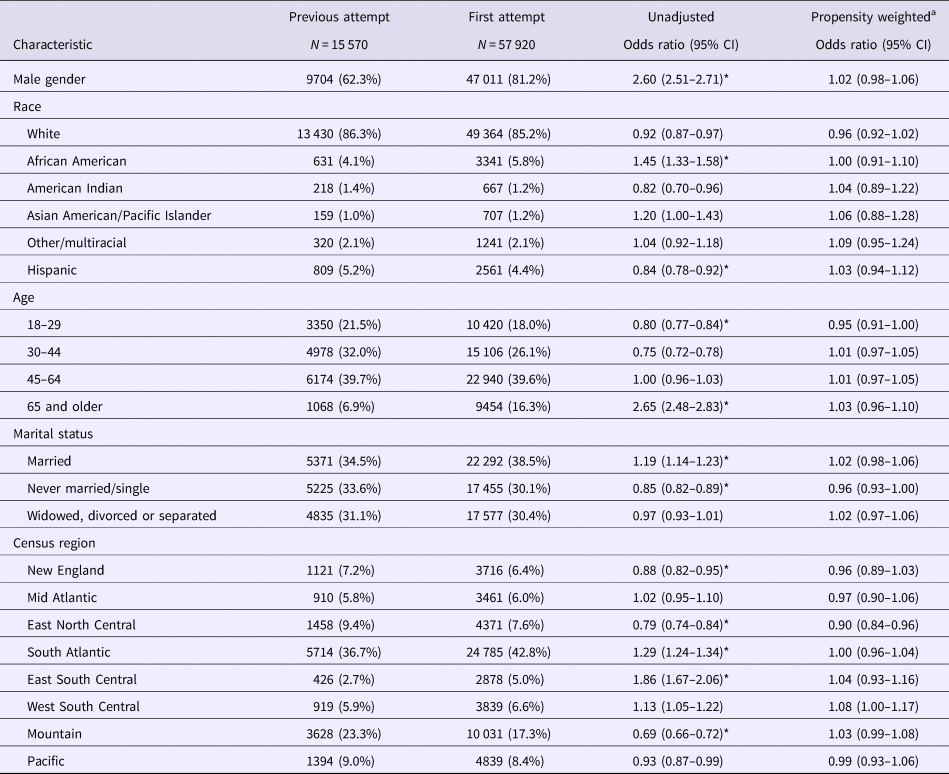
Frequencies and proportions of demographic characteristics are shown in Table 1. Based on univariate odds ratios, FSAD were more than twice as likely to be over the age of 65, were more than twice as likely to be male, and were more likely to be married. In terms of race/ethnicity, they were more likely to be African-American and were less likely to be Hispanic. Geographically, FSAD were more likely to live in the East South Central division (represented in this sample by Kentucky) or in the South Atlantic (Maryland, Virginia, North Carolina, South Carolina). Univariate odds ratios of demographic characteristics after propensity score weighting are also shown in Table 1, to illustrate the effectiveness of weighting in reducing demographic differences between groups. Prior to propensity weighting, the median absolute odds ratio between groups on demographic characteristics was 1.20 and the maximum unweighted odds ratio was 2.65; after weighting, the median absolute odds ratio was 1.03, and maximum absolute odds ratio was 1.11, suggesting that covariates were balanced between groups after weighting.
Demographic characteristics of suicide decedents who did and did not have a previous suicide attempt

CI, confidence interval.
a Odds ratios are from inverse probability weighted (IPW) propensity score models based on the demographic characteristics above, shown to demonstrate the effects of IPW on minimizing differences between groups. The propensity model showed good overlap between groups, with a range of predicted probability of selection for the group with no history of suicide attempt ranging from 0.49 to 0.96, and 0.49 to 0.95 for the group with a history of suicide attempt.
*Significant at Bonferroni-corrected p value of p < 0.0012.
Suicide-related characteristics
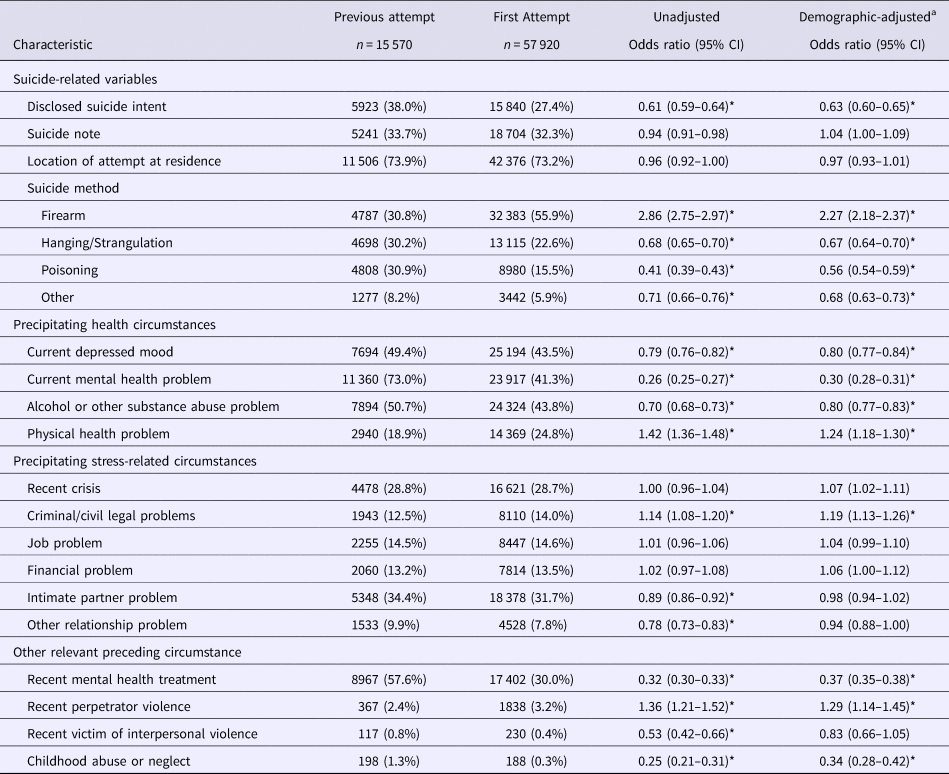
Examination of differences in clinical characteristics and precipitating circumstances, with and without propensity score weighting, are shown in Table 2. Results were similar regardless of demographic adjustment. FSAD were less likely to disclose their intent to others preceding their death by suicide (27.4% v. 38.0%). They were also more likely to use a firearm than decedents with a history of suicide attempt (55.9% v. 30.8%), which is consistent with a prior study of the NVDRS (Anestis, Reference Anestis2016). Decedents with a history of suicide attempt were twice as likely to die by poisoning than FSAD. A secondary subgroup analysis among decedents that did not die by firearm (n = 36 320) showed that FSAD were more likely to die by hanging/strangulation [odds ratio(OR 1.15, |z| = 5.53, p < 0.001, 95% confidence intervals (CI) 1.09–1.20] whereas decedents with a history of suicide attempt were more likely to die by poisoning (OR 0.86, |z| = 5.92, p < 0.001, 95% CI 0.82–0.91). There were no differences between groups in terms of location of death (nearly 75% at their residence), and about one-third of decedents in both groups left a note.
Clinical characteristics and circumstances of suicide decedents who did and did not make a previous suicide attempt

CI, confidence intervals
a Estimates based on inverse probability weighted propensity score models that account for gender, age, race/ethnicity, marital status, and geographic region.
*Significant at Bonferroni-corrected p value of p < 0.0012.
Precipitating health circumstances
Results were consistent in unadjusted and demographic-adjusted models. FSAD were more likely to die by suicide in the context of a physical health problem (defined as terminal disease, debilitating conditions that left the decedent dependent on oxygen, confined to their bed, or requiring a caregiver). This accounted for one-quarter of all deaths by suicide among FSAD. Decedents with a history of suicide attempt were significantly more likely to die by suicide in the context of a current mental health problem (73% v. 41%), had a depressed mood prior to their death, and were more likely to have had an alcohol or substance abuse problem. Approximately 20% of FSAD were not identified as having a depressed mood around the time of their suicide, have a documented current mental health problem, or have an alcohol or other substance abuse problem that contributed to their suicide.
Precipitating stress-related circumstances
First attempt decedents were more likely to die by suicide during criminal/legal problems in both unadjusted and adjusted models. Few decedents in the NVDRS died by suicide while in a jail, prison, or detention facility (7.6%), meaning that the majority of these deaths by suicide occurred outside of incarceration. In unadjusted models, decedents with a history of suicide attempt were more likely to die in the context of interpersonal problems; however, this association did not remain statistically significant after adjusting for demographic characteristics. Nearly 30% of all decedents died in the context of a recent crisis, but there were no differences between groups. Similarly, the most common precipitating stress-related circumstance for both groups were intimate partner problems (32%).
Other relevant history and circumstances
In both unadjusted and adjusted models, FSAD were more likely to have perpetrated violence in the previous month, although the base rate was small (3.2% v. 2.4%). They were less likely to have recently received mental health care than individuals who had a history of suicide attempt (30.0% v. 57.6%) and were less likely to have a known history of childhood abuse and/or neglect. In the unadjusted model only, multiple attempt decedents were more likely to have been a victim of violence in the month preceding their suicide.
Exploratory analysis
In order to identify characteristics that differentiate most between FSAD and decedents with a history of suicide attempt, we tested an additional logistic regression in which all demographic, suicide-related, health, stress, and other characteristics were entered simultaneously in the same model. Results largely mirrored univariate findings, with absence of a known mental health condition (OR 0.36, |z| = 33.70, p < 0.001, 95% CI 0.34–0.39), use of a firearm (OR 2.28, |z| = 30.59, p < 0.001, 95% CI 2.16–2.40), male gender (OR 1.77, |z| = 25.16, p < 0.001, 95% CI 1.70–1.85), absence of disclosed suicide intent (OR 0.69, |z| = 17.80, p < 0.001, 95% CI 0.66–0.72), and 65 years of age or older (OR 2.20, |z| = 16.54, p < 0.001, 95% CI 2.01–2.42) emerging as the largest predictors of FSAD status.
Discussion
The present study used a large, geographically diverse violent death surveillance system to examine characteristics and precipitating circumstances of death by suicide, comparing individuals with and without a history of suicide attempt. To our knowledge, this is the first large-scale study of its kind to examine differences between FSAD compared to those with a history of suicide attempt. There were several observed differences between decedents with and without a history of suicide attempt. In terms of demographic characteristics, FSAD were more likely to be male, to be married, to be African-American, and to be 65 and older. Even after adjusting for demographic characteristics, FSAD were more likely to use a firearm in their attempt and were less likely to have been identified as having a mental health problem, to disclose their intent to others, or to have recently received mental health treatment. Individuals who died on their first suicide attempt were more likely to die in the context of a physical health problem or in the setting of criminal/civil legal problems and were more likely to have perpetrated violence in the month preceding their suicide. In a multivariate model that included all aforementioned types of characteristics and circumstances, absence of a known mental health problem, use of a firearm, male gender, absence of disclosed suicide intent, and age of 65 or older were the strongest predictors of FSAD status.
Several of these findings–specifically, that males are more likely to die by suicide on their first attempt, that FSAD are more likely to use firearms, and that they are more likely to be older–are consistent with previous research (Blow et al., Reference Blow, Brockmann and Barry2004; Innamorati et al., Reference Innamorati, Pompili, Masotti, Pearsonéi, Lester, Tatarelli, Girardi and Amore2008; Anestis, Reference Anestis2016; Jamison and Bol, Reference Jamison and Bol2016). The observation that men are more likely to die from a suicide attempt than women is well-established (Drapeau and McIntosh, Reference Drapeau and McIntosh2017), and is likely related to the fact that men are more likely to use more lethal methods than women (Ajdacic-Gross et al., Reference Ajdacic-Gross, Weiss, Ring, Hepp, Bopp, Gutzwiller and Rössler2008). Firearms have the highest fatality rate of all suicide methods (Spicer and Miller, Reference Spicer and Miller2000; Miller et al., Reference Miller, Azrael and Hemenway2004), and accounted for more than half of deaths by suicide among FSAD. As noted by Anestis (Reference Anestis2016), this in and of itself indicates that a significant proportion of individuals who die by suicide will be overlooked, as there is often an emphasis on prior suicide attempts in risk assessment protocols. Laws that reduce firearm ownership, regulate handgun ownership (permit to purchase firearms, registration of firearms, and licenses to own firearms), and extreme risk protection order laws (which temporarily prohibit possession of firearms for individuals at risk of violence to themselves or others) have been shown to reduce firearm suicide rates (Anestis et al., Reference Anestis, Khazem, Law, Houtsma, LeTard, Moberg and Martin2015; Mann and Michel, Reference Mann and Michel2016; Swanson et al., Reference Swanson, Norko, Lin, Alanis-Hirsch, Frisman, Baranoski, Easter, Robertson, Swartz and Bonnie2017; Kivisto and Phalen, Reference Kivisto and Phalen2018). Such public policy initiatives represent promising avenues for reducing the suicide epidemic. Interestingly, in our subgroup analysis among decedents that did not die by firearm, FSAD were more likely to use hanging/strangulation–another method that has one of the highest fatality rates (Spicer and Miller, Reference Spicer and Miller2000; Miller et al., Reference Miller, Azrael and Hemenway2004), and decedents with a history of suicide attempt were more likely to use poisoning–a method which has one of the lowest fatality rates (Spicer and Miller, Reference Spicer and Miller2000; Miller et al., Reference Miller, Azrael and Hemenway2004)–even when adjusting for demographic characteristics. Overall, this indicates that FSAD are more likely to use methods with high lethality.
In terms of precipitating health circumstances preceding suicide, FSAD were less likely to have died in the setting of an identified current depressed mood, mental health problem, or an alcohol/substance use disorder. Psychological autopsy studies suggest that approximately 90% of individuals that die by suicide have a psychiatric disorder (Cavanagh et al., Reference Cavanagh, Carson, Sharpe and Lawrie2003), and that suicide decedents without a known psychiatric disorder have significant psychiatric symptomatology preceding their suicide (Joiner et al., Reference Joiner, Buchman-Schmitt and Chu2017). In the present study, 73% of decedents with a history of prior suicide attempt had a known current mental health condition, as opposed to 41% of FSAD. Psychiatric disorders, therefore, may have been underestimated by FSAD in the NVDRS, and these individuals were often not identified as having a mental health problem. This is supported by the finding that only 30% of FSAD had recently received mental health treatment in our sample. FSAD were more likely to die by suicide in the context of a physical illness, although the effect size was small. Physical illnesses are considered a leading stressful life event (Holmes and Rahe, Reference Holmes and Rahe1967), are associated with suicide attempts independent of psychiatric disorders (Goodwin et al., Reference Goodwin, Marusic and Hoven2003), and are associated with elevated suicide rates (Zaorsky et al., Reference Zaorsky, Zhang, Tuanquin, Bluethmann, Park, Park and Chinchilli2019). Given that a quarter of FSAD died in the context of physical health problems (i.e. terminal illness, debilitating conditions, chronic pain), this represents a population at elevated risk for lethal suicide attempts.
About one-third of the overall study group died by suicide in the setting of intimate partner problems, which rank among the most stressful life events (Holmes and Rahe, Reference Holmes and Rahe1967). This precipitating circumstance was slightly more common among decedents with a prior history of suicide attempt in unadjusted models. FSAD were slightly more likely to die by suicide in the context of criminal or civil legal problems than multiple attempt decedents, and their suicides occurred primarily outside of jail, prisons, or detention facilities. This suggests that individuals who are facing or currently undergoing criminal/civil legal issues may be at elevated risk for suicide. Previous research has shown that approximately one third of inmates that die by suicide do so when they attend or are scheduled to attend a court hearing, and most occur within 2 days before or after the hearing (Hayes, Reference Hayes2012). Results from the present study indicate that suicide risk by persons involved in the justice system is not limited to those in custody. And, although the base rate was small in both groups, FSAD were more likely to have perpetrated violence within the month of their suicide. Given that the NVDRS does not inquire about other lifetime violence and aggression, it is unclear whether FSAD have a greater predisposition for violence, which has been linked to serious suicide attempts (Jordan and Samuelson, Reference Jordan and Samuelson2015; Stefansson et al., Reference Stefansson, Nordström, Runeson, Åsberg and Jokinen2015).
Even after demographic adjustments, there were noticeable differences between groups. For example, FSAD are more likely to use highly lethal methods than decedents with a history of suicide attempt. Contemporary theories of suicide posit that the capability for suicide develops through several processes: some individuals are genetically predisposed to suicide; individuals can acquire the capability to inflict lethal self-harm through habituation to fear and pain that facilitates lethal self-harm; and access to and knowledge of lethal means make an individual more capable of suicide (Joiner, Reference Joiner2005; O'Connor, Reference O'Connor, O'Connor, Platt and Gordon2011; Klonsky and May, Reference Klonsky and May2015). It is possible that multiple attempt decedents acquire the capability for suicide through their history of suicide attempts, whereas some individuals with a genetic predisposition towards suicide, and who have available lethal means, have the capability for suicide when the desire for death develops.
There are several limitations to the present study. First, the NVDRS relies upon the reports of law enforcement and/or medical examiners and not trained mental health professionals, and therefore information related to psychiatric symptoms may be under-identified. This is plausible, given the low prevalence rate of known mental health conditions in the NVDRS. Details are limited to informants' reports, which may increase the risk of false negatives depending on their knowledge of the decedent. Therefore, it is possible that more individuals classified as FSAD did indeed have a prior history of suicide attempts or behaviors. The proportion of suicide decedents identified as having died on their first suicide attempt is consistent with previous psychological autopsy studies (e.g. Innamorati et al., Reference Innamorati, Pompili, Masotti, Pearsonéi, Lester, Tatarelli, Girardi and Amore2008; Buchman-Schmitt et al., Reference Buchman-Schmitt, Chu, Michaels, Hames, Silva, Hagan, Ribeiro, Selby and Joiner2017), however, which suggests that false negative rates of FSAD may not be worse than the ‘gold standard’. Another important limitation is that reports by informants are subject to the informants' perceptions and possible bias. Relatedly, unknown/unavailable information is coded as absent by the data abstractors, which increases the likelihood that some information is underestimated. It is therefore plausible that there are false negatives overall. Because the focus of the present investigation was to broadly characterize FSAD, the sample was not stratified by demographic characteristics (e.g. age, gender) that may identify potentially high-risk subgroups. Future research should consider characterizing more focused populations (e.g. suicide decedents with physical health problems, women that die on their first suicide attempt) and whether there are patterns of risk factors that may be more prevalent in FSAD than in decedents with a history of suicide attempt. Finally, the current study used data from US states that participated in the NVDRS; and, although the range of states in the NVDRS are diverse, is not a fully nationally representative sample. Similarly, it is unclear how well the differences observed in the NVDRS generalize to other countries.
Despite these limitations, the present study is an important step in better understanding a population that has often been overlooked in suicide research thus far. The large sample size and rich breadth of information collected in the NVDRS allowed for an examination of a diverse array of differences in demographic and clinical characteristics, as well as the manner of death and circumstances preceding the suicide of individuals without a prior suicide attempt. This study also identified several precipitating circumstances that were more common in FSAD that have the potential to improve suicide prevention efforts. For example, engaging primary/specialty medical care and the justice system in suicide prevention efforts may help reduce the suicide epidemic. Further research is needed to better identify individuals at risk for suicide within these systems, particularly those without a prior history of suicide attempt, to guide and improve prevention efforts. Finally, future studies that use psychological autopsies may be an important next step in understanding why some individuals die by suicide on their first attempt.
Previous presentation
Portions of this paper were presented at the American Association of Suicidology annual meeting, Denver, Colorado, 24–27 April 2019.
Author ORCIDs
Joshua T. Jordan, 0000-0001-7007-8098
Financial support
None.
Conflict of interest
None.
Disclaimer
The National Violent Death Reporting System (NVDRS) is administered by the Centers for Disease Control and Prevention (CDC) by participating NVDRS states. The findings and conclusions of this study are those of the authors alone and do not necessarily represent the official position of the CDC or of participating NVDRS states.