INTRODUCTION
Forests are an important source of environmental services and livelihoods in Malawi, as in other parts of Africa. However, forest cover has been declining steadily in Malawi, and total forest area fell from 59% of land cover in the 1960s to 27% by 2005 (Jumbe & Angelsen Reference Jumbe and Angelsen2007). The country lost more than 33 000 ha yr−1 of forest between 2000 and 2005 (FAO [Food and Agriculture Organization of the United Nations] 2005). Although Malawi's experience has been typical for sub-Saharan Africa, recent data (FAO 2010a, b) indicate rates of decline of 0.88% per annum between 1990 and 2000, and 0.99% per annum between 2005 and 2010, which exceed rates for Africa over the same period (0.56% and 0.50%, respectively). Most alarmingly, the annual rate of decline in primary forests in Malawi has been accelerating, from 2.6% over the period 1990–2000 to 3.8% during the period 2005–2010 (FAO 2010a, see table 8 therein). In addition to environmental damage caused by high rates of deforestation, forest loss harms communities by increasing the time, energy and inputs required to complete tasks ranging from cooking food to constructing buildings. Women and children often are the most negatively affected by forest degradation because they are responsible for most forest-related household activities (Bhalotra Reference Bhalotra2006).
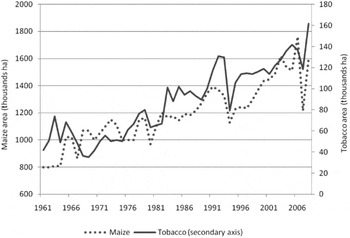
As elsewhere, the major threat to Malawi's forests is clearing for agricultural expansion by smallholder farmers (Government of Malawi 1998). Agriculture currently supports 80% of the country's population of 14 million, contributes 39% of GDP, accounts for 83% of export earnings and employs 85% of the labour force (Government of Malawi 2009). Since Malawi attained independence in 1964, its agricultural strategy has been a dual policy of pursuing food self-sufficiency through enhancement of smallholder production of maize and achieving economic growth through estate production focusing on cash crops, especially tobacco, for export. Area allocated to maize and tobacco has been increasing steadily over time (Fig. 1), partly at the expense of other crops, but largely at the expense of forests. Together, tobacco and maize account for more than 70% of cultivated area.
Total land area allocated to maize and tobacco in Malawi, 1961–2008. Source: FAOSTAT (2011).

Although farmers undoubtedly degrade forests, placing complete blame for forest loss on farmers may be misguided. At a conceptual level, the literature distinguishes between economic agents as the proximate causes of deforestation and policies as the ultimate causes (Shaw Reference Shaw1989). Market failures, poorly designed government interventions and weaknesses in forest governance are among the underlying features that precipitate forest loss by influencing market signals, creating access to technologies and information, and determining patterns of infrastructure or institutional development (Gbetnkom Reference Gbetnkom2005; Rodríguez et al. Reference Rodríguez, Nassar, Rodríguez-Clark, Zager, Portillo-Quintero, Carrasquel and Zambrano2008). Moreover, empirical evidence on the specific role of agriculture in deforestation is mixed. Some authors suggest that policies and technologies that increase the relative returns to agriculture can reduce subsistence-driven forest clearing, but may instead encourage forest clearing for market-driven production (see for example Bagachwa et al. Reference Bagachwa, Shechambo, Sosovele, Kulindwa, Naho and Cromwell1995; Kaimowitz & Angelsen Reference Kaimowitz and Angelsen1998; Angelsen et al. Reference Angelsen, Shitindi and Aarestad1999; Angelsen & Kaimowitz Reference Angelsen and Kaimowitz1999; van Soest et al. Reference van Soest, Bulte, Angelsen and van Kooten2002; Perz Reference Perz2003). Other studies have linked agricultural intensification to reduced pressure on forests (see Godoy et al. Reference Godoy, O'Neill, Groff, Kostishack, Cubas, Demmer, Mcsweeney and Overman1997; Shively Reference Shively2001; Shively & Pagiola Reference Shively and Pagiola2004). Some studies (for example see Perfecto & Vandermeer Reference Perfecto and Vandermeer2010) even question the conceptual basis for an intensification/extensification dichotomy. Whether agricultural policies might be responsible for forest decline remains a contentious academic and policy debate (see, for the Mexican case, García-Barrios et al. Reference García-Barrios, Galván-Miyoshi, Valdivieso-Pérez, Masera, Bocco and Vandermeer2009). In Malawi, fuel for this debate has come, in part, from the large-scale Farm Input Subsidy Programme (FISP). This paper examines whether Malawi's FISP influenced farmers’ forest-clearing decisions (Appendix 1 provides the history and organization of the FISP, see supplementary material at Journals.cambridge.org/ENC). Our goal is to provide evidence-based guidance for efforts to conserve forests in developing areas, to help shape mitigation and monitoring programmes to support forest conservation. Our specific objective is to test whether the incentives embedded in Malawi's input subsidy programme are consistent with ongoing efforts to conserve remaining forests. We do this by estimating a series of two-stage regression models to measure the correlation between programme participation and forest clearing, while controlling for the endogeneity of programme participation.
METHODS
Empirical approach
A two-stage instrumental variables regression method was used to study the impacts of the FISP on forest clearing. In the first stage, selection into the subsidy programme was treated as endogenous and conditional on household- and village-specific factors. We used a multinomial logistic (MNL) regression to predict the probability of programme participation, placing households into four mutually exclusive categories based on their receipt of subsidy coupons for maize: (1) those that received no coupons (a control group); (2) those that received a coupon for seed only; (3) those that received coupon(s) for fertilizer only; or (4) those that received both fertilizer and seed coupons. The second stage was a regression to identify the determinants and extent of forest clearing. This included as control variables predicted programme participation variables from the first stage MNL. A simple ordinary least squares (OLS) regression was inappropriate for the second stage regression, since it did not accurately account for the fact that a large proportion of households did not clear forest. In developing a strategy for the second stage, several options were considered, including a one-tailed Tobit regression, and two-step models that treated the decision to clear forest and the amount of forest cleared as separate but related decisions. One attractive model for this purpose was Cragg's (Reference Cragg1971) ‘double hurdle’ model, which incorporates a probit model for the first binary decision and a truncated normal regression for the second decision. The primary advantage of Cragg's model over the Tobit is that separate processes determine an independent variable's influence over the probability of a positive outcome and its impact on the extent of a positive outcome. However, the choice of approach is an empirical matter. The Lagrange multiplier test suggested by Lin and Schmidt (Reference Lin and Schmidt1984) provides some evidence in favour of the double-hurdle specification. However, the point estimates in the first-tier probit model are uniformly weak and uninformative about factors that might be driving forest clearing decisions. We therefore employed a lower truncated Tobit regression for the forest clearing decision. The implicit assumption is that the same underlying forces drive the probability of forest clearing and the extent of forest clearing. The first-stage regression is:
 \begin{equation}
C^j _i = {\rm \beta }_0 + {\rm \beta }_{\rm 1} {\bm {\rm Z}}_i + {\rm \beta }_{\rm 2} S_i + {\rm \beta }_{\rm 3} {\bm {\rm P}}_i + {\rm \beta }_4 V_i + \beta_5 K_i + \varepsilon _i\end{equation}
Variable Si represents the household's social capital, measured as the number of years the household head had resided in the village at the time of the survey. The longer the household had been a village resident, the more likely he or she would have been to be favoured by the village chief and the Village Development Committee during coupon distribution. Vector Pi represents control variables for participation in the subsidy programme during the previous season, which could have influenced a household's chances of receiving coupons during the study period. Vi is a variable for the population of household i's village. Since inception of the FISP, a number of new, small villages have been formed, many as breakaways from larger villages. Village formation has occurred at a much higher rate than before the subsidy programme, and some of these new villages consist of entirely new village heads and their families. Most are not registered by the District Commissioner and therefore are not formally recognized. These unregistered villages are less likely to receive coupons. We hypothesized that residents of older and larger villages had a higher probability of receiving coupons than residents of smaller newer villages. Ki is a binary variable, indicating whether a household resided in Kasungu district or not.
Properly identifying the forest clearing decision requires the inclusion of at least one variable in the MNL model that does not enter the forest clearing regression. Valid instruments in this case will be variables that are correlated with coupon receipt but uncorrelated with the error term in the forest clearing regression. For identification, we used several variables which we hypothesized affected participation in the FISP, but which did not directly affect the household's forest clearing decision. These included participation in the subsidy programme during the previous season, tenure of residence in the village and village population. The structure of our model does not provide a straightforward method of testing for over identification; however, point estimates in the second-stage regression are invariant in sign, significance and magnitude to including subsets of the instruments in that regression. Additionally, the estimated coefficients on these variables were not significantly different from zero when included in conjunction with the predicted coupon receipt variables. The second-stage regression takes the form:
 \begin{eqnarray}
&&A_i = \lambda _0 + \lambda _1 {\bm {\rm H}}_i + \lambda _2 {\bm {\rm M}}_i + \lambda _3 {\bm {\rm F}}_i + \lambda _4 {\bm {\rm X}}_i + \lambda _5 T_i \nonumber\\
&&\quad +\, \lambda _6 K_i + \lambda _7 {\bm {\rm \hat{C}}}_i + \mu _i\end{eqnarray}
Vector Hi represents household-specific variables for labour availability (number of adult workers) and farm size (per household resident). In Malawi, farm size per household resident provides a good indication of a household's agricultural production capacity and degree of food security (Peters Reference Peters1996). Households with relatively small landholdings per person may have both the need and the labour capacity to engage in forest clearing, provided forests are accessible.
Vector Mi contains predetermined (those of the prior year) village-level price variables for maize and tobacco. These capture the financial incentives for clearing forest for agricultural expansion. Previous research supports the assertion that higher prices for agricultural products stimulate forest clearing by inducing existing and migrant populations to move resources into forest clearing as the agricultural frontier becomes more profitable (Elnagheeb & Bromley Reference Elnagheeb and Bromley1994; Bagachwa et al. Reference Bagachwa, Shechambo, Sosovele, Kulindwa, Naho and Cromwell1995; Barbier & Burgess Reference Barbier and Burgess1996; Angelsen et al. Reference Angelsen, Shitindi and Aarestad1999).
Vector Fi represents variables for forest access and control. Three forms of forest ownership exist in the study areas: private, public and customary. Privately owned forests belong to individuals who have complete control over use, access and rights transfer. Public forests are de jure owned and protected by the state. Since the late 1990s, the government of Malawi has allowed local communities living in close proximity to extract some forest products under local forest management or forest co-management arrangements. The regulatory framework for co-management is through a local constitution, but compliance with forest regulations varies across reserves due to differences in leadership and the degree of tribal cohesion (Jumbe & Angelsen, Reference Jumbe and Angelsen2007). Communities are not permitted to convert public forests for agricultural uses, although cases of forest encroachment have been reported in some areas. Conversely, customary forests are owned collectively by members of the village and regulated by the village natural resource management committee (VNRMC). Where VNRMCs exist, rules and regulations governing the use of the customary forests vary from one community to the next, depending on the leadership and cooperation between leaders and the community (Jumbe Reference Jumbe2005). Where rules are absent, open access prevails. Since no person or group controls the forest, conversion to agriculture is quite common. We therefore included two indicator variables in our forest clearing regression, one for private and the other for customary forests. We also included a variable for the presence in the village of a VNRMC, loosely defined in the current context as a group of residents cooperating in the collection and extraction of a similar forest product, such as honey or bamboo. We hypothesized that VNRMC presence would reduce forest clearing.
Previous research from Malawi suggests that positive income shocks can reduce incentives for households to degrade forests (Fisher & Shively Reference Fisher and Shively2005). In other settings, negative shocks (such as crop failure, livestock loss, illness or death of adult family member) have been found to be positively correlated with forest degradation (Pattanayak & Sills Reference Pattanayak and Sills2001; Takasaki et al. Reference Takasaki, Barham and Coomes2004; Delacote Reference Delacote2007; Yemiru, et al. Reference Yemiru, Roos, Campbell and Bohlin2010; Debela et al. Reference Debela, Shively, Angelsen and Wik2012). We therefore included a set of three self-reported binary indicator variables, represented by vector Xi, to account for negative shocks experienced by the household during the 12 months preceding the 2008/2009 agricultural season. Shock 1 equals one if a working-age household member suffered from sickness, injury and/or death. Shock 2 equals one if the household experienced crop losses resulting from pests, diseases or theft. Shock 3 equals one if the household experienced an unanticipated low price for crop output, or a physical loss of cash through theft or other means.
Ti is the approximate number of trees the household harvested for the construction of a tobacco drying shed. Although historically tobacco has been an estate crop in Malawi, changes in agricultural policy in 1990 accorded smallholders the opportunity to grow the crop. This change, undertaken as part of the World Bank and International Monetary Fund's Structural Adjustment Programmes, led to an immediate rise in tobacco production (Tobin & Knausenbeeger Reference Tobin and Knausenberger1998). Today, Malawi is the largest producer and exporter of burley tobacco in the world, and smallholder farmers contribute about 70% of Malawi's total tobacco production (Jaffee Reference Jaffee2003). Tobacco, of course, competes with other crops for land, sometimes at the expense of forests. In addition, farmers use wood harvested from natural forests to construct the barns in which they cure burley tobacco. These barns typically are replaced after one or two years. Tobacco production therefore has a potential dual effect on forests: (1) through the direct demand for land for planting the crop, and (2) through the derived demand for trees for curing the tobacco leaf and/or constructing tobacco drying sheds. The correlation between the number of trees harvested for constructing a tobacco drying shed and the amount of forest cleared represents an induced decision to remove trees, since other sources of lumber exist. As an example, Bunderson and Hayes (Reference Bunderson and Hayes1997) estimated that construction of a drying shed sufficient for 1 hectare of burley tobacco required about 985 trees, an equivalent of 0.2 hectares of standing timber for every hectare of burley tobacco. Several studies document similar negative impacts of tobacco growing on forests in Malawi and other tropical countries (Tobin & Knausenberger Reference Tobin and Knausenberger1998; Contreras-Hermosilla Reference Contreras-Hermosilla2000). Ideally, the inclusion of an instrumented indicator of tobacco coupon receipt is desirable to control directly for the impact of tobacco subsidies. However, data constraints precluded this approach: only 7% of our sample received subsidy coupons specific to tobacco, and only a very small percentage of those received a tobacco coupon only. As a result, we focused our policy attention on maize coupons, which 86% of sample households received in some form. Tree collection appears as an indirect, albeit endogenously determined indicator of tobacco's impact. We also included binary variable Ki, which equals one for households residing in Kasungu District and zero otherwise. This controlled for regional differences in forest clearing that may be reflective of differences in agronomic features of the sample, including prevalence of tobacco growing.
Finally, vector Ĉi represents our set of policy variables for coupon receipt. These are the instrumented values from the first-stage MNL regressions, and as such are best understood as predicted probabilities controlling for the latent characteristics of coupon recipients. The intent of the subsidy programme was to promote intensification of agricultural production among smallholder farmers, primarily for the purpose of achieving food self-sufficiency and increasing resource-poor farmers’ incomes (Government of Malawi 2007). How such incentives might have affected behaviour a priori is unclear, and the ultimate effects of coupon receipt on forest clearing are therefore indeterminate. Following the logic outlined in Shively and Fisher (Reference Shively and Fisher2004), our hypothesis was that by increasing the marginal value product of labour used in maize production, the coupons created an immediate incentive for households to reallocate labour away from less valuable activities, including forest clearing.
This framework did not fully account for all sources and causes of forest pressure in Malawi. For example, also responsible for forest pressure, but not measured here, was a high rate of wood extraction for fuel. Biomass provides more than 90% of Malawi's energy demand (Government of Malawi 1998) and urban demand for charcoal has intensified forest clearing. However, our empirical aim was not to explain all patterns or sources of forest use and forest clearing (see for example Jumbe & Angelsen, Reference Jumbe and Angelsen2011). Instead, we aimed to measure as accurately as possible, within the limits of our data, the ways in which a specific policy (in this case input subsidies for maize) might have influenced forest clearing.
Data sources
Data come from a 2009 survey of 380 households living near the Chimaliro and Liwonde forest reserves, in Kasungu and Machinga districts, respectively. These are among the largest public forest reserves in Malawi, covering approximately 160 000 ha and 274 000 ha, respectively (Jumbe & Angelsen Reference Jumbe and Angelsen2006). In addition, privately- and customarily-owned forests of various sizes exist in the study sites. As discussed above, these forests can be converted to agriculture, depending on the local rules governing their use. Among the data collected as part of our survey were household demographic information and details of agricultural production and forest activities during the 12 months preceding the survey.
The 35 survey villages were purposively selected to follow-up on a 2002 forest co-management survey (see Jumbe Reference Jumbe2005). The original villages had been selected at random from a larger population of villages adjacent to the forest reserves. That sample frame was developed in conjunction with staff from the Forest Department, District Forestry Offices and the Forestry and Research Institute of Malawi (FRIM). Given the goals of the original sample selection process, and therefore the selection criteria for the data used here, our sample should not be considered fully representative of smallholder farmers in Malawi. Nevertheless, the sample households possess a range of characteristics that are broadly shared by households in rural Malawi. For example, they derived most of their livelihoods from rain-fed agriculture, and their family sizes and land and labour productivity challenges were similar to all farmers in Malawi. Studying these farmers therefore provides important and accurate insights regarding the FISP, which was administered nationwide. Trained enumerators working in local languages (including Chichewa, Malawi's national language) interviewed households using a pre-tested household questionnaire. The enumerators interviewed heads of households, and spouses and children who were involved in collecting forest products.
RESULTS
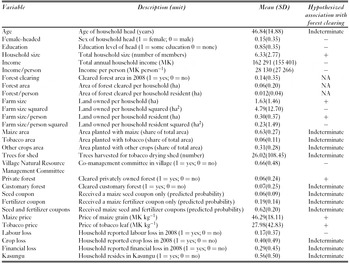
The average age for household heads was 47 (Table 1). On average, each household had six members, and 1.6 ha of land. Approximately 15% of sample households were female-headed; 85% of household heads had some schooling. The average annual income for households in our sample was MK 162 291 (US$ 200) per person, slightly higher than the national average reported by the 2005 Integrated Household Survey (Government of Malawi 2005).
Descriptive statistics for variables used in the analysis. SD = standard deviation, + = positive, − = negative, NA = not applicable.

The dominance of maize in the cropping system was clearly evident. Farmers devoted and average 63% of their land to maize, and of the 380 households in the sample, only four did not plant maize. Thirty-two per cent of all households planted tobacco, allocating on average 6% of their land to the crop. Remaining land (31%) was allocated to other small crops, including groundnuts, soybean, cowpea, cassava, sweet potatoes and pigeon pea. Overall, 14% of households reported forest clearing during the 12 months leading up to the survey; 89% of those who cleared forest used the new land for crop production.
Determinants of coupon receipt
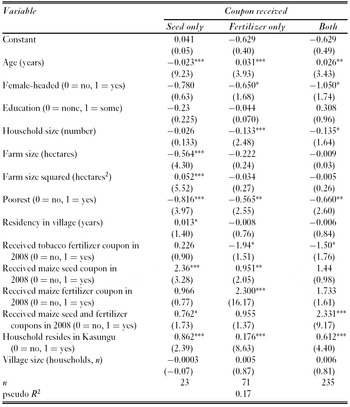
The main goal of this first-stage regression was to derive appropriate instrumented versions of the coupon receipt variables, to be used as policy ‘treatment’ variables in the forest conversion regression. Nevertheless, these regressions hold some interest in their own right. Our findings (Table 2) suggest that the most vulnerable people were not the main beneficiaries of coupons. For example, female-headed households were intended as targets, but were less likely than male-headed households to receive subsidy coupons (Table 2). Furthermore, asset-poor households were less likely to receive coupons than better-off households (Table 2).
Multinomial logit regression results for coupon receipt. Note: base outcome is ‘received no coupon’ (n = 51). Robust standard errors clustered at district level. Absolute value of t statistic in parentheses; * p < 0.10, ** p < 0.05, *** p < 0.01.

The MNL regression also reveals district-level differences in administration of the subsidy programme: farmers in Kasungu district were more likely to have received coupons than those in Machinga. Land area per person is lower in Kasungu than in Machinga (78 versus 98 persons km−2), so Kasungu might have been viewed by administrators as having greater potential for maize production, and therefore to be more deserving of coupons. Agriculture is also more prevalent in Kasungu and, consequently, the government may have allocated proportionately more coupons there. Some continuity across time is evident, as households that received coupons during the previous agricultural season were more likely to receive the same coupons during the current season. The overall explanatory power of the MNL regressions provides support for our two-stage approach of treating coupon receipt as a non-randomly assigned outcome.
Determinants and extent of forest clearing
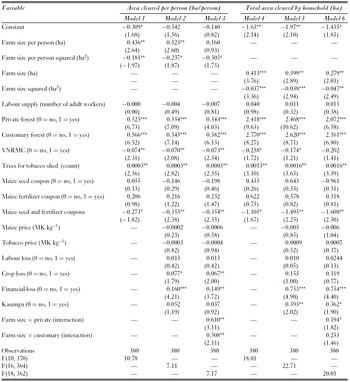
We derived six sets of regression results for the model of forest clearing (Table 3). In models 1–3, the dependent variable is the area of forest cleared per household resident. Models 4–6 use the total area of forest cleared by the household as the dependent variable. Regressions 1 and 4 are short regressions containing the main household- and village-level controls. Regressions 2 and 5 add variables for output prices, household shocks and location. Regressions 3 and 6 add to these a set of [farm-size] × [forest-tenure] interaction terms, where the farm size variable used in the interaction matches that from the respective regression. The F-statistics for all models show that the variables are jointly significant in explaining the extent of forest clearing. The signs, magnitudes and significance of the explanatory variables are broadly robust to specification. The correlation between landholdings and the amount of forest cleared is positive and statistically strong, but shows some curvature. Households with relatively larger landholdings cleared more forest, whether we measured clearing in per person (models 1–3) or aggregate (models 4–6) terms. There appears to be no strong short-run correlation between agricultural output prices and forest clearing. The coefficients on the price variables for maize grain and tobacco leaf did not differ statistically from zero at the 95% confidence level.
Regression results for models of forest clearing. Note: absolute value of robust t statistics in parentheses, clustered by district; * p < 0.10, ** p < 0.05, *** p < 0.01. Coupon variables are instrumented values derived from the multinomial logit regression (reported in Table 2).

The correlations between forest clearing and both private and customary ownership of forests were positive. Nearly 48% of those respondents who reported forest-clearing activity classified the forests from which they cleared the land as customary, 44% classified them as private and the remaining 8% classified them as public. The magnitudes of the estimated coefficients on the two variables were stable across models and differed statistically from zero in all instances. In the study areas, privately- and customarily-owned forests were more vulnerable to conversion than public forests. Less forest clearing appeared to occur in the presence of a VNRMC. Households in villages with VNRMCs cleared, on average, 0.07 ha less forest per household than did households in villages without a VNRMC. Forest clearing may depend in a non-linear way on the interactions between land holdings and forest tenure, and farm size may have a different role and effect if clearing takes place on communal or public land than if it takes place on personally owned land. Including interactions between land holdings and the private forest and customary forest indicators strengthened most of the previous findings, and also demonstrated that it may not be land per se that matters to forest clearing, but holdings linked to forests with customary or private title.
Although higher output prices for tobacco and maize did not appear to be driving forest clearing in the short run, the association between forest clearing and the number of trees harvested to construct drying sheds was unsurprisingly positive. The estimated correlation differed significantly from zero at the 95% confidence level, although its magnitude was understandably small (c. 0.3 ha of forest cleared for every 1000 trees harvested). Forest clearing took place at a statistically higher rate in Kasungu, where tobacco is the predominant crop. The correlation between forest clearing and the indicator of whether the household experienced a crop loss in the preceding year was positive; it was also statistically significant in models 1–3. Crop losses may arise due to flooding, drought, pests or diseases. Such losses in crop yield may act as incentives for farmers to clear more land if they consider declining soil fertility as the primary reason for the loss (Morton et al. Reference Morton, DeFries, Shimabukuro, Anderson, Arai, Espirito-Santo, Freitas and Morisette2006). We found no strong correlations between forest clearing and either labour capacity or labour shocks; however, evidence strongly supports the conjecture of a positive correlation between financial losses and forest clearing.
The variables of policy interest to the present study were the different forms of subsidy received. We included three predicted probabilities as explanatory variables: receipt of a maize seed coupon (only), receipt of a maize fertilizer coupon (only), and receipt of a maize seed and fertilizer coupon (combined). The correlation between forest clearing and the receipt of a complete packet of coupons for maize production (improved seed and fertilizer) was consistently negative across the model specifications, indicating a robust pattern of association. The estimated coefficient on the variable also differed statistically from zero at the 90% confidence level or above in all models. On average, households that received coupons for maize seed and fertilizer cleared c. 0.27 ha less forest per person and 1.6 ha less forest per household than those who did not receive the full subsidy.
DISCUSSION
Previous research on the effects of agricultural input subsidies on forests in Malawi suggests a negative correlation between participation in subsidy programmes and rates of forest extraction (Fisher & Shively Reference Fisher and Shively2007). Our results are consistent with this finding and (based on results of Model 6) indicate that recipient households cleared less forest during the study year. The reported models do not reveal the overall change in likelihood of forest clearing that accompanies coupon receipt. However, results from a probit model (not reported here) suggest that, at the sample mean, receipt of a complete FISP package for maize, consisting of coupons for seed and 100 kg of fertilizer, reduced the probability of forest clearing by approximately 60%. In addition, although our reported results are derived from Tobit regressions, inference based on a double-hurdle specification is similar. One noteworthy exception is that in the double-hurdle model, explanatory power of the variable for the predicted probability of receiving both seed and fertilizer coupons sometimes shifted from the second tier decision to the first tier decision (0/1). Thus, to the extent coupon receipt alters behaviour, it seems to be exerting some influence over both the decision to clear forest and the decision concerning how much forest to clear. Our view is that subsidies encouraged intensification rather than area expansion, although we acknowledge the observed pattern could reflect a background level of forest decline that has constrained farmers from clearing land for agricultural expansion. We found that coupon receipt was lower for targeted groups, such as women and the asset-poor. This pattern is consistent with reports by Ricker-Gilbert et al. (Reference Ricker-Gilbert, Jayne and Chirwa2011) and Xu et al. (Reference Xu, Burke, Jayne and Govereh2009) for elsewhere in Malawi and in Zambia, respectively.
Studying the same sample, Chibwana et al. (Reference Chibwana, Fisher and Shively2012) found that receipt of tobacco fertilizer coupons induced farmers to plant a greater share of land with tobacco at the expense of other crops (such as legumes). The shift stimulated demand for trees to construct drying sheds. This may indicate that tobacco-producing households cleared forests to obtain the inputs for constructing drying sheds. As a result, the need for poles for the construction of drying sheds for burley tobacco, rather than the demand for additional cropland, seem to be driving forest clearing. The sub-set of our sample that received coupons for tobacco fertilizer was small, making it difficult to conduct in-depth analysis of these households. However, a simple two-sample t-test comparison of the mean number of trees cut for poles between those who received a tobacco coupon (mean = 110.8) and those who did not (mean = 18.7; t = 2.39 assuming unequal variances) underscores the potential deleterious forest impacts of promoting tobacco production.
Agricultural prices do not appear to be correlated with short-run forest-clearing activities in the two study areas. In the longer run, however, higher agricultural output prices could still stimulate forest expansion (Elnagheeb & Bromley Reference Elnagheeb and Bromley1994; Monela Reference Monela1995; Bagachwa et al. Reference Bagachwa, Shechambo, Sosovele, Kulindwa, Naho and Cromwell1995; Barbier & Burgess Reference Barbier and Burgess1996; Angelsen & Kaimowitz Reference Angelsen and Kaimowitz1999; Angelsen et al. Reference Angelsen, Shitindi and Aarestad1999). Our data did not allow us to test this conjecture.
Results show that households may be more likely to clear communal and privately owned forests for agricultural expansion than public forests. For forests held under customary tenure, this result could indicate the lack of rules governing forest use and access by community members. Where such rules exist, it could indicate their lack of enforcement. The inclusion in the regressions of interaction terms between farm size and forest tenure suggests that forest clearing is proportionately greater when farms are large and held under private or customary title.
The presence of a VNRMC in a village was associated with a lower rate of forest clearing. This could imply that, where they exist, VNRMC members and their leaders help enforce rules and regulations to protect resources upon which they depend. This result is consistent with findings by Gibson et al. (Reference Gibson, Williams and Ostrom2005) who argued that local rule enforcement has a positive correlation with forest condition, regardless of whether user groups are formally organized. Alternatively, VNRMCs could arise and function where forest resources are shrinking.
We found a positive relationship between forest clearing and crop failures. A possible explanation for this result is that crop losses may lead farmers to clear more land if they consider declining soil fertility as a primary reason for loss and regard newly opened areas as more fertile than existing plots (Morton et al. Reference Morton, DeFries, Shimabukuro, Anderson, Arai, Espirito-Santo, Freitas and Morisette2006). This search for fertile soils could also help explain the positive and significant relationship between forest clearing and the experience of a negative income shock in the 12 months prior to the reported forest clearing activity. Because negative income shocks result in a loss of purchasing power, and thereby a reduction in a household's ability to purchase chemical fertilizers to intensify food production, the clearing of new land to expand production would seem to be a natural response to such shocks. In addition, income shocks to poor households could lead them to clear land to extract poles for sale to others.
Households in Kasungu reported higher rates of forest clearing than those in Machinga. This may reflect differences in the prevalence of agriculture in general (according to the National Statistical Office of Malawi, in 2005, 66% of households in Kasungu district were employed in agriculture compared to 33% in Machinga district). The result may also indicate a decline in the availability of forest area in Machinga. Previous research reported higher forest degradation rates in Machinga than in Kasungu (Makungwa & Kayambazinthu Reference Makungwa, Kayambazinthu, Ngulube, Mwabumba and Chirwa1999).
Three policy lessons emanate from these findings. First, given that tobacco production is driving demand for trees to construct drying sheds, public officials should closely align any efforts to promote tobacco production with commensurate efforts to promote tree-planting programmes to replace lost timber. Second, stronger forest governance in areas with customary forests will be required to maintain existing forest stocks. Since VNRMCs appear to help reduce local rates of forest clearing, communities should be encouraged to establish, maintain and strengthen these groups. Finally, the primary concern motivating this analysis, namely that input subsidies for maize might be precipitating forest clearing, was not supported by our evidence. Instead, we are cautiously optimistic that, at least in the short run, maize intensification can contribute to forest conservation efforts by reducing the pressure to expand farm area in cases where maize is primarily a subsistence crop (57% of the households in our sample were net buyers of maize, which is consistent with the 60% national average for Malawi reported by Dorward et al. Reference Dorward, Chirwa, Kelly, Jayne, Boughton and Slater2008 and Holden & Lunduka Reference Holden and Lunduka2010). Holden and Lunduka (Reference Holden and Lunduka2010) also found that increased intensification for maize from fertilizer and seed subsidies reduced maize land shares and potentially helped to reduce pressure on forests. In the future, policy in Malawi will need to focus on reducing farmers’ dependence on subsidies while simultaneously reducing the pressures farmers are placing on forests. Improved governance at the local level may help. In addition, improving smallholder access to agricultural markets for both input and outputs will be important, as this will make subsidies less necessary. At the same time, further implementation of FISP will likely be much more effective at reducing forest pressure in locations where smallholders have access to alternatives and substitutes for the goods, services and incomes they would otherwise obtain from forests.
CONCLUSIONS
We analysed the effects of the expanded farm input subsidy programme in Malawi on forest clearing. Our results were derived from cross-sectional observations of farm households from Chimaliro and Liwonde forest reserves in Kasungu and Machinga districts, respectively, supplemented with some information from the recent past regarding unanticipated shocks and receipt of subsidies. We found lower rates of forest clearing among households that were recipients of subsidized inputs for maize. We found lower rates of forest clearing in public forests, and in settings where VNRMCs exist. We also found that farmers that received input subsidies for maize (in the form of coupons for improved seed and fertilizer) were less likely to have cleared forest and cleared less area on average than those not receiving subsidies. We conclude that, at least in the short-run, input subsidies and market forces do not appear to be directly driving agricultural area expansion in the two study areas. However, given the nature of our data, causality based on evidence of correlation cannot be reliably inferred. Additional research, especially analysis with longitudinal data, is required to establish greater confidence that Malawi's input subsidy programme is reducing forest pressure.
ACKNOWLEDGEMENTS
This research was made possible through support provided by the Norman Borlaug International Agricultural Science and Technology Fellows Program, and the US Agency for International Development Bureau of Economic Growth, Agriculture and Trade, through the BASIS Assets and Market Access Collaborative Research Support Program. The opinions expressed herein are those of the authors and do not necessarily reflect the views of the sponsoring agencies. We thank Monica Fisher, Will Masters, John Mazunda, the editor and four anonymous reviewers for helpful comments and assistance.