INTRODUCTION
Children face a challenging task when acquiring the phonological system of their native language. According to Watson (Reference Watson and Bialystok1991: 27), it involves (i) learning to recognize different acoustic patterns; (ii) deducing relevant phonological oppositions; (iii) associating acoustic patterns with the phonological system; and (iv) mastering accurate articulatory routines. This task becomes even more complex for children acquiring two or more languages.
It is therefore not surprising that some studies have reported slower rates of phonological development in bilingual children compared with their age-matched monolingual peers, a phenomenon termed delay or deceleration (Dodd, So & Li, Reference Dodd, So, Li, Dodd, Campbell and Worrall1996; Fabiano-Smith & Goldstein, Reference Fabiano-Smith and Goldstein2010; Gildersleeve-Neumann, Kester, Davis & Peña, Reference Gildersleeve-Neumann, Kester, Davis and Peña2008; Goldstein & Washington, Reference Goldstein and Washington2001). Gildersleeve-Neumann et al. (Reference Gildersleeve-Neumann, Kester, Davis and Peña2008), for example, examined the English phonological development of three- to four-year-old Spanish–English bilingual children and English monolinguals. They found that the bilinguals made more consonant and vowel errors and received lower intelligibility ratings than the English monolinguals. Similarly, Fabiano-Smith and Goldstein (Reference Fabiano-Smith and Goldstein2010) report that the three- to four-year-old Spanish–English bilinguals in their study lagged behind age-matched Spanish monolinguals with respect to consonant production accuracy. Deceleration effects are also reported in Goldstein and Washington's (Reference Goldstein and Washington2001) study of four-year-old Spanish–English bilinguals and Dodd et al.,'s (Reference Dodd, So, Li, Dodd, Campbell and Worrall1996) study of Cantonese–English bilingual children.
Other studies have reported the opposite effect, i.e. faster rates of acquisition by bilinguals than monolinguals, a phenomenon termed acceleration. Kehoe, Trujillo, and Lleó (Reference Kehoe, Trujillo, Lleó, Cantone and Hinzelin2001) and Lleó, Kuchenbrandt, Kehoe, and Trujillo (Reference Lleó, Kuchenbrandt, Kehoe, Trujillo and Müller2003), for example, found that Spanish–German bilingual children produced final consonants in Spanish more accurately than Spanish monolinguals, perhaps because the less restricted codas in German had a facilitative effect. Similarly, Grech and Dodd (Reference Grech and Dodd2008) found that two- to six-year-old Maltese–English bilingual children who were exposed to both languages in the home had significantly higher percent consonant correct scores and greater consistency in their productions than children only exposed to one language in the home. Acceleration effects have also been reported for older children. Thus, the seven- to eight-year-old Polish–English bilinguals in Tamburelli, Sanoudaki, Jones, and Sowinska (Reference Tamburelli, Sanoudaki, Jones and Sowinska2012) outperformed age-matched English monolinguals on production of initial /s/ + obstruent clusters in a non-word repetition task. In a similar vein, the six-year-old Spanish–English bilinguals in Goldstein and Bunta's (Reference Goldstein and Bunta2012) study exhibited greater phonological skills in English than monolinguals on a number of measures, including whole word proximity, percent consonant correct and percent vowel correct. Interestingly, they were broadly commensurate with monolinguals in their phonological skills in Spanish. The authors argue that the latter result could also be interpreted as evidence for acceleration since the bilinguals attained similar levels of proficiency as Spanish monolinguals despite reduced levels of input.
Acceleration and deceleration effects are assumed to arise from cross-linguistic interactions (Fabiano-Smith & Goldstein, Reference Fabiano-Smith and Goldstein2010; Goldstein & Bunta, Reference Goldstein and Bunta2012). Thus, bilinguals may be particularly responsive to features that are shared across languages, leading to enhanced cue strength and cue reliability. As a consequence, they may acquire these features faster than monolinguals. On the other hand, cross-linguistic interactions may lead to interference or negative transfer. Keshavarz and Ingram (Reference Keshavarz and Ingram2002), for instance, report that the Farsi–English bilingual in their study used categories specific to one language in the other language. Similarly, the Cantonese–English consecutive bilinguals in Holm and Dodd (Reference Holm and Dodd1999) transferred language-specific phonological processes to the other language. This resulted in errors that would be considered atypical in monolingual speakers. Many other studies on bilingual phonological development have reported instances of interference (e.g. Fabiano & Goldstein, Reference Fabiano and Goldstein2005; Yang & Hua, Reference Yang and Hua2010). The overall incidence of interference in these studies is low, however.
It is well known that bilinguals are not ‘the sum of two complete or incomplete monolinguals, but have a specific and unique configuration’ (Grosjean, Reference Grosjean, Milroy and Muysken1995: 259). Thus, instead of comparing monolinguals and bilinguals, some studies have focused on different types of bilingual. Goldstein, Fabiano, and Washington (Reference Goldstein, Fabiano and Washington2005), for instance, investigated the phonological skills of three sets of Spanish–English bilingual children: Spanish-dominant children, English-dominant children, and children with approximately equal use of both languages. Interestingly, the results revealed no effect of language use patterns on phonological acquisition in either language. In contrast, Gildersleeve-Neumann et al. (Reference Gildersleeve-Neumann, Kester, Davis and Peña2008) showed that English-dominant Spanish–English bilinguals made fewer errors on English words than those with equal exposure to both languages. Similarly, Munro, Ball, Müller, Duckworth, and Lyddy's (Reference Munro, Ball, Müller, Duckworth and Lyddy2005) study of singleton consonant acquisition in Welsh–English bilingual children and Mayr, Jones, and Mennen's (in press) study of onset cluster acquisition in the same population yielded dominance effects. In both studies, the Welsh-dominant bilinguals demonstrated better phonological skills in Welsh than the English-dominant bilinguals. Interestingly, however, performance on English singleton consonants and onset clusters was variable with the English-dominant bilinguals performing better than their Welsh-dominant counterparts on some items but not others. Law and So (Reference Law and So2006) examined the phonological development of Cantonese–Putonghua bilingual children differing in language dominance. They found that Cantonese-dominant bilinguals developed Cantonese phonology faster than Putonghua-dominant ones and that Putonghua-dominant bilinguals developed Putonghua phonology faster than Cantonese-dominant bilinguals, thus exhibiting dominance effects. However, interestingly, both sets of bilinguals showed faster development in Cantonese overall. The authors argue that these patterns may be due to the comparatively greater intrinsic complexity of Putonghua phonology.
Studies of bilingual phonological development have targeted a number of different areas. The most common ones are measures of phonetic inventories, phonological processes, and segment accuracy, such as percent consonant correct (PCC) and percent vowel correct (PVC) (Fabiano-Smith & Goldstein, Reference Fabiano-Smith and Goldstein2010; Goldstein & Bunta, Reference Goldstein and Bunta2012; Law & So, Reference Law and So2006). One area that has received little attention thus far is consonant cluster development. This is surprising since consonant clusters constitute one of the most protracted areas of phonological development (McLeod, van Doorn & Reed, Reference McLeod, van Doorn and Reed2001) and are commonly impaired in phonologically disordered children (Chin & Dinnsen, Reference Chin and Dinnsen1992; Wyllie-Smith, McLeod & Ball, Reference Wyllie-Smith, McLeod and Ball2006). The present paper aims to address this gap in the literature.
Consonant cluster acquisition
Consonant clusters are sequences of consonants produced in temporal succession without an intervening vowel. heterosyllabic clusters stretch across syllable boundaries, e.g. /lf/ in dolphin, while tautosyllabic clusters occur within the same syllable. The latter may occur in syllable-initial position as onset clusters, e.g. /pl-/ in play, or in syllable-final position as coda clusters, e.g. /-sk/ in ask. Some languages have complex consonant cluster patterns, such as Greek (Mennen & Okalidou, Reference Mennen, Okalidou and McLeod2007) while others permit few or no clusters. Cantonese, for instance, only contains two clusters, i.e. /kw-/ and /kʰw-/ (So & Dodd, Reference So and Dodd1995).
The acquisition of consonant clusters in monolingual children is an extended process which may not even be complete by 9;0 (Smit, Hand, Freilinger, Bernthal & Bird, Reference Smit, Hand, Freilinger, Bernthal and Bird1990). Nonetheless, some clusters are produced accurately by children as young as 2;0 (Watson & Scukanec, Reference Watson and Scukanec1997). Interestingly, word-final clusters tend to be acquired before word-initial ones (cf. Kirk & Demuth, Reference Kirk and Demuth2005, for English; Levelt, Schiller & Levelt, Reference Levelt, Schiller and Levelt2000, for Dutch; Lléo & Prinz, Reference Lléo and Prinz1996, for German), although Demuth and Kehoe (Reference Demuth and Kehoe2006) found the reverse pattern for French-learning children. Kirk and Demuth (Reference Kirk and Demuth2005) argue that the earlier acquisition of word-final than word-initial clusters in their study is likely due to articulatory factors, rather than structural, morphological, or frequency-based ones. As their study was confined to fricative + stop/nasal, and stop/nasal + fricative clusters, it is, however, not clear whether their explanations are more widely applicable to other cluster types.
Children usually undergo a number of stages in the acquisition of consonant clusters. According to Greenlee (Reference Greenlee1974), four stages are involved: in the first stage, children delete the entire cluster, e.g. wasp as [wɒ], in the second stage, they reduce it to a single consonant, e.g. child as [tʃaɪd], while in the third stage they preserve the number of consonants in the cluster, but with substitution of one or more of them, e.g. mask as [mɑst]. Finally, the cluster is produced accurately. Not all children undergo all stages for every consonant cluster, however, and the various stages may take place concurrently for different cluster types. Moreover, children may exhibit a number of additional error patterns, such as vowel epenthesis, which involves insertion of a vowel between the consonants making up a cluster, e.g. twelve as [twεləv], or metathesis, which involves a change in the ordering of consonants within a cluster, e.g. desk as [dεks] (cf. McLeod et al., Reference McLeod, van Doorn and Reed2001, for further details).
Much of the research on cluster development has focused on reductions (Goad & Rose, Reference Goad, Rose, Kager, Pater and Zonneveld2004; Lleó & Prinz, Reference Lléo and Prinz1996). The sonority sequencing principle (SSP) provides an explanation for these patterns (Gierut, Reference Gierut1999; Wyllie-Smith et al., Reference Wyllie-Smith, McLeod and Ball2006). Sonority refers to a sound's ‘loudness relative to that of other sounds with the same length, stress and pitch’ (Ladefoged, Reference Ladefoged1975: 221). By this definition, vowels are the most sonorous sounds, followed by glides, liquids, and nasals, with fricatives and stops the least sonorous. The most common reduction pattern for word-final clusters involves preservation of the least sonorous consonant, producing a maximal drop in sonority from the syllable nucleus to its coda. Sometimes clusters are reduced to a single consonant that does not match either of those occurring in the adult form. This may involve feature synthesis or coalescence (Chin & Dinnsen, Reference Chin and Dinnsen1992), e.g. box realized as [bɒt], with the [t] preserving the manner of articulation of /k/ and the alveolar place of articulation of /s/.
Substitution patterns predominate in older children. They may be predictable on the basis of processes affecting singleton consonants, e.g. gliding, stopping, fronting (Grunwell, Reference Grunwell1987). Thus, children who realize /r/ as [w] or [υ] in singletons, may also do so where /r/ occurs in clusters. However, not all substitutions are explicable in this way. Thus, Kirk (Reference Kirk2008) showed that almost a third of substitutions in her study of English monolinguals aged 1;5–2;7 were not predictable on the basis of singleton consonant development, and that approximately 70% of these were motivated by assimilatory processes of adjacent consonants within the cluster.
While cluster development has been researched extensively in monolinguals, little is known about the way in which consonant clusters are acquired by bilingual children. Some studies on bilinguals include information on clusters alongside other areas of phonological development (Grech & Dodd, Reference Grech and Dodd2008; Holm & Dodd, Reference Holm and Dodd1999). For example, Holm and Dodd (Reference Holm and Dodd1999) report that the Cantonese–English bilingual children in their study reduced Cantonese /kw-/ to [t], but English /kw-/ to [w], exhibiting language-specific differences in error patterns. Likewise, Grech and Dodd (Reference Grech and Dodd2008) report different patterns of cluster reduction in three-year-old children exposed to Maltese and English at home compared with those only exposed to Maltese: all children reduced word-initial fricative + stop, fricative + nasal, and stop + stop clusters, but the children who were only exposed to Maltese also reduced word-initial stop + approximant clusters and word-final stop + fricative clusters.
Only a few studies have been specifically dedicated to cluster development in bilingual children. Yavaş and his associates investigated the role of sonority in the acquisition of initial /s/-clusters by typically developing Haitian Creole–English bilingual children (Yavaş & Beauburn, Reference Yavaş and Beauburn2006) and Spanish–English bilingual children (Yavaş & Barlow, Reference Yavaş and Barlow2006; Yavaş & Someillan, Reference Yavaş and Someillan2005). Tessier, Sorensen Duncan, and Paradis (Reference Tessier, Sorenson Duncan and Paradis2013), in turn, examined English onset clusters in the spontaneous productions of five- to six-year-old consecutive Chinese–English and Hindi/Punjabi–English bilingual children who had been exposed to English for an average of 5·9 months. The results revealed developmental patterns alongside L1-related effects, such as a substantially greater preference for vowel epenthesis on the part of the Hindi/Punjabi–English bilinguals. The only comprehensive experimental account of cluster development in bilingual children is Mayr et al.,'s (in press) study of word-initial cluster acquisition in Welsh–English bilingual children, differing in age and language dominance. However, no study thus far has systematically investigated the acquisition of word-final consonant clusters in bilingual children. This is a significant omission since word-final clusters tend to contain more morphologically important information than word-initial clusters, at least in commonly investigated languages. Moreover, as the acquisition patterns of word-initial and word-final clusters have been shown to differ substantially in monolinguals (Demuth & Kehoe, Reference Demuth and Kehoe2006; Kirk & Demuth, Reference Kirk and Demuth2005; Levelt et al., Reference Levelt, Schiller and Levelt2000; Lléo & Prinz, Reference Lléo and Prinz1996), it is important to examine both types of cluster in bilingual development. This paper aims to extend existing research by providing the first systematic account of word-final cluster acquisition in bilingual children on the basis of data from Welsh–English bilinguals, aged 2;5 to 5;0, who differ in their language dominance.
Word-final clusters in Welsh and English
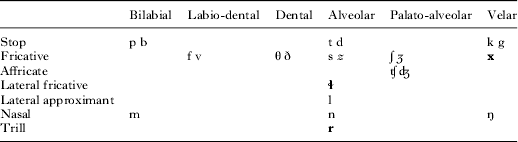
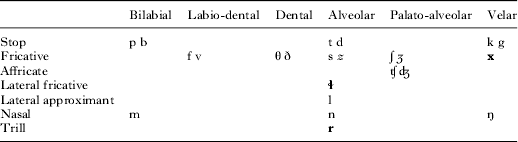
The consonant systems of Welsh and English, as used in the county of Pembrokeshire in southwest Wales where the study was conducted, are highly similar, sharing many of their categories (cf. Table 1). Only Welsh contains the fricatives /ɬ/ and /x/, however. Note also that, unlike South Wales English, Welsh is rhotic, with /r/ normally realised syllable-finally as a voiced alveolar trill [r] (see Ball, Müller & Munro, Reference Ball, Müller and Munro2001a; Ball & Williams, Reference Ball and Williams2001, for further details).
Word-final consonants of Pembrokeshire Welsh and English; Welsh-specific consonants are in bold, English-specific ones in italics
In phonotactic terms, both languages allow complex patterns. Up to four consonants can occur in syllable codas in English, although these patterns are rare and mostly involve a morpheme boundary, e.g. /-lfθs/ as in twelfths. Triple codas, in turn, predominantly consist of a liquid or nasal followed by a sequence of two obstruents, e.g. /-nst/ as in against or /-lst/ as in whilst, although they may consist of three obstruents, e.g. /-kst/ as in next (see Yavaş, Reference Yavaş and Beauburn2006, for further details). Welsh also allows triple codas, e.g. /-stl/ as in gwystl ‘hostage’, or /-stn/ as in wystn ‘stump’ (cf. Awbery, Reference Awbery, Ball and Jones1984; Ball & Williams, Reference Ball and Williams2001, for details). However, these patterns are rare, and often involve deletion of the final sonorant, or vowel epenthesis. For example, ffenestr ‘window’ is typically realized as [ˈfεnεst] or, less commonly, [fεˈnεstεr]. Hannahs (Reference Hannahs and Carnie2011) argues that these patterns arise in order to counteract a sonority sequencing violation.
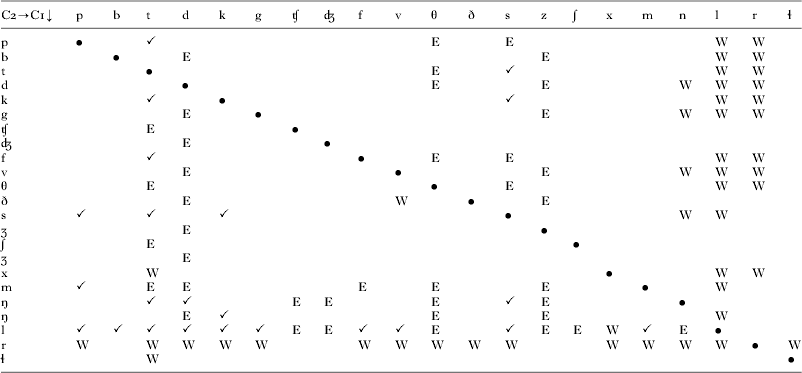
The majority of coda clusters in both languages consist of two elements. Table 2 depicts the double clusters that are permissible word-finally in Pembrokeshire Welsh and English.
Double coda clusters permissible in Pembrokeshire Welsh (W), Pembrokeshire English (E), or both (✓); C1 and C2 denote the first and second consonants of each cluster, respectively; ‘•’ denotes impossible combinations
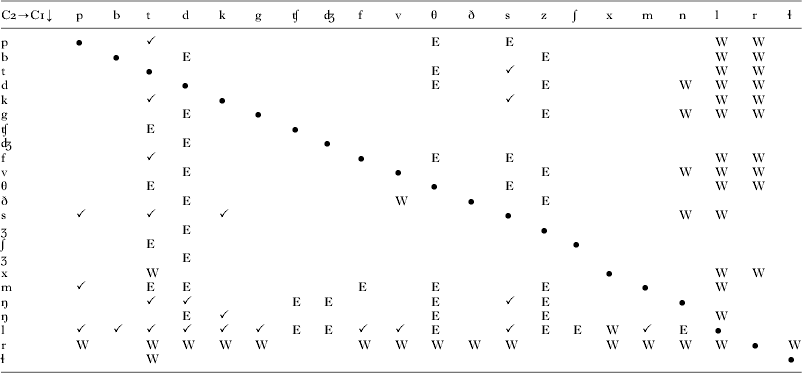
Inspection of Table 2 indicates that many clusters are shared between the two languages, e.g. /-pt -ts -sp -lp -mp/. However, only English allows nasal + affricate clusters. Moreover, a larger number of cluster combinations with /t d s z/ as second element is permissible in English than Welsh, perhaps because of the role that these segments play in English morphology.
Welsh also distinguishes a number of language-specific clusters, such as /-ðv/ as in deddf ‘act’, /-ɬt/ as in gwallt ‘hair’, or /-vn/ as in ofn ‘fear’. Note that the last of these constitutes a genuine coda cluster, rather than a bisyllabic word with a syllabic nasal, as in English oven /ˈʌ.v /. The same holds true for obstruent–lateral sequences, e.g. /-gl/ as in arogl ‘smell’, /-bl/ as in disgybl ‘pupil’, or /-dl/ as in odl ‘rhyme’. While these consonant sequences involve syllabic laterals in English, e.g. bottle realized as [ˈbɒt
 ], they are genuine coda clusters in Welsh. This is apparent when considering the word disgybl ‘pupil’, which in conformity with the regular Welsh word stress pattern is accented on the penultimate syllable, i.e. /ˈdɪs.ɡəbl/. Finally, as Pembrokeshire Welsh is rhotic, it allows /-rC/ clusters, such as /-rt/ as in pert ‘pretty’, /-rn/ as in darn ‘piece’, or /-rθ/ as in gwerth ‘value’. Pembrokeshire English, in contrast, is non-rhotic, and as a result does not contain /-rC/ clusters.
METHOD
Participants
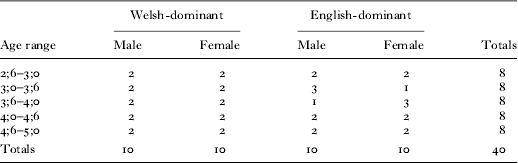
Forty Welsh–English bilingual children attending Welsh-medium nurseries and primary schools in Pembrokeshire, West Wales participated in the study. The postcode area from which the children were recruited is amongst those with the largest concentration of Welsh speakers in Wales, with 52% of the population able to speak Welsh, according to the 2011 Census (Office for National Statistics: http://neighbourhood.statistics.gov.uk). The participants were assigned to one of five age cohorts, ranging from 2;6 to 5;0, with an equal number of males and females (see Table 3).
Participants

The sample was further stratified in terms of language dominance. A bilingual's language dominance is notoriously difficult to measure and various methods have been suggested for operationalizing it (cf. Daller, Yildiz, de Jong, Kan & Basbagi, Reference Daller, Yildiz, de Jong, Kan and Basbagi2011; Dunn & Fox Tree, Reference Dunn and Fox Tree2009). For the purposes of the present study, dominance was defined in terms of the children's language use in their homes. This approach was considered the best reflection of community reality since virtually all Welsh–English bilingual children attend Welsh-medium education, while only some of these also use Welsh in their homes. Children from Welsh-only homes were considered Welsh-dominant and children from English-only homes English-dominant. Following Gathercole, Thomas, and Hughes’ (Reference Gathercole, Thomas and Hughes2008) approach, children from homes in which the dominant language is used most of the time, although not exclusively, were also included in the study. On the other hand, children who regularly use both languages in their everyday interactions at home were excluded since the purpose of this study was to capture maximally distinct types of linguistic experience.
To obtain detailed information on home language use, the children's parents completed a language background questionnaire in which they were asked to comment on the frequency with which their child uses Welsh and/or English with each of the most significant individuals in the home environment, including grandparents, extended family members, and close friends. The data were assessed qualitatively, revealing that children from Welsh-speaking homes had entirely different profiles from children from English-speaking homes. Thus, in the former setting, both parents spoke Welsh all the time or most of the time, and occasionally English with some friends and neighbours, while Welsh was virtually non-existent in English-speaking homes. Moreover, the vast majority of parents from Welsh-speaking homes completed the Welsh version of the language background questionnaire, while all parents from English-speaking homes completed the questionnaire in English.
No speech, language, or communication difficulties were reported. All participating children had normal hearing.
Materials
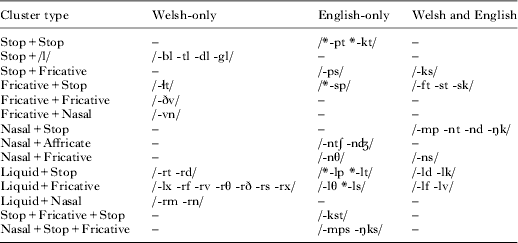
Thirty-one Welsh and twenty-seven English word-final clusters were included in the study (cf. Table 4). They capture most phonotactically admissible patterns, with the exception of rare clusters that only occur in low-frequency words, such as /-mf -mθ -ŋθ -lʧ -lʤ -lʃ -lpt -lps -lst/ in English, and /-dn -ɡn -sn -stn -rp -rɬ -vl -fl -θl/ in Welsh. Of the clusters included in the study, some are language-specific, while others occur in both languages. Although morphologically complex clusters, e.g. /-bz/ in labs, are typically amongst the first to be acquired (Kirk & Demuth, Reference Kirk and Demuth2005), they were excluded to avoid any confounds with the children's developing language skills.
Word-final clusters included in the study

note:* = word-final clusters which also occur in a small set of Welsh words, predominantly in loanwords from English, with which young children are not normally familiar, e.g. /-lt/ in ocwlt ‘occult’.
Two words were selected to represent each of the word-final clusters in the two languages, yielding a total of sixty-two Welsh words and fifty-four English ones (see ‘Appendix’ for details). Wherever possible, words were chosen with which young children were expected to be familiar, and which could be elicited via pictorial representation. A few loanwords from English were included in the Welsh set since they are fully integrated into the Welsh language and appear in standard Welsh dictionaries.
Procedure and analysis
Data collection took place in individual sessions in a quiet room on the premises of the participating schools and nurseries. Each participant was seen twice, once in a Welsh session, and once in an English one, with the two sessions scheduled on different days. Recordings were made using a Zoom H4 Handy Recorder with integrated condenser microphone, which was positioned a few centimetres from the participant's mouth.
Each session commenced with a brief interaction between the participant and the second author, a native speaker of Pembrokeshire Welsh. This procedure aimed to set the participants into a monolingual language mode (Grosjean, Reference Grosjean and Nicol2001) to the extent that this was possible with a bilingual experimenter. Following familiarization with the task, the children were asked to name 124 pictures in the Welsh session (two repetitions of each of the 62 target words), and 108 pictures in the English session (two repetitions of each of the 54 target words). This yielded a total of 124 (pictures) × 40 (children) = 4960 Welsh tokens, and 108 (pictures) × 40 (children) = 4320 English tokens. Where items could not be elicited spontaneously, the children were given phonemic or semantic prompts, and if these were unsuccessful, the words were modelled by the experimenter. No attempts were made to elicit the clusters in isolation. On average, the recording sessions lasted around 25 minutes.
All data were transcribed in broad phonetic transcription by a phonetically trained transcriber who is a second language learner of Welsh, using the symbols of the International Phonetic Alphabet (IPA) (International Phonetic Association, 2005). Upon initial transcription, 25% of the sessions were randomly selected from the pool of productions, and reanalyzed by a second phonetically trained transcriber, an early Welsh–English bilingual. Mean inter-transcriber reliability was 84·69%, ranging from 81·75% for the Welsh tokens to 88·94% for the English tokens. Any differences between the two transcribers were resolved by consensus.
Tokens were deemed correct if the children's productions of the word-final consonant clusters conformed to the patterns used in adult pronunciation; otherwise they were classified as errors. Note, however, that mismatches in voicing between the target clusters and the children's productions were ignored since reliable voicing distinctions are acquired late (Kirk, Reference Kirk2008; Stoel-Gammon & Buder, Reference Stoel-Gammon, Buder and Ohala1999). Moreover, dialectal variation was taken into account. Thus, the children were not penalised for epenthesizing /-vn/ clusters, e.g. ofn ‘fear’ produced as [ɔvɔn], as these realizations are common in Pembrokeshire Welsh (Awbery, Reference Awbery, Ball and Jones1984). For the same reason, vowel epenthesis in plosive + lateral clusters, e.g. odl ‘rhyme’ as [ɔdəl], was deemed acceptable, as well.
RESULTS
Accuracy of cluster production
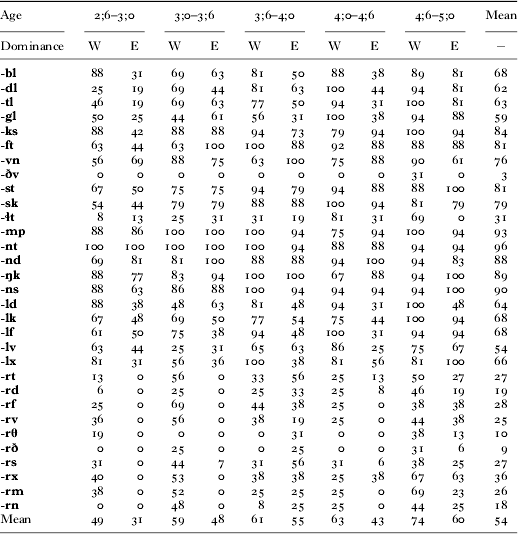
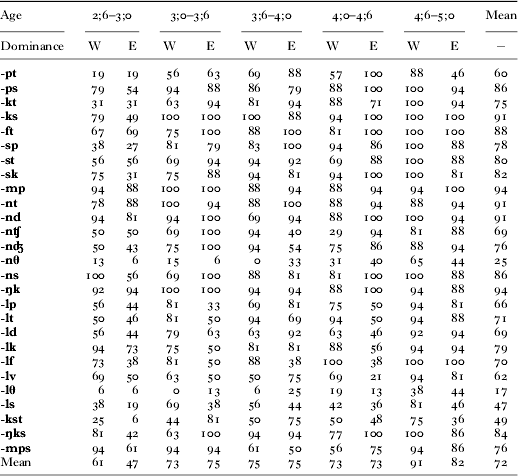
Tables 5 and 6 depict the participants' mean percent correct performance on the 31 Welsh clusters and the 27 English ones, broken down by age and language dominance.
Percent correct production of thirty-one Welsh word-final consonant clusters by age and language dominance; W = Welsh-dominant bilinguals; E = English-dominant bilinguals

Percent correct production of twenty-seven English word-final consonant clusters by age and language dominance; W = Welsh-dominant bilinguals; E = English-dominant bilinguals
Inspection of Tables 5 and 6 indicates that the children produced the English clusters overall more accurately than the Welsh ones. This pattern holds for both dominance groups. To investigate the effects of age and language dominance on cluster production systematically, a 27 (cluster) × 5 (age) × 2 (dominance) mixed plot ANOVA (repeated measures) was conducted for the English dataset, and a 31 (cluster) × 5 (age) × 2 (dominance) mixed plot ANOVA (repeated measures) was conducted for the Welsh dataset. Unsurprisingly, the results revealed significant main effects of cluster (Welsh: F(30,900) = 46·005, p < ·001; English: F(26,780) = 24·173, p < ·001) and age (Welsh: F(4,30) = 3·776, p = ·013; English: F(4,30) = 4·575, p = ·005). In addition, the Welsh dataset revealed a significant main effect of dominance (F(1,30) = 9·812, p = ·004), with the Welsh-dominant bilinguals consistently outperforming the English-dominant ones (Mean Welsh-dominant: 61%; mean English-dominant: 47%). Interestingly, the main effect of dominance was not significant for the English dataset (p > ·1).
Significant interactions for the Welsh clusters include cluster*dominance (F(30,900) = 2·147, p < ·001) and cluster*age*dominance (F(120,900) = 1·277, p = ·031). Significant interactions for the English clusters include cluster*age (F(104,780) = 1·514, p = ·001), cluster*dominance (F(26,780) = 1·986, p = ·003), and cluster*age*dominance (F(104,780) = 1·293, p = ·033).
This analysis was followed up by a series of one-way between-subjects ANOVAs to examine the effects of age and dominance on the production of each of the clusters.
Effects of age
Tables 5 and 6 indicate that some clusters were produced accurately by all age groups, including the youngest, e.g. /-nt/ in both languages, while others deviated consistently from the adult target, e.g. the Welsh /-rC/ clusters. No significant age effects were found for fricative + nasal, nasal + affricate, liquid + stop, liquid + fricative, liquid + nasal, and nasal + stop + fricative clusters. All other cluster types exhibited some significant differences across the age groups. In the following, these are discussed in more detail.
Stop + stop
The younger age groups found English /-pt/ and /-kt/ difficult to produce, in particular those under 3;0. However, with increasing age, the subjects showed significant improvements in production accuracy (/-pt/: F(4,30) = 4·405, p = ·006; /-kt/: F(4,30) = 5·349, p = ·002), with the exception of /-pt/ for the English-dominant children in the oldest age group.
Stop + /l/
Overall, performance on the Welsh-specific stop + /l/ clusters was good, with high degrees of accuracy in the productions of the oldest age group. Note, however, that the Welsh-dominant subjects consistently outperformed the English-dominant ones from the outset (see below for details of dominance effects). While /-dl/ and /-tl/ showed significant age effects (/-dl/: F(4,30) = 5·165, p = ·003; /-tl/: F(4,30) = 2·947, p = ·036), performance on /-bl/ and /-gl/ was more varied, with considerable variation across the age groups, in particular for the English-dominant subjects.
Stop + fricative
Performance was generally excellent in both languages, with the exception of some erroneous realizations in the youngest age group (Welsh /-ks/: F(4,30) = 2·930, p = ·037; English /-ks/: F(4,30) = 6·468, p = ·001; English /-ps/: F(4,30) = 3·68, p = ·015).
Fricative + stop
The subjects struggled with Welsh-specific /-ɬt/, which was only consistently target-like in the older Welsh-dominant bilinguals' productions. Otherwise, performance on fricative + stop clusters was good, except in the youngest age group. Significant age effects were found for /-sk/ in both languages (Welsh: F(4,30) = 3·698, p = ·015; English: F(4,30) = 3·622, p = ·016), /-sp/ on the English words (F(4,30) = 6·852, p < ·001), and /-ft/ on the Welsh words (F(4,30) = 2·977, p = ·035).
Fricative + fricative
The subjects generally failed to realize Welsh-specific /-ðv/ accurately, with only the oldest Welsh-dominant bilinguals producing some accurate realizations (F(4,30) = 2·778, p = ·045).
Nasal + stop
Performance on all nasal + stop clusters was excellent with all age groups achieving high degrees of accuracy in both languages. Only /-mp/ showed a significant age effect on the Welsh words (F(4,30) = 2·826, p = ·042).
Nasal + fricative
Across the age groups, the subjects performed well on /-ns/ in both languages, with a significant age effect on the Welsh words (F(4,30) = 2·912, p = ·038). They all struggled, however, with the production of English-specific /-nθ/, although performance improved with increasing age (F(4,30) = 3·857, p = ·012).
Stop + fricative + stop
Performance on English /-kst/ was somewhat erratic, in particular with the English-dominant bilinguals who performed well between 3;0 and 4;0, but not in older age groups (F(4,30) = 2·819, p = ·043).
Effects of dominance
Overall, the Welsh-dominant bilinguals were more accurate on the Welsh clusters than the English-dominant bilinguals, without lagging behind them on the English clusters (cf. Tables 5 and 6). They performed significantly better on two Welsh clusters that also feature in English, i.e. /-ld/ (F(1,30) = 11·201, p = ·002) and /-lf/ (F(1,30) = 10·976, p = ·002). Nevertheless, significant dominance effects were predominantly found for clusters specific to Welsh. Some of these were produced with near-perfect accuracy, at least by the older Welsh-dominant bilinguals, e.g. /-bl/ (F(1,30) = 6·672, p = ·015), /-dl/ (F(1,30) = 5·854, p = ·022), /-tl/ (F(1,30) = 6·878, p = ·014), /-lx/ (F(1,30) = 7·239, p = ·012), /-ɬt/ (F(1,30) = 4·32, p = ·046). Others still differed consistently from the adult targets, in particular /-rC/ clusters. Of those, only three exhibited significant dominance effects, i.e. /-rf/ (F(1,30) = 4·959, p = ·034), /-rv/ (F(1,30) = 6·391, p = ·017), and /-rm/ (F(1,30) = 7·472, p = ·01).
Patterns of acquisition
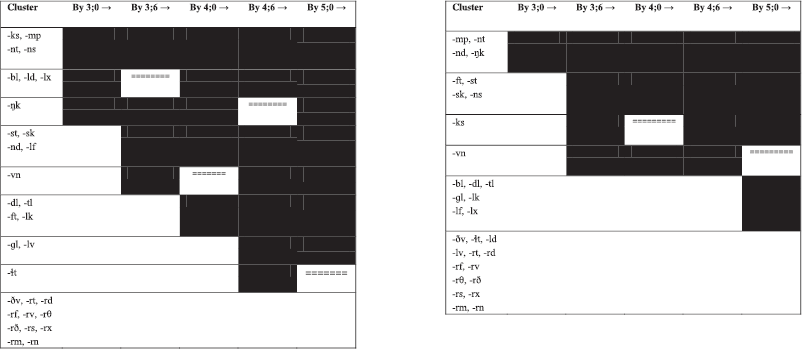
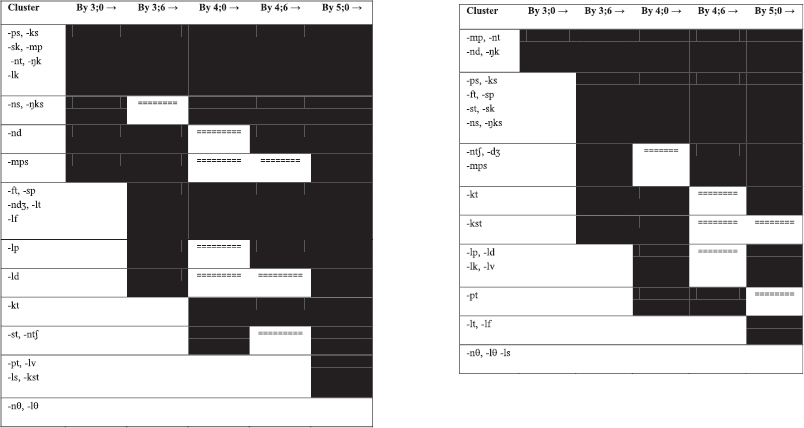
Tables 7 and 8 depict the stages of acquisition for the Welsh and English clusters, displayed separately for the Welsh-dominant and the English-dominant bilinguals. Note that for the purposes of the present study, acquisition was defined in terms of Sander's (Reference Sander1972) criterion for ‘age of acquisition’, i.e. 75% correct, in line with many previous studies of phonological acquisition (Munro et al., Reference Munro, Ball, Müller, Duckworth and Lyddy2005; So & Dodd, Reference So and Dodd1995; Templin, Reference Templin1957).
Welsh acquisition stages: Welsh-dominant bilinguals (left); English-dominant bilinguals (right); blackened areas indicate successful acquisition (⩾75% correct), blank areas lack thereof; broken lines denote fluctuating acquisition patterns in which initial acquisition is not maintained in subsequent age groups
English acquisition stages: Welsh-dominant bilinguals (left); English-dominant bilinguals (right); blackened areas indicate successful acquisition (⩾ 75% correct), blank areas lack thereof; broken lines denote fluctuating acquisition patterns in which initial acquisition is not maintained in subsequent age groups
Inspection of Tables 7 and 8 indicates stable acquisition patterns for some clusters by the age of 3;0, e.g. /-mp/, /-nt/, and /-ŋk/. These hold across the two dominance groups. Other early acquired clusters include /-ns/, /-nd/, /-ks/, /-sk/ in both languages, as well as English-specific /-mps/ and /-ndʒ/, and Welsh-specific /-vn/. On the other hand, English-specific /-nθ/ and /-lθ/, Welsh-specific /-ðv/, as well as the Welsh /-rC/ clusters were still not acquired by 5;0. Note, however, that the oldest Welsh-dominant bilinguals came close to the 75% threshold for /-rx/ and /-rm/.
The patterns also suggest some dominance-related differences in acquisition. Thus, the Welsh-dominant bilinguals acquired a number of Welsh-specific clusters earlier than their English-dominant counterparts, notably /-lx/ and the stop + lateral clusters /-bl/, /-dl/, /-tl/, and /-gl/, which the latter only acquired in the oldest age group. Moreover, while the English-dominant bilinguals failed to acquire /-ɬt/ altogether, the Welsh-dominant bilinguals managed to acquire the cluster by the age of 4;6. Note, however, that acquisition was not noted in the oldest age group, with the accuracy score dropping to just below the 75% threshold.
Differences across the dominance groups were also observed for the English clusters. For example, the English-dominant bilinguals acquired /-pt/ by 4;0, while the Welsh-dominant bilinguals only acquired the cluster by 5;0. The same pattern emerged for English-specific /-kt/, /-kst/, and /-nʧ/. On the other hand, the Welsh-dominant bilinguals managed to acquire several English clusters earlier than their English-dominant counterparts: /-lk/, for instance, was acquired by 3;0 by the Welsh-dominant bilinguals, but not until 4;0 by the English-dominant bilinguals; /-lt/ and /-lf/ were acquired by 3;6 by the Welsh-dominant bilinguals, but not until 5;0 by the English-dominant ones; and /-ls/, for which the Welsh-dominant bilinguals reached the 75% threshold in the oldest age group, was still not acquired by 5;0 by the English-dominant bilinguals.
Correlations
In order to investigate whether cluster production in one language is related to cluster production in the other, a series of correlation analyses was carried out across the thirteen clusters shared by Welsh and English. The results revealed a significant positive correlation for /-ks/ (r = ·67, p < ·001), /-ft/ (r = ·691, p < ·001), /-st/ (r = ·634, p < ·001), /-sk/ (r = ·679, p < ·001), /-nd/ (r = ·315, p = ·048), /-lk/ (r = ·728, p < ·001), /-lf/ (r = ·836, p < ·001), and/-lv/ (r = ·472, p = ·002). There was no indication of a significant relationship between the two languages for /-mp/, /-nt/, /-ŋk/, /-ns/, and /-ld/. Note, however, that these clusters were all produced with near-perfect accuracy across the various age groups, suggesting ceiling effects.
Error patterns
A total of 2147 Welsh tokens and 1117 English tokens were classed as errors. With increasing age, not only did the children's overall error rates decrease, but also the number of error types they produced per cluster, ranging from a mean of 4·33 error types per cluster in the youngest English-dominant group to 1·62 in the oldest Welsh-dominant group (cf. Table 9). This indicates that as the children's age increased, their productions became increasingly more focused and less variable. Variability was also found to be related to language dominance, with more varied patterns on average by the English-dominant children, in particular when attempting the Welsh words. The patterns were not only found to vary according to age and dominance, however, but also to cluster type. Thus, some clusters exhibited very homogeneous error patterns. Across all participants, Welsh /-mp -nt -nd/ and English /-ft/, for example, only involved three types of non-target-like realizations each. Other clusters, in contrast, showed highly heterogeneous error patterns, in particular the Welsh /-rC/ clusters, with /-rð/ the most varied with thirty-five different realizations.
Mean number of error types per cluster by age and language dominance; SDs in parenthesis; W = Welsh-dominant bilinguals; E = English-dominant bilinguals

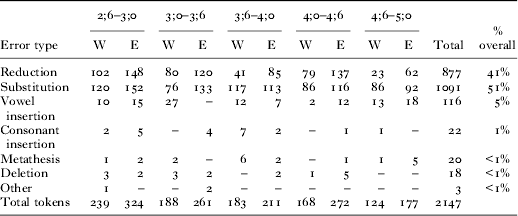
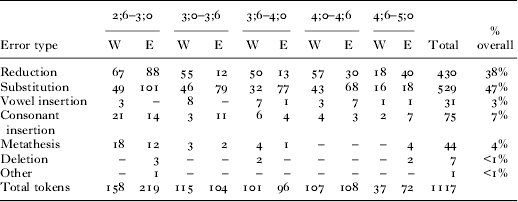
The children's error patterns were also analyzed in terms of their type. Only 25 tokens, i.e. less than one percent of errors involved deletion of the entire cluster (cf. Tables 10 and 11 for details). Errors that involve omission of one element, or two in the case of the English triple clusters, were classed as reductions. These account for 41% of errors on the Welsh words (879 tokens) and 38% of errors on the English words (430 tokens). As Tables 10 and 11 indicate, the incidence of cluster reduction decreased with age, despite some reversal patterns. Note, however, that even in the oldest age group reduction remained a comparatively common error type. The English-dominant bilinguals consistently reduced a larger number of Welsh clusters than their Welsh-dominant counterparts. In contrast, the reduction patterns on the English words were more varied, with no overall difference across the dominance groups.
Error types by age and dominance: Welsh words; W = Welsh-dominant bilinguals; E = English-dominant bilinguals

Error types by age and dominance: English words; W = Welsh-dominant bilinguals; E = English-dominant bilinguals

All clusters exhibited reductions, except for English /-ks/ and Welsh /-bl -dl -tl -gl/. The majority of reduced double clusters in English (59%) involved omission of the second element, e.g. lift as [lɪf], while omission of the first element only accounted for 26% of cases, e.g. bank as [bæk]. In contrast, the children omitted the first element in 62% of instances in Welsh clusters, e.g. gwers /gwεrs/ ‘lesson’ as [gwεs], while the second element was only omitted in 17% of cases, e.g. ofn /ɔvn/ ‘fear’ as [ɔv]. Closer inspection of the Welsh data indicates, however, that the majority of tokens with omitted first elements (57%) involved omission of consonants that are known to be acquired late in Welsh singletons, e.g. /ð/ in /-ðv/ and /r/ in /-rC/ clusters (cf. Ball et al., Reference Ball, Müller and Munro2001a, Reference Ball, Müller and Munro2001b; Munro et al., Reference Munro, Ball, Müller, Duckworth and Lyddy2005). If these are disregarded, the proportions of omitted first and second elements conform closely to those of the double clusters in English, 32% and 52%, respectively.
The remaining 21% of reduced double clusters in Welsh and 15% in English were reductions to singletons that did not match either of the consonants in the target. Many of these involved substitutions for late-acquired sounds that have similar phonetic features. For example, /-rs/ was realized as [θ l ç f ʃ x ʀ v], and /-ɬt/ as [x] and [s], with most of the children's productions matching one of the consonants in the target in terms of manner of articulation. Some non-target-like reductions were motivated by assimilation to sounds occurring earlier in the word, e.g. belt as [bεp]. Feature synthesis, in turn, occurred comparatively rarely, although a few possible instances were identified. For example, /-ks/ in clecs /klεks/ ‘gossip’ was realized as [t], thus combining the manner of articulation of the first element in the target with the place of articulation of the second. Alternatively, however, this realization may constitute an instance of velar fronting with concomitant omission of /s/, or stopping of /s/ with concomitant omission of /k/.
Finally, the reduction patterns of the English triple clusters were examined. They involved a range of different realizations, with a preponderance of two-element patterns; /-kst/ and /-ŋks/ showed a preference for omission of the third element, while /-mps/ predominantly involved omission of the first element. Reduction patterns with concomitant substitutions occurred rarely, e.g. /-kst/ in next as [kθ], as did reductions to singletons.
substitutions constituted the most common error type, accounting for 51% of errors on the Welsh words (1091 tokens) and 47% of errors on the English words (529 tokens). These involve clusters consisting of the correct number of consonants but with one or more of these substituted for another. As Tables 10 and 11 indicate, the number of substitution errors decreased with increasing age, despite some reversals. Moreover, the English-dominant bilinguals produced consistently more substitutions than the Welsh-dominant ones.
The majority of substitution errors in both languages (51% in Welsh and 55% in English), involved clusters consisting of one target-like consonant and one consonant with target-like manner of articulation, e.g. wasp as [wɒst]; odl /ɔdl/ ‘rhyme’ as [ɔɡl]. Many of the substitutions in Welsh /-rC/ clusters followed this pattern, with /r/ predominantly realized as [l], [ɣ], [ʀ], [ʁ], and less commonly [υ]. Note that for the present purposes both rhotic consonants and lateral approximants were classed as liquids.
Substitution patterns consisting of one target-like consonant and one not matching in either place or manner of articulation were also common, accounting for 28% of the Welsh substitutions and 29% of the English ones. Substitutions in which neither consonant is target-like but both match in terms of place or manner of articulation, in turn, occurred relatively frequently in Welsh, in particular on /-rC/ clusters, accounting for 13% of substitutions, e.g. arth /ɑrθ/ ‘bear’ as [aɣf]. In English, in contrast, these patterns were marginal and only occurred in 2% of substitutions, e.g. box as [bɒcç]. Similarly, clusters consisting of one target-like segment and one segment with target-like place of articulation occurred rarely, e.g. dance as [dɑnt]; gweld /ɡwεld/ ‘see’ as [wεlɬ].
In addition to reduction and substitution patterns, 5% of errors on the Welsh clusters (116 tokens), and 3% on the English clusters (31 tokens) involved vowel insertions. These consisted of clusters broken up by epenthetic vowels, predominantly schwa, either with or without concomitant substitutions, e.g. Siôn Corn /ʃon kɔrn/ ‘Santa Clause’ as [ʃon kɔlən] or [ʃon kɔrən]. In a few instances, vowel insertion was accompanied by loss of one of the consonants in the cluster, e.g. twelve as [twεlə] or Siôn Corn as [ʃon kɔlə]
consonant insertions, in turn, occurred infrequently on the Welsh clusters, accounting for a mere 1% of errors (22 tokens), while they were more common on the English ones, with 7% of errors (75 tokens). These predominantly involved insertion of a stop or fricative, either cluster-medially, e.g. false as [fɒlfs] or cluster-finally, e.g. wasp as [wɒspt]. In some instances, consonant insertions were accompanied by substitutions, e.g. gwallt /gwaɬt/ ‘hair’ as [gwaxst].
Similarly, errors classed as metathesis occurred infrequently, accounting for a mere 4% of errors on the English words (44 tokens) and less than 1% of errors on the Welsh words (20 tokens). These predominantly involved a change in the order of elements within a cluster, e.g. crisp as [kwɪps]; ofn ‘fear’ as [ɔnv], and were sometimes accompanied by substitutions, e.g. clecs ‘gossip’ as [klεθk]. In a few instances, consonants outside the word-final cluster were involved in metathesis errors. One child, for example, realized arogl /arəɡl/ ‘smell’ as [alɔɡɔr] and a different child realized twelve as [tlεʊf].
Finally, four tokens, three on the Welsh dataset and one on the English dataset, could not be easily assigned to any of the preceding error categories (cf. ‘Other’ in Tables 10 and 11). These include Pasg /pask/ ‘Easter’ realized as [parʃ], which could be analyzed as metathesis with concomitant substitution of both cluster elements, or alternatively as consonant insertion with concomitant loss of the final plosive in the target and modification of the fricative. Since we could not be certain what processes were involved, we opted for a conservative approach and decided not to classify this error in terms of the preceding categories, in line with previous accounts (e.g. Kirk, Reference Kirk2008). In like manner, it was not possible to determine with any certainty the underlying processes for dosbarth /dɔsbarθ/ ‘class’ realized as [dɔfbast], palf /palv/ ‘palm’ as [pavz], and act as [ants].
DISCUSSION
The purpose of this study is to add to the growing literature on bilingual phonological development by conducting the first systematic investigation of word-final consonant cluster productions in bilingual children. To this end, forty Welsh–English bilingual children aged 2;6 to 5;0, half of whom were Welsh-dominant, the other half English-dominant, were assessed in a picture-naming task. The data were analyzed in terms of the accuracy with which word-final clusters were produced in the two languages. The results revealed significant effects of age and language dominance on acquisition.
Cluster acquisition and age
Even the children in the youngest age groups showed evidence of successful cluster acquisition. Thus, by 3;6, the children were able to produce most word-final nasal + stop, nasal + fricative, stop + fricative, and fricative + stop clusters accurately in both languages. In contrast, they failed to reach the 75% acquisition threshold for /-ðv/ and all /-rC/ clusters in Welsh, and /-nθ/ and /-lθ/ in English. The English-dominant bilinguals also failed to acquire Welsh /-ɬt/, /-lv/ and /-ld/, and English /-ls/ by 5;0. These results are not surprising considering most of these clusters contain sounds that are known to be acquired late in singletons (cf. Ball et al., Reference Ball, Müller and Munro2001a, Reference Ball, Müller and Munro2001b; Munro et al., Reference Munro, Ball, Müller, Duckworth and Lyddy2005, for Welsh; Dodd, Holm, Hua & Crosbie, Reference Dodd, Holm, Hua and Crosbie2003; Templin, Reference Templin1957, for English).
The results not only showed a steady increase in production accuracy across the age range, but also fluctuating acquisition patterns. For example, the Welsh-dominant bilinguals produced Welsh /-bl/, /-ld/, and /-lx/ accurately between 2;6 and 3;0, but acquisition was not maintained in the subsequent age group. Fluctuating patterns of this kind have been well documented in the literature (Mayr et al., in press; Munro et al., Reference Munro, Ball, Müller, Duckworth and Lyddy2005; Smit et al., Reference Smit, Hand, Freilinger, Bernthal and Bird1990; Templin, Reference Templin1957). They may be a manifestation of individual variation in the cross-sectional sample of this study, or due to differences in lexical acquisition patterns (Ota & Green, Reference Ota and Green2013). Alternatively, these patterns may have arisen from reorganization of the children's phonological systems as new items were added, resulting in periods of greater variability (Ingram, Reference Ingram1989). Since bilinguals need to distinguish a larger number of phonological patterns than monolinguals, perhaps these periods of variability are more common in bilinguals than monolinguals. Grech and Dodd (Reference Grech and Dodd2008) found that this was indeed the case for their three- to four-year-old Maltese–English bilinguals. Interestingly, however, older bilingual children in their study were more consistent in their productions than age-matched monolinguals.
Rate of acquisition
No previous data on the acquisition of word-final consonant clusters in Welsh are available. Comparisons with studies on English cluster acquisition in monolingual children (Templin, Reference Templin1957) suggest that the Welsh–English bilinguals in the present study may have acquired English word-final consonant clusters at a faster rate. Recall that they acquired all clusters by 5;0, except /-lθ/ and /-nθ/, and /-ls/ in the case of the English-dominant bilinguals. In contrast, in Templin's (Reference Templin1957) study, a number of additional clusters had not yet reached the 75% acquisition threshold by that age, including /-kt –sp –st –nd/. This could indicate accelerated rates of acquisition in the bilingual children, although one needs to be cautious with this interpretation since no comparable data from age-matched monolingual English-speaking children from the same community are available. Note also that Templin only examined nineteen of the twenty-seven English word-final clusters that feature in this study. No comparisons were possible for /-ns -ld -ps -nʧ -ndʒ -lv -ls -ŋks/.
The results obtained here, then, appear to be in line with a growing number of studies that have indicated accelerated rates of phonological acquisition in bilinguals compared with age-matched monolinguals (Goldstein & Bunta, Reference Goldstein and Bunta2012; Grech & Dodd, Reference Grech and Dodd2008; Kehoe et al., Reference Kehoe, Trujillo, Lleó, Cantone and Hinzelin2001; Lleó et al., Reference Lleó, Kuchenbrandt, Kehoe, Trujillo and Müller2003; Tamburelli et al., Reference Tamburelli, Sanoudaki, Jones and Sowinska2012). In view of other studies reporting delayed acquisition by bilinguals (Dodd et al., Reference Dodd, So, Li, Dodd, Campbell and Worrall1996; Fabiano-Smith & Goldstein Reference Fabiano-Smith and Goldstein2010; Gildersleeve-Neumann et al., Reference Gildersleeve-Neumann, Kester, Davis and Peña2008; Goldstein & Washington, Reference Goldstein and Washington2001), what, then, can account for the Welsh–English bilingual children's apparent enhanced performance on English word-final clusters?
According to Goldstein and Bunta (Reference Goldstein and Bunta2012), acceleration effects occur where the phonological systems of a bilingual's two languages exhibit a large degree of overlap, leading to enhanced cue strength and cue reliability. This is the case in the present context as most English consonant categories and many cluster patterns also occur in Welsh (cf. Tables 1 and 2). Moreover, English lexical items are regularly used in otherwise Welsh utterances, resulting in code-switching and borrowing (Deuchar & Davies, Reference Deuchar and Davies2009). These processes may have further enhanced the children's experience with English phonology.
Cluster acquisition and dominance
Independent of language dominance, the bilingual children produced the English clusters more accurately than the Welsh ones. A possible explanation for this finding is that the two sets of clusters differed in their phonological complexity. Thus, the Welsh clusters contained more sounds that are known to be acquired late in singletons, such as /r/, /ɬ/, and /ð/ (Ball et al., Reference Ball, Müller and Munro2001a, Reference Ball, Müller and Munro2001b), than the English ones. This finding is consistent with Law and So's (Reference Law and So2006) study of Cantonese–Putonghua bilingual children, which revealed that both Cantonese-dominant and Putonghua-dominant bilinguals developed Cantonese phonology faster than the more complex phonology of Putonghua.
Law and So's (Reference Law and So2006) study also exhibited symmetrical dominance effects: the Cantonese-dominant bilinguals outperformed the Putonghua-dominant ones on Cantonese phonology, and the Putonghua-dominant bilinguals the Cantonese-dominant ones on Putonghua phonology. This finding differs from the asymmetrical dominance patterns observed in the present study in which the Welsh-dominant bilinguals acquired the Welsh clusters earlier and with greater accuracy than the English-dominant bilinguals, without thereby lagging behind on the English clusters. It is therefore likely that, in addition to differences in the phonological complexity of Welsh and English clusters, other factors may be responsible for the observed patterns.
The Welsh-dominant bilinguals may have shared certain characteristics that might have put them at an advantage over their English-dominant counterparts. Some previous studies have, for instance, found delayed phonological acquisition in children from deprived social backgrounds (e.g. Burt, Holm & Dodd, Reference Burt, Holm and Dodd1999; Templin, Reference Templin1957), although others have found no effect of socioeconomic status (SES) (e.g. Dodd et al., Reference Dodd, Holm, Hua and Crosbie2003; Smit et al., Reference Smit, Hand, Freilinger, Bernthal and Bird1990). No formal assessment of the children's SES was carried out in the present study, and consequently it cannot be ruled out as a contributing factor. However, based on the impression of the second author who is native to the rural community in Pembrokeshire from which the participants were recruited, there is no reason to suppose any systematic differences in SES across Welsh-speaking homes and English-speaking homes in the community.
Another factor that has been shown to affect phonological acquisition is gender. Thus, some studies have found better performance by girls than boys (Kenny & Prather, Reference Kenny and Prather1986; Wellman, Case, Mengert & Bradbury, Reference Wellman, Case, Mengert and Bradbury1931), although not always across all age groups (Dodd et al., Reference Dodd, Holm, Hua and Crosbie2003; Smit et al., Reference Smit, Hand, Freilinger, Bernthal and Bird1990). The distribution of girls and boys in the present study was the same for the two dominance groups, however. Differences in gender distribution can therefore not explain the observed pattern.
While other variables, such as sibling status (Barron-Hauwaert, Reference Barron-Hauwaert2011) or intelligence (Moore, Reference Moore1967), cannot be ruled out as potentially influencing factors, it is perhaps more likely that the observed asymmetry is a direct reflection of the sociolinguistic situation in Wales, with English as the dominant language and Welsh as the minority language. Thus, the children from English-only homes are unlikely to have received Welsh-language input before entering Welsh-medium education. In contrast, the children from Welsh-only homes would typically be exposed to English from an early age via the media, friends, or neighbours. This interpretation is consistent with Vihman, Thierry, Lum, Keren-Portnoy, and Martin's (Reference Vihman, Thierry, Lum, Keren-Portnoy and Martin2007) study on word form recognition in monolingual Welsh-speaking children, monolingual English-speaking children, and bilingual children growing up with both languages, as well as with growing evidence from lexical and grammatical acquisition which suggests that bilingual children attain high levels of proficiency in the dominant language regardless of home language background, while attainment in the minority language is directly dependent on the degree of input at home and at school (Gathercole & Thomas, Reference Gathercole and Thomas2009).
Error patterns
Where the clusters were not target-like, they tended to involve substitutions and reductions. Other error types, such as metathesis and deletion, occurred rarely. Many studies have attempted to explain the errors arising in cluster reductions on the basis of the Sonority Sequencing Principle (Gierut, Reference Gierut1999; Wyllie-Smith et al., Reference Wyllie-Smith, McLeod and Ball2006). Accordingly, reduction patterns are favoured that maximize a difference in sonority between the syllable nucleus and coda, e.g. bank as [bæk] rather than [bæŋ]. In conformity with these accounts, many reduced clusters involved omission of the first more sonorous element, in particular the Welsh /-rC/ clusters. However, the majority of reduced clusters involved omission of the second element. For present purposes, sonority-based accounts may therefore have limited explanatory power, or require further refinement.
Alternatively, the patterns observed may be due to articulatory and perceptual difficulties. Thus, sounds that are known to be acquired late in singletons, such as Welsh /r/ or /ɬ/ (Ball et al., Reference Ball, Müller and Munro2001a, Reference Ball, Müller and Munro2001b), were not produced consistently in clusters, either, resulting in omissions, or substitutions with phonetically similar sounds. For example, the lateral fricative /ɬ/ was predominantly realised as [x] in /-ɬt/ clusters, which, as Ball et al. (Reference Ball, Müller and Munro2001b) argue, may be due to velar and lateral fricatives sharing acoustic characteristics, such as similar noise spectra, that set them apart from other fricatives.
Not all substitutions are predictable on the basis of children's performance on singleton consonants, however. Interestingly, many unpredictable substitutions involved homorganic clusters, in which adjacent consonants were produced at the same place of articulation, e.g. mask as [mɑst], and hence require less complex motor control than the adult target. The observed patterns therefore appear not only to be motivated by children's attempts to approximate the adult target, but also by assimilatory processes within the clusters themselves. Similar results are reported in Kirk's (Reference Kirk2008) study of monolingual English-speaking children, aged 1;5–2;7, in which almost 70% of unpredictable substitutions were motivated by assimilation within clusters.
The error patterns also revealed some interesting differences across the dominance groups. Thus, the English-dominant bilinguals exhibited a much higher incidence of /l/-vocalizations in both languages than the Welsh-dominant ones, producing 89% (80 tokens) of the vocalized Welsh /-lC/ clusters and 84% (151 tokens) of the vocalized English /-lC/ clusters. Moreover, /l/-vocalization occurred consistently in the English-dominant children up to 4;6, while it was virtually non-existent beyond 3;6 in the Welsh-dominant children. How can these differences across the dominance groups be explained?
Vocalization of laterals is a common process in monolingual (Vihman, Reference Vihman1996) and bilingual (Khattab, Reference Khattab2002) children learning English. It has not been reported in previous studies on Welsh singleton consonant acquisition, however. Thus, if /l/-vocalization is an ‘English process’, it is not surprising that the English-dominant bilinguals who received more English-language input vocalized a substantially greater amount of /l/-tokens. The use of /l/-vocalization in Welsh words, in turn, could be ascribed to cross-linguistic interaction effects.
Alternatively, the patterns observed may not be due to the quantity of English-language input per se, but due to differences in the realization of laterals in the input to which the children were exposed. In South Wales English and Southern Welsh, laterals are commonly clear in word-final position, and thus realized with the tongue body towards the front of the oral cavity (Ball & Williams, Reference Ball and Williams2001; Mees & Collins, Reference Mees, Collins, Foulkes and Docherty1999; Walters, Reference Walters2001). This differs from most other varieties of English and Welsh where word-final /l/ tends to be dark, with the back of the tongue raised towards the velum (Recasens, Reference Recasens2004), making dark [ɫ] more prone to vocalic substitutions. While the accent used by the children's parents was not formally assessed in this study, it stands to reason that children from Welsh-speaking homes are more likely to be exposed to varieties native to South Wales, and thus to clear realizations of /l/, than children from entirely English-speaking homes whose parents may have moved to Pembrokeshire from other parts of the United Kingdom and whose accents are therefore more likely to contain dark [ɫ], or even vocalized /l/. The differential error patterns in the two dominance groups may hence be related to variational differences in the children's input.
Cross-linguistic interactions
The /l/-vocalization patterns not only reveal differences across the dominance groups, however. They also suggest cross-linguistic interactions. After all, the English-dominant bilinguals not only vocalized their realizations of English /l/, but also those of Welsh /l/, even though the lateral is clear in Pembrokeshire Welsh. It therefore stands to reason that they may have transferred /l/-vocalization from English to Welsh. Cross-linguistic effects impacting on phonological processes are not well documented in the literature. This is regrettable since transfer of language-specific phonological processes may result in patterns that would be considered atypical in monolingual children. Thus, Holm and Dodd (Reference Holm and Dodd1999) showed that the Cantonese–English bilingual children in their study used error patterns in both languages that would be indicative of a phonological disorder.
The majority of studies on cross-linguistic interactions have found evidence of transfer at the segmental level (Fabiano & Goldstein, Reference Fabiano and Goldstein2005; Fabiano-Smith & Goldstein, Reference Fabiano-Smith and Goldstein2010; Keshavarz & Ingram, Reference Keshavarz and Ingram2002), and to a lesser extent the prosodic level (Paradis, Reference Paradis2001). In terms of the use of language-specific segments in the wrong language, there is little evidence of such patterns in the present study, perhaps because the consonant systems of Welsh and English are largely overlapping. A possible example of a cross-linguistic effect is the use of Welsh-specific /ɬ/ in realizations of English /-st/. However, this pattern was marginal, and the use of /ɬ/ is well attested in monolingual English-speaking children (Grunwell, Reference Grunwell1987), for example as an instance of feature synthesis in /sl-/ or /-ls/ clusters.
Evidence for cross-linguistic interactions was found in connection with the correlation analyses conducted across shared clusters. Thus, the results revealed significant positive correlations for eight of the thirteen shared clusters, and ceiling effects elsewhere. Hence, overall the more accurately the children produced the English clusters, the more accurately they produced their Welsh counterparts. These interaction effects are consistent with previous research suggesting enhanced cue strength and reliability in patterns that are shared across languages (Fabiano-Smith & Goldstein, Reference Fabiano-Smith and Goldstein2010; Goldstein & Bunta, Reference Goldstein and Bunta2012). It is therefore likely that the interaction effects observed for shared clusters in the present study underpin the accelerated rates of acquisition reported above.
Clinical implications
The data from this study have important implications for speech and language therapists as they provide a benchmark for normal acquisition of word-final clusters in Welsh–English bilingual children differing in age and language dominance. Despite a relatively modest sample size, the study thus constitutes a meaningful extension of existing normative data on singleton consonant acquisition (Ball et al., Reference Ball, Müller and Munro2001a, Reference Ball, Müller and Munro2001b; Munro et al., Reference Munro, Ball, Müller, Duckworth and Lyddy2005) and onset cluster acquisition (Mayr et al., in press) in the same population. The results underscore the importance of the fact that monolingual norms cannot be readily applied to bilinguals. After all, the rate and pattern of development of English word-final clusters in the present study differed substantially from that of age-matched English monolinguals reported elsewhere (Templin, Reference Templin1957). Moreover, the study demonstrates that merely differentiating the norms of monolinguals and bilinguals may not be sufficient, either, since the performance of the Welsh-dominant and the English-dominant bilinguals was fundamentally different. Failure to take account of the diverse input patterns that children receive in their environment hence runs the risk of inadvertently misidentifying normally developing children as phonologically disordered.
APPENDIX: EXPERIMENTAL MATERIALS