1. Introduction
The probabilistic analysis of information propagation has received vast attention in the last few decades. In the behavioural study of communication systems, one of the problems of interest is the propagation problem where one component has some information which it wants to pass on to the other components of the system. Gilbert [Reference Gilbert13] was the first to introduce a model consisting of a signal transmission through a relay of transmitters to its recipient. Maki and Thompson [Reference Maki and Thompson19] later introduced a variation to this model, and Sudbury [Reference Sudbury24] studied this variant of the information-transmission model introduced in [Reference Maki and Thompson19]. The most readily available models are inspired by classical epidemic models, such as SIR, SIS, and SI. They are simple models of an epidemic of an infectious disease or spreading of information in a large population. In these models, the population consists of three types of individuals, referred to as ignorants, spreaders, and stiflers. Basic models and some of their generalizations can be found, for instance, in [Reference Berger, Borgs, Chayes and Saberi2], [Reference Coletti, Rodrguez and Schinazi5], [Reference Comets, Delarue and Schott6], [Reference Daley and Kendall7], [Reference Durrett and Jung8], [Reference Isham, Harden and Nekovee14], [Reference Lebensztayn, Machado and Rodríguez17], [Reference Lebensztayn, Machado and Rodríguez18], [Reference Maki and Thompson19], [Reference Moreno, Nekovee and Pacheco20], and [Reference Pittel21].
This paper aims to study a long-range rumour propagation model where the individuals are located at the sites of
 $\mathbb{N^*}=\mathbb{N} \bigcup \{0\}$
. There are two initial spreaders located at sites 0 and 1, and sceptical ignorants at all other sites of
 $\mathbb{N^*}$
. Let
 $R_0, R_1, \ldots $
be a sequence of independent and identically distributed (i.i.d.)
 ${\mathbb N}^*$
-valued random variables. For arbitrary integers
 $a, b\in \mathbb{N^*}$
, we let [a, b] denote the set of all integers between a and b. The spreaders located at sites 0 and 1 start a rumour and propagate it to all individuals in the interval
 $[0,R_0]$
and
 $[1,1+R_1]$
respectively. For
 $i=2,3,\ldots$
, a sceptical individual located at
 $i\in [1,\min\{R_0, 1+R_1\}]$
receives the rumour from two different sources 0, 1 and then accepts and transmits it further among individuals in
 $[i,i+R_i]$
. The rumour spreads in this manner, that is, a sceptic
 $j \in \mathbb{N^*}$
spreads the rumour to the individuals located in the interval
 $[j,j+R_j]$
when s/he receives the rumour from at least two different sources. This extension may be valuable for the investigation of information propagation in social networks where the acceptance of a rumour requires it to be received from different sources, or for the study of the intensity of spreading of an epidemic disease within a society, when people need to be exposed to more than one infected individual to contract that disease. The results are valid for sceptics who need to receive the information from k or more different sources to accept and transmit it. However, for the sake of simplicity, we restrict ourselves to
 $k = 2$
.
The rumour propagation model was initially introduced by Junior et al. [Reference Junior, Machado and Zuluaga15], who called it the firework process. Their model starts with one spreader at site 0 and ignorants at all of the other sites of
 ${\mathbb N}$
, where each spreader transmits the rumour, independently, to the individuals within a random distance on its right. Junior et al. [Reference Junior, Machado and Zuluaga15] obtained sufficient conditions for the rumour to survive with positive probability. It should be noted that related results were first obtained by Athreya et al. [Reference Athreya, Roy and Sarkar1] in the context of space covering processes. For more recent work on this model, see [Reference Bertacchi and Zucca3], [Reference Gallo, Garcia, Junior and Rodríguez10], [Reference Junior, Machado and Zuluaga16], and [Reference Sajadi and Roy23]. In 2014, Gallo et al. [Reference Gallo, Garcia, Junior and Rodríguez10] found necessary and sufficient conditions for survival of the rumour. Their method benefits from a direct comparison between the rumour processes and a discrete-time renewal process. Using this connection, they found an exact expression for the probability of survival, and also obtained information about the distribution of the range of the rumour when it dies out, using the results of [Reference Garsia and Lamperti12] and [Reference Gallo, Lerasle and Takahashi11].
Rumour propagation among sceptics was first introduced by Sajadi and Roy [Reference Sajadi and Roy23]. They introduced sceptics: the individuals who need to receive the rumour from at least two different sources to accept and transmit it. They considered an alternative formulation of the homogeneous firework process by devoting a sequence
 $X_{0}, X_1, \dots $
of i.i.d. Bernoulli
 $\{0, 1\}$
-random variables to the states of
 ${\mathbb N}$
, which determines two types of individuals: believers (
 $X_i=1$
) and unbelievers (
 $X_i=0$
). They also defined a collection of i.i.d.
 ${\mathbb N}$
-valued random variables, independent of the first sequence, which works as the radius of rumour propagation for the individuals located at the states of
 ${\mathbb N}$
. They showed that the rumour model survives among the sceptics and non-sceptic believers, under the same condition. An equivalent version of this model in stochastic geometry is the study of
 ${\mathbb N}^d$
-coverage by random sets when each vertex of
 ${\mathbb N}^d$
should be covered by at least two distinct random sets. The problem of sceptical rumour propagation has recently been studied in the Markovian setup for
 $\{X_0, X_1, \ldots\}$
by Esmaeeli and Sajadi [Reference Esmaeeli and Sajadi9], who also prove that the rumour will survive among sceptics under the same conditions as for non-sceptics.
Our model for the investigation of sceptical rumour spread is different from those of [Reference Esmaeeli and Sajadi9] and [Reference Sajadi and Roy23], and is an extension of the classical model in [Reference Gallo, Garcia, Junior and Rodríguez10] such that the information transfers more slowly in our model. Similarly to the previous versions of information transmission, the probability of survival is the first issue. We attain an exact formula for the probability of survival of the sceptical rumour process, which gives us a necessary and sufficient condition of survival. We also obtain some upper bounds for the tail distribution of the final range of the sceptical rumour. The main idea of the proof is similar to that of [Reference Gallo, Garcia, Junior and Rodríguez10] and derived from a connection between the rumour process and a discrete-time renewal process. However, our novelties are related to the extension of the rumour process to the sceptical one and its mathematical modelling, and especially to the construction of a convenient discrete-time renewal process, which is difficult to define due to the complexity of our model. We also prove that the condition for the rumour process to survive among the sceptics is equivalent to the available condition of surviving among the non-sceptics, which is in line with the results in [Reference Esmaeeli and Sajadi9] and [Reference Sajadi and Roy23].
The remainder of the paper is organized as follows. In Section 2 we state the formal setup of our model and the main results. In Section 3 we present two lemmas that will help us to prove our main results.
2. The model and statement of results
Define
 $R=(R_{i})_{i\geq 0}$
to be a sequence of
 ${\mathbb N}^{*}$
-valued i.i.d. random variables and
 \[\alpha_{k}\,:\!=\, {\mathbb P}(R_{0}\leq k),\quad k\geq 0,\]
where
 $0<\alpha_{0}<1$
. We suppose that one individual is located at each site of
 ${\mathbb N}^*$
, who can spread the information within a random distance to its right. The main goal is to understand whether the probability of having an infinite set of individuals who know the rumour is positive. In other words we are interested in knowing the probability of rumour survival. In order to prepare for the forthcoming analysis, we recapitulate a simple model from [Reference Gallo, Garcia, Junior and Rodríguez10], along with the corresponding results and the notation, as this will turn out to be very useful.
For any
 $n\geq 0$
, let
 $A_n$
denote the set of individuals who are informed at stage n. Initially, 0 is the only spreader and then
 $A_{0}=\{0\}$
. Gallo et al. [Reference Gallo, Garcia, Junior and Rodríguez10] defined the sequence
 $(A_n)_{n\geq 1}$
recursively via
 \[A_{n}\,:\!=\, \{i\in{\mathbb N} \mid \exists j\in A_{n-1}\,:\, i\in[j,j+R_{j}]\}\setminus A_{n-1}.\]
Put another way, in their model a newly informed person at the current stage was an ignorant at the previous stage and was located within the transmission radius of his/her left spreader. When an ignorant is informed then s/he becomes a spreader forever. Let
 $A\,:\!=\, \bigcup_{i\geq 0}A_i$
and
 $M\,:\!=\, |A|$
. Then A denotes the set of final spreaders and M is the final number of spreaders. The event
 $\mathcal{A}\,:\!=\, \{M=\infty\}$
means that the rumour survives. Gallo et al. [Reference Gallo, Garcia, Junior and Rodríguez10] showed the following.
Theorem 1. We obtain
 \[{\mathbb P}({\mathcal{A}})=\dfrac{1}{\mu},\]
where
 \[ {\mu}=1+\sum_{k\geq 1}\prod_{i=0}^{k-1}{\alpha}_{i}. \]
As a result of the above theorem, it is known that the rumour survives with positive probability if and only if
 \[\sum_{k\geq 1}\prod_{i=0}^{k-1}{\alpha}_{i}<\infty.\]
Gallo et al. [Reference Gallo, Garcia, Junior and Rodríguez10] also found some bounds for the tail distribution of the final range of the rumour (see Propositions 1 and 2 in [Reference Gallo, Garcia, Junior and Rodríguez10]. It is worth mentioning that
 $\mu$
is the mean of a geometric distribution for the event that hinders rumour survival.
In our model we suppose that sceptical individuals are the ones who accept and transmit the rumour only if they receive it from at least two different sources.
Initially, only
 $\{0, 1\}$
are spreaders and thus
 $B_{0}=\{0, 1\}$
. Then the sequence
 $(B_{n})_{n\geq 1}$
is defined recursively via
 \[ B_{n}\,:\!=\, \Biggl\{i\geq 2 \mid \exists j_{1}\neq j_{2}\in \bigcup_{i=0}^{n-1}{B_{i}} \,:\, i\in[j_{1},j_{1}+R_{j_1}]\cap[j_{2},j_{2}+R_{j_2}]\Biggr\}\setminus {\bigcup_{i=1}^{n-1}{B_{i}}}. \]
We define
 $B\,:\!=\, \bigcup_{n\geq 0}B_{n}$
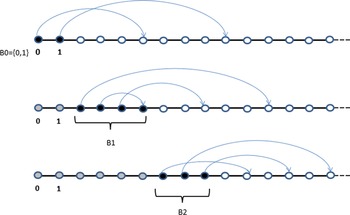
. Then B is the set of sceptical spreaders at the end of the spreading procedure (see Figure 1).
The white, grey, and black circles stand for the sceptical ignorants, sceptical spreaders from earlier stages, and current sceptical spreaders respectively.

Let
 $D\,:\!=\, |B|$
be the final number of the sceptical spreaders. Note that
 $D\geq 2$
. Now, by defining the event
 $\bar{\mathcal{A}}\,:\!=\, \{D=\infty\}$
, we have the following theorem, which gives the exact probability of rumour survival among sceptics.
Theorem 2. We have
 \[{\mathbb P}(\bar{\mathcal{A}})=\dfrac{1}{\bar{\mu}},\]
where
 \[\bar{\mu}=2+\sum_{k\geq 2}\prod_{i=2}^{k}\bar{\alpha}_{i}\]
and
 \begin{equation}\bar{\alpha}_{i}=\sum_{j=1}^{i}\prod_{t=1, t\neq j}^{i}\alpha_{t-1}-(i-1)\prod_{t=1}^{i}\alpha_{t-1}.\end{equation}
Similarly,
 $\bar{\mu}$
could be seen as the mean of a geometric distribution for the event that prevents the survival of the rumour among sceptics. Further, we are able to obtain the same bounds in [Reference Gallo, Garcia, Junior and Rodríguez10] to the tail distribution of the final range of the rumour among the sceptics.
Proposition 1. The random variable D has finite expectation if
 $\prod_{k\geq 0}{{\alpha}_k}>0$
, and has exponential tail distribution when
 ${\alpha}_{k}$
increases exponentially fast to 1, i.e.
 $1-{\alpha}_{k} \sim \gamma {\text{e}}^{-\beta k}$
,
 $\gamma>0$
,
 $\beta>0$
.
Proposition 2. We have the following explicit bounds for the tail distributions.
-
(i) If
 $1-{\alpha}_k\leq C_r r^k$
,
$k\geq 2$
, for some
$r\in(0, 1)$
and a constant
$C_r\in(0,\log({1}/{r}))$
, then
\[{\mathbb P}(D\geq k)\leq\dfrac{1}{C_r}\bigl({\text{e}}^{C_r}r\bigr)^k.\]
-
(ii) If
$1-{\alpha}_k \sim (\!\log k)^\beta k^{-\gamma}$
,
$\beta\in\mathbb{R}$
,
$\gamma>1$
, then there exists
$C>0$
such that, for large k, we have
\[{\mathbb P}(D\geq k)\leq C(\!\log k)^\beta k^{-\gamma}.\]
-
(iii) If
$1-{\alpha}_k= {r}/{k}$
,
$k\geq 2$
, where
$r\in(0, 1)$
, there exists
$C>0$
such that, for large k, we have
\[{\mathbb P}(D\geq k)\leq{C}\dfrac{(\!\ln k)^{3+r}}{(k)^{2-(1+r)^2}}.\]
-
(iv) If
${\alpha}_k \sim ((k+1)/(k+2))^\gamma$
,
$\gamma\in(1/2,1)$
, then there exists
$C=C(\gamma)>0$
such that, for large k, we have
\[{\mathbb P}(D\geq k)\leq\dfrac{C}{k^{1-\gamma}}.\]





Remark 1. From Theorem 1 we know that the behaviour of
 ${\mathcal{A}}$
is tied to that of
 $\mu$
, which depends on the infinite product of
 ${\alpha}_{k}$
. In addition,
 $\prod_{k\geq 0}{\alpha}_{k}$
converges if and only if
 $\sum_{k\geq 0}$
 $(1-{\alpha}_{k})$
converges. Therefore the above ranges for
 ${\alpha}_{k}$
are considered in Proposition 2. Moreover, they are the well-known convergence rates studied in [Reference Bressaud, Fernández and Galves4], [Reference Gallo, Garcia, Junior and Rodríguez10], [Reference Gallo, Lerasle and Takahashi11], and [Reference Garsia and Lamperti12].
We can also deduce that the rumour dies out among the non-sceptics if and only if it dies out among the sceptics. In other words, we have the following theorem.
Theorem 3. We obtain
 \[{\mathbb P}(\bar{\mathcal{A}})=0\Longleftrightarrow{\mathbb P}({\mathcal{A}})=0.\]
Remark 2. Sajadi and Roy [Reference Sajadi and Roy23] have presented an alternative but equivalent formulation to our model. In fact they consider the i.i.d. Bernoulli(p) random variables
 $X_1, X_2, \ldots$
as follows:
 \begin{equation*}X_i =\begin{cases}1& \text{with probability} \, {p}, \\ 0& \text{with probability} \, 1-p,\end{cases}\end{equation*}
together with a collection of i.i.d.
 $\mathbb{N}$
-valued random variables
 $\{\rho_{i}\,:\, i\geq 1\}$
, independent of the collection
 $\{X_{i} \,:\, i\geq 1\}$
. For their model, an individual at i transmits the rumour to all individuals in the region
 $[i,i+\rho_{i}]$
if
 $X_{i}=1$
, and there are two individuals at j and k with
 $j\neq k$
,
 $X_{j}=X_{k}=1$
and
 $1\leq j$
,
 $k<i$
such that
 $i\in [j,j+\rho_{j}]\cap[k,k+\rho_{k}]$
. Our model may be seen to be equivalent to this formulation by taking
 $p=\mathbb{P}(R_{0}>0)$
and
 $\rho$
to have the same distribution as that of
 $R_{0}|(R_{0}>0)$
, where
 $\rho$
is a generic random variable with the same distribution as
 $\rho_{i}$
. Therefore Theorem 3 says that under our setup for the propagation model and also under the setup in [Reference Sajadi and Roy23], we have the same result for the probability that the rumour survives among the sceptics.
Since the rumour process is an SI epidemic model, our setup may also be considered as an epidemic model where individuals located at the sites of
 $\mathbb{N^*}$
are members of a numerous society who may be in mutual contact. Suppose that an infection appears in this society. The sceptical rumour process means that an individual of this society will be infected if s/he is exposed to at least two sick people. The infection then spreads more slowly in our model. In this case, the survival means that the infection spreads to all members of this society, and Theorem 2 gives us an exact formula for the probability of survival. Propositions 1 and 2 specify how the tail distribution of the final range of the epidemic behaves in the worst scenario. Finally, Theorem 3 states that the low transitive power of this infection cannot necessarily prevent spread of the infection to all members, and this epidemic happens under the same condition that the SI epidemic occurs.
3. Proofs
Similarly to [Reference Gallo, Garcia, Junior and Rodríguez10], our results will be based on a remarkable relationship between the rumour process and a specific discrete-time renewal process. Then we briefly introduce a discrete renewal process.
Let
 $(\bar{q}_{k})_{k\geq 1}$
be a probability distribution on
 $\mathbb{N}\cup\{\infty\}$
defined by
 \begin{gather*} {\bar{q}_{1}=0,} \\ {\bar{q}_{k}=(1-\bar{\alpha}_{k})\prod_{j=2}^{k-1}\bar{\alpha}_{j},\quad k\geq 2,} \end{gather*}
where
 $\bar{\alpha}_{j}$
is defined in (1) for
 ${j\geq 2}$
and
 $\bar{q}_{\infty}=1-\sum_{k\geq1} \bar{q}_{k}$
.
Let
 $(T_n)_{n \geq 1}$
be an i.i.d. sequence of random variables taking values in
 $\mathbb{N}\cup\{\infty\}$
with common distribution
 $(\bar{q}_{k})_{k\geq 1}$
. We set
 $Y_0=1$
,
 $Y_1=0$
, and for
 $n \geq 2$
,
 \[Y_n = \begin{cases} 1 & \text{if for some} \, {i}, \, {T_1+\cdots+T_i=n,}\\0 & \text{otherwise.}\end{cases}\]
Each occurrence of 1 in
 $(Y_n)_{n \geq 2}$
is called a renewal and
 $Y=(Y_n)_{n \geq 0}$
is a discrete renewal process. Moreover,
 $T_n$
is the distance between the
 ${(n-1)}$
th and nth occurrences of 1 in Y, and
 $(\bar{q}_{k})_{k\geq 1}$
is called the inter-arrival distribution of Y. The process Y is recurrent if and only if
 \begin{align*}\mathbb{P}(T_1=\infty)=1-\sum_{k\geq 1}\bar{q}_{k}&=1-\Biggl((1-\bar{\alpha}_2)+\sum_{k\geq 3}(1-\bar{\alpha}_k)\prod_{i=2}^{k-1}\bar{\alpha}_{i}\Biggr) \\ &=\bar{\alpha}_2+\sum_{k\geq 3}\Biggl(\prod_{i=2}^{k}\bar{\alpha}_{i}-\prod_{i=2}^{k-1}\bar{\alpha}_{i}\Biggr)\\&=\sum_{k\geq 2}\Biggl(\prod_{i=2}^{k}\bar{\alpha}_{i}-\prod_{i=2}^{k-1}\bar{\alpha}_{i}\Biggr) \\ &=\prod_{i\geq 2}\bar{\alpha}_{i}=0,\end{align*}
and it is positive recurrent if and only if
 $\bar{\mu} < \infty$
, where
 $\bar{\mu}$
is the mean of
 $(\bar{q}_{k})_{k\geq 1}$
. Let
 $u_{n}\,:\!=\, \mathbb{P}(Y_{n}=1)$
,
 $ n\geq 0$
be the corresponding discrete renewal sequence. It can be shown that
 $u_n \rightarrow {1}/{\bar{\mu}}$
[Reference Ross22].
We also construct our model via a sequence
 $U=(U_{i})_{i\in{\mathbb Z}}$
of i.i.d. random variables uniformly distributed on [0, 1). For
 $i\geq 0$
, define the random variable
 \[ R_{i}=\sum_{k\geq 0}k1_{\{ U_{i} \in [\alpha_{k-1},\alpha_{k})\}},\quad \text{where}\ \alpha_{-1}\,:\!=\, 0. \]
The random radius
 $R_i$
is the distance at which the individual at site i transmits the information at its right.
Recall that M and D are the final numbers of the spreaders and sceptical spreaders respectively. The proof of Theorem 2 is based on the following lemma, which gives us the tail distribution of D and the fact that for a discrete renewal process we have
 $u_{n}\rightarrow {1}/{\bar{\mu}}$
, where
 $\bar{\mu}$
is the mean value of the process [Reference Ross22]. Proposition 1 follows from Proposition 1 in [Reference Gallo, Garcia, Junior and Rodríguez10] and the fact that
 ${\mathbb P}(D\geq k)\leq{\mathbb P}(M\geq k)$
. There is no simple explicit formula for
 $u_n$
,
 $n\geq 2$
, and only some results are available about the information concerning the rate at which
 $u_{n}\rightarrow {1}/{\bar{\mu}}$
. All of these investigated cases have been collected in Proposition 4 in [Reference Gallo, Garcia, Junior and Rodríguez10] and classified based on the various regimes of
 ${\alpha}_n$
. Because of the relation between the distributions of D and M, we apply Proposition 4 in [Reference Gallo, Garcia, Junior and Rodríguez10] to find some explicit upper bounds for the tail distribution of D based on various regimes of
 ${\alpha}_n$
in Proposition 2.
Lemma 1. For any
 $n\geq 2$
, we have
 $\mathbb{P}(D> n)=u_{n}$
.
Proof. Note that D is the number of the first person who has not received the rumour from at least two people located on her/his left. Thus, if we consider every D’s left-neighbourhood with length at least two, then there are less than two people in this neighbourhood who transmit the rumour to her/him. It means that the radius of their transmission is less than their distance to D. Therefore, using the definition of
 $R_i$
, we can write D as follows:
 \begin{align*}D&=\min\Biggl\{i\geq 2,\ \text{for all}\ j\in\{2,\ldots ,i\}\ ;\ \bigcup_{m=1}^{j}\bigcap_{r=1,r\neq m}^{j}\{R_{i-r}<r\} \neq\emptyset\Biggr\} \\ &=\min\Biggl\{i\geq 2,\ \text{for all}\ j\in\{2,\ldots ,i\}\ ;\ \bigcup_{m=1}^{j}\bigcap_{r=1,r\neq m}^{j}\{U_{i-r}<\alpha_{r-1}\}\neq\emptyset\Biggr\}.\end{align*}
Define the following ‘house of cards’ process
 $(\bar{H}^{m})_{m\in\mathbb{Z}}$
. This process is a Markov chain on the set of natural numbers, which is useful in the construction of couplings for processes with long-range memory and dynamical systems [Reference Bressaud, Fernández and Galves4], and can go up with one unit or go down to zero. Given a sequence of independent and uniformly distributed random variables
 $U=(U_n)_{n\in{\mathbb Z}}$
on [0, 1), we can view the process
 $\bar{H}^{m}$
generated via the following recursion.
For any
 $m\in\mathbb{Z}$
, set
 $\bar{H}^{m}_{m}=0$
,
 $\bar{H}^{m}_{m+1}=1$
and
 \begin{equation*} \bar{H}^{m}_{m+n}=\bigl(\bar{H}^{m}_{m+n-1}+1\bigr)1_{E_{m,n}},\quad n\geq 2, \end{equation*}
where
 \[ E_{m,n}\,:\!=\, {\Biggl\{\bigcup_{j=1}^{n}\bigcap_{r=1,r\neq j}^{n} \bigl\{U_{m-r} < \alpha_{\bar{H}_{m+r-1}^{m}}\bigr\}\neq\emptyset\Biggr\}}.\]
Note that the index m in
 $\bar{H}^{m}$
indicates where each
 $\bar{H}$
starts, and
 $\bar{H}^{m}_{m+n}$
denotes receiving the information by person m from the people who are located on her/his left and in her/his n-neighbourhood. If there exists
 $n\in\{2,\ldots,m\}$
such that
 $\bar{H}^{m}_{m+n}=0$
, then it means the rumour is spread to m from at least two people on her/his left and if, for every
 $n\in\{2,\ldots,m\}$
,
 $\bar{H}^{m}_{m+n}\neq 0$
, then m has not received or accepted the rumour and will not be a spreader. Therefore we have
 $\bar{H}_{m}^m=0$
,
 $\bar{H}_{m+1}^m=1\neq 0$
and
 $\bar{H}_{m+2}^m\neq 0$
whenever
 \[\bigcup_{j=1}^{2}\bigcap_{r=1,r\neq j}^{2} \{U_{m-r} < \alpha_{r-1}\}\neq\emptyset.\]
Similarly,
 $\bar{H}_{m+k-1}^m\neq 0$
whenever
 \[\bigcup_{j=1}^{k-1}\bigcap_{r=1,r\neq j}^{k-1} \{U_{m-r} < \alpha_{r-1}\}\neq\emptyset.\]
However,
 $\bar{H}_{m+k}^m= 0$
whenever
 \[\bigcup_{j=1}^{k}\bigcap_{r=1,r\neq j}^{k} \{U_{m-r} < \alpha_{r-1}\}=\emptyset.\]
The event that
 $\bar{H}_{m+k}^{m}=0$
for the first time after starting from 0 (i.e.
 $\bar{H}_{m}^{m}=0$
) is equivalent to the event that
 \[\bigl\{\bar{H}_{m+1}^{m}\neq 0\bigr\}\cap\bigl\{\bar{H}_{m+2}^{m}\neq 0 \bigr\} \cap\cdots\cap \bigl\{\bar{H}_{m+k-1}^{m}\neq 0\bigr\}\cap \bigl\{\bar{H}_{m+k}^{m}= 0\bigr\}.\]
Since
 $\bar{H}^{m}$
is a Markov chain, it renews at each visit to 0. According to its definition, the distance between two successive visits to 0 is at least 2. In other words, since
 $\bar{H}_{m+1}^{m}$
is equal to 1, we have
 \[{\bar{q}_{1}={\mathbb P}\bigl(\bar{H}_{m+1}^{m}=0 \mid \bar{H}_{m}^{m}=0\bigr)=0},\]
and for
 $k\geq 2$
,
 $\bar{H}^{m}$
has the distribution
 \begin{align*} \bar{q}_{k}&={\mathbb P}\bigl(\bar{H}_{m+1}^{m}\neq 0, \bar{H}_{m+2}^{m}\neq 0,\ldots, \bar{H}_{m+k-1}^{m}\neq 0, \bar{H}_{m+k}^{m}= 0 \mid \bar{H}_{m}^{m}=0\bigr) \\ &= {\mathbb P}\bigl(\bar{H}_{m+1}^{m}\neq 0 \mid \bar{H}_{m}^{m}=0\bigr)\,{\mathbb P}\bigl(\bar{H}_{m+2}^{m}\neq 0 \mid \bar{H}_{m}^{m}=0,\bar{H}_{m+1}^{m}\neq 0\bigr)\cdots \\ &\quad\, {\mathbb P}\bigl(\bar{H}_{m+k-1}^{m}\neq 0 \mid \bar{H}_{m}^{m}=0,\bar{H}_{m+1}^{m}\neq 0,\ldots , \bar{H}_{m+k-2}^{m}\neq 0\bigr)\\ &\quad\, {\mathbb P}\bigl(\bar{H}_{m+k}^{m}=0 \mid \bar{H}_{m}^{m}=0, \bar{H}_{m+1}^{m}\neq 0,\ldots ,\bar{H}_{m+k-1}^{2}\neq 0\bigr) \\ &=(1-\bar{\alpha}_{k})\prod_{i=2}^{k-1}\bar{\alpha}_{i},\end{align*}
when for
 $i\geq 2$
,
 \begin{align}\bar{\alpha}_i&= \mathbb{P}\Biggl(\bigcup_{j=1}^{i} E_j\Biggr),\end{align}
where
 \[E_j=\bigcap_{t=1, t\neq j}^{i} \{U_{i-t}<\alpha_{t-1}\}.\]
Note that
 $(\bar{q}_{k})_{k\geq 1}$
is the inter-arrival distribution of
 ${(\bar{H}^{(m)})_{m\in\mathbb{Z}}}$
, and
 $\prod_{i=2}^{k-1}\bar{\alpha}_{i}$
means that the chain climbs up from 1 to
 $k-1$
and
 $(1-\bar{\alpha}_{k})$
means that it falls down to 0. Therefore
 $(\bar{H}^{(m)})_{m\in\mathbb{Z}}$
is recurrent if and only if
 $\mathbb{P}(T_1=\infty)=\prod_{i\geq 2}\bar{\alpha}_{i}=0$
. Consequently, for any
 $m\in\mathbb{Z}$
and
 $k\geq 0$
, we have
 $u_{k}=\mathbb{P}(\bar{H}^{m}_{m+k}=0)$
. Observe that this Markov process is monotone as well as coalescent at 0. By monotonicity, we mean that
 \[\bar{H}^{m}_{n}\geq \bar{H}^{k}_{n}\quad \text{for all $ m<k\leq n$,}\]
which implies in particular that
 $\bar{H}^{m}_{n}=0\Rightarrow \bar{H}^{k}_{n}=0$
for all
 $m<k\leq n$
. Also, being coalescent at 0 means that
 \[\bar{H}^{m}_{n}=0\Rightarrow \bar{H}^{m}_{t}=\bar{H}^{k}_{t} \quad\text{for all $ m<k\leq n\leq t$.}\]
Using all of these properties, we obtain the following sequence of equivalences for
 $n\geq 2$
:
 \begin{align*} {D}>n&\Leftrightarrow \forall i\in\{2,\ldots ,n\},\ \exists j\in\{2,\ldots ,i\}\ ;\ \bigcup_{m=1}^{j}\bigcap_{r=1,r\neq m}^{j}\{R_{i-r}<r\}=\emptyset \\ &\Leftrightarrow \forall i\in\{2,\ldots ,n\},\ \exists j\in\{2,\ldots ,i\}\ ;\ \bigcup_{m=1}^{j}\bigcap_{ r=1,r\neq m}^{j}\{U_{i-r}<\alpha_{r-1}\}=\emptyset \\&\Leftrightarrow \forall i\in\{2,\ldots ,n\},\exists j\in\{2,\ldots ,i\}\ ;\ \bar{H}^{i}_{i+j}=0\\&\Leftrightarrow \forall i\in\{2,\ldots ,n\} ;\ \bar{H}^{i}_{i+i}=0\\&\Leftrightarrow \forall i\in\{2,\ldots ,n\} ;\ \bar{H}^{-i}_{0}=0\\ & \Leftrightarrow \bar{H}^{-n}_{0}=0,\end{align*}
where the first two equivalences follow from the definition of D, the third one follows from the definition of the family of Markov processes
 $(\bar{H}^{m})_{m\in\mathbb{Z}}$
, the fourth line holds according to the coalescence property of
 $(\bar{H}^{m})_{m\in\mathbb{Z}}$
, the fifth equivalence is true because of the Markov property, and the final equivalence holds because of the monotonicity property. Therefore we obtain that
 \[ {\mathbb P}(D> n)={\mathbb P}\bigl(\bar{H}^{-n}_{0}=0\bigr)={\mathbb P}\bigl(\bar{H}^{0}_{n}=0\bigr). \]
Thus we have
 ${\mathbb P}(D> n)=u_{n}$
.
Now we are ready to calculate
 $\bar{\alpha}_{i}$
,
 $ i\geq 2$
and then
 $\bar{\mu}$
, which is the mean of distribution
 $\bar{q}_{k}$
,
 $ k\geq 2$
. From (2) we have
 \[\bar{\alpha}_{i}=\mathbb{P}\Biggl(\bigcup_{j=1}^{i} E_j\Biggr),\quad E_j=\bigcap_{t=1, t\neq j}^{i} \{U_{i-t}<\alpha_{t-1}\}.\]
By using the inclusion–exclusion principle, we get
 \begin{align} \bar{\alpha}_{i} \notag &=\mathbb{P}\Biggl(\bigcup_{k=1}^{i} E_k\Biggr)\\ \notag &=\sum_{k=1}^{i}({-}1)^{k-1}\sum_{I\subset\{1,\ldots,i\}, |I|=k}\mathbb{P}\Biggl(\bigcap_{j\in I}E_j\Biggr)\\ \notag &=\sum_{I\subset\{1,\ldots,i\}, |I|=1}\mathbb{P}\Biggl(\bigcap_{j\in I}E_j\Biggr)+\sum_{k=2}^{i}({-}1)^{k-1}\sum_{I\subset\{1,\ldots,i\}, |I|=k}\mathbb{P}\Biggl(\bigcap_{j\in I}E_j\Biggr)\\ &=\sum_{k=1}^{i}\mathbb{P}(E_k)+\sum_{k=2}^{i}({-}1)^{k-1}\sum_{I\subset\{1,\ldots,i\}, |I|=k}\mathbb{P}{\Biggl(\bigcap_{j\in I}E_j\Biggr)}.\end{align}
Now, from the definition of
 $E_j$
, for each
 $ k\geq 2$
and
 $I\subset\{1,\ldots,i\}$
,
 $|I|=k$
, we have
 \[\mathbb{P}\Biggl(\bigcap_{j\in I}E_j\Biggr)=\mathbb{P}\Biggl(\bigcap_{t=1 }^{i}\{U_{i-t}<\alpha_{t-1}\}\Biggr)=\prod_{t=1}^{i}\mathbb{P}(\{U_{i-t}<\alpha_{t-1}\}).\]
Therefore we get from (3)
 \begin{align}\bar{\alpha}_{i}\notag &=\sum_{k=1}^{i}\prod_{t=1, t\neq k}^{i}\mathbb{P}(\{U_{i-t}<\alpha_{t-1}\})+\sum_{k=2}^{i}({-}1)^{k-1}\left(\begin{array}{c}i\\k\end{array}\right)\prod_{t=1}^{i}\mathbb{P}(\{U_{i-t}<\alpha_{t-1}\})\notag \\&=\sum_{k=1}^{i}\prod_{t=1, t\neq k}^{i}\alpha_{t-1}+\prod_{t=1}^{i}\alpha_{t-1}\sum_{k=2}^{i}({-}1)^{k-1}\left(\begin{array}{c}i\\k\end{array}\right)\notag \\&=\sum_{k=1}^{i}\prod_{t=1, t\neq k}^{i}\alpha_{t-1}-(i-1)\prod_{t=1}^{i}\alpha_{t-1}.\end{align}
The last equality holds since
 \[ \sum_{k=1}^{i} ({-}1)^{k-1} \left(\begin{array}{c}i\\k\end{array}\right)=1-(1-1)^{k}=1. \]
Furthermore, we are able to obtain another formula for
 $\bar{\alpha}_{i}$
as follows. From (4) we have
 $\bar{\alpha}_{2}=\alpha_0+\alpha_1-\alpha_0\alpha_1$
, and for
 $i\geq 3$
,
 \begin{align}\bar{\alpha}_{i}\notag &=\sum_{k=1}^{i}\prod_{t=1, t\neq k}^{i}\alpha_{t-1}-(i-1)\prod_{t=1}^{i}\alpha_{t-1}\notag \\ &=\Biggl(\prod_{t=1, t\neq 1}^{i}\alpha_{t-1}+\prod_{t=1, t\neq 2}^{i}\alpha_{t-1}-\prod_{t=1}^{i}\alpha_{t-1}\Biggr) +\Biggl(\sum_{k=3}^{i}\prod_{t=1, t\neq k}^{i}\alpha_{t-1}-(i-2)\prod_{t=1}^{i}\alpha_{t-1}\Biggr)\notag \\&=\Biggl(\prod_{t=1, t\neq 1,2}^{i}\alpha_{t-1}\Biggr){(\alpha_1+\alpha_0-\alpha_0\alpha_1)}+\alpha_0\alpha_1\Biggl(\sum_{k=3}^{i}\prod_{t=3, t\neq k}^{i}\alpha_{t-1}-(i-2)\prod_{t=3}^{i}\alpha_{t-1}\Biggr)\notag \\ &=\bar{\alpha}_{2}\prod_{t=1, t\neq 1,2}^{i}\alpha_{t-1}+\alpha_0\alpha_1{\Biggl(\sum_{k=3}^{i}\prod_{t=3, t\neq k}^{i}\alpha_{t-1}(1-\alpha_{k-1})\Biggr)}. \end{align}
According to the definition of
 $\bar{q}_{k}$
in our model, we have
 \begin{align*} \bar{\mu}\notag &=\sum_{k\geq 2}k\bar{q}_{k}=\sum_{k\geq 2}k\Biggl[(1-\bar{\alpha}_{k})\prod_{i=2}^{k-1}\bar{\alpha}_{i}\Biggr]\\ \notag &=2(1-(\bar{\alpha}_{0}+\bar{\alpha}_{1}-\bar{\alpha}_{0}\bar{\alpha}_{1}))+\sum_{k\geq 3}k\Biggl[(1-\bar{\alpha}_{k})\prod_{i=2}^{k-1}\bar{\alpha}_{i}\Biggr]\\ \notag &=2-2(\bar{\alpha}_{0}+\bar{\alpha}_{1}-\bar{\alpha}_{0}\bar{\alpha}_{1})+\sum_{k\geq3}\Biggl[k\prod_{i=2}^{k-1}\bar{\alpha}_{i}-k\prod_{i=2}^{k}\bar{\alpha}_{i}\Biggr]\\ \notag &=2+\sum_{k\geq 2}\Biggl[(k+1)\prod_{i=2}^{k}\bar{\alpha}_{i}-k\prod_{i=2}^{k}\bar{\alpha}_{i}\Biggr]\\ &=2+\sum_{k\geq 2}\prod_{i=2}^{k}\bar{\alpha}_{i}.\end{align*}
The proof of Theorem 3 is deduced from the following lemma, together with Theorems 1 and 2.
Lemma 2. We obtain
 $\bar{\mu}<\infty$
if and only if
 $\mu<\infty$
.
Proof. According to the definitions of M and D, we have
 ${\mathbb P}(D\geq k)\leq{\mathbb P}(M\geq k)$
,
 $ k\geq 2$
. Because of continuity in probability, we get
 ${\mathbb P}(\bar{\mathcal{A}}) \leq {\mathbb P}({\mathcal{A}})$
. Therefore
 $\mu\leq \bar{\mu}$
from Theorems 1 and 2. To show the converse, let
 $\mu<\infty$
; then
 $\prod_{i=0}^{j}\alpha_{i}\downarrow 0$
, so we get
 $\alpha_i<1$
for all
 $i\geq 0$
. We use a contrary argument to show this. Suppose there exists
 $ {k}^{*} \geq 1$
such that
 $\alpha_{{k}^{*}}=1$
; then
 $\alpha_i=1$
for all
 $i\geq {k}^{*}$
since
 $\{\alpha_i\}_{i\geq 0}$
is increasing according to its definition. Therefore, for all
 $j\geq {k}^{*}$
,
 \[\prod_{i=0}^{j} \alpha_{i}=\prod_{i=0}^{{k}^{*}-1} \alpha_{i}>0,\]
which is a contradiction. In the remainder of the proof we need to find another representation for
 $\bar\alpha_i$
. In fact, we prove by induction on i that
 \begin{equation}\bar{\alpha}_{i}=\alpha_{i-1}\bar{\alpha}_{i-1}+(1-\alpha_{i-1})\prod_{t=1}^{i-1}\alpha_{t-1},\quad i\geq 3.\end{equation}
The case of
 $i=3$
is deduced from (5). We assume that (6) holds for some value of i greater than 3 and show that it holds for
 $i+1$
. From (5), we have
 \begin{align}\bar{\alpha}_{i+1}\notag &=\bar{\alpha}_{2}\prod_{t=1, t\neq 1,2}^{i+1}\alpha_{t-1}+\alpha_0\alpha_1\Biggl(\sum_{j=3}^{i+1}\prod_{t=3, t\neq j}^{i+1}\alpha_{t-1}(1-\alpha_{j-1})\Biggr)\\&=\bar{\alpha}_{2}\prod_{t=1, t\neq 1,2}^{i+1}\alpha_{t-1} +\alpha_0\alpha_1\Biggl(\sum_{j=3}^{i}\prod_{t=3, t\neq j}^{i+1}\alpha_{t-1}(1-\alpha_{j-1})+\alpha_0\alpha_1\Biggl(\prod_{t=3}^{i}\alpha_{t-1}(1-\alpha_{i})\Biggr)\Biggr)\notag \\&={\alpha}_{i}\Biggl(\bar{\alpha}_{2}\prod_{t=1, t\neq 1,2}^{i}\alpha_{t-1}+\alpha_0\alpha_1\Biggl(\sum_{j=3}^{i}\prod_{t=3, t\neq j}^{i}\alpha_{t-1}(1-\alpha_{j-1})\Biggr)\Biggr) +\prod_{t=1}^{i}\alpha_{t-1}(1-\alpha_{i})\notag \\&=\alpha_{i}\bar{\alpha}_{i}+(1-\alpha_{i})\prod_{t=1}^{i}\alpha_{t-1}\notag .\end{align}
The last equality holds because of the induction hypothesis (6). Therefore
 $\bar{\alpha}_{i}$
is a convex combination of
 $\bar{\alpha}_{i-1}$
and
 $\prod_{t=1}^{i-1}\alpha_{t-1}$
for all
 $i\geq 3$
. Moreover, we have
 $\bar{\alpha}_{2}=\alpha_1(1-\alpha_0)+\alpha_0$
from (4), that is,
 $\bar{\alpha}_{2}$
is a convex combination of
 ${\alpha}_{1}$
and 1. Now, since
 $\alpha_{i}<1$
for all
 $i\geq 0$
, then
 $\bar{\alpha}_{2}<1$
and
 $\{\bar{\alpha}_i\}_{i\geq 2}$
is strictly decreasing from (6). Furthermore,
 $\bar{\alpha}_{i}\geq 0$
for all
 $i\geq 2$
. Thus there exists
 $c\in[0, 1)$
such that
 $\bar{\alpha}_i\downarrow c$
.
On the other hand, we have
 $\alpha_i\uparrow 1$
by definition, so there exists
 $k^{*}\geq 2$
such that for all
 $i\geq k^{*}$
,
 $\bar{\alpha}_{i}\leq {\alpha}_{i}$
. Therefore we have for all
 $k\geq k^{*}$
 \begin{equation}\prod_{i=k^{*}}^{k}\bar{\alpha}_{i}\leq \prod_{i=k^{*}}^{k}{\alpha}_{i}.\end{equation}
Now we are ready to complete our proof. Since
 $\mu<\infty$
, we have
 \[{\sum_{k\geq k^{*}}\prod_{i=0}^{k-1}{\alpha}_{i}<\infty}.\]
Then we get
 \begin{align*}\sum_{k\geq k^{*}}\prod_{i=0}^{k-1}{\alpha}_{i}&=\sum_{k\geq k^{*}}\Biggl(\prod_{i=0}^{k^{*}-1}{\alpha}_{i}\Biggr)\Biggl(\prod_{i=k^{*}}^{k-1}{\alpha}_{i}\Biggr) =\Biggl(\prod_{i=0}^{k^{*}-1}{\alpha}_{i}\Biggr)\sum_{k\geq k^{*}}\prod_{i=k^{*}}^{k-1}{\alpha}_{i}.\end{align*}
Hence we get
 \[\sum_{k\geq k^{*}}\prod_{i=k^{*}}^{k-1}{\alpha}_{i}<\infty,\]
that is,
 \[\prod_{k\geq k^{*}} \Biggl(1-\prod_{i=k^{*}}^{k-1} {\alpha}_i\Biggr) >0.\]
Finally, we have from (7)
 \begin{equation*}\prod_{k\geq k^{*}} \Biggl(1-\prod_{i=k^{*}}^{k} {\bar{\alpha}}_i\Biggr)\geq\prod_{k\geq k^{*}} \Biggl(1-\prod_{i={k^{*}}}^{k} {{\alpha}}_{i}\Biggr)\geq\prod_{k\geq k^{*}} \Biggl(1-\prod_{i={k^{*}}}^{k-1} {{\alpha}}_{i}\Biggr)>0.\end{equation*}
Therefore
 $\bar\mu<\infty$
, since
 \begin{equation*} \prod_{k\geq k^{*}} \Biggl(1-\prod_{i=2}^{k} {\bar\alpha}_i\Biggr)\geq\prod_{k\geq k^{*}} \Biggl(1-\prod_{i=k^{*}}^{k} {\bar\alpha}_i\Biggr)>0.\end{equation*}
Corollary 1. We have
 $\lim_{i\rightarrow\infty}\bar{\alpha}_i=0$
when
 \[ \Biggl\{\sum_{j=1}^{i-1}\prod_{t=1, t\neq j}^{i-1}\alpha_{t-1}\Biggr\}_{i\geq 3} \]
is decreasing.
Proof. From (6), we observe that
 $\bar{\alpha}_{i}$
is located on the line connecting
 $\bar{\alpha}_{i-1}$
to
 $\prod_{t=1}^{i-1}\alpha_{t-1}$
for
 $i\geq 3$
. We denote the length of this line by
 $S_{i}$
, and we have from (4)
 \begin{align*} S_{i}=\bar{\alpha}_{i-1}-\prod_{t=1}^{i-1}\alpha_{t-1} &=\sum_{j=1}^{i-1}\prod_{t=1, t\neq j}^{i-1}\alpha_{t-1}-(i-2)\prod_{t=1}^{i-1}\alpha_{t-1}-\prod_{t=1}^{i-1}\alpha_{t-1} \\ &=\sum_{j=1}^{i-1}\prod_{t=1, t\neq j}^{i-1}\alpha_{t-1}-(i-1)\prod_{t=1}^{i-1}\alpha_{t-1}\\&=\sum_{j=1}^{i-1}\Biggl(\prod_{t=1, t\neq j}^{i-1}\alpha_{t-1}-\prod_{t=1}^{i-1}\alpha_{t-1}\Biggr) \\ &=\sum_{j=1}^{i-1}\prod_{t=1, t\neq j}^{i-1}\alpha_{t-1}(1-\alpha_{j-1}).\end{align*}
Now let
 \[a_j\,:\!=\, 1-\alpha_{j-1}\quad\text{and}\quad t_{j,{i}}\,:\!=\, \prod_{t=1, t\neq j}^{i-1}\alpha_{t-1},\]
and then
 \[S_i=\sum_{j=1}^{i-1} t_{j,{i}}a_j.\]
According to the assumption, we get
 $\alpha_i<1$
for all
 $i\geq 0$
. We use a contrary argument to show this. Suppose there exists
 $n\geq 1$
such that
 $\alpha_i=1$
for all
 $i\geq n$
. Then, for all
 $m> n$
,
 \begin{align*}\sum_{j=1}^{m-1}\prod_{t=1, t\neq j}^{m-1}\alpha_{t-1}&=\sum_{j=1}^{n-1}\prod_{t=1, t\neq j}^{n-1}\alpha_{t-1}+\sum_{j=n}^{m-1}\prod_{t=1, t\neq j}^{n-1}\alpha_{t-1} \\ &=\sum_{j=1}^{n-1}\prod_{t=1, t\neq j}^{n-1}\alpha_{t-1}+(m-n)\prod_{t=1, t\neq j}^{n-1}\alpha_{t-1} \\ &> \sum_{j=1}^{n-1}\prod_{t=1, t\neq j}^{n-1}\alpha_{t-1},\end{align*}
which is a contradiction since
 \[\Biggl\{\sum_{j=1}^{i-1}\prod_{t=1, t\neq j}^{i-1}\alpha_{t-1}\Biggr\}_{i\geq 3}\]
is decreasing.
Now we have
 $\lim_{j\rightarrow\infty}\alpha_j=1$
and
 $\alpha_i<1$
for all
 $i\geq 0$
. Then
 $\lim_{j\rightarrow\infty}a_j=0$
, and for fixed j,
 $\lim_{i\rightarrow\infty}t_{j,{i}}=0$
. On the other hand,
 \[\sum_{j=1}^{i-1}\prod_{t=1, t\neq j}^{i-1}\alpha_{t-1}\leq \alpha_0+\alpha_1<2, \quad i\geq 3.\]
Finally, from Toeplitz’s theorem we get
 $\lim_{i\rightarrow\infty}S_i=0$
and then
 $\lim_{i\rightarrow\infty}\bar{\alpha}_i=0$
.
Remark 3. In our model we suppose that
 $0<\alpha_0<1$
. This condition enables us to consider the possibility of no rumour transmission besides the rumour transmission by each individual, which is a natural assumption. If
 $\alpha_0=1$
, then
 $\alpha_i=1$
,
 $i\geq 1$
, as
 $\{\alpha_i\}_{i\geq 0}$
is an increasing sequence according to its definition. In this case
 $\mu=\infty$
from its definition and
 $\bar{\alpha}_j=1$
,
 $j\geq 2$
from (4), and then
 $\bar{\mu}=\infty$
.
4. Examples
Example 1. Consider the random variable R with the following probability mass function:
 \[\mathbb{P}(R=k)=(1-\gamma)^k \gamma, \quad 0< \gamma <1, \ k\geq 0 .\]
Then we get
 $\mathbb{P}(R>k)=(1-\gamma)^{k+1}$
and
 \[\mathbb{E}(R)=\sum_{k\geq 0} \mathbb{P}(R>k)=\frac{1-\gamma}{\gamma} <\infty,\]
or equivalently,
 \[\prod_{k\geq 0} \mathbb{P}(R\leq k)=\prod_{k\geq 0} \alpha_k > 0 .\]
From Proposition 1 in [Reference Gallo, Garcia, Junior and Rodríguez10], the final number of spreaders, i.e. M, has finite expectation. Note that
 $\mathbb{E}(M)=\sum_{n\geq 0} \mathbb{P}(M>n)$
and
 $\mathbb{P}(M>n)=u_{n+1}$
. Therefore
 $u_{n+1}\rightarrow 0$
. On the other hand, from [Reference Ross22],
 $u_{n}\rightarrow {1}/{{\mu}}$
. Then
 $\mu =\infty$
and
 ${\mathbb P}({\mathcal{A}})={1}/{{\mu}} = 0$
. By Theorem 3 we have
 ${\mathbb P}(\bar{\mathcal{A}}) =0$
, and hence the rumour will not survive among the sceptics.
Example 2. Consider the random variable R with the following probability mass function:
 \[ \mathbb{P}(R=k)=\dfrac{2}{(k+2)(k+3)}, \quad k\geq 0 . \]
We have
 $\alpha_k=1-{2}/{(k+3)}$
, and
 \[\mathbb{E}[R]=\sum_{k\geq 0} \mathbb{P}(R>k)=\infty ,\]
or equivalently
 \[\prod_{k\geq 0} \mathbb{P}(R\leq k)=\prod_{k\geq 0} \alpha_k = 0 .\]
But
 \[\mu =1+\sum_{k\geq 1}\prod_{i=0}^{k-1}\alpha_i = 1+\sum_{i\geq 1}\frac{2}{(i+1)(i+2)}=2 < \infty.\]
Therefore, by Lemma 2, we have
 $\bar{\mu} <\infty$
and hence
 ${\mathbb P}(\bar{\mathcal{A}})={1}/{\bar{\mu}} > 0$
. In other words the number of informed sceptical individuals is infinity with positive probability.
Acknowledgements
We would like to express our very great appreciation to Professor Rahul Roy for his valuable and constructive suggestions during our visit to the Indian Statistical Institute, Delhi Centre for this research project. We would also like to thank the head of the Indian Statistical Institute for providing all facilities during our visit, and in particular we want to thank Professor Rahul Roy for making this visit possible.
Funding information
There are no funding bodies to thank relating to the creation of this article.
Competing interests
There were no competing interests to declare which arose during the preparation or publication process of this article.