Thorough routine cleaning and disinfection of hospital patient rooms at discharge removes most but likely not all surface pathogens.Reference Sigler and Hensley 1 , Reference Goodman, Platt, Bass, Onderdonk, Yokoe and Huang 2 Thus, newly admitted patients may be at increased risk of pathogen acquisition.Reference Huang, Datta and Platt 3 Ultraviolet (UV) disinfection complementing routine high-touch surface cleaning can reduce acquisition of important pathogens left behind from previous patients.Reference Anderson, Chen and Weber 4 – Reference Rutala, Gergen and Weber 6 The logistics of implementing a UV disinfection program are poorly understood and likely vary by institution and equipment. Reports from a recent large trial indicate that hospital staff perception is important, one barrier to program success was a perceived delay in patient flow caused by UV disinfection.Reference Anderson, Knelson and Moehring 7
The goal of this study was to maximize program efficiency and enhance UV disinfection coverage of isolation rooms without postponing subsequent admissions or requiring additional capital investment. Because we elected to not hold rooms for disinfection, technicians needed to complete UV treatment in the time between completion of room cleaning and room occupancy by the next patient. We hypothesized that to avoid flow delay, we needed to maximize the window for UV disinfection. We undertook a 60-day improvement initiative to determine whether additional time could be gained to reduce overall room readiness time to increase isolation room UV disinfection opportunities.
Methods
Setting
Cincinnati Children’s Hospital Medical Center (CCHMC) is a nonprofit, 619-bed, free-standing academic pediatric medical center that manages ∼33,000 inpatient admissions and >1.3 million patient encounters annually. The CCHMC places a strong emphasis on safety culture, and quality transformation is embedded in its framework.Reference Britto, Anderson and Kent 8 The Lean Collaborative is one of a portfolio of quality improvement training programs offered to CCHMC employees through the James M. Anderson Center for Health Systems Excellence. 9 The Lean Collaborative is an 8-week team-based course based on the Toyota Production System. This system and Lean aim to eliminate waste, or non–value-added work, defined as components of a process that add no value to the product (eg, excess body motion or transportation to retrieve items, excess supply inventory, waiting, overprocessing, overproduction, and defects).Reference Liker 10 , 11 The Lean Collaborative and its principle of eliminating non–value-added work enabling less resource utilization and increased value to the customer has been used successfully in healthcare contexts.Reference Kim, Spahlinger, Kin and Billi 12 , Reference Fields, Neogi, Schoettker and Lail 13
Environmental services program
Environmental services (ES) for inpatient areas are contracted through an outside vendor (Crothall Healthcare, Wayne, PA) that provides custodial services, laundry and linen services, cleaning, and delivery of beds and durable medical equipment. The service goals established in the agreement contract are linked to payment and are monitored and reviewed monthly by hospital stakeholders. A strong partnership exists between the ES technicians and the infection prevention and control program, and the teams meet weekly to discuss current issues and plan for future endeavors. The ES tasks are completed by teams of technicians trained by a dedicated group of trainers, with frequent refreshers. Cross coverage is minimized, and housekeepers are assigned to a single clinical area whenever possible. The UV disinfection program started in late 2016 with the purchase of 2 LightStrike UV-C robots (Xenex, San Antonio, TX), and it has been managed by ES since August 2017. Currently, a team of dedicated UV technicians (2.4 full-time equivalents) cover 2 shifts per weekday and 1 shift per weekend day (ie, 12 shifts per week). On average, 950 UV disinfection opportunities occur monthly from isolation room discharges; ∼80% of these are treated with the UV disinfection procedure.Reference Schaffzin, Finney, Wilhite, Li, Moore and Connelly 14
Planning the intervention
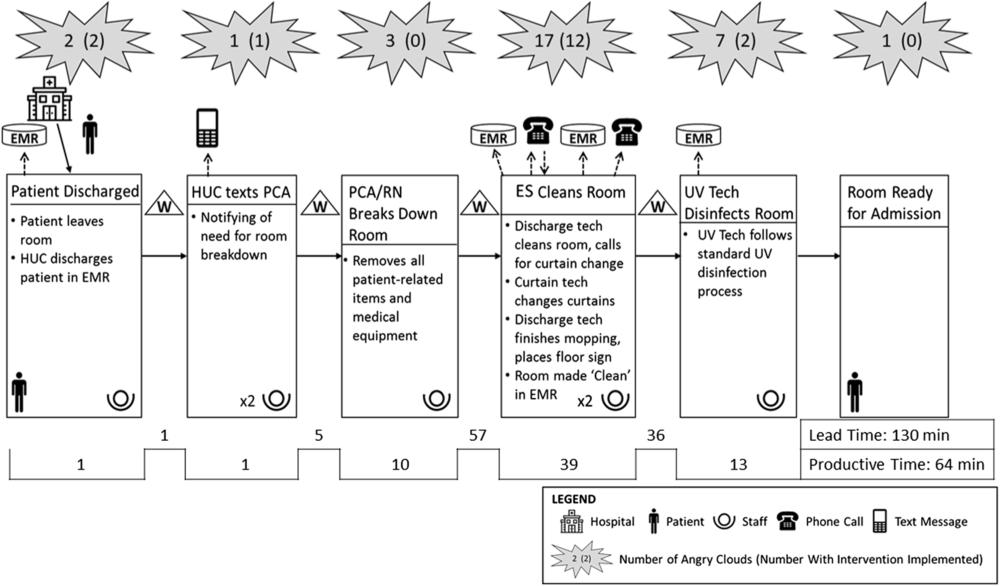
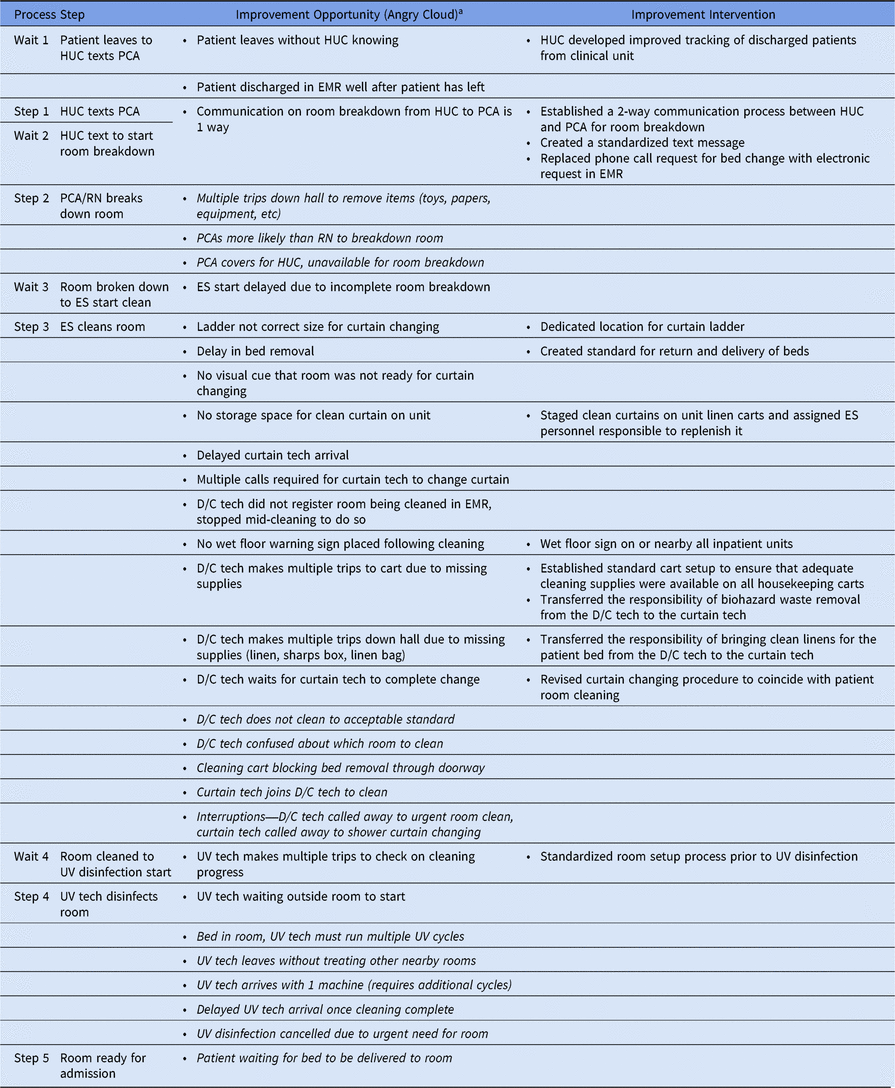
The improvement test site was a 24-bed medical and surgical unit with all private rooms, housing predominantly gastrointestinal and colorectal patients, with an average of 34 isolation discharges per month. We formed a multidisciplinary improvement team composed of an infection preventionist, an ES manager and data analyst, a patient flow coordinator, and a health unit coordinator (HUC) from the participating test unit. The team was supported by 2 Lean Collaborative coaches as well as the unit clinical director, the director of infection prevention and control, and the hospital chief of staff. The 60-day project took place from July 10 to September 11, 2018. The current state of the 5-step room turnover process (Fig. 1) was documented in greater detail with both process (execution) steps and ‘wait’ (interspersed inactive) steps, which were used to create a value stream map (Fig. 2). The team proposed areas to target (ie, ‘Kaizens’) initially from experience; they were later modified based on observations and manual time studies conducted over 2 weeks at the project’s outset. 15 The team then created an improvement summary by identifying and prioritizing the greatest areas of opportunity for improvement to help drive the work (Table 1). Interventions were targeted at non–value-added work that was believed to prolong room turnover. 15 Team members engaged the unit clinical director and nursing staff, including the use of a dry erase board in the staff break room, to communicate and monitor changes and their effects.
Simplified 5 step process for isolation room turnover.

Current state value stream map. Potential non-value added work was identified (see Table 1) and represented by an “angry cloud” over the appropriate process step. Numbers in parentheses represent the potential wastes that were addressed with an intervention. Mean times in minutes are displayed below the process. HUC, health unit coordinator; PCA, patient care assistant; RN, registered nurse; ES, environmental services; D/C tech, discharge technician; UV tech, ultraviolet technician; EMR, electronic medical record.

Improvement Summary

Note. HUC, health unit coordinator; PCA, patient care assistant; RN, registered nurse; ES, environmental services; D/C tech, discharge technician; UV tech, ultraviolet technician; EMR, electronic medical record.
a Opportunities in italics had no improvement intervention.
Operational definitions
An isolation room was defined as any room housing a patient in any type of transmission-based precautions. Proper isolation-room cleaning was defined according to hospital policy as complete cleaning and disinfection in accordance with standard cleaning procedures including cleaning all vertical and horizontal surfaces and changing the patient room privacy curtain. Successful UV disinfection was defined as completion of robot automated cycles in the bathroom and room. Room turnover was defined as the time in minutes from the moment a patient left an isolation room to the time of successful UV disinfection. Process time was the time spent performing an action, and wait time was the time spent between actions. Lead time was the total time spent during and between actions (process time plus wait time).
Data collection and analysis
Manual time studies were conducted using paper forms, noting the time in minutes for each wait and process time. Any step that took less than a full minute was rounded up to 1 minute. Baseline data were collected for 17 room turnovers during a 2-week period (July 16 through July 29, 2018). Postimplementation data were collected for 30 room turnovers over ∼5 weeks (August 24 through October 3, 2018). Normal distribution of the data was confirmed using a normal probability plot. Differences in pre- and postintervention times for lead, wait, and process times were evaluated using the 2-tailed Student t test and the Wilcoxon signed rank test. For all tests, a P value <.05 was considered statistically significant. All analyses were performed using SAS version 9.3 software (SAS Institute, Cary, NC).
Human subjects protection
This quality improvement initiative was considered nonhuman subjects research and was exempt from formal review by the Cincinnati Children’s Hospital Medical Center Institutional Review Board.
Results
Improvement activities
Initial efforts sought to improve the timely discharge of patients in the electronic medical record (EMR) to start the room turnover process (see Table 1, wait 1). The EMR discharge is the responsibility of the HUC when the patient leaves the unit and receives a security sticker. In some instances, HUCs did not see patients leave due to distractions and competing priorities, and patients received security stickers from other unit staff. We implemented a process to ensure EMR discharge at the time a sticker was given by restricting distribution of stickers to a limited group. We employed the 5S Lean strategy (ie, sort, set in order, shine, standardize, and sustain) 15 to create a dedicated space for the stickers for HUC use only and to ensure an adequate supply was always available.
To address delays in initiating room break down (Step 1), we created a process that used a 2-way dynamic communication interchange (Voalte, Sarasota, FL) system. Briefly, after discharging a patient from the EMR, the HUC assigned room breakdown to a patient care assistant (PCA) through a secure mobile text. If the PCA was unavailable, the HUC sent a group text to the other PCAs and nursing staff on the unit, and whoever was available would respond to the group.
All other modifications focused on the room cleaning and curtain changing process (Step 3). To eliminate delays caused by discharge technicians searching for items needed to complete the room cleaning process, wet floor caution signs were predeployed to the unit and a standard list of cart supplies was created for use when loading carts at the start of a shift. Prior to the intervention, considerable delays occurred during curtain changes. When the discharge technician was ready, the curtain technician would be notified. This technician would then need to travel to a storage area located away from the unit to retrieve a clean curtain and carry the clean curtain to the isolation room, often waiting for elevators for prolonged periods. To change the curtains, the technician would use a step ladder; if one was not readily available, further delay would result. To address this non–value-added work, clean curtains were deployed daily to the unit’s clean-linen cart by an assigned ES staff member, and curtains were replenished on a scheduled basis to ensure that the unit always had clean curtains available. Additionally, step ladders were designated a space in the ES unit closet, and ladders were purchased for all hospital units to prevent migration and to ensure one was available when needed. No other changes to the room cleaning process were made.
Housekeeping and curtain technicians were educated on the new process in multiple settings including shift huddles, one-on-one discussions with a supervisor, and digital messaging displayed in staff break areas. Compliance was monitored, and feedback was shared during rounds with shift managers, and suggestions were escalated to the project team. The interventions are summarized in Table 1.
Room turnover time
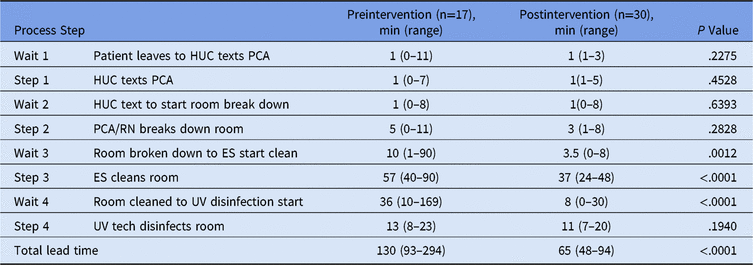
The median room turnover time at baseline was 130 minutes (range, 93–294 minutes); the team set a goal for room turnover time of 78 minutes. Following our interventions, room turnover decreased to 65 minutes (range, 48–95 minutes; P < .0001). A decrease or no change was observed for all wait and process times, with the greatest change noted in median wait time between room breakdown and cleaning start (from 10 to 3 minutes; P = .004), wait time between cleaning room complete to UV disinfection start (from 36 to 8 minutes; P < .0001), and process time for room cleaning and curtain changing (from 57 to 37 minutes; P < .0001) (Table 2). No increases were observed in any of the process or wait times. Successful UV disinfection was completed in all observed rooms (data not shown).
Median Times Before and After the Intervention

Note. HUC, health unit coordinator; PCA, patient care assistant; RN, registered nurse; ES, environmental services; D/C tech, discharge technician; UV tech, ultraviolet technician.
Discussion
We successfully decreased isolation room turnover by half by targeting and eliminating wasted time generated by our process, specifically with ES technician coordination. Active collaboration among diverse team members drove these improvements in a relatively short time period.
UV disinfection has been shown to be effective at killing pathogens, and in preventing environmental transmission.Reference Anderson, Chen and Weber 4 , Reference Anderson, Moehring and Weber 16 – Reference Hosein, Madeloso, Nagaratnam, Villamaria, Stock and Jinadatha 18 However, UV equipment is costly and may require specialized training for operation. To achieve broad room coverage, multiple UV machines must be purchased. The key elements of a successful UV program are not well defined; they likely include deliberate program design and clinical staff acceptance.Reference Schaffzin, Finney, Wilhite, Li, Moore and Connelly 14 , Reference Spencer, Vignari, Bryce, Johnson, Fauerbach and Graham 19
By design, our rooms are released for admission following cleaning; no hold is placed for UV disinfection. We chose to avoid patient flow delays, and we gave staff a sense of control over room availability, accepting that we likely missed opportunities due to patient need. We hypothesized that increasing the window of time for UV disinfection would create greater opportunity and increase our UV disinfection coverage. During this study, we did not observe an increase in the percentage of rooms disinfected on the study unit (data not shown), but this could be due to the small scale of this study. Regardless of its impact on UV disinfection coverage, an effort to improve room turnover could benefit important metrics such as patient flow.Reference Jweinat, Damore, Morris, D’Aquila, Bacon and Balcezak 20
The Lean methodology has been utilized in various healthcare contexts, including hospitals, emergency rooms, and surgical care.Reference King, Ben-Tovim and Bassham 21 – Reference Improta, Cesarelli, Montuori, Santillo and Triassi 23 Although its impact on short-term value is significant, its impact in the long term and on sustainability are less clear.Reference D’Andreamatteo, Ianni, Lega and Sargiacomo 24 , Reference Glasgow, Scott-Caziewell and Kaboli 25 Kim et alReference Kim, Spahlinger, Kin and Billi 12 posit that the hospital is an ideal setting for Lean-driven interventions, but they also cite a number of cultural and practical challenges in translating the method from industry to healthcare. Specifically, the requirement to involve all operators in intervention design and execution, independent of hierarchy, may be challenging in most healthcare systems where individual ‘silo’ focus is the standard.
Conversely, a potential benefit of the Lean approach is staff empowerment to build relationships, foster empathy, and improve experience.Reference Kim, Spahlinger, Kin and Billi 12 Anecdotally, staff from the test unit, ES, and patient flow coordination reported a positive sense of teamwork and cooperation not normally experienced in their specialized tasks. Additionally, many reported feeling that their work was more effective and appreciated. In particular, intervening to affect wait 1 (Table 1) was driven more by staff preference than need for improvement. Stakeholders felt it important to address because a delay in this step would keep the process from taking place at all. Despite no statistical time reduction, addressing this step helped focus and recruit support for the project and may have enabled the improvement observed. In future efforts, we will seek to maintain the cooperative nature of the intervention by demonstrating the benefit of prioritizing work that adds value.
Our study is subject to a number of limitations. First, it took place at a single institution on a single unit, which may limit its generalizability. As with any improvement project, context is important; institutions and units may not have same precedent and structure.Reference Kaplan, Brady and Dritz 26 In choosing the testing unit, we opted for one unit with a tendency to house patients with a range of medical and surgical issues, many of whom are in transmission-based precautions, to increase spread potential. Second, our project was designed to take place in a short time period, and we were unable to measure its sustainability. We are currently spreading our process to other inpatient units, and we will be able to test both generalizability and sustainability of the process. The short duration also precluded measurement of the effect of UV disinfection on healthcare-acquired infections. We implemented our UV program based on evidence that disinfection can eliminate pathogens and prevent transmission,Reference Anderson, Chen and Weber 4 , Reference Anderson, Moehring and Weber 16 and we focused on implementation rather than effectiveness. Furthermore, our rates at baseline are low, and differentiating a secular trend from true change would likely be difficult (not shown). Finally, our time studies could have been influenced by the Hawthorne effect, in which adherence and effort improves with the knowledge that one is being observed.Reference Chen, Vander Weg, Hofmann and Reisinger 27 To avoid this effect, we conducted a large number of observations using different team members to make it less clear when observations were taking place. Additionally, it is not uncommon to have observers on a clinical unit for research, process improvement, hand hygiene adherence, etc. Staff likely had grown accustomed to observers and thus were less likely to be influenced by the Hawthorne effect.Reference Chen, Vander Weg, Hofmann and Reisinger 27
We used Lean methodology to decrease room turnover time by half by eliminating effort that did not add value to the system or outcome. This methodology could likely be applied in other contexts to improve infection prevention and hospital processes and systems.
Acknowledgments
We would like to thank the A4S and ES staff for all their hard work in making this project a success.
Financial support
No financial support was provided relevant to this article.
Conflicts of interest
All authors report no conflicts of interest relevant to this article.
Supplementary material
To view supplementary material for this article, 377 please visit https://doi.org/10.1017/ice.2019.199