Introduction
Longitudinal birth cohort studies are essential for studying potential causal factors of disease throughout the life course.Reference Richmond, Al-Amin, Smith and Relton1–Reference Oken, Bastain and Bornkamp3 Data from birth cohort studies have led to an improved understanding of disorders such as attention deficit hyperactivity disorder, autism, allergic disorders, asthma, and obesity.Reference Ji, Hong and Wang4–Reference Farhan, Kothalawala and Kurukulaaratchy8 These and other advancements, as well as current knowledge gaps on life course health, underscore the importance of continuing efforts to conduct birth cohort studies.
Conducting birth cohort studies with sustained participant engagement is resource-intensive. A study team’s success depends on the ability to recruit and retain participants representative of the source population, which in birth cohort studies are commonly biological mother–child dyads.
Attrition, which can result in bias threatening the internal and external validity of study findings, can stem from participant passive withdrawal (no-show or failure to respond to team outreach), active withdrawal (refusing further participation), or lost to follow-up resulting from outdated participant contact information.Reference Fewtrell, Domellof and Hojsak9–Reference Kristman, Manno and Cote11 Conducting observational studies also carries the inherent risk of decreased participant interest over time, especially when there is no obvious direct benefit to participating.Reference Lemas, Wright and Flood-Grady12 Attrition in birth cohort studies is more common across certain sociodemographic characteristics (e.g., age, income, education), relationship status, employment status (e.g., occupation), social behaviors (e.g., smoking status), and housing characteristics.Reference Goldstein, Bakhireva and Nervik13–Reference Vejrup, Magnus and Magnus18 However, studies investigating attrition factors have several limitations, including lack of a racially/ethnically diverse population or unreported race/ethnic percentages, review of only maternal characteristics (not paternal), or short follow-up duration. Furthermore, publications from cohort studies often do not report on retention strategies and their effectiveness in sustaining engagement and interest in the research.Reference Teixeira, Queiroga and Freitas19,Reference Abshire, Dinglas, Cajita, Eakin, Needham and Himmelfarb20 These gaps in understanding combined with the inherent risk of attrition occurring in birth cohort studies underscores an ongoing need to identify retention strategies that mitigate attrition in birth cohort studies.Reference Canova and Cantarutti21 While retention is a persistent challenge in longitudinal and health research, there exists an abundance of strategies available at a study team’s disposal, ranging from study stipends to providing child care at visits.Reference Murray and Xie22 A recent review by Robinson et al. assessed 88 health studies that involve in-person follow-up and identified a fourfold increase in published strategies in the past two decades alone.Reference Robinson, Dinglas and Sukrithan23 Despite this, a systematic review by Teague et al. looking at the effectiveness of retention strategies, specifically in longitudinal research design found that the practice of using more retention strategies did not result in higher retention rates.Reference Teague, Youssef and Macdonald24 This is suggestive that quality not quantity is more important, and tailored strategies may be most effective to prevent attrition. Further understanding of the factors related to birth cohort study attrition will allow for better development and/or deployment of retention strategies.
Thus, in the present analyses, we sought to better understand attrition through the identification of factors associated with participation patterns in the birth cohort, the “Wayne County Health, Environment, Allergy and Asthma Longitudinal Study” (WHEALS). WHEALS provides a unique opportunity to study participation patterns in a racially and sociodemographic diverse population, with participants residing in urban and suburban neighborhoods. A wealth of data were obtained in the initial stages of the study (including assessment of paternal characteristics) with over a decade of follow-up time. In this study, we first identified underlying patterns of participation in WHEALS using longitudinal latent class analysis (LCA) based on participation in the study over time. We then examined whether baseline characteristics from the prenatal period were associated with identified participation classes and attempted to identify a subset of the most important characteristics, as well as evaluate potential interactive effects between characteristics. Identification of factors related to attrition, in a diverse cohort such as WHEALS, may support research teams in identifying resources and strategies to retain a greater percentage of participants over longer periods of time.Reference Young, Powers and Bell10 If characteristics of participants at enrollment are associated with their future level of participation, tailored interventions, and retention strategies could be developed and applied early during the study to improve retention.
Methods
Study population
WHEALS is a population-based longitudinal birth cohort study that originated to investigate the associations of environmental and biological factors in early life with the development of childhood allergy and asthma. Details of the cohort have been published previously.Reference Wegienka, Havstad and Joseph25–Reference Cassidy-Bushrow, Sitarik and Johnson-Hooper27 Mothers were recruited during pregnancy from September 2003 to December 2007, were between the ages of 21–49 years, and in their second trimester or later. Using electronic medical records, 5197 potentially pregnant mothers were identified using ICD-9 codes for visits at one of five HFH obstetric clinics, and of these, 1258 participants were ultimately enrolled. Participants resided in a predefined cluster of zip codes in and surrounding the city of Detroit, Michigan, United States. Recruitment of participants from diverse socioeconomic and racial backgrounds was an inherent component of the study design, through both the inclusion of the city of Detroit (82% Black based on 2000 Census data) in addition to the suburbs, which ranged from 1 to 68% Black.Reference Havstad, Wegienka and Zoratti28 All mothers recruited provided written informed consent and completed the prenatal maternal questionnaire. Child assent at the 10–12 year follow-up visit was obtained for those who participated. Biological fathers were also approached for informed consent at the prenatal visits, but their enrollment in the study was optional. Retention methods included yearly mailings of holiday cards and birthday cards and sharing of study results via participant newsletters. Study stipends and/or gifts were also provided at select timepoints, including the 3–6-year interview and 10–12-year clinic visit. All study activities and protocols were approved by the HFH Institutional Review Board.
Cohort data and sample collection summary
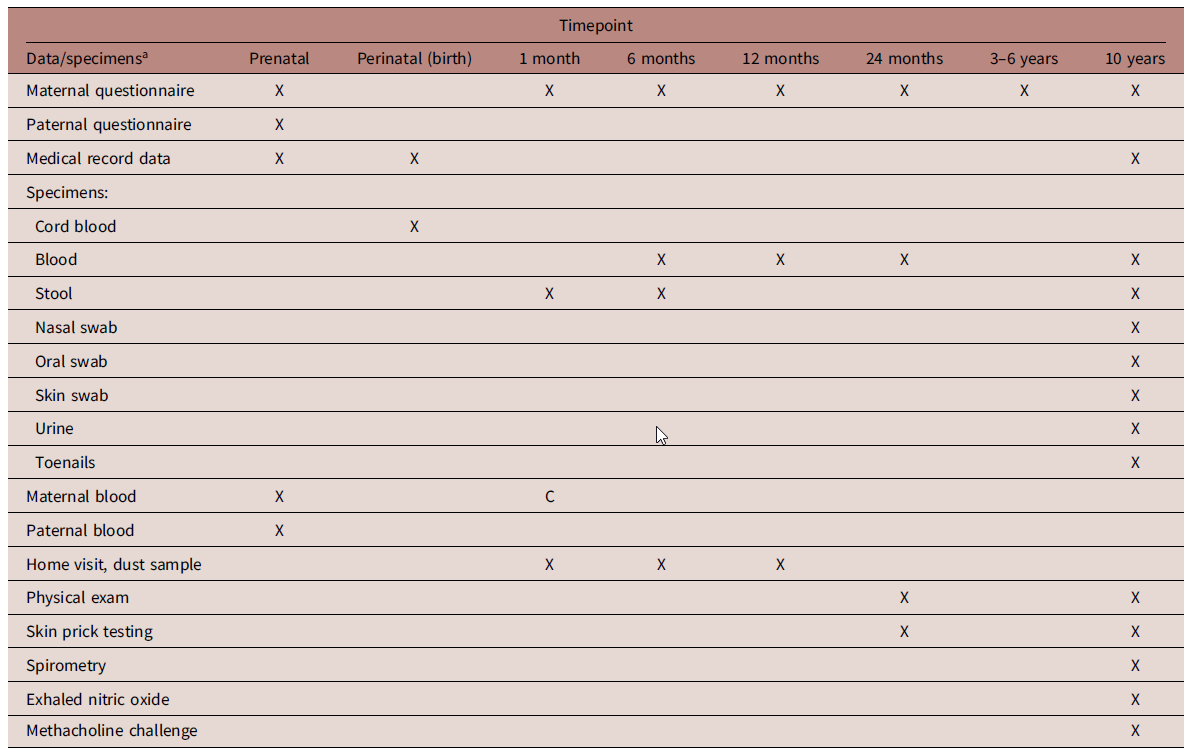
At the time of cohort formation, the study planned to include measurements of allergen-specific immunoglobulin E with the endpoint age of the child at 2 years old; however, the WHEALS cohort remains active in both the analyses of existing data and ongoing data collection. Longitudinal birth cohorts often evolve over time as new funding opportunities arise, the focus/scope of collaborators changes, or new scientific interests emerge. Over the course of the study, WHEALS participants have been invited to participate in new protocol study activities, led by site investigators, as well as study activities as part of larger research consortiums to harmonize data across birth cohorts for both asthma/allergy research and other child health outcomes.Reference Gern, Jackson and Lemanske29,Reference Zanobetti, Ryan and Coull30 For this study, we focused on timepoints that were investigator driven from the original site (vs. activities part of larger research consortiums). These timepoints span prenatally to child age at 1, 6, 12, and 24 months; 3–6 years; and 10–12 years (Table 1). The data collected included staff-administered questionnaires, home visits with dust sample collection, child clinical exams, and biological specimens from mother, father, and child.
Data and specimens collected from WHEALS participants (n = 1,258) spanning enrollment period 2003–2007 through 10–12-year follow-up visit

C, catch-up timepoint if not collected at previous timepoint; WHEALS, Wayne County Health, Environment, Allergy, and Asthma Longitudinal Study.
aData and/or specimens are from child participant unless otherwise noted by “maternal” or “paternal.”
Questionnaires. The study staff-administered the questionnaires throughout the prenatal period through the 10–12-year follow-up either at home, in-person at clinic visits, or over the phone. Enrollment was conditional on completion of the maternal prenatal questionnaire, which included age, race/ethnicity, education, occupation, insurance coverage, alcohol and tobacco use, obstetrical history, asthma/allergic history and current symptoms, and medication use. Similar data elements were also captured about the biological father with non-applicable data elements omitted (e.g., obstetrical history). If the biological father was present and willing to answer questions, he answered for himself; otherwise, each mother answered on the father’s behalf if they were willing.
Data elements about the child included daycare attendance, breastfeeding/formula use, solid food introduction, lung health, episodes of illness, healthcare use, doctor diagnoses of asthma/allergy, parent-reported child wheeze, insurance coverage, and exposure to environmental tobacco smoke (ETS).
Household data elements included location of residence, household income, home ownership, ETS, and dog or cat exposure.
Medical record data. Medical chart abstraction was completed throughout the study and included ascertainment of delivery information (i.e., mode of delivery, child date of birth, and sex at birth) and child’s heath status.
Specimens. Blood was collected from the mother, father (optional), and child.Reference Wegienka, Havstad and Joseph25 Multiple specimens were collected from the child from birth to the 10–12-year follow-up clinic visit and included: cord blood, blood (6 months, 12 months, 24 months, 10–12 years), stool (1 month, 6 months, and 10–12 years), nasal swab (10–12 years), skin swab (10–12 years), urine (10–12 years), and toenail clippings (10–12 years).
Home visits. Home visits (1 month and 6 months) involved the collection of dust samples from the child’s and mother’s bedroom floors and mattresses and the family living space. Details were collected on the presence of mold and rodent droppings.
Child’s clinic visits. The 24-month clinic visit included a physician exam with clinical assessment of eyes, ears, nose, throat, lungs, and skin confirming past or present diagnoses of reactive airway disease, asthma, allergic rhinitis, urticaria/hives, angioedema, anaphylaxis, and atopic dermatitis as well as skin prick testing (SPT).Reference Wegienka, Havstad and Joseph25 The 10–12-year follow-up clinic visit also included a physical exam which included anthropometric measurements, vital signs, SPT, exhaled nitric oxide, spirometry, and a methacholine challenge.
Exposure assessment
Data at baseline and very early life (1 month) were selected to examine the association with attrition through to the 10–12-year endpoint. Baseline measurements were chosen close to enrollment, as data in later timepoints were not available for participants who experienced attrition. These data were derived from maternal/paternal questionnaires, medical chart reviews, and 1-month follow-up questionnaires. Data elements collected within these timepoints include maternal (age, race/ethnicity, education, employment, insurance, smoking status, alcohol use, asthma/allergy history), delivery (gravidity, parity, mode of delivery), paternal (age, race/ethnicity, education, employment or student status, asthma/allergy history), household (residence location, income, ETS, and exposure to indoor dogs or cats), and infant characteristics (sex at birth, daycare attendance, and breastfeeding status). The maternal insurance variable is reflective of the US-based healthcare system which at the time of WHEALS enrollment included “private” and “public” government-sponsored programs such as Medicaid. The data element of dog or cat exposure was included in our study as the overall objective of the WHEALS birth cohort was to determine the effect of early exposure to dogs and cats on the development of allergic disorders. Emerging evidence around the initiation of the WHEALS cohort revealed that early pet exposure, especially dogs, was associated with overall decreased allergic sensitization to multiple allergens and reduced risk of childhood asthma.Reference Ownby and Johnson31–Reference Almqvist, Egmar and Hedlin34 Multiple related papers resulted from WHEALS data, including early studies showing a protective effect on the early trajectory of total IgE patterns from prenatal exposure to dogs or cats.Reference Havstad, Wegienka and Zoratti28,Reference Nicholas, Wegienka, Havstad, Zoratti, Ownby and Johnson35-Reference Aichbhaumik, Zoratti and Strickler37 Summaries of results were shared in newsletters and, thus, we wanted to test whether having a dog or cat (other self-reported pets were uncommon) impacted a participant’s likelihood to remain in the study over time.
Outcome assessment
Since its inception, the WHEALS cohort study has maintained a participant communication database for tracking of participant’s contact information and documenting visit completion. Study staff entered details of every correspondence with participant in this tracking database (e.g., email communication or phone call). For this study, participation status was coded as binary yes/no based on any data collected at each timepoint. Participants that provided no data at a timepoint (in form of surveys, clinical measures, or specimens) were coded as “no,” whereas participants that provided at least one data type were coded as a “yes.” We assessed participant status at 1-month, 6-month, and 12-month home visits, 24-month clinic visit, 3–6 year survey, and the 10–12 year clinic visit. These binary measures at each timepoint were used to determine classes of attrition via LCAs, described in detail below.
Statistical analyses
All analyses were performed using R version 4.2.3 (R Foundation, Vienna, Austria) or Mplusversion 8.9 (Muthén & Muthén, Los Angeles, CA). Mplus was used for all LCAs, while R was used for the remaining analyses. Statistical significance was prespecified at P ≤ 0.05.
LCA was performed to identify distinct groupings of participation over time. LCA allows for the clustering of subjects such that members of each class are more similar to each other than they are to members of other classes with respect to the variables used to identify the classes.Reference Sinha, Calfee and Delucchi38 Using six binary indicators for participation across study timepoints (i.e., variables at 1 month, 6 months, 12 months, 24 months, 3–6 years, and 10–12 years), classes were identified.Reference Nylund-Gibson, Garber and Carter39
The appropriate number of classes was determined using a variety of fit statistics: Akaike Information Criterion (AIC), Bayesian Information Criterion (BIC), Sample-size-adjusted Bayesian Information Criteria (SABIC), Lo–Mendell–Rubin Adjusted Likelihood Ratio Test (LMR P value), and Bootstrap Likelihood Ratio Test (BLRT P value). Lower AIC, BIC, and SABIC values indicate superior fit. The BLRT and LMR P values indicate whether the addition of a class results in a statistically significant improvement in model fit.Reference Nylund-Gibson, Garber and Carter39 Class interpretability and sample size were also considered in class number selection.
We first examined associations between baseline characteristics with each participation class by assigning each participant to the class with the highest probability of assignment (i.e., the “classify-analyze” approach). We then formally tested the association between baseline characteristics and participation class using the three-step procedure for latent class predictors described by Asparouhov and Muthén 2014 (R3STEP in Mplus), which takes into account classification uncertainty.
Conditional inference trees were used to identify the factors most strongly associated with participation class using the “classify-analyze” approach. These nonparametric decision trees allow for exploring nonlinear relationships and identifying population subgroups that are homogenous with respect to outcomes. Identification of subgroups and pathways through conditional inference tree modeling can provide insight into potential interactive effects.Reference Venkatasubramaniam, Wolfson, Mitchell, Barnes, JaKa and French40 In decision tree models, the “root node” starting with the nomenclature of “node 1” contains all observations, while subsequent nodes are made after each partition (“split”) of the sample. Splits below root node serve as “branches” in the tree and splitting continues until a stopping rule occurs resulting in the “terminal node.”Reference Venkatasubramaniam, Wolfson, Mitchell, Barnes, JaKa and French40 Conditional inference trees allow for estimating the relationship between multiple exposure variables and outcome of attrition by repeatedly (recursively) testing the null hypotheses of independence. The null hypothesis for our study would be that no covariates have an effect on participation class. If this is rejected, the input variables that have the strongest association with the outcome (participation class) are retained in the model. The algorithm selects variables in an unbiased way (unlike random forests, which are known to favor predictors with many possible splits), avoids overfitting, can handle missing data, and are easy to interpret. The function “ctree” in the R “partykit” package was used with default parameters.Reference Hothorn, Hornik and Zeileis41
Results
Latent classes
The evaluation of model fit statistics resulted in consistent agreement that the four-class model best fit the data (Supplementary Table S1), with AIC, BIC, and SSA-BIC having the lowest values, and with the LMR and BLRT test suggesting four classes. The four classes can generally be described as: class 1: high early participation with gradual loss to follow-up (LTFU); class 2: sporadic participation; class 3: consistently high participation; and class 4: consistently low participation. Figure 1 represents participation trends for each follow-up visit timepoint (x-axis) with the percentage of participants that completed at least one data collection (y-axis) within each latent class (Fig. 1). Each class is described in more detail below:
The 4-class solution to describe participation in WHEALS using longitudinal latent class analysis. Class 1: High early participation with gradual loss-to-follow-up; Class 2: Sporadic participation; Class 3: Consistently high participation; Class 4: Consistently low participation.

Class 1 (n = 109, 8.7%): high early participation with gradual LTFU. The fewest number of participants were observed in this class. Among this group, participation was high early in the study but after the 6-month timepoint, participation decreased, with no participants participating by the 3–6-year timepoint.
Class 2 (n = 252, 20.0%): sporadic participation. This group had variable rates of participation, with a steady drop below 50% observed in participation from the prenatal timepoint to the 12-month timepoint, followed by an increase in participation at the 3–6-year timepoint, and another dip below 50% at the 10–12-year timepoint.
Class 3 (n = 675, 53.7%): consistently high participation. The majority of participants fell into this class, with participation above 80% across all timepoints.
Class 4 (n = 222, 17.6%): consistently low participation. Participants in this class had consistently low participation across all timepoints after the prenatal timepoint, dropping to less than 30% at 1-month and to 0% by the 2-year-timepoint.
Association between baseline characteristics and participation class
We first describe baseline characteristics of the consistently high participation class (reference class 3). Class 3 had the highest proportion of maternal and paternal participants having a bachelor’s degree or more (37.2%, 30.0% respectively; Supplementary Table S2). Class 3 also had the highest average maternal and paternal age (30.2 years and 33.1 years, respectively), compared to other classes. Class 3, along with class 1 (high early participation with gradual LTFU), had a higher proportion of participants residing in suburban households (49.8% and 52.3%, respectively). Class 3 also had a higher proportion of households with incomes of $80,000 to less than $100,000 or $100,000 or more (14.2% and 15.1%, respectively), compared to other classes. Class 3 also had the highest proportion of participants with private insurance (65.4%), relative to other classes.
Maternal characteristics by participation class
We then formally tested the associations between baseline characteristics and latent class, using the consistently high participation class as the reference. The relationships between maternal characteristics and latent classes are shown in Table 2. For every 10-year increase in maternal age, the odds of sporadic participation were 0.34 times lower (OR [95% CI] = 0.34 [0.20, 0.56]) and the odds of consistently low participation were 0.54 times lower (OR [95% CI] = 0.54 [0.38, 0.76]). Relative to White mothers, Black mothers had more than four times higher odds of sporadic participation (OR [95% CI] = 4.30 [2.01, 9.22]) and nearly three times higher odds of consistently low participation (OR [95% CI] = 2.89 [1.85, 4.50]). Relative to mothers with less than a high school diploma, mothers with some college (OR [95% CI] = 0.32 [0.12, 0.84]) or a bachelor’s degree or more (OR [95% CI] = 0.19 [0.07, 0.52]) had lower odds of high early participation with gradual LTFU. Mothers with a bachelor’s degree or more also had lower odds of sporadic participation (OR [95% CI] = 0.11 [0.03, 0.40]) or consistently low participation (OR [95% CI] = 0.14 [0.06, 0.33]). Relative to employed mothers, unemployed mothers had nearly two times greater odds of high early participation with gradual LTFU (OR [95% CI] = 1.94 [1.10, 3.43]); Medicaid insurance was also associated with greater odds of high early participation with gradual LTFU (OR [95% CI] = 2.26 [1.28, 3.99]). Prenatal smoking was associated with increased odds of high early participation with gradual LTFU (OR [95% CI] = 3.15 [1.55, 6.37]), sporadic participation (OR [95% CI] = 2.59 [1.25, 5.38]), and consistently low participation (OR [95% CI] = 2.25 [1.28, 3.97]). No significant associations were identified for alcohol use during pregnancy or history of allergies or asthma.
Delivery characteristics by participation class
The only significant delivery characteristic was first born child (dichotomous parity), which had lower odds of consistently low participation (OR [95% CI] = 0.68 [0.48, 0.98]). No significant associations were observed between participation and first pregnancy (dichotomous gravidity) or mode of delivery.
Paternal characteristics by participation class
Overall, associations between paternal age and paternal race-ethnicity with attrition were similar to maternal associations. (Table 2). However, some paternal college education (relative to less than a high school diploma) was associated with lower odds of sporadic participation (OR [95% CI] = 0.33 [0.14, 0.79]). Additionally, relative to employed fathers, unemployed fathers had more than two times greater odds of consistently low participation (OR [95% CI] = 2.29 [1.19, 4.41]). Paternal history of allergies was associated with lower odds of consistently low participation (OR [95% CI] = 0.40 [0.21, 0.74]), while paternal history of asthma was associated with higher odds of high early participation with gradual LTFU (OR [95% CI] = 2.47 [1.32, 4.63]).
Association between baseline characteristics and participation classes in WHEALS

aOdds ratios and 95% CIs were estimated using multinomial logistic regression for each covariate with the 3-step procedure described by Asparouhov and Muthén 2014. All odds ratios are relative to class 3 (consistently high participation), which was comprised of 675 participants.
bUnstable estimate due to small sample size.
ETS, environmental tobacco smoke; HS, high school; LTFU, lost to follow-up; MENA, Middle East and North Africa; WHEALS, Wayne County Health, Environment, Allergy, and Asthma Longitudinal Study.
Household characteristics by participation class
Urban residence was associated with higher odds of sporadic (OR [95% CI] = 2.81 [1.71, 4.63]) and consistently low participation (OR [95% CI] = 2.27 [1.61, 3.21]; Table 2). Higher household income categories (relative to <$20,000) were associated with lower odds of high early participation with gradual LTFU, sporadic, and consistently low participation. ETS exposure during pregnancy associations were similar to that of prenatal smoking. Prenatal indoor dogs were associated with lower odds of consistently low participation (OR [95% CI] = 0.47 [0.30, 0.72]). No significant associations were observed for indoor cats during prenatal period.
Infant characteristics by participation class
Daycare attendance at 1 month was associated with higher odds of high early participation with gradual LTFU (OR [95% CI] = 3.30 [1.19, 9.11]; Table 2). Additionally, relative to formula fed children, children who were breastfed (OR [95% CI] = 0.35 [0.16, 0.79]) or mixed fed (OR [95% CI] = 0.56 [0.33, 0.97]) had lower odds of high early participation with gradual LTFU. No significant associations were observed for child sex.
Variable selection using conditional inference trees
When conditional inference tree modeling was used to perform variable selection for factors associated with participation class and examine interactive effects, the data first split on maternal education for the root node (node 1), followed by branching nodes of insurance type (node 3), and then household income (node 4). The model resulted in four terminal nodes (2, 5, 6, and 7) with 72, 11, 16%, and 1%, respectively, of participants within each node (Fig. 2). Node 2 included mothers with education levels less than a bachelor’s degree. Node 5 included mothers with a bachelor’s degree or more, all insurance types except for Medicaid, and income less than $80,000. Node 6 included mothers with a bachelor’s degree or more, all insurance types except for Medicaid, and income greater than $80,000. Node 7 included mothers with at least a bachelor’s degree and Medicaid insurance.
Conditional inference tree modeling for baseline factors associated with participation class in the WHEALS cohort. Class 1: High early participation with gradual loss-to-follow-up; Class 2: Sporadic participation; Class 3: Consistently high participation; Class 4: Consistently low participation. HS, high school.

The highest probability of a class in all four terminal nodes was the consistently high participation class (Supplementary Table S3). Relative to all other nodes: mothers in node 2 (education levels less than a bachelor’s degree) had a greater probability of sporadic participation (23.3% vs. 14.3%, 9.2%, 18.8% in nodes 2 vs. 5, 6, 7). Mothers in node 5 (bachelor’s degree or more, all insurance types except for Medicaid, income less than $80,000) had a greater probability of high early participation with gradual LTFU relative to other nodes (14.3% vs. 9.0%, 3.6%, 0.0% in nodes 5 vs. 2, 6, 7). Mothers in node 6 (bachelor’s degree or more, all insurance types except for Medicaid, income greater than or equal to $80,000) had a greater probability of consistently high participation (82.1% vs. 46.7%, 59.3%, 50.0% in nodes 6 vs. 2, 5, 7). Mothers in node 7 (bachelor’s degree or more, Medicaid insurance) had a higher probability of consistently low participation relative to other nodes (31.2% vs. 20.9%, 12.1%, 5.1% in nodes 7 vs. 2, 5, 6).
Discussion
Longitudinal birth cohort studies, which often span decades, require intensive efforts by study staff to enroll and retain participants. This study adds to the limited published research available about participant attrition in birth cohort studies, and to our knowledge, this is the first study, utilizing LCA for this purpose. Looking at the four participation classes, just over half of WHEALS participants fell into the “consistently high participation” class 3 with the remaining participants categorized into the “sporadic participation” class 2 (20%), “consistently low participation” class 4 (17.6%), and “high early participation with gradual LTFU” class 1 (8.7%) classes. These four classes demonstrate that a study population affected by attrition is not homogenous but rather is composed of distinct underlying patterns of participation.
Specifically, higher education, private insurance, suburban residence, and higher household incomes were associated with increased likelihood being in the high participation class (class 3).
Taken together, these characteristics are indicative of higher socioeconomic status (SES), which is positively associated with sustained study engagement in the WHEALS cohort. These findings support the relation of SES with engagement in research studies.Reference Cameron, Osborne, Spinks, Davey, Sipe and McClure14,Reference Jang and Vorderstrasse42 Consistent with the findings of other cohort studies, older age was associated with high participation (both maternal and paternal), while younger age was associated with sporadic participation and consistently low participation. Previous cohort studies have shown that younger mothers are more likely to experience attrition.Reference Young, Powers and Bell10,Reference Zook, Jordan and Adams15,Reference Vejrup, Magnus and Magnus18,Reference Zivadinovic, Abrahamsen and Pesonen43 Our study adds further granularity in regard to father’s age and by showing the type of participation patterns associated with age.
Notably, class 1 (high early participation with gradual LTFU) and class 3 (consistently high participation) did not significantly differ on several characteristics, including age, race-ethnicity, and location of residence. However, Medicaid insurance was associated with increased odds of high early participation with gradual LTFU relative to high participation. In addition, formula feeding was associated with increased odds of high early participation with gradual LTFU. Class 1 highlights a unique group of participants who initially showed eagerness to participate but disengaged soon after enrollment and did not continue in providing long-term data. Research is needed to determine the causal relationships involved in early attrition. In contrast, class 4, the lowest participating class, was associated with lower average age, Black race, lower household income, lower maternal education, and urban residency.
Combined, these findings suggest that participants with lower SES may need more targeted resources to enable sustained study engagement. These findings mimic research in the clinical pediatric setting, where socioeconomic disadvantage, measured by having public health insurance (Medicaid) or no insurance, geographic setting, and having a lower zip code median incomeReference Guzek, Fadel and Golomb44–Reference Bohnhoff, Taormina, Ferrante, Wolfson and Ray46 are associated with clinic no-shows, including for well-child visits. Birth cohort study preparatory activities could include focus groups with individuals with these characteristics to better understand the barriers to participation as well as the preferred methods for overcoming these barriers.
Through conditional inference modeling, we demonstrated how maternal education, insurance, and household income are most strongly associated with participation class (Fig. 2). For example, we found that relative to other terminal nodes, participants with maternal education of bachelor’s degree or more, all insurance types except for Medicaid, and income greater than or equal to $80,000 (node 6), had a greater probability of consistently high participation. This finding is not surprising given that high SES indicators were associated with high participation, but the conditional inference tree additionally demonstrated a cumulative effect of individual SES indicators. Further, interactive effects were observed, as insurance and income were associated with participation class among highly educated women (with a bachelor’s degree or more), but not among women with less education. Specifically, mothers with a bachelor’s degree or more and Medicaid insurance (node 7) had a greater probability of consistently low participation relative to other classes. This shows that despite having more education, having Medicaid (public insurance) could be a surrogate variable representing other factors that may result in lower participation. Mothers in node 5, with higher education (bachelor’s degree or more) and all insurance except Medicaid, but with lower income, had a greater probability of high early participation with gradual LTFU. This finding supports the importance of income in sustained participation. We found that mothers in node 2, with lower education (less than a bachelor’s degree) had agreater probability of sporadic participation, relative to other classes. For WHEALS, the specific visits with consistently low participation were the 1-month, 6-month, 12-month, and 10–12-year visits. Study teams may consider identifying participants with lower education, lower income, and/or who have public insurance at higher risk for attrition and consider providing additional support to participate, such as more convenient study visit locations and study appointment times, and/or additional resources for transportation or for childcare for siblings not in the study. Over-recruitment of these individuals may be beneficial to ensure that this subgroup is appropriately represented in the analyses.
Notable strengths of our study were the racial and socioeconomic diversity of our cohort; the long length of follow-up to characterize participation patterns; and the detailed data collected at baseline and early life from mother, fathers, households, and children. However, our study has several limitations. We were unable to examine the role of psychological characteristics or mental health factors such as substance use, perceived stress, or depression in participation patterns. The associations with psychological characteristics are mixed, but previous studies have shown significant associations between temperament sociability or perceived stress and study retention.Reference Zook, Jordan and Adams15,Reference Gustavson, von Soest, Karevold and Roysamb47 Technological modes of communication that exist today such as web surveys, texting, and social media were rarer during WHEALS recruitment in 2003. The association between these communication strategies and retention should be studied. Our original study protocol changed over time (the length of study was extended as additional funding was received); thus, participants who did not choose to participate at later timepoints simply may not have intended to participate beyond what was originally agreed upon at study inception. It could also be argued that participants may not have understood reasoning for additional study timepoints, some of which warranted new informed consent. Changes in birth cohort data collection protocols are not uncommon and may occur when new grant funding opportunities arise. Study teams may wish to inform participants of the possibility of additional participation upfront, such as including language embedded in the informed consent formto declare the study’s possibility of wanting to partner with the family to follow the child over the long term. We did not have a means of measuring study team/participant relationships or trust. Participants who know and trust the research teamare more likely to take part in the data collection process.Reference Murray, Kendall and Carduff48,Reference Graziotti, Hammond and Messinger49 This may be especially important for birth cohort studies, where research participation most commonly places the unique burden of participating on the mother, which may be compounded if there are other children to care for in the household. Establishing rapport, through the creation of partnerships with participants, fosters an environment where participants feel like valued partners in the research process.Reference Ely and Coleman50 A recent scoping review of retention methods and longitudinal birth cohorts by Goldstein et al. found that studies that focused on building trusting relationships with participants facilitated improved research recruitment and participation.Reference Goldstein, Bakhireva and Nervik13 Rapport may even be more critical in this post-COVID-19 pandemic era where medical mistrust is common.Reference Ojikutu, Bogart and Dong51
Conclusions
Using a wealth of data available prenatally to age 10–12 years, from a large diverse cohort, we demonstrate that attrition is not a single construct. Instead, our research supports the presence of distinct participation patterns which we emphasize should be accounted for when developing retention strategies during study initiation. Preparatory communications about potential barriers to sustained participation early on in the study with those who are at the highest risk of discontinuation may be arranged. Future studies to identify and test potential interventions to reduce attrition are needed.
Supplementary material
The supplementary material for this article can be found at https://doi.org/10.1017/S2040174425000029.
Acknowledgments
We generously continue to thank the WHEALS birth cohort participants for their indispensable involvement in this research.
Author contribution
AU and ARS conceptualized and designed the study. ARS performed the statistical analyses. AU drafted the initial manuscript. CCJ, AECB, and GW provided feedback over the course of the analysis. All authors, including AC, KGM, JKS, and SS, read, contributed to, and approved the final manuscript.
Financial support
The WHEALS study was supported by the National Institutes of Health (R01 HD082147; R01 AI050681; R01 HL-113010; R01 AI061774; P01 AI089473) and the Fund for Henry Ford Hospital.
Competing interests
None.
Ethical standard
The authors assert that all procedures contributing to this work comply with the ethical standards of the relevant national guidelines on human experimentation in the United States and with the Helsinki Declaration of 1975, as revised in 2008, and have been approved by the Henry Ford Health Institutional Review Board. Informed consent was obtained from all WHEALS research participants.