

Introduction
Hydrangea and Schizophragma genera are popular ornamental plants (Rehder, Reference Rehder1940) and important genera as landscape and for potted plants. Hydrangea anomala subsp. petiolaris (Siebold & Zucc.) E. M. McClint. and Schizophragma hydrangeoides Sieb. & Zucc. are both climbing and deciduous plants. Leaves of H. anomala subsp. petiolaris are broad ovate to ovate or oval, acute or acuminate, cordate or round at base with short petioles and serrate, nearly glabrous and lustrous at the tip. Leaves of S. hydrangeoides are suborbicular or broad ovate, short acuminate, rounded or cordate at base, and long, remotely coarsely dentate, nearly glabrous (Rehder, Reference Rehder1940). The number of styles (two for H. anomala subsp. petiolaris and one for S. hydrangeoides) and the number of sepals of the asexual flower (four for the former and one for the latter) could be used for identification of these two similar ornamental plants (Anderson, Reference Anderson1933).
Hydrangea anomala subsp. petiolaris and S. hydrangeoides plants were growing sympatrically in Jeju, Korea, but one group of plants showed different leaf morphology than the others (Fig. 1(a) and (b)). At the time of collection, tentative identification of the four unknown accessions nos. 2, 9, 10 and 11 could only be done based on leaf morphology, leaf serration pattern and the number of teeth, and shape of the leaf base; these unidentified accessions were considered as putative intergeneric hybrids between H. anomala subsp. petiolaris and S. hydrangeoides, specifically nos. 1 and 3, respectively (Fig. 1).
Native sites and leaf morphology of Hydrangea and Schizophragma. Native collection site in Jeju, Korea (a), where Hydrangea anomala subsp. petiolaris (no. 1), unidentified accession (no. 2), and Schizophragma hydrangeoides (no. 3), appearance of plants of three accessions in pots (b), S. hydrangeoides measurement showing the two teeth (point A and B) and point C where the depth of tooth, width (W) and length (L) (c), and various leaf and petiole shapes of Hydrangea and Schizophragma are presented (bar = 2 cm) (d). Refer Table 1 for accession information. Due to a limitation of the tables and figures, statistical analysis data are not presented.

Polymerase chain reaction (PCR)-generated markers have been applied to plant identification and hybrid verification. Markers generated from randomly amplified polymorphic DNA (RAPD) (Williams et al., Reference Williams, Kubelik, Livak, Rafalski and Tingey1990; Joung and Roh, Reference Joung and Roh2006; Lee et al., Reference Lee, Yeau, Park and Roh2006), single nucleotide polymorphisms (SNPs; Brooks, Reference Brooks1999; Roh et al., Reference Roh, Lee, Suh and Slovin2006) and simple sequence repeat (SSR) (Rinehart et al., Reference Rinehart, Scheffler and Reed2006; Reed and Rinehart, Reference Reed and Rinehart2007) have been used to evaluate genetic diversity and to examine patterns of hybridization in natural populations of Penstemon (Wolfe et al., Reference Wolfe, Xiang and Hephart1998). A phylogenetic analysis of Hydrangeaceae based on the sequences of the rbcL gene and morphological data revealed the evolution of Hydrangeaceae based on the rbcL sequence data (Soltis et al., Reference Soltis, Xiang and Hufford1995) and monophyly of Schizophragma and H. anomala within Hydrangea clade (Hufford et al., Reference Hufford, Moody and Soltis2001). Despite the potential limitation of using RAPD markers, due to concerns on reproducibility among various laboratories (Penna et al., Reference Penna, Bush, Wise, Kim, Domier, Kasha, Laroche, Scoles, Molnar and Fedak1993; Jones et al., Reference Jones, Edwards, Castaglikone, Winfield, Sala, van de Wiel, Bredemeijer, Vosman, Matthes, Daly, Brettschneider, Bettini, Buiatti, Maestri, Malcevschi, Marmiroli, Aert, Volckaert, Rueda, Linacero, Vazquez and Karp1997), RAPD results were used in combination with other data such as morphological data and SNPs, which supported the credibility of the RAPD results (Joung and Roh, Reference Joung and Roh2006).
The objectives of this study are to investigate whether or not the unknown accessions from Jeju are intergeneric hybrids involving H. anomala subsp. petiolaris and S. hydrangeoides by comparing with other H. anomala and S. hydrangeoides accessions based on morphological characters and molecular markers.
Materials and methods
Morphological characteristics
Data were collected from a total of five mature leaves; two or three leaves each of two greenhouse-grown plants, which were collected from the mid segment of each shoot. The number of teeth, distance and depth of teeth measured at the tip of leaf blade, width and length of leaf blade and petiole length were recorded from the enlarged images of scanned leaves (Fig. 1(c)). Distance between the teeth was measured from the tips of the adjacent two teeth at point A and B, and depth of teeth was measured perpendicular from the point C to the line connecting two points, A and B. Data were subjected to the analysis of variance, and means were compared by Duncan's multiple range test.
Plant materials and DNA extraction
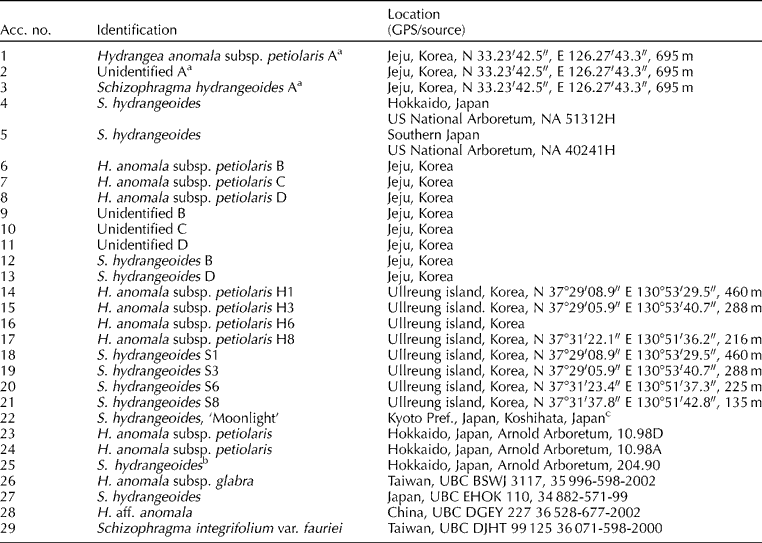
Hydrangea anomala subsp. petiolaris, S. hydrangeoides and unknown accessions were collected from the natural site in Jeju, Korea, from the natural population native to Ullreung island, Korea, and from species or subspecies growing in botanical gardens or arboreta (Table 1). Cuttings of nos. 1, 2 and 3 were collected in 2005, and leaf samples of other accessions from Jeju were collected in 2006 as indicated. Leaf samples from herbarium vouchers were received from the Arnold Arboretum, Jamaica Plain, MA, USA and University of British Columbia, Vancouver, Canada, in 2006. Total genomic DNA was extracted from 100 mg (fresh weight) or 50 mg (dry weight) of young leaves as described previously (Roh et al., Reference Roh, Lee, Suh and Slovin2006).
Accession information of Hydrangea and Schizophragma

a Accession A was collected in 2005, and accessions B, C and D were collected in 2006, and GPS information is not presented.
b Received initially as S. hydrangeoides from the Morris Arboretum, but identified as H. anomala subsp. petiolaris based on the result of this work. Therefore, the original accession name is retained in the table. Received from Brookside Gardens, Wheaton, MD, USA.
c Received from Brookside Gardens, Wheaton, MD, USA.
RAPD analysis
After screening 45 10-mer random primers (Operon Technologies, Alameda, CA, USA), 11 primers (A-04, A-11, A-18, B-11, B-17, B-19, C-06, C-08, C-11, C-12 and C-16) were selected for the final analysis. Amplification was performed using 10 ng of template DNA and 5 pM of primers in a 25 μl reaction volume using Ready-To-Go PCR Beads (GE Healthcare Bio-Sciences Corp., Piscataway, NJ, USA) and using a PTC-100 Programmable thermal cycler (MJ Research, Watertown, MA, USA).
PCR amplification cycles were 94°C for 3 min followed by 35 cycles of 94°C for 30 s, 37°C for 1 min and 72°C for 1.5 min, and a final extension at 72°C for 5 min. The amplified products were separated on a 1.7% agarose gel in 1 × Tris borate EDTA buffer at 105 V for 3 h and stained with ethidium bromide (5 μg/ml) (Joung and Roh, Reference Joung and Roh2004). The amplified bands were scored manually to compile a data matrix for bands. Dendrograms, based on p-genetic distance, were analysed using the bootstrap (BS) test applied to unweighted pair group methods of clustering using averages (UPGMA; BS-UPGMA) or interior-branching (IB) test applied to the neighbour-joining (NJ; IB-NJ) tree-building methods constructed using MEGA 3.1 program (Kumar et al., Reference Kumar, Tamura and Nei2004). BS values>70 from 1000 replications were obtained.
rbcL gene analysis and sequencing
Primers were constructed based on the ribulose-1, 5-bisphosphate carboxylase/oxygenase large subunit (rbcL) gene of S. hydrangeoides (AF 323189). Amplification was performed to generate a fragment of the rbcL gene from positions 162 to 762 using primer sets (left: GCTGCCGAATCTTTCTACGG and right: TGGCAAATACAGCCCTTTTC) to produce 600 bp fragment and also from positions 763 to 1388 using primer sets (left: GAGAATTGGGAGTTCCTATCGTAAT and right: TTTAATTTCCTTCCATACCTCACAA) to produce 625 bp band. SNP positions for the region of 162–762 and for the region of 763–1388 of the rbcL gene were not combined due to different SNPs of several accessions, although it is one continuous sequence.
Amplification was performed using 10 ng of DNA and 10 pM of primers in a 25 μl reaction volume using Ready-To-Go PCR Beads (Amersham Pharmacia Biotech, Pharmacia Biotech Inc.). PCR amplification cycles were 95°C for 5 min, followed by 29 cycles of 92°C for 2 min, 57°C for 1 min and 72°C for 1 min, and a final extension at 72°C for 5 min. The amplified bands were sequenced with 0.5 μl of BigDye Terminator version 3.1 (Applied Biosystems, Foster City, CA, USA), 0.3 μM of the original PCR primers, 1 × of Taq DNA polymerase Buffer (Promega, Madison, WI, USA) and 1.75 mM of MgCl2 in 5 μl reaction volume. The sequencing reactions were analysed on a 3730 Genetic Analyzer (ABI PRISM, Applied Biosystems, Foster City, CA, USA). Sequence data were analyzed and aligned with the standard Phred and Phrap DNA analysis software, and nucleotide polymorphisms were carried out with PolyBayes (Marth et al., Reference Marth, Korf, Yandell, Yeh, Gu, Zakeri, Stitziel, Hillier, Kwok and Gish1999). Dendrograms of BS-UPGMA and IB-NJ based on SNPs of the rbcL gene using MEGA 3.1 program, which were constructed with BS values from 1000 replications, were indicated at the node.
Results
Morphological differences of three accessions collected from Jeju, Korea
Leaf sizes and colours of the petioles are different among three accessions collected from Jeju (Fig. 1(b) and (d)). The number of teeth of unknown no. 2 (26.2) was significantly higher (P>0.01) than that of H. anomala subsp. petiolaris (no. 1) and S. hydrangeoides (no. 3). However, the width (2.17 mm) and depth (1.28 mm) of the teeth of no. 2 were significantly less than those of the other two, nos. 1 and 3 (data not presented). The width (6.89 cm) and length (5.06 cm) of the leaf blades and the petiole length of no. 2 were significantly different (P>0.01) and intermediate between H. anomala subsp. petiolaris (no. 1) and S. hydrangeoides (no. 3) (data not presented). The length of petiole of unknown no. 2 was significantly longer than no. 1, but shorter than no. 3. Emergence of leaf from dormant leaf buds was the fastest for no. 1 when compared to nos. 2 and 3 in 2008. The presence of trichomes on the scales of the axillary buds was only noticed with no. 3 (Fig. 2). Accessions no. 2, 9, 10 and 11 had no trichomes on the lower surface of the leaves. Unknown accession A did not flower in the greenhouse for 4 years, and floral morphology such as the styles of fertile flowers could not be observed.
Morphology of shoot tips (a) and buds (b) of Hydrangea anomala var. petiolaris (1), unidentified accessions (2) and Schizophragma hydrangeoides (3). Photos of plants maintained at 7°/5°C greenhouse during the winter were taken on 3 April 2007. Refer Table 1 for accession information.

RAPD analysis
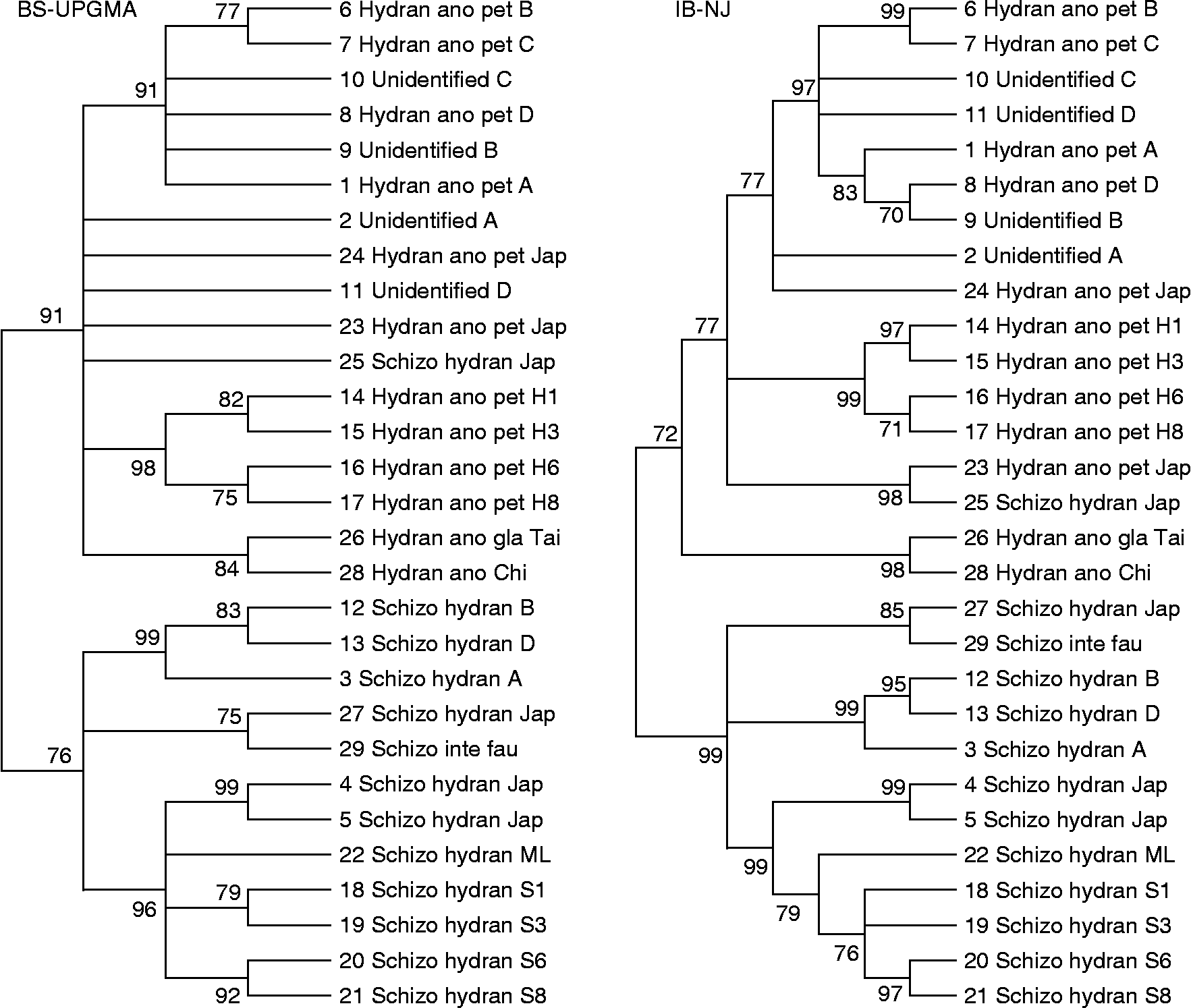
A total of 126 RAPD polymorphic bands were scored (data not presented). All H. anomala subsp. petiolaris from Jeju (nos. 1, 6, 7 and 8) clustered together with unknown nos. 2, 9, 10 and 11 in both BS-UPGMA and IB-NJ dendrograms (Fig. 3). All H. anomala subsp. petiolaris accessions from Ullreung island (nos. 14, 15, 16 and 17) formed a subcluster and grouped with all other H. anomala subsp. petiolaris from Jeju and unknown accessions. Accessions of S. hydrangeoides from Jeju (nos. 3, 12 and 13) and Ullreung island (nos. 18, 19, 20 and 21) formed one major cluster along with accessions collected from Japan (nos. 4, 5 and 27), ‘Moonlight’ (no. 22) and Schizophragma integrifolium var. fauriei from Taiwan (no. 29). Accessions of H. anomala subsp. glabra (no. 26) from Taiwan and H. aff. anomala (no. 28) from China formed a subcluster, but clustered with other H. anomala collected from Korea.
Dendrograms using the bootstrap test (BS) or interior-branching (IB) test applied to unweighted pair group methods of clustering using averages (UPGMA) and the neighbour-joining (NJ) building methods based on bands generated by randomly amplified polymorphic DNA. Refer to Table 1 for details of accession information. Hydran ano pet, Hydrangea anomala subsp. Petiolaris; Hydran ano gla, H. anomala subsp. glabara; and Schizo hydran, Schizophragma hydrangeoides. The origin of country name has been abbreviated by the first three letters. Bootstrap values are indicated next to the nodes.

SNPs of the rbcL gene
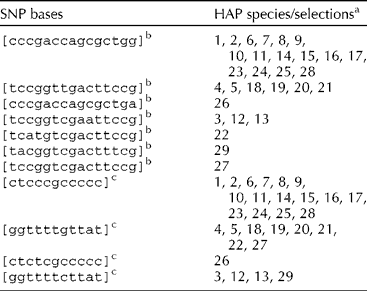
Seven haplotypes (HAP) for positions from 162 to 762 of the rbcL gene and four HAP for positions from 763 to 1388 of the rbcL gene were observed (Table 2). All Hydrangea accessions including unknown nos. 2, 9, 10, 11 and 25, which were initially collected as S. hydrangeoides, had the same SNPs. S. hydrangeoides nos. 3, 12 and 13 from Jeju had different SNPs as compared to those collected from Ullreung island (nos. 18, 19, 20 and 21) and Japan (nos. 4, 5 and 27). S. hydrangeoides no. 25 clustered with other H. anomala subsp. petiolaris accessions (Fig. 3).
Haplotype (HAP) analysis based on single-nucleotide polymorphisms (SNPs) of rbcL gene of Hydrangea and Schizophragma accessions
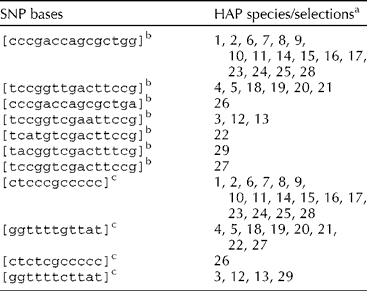
a Refer Table 1 for details on accession information.
b SNP positions for 162–762 rbcL gene: 75–83–89–98–123–153–159–216–219–234–321–487–514–515–546.
c SNP positions for 763–1388 rbcL gene: 63–68–79–121–208–211–400–478–496–512–541.
Discussion
Based on the leaf morphological characters, RAPD markers and SNPs of rbcL gene sequence analysis, the unidentified accession no. 2 from Jeju was characterized as H. anomala subsp. petiolaris, and does not support the initial hypothesis of intergeneric hybrid origin between H. anomala subsp. petiolaris and S. hydrangeoides. When forced in the greenhouse, unidentified accession no. 2 flowered in 2008, and displayed three sepals and two stigmas, confirming that it is H. anomala var. petiolaris. Seeds did not germinate, although it was reported that seeds will germinate without any pretreatment (Dirr, Reference Dirr1990). Fertile seeds might not have been produced since this species of H. petiolaris is known to be self-sterile (Mortreau et al., Reference Mortreau, Bertrand, Lambert and Laemand2003; Rehder, Reference Rehder1940).
Although the presence of trichomes in the lower surface of the leaves supports the identification of S. hydrangeoides accession no. 25 as H. anomala subsp. petiolaris, this cannot be used effectively since Schizophragma ‘Moonlight’ does not have trichomes (observation, Roh). The presence of trichomes in all S. hydrangeoides collected from Korea, but not in those from Japan, suggests that morphological characteristics may not be a useful key to identify the accessions (Anderson, Reference Anderson1933). This is evident for accession no. 25 which was collected and documented as Schizophragma based on morphological characters, but is now identified as H. anomala var. petiolaris analysed by RAPD markers and SNPs of the rbcL gene. Based on the DNA sequences from MatK alone or in combination with the rbcL plastic genes, H. anomala was resolved from Schizophragma (Hufford et al., Reference Hufford, Moody and Soltis2001).
Based on the clustering by RAPD markers and SNPs of the rbcL gene, all accessions belonging to the genus Hydrangea grouped in a major cluster and all accessions of Schizophragma in another cluster. Unidentified nos. 2, 9, 10 and 11 are clustered with H. anomala subsp. petiolaris from Jeju (nos. 6, 7 and 8) and with those collected from Ullreung island (nos. 14, 15, 16 and 17), supporting the finding that the unidentified accessions are indeed H. anomala subsp. petiolaris. Since unidentified accession no. 2 did not flower in the greenhouse for 4 years, it is not possible to confirm whether it is related to Hydrangea or Schizophragma based on the floral morphology. This was also confirmed by using SSR markers developed for the genus Hydrangea (Rinehart et al., Reference Rinehart, Scheffler and Reed2006) and also for genetic relationships within H. macrophylla (Reed and Rinehart, Reference Reed and Rinehart2007) (data not presented).
Even with the limited number of accessions from Taiwan, China and Japan examined, Schizophragma plants collected from Taiwan and Jeju are genetically close to each other, and those collected from Ullreung island, and from Hokkaido, Japan, are genetically close to each other. This could be attributed to the geographic proximities, which are not separated by land mass that may affect the migration of pollen. Jeju Island can be considered close to Taiwan and Ullreung island to northern parts of Japan. Based on the phytogeographical affinities, several forest floras native to eastern China particularly shared closer relationship to those in the southern part of Japan than those in Korea or northeast China (Xie, Reference Xie1997).
Results of RAPD markers can be effectively used for characterization and identification of H. anomala and Schizophragma germplasm, supported by the SNPs of the rbcL gene. In conclusion, the RAPD markers, SNPs of the rbcL gene and examination of floral organs for H. anomala and Schizophragma confirmed that the unidentified nos. 2, 9, 10 and 11 are H. anomala subsp. petiolaris.
Acknowledgements
We thank Peter Wharton, Jack Alexander and Carole Bordelon for providing samples. Skilful technical assistances from Deric Picton, Keenan Amundsen and Alicia Burtles are greatly appreciated. Critical review by R. G. Anderson and T. Rinehart is greatly appreciated. A part of this research was supported by a grant from BioGreen 21 Program, Rural Development Administration, Korea, to Y. H. Joung (Code 20070401-034-026-008-04-00).