


Helen Berry, The Castrato and His Wife (Oxford: Oxford University Press, 2011).
Rachel Cowgill and Hilary Poriss, eds., The Arts of the Prima Donna in the Long Nineteenth Century (Oxford: Oxford University Press, 2012).
Michal Grover-Friedlander, Operatic Afterlives (New York: Zone Books, 2011).
John Potter and Neil Sorrell, A History of Singing (Cambridge: Cambridge University Press, 2012).
Silence
Simoni, Renato
Singers
Singing
Smith, Marian
Song
Song of Songs
Soul
Soundtrack
Speech (speaking voice)
Spheres, Music of the
Occasionally, the index of a book can be revealing. The list given above is from Michal Grover-Friedlander’s Operatic Afterlives. Librettist (Simoni) and dance scholar (Smith) aside, it reflects the volume’s key themes: voices and the supersensory, maybe even the spiritual; certainly, death. The entry for ‘singers’ lists no names, but provides three entries under ‘dead’. The entry for ‘soul’ instructs ‘See also Dead Souls’ while ‘song’ includes subentries for ‘dead singer’s’, ‘delimited’, ‘ghost’, ‘inaudible’, ‘independent’, ‘silent’, ‘temporary’, ‘unceasing’.
There are no matching entries in the indices of the other three books under review here; certainly, nothing listed for ‘silence’. Indeed, each index presents a different type of singer:
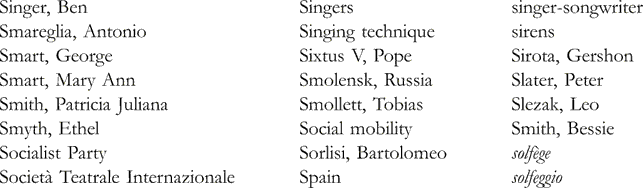
We can detect which list belongs to which volume according to their historical range: Pope Sixtus V and Tobias Smollett feature in Helen Berry’s biography of the castrato Giusto Ferdinando Tenducci; the Smarts in the collection of essays on the prima donna in the long nineteenth century edited by Rachel Cowgill and Hilary Poriss; cantor Gershon Sirota and biologist Peter Slater rub shoulders in the global history of singing by John Potter and Neil Sorrell. It is also evident from this somewhat arbitrary selection that while these books investigate different periods and methodologies they have a common concern with particularities: with certain people, places and societies. As such they reflect a reinvigorated investment in the relationship between vocal music – let’s call it opera – and materiality.
I write reinvigorated because materiality has always mattered to opera, if in ways that have proved problematic for critical discourse. Its origins in luxurious court entertainment and its emphatic privileging of live experience, its stars and their fans, have only lately become the stuff of scholarship. Before then, as Nicholas Till explains in his preface to The Cambridge Companion to Opera Studies, academic interest focused on formal and stylistic development, on musical and dramatic principles.Footnote 1 The trappings of opera – singers, stagings – were rarely engaged with outside popular histories, unless they helped explain how those works came into being.Footnote 2 Production details were granted a degree of intellectual respectability on being included in critical editions.Footnote 3 But it has only been relatively recently that such materials have begun to be interpreted as more than documentation of practicalities; as a means to breathe life into texts, to detect how their hearts once beat.
For an inherently fantastical genre, scholars of opera seem unusually determined to talk about reality. For one branch – mostly those who came of age, musicologically speaking, about twenty-five years ago – ‘the real’ is a category within Lacanian theory, and connects with the ‘materiality’ of singing bodies.Footnote 4 While attending to those voices opened up new paths for considering, among other things, hierarchical representations of gender and ethnicity, for the most part they were read rather than heard in performance.Footnote 5 Grover-Friedlander explains:
Materiality and embodiment are dismissed in favour of an emphasis on its transcendental, metaphysical nature. As a result, no true account has been given of opera’s existence (and that of music as a whole) in and as live performance. But opera is a paradoxical amalgam of the two worlds. [Carolyn] Abbate locates within the works themselves, in their different modes of singing [the phenomenal and noumenal], the very distinction between the material and the transcendental. (28)
Abbate parsed the material and transcendental still more carefully in her subsequent writings on the ‘drastic’ and the ‘gnostic’.Footnote 6 In more user-friendly terms, the introduction to her History of Opera (co-authored with Roger Parker) explains that the score is not enough:
To get at the real thing, we need a lot more – the sound of a live orchestra, the view of the stage, and so on. Most important of all, what’s missing is voice, the specific, irreplaceable quality of human vocal cords, membrane stretched across the larynx, vibrating in song.Footnote 7
The discrepancy between the ‘metaphorisation of the voice’ and ‘its material articulation and audibility’, long acknowledged in media studies, has only recently begun to be incorporated in discussions of opera.Footnote 8 However, as Michelle Duncan has pointed out, the bifurcation of ‘meaning’ and ‘presence’ culture remains locked into the musical experience rather than the visual one.Footnote 9 Despite her work as an opera director, there are scant references to actual performances in Grover-Friedlander’s Operatic Afterlives; she claims that we do not go ‘to see’ singers’ bodies, but to hear them (71). The crucial moment for the voices she traces instead is that of their death, of their silencing: perfect operatic singing is angelic (151).Footnote 10
Grover-Friedlander divides her book into two halves: the first concerns the reanimation of dead bodies with living voices (Franco Zeffirelli’s documentary Callas Forever, Puccini’s Gianni Schicchi and Michael Ching’s sequel, Buoso’s Ghost); the second considers the dybbuk of Kabbalistic stories, a wandering dead soul who inhabits living bodies (and the subject of an opera by Lodovico Rocca and an oratorio by Mordecai Seter). The final chapter shifts attention to another kind of animation, Disney’s The Whale Who Wants to Sing at the Met, which apparently creates through the fantastical voice of its cartoon hero ‘an immortal operatic being’ (205). The breadth of reference is impressive, although the overarching narrative is familiar: the discussion progresses from the interdependence of voice and body in performance, to song becoming detached from characters. Eventually, ‘music echoes and impersonates other music’; there are multiple, extended music examples to prove it (179). Once again, the absolute becomes the highest form of musical expression; a trope already found – among all the other places – in nineteenth-century French discourse around the diva (as argued by James Q. Davies in another of the volumes under review) and perhaps not one that needs re-inscription.
Another branch of opera studies, by contrast, has focused on specific stagings.Footnote 11 Gundula Kreuzer argues that ‘the enduring association of a particular work with one set of specific visual ideas and material practices … complicates the notion of what defines an opera. It exposes us to elements beyond the authorial text(s) that were nevertheless understood in their time to belong to “the work itself”.’Footnote 12 Considering opera as event has provided a route into talking about multiple materialities. For example, a graphic report of a fire at the Metropolitan Opera House during an 1884 performance of Meyerbeer’s Le Prophète is said by Bonnie Gordon to ‘ooze materiality’, reminding us of the extent to which ‘machines … have been a crucial part of the operatic experience’.Footnote 13 But the phantasmagorical experience created by those machines is precarious, whether in Kreuzer’s account of the use of steam in Wagner productions, or in responses to Covent Garden’s 2012 production of Robert le diable (it was hard not to giggle when the jaws of hell stuck in the wings).Footnote 14
Somewhat problematically, opening up scholarship on particular productions has also been taken as sanction for re-entering the archive. A different kind of materiality has thus emerged, one concerned with texts to be feverishly pored over; with records, ephemera and – most reassuringly – lists. The ‘real’ has thereby accrued pragmatic as well as philosophical import. Of the books under review here, all but Grover-Friedlander’s tend towards this latter type of materiality. As such their emphasis is on producing histories of singers; histories which do not always capture their song.
Tenducci’s teeth
It was said that Tenducci carried with him a red velvet purse containing his preserved testicles. Berry conjectures that the sack served as a relic, and perhaps allowed the castrato to take communion. She adds: ‘[t]he physical weight of the bag within his breeches may also have been comforting, providing a psychological boost to Tenducci’s self-esteem’ (187), although it could just as well have been a reminder of what he could not have, as suffered by Dante’s usurers. Tenducci’s gruesome worry balls were cited, somewhat gratuitously, as evidence of his castration in the court case arguing for the annulment of his marriage to the young Irish singer Dorothea Maunsell (the course of which takes up the majority of Berry’s book). They were only one of many physical symbols lent to Tenducci and other castrati: put crudely, such surplus materiality made up for what the singer lacked and now, perhaps, represents something of what the historian misses too.
Berry explains that hers is not a biography of Tenducci, but a ‘microhistory’, ‘a story of one man’s entanglement in a complex web of competing economic, cultural, and social forces in a rapidly changing world’ (4). She came across the singer’s story while researching childless men in eighteenth-century England, which explains her book’s emphasis on attitudes towards consumerism and castration, and on the ‘close relationship between luxury and suffering’ (212). Berry begins her Prologue with an elaborate description of the famous Farinelli’s appearance at an ambassadorial function in 1735 (the year of Tenducci’s birth), concluding:
And so, the members of the audience take their seats, fans fluttering in the candlelight. There are a few last-minute coughs. The host rises to make his introduction. The castrato dabs his brow with a handkerchief. And then the room falls silent, and he begins to sing. (3)

The use of musical notation to represent a section break only emphasises the absence of Farinelli’s – and later Tenducci’s – singing voice throughout the book; an absence Berry explains is caused by missing letters and diaries, but probably would not be filled by them either.
Of course, nobody knows what an eighteenth-century castrato sounded like; all we are left with is the effect on others.Footnote 15 One of several illustrations included by Berry is an unfinished portrait by Thomas Gainsborough which, unusually, shows Tenducci singing:
The sensitivity of the singer is conveyed by his slightly raised eyebrows, his emotional absorption in what he is doing. Unlike portraits where the gaze of the sitter is direct, Tenducci seems to invite his audience’s attention while simultaneously being oblivious to their presence, lost as he is in music. It was extremely unusual to portray a sitter with his mouth open at this time, gaping, open-lipped smiles (particularly among female subjects) being regarded as uncouth, and associated with low morals. In an era of poor dental hygiene, the attractiveness of the sitter would not usually have been improved by showing their teeth. Here Tenducci’s open-mouthed posture is acceptable since it is shown for a reason: he is engaged in the polite activity at which he excelled as a virtuoso opera singer. (72)
The portrait barely shows Tenducci’s teeth. If this is virtuoso singing, it is of a tight-lipped sort, not the gaping maw of later singer portraits (compare it with John Singer Sargent’s depiction of ‘Mrs George Batten Singing’ c.1897). What is evident, beyond Tenducci’s absorption in his performance, is the material wealth of the sitter: he is well dressed and well fed. More telling is that it is easier for Berry to imagine the state of his dental hygiene than his voice.
The question of how to encourage engagement with past musicians, hitherto silenced by history, is also raised by Cecilia Bartoli’s recent recording project, which is worth a brief digression here as it – and its spinoff project, Donna Leon’s novel Jewels of Paradise – supplies the voice Berry’s biography yearns for, with mixed results. Devoted to the music of Agostino Steffani (1654–1728), Bartoli’s album Mission is being sold as a selection of gems by a forgotten master, finally showcased by best-selling artists. The mezzo appears on the cover dressed in black and dog collar, thrusting a crucifix towards the camera and, most strikingly, bald. By attempting to sell the CD without her usual accoutrements (long hair, gowns), Bartoli might intend to focus our attention on the music. But the dressing up is distracting: the materiality of operatic history is stressed once again, by drawing attention to the importance of appearances in the presentation of prima donnas (of which more shortly), and to the anachronism of the enterprise in terms of performance practice.Footnote 16
The unlikely heroine of Leon’s novel inspired by and accompanying Mission is a highly dedicated young female musicologist, who gives up a post at the University of Manchester to investigate an obscure archive in Venice. Her reasons for leaving Manchester – among them weeks ‘when she thought she might as well have been lecturing in mathematics, so far did this subject seem from the magic thrill of the singing voice’, and the fact that ‘most musicologists would have traded their first born’ for the opportunity to peruse two chests of papers probably belonging to a once-famous composer of the Baroque period – may not ring entirely true.Footnote 17 However, unlike most of the academic writers under review here, the novelist feels drawn to describe those moments when, leafing through historical material, one senses musical magic:
Her heart stopped. It was entirely involuntary: the shock of seeing it grabbed her heart and tightened her throat. On top of the pile now lay a sheet of music, the notes doing their visual dance across the lines from left to right. Making no sound that could be heard by anyone, she began to sing the music line by line, heard the bass line and the violins. When she turned to the second page, she saw the words and knew she was no longer giving voice to the instruments but was singing an aria.Footnote 18
She confesses to the suspiciously attractive lawyer Moretti (all the main characters have brand names) that despite being a musicologist ‘I love the spectacle of [opera] … dragons, people and monsters flying through the air, witches, magic all over the place’ and explains that Baroque opera singers were the Madonnas and Mick Jaggers of their day: ‘Or maybe it’s only that singing’s so close to us. We do it with our bodies’ (120). The Jewels of Paradise to which the novel’s title refers, and which our heroine has been hired to discover, are – for most of the characters – disappointing. With apologies to those of you looking forward to reading the whole book, I will reveal here that only Moretti has the faith to find value in the remains of saints; relics that, like Tenducci’s teeth and testicles, by their very materiality remind one of another, less tangible, existence.
Getting dirty
The absence of voice in historical accounts of singers is tackled head on in Cowgill and Poriss’s introduction to The Arts of the Prima Donna. They promise essays which ‘draw on a greater diversity of sources than those traditionally consulted by opera scholars, bringing the visual into dialogue with the sonic and textual in ways that limn the process of image-making and its importance in mediating the cultural presence of the prima donna’ (xxix–xxx). Few authors venture towards the theoretical, preferring instead to survey the available sources: they include opera house archives, poetry and literature of varying quality, journalism, portraits, (auto)biographies, letters, sheet music, films (both silent and sound) and recordings.
James Currie – one of the more theoretically intrepid contributors – refers to all this information as ‘dirt’ (102). He argues against the approach of Susan Rutherford’s influential study of prima donnas (frequently cited within this volume), which advocates looking beyond ‘the phenomenon of a particular singer’s fascination’ to consider ‘the social, cultural and political framing that shaped individual experience, artistic endeavour and audience reception’.Footnote 19 Currie claims that, in so doing, one cleanses the prima donna of ideology. Taking as his starting point Adorno’s search for Wagner beyond the dilettante, he proposes that only with ‘a little dirt’ can the prima donna ‘participate in the materiality of history’ (102). His examples – Wilhelmine Schröder-Devrient, Marie Bashkirstseff, Lillian Nordica, Joan Didion, himself – are said to pursue ‘an art of risk’ (111), a risk that can produce aesthetic pleasure.Footnote 20 Beyond the wide range of reference (Narcissus, Rilke’s Duino Elegies, Barack Obama), it is difficult to see how these singer stories get dirtier than any of the more straightforwardly historical pieces in the book; indeed, Rutherford’s own contribution evaluates the aspirations and achievements of impresario Emma Carelli with a keen eye for contextual and ideological detail.
Six of the sixteen essays deal with London which, the editors explain, reflects the city’s appeal and appetite for continental singers but perhaps also reflects that they are all by Anglo-American scholars. In addition, the focus on Britain maybe encourages discussions of the prima donna in relation to issues of class and morality in an extended long nineteenth century. For ‘the polite and accomplished woman’ in Georgian society, Cowgill explains, the prima donna was ‘a troubling presence – “other” to the self, but also a model against which the self is measured’ (218). The singer as troubling other, a mould in which to shape positive and negative ideas of feminine behaviour, reappears throughout the book in various guises and places. The majority of box holders at the King’s Theatre in the early 1800s were female, Cowgill continues, and they regarded the opera house as an extension of their drawing rooms. However, an increasing number of those women belonged not to the aristocracy but to ‘a more culturally assertive bourgeoisie’ made rich by war, trade and government loans (232). While the English elite ‘discreetly veiled by gentility and politeness’ their ‘wholesale investment in the cultivation of accomplished daughters’, a professional singer such as Angelica Catalani, who sang for economic gain, laid bare their acquisitiveness (239).
At the same time, prima donnas were keen to present idealised versions of themselves to attain a certain (commercially useful) social respectability. Dozens of examples of such behaviour are offered in this book, from Giuditta Pasta’s simple hairstyle to Jenny Lind’s plainness, Henriette Sontag’s regal bearing and Ernestine Schumann-Heink’s motherliness (see, for example, the chapters by Francesco Izzo and Roberta Montemorra Marvin). Marcella Sembrich’s extensive charity work in New York City is explained by Hilary Poriss as a means to counter reports of her unseemly behaviour during the San Francisco earthquake (when the singer scrambled back into her hotel to save not even her pet, but her jewels) (54). Contralto Clara Butt – who started her career as ‘a simple Bristol girl’ – consolidated her formidable reputation as national treasure through her fund-raising efforts during the First World War.Footnote 21
The question of whether the women under discussion in these essays were feminists is asked several times and rarely answered in the affirmative. Despite their lifestyles, prima donnas seldom seem to have openly supported suffrage, being too canny to align themselves with potentially career-damaging political campaigns. Geraldine Farrar and Mary Garden, singers who became early film stars, emphasised their physical prowess through scenes of derring-do (fights and the like), ‘exposing (if not pitching) this vision of the “New Woman”’, according to Mary Simonson (95). Yet the ‘New Woman’ was of greater interest to members of the middle and upper classes than more regular cinema audiences, drawn from working-class and immigrant communities. Moreover, there remained reservations about singers’ morality. Joy Calico distinguishes between male authors manufacturing scandal at the fin-de-siècle through shocking plays, extended tonality and shameless theatricality, while women ‘managed the scandal’, by presenting alternative ‘real-life’ – and we might even say onstage – versions of their characters (61). For example, the first Salome, Marie Wittich, did not dance with seven veils herself, which separated the character’s voice and body. Further distance between singer and role was created by Wittich being known for her Isolde: the antithesis of Strauss’s exotic and adolescent femme fatale.
One of the most eloquent and imaginative contributions in the volume, by James Q. Davies, gives a brief account of definitions of the prima donna’s troublesome relative, the diva, suggesting the importance of national stereotypes (and their dispersal). Italian references from the fourteenth century onwards use diva to mean ‘goddess’, ‘beautiful woman’, ‘inamorata’ or ‘mistress’, but the diva was, Davies claims, a French creation, who took centrestage at the Théâtre Italien:
[at] a crucial moment [c.1830] … when the imperious tragic roles that singers impersonated flooded real-life worlds, when public and private merged, when art collapsed into life, when fact and fiction, visual and aural, possible and impossible fused, when offstage performers were aestheticized, sacralized, and worshipped ‘for their own sake’ as objects of absolute transcendence … ‘diva’ – an art-being that had supposedly never been experienced before, or perhaps had always lain dormant, awaiting ‘archaeological recovery’. (126)
Brush off the dirt, this seems to say: admire the celebrity. However, by the 1880s, dictionaries across Europe habitually defined the diva as a very famous actress or singer; Tracy C. Davis explains that in the Edwardian era ‘divadom was understood as a set of signifiable practices … claimed through a rhetoric of resemblance rather than an achievement of uniqueness’ (256). Such accounts suggest a rather more mundane figure than the art-being described above.
What of those voices promised by the editors? Davies observes that Gautier’s notion of the diva arose in parallel with investment in the autonomous art work: ‘The necessity for this sensual being totally severed from life owed everything to his searing vision of an asocial art conceived only for unadulterated, self-seeking pleasure’ (127). Hardly any of the essays here offer ‘an asocial art’; chapters that include music examples are scarce and their discussion is heavily contextualised.Footnote 22 More tangible voices are found in those chapters that stray further into the twentieth century, and can thereby refer to recordings. The separation of voice and body touched on by Calico with regard to early performances of Salome becomes still more pronounced here, part-validating Currie’s description of the songs of prima donnas past as ‘magic, smoothing out a conduit to a different register of being, rather than arising from a material bodily labor that requires training and great concentration’ (101). For example, Susan C. Cook describes how recordings by Alma Gluck released in 1915, after the birth of her second child, gave her ‘a public presence even as they removed her maternal body from actual view’ (303). Along similar lines, Alexandra Wilson credits Amelita Galli-Curci’s ability to sell-out the cavernous Royal Albert Hall eight months before she arrived in Britain in 1924 to the advance circulation of recordings, which also heightened a sense of ‘ownership’ of her voice. She explains: ‘The emerging concept of voice as a material artefact, and the way in which a recording allowed you to feel close to somebody without their being physically present’ (328). Those artefacts also raised expectations and ‘phonogenic’ voices such as Galli-Curci’s did not necessarily bear up to scrutiny in the concert hall (singers were not helped by the British music press expressing their distaste for coloratura singing and the ‘international celebrity’ circuit).
The materiality of recorded voices, like the materiality of anything, heightens absence as well as presence. Terry Castle, with characteristic élan, finds that ‘uncanny traces’ of singers ‘linger in the form of recordings’, with ‘distortion and tape hiss – a sort of electrostatic parody-breathing’ meaning that ‘the net feeling remains one of attenuation, obsolescence, loss’ (210). Grover-Friedlander similarly distinguishes in her book between the ‘sense of presence’ captured on sound recordings and those constructed through documentaries; specifically Zeffirelli’s Callas Forever, which depicts what could have happened in the last few months of the singer’s life. She explains:
Opera is linked to deep intimations of ephemerality, of the constant threat that singing will be terminated; film, on the other hand, is linked to remains, to intimations of mortality and the promise of continuity and inheritance. (48)
Encounters with mortality in the Western world are less frequent today than they were. In The Arts of the Prima Donna, Helen Greenwald’s chapter compares representations of Mimì’s death in early productions of La bohème with more recent ones, observing that in those caught on video the death of Mimì is typically rendered as the soprano falling asleep, ‘head nodding, eyes closed, and hand falling to the side. But is this legitimate?’ Greenwald’s point is that Puccini himself wanted the audience to ‘hear the silence and share in the grief of the living’, rather than see death up close (180). In that case she – and he – may have approved of the Austrian film Zauber der Bohème (1937) in which the opera’s romance rang doubly true. Tenor Jan Kiepura played opposite his wife-to-be, soprano Marta Eggerth, as a couple, René and Denise, starring in a production of Puccini’s opera; but Denise actually expires during the performance. At least within the terms of the film, the singer’s silence is heard and the grief of the survivors shared.
Singing from a book
‘Of course, it has never been possible to learn singing from a book’, John Potter points out, in his co-authored History (90–1). Any text written before the era of the gramophone, he continues, was typically driven by unhappiness with the current state of affairs, authors either harking back to better times or advocating change. Yet recording changed things too: it caused a retrenchment from ‘creative singing’ – the ‘rampant individualism’ of the greats – as classical musicians in the post-war period began to pay more attention to the texts from which they sang. And, as the already-mentioned chapters from The Arts of the Prima Donna explore, interpretative strategies followed suit.
Opera singers feature in two chapters of the History (‘The age of the virtuoso’ and ‘The nineteenth-century revolution’) but they are by no means the book’s stars; they simply people a whirlwind tour of vocal techniques from the seventeenth to the early twentieth century. Opera is described initially as:
singing that has transcended national boundaries but retained its essential European-ness in a world teeming with other vocal varieties … No other variety of singing has embedded itself in the various national musical psyches to such an extent, though many countries have a form of national music that may have a wider appeal and much rock music comes close to the status of classical music in its seriousness of purpose. (37)
Conceiving opera as ‘singing’ rather than as ‘work’ is refreshing, and though some might balk at the parallel to rock, the comparative approach taken by Potter and Sorrell could provide insight into how the critical discourse surrounding opera and its singers compares to discussions of other vocal genres. There are few moments, though, when examples from Western classical and non-Western or non-classical music are brought together. If you only read the chapters on opera, you would not necessarily be aware that they are sandwiched between a survey of theories and myths about the origins of singing, accounts of the classical Hindustani ‘Great Tradition’ and something on Elvis Presley’s vocal persona.
What is more, despite the multiple perspectives on offer here, none of the writings about operatic voices mentioned at the start of this review appear in this History of Singing. There are no references to ‘angel cries’ or ‘unsung voices’, to bodies or stagings. Instead, the two methodologies outlined in the Introduction are Cantometrics (devised by folk-song collector Alan Lomax in the 1960s as a means to quantify performance styles) and Roland Barthes’s 1972 essay, ‘The Grain of the Voice’. The latter, surely not a methodology in itself, is said to have been particularly helpful for those attempting ‘to understand how pop singing worked’ (6).Footnote 23 Even within the confines of a single-volume history these seem rather limited perspectives on how to conceive vocality. Still, from its brisk survey of the centuries, a portrait emerges about the relationship between opera and materiality not dissimilar to the other books under review.
Thus the rise of the diva in the early nineteenth century is sketched in a paragraph, which concludes that, while many were well-trained and successfully wed, ‘[t]hey were not all the products of diligent study and grooming’ (110). An example is made of Brigida Banti, who was rumoured to have begun life as a street singer. Supposedly illiterate, she was equipped with a ‘formidable’ musical memory:
She was notoriously immune to the potential benefits of pedagogy, had little time for the niceties of bourgeois drawing-rooms and was said to drink a bottle of wine a day. In these circumstances her vocal charisma must have been extraordinary; by all accounts she had a powerful voice with an easy coloratura (110).
Natural talent and social rebellion: we are back in what Currie would call the ‘dirt’ of the diva’s history. In the remainder of this brief biographical sketch, Potter manages to encapsulate the commercial power of the prima donna: Haydn made 4,000 gulden from a benefit performance of his Scena di Berenice, written for Banti; crowds stampeded the stage at her concerts. He also introduces a major change in operatic practice; namely, the twilight of the castrato on London stages, just a decade after Tenducci’s death. Banti returned to Italy in 1802, and died there four years later. Potter slips in one last material trace: ‘she left her larynx (said to be unusually large) to the city of Bologna (which has since mislaid it)’ (111). One large larynx; two dried testicles; a musical score; a shellac disk: symbols all for the continuing search for something beyond opera’s materiality.


