Introduction
Mental health conditions (MHC) are a risk factor for several barriers to quitting smoking cigarettes, such as increased nicotine dependence, greater stress, smoking for symptom management, and more frequent relapse (Morisano, Bacher, Audrain-McGovern, & George, Reference Morisano, Bacher, Audrain-McGovern and George2009; Schroeder & Morris, Reference Schroeder and Morris2010). Cigarette smoking rates remain high among adults with MHC (Cook et al., Reference Cook, Wayne, Kafali, Liu, Shu and Flores2014; Grant, Hasin, Chou, Stinson, & Dawson, Reference Grant, Hasin, Chou, Stinson and Dawson2004), who have greater difficulty quitting cigarettes compared to other smokers (Mackowick, Lynch, Weinberger, & George, Reference Mackowick, Lynch, Weinberger and George2012). This reflects a strong association between mental illness and smoking (McClave, McKnight-Eily, Davis, & Dube, Reference McClave, McKnight-Eily, Davis and Dube2010). However, despite less success in smoking cessation interventions, comparable levels of motivation to quit smoking have been found between smokers with MHC and those without (Siru, Hulse, & Tait, Reference Siru, Hulse and Tait2009). Prevalence of tobacco use is also higher among veterans (Odani, Agaku, Graffunder, Tynan, & Armour, Reference Odani, Agaku, Graffunder, Tynan and Armour2018), especially in those with MHC (Travaglini, Li, Brown, & Bennett, Reference Travaglini, Li, Brown and Bennett2017). Altogether, this suggests veteran smokers with MHC to be a population requiring further research in smoking behavior and cessation.
Electronic cigarettes (e-cigarettes) may have a role in reducing harm from smoking (Shahab et al., Reference Shahab, Goniewicz, Blount, Brown, McNeill and Alwis2017) and assisting smokers in quitting smoking (McRobbie, Bullen, Hartmann-Boyce, & Hajek, Reference McRobbie, Bullen, Hartmann-Boyce and Hajek2014). E-cigarette use has also increased over time in the USA (Weaver et al., Reference Weaver, Majeed, Pechacek, Nyman, Gregory and Eriksen2016), especially by current cigarette smokers (King et al., Reference King, Alam, Promoff, Nyman, Gregory and Eriksen2013), signaling a growing future impact of e-cigarettes on smokers worldwide. It is too soon to fully comprehend the longitudinal effects of e-cigarettes; however, initial safety evaluations suggest that e-cigarettes contain fewer harmful contents than cigarettes (Farsalinos & Polosa, Reference Farsalinos and Polosa2014), and a 2017 report found no health concerns in e-cigarette users after a 3-year follow-up (Polosa, Cibella, & Caponnetto, Reference Polosa, Cibella and Caponnetto2017).
There is a growing body of literature highlighting the use of e-cigarettes in smokers with MHC (Peters, Harrell, & Hendricks, Reference Peters, Harrell and Hendricks2015; Prochaska & Grana, Reference Prochaska and Grana2014), and their effectiveness in smoking cessation within this group (O'Brien, Knight-West, & Walker, Reference O'Brien, Knight-West and Walker2015; Stein, Caviness, & Grimone, Reference Stein, Caviness and Grimone2016). Recent surveys have demonstrated that smokers with MHC were more likely to have tried or to currently use e-cigarettes than smokers without MHC (Cummins, Zhu, Tedeschi, Gamst, & Myers, Reference Cummins, Zhu, Tedeschi, Gamst and Myers2014), and that former smokers with MHC had greater rates of e-cigarette use during their quit attempts than former smokers without MHC (Spears, Jones, Weaver, Pechacek, & Eriksen, Reference Spears, Jones, Weaver, Pechacek and Eriksen2017). Another report found lower rates of substance use disorder and no difference in smoking cessation success in e-cigarette users versus non-users among smokers with MHC (Hefner et al., Reference Hefner, Rosenheck, Merrel, Coffman, Valentine and Sofuoglu2016). Currently, preliminary studies report reductions in cigarette use following the adoption of e-cigarette use among both smokers with schizophrenia (Caponnetto, Auditore, & Russo, Reference Caponnetto, Auditore and Russo2013) and opioid use disorder (Stein et al., Reference Stein, Caviness and Grimone2016). Yet this research area is novel; there is still a need to better characterize the population of e-cigarette users among veteran smokers with MHC, as these previous studies have been limited by size.
This study used baseline survey data from a smoking cessation study with veteran smokers with MHC from four Veterans Health Administration (VA) health care systems in different regions of the USA (New York, Minneapolis, Houston, and Tampa) to characterize features of e-cigarette users in this population. We aimed to assess baseline characteristics of veteran smokers with MHC who use e-cigarettes, and to compare e-cigarette users and non-users in this population according to smoking behavior, motivation to quit, psychological distress, depression, primary mental health diagnosis, and other demographic factors.
Methods
Data were obtained from a baseline survey of participants in a study testing a tobacco treatment program for smokers receiving VA mental health services. Participants were recruited from four VA facilities: (1) the VA New York Harbor Healthcare System in New York City, (2) the VA Minneapolis Healthcare System in Minneapolis, Minnesota, (3) the Michael E. DeBakey VA Medical Center in Houston, Texas, and (4) the James A. Haley Veterans Hospital in Tampa, Florida. The research activities were approved by the VA Central Institutional Review Board (protocol #12-42) and each site's Research and Development Committee.
Patients at these sites were eligible for inclusion if they: (1) had smoked even a cigarette puff in the past 30 days and (2) had a VA mental health clinic visit in the past 12 months. Exclusion criteria were: (1) ICD-9 diagnosis of dementia, (2) does not speak English, and (3) no telephone or mailing address.
Potential participants were identified using administrative data from the VA's Electronic Medical Record (EMR). After compiling a list of eligible smokers, all women and a random sample of men were selected for the initial recruitment pool. Because the VA population is mostly men, all women were included to attempt recruiting as many women as possible. Each month, we then updated our recruitment pool until we reached our target sample size of 1,900 participants to sufficiently power the tobacco treatment program study. Data collection occurred between 2013 and 2017.
A baseline survey and letter describing the study and informed consent were mailed to all participants in the recruitment cohort, with a pre-paid envelope for return. Respondents were enrolled in the study and were mailed a $10 check as reimbursement for survey completion, as stated in the informed consent.
The baseline survey assessed the characteristics including sociodemographics, smoking habits and history, past quit attempts, stages of change for smoking cessation (1–10 scale), and general health (Rogers et al., Reference Rogers, Fu, Krebs, Noorbaloochi, Nugent and Radha2014). A ‘recent’ quit attempt was defined as any attempt to quit occurring within the prior 12 months (Rogers et al., Reference Rogers, Fu, Krebs, Noorbaloochi, Nugent and Radha2014). Readiness to quit was assessed with a 1–10 contemplation ladder (Hartman & Brody, Reference Hartman and Brody2004). Additional detail is available in our protocol paper for the smoking cessation outreach study (Rogers et al., Reference Rogers, Fu, Krebs, Noorbaloochi, Nugent and Radha2014).
The Kessler-6 scale was used to assess psychological distress (scored 0–24, 0–5 indicates no psychological distress) (Kessler et al., Reference Kessler, Green, Gruber, Sampson, Bromet and Cuitan2010), and the PHQ-8 was used to assess depressive symptoms (scored 0–24, 0–9 indicates no depression) (Kroenke et al., Reference Kroenke, Strine, Spitzer, Williams, Berry and Mokdad2009). The EMR was used to obtain the primary mental health diagnosis, defined as the most frequent diagnosis coded during mental health clinic encounters in the prior 12 months, and the number of unique psychiatric diagnoses for each participant.
To assess e-cigarette use, participants were asked (1) if they currently use e-cigarettes, (2) if they have ever used e-cigarettes, and (3) their reasons for any e-cigarette use. Choices for reasons included ‘to help quit smoking cigarettes’, ‘to help reduce the amount of cigarettes smoked’, ‘to be able to smoke in public places’, and ‘other’.
Participants were coded as e-cigarette users or never-users for most elements of data analysis, with the category of e-cigarette users including both current users and former users. Former users were defined as anyone who had ever tried an e-cigarette. Data for thoughts on quitting smoking were broken down further to compare current, former, and never-users separately. We divided primary psychiatric diagnoses into two categories, substance use disorders and others, to obtain odds ratios. This method was selected because substance use disorders are more similar to each other clinically than they are to other common diagnoses such as anxiety, post-traumatic stress disorder (PTSD), and schizophrenia. Other categorical variables were also assessed using odds ratios, by combining response categories appropriately to form two groups for comparison.
Bivariate statistical analyses were conducted using SAS 9.2 software. Missing responses were discarded and were not treated as data in our analyses. We used the χ 2 statistic and ANOVA Type-3 F-test to test the association between e-cigarette use and the variables measured. Weighted proportions and 95% confidence intervals were obtained for variables of interest.
Results
We received 1,836 completed surveys. Respondents were mostly Caucasian (62%), male (87%), retired or unable to work (63%), and educated through high school (34%) or some college (33%), with a mean age of 58.5 years.
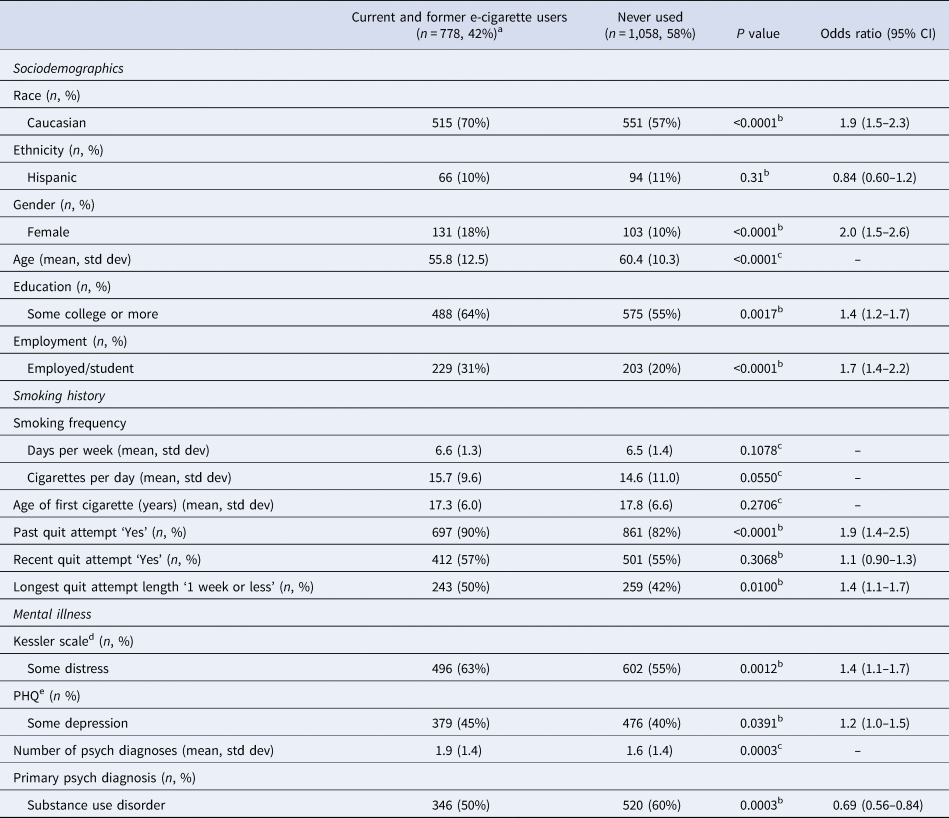
Table 1 displays the demographic characteristics, smoking history, and mental illness attributes of respondents by the use of e-cigarettes. A total of 275 participants (15%) were current e-cigarette users and 503 (27%) were former users. The remaining 1,058 (58%) had never used e-cigarettes. E-cigarette users were younger (55.8 vs. 60.4 years, P < 0.0001) and more often Caucasian (70% vs. 57%, OR 1.9, 95% CI 1.5–2.3) than never-users. They also had a higher education level (64% vs. 55% some college or more, OR 1.4, 95% CI 1.2–1.7) and were more often employed or students (31% vs. 20%, OR 1.7, 95% CI 1.4–2.2) as compared to never-users.
Sociodemographics, smoking history, and mental illness of e-cigarette users and non-users

a Column includes current (15%) and former (27%) e-cigarette users.
b Pearson's χ 2.
c ANOVA Type 3 F-test.
d Scored 0–24, 0–5 is no psychological distress.
e Scored 0–24, 0–9 is no depression.
Current and former e-cigarette users were more likely to have had a previous smoking quit attempt than never-users (90% vs. 82%, OR 1.9, 95% CI 1.4–2.5). They were also more likely to have had a longest quit attempt lasting under 1 week (50% vs. 42%, OR 1.4, 95% CI 1.1–1.7). There was no difference in cigarettes per day, time to first cigarette, age of first cigarette, and number of past quit attempts (among those with an attempt) between e-cigarette users and never-users (P > 0.05).
E-cigarette users were more likely to report some mental distress on the Kessler scale than never-users (63% vs. 55%, OR 0.73, 95% CI 0.60–0.88). Additionally, current and former e-cigarette users were more likely to have depressive symptoms on the PHQ scale (45% vs. 40%, OR 1.2, 95% CI 1.0–1.5). Current and former e-cigarette users averaged more unique psychiatric diagnoses than never-users (1.9 vs. 1.6, P = 0.0003). The most common primary psychiatric diagnosis overall was non-alcohol substance use disorder (48%). Current and former e-cigarette users were more likely than never-users to have a primary psychiatric diagnosis of anxiety (9% vs. 4%) or PTSD (12% vs. 8%), and were less likely to have a primary diagnosis of substance use disorder (46% vs. 50%) or ‘other alcohol’ disorder (4% vs. 10%). Overall, current and former e-cigarette users were less likely to have any substance use disorder as their primary psychiatric diagnosis than never-users (50% vs. 60%, OR 0.69, 95% CI 0.56–0.84).
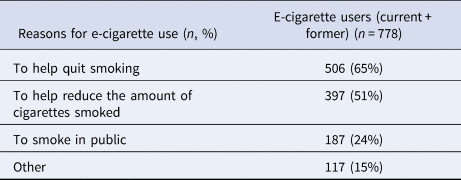
Table 2 displays the reasons for e-cigarette use for current and former e-cigarette users. Participants selected reasons from a list of four choices, including ‘other’. Participants could select multiple reasons, and each was included in our frequency count. The most common reasons for e-cigarette use were to help quit smoking (65%) and to reduce the smoking amount (51%).
Reasons participants report for using electronic cigarettes

Percentages sum to more than 100% as respondents could choose multiple categories.
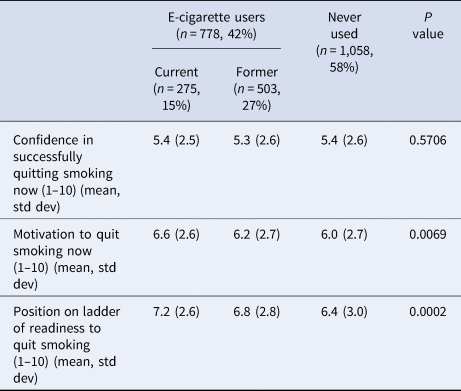
Table 3 displays the thoughts on quitting smoking for current, former, and never-users of e-cigarettes. Participants rated themselves from 1 to 10 on motivation to quit smoking, confidence of success, and position on a contemplation ladder of readiness to quit. Current users were the most motivated to quit, followed by former users, with never-users scoring lowest (6.6 vs. 6.2 vs. 6.0, P = 0.0069). Current users also rated themselves highest on readiness to quit, followed by former and never-users (7.2 vs. 6.8 vs. 6.4, P = 0.0002). Confidence across all three groups was similar (5.4 vs. 5.3 vs. 5.4, P = 0.5706), i.e. all groups thought they were equally likely to successfully quit.
Thoughts on quitting smoking of current, former, and never e-cigarette users

P values obtained from ANOVA Type 3 F-test.
Discussion
We compared the features of e-cigarette-using veteran smokers with MHC to those who have never used e-cigarettes; our primary findings were that smokers used e-cigarettes to help quit smoking, and that e-cigarette users had more severe mental distress. Our sample had a 15% rate of current e-cigarette use and an additional 27% rate of previous use, consistent with a 2014 National Center for Health Statistics survey of US smokers reporting a 16% prevalence of current e-cigarette use and a 29% prevalence of previous e-cigarette use (Schoenborn & Gindi, Reference Schoenborn and Gindi2015). This suggests minimal differences in e-cigarette use between smokers with MHC and those without. Additionally, we found that e-cigarette users were 5 years younger on average, and more often Caucasian, well-educated, and employed, which also matches nationally representative data on e-cigarette use in US adults (Wilson & Wang, Reference Wilson and Wang2017; Hooper & Kolar, Reference Hooper and Kolar2016). Our e-cigarette users cited ‘helping to quit smoking’ and ‘reducing the amount of cigarettes smoked’ most frequently as reasons for use, consistent with the previous qualitative studies of reasons for e-cigarette use in US smokers, and within smokers with MHC specifically (Patel, Davis, & Cox, Reference Patel, Davis and Cox2016; Sharma, Wigginton, Meurk, Ford, & Gartner, Reference Sharma, Wigginton, Meurk, Ford and Gartner2017).
Current e-cigarette users rated themselves as more motivated and ready to quit smoking, followed by former users, with never-users scoring lowest. This may reflect smokers adopting e-cigarettes to help quit smoking, a trend previously noted by a large survey linking e-cigarette use with greater motivation to stop smoking (Simonavicius, McNeill, Arnott, & Brose, Reference Simonavicius, McNeill, Arnott and Brose2017). Increased motivation and readiness to quit smoking in e-cigarette users are corroborated by our findings that e-cigarette users were more likely to have a previous quit attempt than non-users, and that current e-cigarette users were more likely to have a recent quit attempt than former or never-users.
However, e-cigarette users and never-users self-rated equally on the confidence of successfully quitting. Additionally, the two groups did not differ in cigarettes per day, or time to first cigarette, despite e-cigarette users citing quitting smoking and reducing smoking as major reasons for e-cigarette use. Thus, an implication of our study is the need to educate veterans with MHC about effective methods of quitting and reducing smoking.
While data on success rates in our smoking cessation intervention are still pending, previous studies have found the likelihood of successfully quitting smoking to be greater, equal, and even lower in e-cigarette users (Borderud, Li, Burkhalter, Sheffer, & Ostroff, Reference Borderud, Li, Burkhalter, Sheffer and Ostroff2014; Grana, Popova, & Ling, Reference Grana, Popova and Ling2014; Adkison et al., Reference Adkison, O'Connor, Bansal-Travers, Hyland, Borland and Yong2013) (though their populations are not necessarily representative of our own), highlighting a need for further investigation. Notably, the longest quit attempt length was under 1 week for 45% of our subjects who reported any quit attempt, which is much higher than a 14% prevalence of longest attempts under 1 week found in an international survey of adult smokers with previous quit attempts (Borland, Partos, Yong, Cummings, & Hyland, Reference Borland, Partos, Yong, Cummings and Hyland2012). Previous literature has linked longer periods of abstinence from cigarettes to a higher likelihood of continued abstinence (Gilpin, Pierce, & Farkas, Reference Gilpin, Pierce and Farkas1997), showing that the length of a longest quit attempt has significance in predicting future success in quitting smoking. Our finding stresses the greater severity of smoking addiction in our group compared to the general population of smokers, and reinforces the notion that smokers with MHC have greater nicotine dependence (Salin-Pascual, Castillejos-Alcocer, & Galarza-Alejo, Reference Salin-Pascual, Castillejos-Alcocer and Galarza-Alejo2013).
E-cigarette users were more likely to report current mental distress than never-users, possibly due to smokers with psychological distress having greater positive expectancies of e-cigarette effects, an explanation proposed by a study with similar findings (Miller, Tidey, Rohsenow, & Higgins, Reference Miller, Tidey, Rohsenow and Higgins2017). E-cigarette users were also more likely to report some depression from the PHQ, and averaged a higher number of psychiatric diagnoses, reinforcing the link between e-cigarettes and mental illness (Prochaska & Grana, Reference Prochaska and Grana2014). Additionally, our findings of fewer primary psychiatric diagnoses of substance use disorder among e-cigarette users (offset by higher primary diagnoses of disorders such as anxiety or PTSD) are consistent with other recent data (Peters et al., Reference Peters, Harrell and Hendricks2015), and may be from e-cigarette use being less appealing to smokers with alcohol use disorders, due to their greater nicotine dependence (Peters et al., Reference Peters, Harrell and Hendricks2015; Etter & Eissenberg, Reference Etter and Eissenberg2015). Overall, our findings show e-cigarette users in our population to have a different pattern of mental health symptoms and diagnoses than non-users, characterized by greater severity and less substance dependence.
Our study explores a group of veteran smokers using mental health services, a population with an unmet need in smoking cessation and e-cigarette use research. Recent studies by Hefner et al. describe current e-cigarette use in veterans with mental illness from a Connecticut VA hospital (2016), and demonstrate the reduction of cigarette smoking in a sample of 43 veterans with MHC given e-cigarettes over 4 weeks (Valentine et al., Reference Valentine, Hefner, Jatlow, Rosenheck, Gueorguieva and Sofuoglu2018). Our study findings are similar with regards to smoking behavior, quit history, and substance use disorder differences between e-cigarette users and non-users. We expand on their work both by including former e-cigarette users, and by offering a wider population sample with greater variability, from four geographically diverse VA hospitals. We also selected participants from the EMR based on the history of mental health service use, as opposed to a convenience sample of smokers presenting to mental health clinics who self-reported their psychiatric diagnoses, making our sample more representative of all veterans using mental health services. These critical differences make our study the first of its kind with regards to veteran smokers with MHC and e-cigarette use.
Limitations to our findings should be improved on in the future study. As our study was cross-sectional, we can only establish a correlation between e-cigarette use and our measurements, and cannot propose causation in any direction. Additionally, all of our participants were current smokers, so we lack data on e-cigarette users with MHC who do not also smoke cigarettes. A possible limitation of administrative VA data is that psychiatric disorders in the system may be outdated; we attempted to control for this by including only participants with a mental health clinic visit in the past year. Our assessment of reasons for using e-cigarettes is limited by our provision of only three pre-printed choices (along with ‘other’, which was selected by only 15% of participants), as there are certainly other possible reasons for use. For example, adolescents are known to cite flavoring as a primary reason for using e-cigarettes (Pepper, Ribisl, & Brewer, Reference Pepper, Ribisl and Brewer2016). Our findings that wanting to quit or reduce smoking were primary reasons for use may reflect our unique population of older smokers, who may have different motivations than younger e-cigarette users. Finally, our population of veterans limits the generalizability of our findings to any larger population of e-cigarette users.
Conclusions
E-cigarette use by veteran smokers with MHC reflects greater motivation to quit smoking, but also correlates with different attributes of mental illness such as more severe mental distress and depressive symptoms. A future paper will investigate e-cigarette use and success in a proactive outreach smoking cessation intervention in this population, contributing to the landscape of conflicting data on e-cigarette use and quitting smoking. Further studies should also continue exploring reasons for e-cigarette use and patterns of mental illness in this population.
Financial support
This trial was funded by a grant from the US Department of Veterans Affairs Health Services Research and Development Service (S. S. and S. F., grant number IIR 11-291); a grant from the National Institute on Drug Abuse (S. S, grant number 1K24DA038345); and the New York University CTSA grant from the National Center for Advancing Translational Sciences, NIH (S. S., grant number UL1TR000038).
Conflict of interest
None.